Archive

Archive for January, 2025

Ephemeris: 01/03/2025 – GTAS Telescope Clinic tonight

January 3, 2025 Comments off

This is Ephemeris for Friday, January 3rd. The Sun will rise at 8:20. It’ll be up for 8 hours and 55 minutes, setting at 5:15. The Moon, 3 days before first quarter, will set at 9:37 this evening.

Did you or someone in your family get a telescope for Christmas, or have one in a closet or attic because you don’t know how to put it together or how to operate it? Or maybe you are trying to figure out which one to buy. Well, tonight’s your night. The Grand Traverse Astronomical Society (GTAS) will host the annual Telescope Clinic starting at 8 pm at Northwestern Michigan College’s Rogers Observatory. Professor Jerry Dobek will demonstrate the types of telescopes and how to use them. He and other members may be able to help particular problems by seeing participants telescopes, so “bring ‘em if you’ve got ‘em.” This is interesting to say the least. Go to gtastro.org for information and a Zoom link for the meeting.

The astronomical event times given are for the Traverse City/Interlochen area of Michigan (EST, UT – 5 hours). Times will be different for other locations.

Addendum
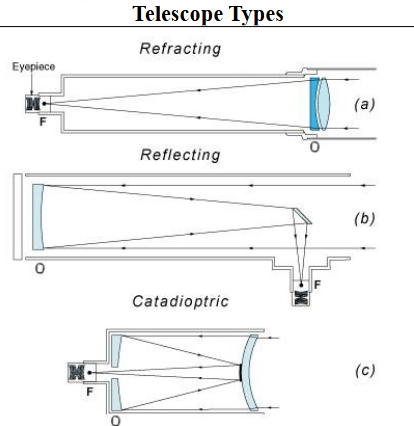
Telescope types
The three basic telescope tapes: Refractors use lenses to form the image, reflector telescopes use mirrors, and catadioptric telescopes use both. The three types are shown with the path of the light takes through them to the eyepiece.

Ephemeris: 01/02/2025 – Today we have the latest sunrise

January 2, 2025 Comments off

This is Bob Moler with Ephemeris for Thursday, January 2nd. The Sun will rise at 8:20. It’ll be up for 8 hours and 54 minutes, setting at 5:14. The Moon, 3 days past new, will set at 8:20 this evening. | As an amateur astronomer I am fascinated by time, the so-called 4th dimension. For example, being at the right place at the right time such as to view a total solar eclipse. The universe isn’t going to wait for you if you’re off in the three dimensions of location or of the time. But today is a different story. Today is the day of the latest sunrise, which is at 8:20 AM. From today to June 15th, the day of the earliest sunrise, is on average about 165 days. That’s about 5 ½ months. We had our earliest sunset back on December 9th. That was 24 days ago so it’s got a head start from there to the latest sunset that it will need because the latest sunset will be on June 26th. So the sunrise times will decrease faster than the sunset times will increase into the June summer solstice period.

The astronomical event times given are for the Traverse City/Interlochen area of Michigan (EST, UT – 5 hours). Times will be different for other locations.

Addendum:
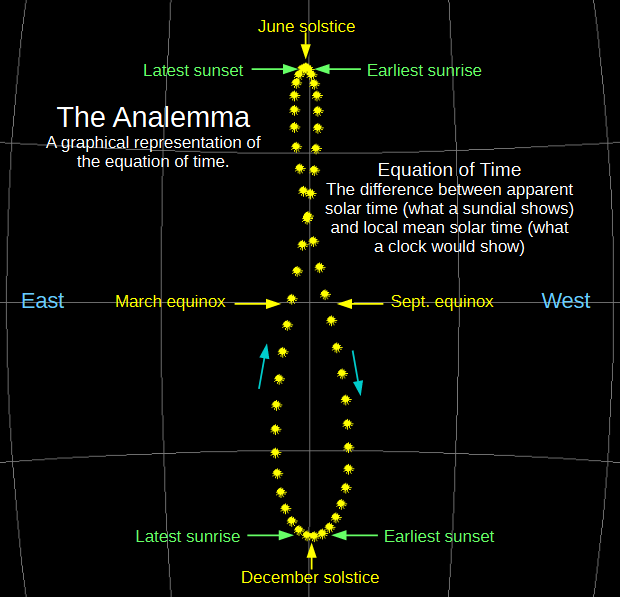
Illustrated Analemma
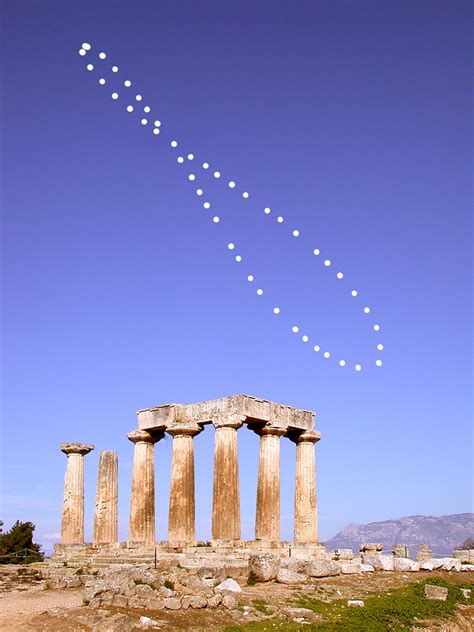
If one took a picture of the sun at the same time each day on the same piece of film for an entire year the image you’d get looks like this funny figure 8. It’s called an analemma and it shows that the sun does not move at the same rate through the entire year. Apparent solar time, which would be displayed by a sundial, does not match or run at the steady rate of a clock. The difference between the two is seen in this figure. I’ve marked out the times of earliest and latest sunrises and sunsets and the solstice and equinoxes showing the inequality in the timing of these events. Note that the time of the sun traveling from the latest sunrise to he earliest sunrise is shorter than that from the earliest sunrise back to the latest. Created using my LookingUp app.
A photograph, a year in the making, of the analemma taken over the ruins of the temple of Apollo in Ancient Corinth, Greece by Anthony Ayiomamitis
A photograph, a year in the making, of the analemma taken over the ruins of the temple of Apollo in Ancient Corinth, Greece by Anthony Ayiomamitis. (https://perseus.gr/)

Ephemeris: 01/01/2025 – A New Year’s Day look at the naked-eye planets

January 1, 2025 Comments off

This is Ephemeris for New Year’s Day, Wednesday, January 1st, 2025. The Sun will rise at 8:20. It’ll be up for 8 hours and 53 minutes, setting at 5:13. The Moon, 2 days past new, will set at 7:02 this evening.

Let’s take our weekly look at the whereabouts of the naked-eye planets. Venus can be spotted in the south-southwestern sky by 5:45 PM, about 30 minutes after sunset, and will also be above and left of the thin crescent Moon. Venus will set at 9:10 PM. Saturn will be in the south-southwestern sky at 6 PM, above and left of Venus, which will be seen to cross paths with it on the 18th of this month. Jupiter is low in the east, about the same time Venus is first spotted. It will be a good object for the small telescope. Mars, rises tonight at 6:31. Mars is still considered a morning planet since it is still up at sunrise. But that will end on the 15th of this month, when Mars reaches opposition from the Sun.

The astronomical event times given are for the Traverse City/Interlochen area of Michigan (EST, UT – 5 hours). Times will be different for other locations.

Happy New Year! I do really hope it will be happy…

Addendum
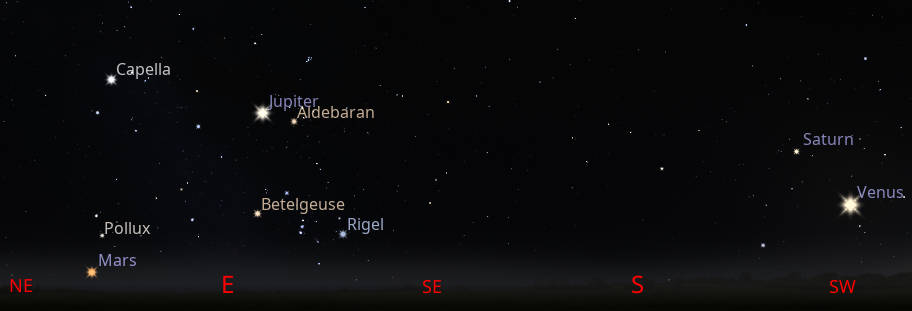
This is a 7 PM planet panorama. Venus and Saturn are in the southwest, and Jupiter is in the east. Mars is just rising in the east-northeast
This is a 7 PM planet panorama. Venus and Saturn are in the southwest, and Jupiter is in the east. Mars is just rising in the east-northeast. Click or tap on the image to enlarge it. Created using Stellarium.
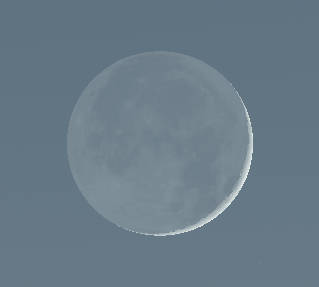
The waxing two day old Moon with earthshine on its night side
The waxing two day old Moon with earthshine on its night side. Created using Stellarium.
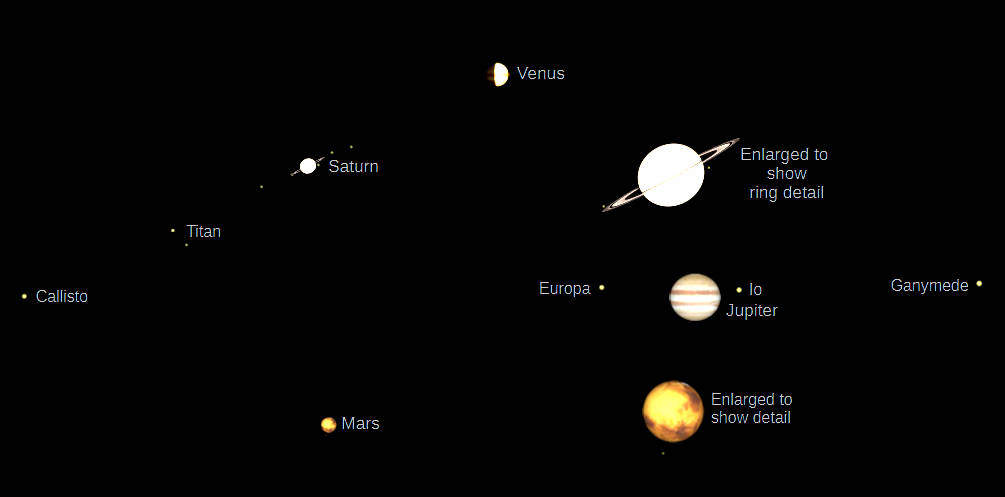
Telescopic Venus, Saturn, Jupiter and Mars (north up) as they would be seen in a small telescope with the same magnification
Telescopic Venus, Saturn, Jupiter and Mars (north up) as they would be seen in a small telescope with the same magnification. All the planets are shown for tonight, Jupiter specifically for 7 PM, January 1, 2025. Apparent diameters: Venus 22.4″, 55% illuminated; Saturn 16.6″, its rings 38.6″, 4.3 degrees from edge on (closing); Jupiter 47.0″; Mars, 14.3″. Planetary surface detail is more subtle than shown here. The ” means seconds of arc, or 1/3600th of a degree. Click or tap on the image to enlarge it. Created using Cartes du Ciel (Sky Charts).
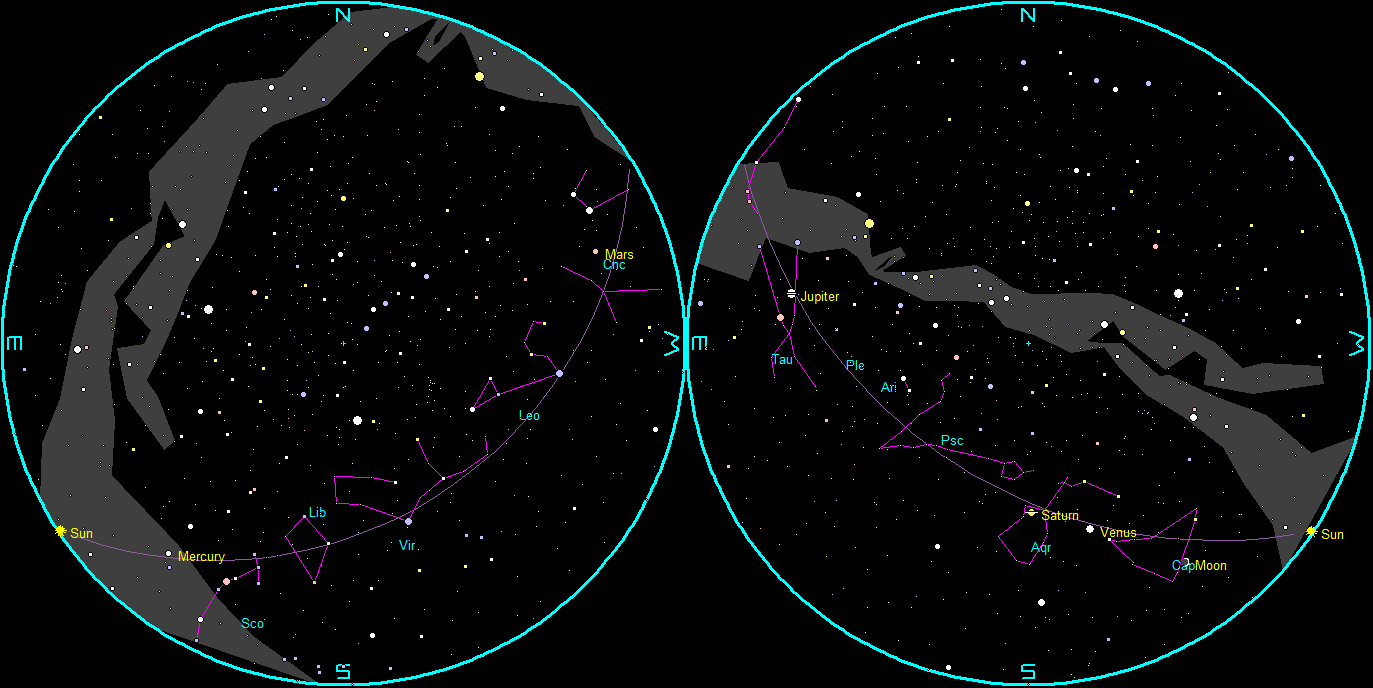
The naked-eye planets and the Moon at sunset and sunrise on a single night, starting with sunset on the right on January 1, 2025. The night ends on the left with sunrise on the 2nd
The naked-eye planets and the Moon at sunset and sunrise on a single night, starting with sunset on the right on January 1, 2025. The night ends on the left with sunrise on the 2nd. Click or tap on the image to enlarge it. Created using my LookingUp app and GIMP.
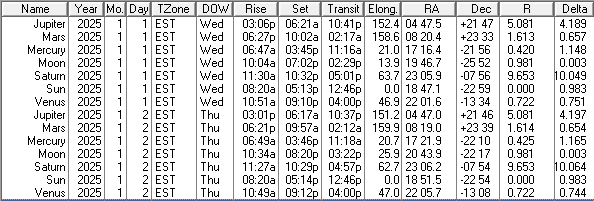
This is a low precision ephemeris of the Sun Moon and naked eye planet positions for today and tomorrow
This is a low precision ephemeris of the Sun Moon and naked eye planet positions for today and tomorrow, January 1 and 2, 2025. Some of the columns are self-explanatory, others not. The transit column is the time that the body crosses the meridian and is due south. Elong, for elongation, is the angle between the Sun and that body. RA is right ascension, which is the object’s east-west position on the celestial sphere in hours and minutes. Dec is declination which is the north-south position of the object on the celestial sphere in degrees and minutes. R is the distance of that object from the Sun in astronomical units. An astronomical unit is about 93 million miles or 150 million kilometers. And Delta is the distance of that object from the Earth, also in astronomical units. I omit the ‘m’ in am and pm for compactness. The data was generated using my LookingUp for DOS app and displayed as a table by my Ephemeris Helper app.