This is Ephemeris for Thursday, March 12th. Today the Sun will be up for 11 hours and 44 minutes, setting at 7:45, and it will rise tomorrow at 7:58. The Moon, 1 day past last quarter, will rise at 5:25 tomorrow morning.
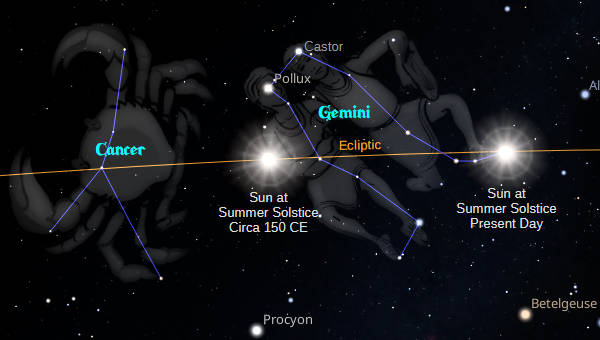
There’s a line on some globes and maps at approximately 23 1/2° north latitude called the Tropic of Cancer. It’s related to the constellation Cancer the crab. However, Cancer no longer fits that role that it was named to a couple of thousand years ago, when the sun entered the constellation of Cancer on the first day of summer. That’s the latitude on the Earth where the Sun was directly overhead on the first day of summer. Now that an honor goes to Gemini. The way we draw the figure of that constellation, the Sun is right near Castor’s big toe on the first day of summer. But I don’t think they’re going to change the name anytime soon. The reason for the change is that the Earth’s axis slowly wobbles like a top or gyroscope as they slow down. The effect is called precession.
The astronomical event times given in this blog are for the Traverse City/Interlochen area of Michigan (Lat 44.7° N, Long 85.7° W; EST, UT – 5 hours) unless stated otherwise. Times will be different for other locations.
Addendum
Comparison of the position of the Sun against the constellations on the summer solstice from 150 CE to now due to the precession of the equinoxes. The reason I chose 150 CE, is that it was the approximate date of Ptolemy’s Almagast, the standard work on astronomy until Copernicus in the 16th century or later. Created using Stellarium, LibreOffice Draw and GIMP.
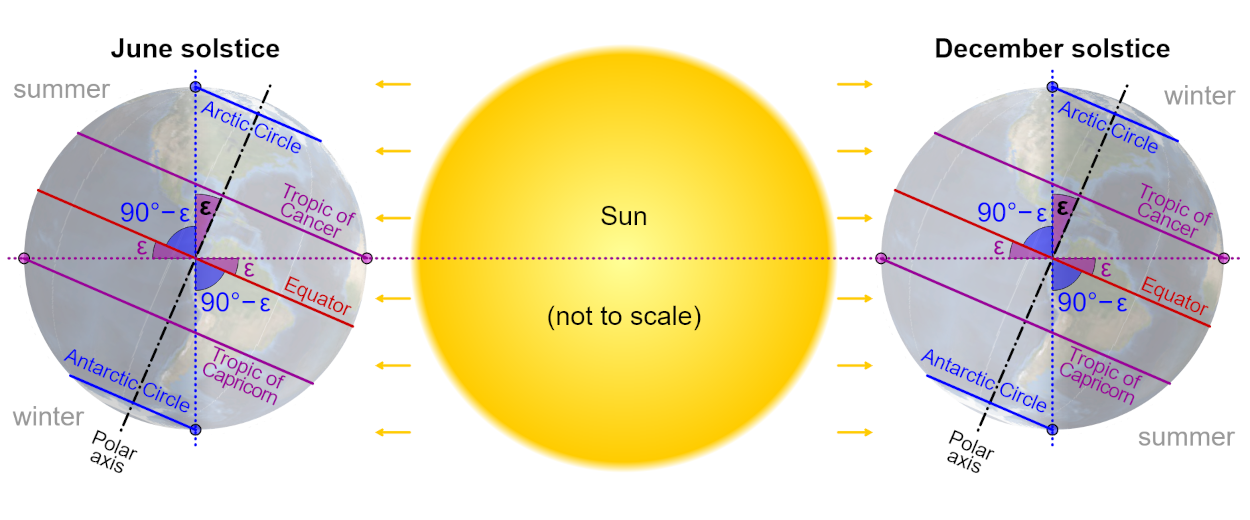
How the tropics of Cancer and Capricorn line up with the Sun on the solstices. From an animation in Wikipedia, in the Public Domain.
The Greek letter epsilon in the image above represents the tilt of the Earth’s axis of around 23.5°. Astronomers call it the obliquity of the ecliptic, the angle between the ecliptic and the celestial equator as seen in the illustration below.
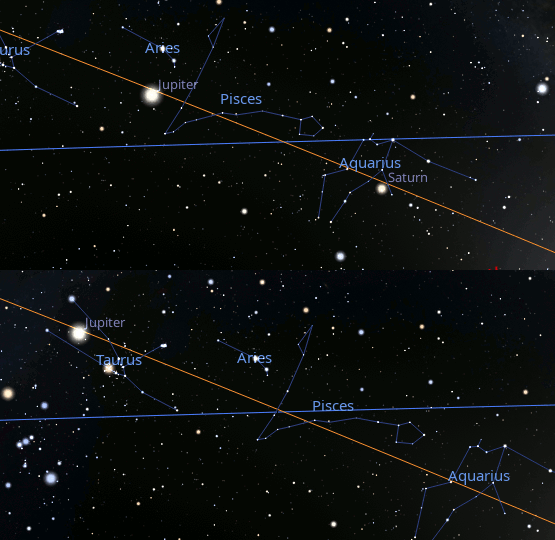
An animation of the precession of the equinoxes. The blue horizontal line is the celestial equator. The orange line is the ecliptic, the apparent annual path of the Sun against the stars. Where the two lines cross is the vernal equinox where the Sun is on the first day of spring, which on our calendar is trending to be March 20th. The slippage of the stars eastward (to the left) along the ecliptic is about the apparent width of the Sun or Moon, or half a degree, in 36 years. We’re looking at two different years 150 CE, the time of Ptolemy, and our time. To tell which is which, the one from our time has Saturn at the lower right. Jupiter happens to be in both of them, but it’s obviously been around lots of times between then and now. Created using Stellarium and GIMP.
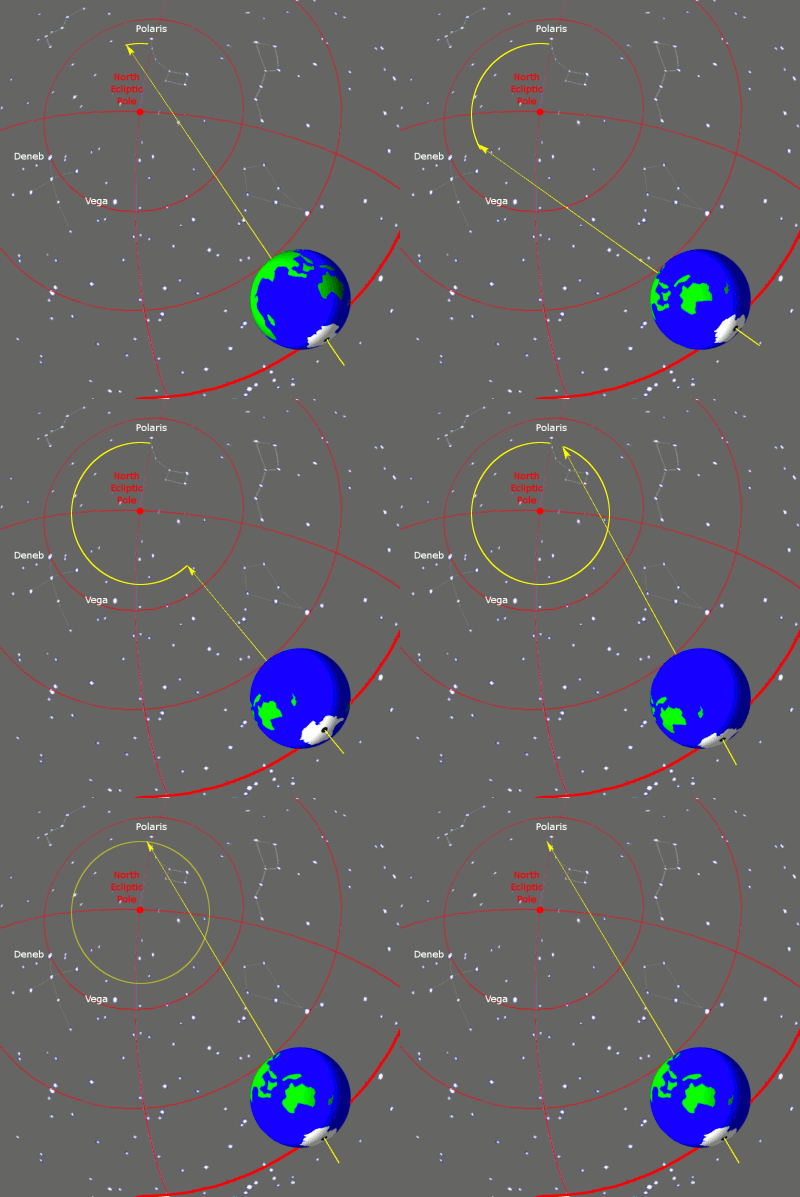
The 25,700-year cycle of precession as seen from near the Earth. The current North Pole star is Polaris (top). In about 8,000 years it will be the bright star Deneb (left), and in about 12,000 years, Vega (left center). The Earth’s rotation is not depicted to scale – in this span of time, it would actually rotate over 9 million times. Credit image Tfrooo, caption Wikipedia.
 Bob Moler's Ephemeris Blog