Archive
Ephemeris: 04/03/2026 – GTAS Astronomy meeting tonight
This is Ephemeris for Good Friday, April 3rd. Today the Sun will be up for 12 hours and 53 minutes, setting at 8:13, and it will rise tomorrow at 7:17. The Moon, 2 days past full, will rise at 10:22 this evening.
The Grand Traverse Astronomical Society will hold its April meeting tonight at 8:00 PM at Northwestern Michigan College’s Joseph H Rogers Observatory. This may be an unstructured meeting, and a good time for anyone interested to ask knowledgeable members anything about the sky or telescopes. Even though our telescope clinic is passed, there will always be someone there to help with your telescope questions or problems. Afterward, about 9 PM if it’s clear, there will be viewing of the heavens through the observatory’s telescopes, featuring Jupiter, its cloud bands and moons. Its Great Red Spot might also be visible. The observatory is located on Birmley Rd. South of Traverse City between Garfield and Keystone roads.
The astronomical event times given in this blog are for the Traverse City/Interlochen area of Michigan (Lat 44.7° N, Long 85.7° W; EST, UT – 5 hours) unless stated otherwise. Times will be different for other locations.
Addendum

Ephemeris:04/02/2026 – Determining the date of Easter
This is Ephemeris for Thursday, April 2nd. Today the Sun will be up for 12 hours and 50 minutes, setting at 8:11, and it will rise tomorrow at 7:19. The Moon, 1 day past full, will rise at 9:14 this evening.
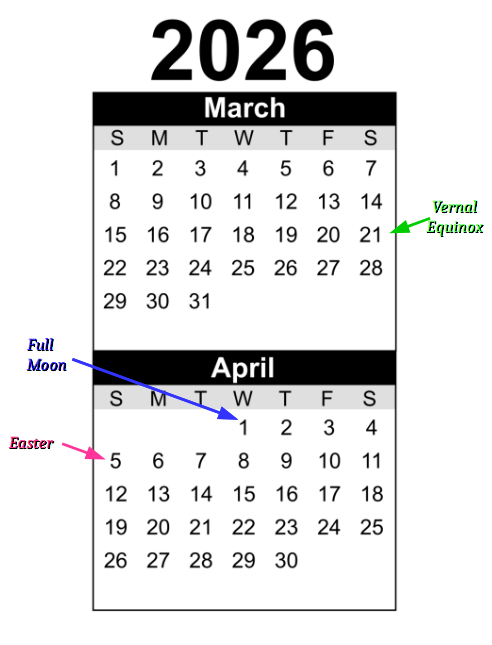
Easter will be celebrated by Western Christian churches this Sunday. Easter is a movable feast in that it falls on a different date each year following the first full moon of spring. It was an attempt to follow the Jewish Passover, which starts on the 15th of the month of Nisan. The Jewish calendar being a lunar calendar, the 15th generally begins at sundown on the night of the full moon. And since the Last Supper was a Seder, according to at least one Gospel, the Christian church wanted to link Easter with Passover as closely as possible using the Roman solar based (Julian) calendar. That’s not always the case, especially with our current Gregorian Calendar. Passover this year began last night at sunset, so this year it is nearly in agreement with the Gospel narrative.
The astronomical event times given in this blog are for the Traverse City/Interlochen area of Michigan (Lat 44.7° N, Long 85.7° W; EST, UT – 5 hours) unless stated otherwise. Times will be different for other locations.
Addendum
*Our Gregorian Calendar will correct for this by making the year 2100, normally a leap year of 366 days, an ordinary year of 365 days. The rule is that century years not divisible by 400 get clipped.
Ephemeris: 04/01/2026 – No fooling, we’re looking at the bright planets for this week
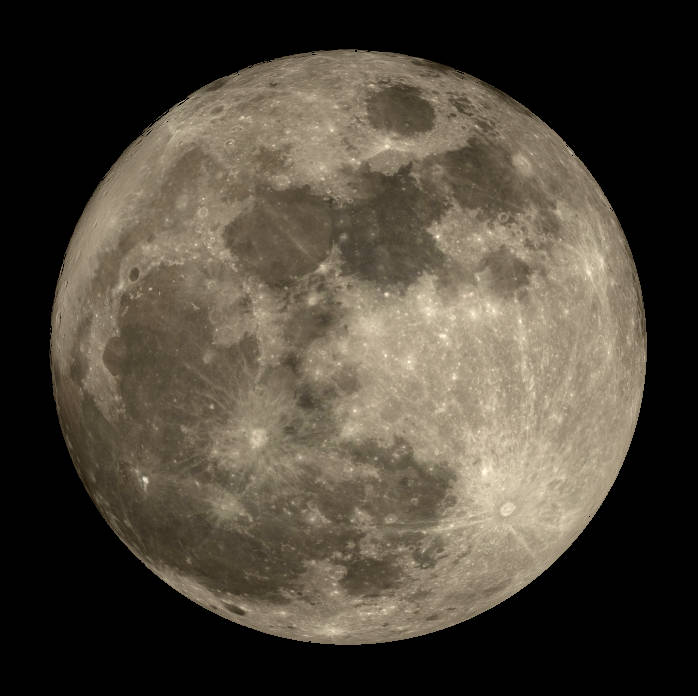
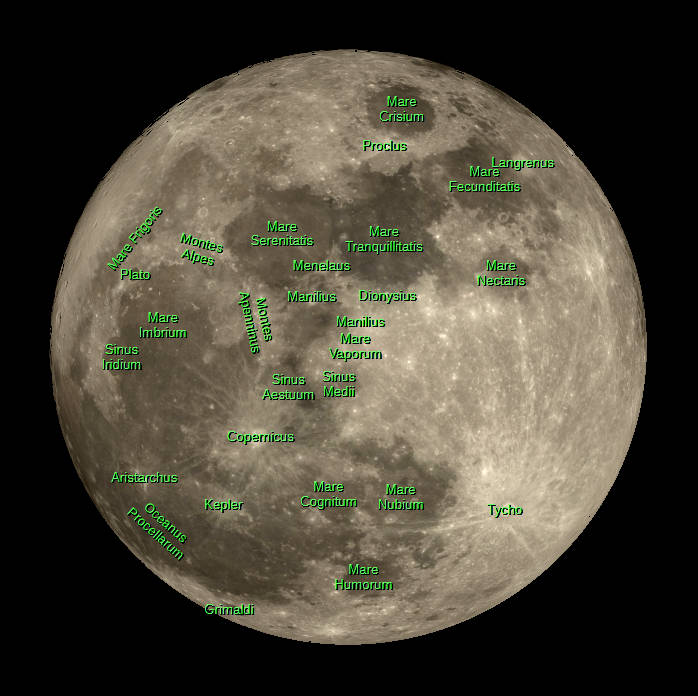
This is Ephemeris for April Fools’ Day, Wednesday, April 1st. Today the Sun will be up for 12 hours and 47 minutes, setting at 8:10, and it will rise tomorrow at 7:21. The Moon, at full today, will rise at 8:06 this evening.
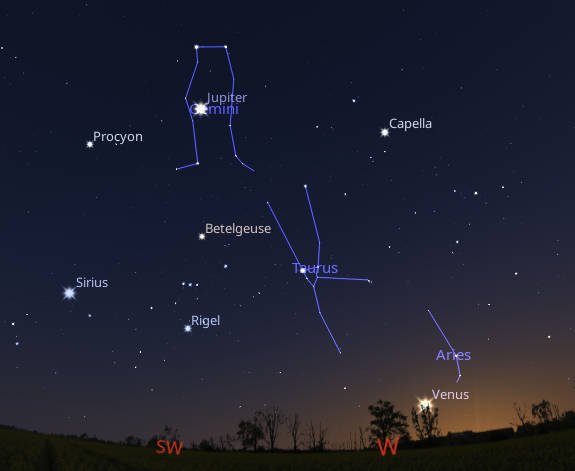
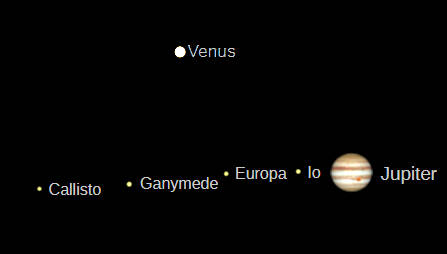
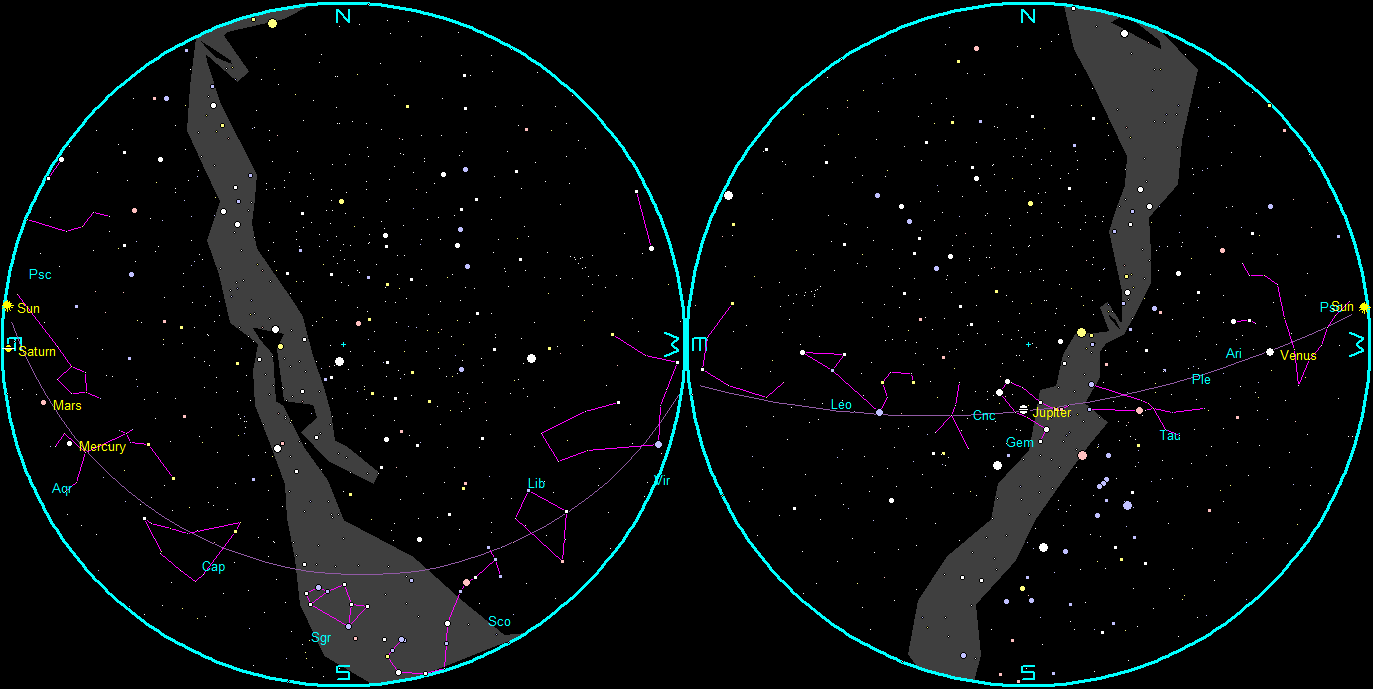
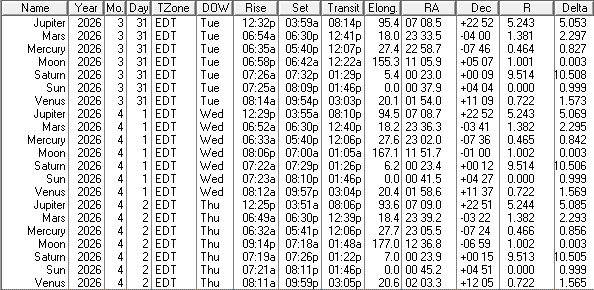
Let’s take our weekly look at the whereabouts of the naked-eye planets. By 8:40 PM tonight or about a half hour or so after sunset, Venus may be seen very low in the West. Binoculars or a telescope will show a very tiny disc on Venus, because it is pretty much behind the Sun, a good way from us. Over the next 7 months it will be moving closer to us and becoming much larger. Jupiter is the brilliant star-like object more than halfway up in the southwestern sky at 9 PM. At that time Venus will still be visible, setting at 9:57 PM. Mercury, Mars and Saturn are lined up just west of the Sun, but unfortunately are overwhelmed by bright morning twilight.
The astronomical event times given in this blog are for the Traverse City/Interlochen area of Michigan (Lat 44.7° N, Long 85.7° W; EST, UT – 5 hours) unless stated otherwise. Times will be different for other locations.
Addendum
 Bob Moler's Ephemeris Blog