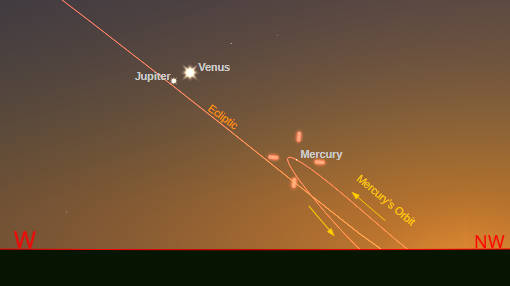
Ephemeris: 06//08/2026 – Observing Mercury in the evening
This is Bob Moler with Ephemeris for Monday, June 8th. Today the Sun will be up for 15 hours and 29 minutes, setting at 9:26, and it will rise tomorrow at 5:57. The Moon, at last quarter today, will rise at 2:18 tomorrow morning.
We have a little more than a week to observe Mercury in the western sky after sunset. Mercury’s greatest eastern elongation or separation from the sun will occur on the 15th. It will get as far as a 24° angle from the sun. That separation is tilted a bit less than 45° to the horizon. Mercury’s greatest eastern elongations, occur about 116 days, more or less apart, because Mercury has the most elliptical orbit of any other planet. This is longer than Mercury’s orbital period of 88 days because we’re viewing it from a planet that is also orbiting the sun. Mercury is easier to observe the week before greatest eastern elongation then the week after. Part of the reason is that the phase of Mercury is waning from gibbous to a crescent and getting dimmer.
The astronomical event times given in this blog are for the Traverse City/Interlochen area of Michigan (Lat 44.7° N, Long 85.7° W; EDT, UT – 4 hours) unless stated otherwise. Times will be different for other locations.
Addendum