Archive
Ephemeris: 05/29/2026 – NASA’s second moon program – soft landers
This is Ephemeris for Friday, May 29th. Today the Sun will be up for 15 hours and 16 minutes, setting at 9:18, and it will rise tomorrow at 6:01. The Moon, 2 days before full, will set at 5:01 tomorrow morning.
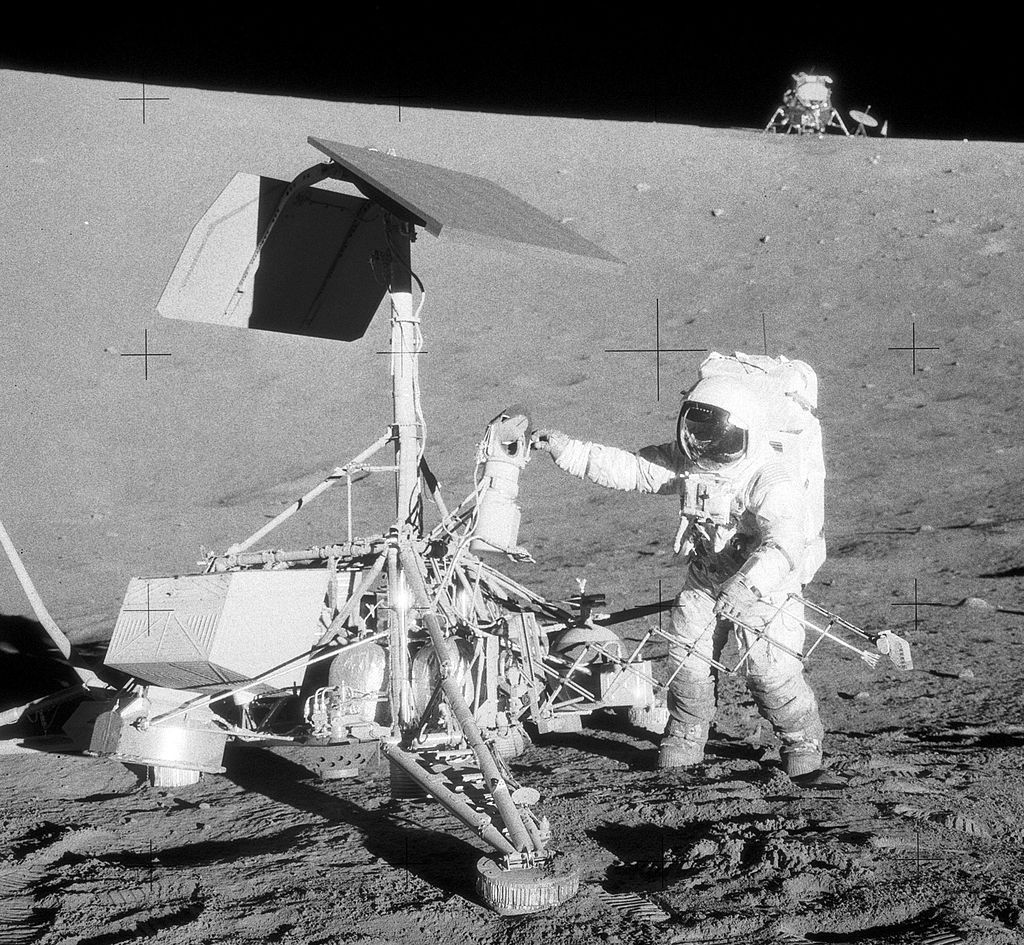
The United States second unmanned moon program in the 1960s was the Surveyor program, to soft land spacecraft on the moon. This was the Surveyor program, which launched 5 Surveyor spacecraft to the moon from 1966 through 1968, three of which were successful, including the very first one. It showed that the moon’s surface was solid enough to support spacecraft landings. There was some speculation earlier that moon dust would be electrostatically charged and suspended above the solid surface of the moon preventing a landing on the surface. The moon’s surface proved to be solid enough, paving the way for the Apollo landings to come. Apollo 12 landed near Surveyor 3 and took a souvenir back to earth, the camera.
The astronomical event times given in this blog are for the Traverse City/Interlochen area of Michigan (Lat 44.7° N, Long 85.7° W; EDT, UT – 4 hours) unless stated otherwise. Times will be different for other locations.
Addendum
Ephemeris: 05/28/2026 – NASA’s first Moon program
This is Ephemeris for Thursday, May 28th. Today the Sun will be up for 15 hours and 15 minutes, setting at 9:17, and it will rise tomorrow at 6:02. The Moon, 3 days before full, will set at 4:32 tomorrow morning.
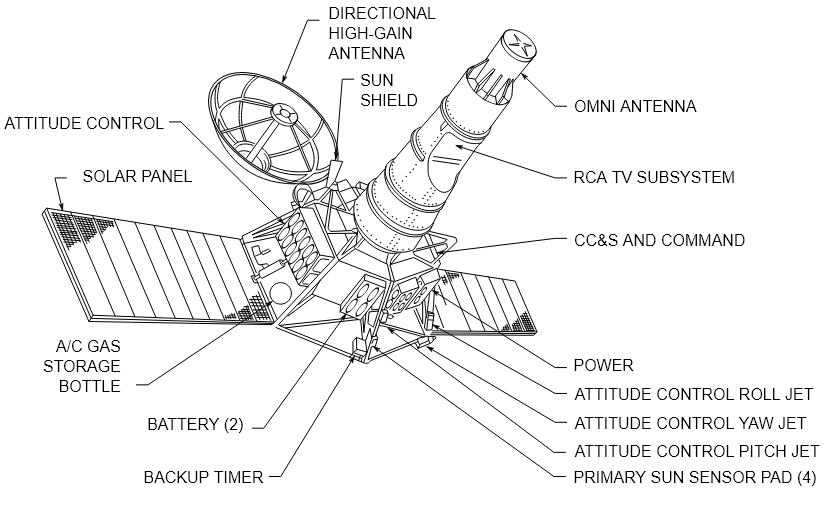
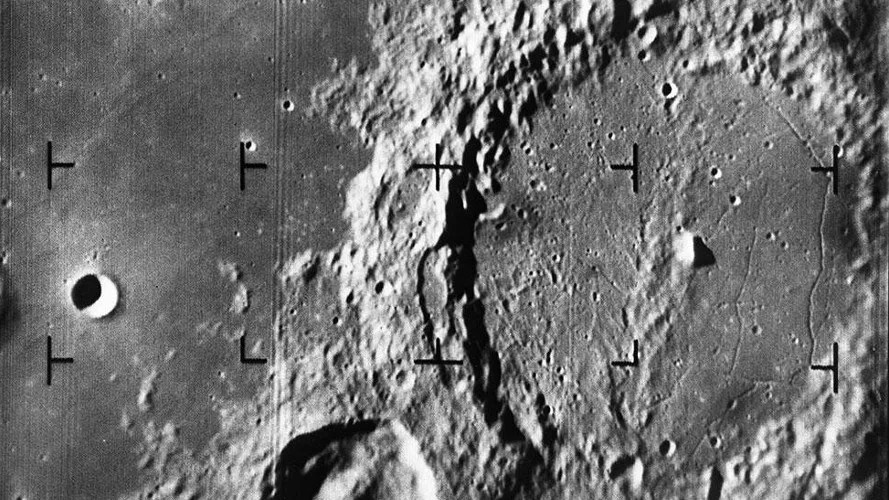
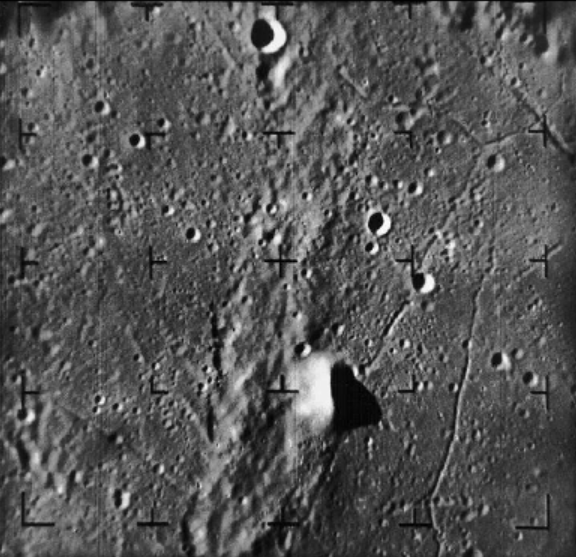
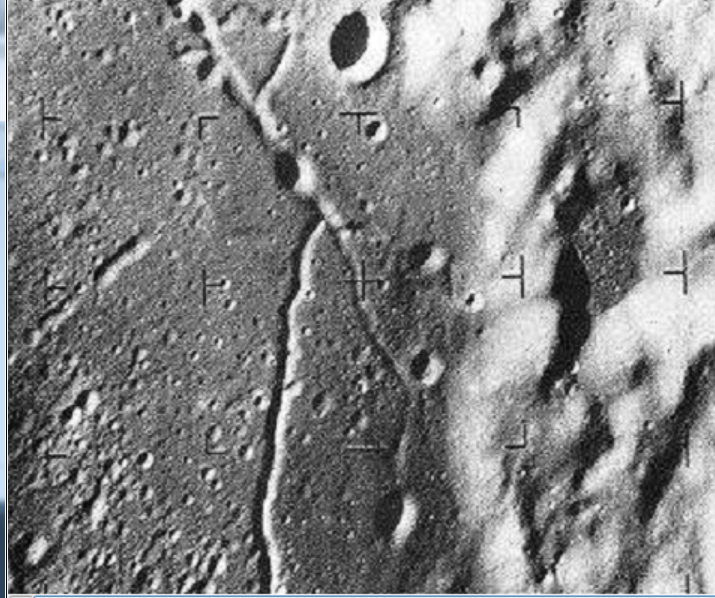
The United States first lunar mission to the moon was the Ranger Program of moon impactors, to televise pictures all the way to impact to see what the moon looked like up close and personal, so to speak. The program actually started before President Kennedy announced plans to send humans to the moon, although the first launch was made several months after that announcement. The program consisted of nine launches of three different variations of the spacecraft. The first two launches failed Then in the next four launches, the spacecraft either missed the moon or were dead on arrival. However, the last three were successful, showing that the moon was indeed mostly smooth enough to land a spacecraft.
The astronomical event times given in this blog are for the Traverse City/Interlochen area of Michigan (Lat 44.7° N, Long 85.7° W; EDT, UT – 4 hours) unless stated otherwise. Times will be different for other locations.
Addendum
Ephemeris: 05/27/2026 – Taking our weekly look at the whereabouts of the naked-eye planets
This is Bob Moler with Ephemeris for Wednesday, May 27th. Today the Sun will be up for 15 hours and 13 minutes, setting at 9:17, and it will rise tomorrow at 6:02. The Moon, halfway from first quarter to full, will set at 4:08 tomorrow morning.
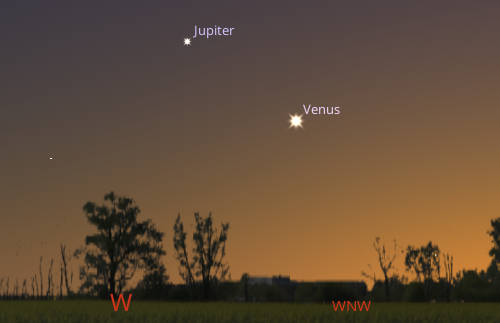
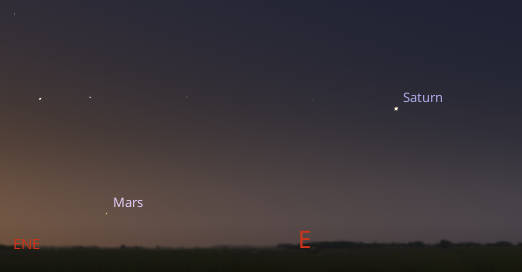
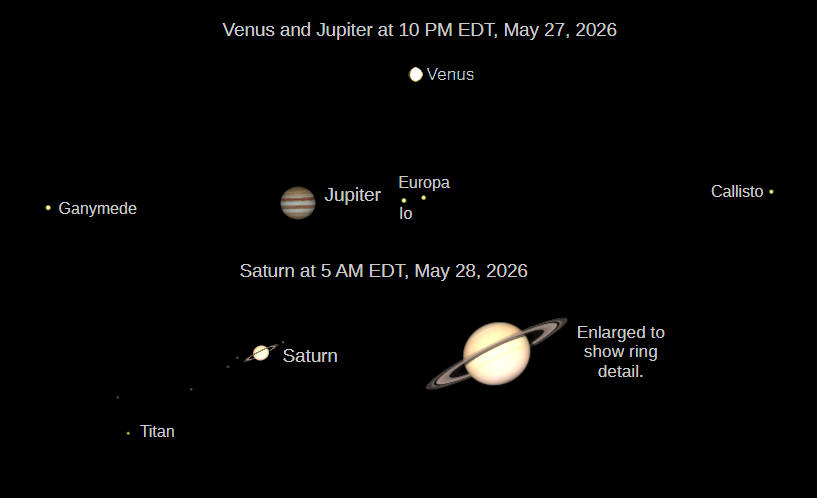
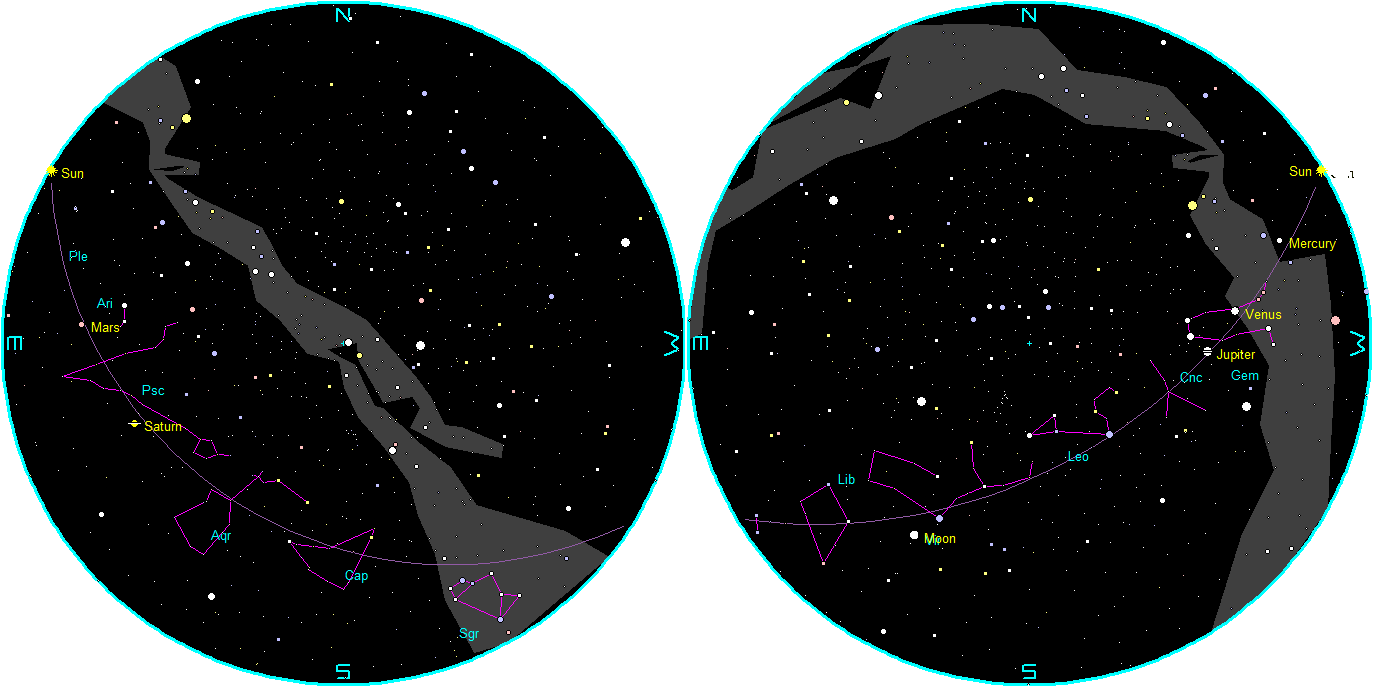
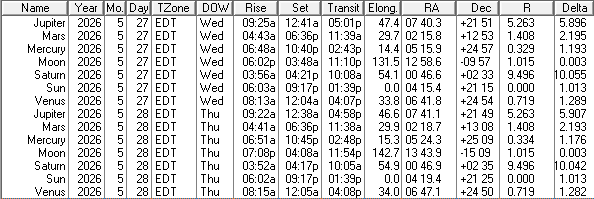
Let’s take our weekly look at the whereabouts of the naked-eye planets. By 10 PM tonight, about 40 minutes after sunset, Venus may be seen in the western sky. A telescope will show a very tiny disc on Venus, because it is still pretty much beyond the Sun, 120 million miles (193 million km) away from us. Over the next 5 months it will be moving closer to us and becoming much larger. Jupiter is the second-brightest star-like object in the western sky seen before 10 PM. It is above and left of Venus tonight. Venus will set at 12:04 AM, while Jupiter will hold out until 12:41 AM. Saturn rises in the east at 3:52 AM, followed by dimmer Mars at 4:42 AM.
The astronomical event times given in this blog are for the Traverse City/Interlochen area of Michigan (Lat 44.7° N, Long 85.7° W; EDT, UT – 4 hours) unless stated otherwise. Times will be different for other locations.
Addendum
Ephemeris: 05/26/2026 – The Soviet Union’s Luna 3 provided first look at the far side of the Moon
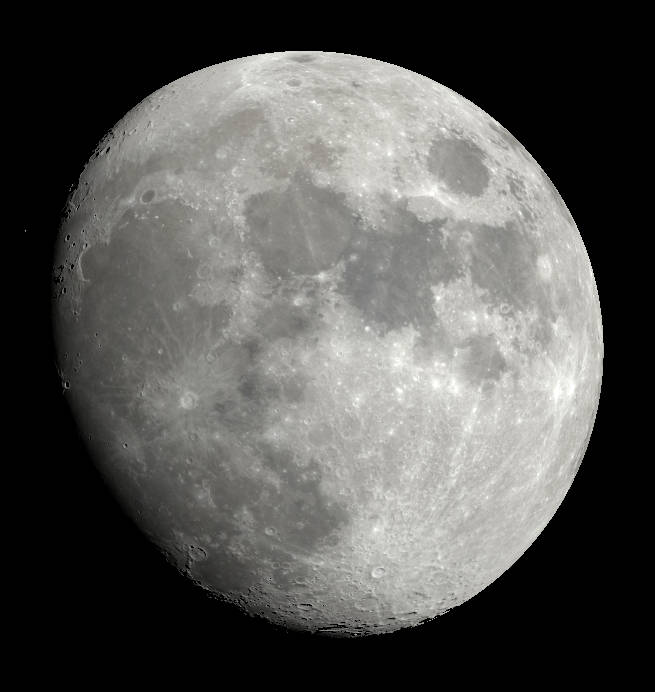
This is Bob Moler with Ephemeris for Tuesday, May 26th. Today the Sun will be up for 15 hours and 11 minutes, setting at 9:16, and it will rise tomorrow at 6:03. The Moon, 3 days past first quarter, will set at 3:48 tomorrow morning.
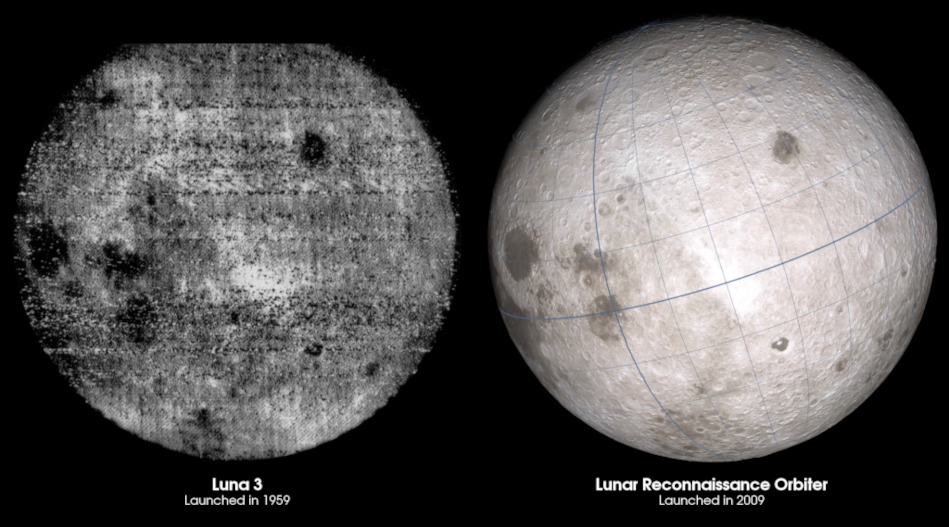
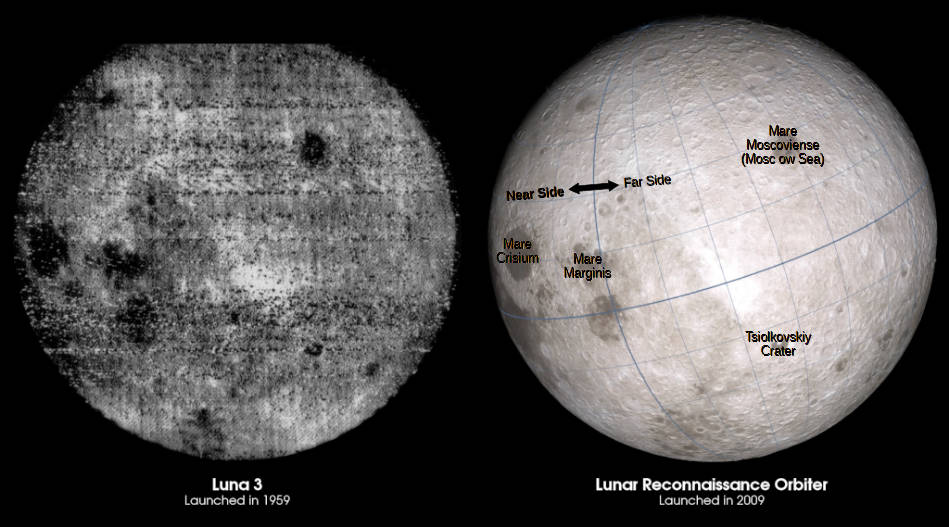
The space race with the Soviet Union started with the launch of Sputnik one in October 1957. The Soviets won the early milestones of the race, including less than two years after Sputnik 1, a flyby of Luna 3 around the moon, and taking the first photographs of the far side. Back then before CCDs, the best quality images from space were photographed onto film and then developed, then scanned on the satellite and the data is sent down to the earth. The images were rather crude and grainy. I was a senior in high school at the time and as interested in astronomy as I am today. We thought that the Far Side of the moon would be more of the same. The Far Side was completely different.
The astronomical event times given in this blog are for the Traverse City/Interlochen area of Michigan (Lat 44.7° N, Long 85.7° W; EDT, UT – 4 hours) unless stated otherwise. Times will be different for other locations.
Addendum
Ephemeris: 05/25/2026 – Remembering the fallen astronauts also
This is Ephemeris for Memorial Day, Monday, May 25th. Today the Sun will be up for 15 hours and 10 minutes, setting at 9:15, and it will rise tomorrow at 6:04. The Moon, 2 days past first quarter, will set at 3:30 tomorrow morning.
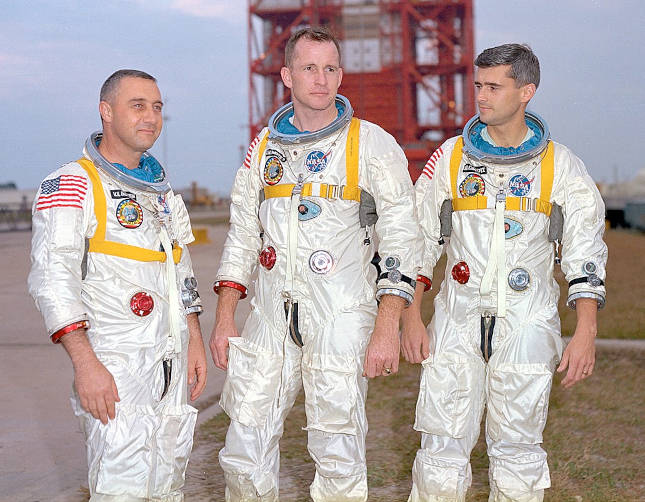
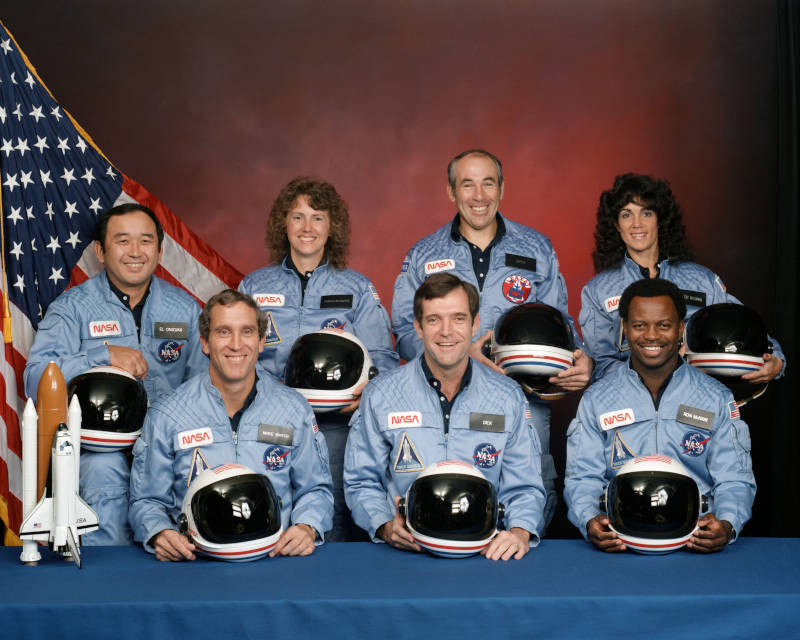
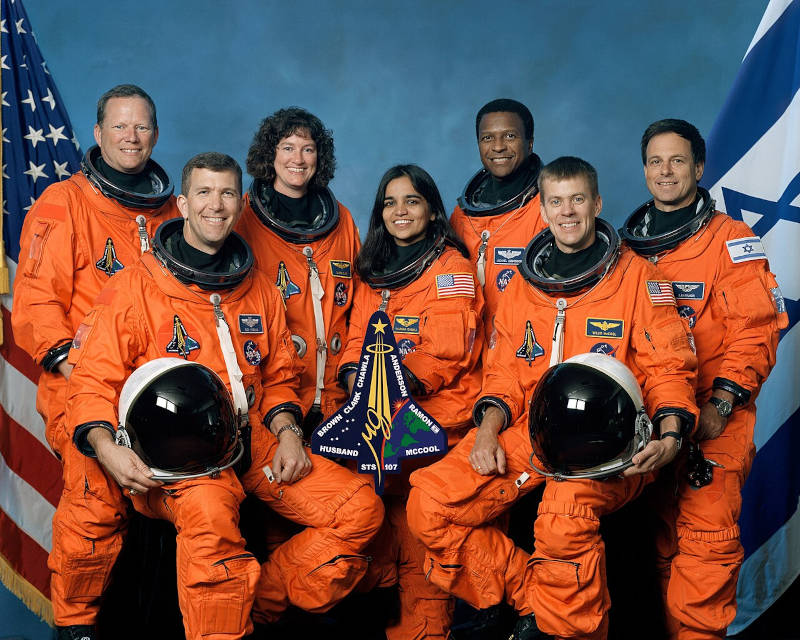
Today we pause to remember those who gave their lives for our country. For purposes of this program that includes those courageous enough to sit on top of or beside a million pounds of explosives to be launched into space. From the three astronauts who died in the Apollo one file in 1967, the explosion of the Space Shuttle Challenger in 1986, to the disintegration of the Columbia in 2003, 17 Americans and other nationals have died in NASA space accidents. The Russians too have lost cosmonauts in the exploration of space. Brothers and sisters in the quest for knowledge and to expand the horizons of human habitation. Per aspera, ad astra, Through difficulties to the stars
The astronomical event times given in this blog are for the Traverse City/Interlochen area of Michigan (Lat 44.7° N, Long 85.7° W; EDT, UT – 4 hours) unless stated otherwise. Times will be different for other locations.
Addendum
Ephemeris: 05/22/2026 – Uranus has rings, like Saturn
This is Bob Moler with Ephemeris for Friday, May 22nd. Today the Sun will be up for 15 hours and 4 minutes, setting at 9:12, and it will rise tomorrow at 6:06. The Moon, 1 day before first quarter, will set at 2:35 tomorrow morning.
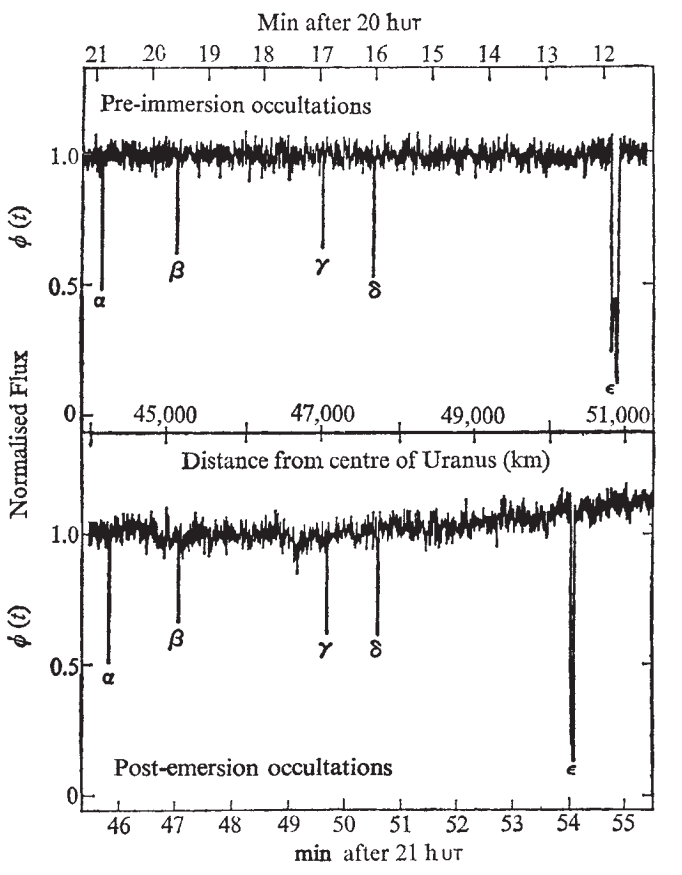
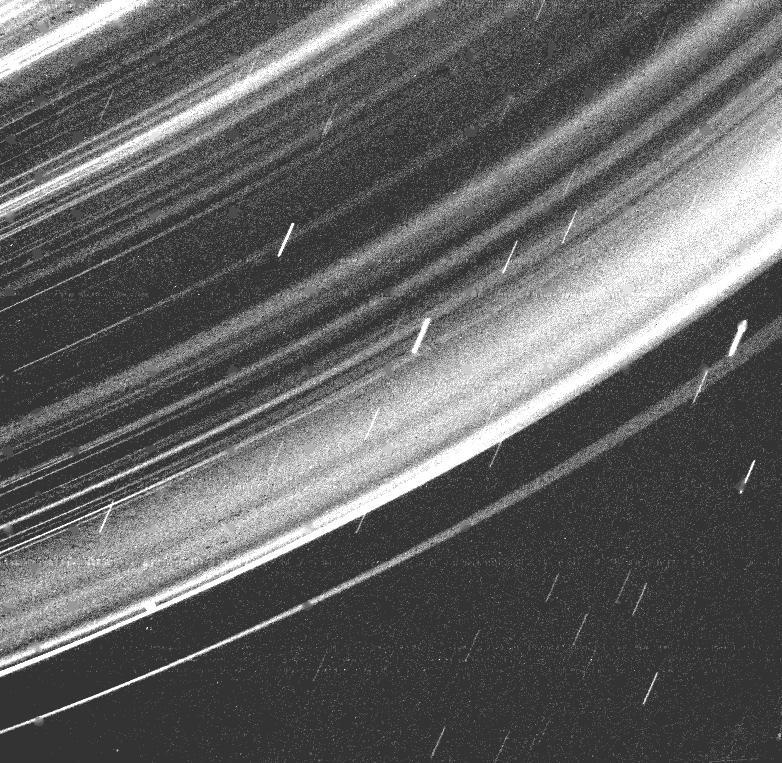
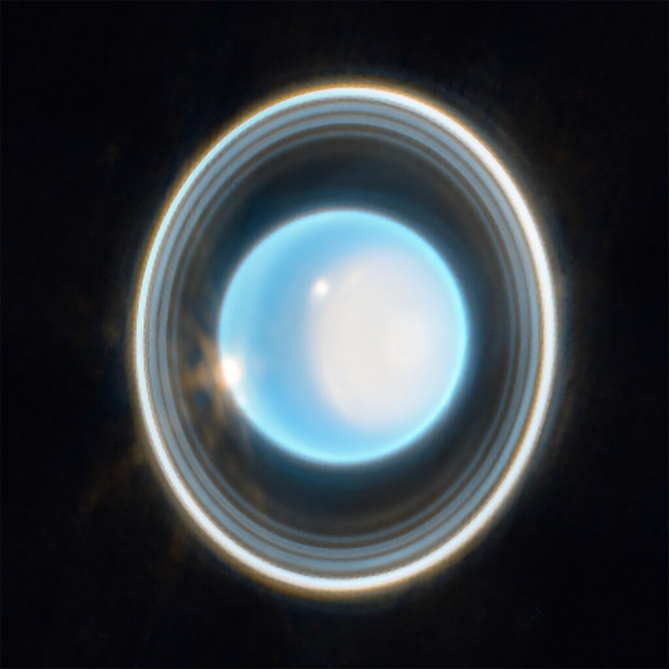
Today, the planet Uranus is in conjunction with the Sun. I don’t talk about Uranus that much, because it can’t be spotted in the sky with the naked eye. However, the James Webb Space Telescope observed it, and gave our clearest view of the planet since Voyager 2 flew past it in January 1986. Uranus has a system of rings, which were discovered in March 1977. Though not visible, they blocked the light of a star. Astronomers at the time were trying to get a more accurate diameter of the planet by timing the disappearance of a star behind the planet. Extra short dips in brightness before and after the main occultation revealed the existence of the rings. Uranus also has an extreme axial tilt of 98 degrees.
The astronomical event times given in this blog are for the Traverse City/Interlochen area of Michigan (Lat 44.7° N, Long 85.7° W; EDT, UT – 4 hours) unless stated otherwise. Times will be different for other locations.
Addendum
Ephemeris: 05/21/2026 – The man who first mapped the Moon
This is Ephemeris for Thursday, May 21st. Today the Sun will be up for 15 hours and 2 minutes, setting at 9:11, and it will rise tomorrow at 6:07. The Moon, 2 days before first quarter, will set at 2:11 tomorrow morning.
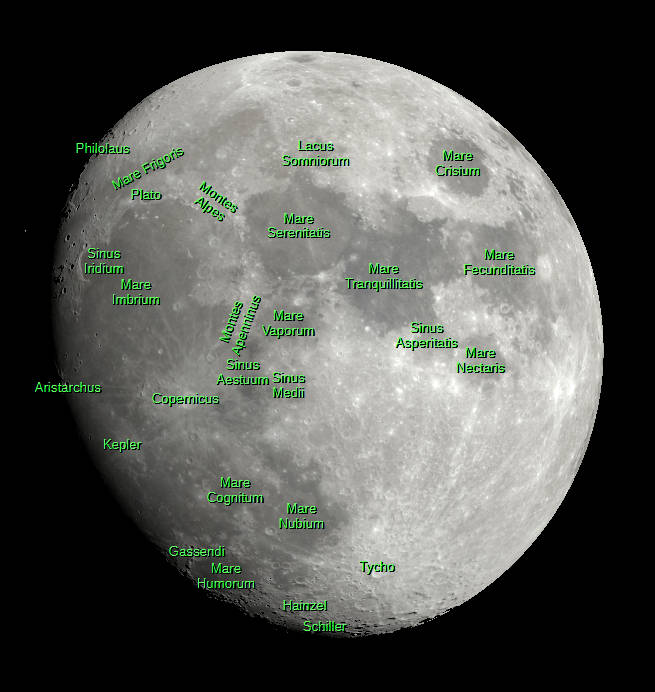
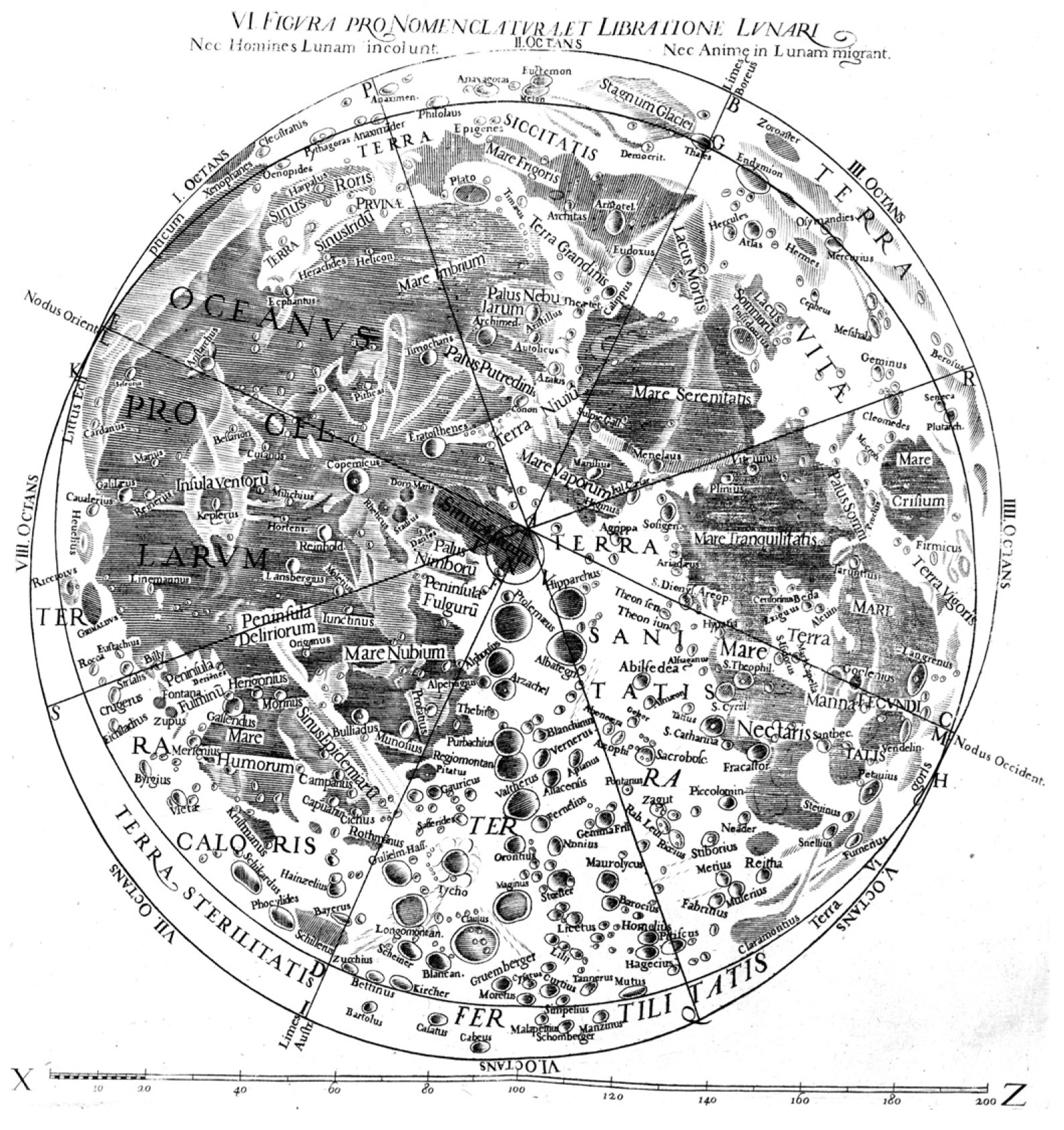
Ever wonder where the names of the features of the Moon come from? Most of the large features on the Moon were named by Giovanni Battista Riccioli, a Jesuit priest of the 17th century. He created the first accurate map of the Moon in 1651, and he named the features he drew, including the Sea of Tranquility (Mare Tranquillitatis), the craters Tycho, Plato, Clavius and many others that I talk about. Even though he professed the Earth centered universe, he gave the heliocentrists Copernicus, Kepler and Aristarchus prominent craters, but in the Ocean of Storms, Oceanus Procellarum, denoting the controversy of the day. Riccioli’s nomenclature became the standard for the Moon and other planets and moons.
The astronomical event times given in this blog are for the Traverse City/Interlochen area of Michigan (Lat 44.7° N, Long 85.7° W; EDT, UT – 4 hours) unless stated otherwise. Times will be different for other locations.
Addendum

Ephemeris: 05/20/2026 – Taking our weekly look at the whereabouts of the naked-eye planets
This is Ephemeris for Wednesday, May 20th. Today the Sun will be up for 15 hours exactly, setting at 9:09, and it will rise tomorrow at 6:08. The Moon, 3 days before first quarter, will set at 1:41 tomorrow morning.
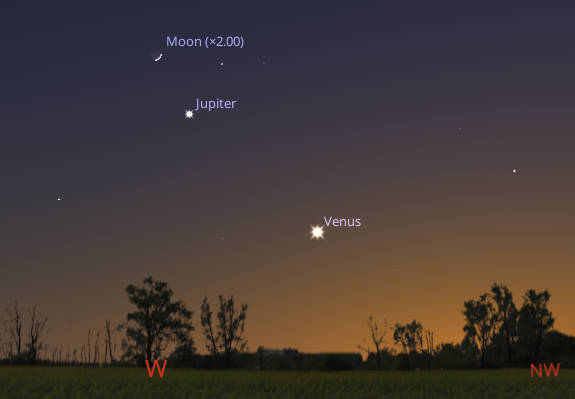
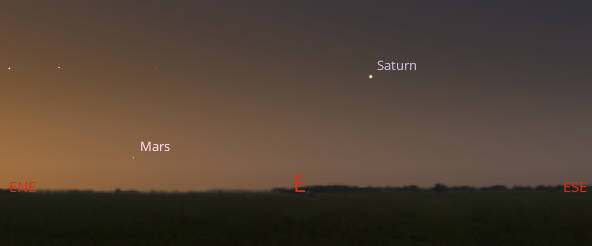
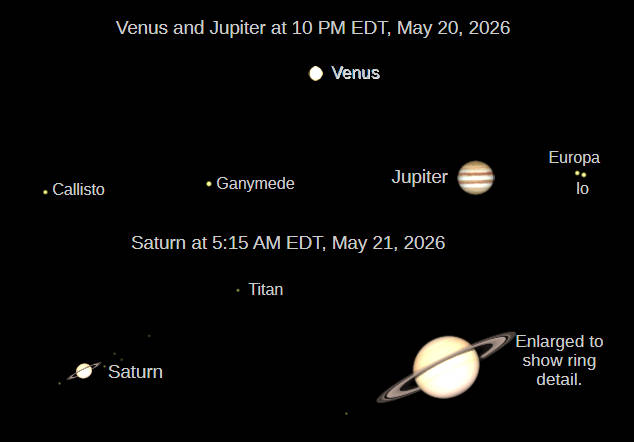
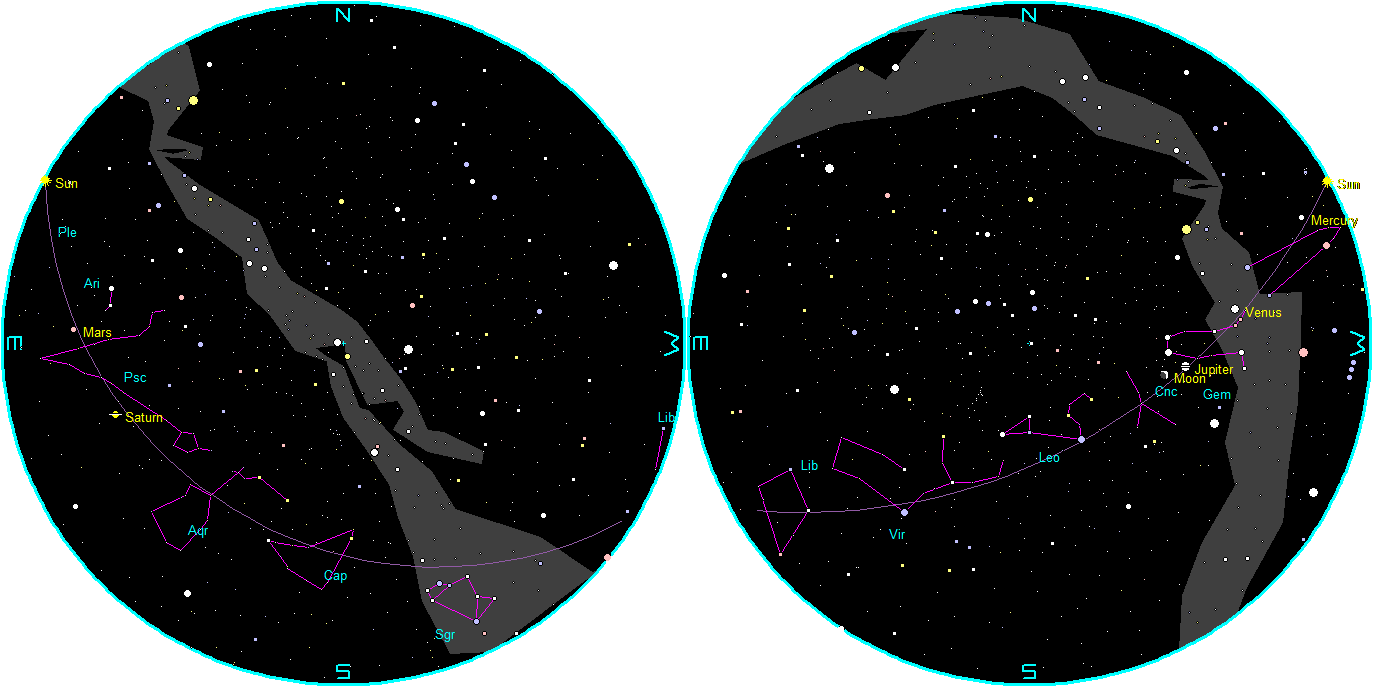
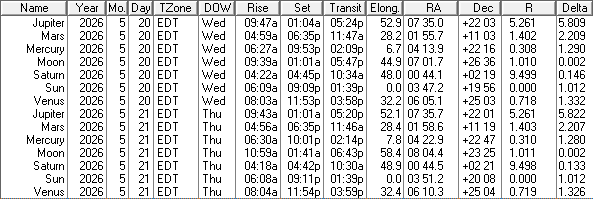
Let’s take our weekly look at the whereabouts of the naked-eye planets. By 9:30 PM tonight, about 20 minutes after sunset, Venus may be seen in the western sky. A telescope will show a very tiny disc on Venus, because it is still pretty much beyond the Sun, 124 million miles (199 million kilometers) away from us. Over the next 5 months it will be moving closer to us and becoming much larger. Jupiter is the second-brightest star-like object in the western sky seen before 10 PM. It is below and right of the Moon tonight. Venus will set at 11:53 PM, while Jupiter will hold out until 1:01 AM. Saturn may be first glimpsed just after it rises in the east at 4:18 AM, before morning twilight overwhelms it later on.
The astronomical event times given in this blog are for the Traverse City/Interlochen area of Michigan (Lat 44.7° N, Long 85.7° W; EDT, UT – 4 hours) unless stated otherwise. Times will be different for other locations.
Addendum
Ephemeris: 05/19/2026 – The Greeks discovered that the Earth was round and determined the Moon’s distance
This is Bob Moler with Ephemeris for Tuesday, May 19th. Today the Sun will be up for 14 hours and 58 minutes, setting at 9:08, and it will rise tomorrow at 6:09. The Moon, 3 days past new, will set at 1:01 tomorrow morning.
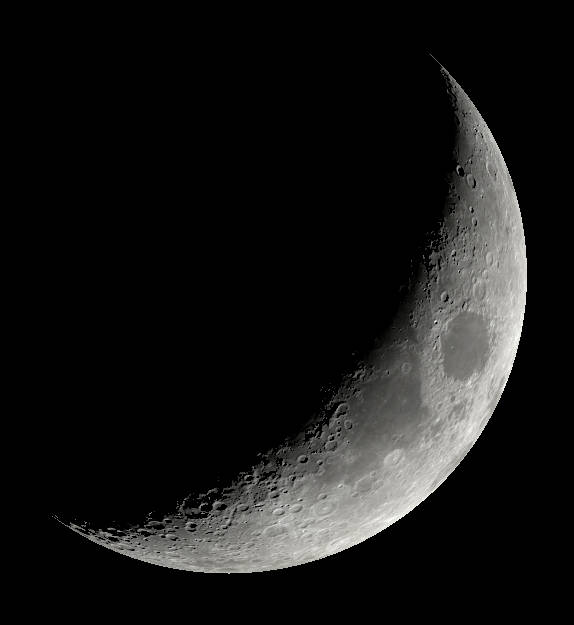
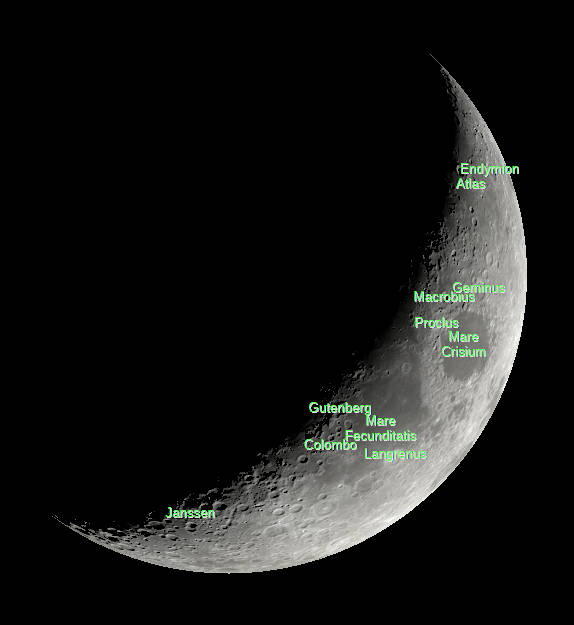
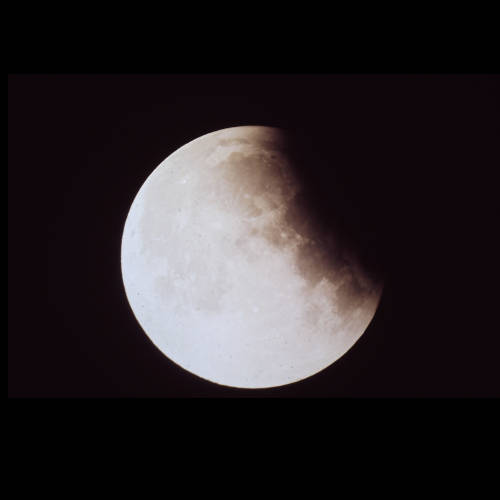
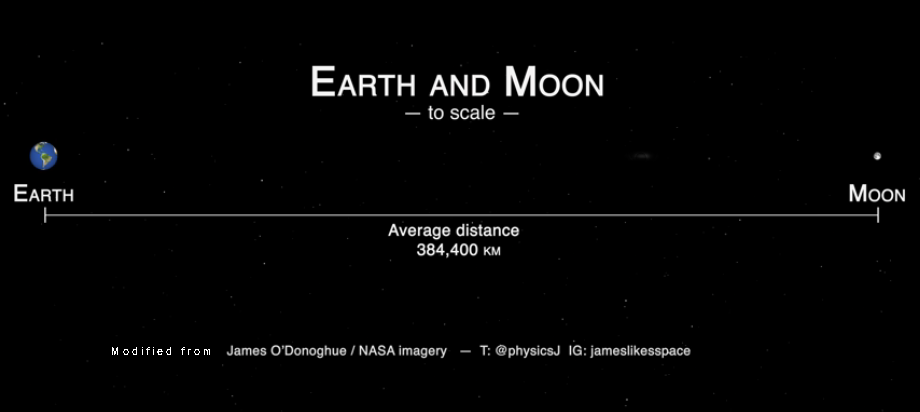
The Ancient Greeks used lunar eclipses to determine that Earth is a sphere, and worked on determining the distance to the Moon. From ancient times, the Greeks knew that an eclipse of the Moon was caused by the Earth’s shadow falling on the Moon. Since the Earth’s shadow was always circular, no matter where the Moon was in the sky during an eclipse, the Earth must be a sphere since that’s the only three-dimensional body that always casts a circular shadow. They also used the size of the Earth’s shadow to estimate the distance to the Moon. The lunar distance, on average, is 60.8 times the Earth’s radius away. The first estimates were about one third of that. Hipparchus in the 2nd century BC got much closer at 68 Earth radii.
The astronomical event times given in this blog are for the Traverse City/Interlochen area of Michigan (Lat 44.7° N, Long 85.7° W; EDT, UT – 4 hours) unless stated otherwise. Times will be different for other locations.
Addendum
Ephemeris: 05/18/2026 – Earth shines on the Moon
This is Bob Moler with Ephemeris for Monday, May 18th. Today the Sun will be up for 14 hours and 56 minutes, setting at 9:07, and it will rise tomorrow at 6:10. The Moon, 2 days past new, will set at 12:07 tomorrow morning.
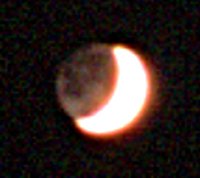
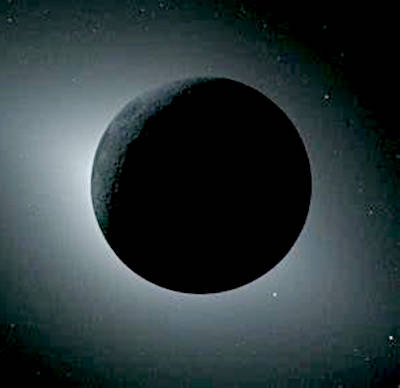
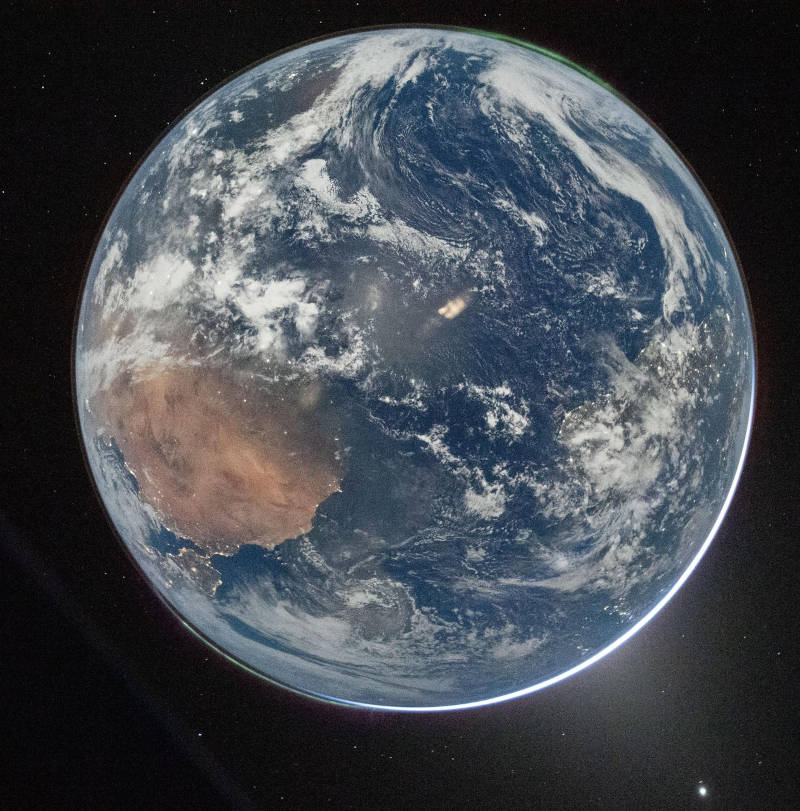
The Moon tonight will appear as a thin sliver, with Venus below and left of it. However, if as you look at the Moon closely tonight you may have the funny feeling that the whole moon is actually visible, you would be right. It’s easily confirmed with a pair of binoculars or a small telescope. What is illuminating the dark part of the Moon is earthshine. The Earth is big and bright in the Moon’s sky, as a fat waning gibbous orb from its vantage point. From the Moon the Earth has the opposite phase that we see of the Moon from the Earth. The effect used to be called by the term “Old moon in the new moon’s arms”. The effect was first explained by Leonardo da Vinci some 500 years ago. The effect will disappear in a few days as the Moon gets brighter and the Earth less so in the Moon’s sky. Earthshine will appear again when the Moon appears as a waning crescent in the morning. But not many of us are up to see it at that hour.
The astronomical event times given in this blog are for the Traverse City/Interlochen area of Michigan (Lat 44.7° N, Long 85.7° W; EDT, UT – 4 hours) unless stated otherwise. Times will be different for other locations.
Addendum