Ephemeris: 08/10/2026 – Previewing Wednesday’s (August 12 , 2026) solar eclipse
This is Ephemeris for Monday, August 10th. Today the Sun will be up for 14 hours and 16 minutes, setting at 8:56, and it will rise tomorrow at 6:40. The Moon, 2 days before new, will rise at 4:58 tomorrow morning.
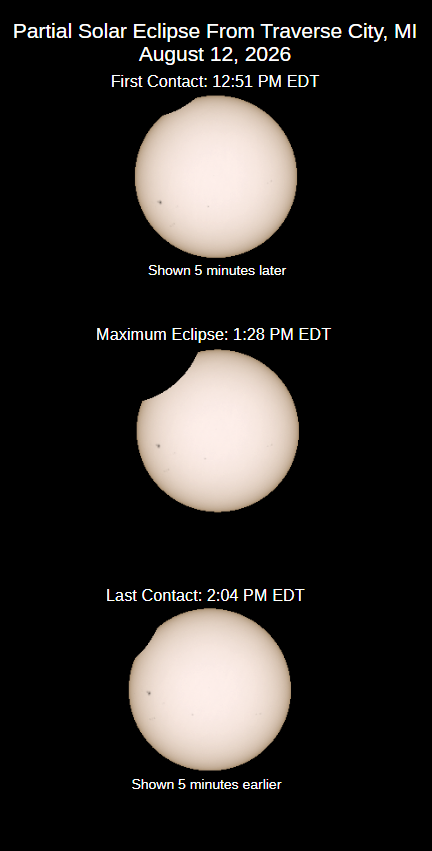
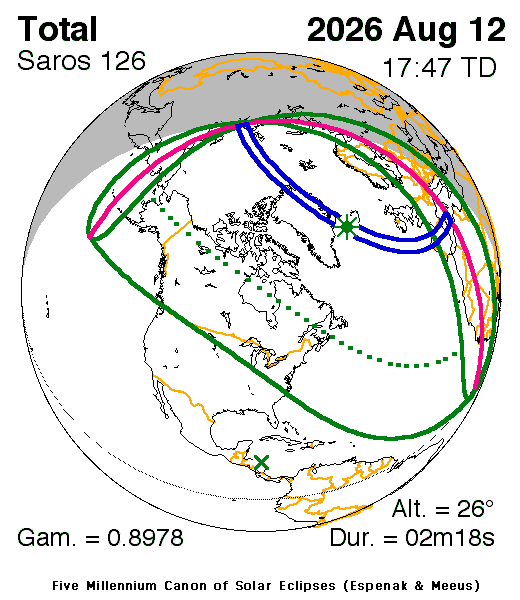
Early Wednesday afternoon there will be a very slight partial solar eclipse visible from northern Michigan. The eclipse begins around 12:51 and extends to 2:04 PM with the greatest coverage of the sun at 1:28 PM when a little bit less than 11% of the sun’s diameter will be covered by the moon. To view the eclipse you need to dig out your eclipse glasses from the 2024 eclipse. Inspect them against a strong light make sure there’s no pin holes that developed in them. You must discard if there are. The other way to view the eclipse is by projection either using a pinhole and a long cardboard box or by using a colander to provide both shade and a lot of small holes to project the sun’s image with. It’s the first of two astronomical events that day.
The astronomical event times given in this blog are for the Traverse City/Interlochen area of Michigan (Lat 44.7° N, Long 85.7° W; EDT, UT – 4 hours) unless stated otherwise. Times will be different for other locations.
Addendum
-
August 12, 2026 at 12:31 amEphemeris: 08/12/2026 – Eclipses, meteors and planets, oh my! | Bob Moler's Ephemeris Blog

