Archive
Ephemeris: 08/25/2026 – Thursday’s lunar eclipse – and when eclipses can occur
This is Ephemeris for Tuesday, August 25th. Today the Sun will be up for 13 hours and 34 minutes, setting at 8:31, and it will rise tomorrow at 6:58. The Moon, 3 days before full, will set at 5:06 tomorrow morning.
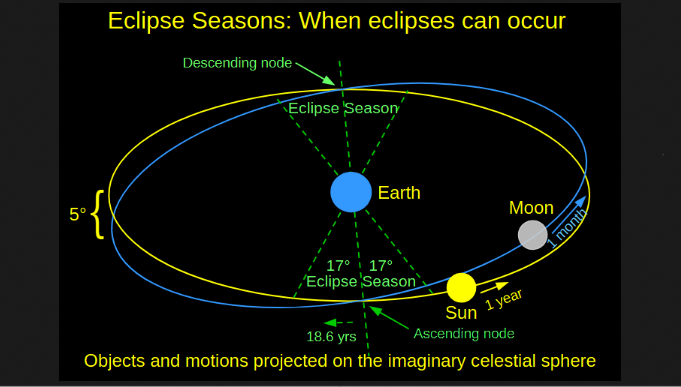
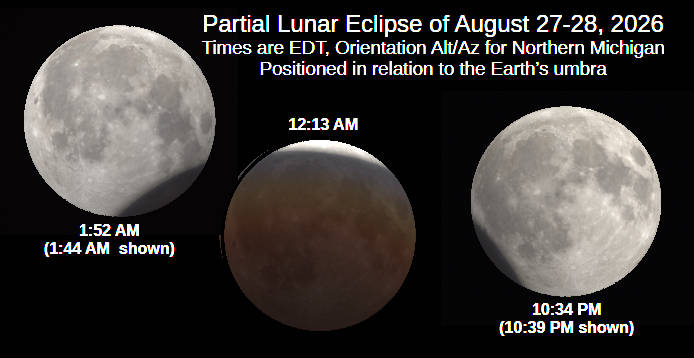
This Thursday’s partial lunar eclipse will occur only 15 days after the last eclipse, a nibble of a solar eclipse for us, and a total eclipse for others on August 12th. Eclipses occur in seasons of about a month long that occur at a bit less than six month intervals, so eclipses will occur a little earlier next year to this. That’s because the crossing points of the Moon’s and the Earth’s orbital planes regress slowly westward. In an eclipse season two eclipses will occur: a solar and a lunar eclipse. On rare occasions when a lunar eclipse occurs in the center of a season a partial solar eclipse can occur two weeks before and again after the lunar eclipse, but they will affect the opposite polar regions of the Earth. For Thursday night, the partial eclipse will start at 10:34 PM. Maximum eclipse occurs at 12:13 AM, and will end at 1:52 AM.
The astronomical event times given in this blog are for the Traverse City/Interlochen area of Michigan (Lat 44.7° N, Long 85.7° W; EDT, UT – 4 hours) unless stated otherwise. Times will be different for other locations.
Addendum