Ephemeris: 11/12/2026 – We’re having a low yield, but very interesting meteor shower now
This is Ephemeris for Thursday, November 12th. Today the Sun will be up for 9 hours and 41 minutes, setting at 5:17, and it will rise tomorrow at 7:37. The Moon, 3 days past new, will set at 7:18 this evening.
This evening we’ll see the peak of the North Taurid* meteor shower. The expected peak numbers will be only 5 an hour. However, they are slow and quite bright. Moonlight doesn’t seem to bother them. Their source is Encke’s Comet one of the first periodic comets discovered, and it has the shortest orbit around the sun of only 3.3 years, which explains their slowness. They will appear to come from near the Pleiades. The particles causing the meteors, technically meteoroids, must be fairly large to be that bright. It is thought, by some, that the Tunguska meteorite that hit the Earth June 30th, 1908 may have been part of a related meteor stream. The meteoroid stream crosses the Earth’s orbit in 2 spots: tonight and around the end of June coming from out from the direction of the sun. The Tunguska meteorite hit in the morning during daylight.
The astronomical event times given in this blog are for the Traverse City/Interlochen area of Michigan (Lat 44.7° N, Long 85.7° W; EST, UT – 5 hours) unless stated otherwise. Times will be different for other locations.
* On the radio program, I misspoke, stating the South Taurid meteor shower. Both were shed by Encke’s Comet, and reach peak a week apart. The Southern Taurids reached peak on the 4th\, but is still active
Addendum
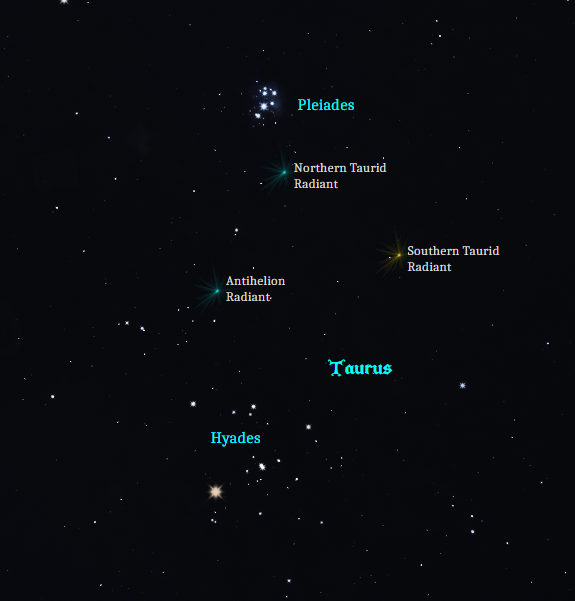
For a good write-up on Antihelion meteors I suggest checking out What Is the Antihelion Source Meteor Shower? from SpaceWeekly.com.

