Archive
03/22/2019 – Ephemeris – The Great Underwater Panther
Ephemeris for Friday, March 22nd. Today the Sun will be up for 12 hours and 14 minutes, setting at 7:57, and it will rise tomorrow at 7:40. The Moon, 2 days past full, will rise at 10:07 this evening.
The Anishinabe peoples of the Great Lakes Region, which includes the Ottawa, Chippewa and Ojibwe Indians have one constellation of winter I know of. It is The Winter Maker which uses many of Orion’s stars and whose arms stretch from Aldebaran in Taurus the bull to Procyon the Little Dog Star, embracing the whole of the winter sky. Now that spring is here he is sinking into the west. The first constellation of spring is Curly Tail, or the Great Underwater Panther. Which uses the stars of Leo the lion’s backward question mark as its tail and the small knot of stars that are the head of Hydra the water snake below Cancer the crab as its head. Keep off the thinning ice or break through and be snatched by the great panther that lives below.
The times given are for the Traverse City/Interlochen area of Michigan. They may be different for your location.
Addendum
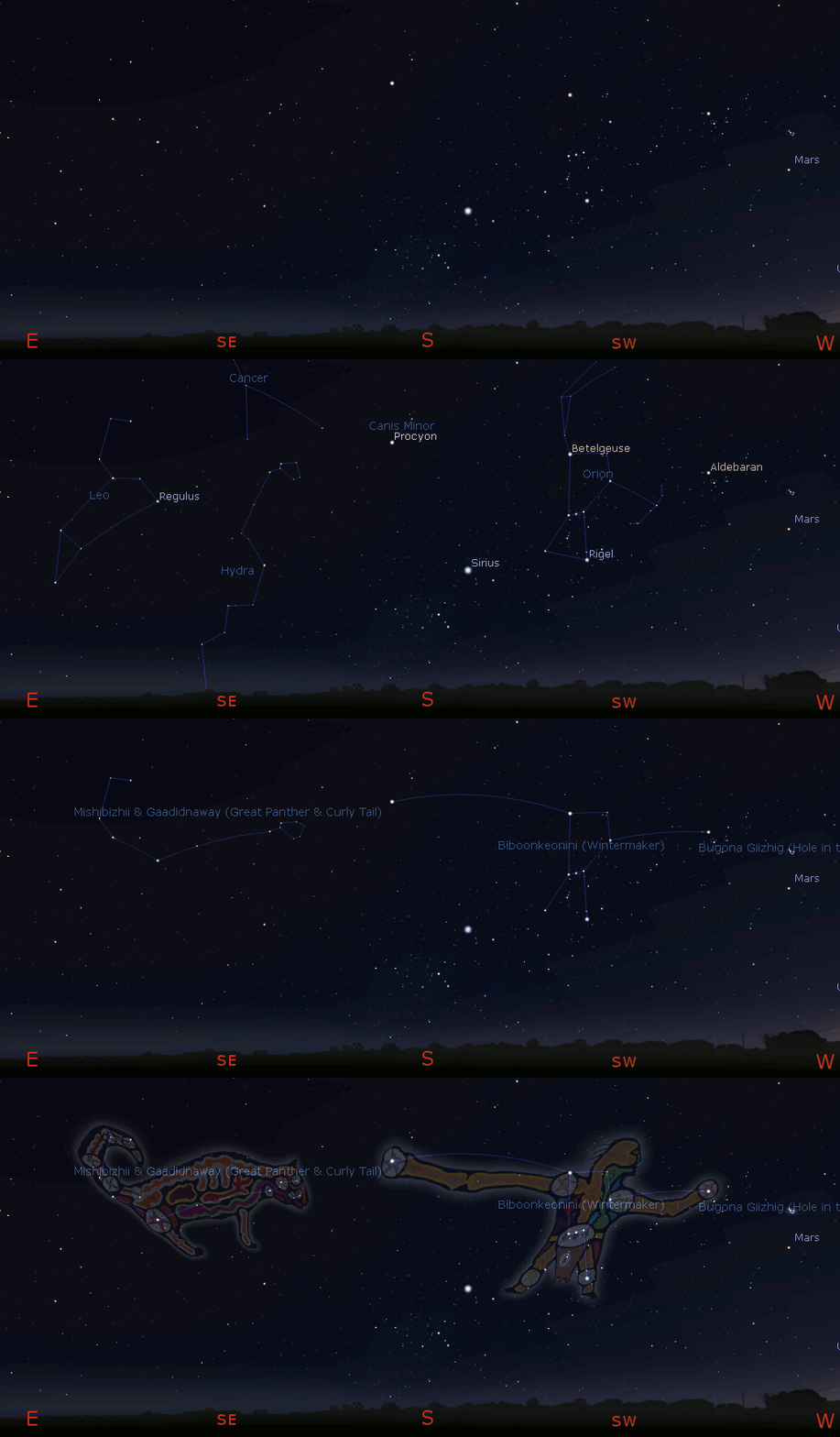
Great Underwater Panther finder animation relating western to Anishinaabe constellations for 9 p.m. March 22, 2019. Click on the image to enlarge. Created using Stellarium.
The constellation art is part of the latest versions of Stellarium. Ojibwe (Anishinaabe) constellation art by Annette S Lee and William Wilson from Ojibwe Sky Star Map Constellation Guide, by A. Lee, W Wilson, C Gawboy, J. Tibbetts. ISBN 978-0-615-98678-4.
03/05/2019 – Ephemeris – The Big Dipper rising in the east
Ephemeris for Fat Tuesday, March 5th. Today the Sun will be up for 11 hours and 21 minutes, setting at 6:35, and it will rise tomorrow at 7:11. The Moon, 1 day before new, will rise at 7:33 tomorrow morning.
While Orion and the stars of winter are still holding forth in the south the Big Dipper is sneaking up in the northeast. Indeed at 8 p.m. the front stars of the dipper’s bowl are half way up the sky, at the same altitude of Polaris the North Star. To the Anishinaabe native peoples of this region the Big Dipper wasn’t part of a bear, it was the hind end of the Fisher, Ojiig in their language. The Fisher, a magical animal of their legends, a weasel-like animal brought warm seasons to the Earth, and serves as a weather indicator. As he climbs the sky in the east he is signaling spring and the maple sugaring season. The Big Dipper is also a pointer to some of the important stars and constellations of spring.
The times given are for the Traverse City/Interlochen area of Michigan. They may be different for your location.
Addendum
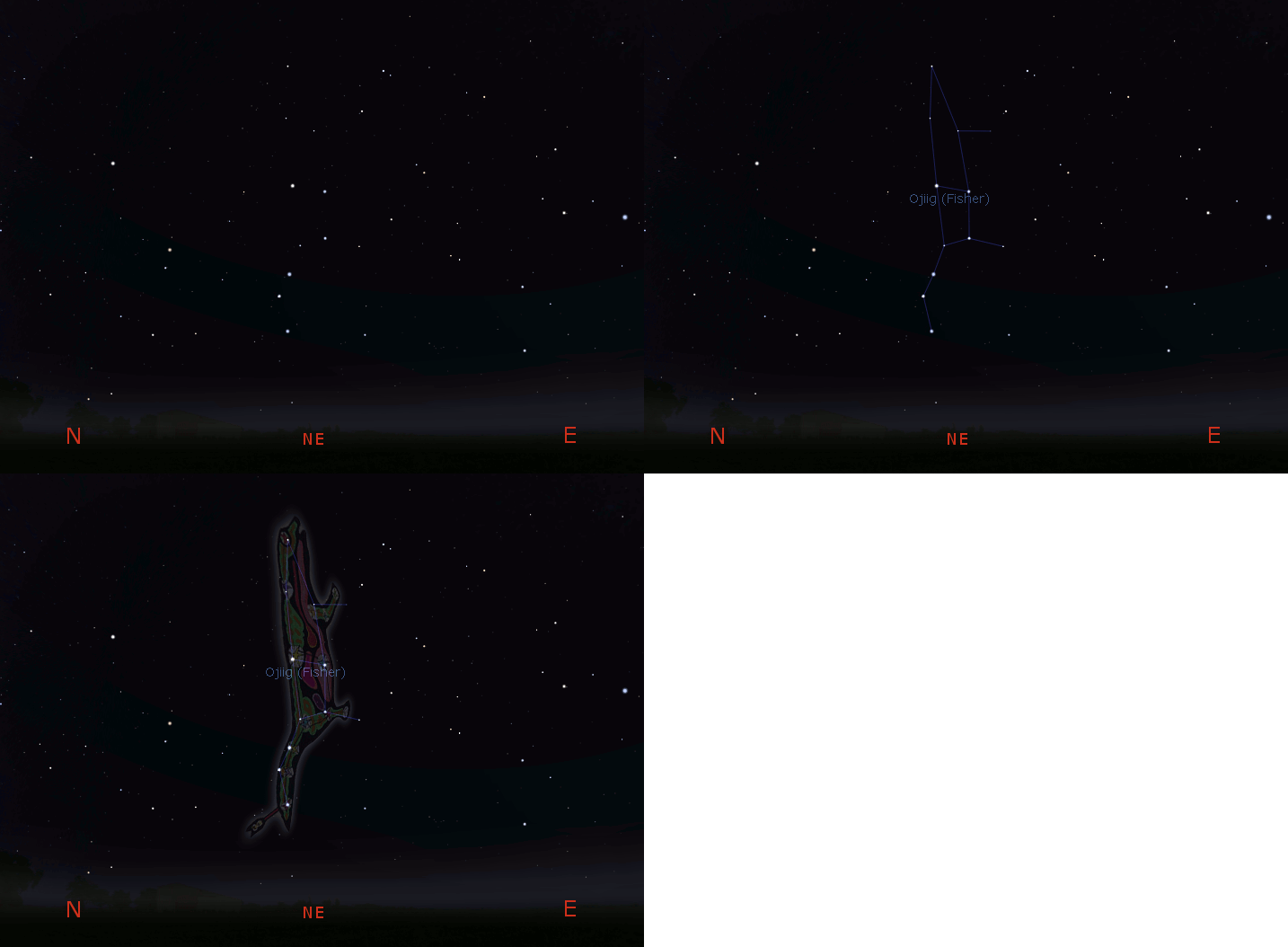
The Big Dipper, as Ojiig the Fisher of the Anishinaabe people rising higher in the northeast at 8 p.m. March 5, 2019. Created using Stellarium.
The Anishinaabe constellation drawing of the Fisher is from Ojibwe Sky Star Map Constellation Guide by Annette S. Lee, William Wilson, Jeffrey Tibbets and Carl Gawboy available locally and online. They are part of the latest editions of Stellarium, a free planetarium program. Links to it are on the right. Other information and links are available within the Sky Lore tab.
My story of the Fisher is here: https://bobmoler.wordpress.com/2012/10/11/the-story-of-the-fisher-star/
11/04/2018 – Ephemeris Extra – Wintermaker rising
A chill is in the air, The Fisher, Ojiig’s bloody tail has swooped low in the north at midnight to paint the trees with their fall colors, and the leaves have fallen to the ground. Haven’t heard of the Fisher? I mention it from time to time here on my Ephemeris program on Interlochen Public Radio. It’s a constellation of the Anishinaabe peoples indigenous to this area of Michigan, of which the Chippewa, Ottawa, and Ojibwe are a part.
The Fisher occupies the stars which we know as the Big Dipper and the Great Bear, Ursa Major. And unlike the bear, a fisher really does have a long tail. The fisher is a real weasel-like animal whose diet apparently does not include fish. It is found across southern Canada and in the American West. I’ve related the story of the Fisher, and how he brought summer to the Earth, in these pages in the August 2012 issue and on my blog bobmoler.wordpress.com. Search for fisher. Like most legends, there are different versions of that story and others about the Fisher.
Fisher or not, summer is gone and the world seems darker and colder. Over in the east these evenings great winter constellation of Orion is rising. It brings to mind the Robert Frost poem Star-Splitter, and our star chart this month from the November 1st post:
“You know Orion always comes up sideways.

Throwing a leg up over our fence of mountains,

And rising on his hands, he looks in on me

Busy outdoors by lantern-light with something

I should have done by daylight, and indeed,

After the ground is frozen, I should have done

Before it froze, and a gust flings a handful

Of waste leaves at my smoky lantern chimney

To make fun of my way of doing things,

Or else fun of Orion's having caught me.

Has a man, I should like to ask, no rights

These forces are obliged to pay respect to?"
The rest of the poem is available on the Poetry Foundation website: https://www.poetryfoundation.org/poems/44273/the-star-splitter. The poem is about one Brad McLaughlin and his telescope. While I don’t approve of how he financed his telescope, I do share his enthusiasm.
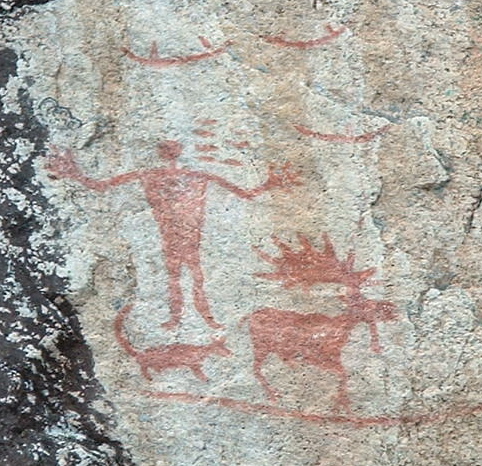
The Wintermaker, Biboonikeonini’s, name literally means North Wind. While his torso is the same as Orion’s his arms stretch from Aldebaran in Taurus to Procyon in Canis Minor, just about spanning the entire winter sky. The pictographs, seen above of the Wintermaker, Curly Tail and Moose can only be seen from a canoe in the cliff face on one side of the narrows between North Hegman and Trease lakes, 15 miles north of Ely, Minnesota
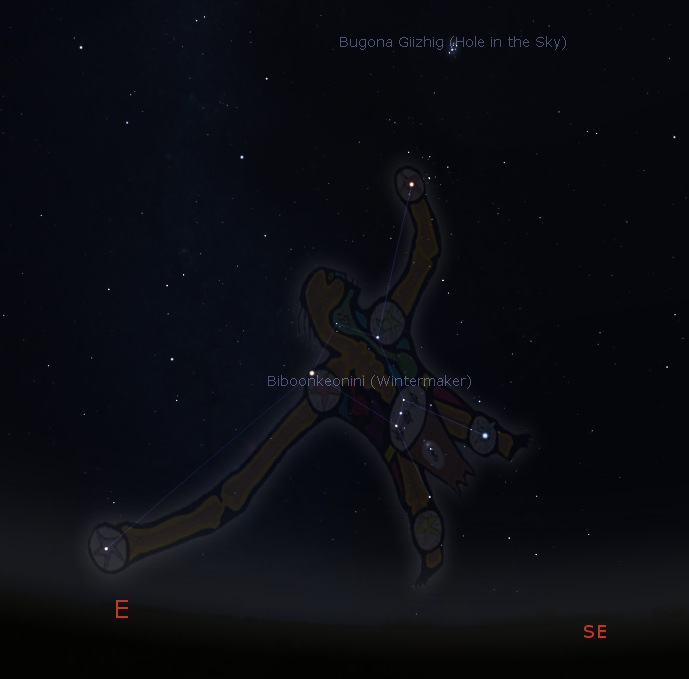
In late winter as Ojiig is rising in the northeast signaling the maple sugaring season, the Wintermaker is moving lower in the southwest. Some Ojibwe parents make bows for their children to shoot arrows at the Wintermaker to convince him to flee the skies so spring can begin as a way to teach them the old legends of their culture.
The Pleiades is an important group of stars for the Anishinaabe in several ways. It is the Hole-In-The-Sky, Bagone’giizhig, through which the Sky Woman fell and to give birth to the first humans on the Earth.
The Pleiades also represent the seven poles of the Shaking Tent Ceremony, and the seven sacred stones that are heated for the sweat lodge, which is also seen in the stars in the spring as Corona Borealis.

They are also the Seven Daughters of the Moon and Sun. They loved to dance and play, and when their father, the Moon was low in the sky, would descend to the Earth in a basket to do their thing. On one of their trips to the earth, one of them was captured by a human and she ended up falling in love with him, and married him. When father Moon found out he permanently dimmed her star, so now most people now only can spot 6 of the stars. This last bit seems to parallel the Greek story of the lost Pleiad.
Note: This is published as an article in the Grand Traverse Astronomical Society’s November 2018 newsletter Stellar Sentinel.
10/11/2018 – Ephemeris – Pegasus the aerobatic horse
Ephemeris for International Day of the Girl, Thursday, October 11th. The Sun will rise at 7:53. It’ll be up for 11 hours and 11 minutes, setting at 7:05. The Moon, 3 days past new, will set at 8:56 this evening.
Rising ever higher in the east at as it gets dark around 9 p.m. can be found one of the great autumn constellations: Pegasus the flying horse of Greek myth. Its most visible feature is a large square of four stars, now standing on one corner. This feature, called the Great Square of Pegasus, represents the front part of the horse’s body. The horse is quite aerobatic because it is seen flying upside down. Remembering that fact, the neck and head is a bent line of stars extending from the right corner star of the square. Its front legs can be seen in a gallop extending to the upper right from the top star of the square. From the left star extend, not hind legs but the constellation of Andromeda, an important constellation in its own right. The Anishinaabek peoples native to this region saw ab upright Moose (Mooz) here.
The times given are for the Traverse City/Interlochen area of Michigan. They may be different for your location.
Addendum
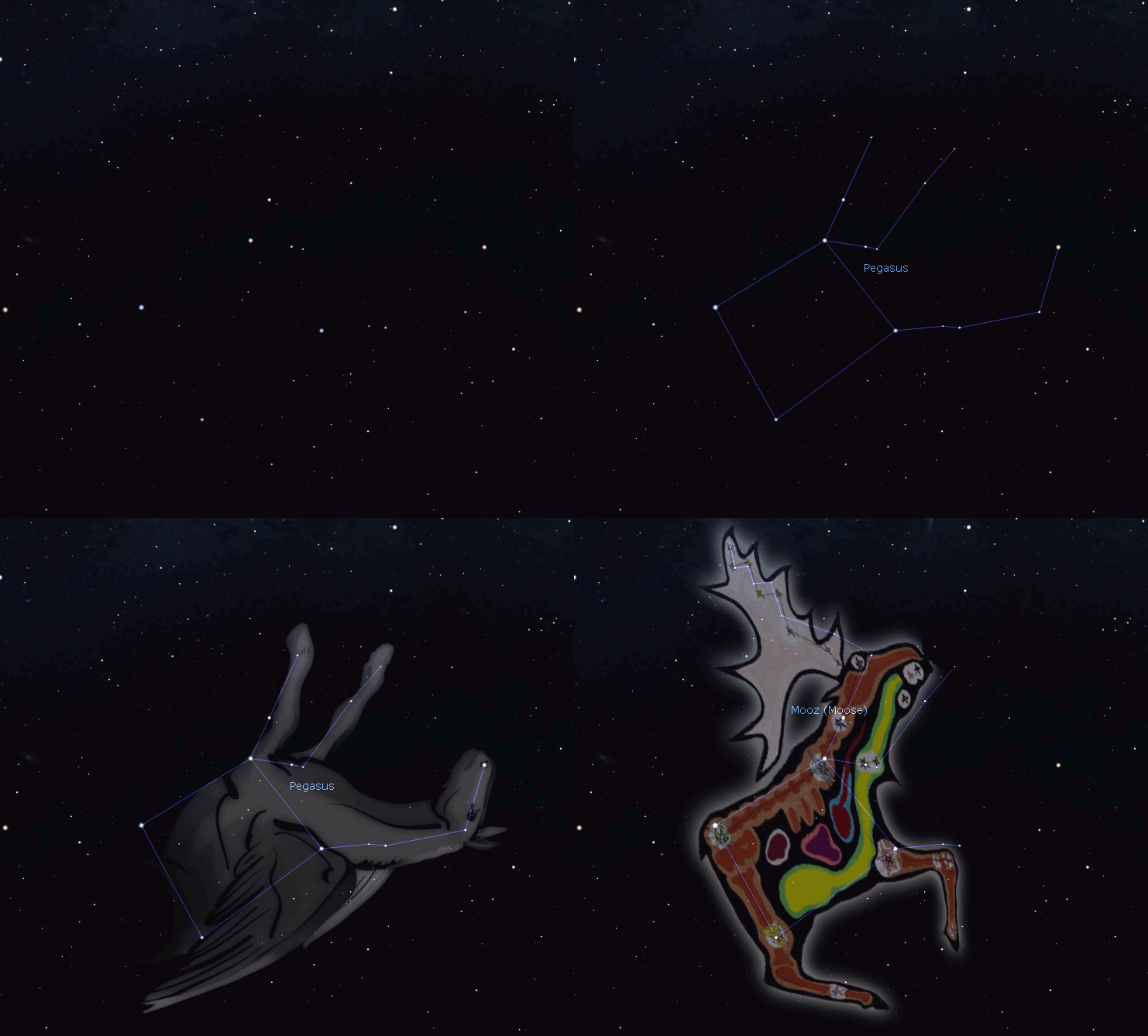
The constellation art is part of the latest versions of Stellarium. Ojibwe (Anishinaabek) constellation art by Annette S Lee and William Wilson from Ojibwe Sky Star Map Constellation Guide, ISBN 978-0-615-98678-4.
06/08/2018 – Ephemeris – Anishinaabek constellation of the Sweat Lodge
Ephemeris for Friday, June 8th. Today the Sun will be up for 15 hours and 29 minutes, setting at 9:26, and it will rise tomorrow at 5:57. The Moon, 2 days past last quarter, will rise at 3:37 tomorrow morning.
This past Monday I talked about the constellation of Corona Borealis, high in the southeast at 10:30 in the evening and the Greek mythology that surrounds it. It’s a small three-quarters of a circle of stars sandwiched between the larger constellations of Boötes to the west or right and Hercules on left or east. To the Anishinaabek people, who are natives of our region of which the Ottawa or Odawa, Chippewa and Ojibwe tribes are a part it is the Sweat Lodge. A section of what we call Hercules next to it is the Exhausted Bather, who is a participant lying on the ground after the ceremony. The seven stones that are heated for the Sweat Lodge ceremony are the Pleiades, now too close to the Sun to be seen.
The times given are for the Traverse City/Interlochen area of Michigan. They may be different for your location.
Addendum
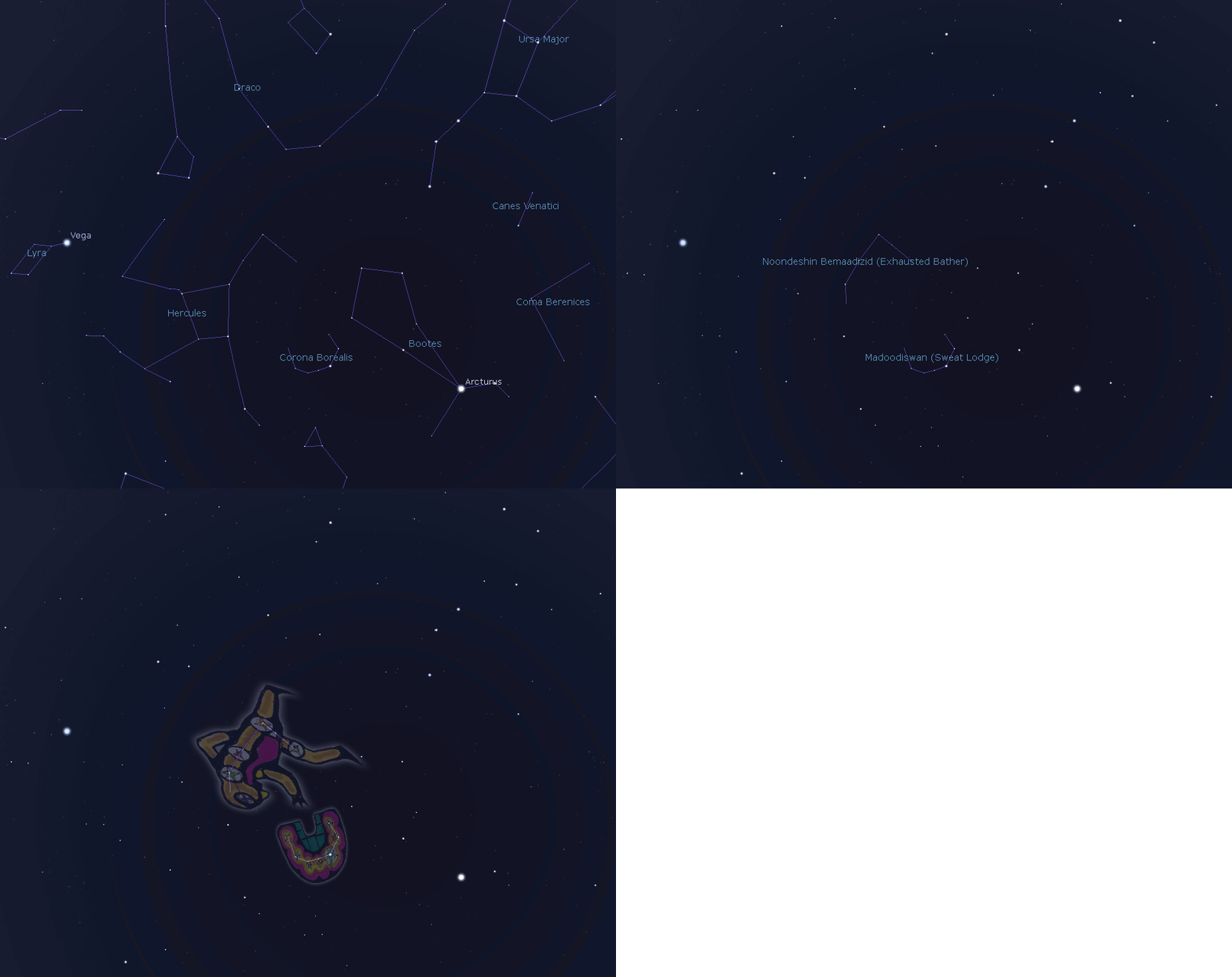
The Anishinaabek constellations of the Sweat Lodge and the Exhausted Bather looking high in the southeast at 10:30 p.m., Click on image to enlarge. June 8, 2018. Created using Stellarium and GIMP.
The constellation art is part of the latest versions of Stellarium. Ojibwe (Anishinaabek) constellation art by Annette S Lee and William Wilson from Ojibwe Sky Star Map Constellation Guide, ISBN 978-0-615-98678-4.
03/12/2018 – Ephemeris – The Fisher is rising as spring approaches
Ephemeris for Monday, March 12th. The Sun will rise at 8:00. It’ll be up for 11 hours and 44 minutes, setting at 7:45. The Moon, 4 days past last quarter, will rise at 6:05 tomorrow morning.
Now in the evening the Big Dipper has moved up in the northeast. The Anishinaabek peoples around the Great Lakes, like the Ottawa and Chippewa saw instead of a dipper or a bear: Ojiig the Fisher. It’s a magical weasel-like creature who, with some animal friends, brought summer to the Earth. The story is too long to relay here, but my telling of it is here. For his trouble he was slain, and was placed among the stars of the sky by the Great Spirit Manitou where we see him today. His blood is said to paint the trees with the fall colors. However as the Fisher rises in the northeast in late winter and early spring it is a signal for the maple trees to bring forth their sweet sap.
The times given are for the Traverse City/Interlochen area of Michigan. They may be different for your location.
Addendum
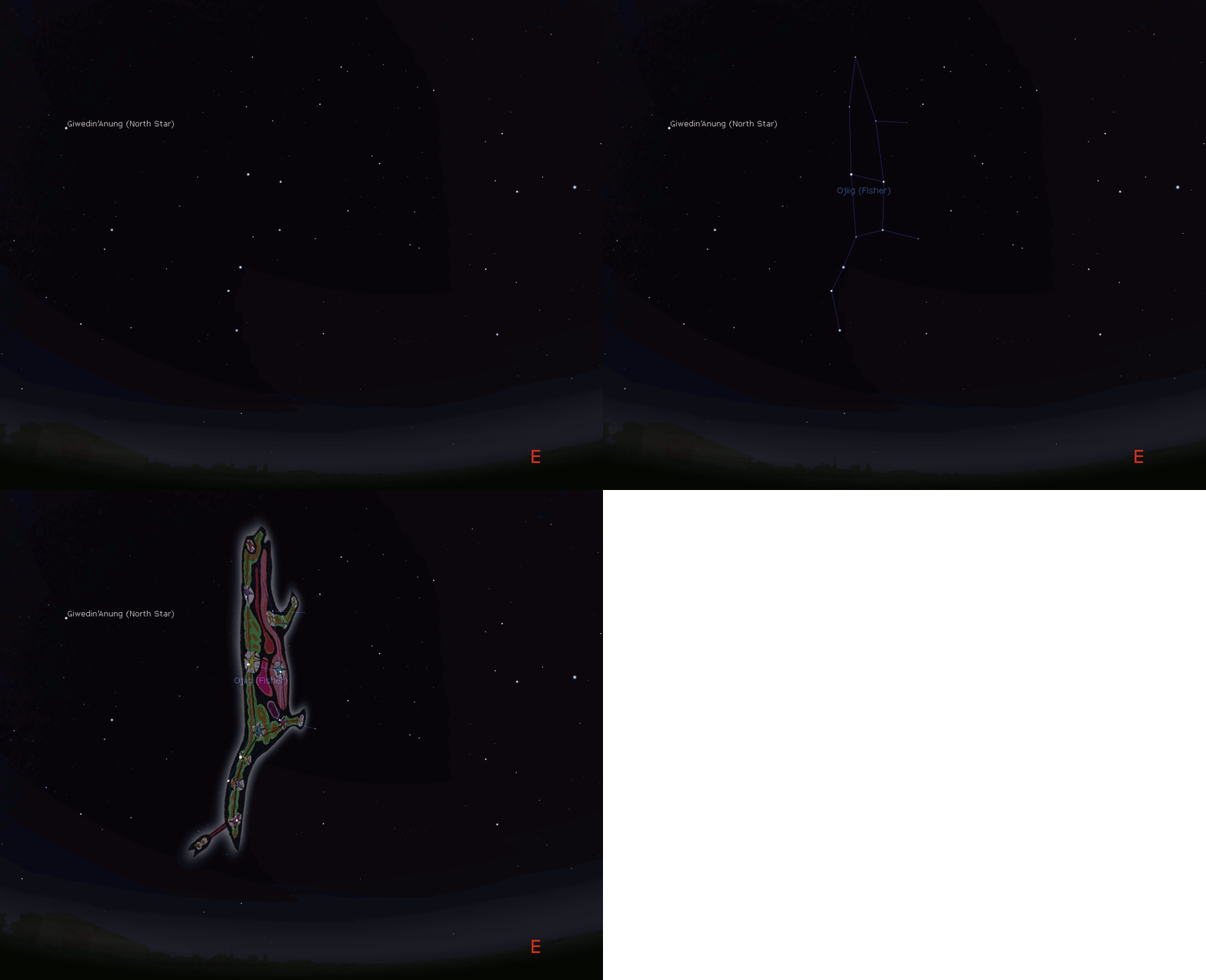
Finding the Big Dipper and the Fisher at 9 p.m., March 12, 2018. Click on the image to enlarge. Created using Stellarium and GIMP.
The Anishinaabek constellation drawings are from Ojibwe Sky Star Map Constellation Guide by Annette S. Lee, William Wilson, Jeffrey Tibbets and Carl Gawboy available locally and online. They are part of the latest editions of Stellarium, a free planetarium program. Links to it are on the left. Other information and links are available within the Sky Lore tab.
Here’s one of the links: http://www.nativeskywatchers.com/. It also contains links to Lakota star maps and lore.
03/08/2018 – Ephemeris – Beware the Great Underwater Panther
Ephemeris for Thursday, March 8th. The Sun will rise at 7:07. It’ll be up for 11 hours and 31 minutes, setting at 6:39. The Moon, 1 day before last quarter, will rise at 1:56 tomorrow morning.
The Anishinaabek people of the Great Lakes Region, which includes the Ottawa or Odawa, Chippewa and Ojibwe Indians have two constellations of winter that I know of. The first is The Winter Maker which uses many of Orion’s stars plus Aldebaran and Procyon. It rises in the eastern skies in the evening as winter is beginning. The second, of late winter and early spring is Curly Tail, the Great Underwater Panther. Which uses the stars of Leo the lion’s backward question mark as its tail and the small knot of stars that are the head of Hydra the water snake below Cancer as its head. I imagine this constellation was a warning to youngsters to keep off the thinning ice of spring, lest they fall in and be snatched by the great underwater panther that lives beneath the ice.
The times given are for the Traverse City/Interlochen area of Michigan. They may be different for your location.
Addendum
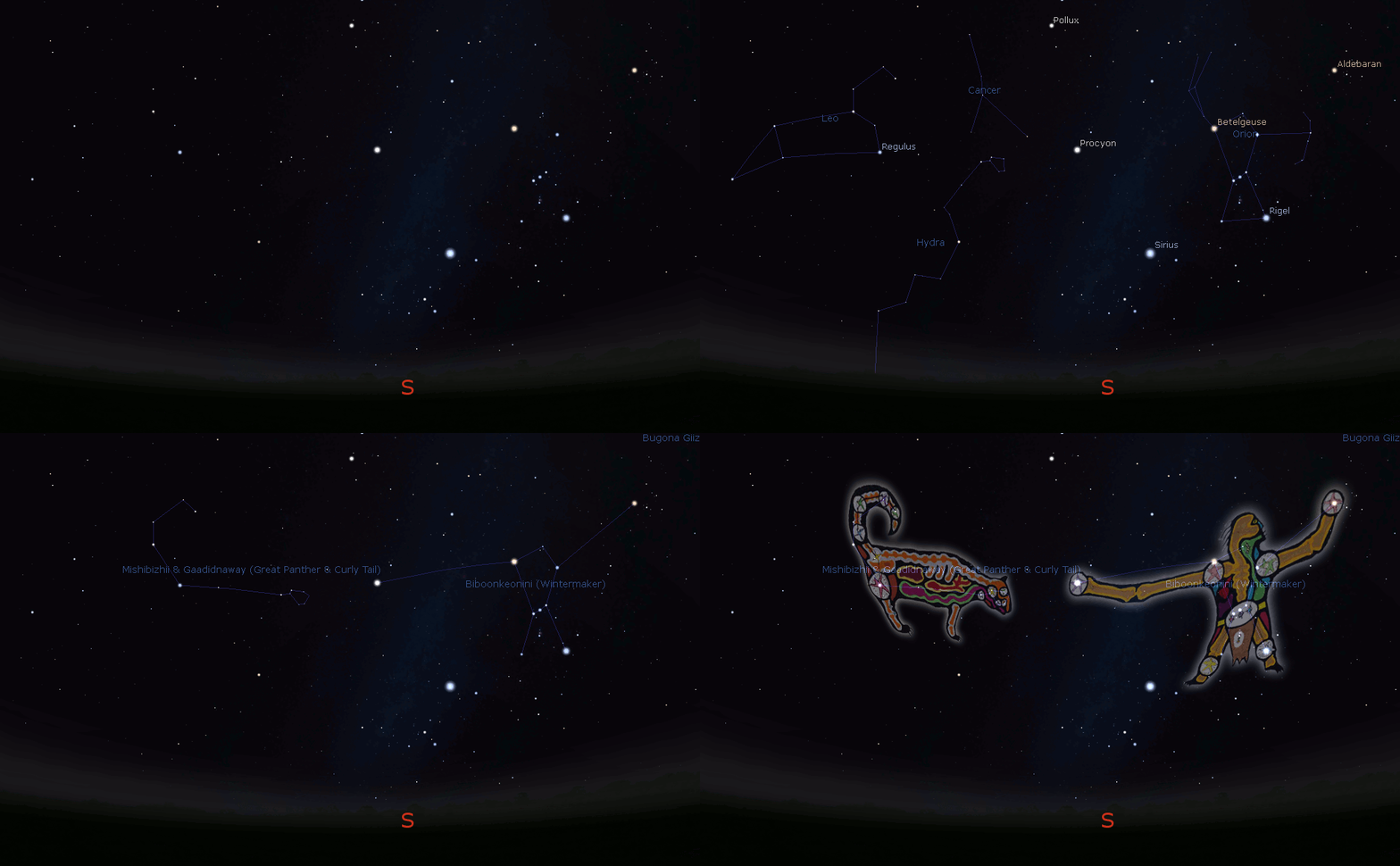
Finder animation for western and Anishinaabek constellations for March 8, 2018 at 9 p.m. Click on image to enlarge. Created using Stellarium and GIMP.
The Anishinaabek constellation drawings are from Ojibwe Sky Star Map Constellation Guide by Annette S. Lee, William Wilson, Jeffrey Tibbets and Carl Gawboy available locally and online. They are part of the latest editions of Stellarium, a free planetarium program. Links to it are on the left. Other information and links are available within the Sky Lore tab.
Here’s one of the links: http://www.nativeskywatchers.com/. It also contains links to Lakota star maps and lore.
02/20/2018 – Ephemeris – Tonight’s the night to spot a chain of three of my favorite craters
Ephemeris for Tuesday, February 20th. The Sun will rise at 7:35. It’ll be up for 10 hours and 43 minutes, setting at 6:18. The Moon, 3 days before first quarter, will set at 11:29 this evening.
I was a day off in my Moon calculations yesterday. The three of my favorite craters, just south of the partially illuminated Sea of Tranquility will be visible tonight. From north to south or top to bottom, near the terminator or sunrise line is Theophilus, which slightly overlaps the crater wall of Cyrillus, then a bit farther south another older crater Catharina. These craters were named by a Jesuit astronomer Giovanni Battista Riccioli (Ri’cholli). He even named a crater Copernicus, even though he followed the Church teachings of the time he didn’t believe in the Copernican Sun centered system, but the system put forth by Danish astronomer Tycho Brahe where the Moon and Sun circled the Earth, but the other planets circled the Sun.
The times given are for the Traverse City/Interlochen area of Michigan. They may be different for your location.
Addendum
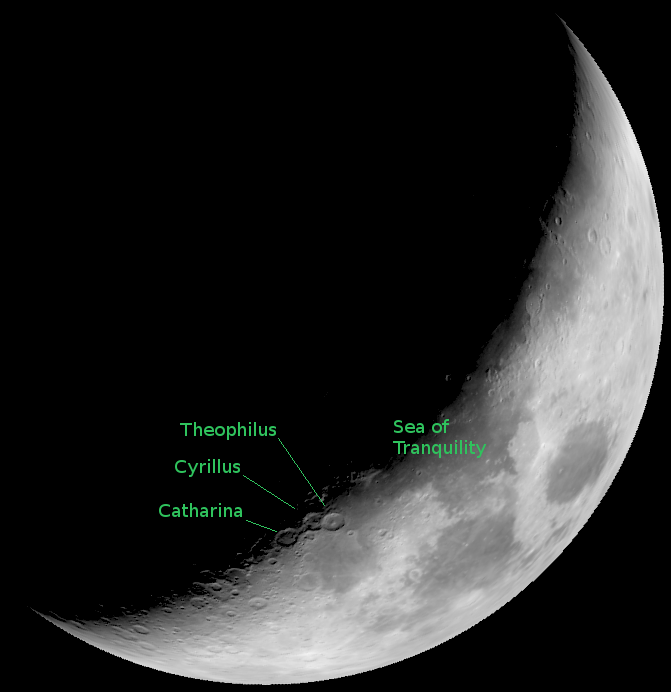
The crescent Moon on the evening of February 20th, 2018. showing the craters discussed in the test. Created using Virtual Moon Atlas and rotated to approximate its orientation in the sky after sunset.
Repeating from yesterday: For anyone east of here who can see the Moon at 19:00 UT, on the 20th should see Theophilus shadow filled with the crater rim and the central peak poking into sunlight. It should be visible from Europe and the Mid East. Let me know with a comment if I guessed right.
10/17/2017 – Ephemeris – The Fisher paints the autumn leaves red
Ephemeris for Tuesday, October 17th. The Sun will rise at 8:00. It’ll be up for 10 hours and 53 minutes, setting at 6:54. The Moon, 2 days before new, will rise at 6:35 tomorrow morning.
This morning, if it’s clear the red planet Mars will appear just to the right of the thin crescent Moon. Mars isn’t the only thing that’s red now. So are the maple leaves as we advance into autumn. The native Anishinaabek peoples have a story about how that came to be. Of how a magical weasel-like creature called the Fisher or Ojiig brought summer to the Earth from Skyland. For his trouble he was shot with an arrow in his only vulnerable spot, the tip of his tail. As he fell to Earth the Great Spirit, Manitou caught him and placed him in the sky where we see the Great Bear (Ursa Major) and the Big Dipper. Every autumn we see his tail swoop down to the ground where his tail paints the leaves red with his blood.
The times given are for the Traverse City/Interlochen area of Michigan. They may be different for your location.
Addenda
The Moon and the morning planets this morning
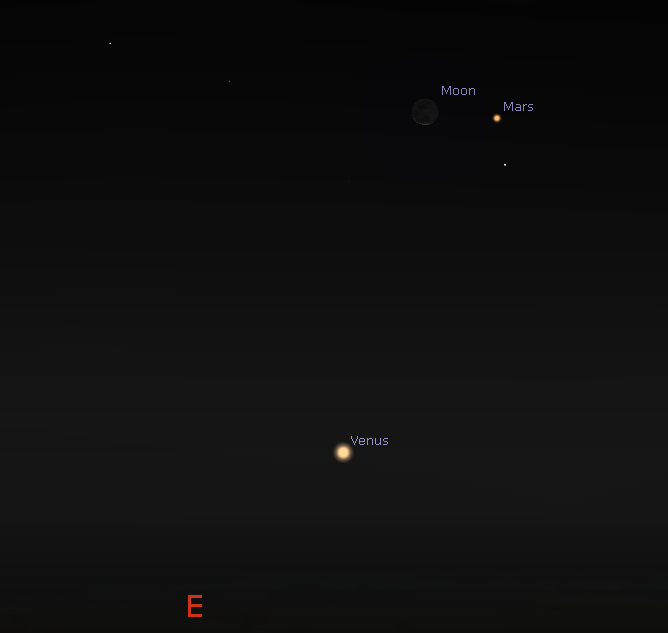
The Moon and Mars at 6:30 this morning October 17, 2017. Click on image to enlarge. Created using Stellarium.
At 00:21 UTC on the 18th Venus will be south of the Moon. It will be visible from Asia.
The Fisher (Ojiig) paints the trees with the autumn colors
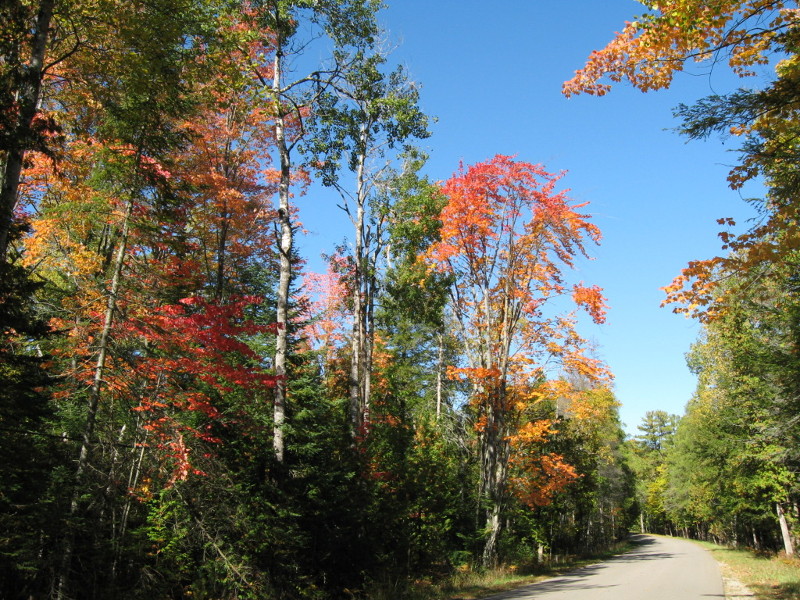
Autumn colors. My image.
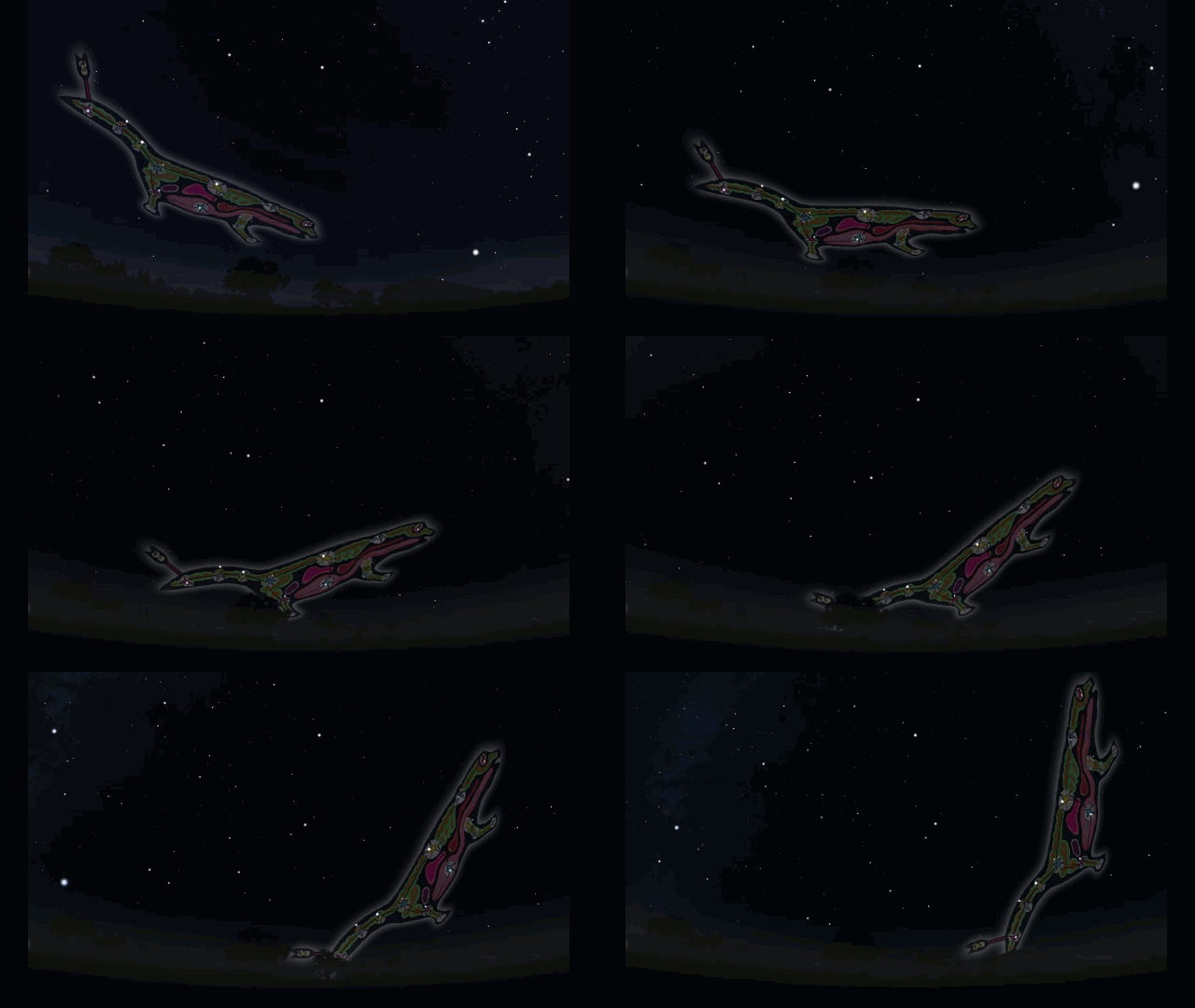
An animation of Fisher brushing his tail along the horizon on autumn nights. Click on image to enlarge. Created using Stellarium.
The constellation art is part of the latest versions of Stellarium. Ojibwe (Anishinaabek) constellation art by Annette S Lee and William Wilson from Ojibwe Sky Star Map Constellation Guide, ISBN 978-0-615-98678-4.
See the version of the story I learned: The story of the Fisher Star.
There are other variations of the story, and other adventures of the Fisher. Perform an Internet search for: Fisher or Fisher Star or Ojiig.
10/09/2017 – Ephemeris – Old World vs New World
Ephemeris for Columbus Day observed, Monday, October 9th. The Sun will rise at 7:50. It’ll be up for 11 hours and 17 minutes, setting at 7:07. The Moon, 3 days before last quarter, will rise at 10:09 this evening.
Today the United States celebrates Columbus Day , a Monday near the date Christopher Columbus landed on a Caribbean island, and found people who got there at least 15 thousand years earlier. Due to superior technology, and nothing else really, the Europeans conquered the peoples of the continents they called the Americas, deeming the indigenous peoples, incorrectly, as savages.
My astronomical journey started with learning the constellations and their stories from the ancient Greeks. About five years ago I began to investigate the constellations and stories of the Anishinaabek peoples whose ancient lands we live on, which turn out to be as rich and as meaningful as those I learned in my youth from the Old World.
The times given are for the Traverse City/Interlochen area of Michigan. They may be different for your location.
 Bob Moler's Ephemeris Blog