Archive
06/17/2014 – Ephemeris – The constellation Corona Borealis, the Northern Crown
Ephemeris for Tuesday, June 17th. Today the sun will be up for 15 hours and 33 minutes, setting at 9:30. The moon, 2 days before last quarter, will rise at 12:46 tomorrow morning. Tomorrow the sun will rise at 5:56.
High in the south at 11 p.m. can be found a small but easily spotted constellation of Corona Borealis, the Northern Crown. It is located just east or left of the kite shaped constellation of Boötes, with its bright star Arcturus at the base. The Northern Crown is a semicircle of stars, like a tiara, with a brighter star Gemma at the bottom. Despite the obvious allusion of stars to diamonds and the sound of the star’s name, this is not a gem studded crown. Gemma means blossom, so Corona Borealis may represent a floral crown. According to Greek mythology it belonged to Princess Ariadne, daughter of King Minos of Crete. She was abandoned by Theseus, whom she helped out of the Labyrinth of the Minotaur.
Times are for the Traverse City/Interlochen area of Michigan. They may be different for your location.
Addendum

Corona Borealis with Boötes. Created with Stellarium.
For the Anishinabek peoples around the Great Lakes, Corona Borealis is a Sweat Lodge.
04/22/2014 – Ephemeris – The Great Bear and the Fisher Star
Ephemeris for Earth Day, Tuesday, April 22nd. The sun rises at 6:46. It’ll be up for 13 hours and 49 minutes, setting at 8:36. The moon, at last quarter today, will rise at 3:31 tomorrow morning.
This evening the Big Dipper is practically overhead. The Europeans and some Native Americans say it as the hind end of a bear with dimmer stars making up the rest of the bear. The official constellation of which the Big dipper is a part is Ursa Major, the Great Bear. The native Americans were smart enough to depict the handle stars of the dipper as three hunters following the bear, rather than the bear’s unnaturally long tail. The Anishinabek Indians who settled around here saw instead of a bear a weasel like creature, who did have a long tail called Fisher or Fisher Star, who through a great adventure, with his other animal friends, brought summer and the rest of the seasons to the frozen earth.
Times are for the Traverse City/Interlochen area of Michigan. They may be different for your location.
Addendum
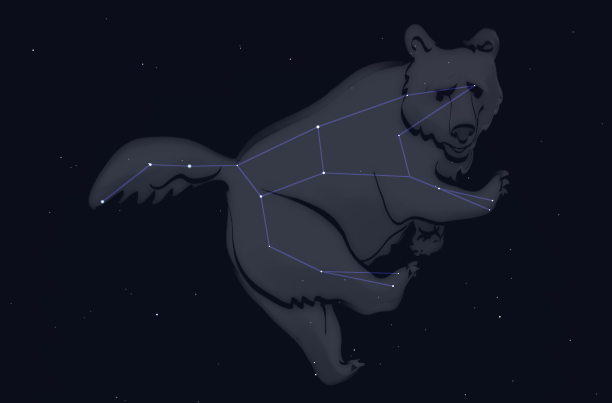
The Great Bear as the Europeans saw it. Created using Stellarium.
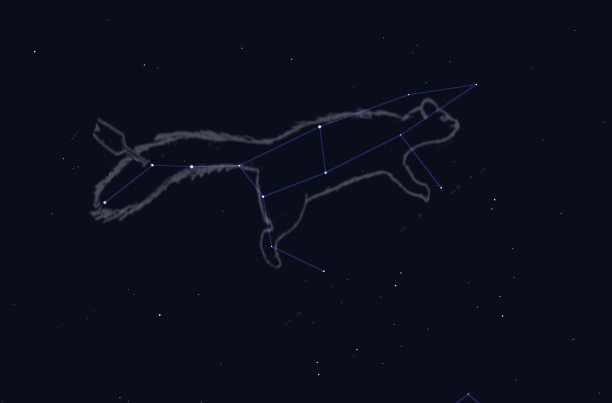
The Fisher Star. Created using Stellarium.
03/27/2014 – Ephemeris – Hydra and the Great Underwater Panther
Ephemeris for Thursday, March 27th. The sun will rise at 7:32. It’ll be up for 12 hours and 31 minutes, setting at 8:03. The moon, 3 days before new, will rise at 6:06 tomorrow morning.
Today I will take a fresh, for me at least look at the constellation of Hydra the water snake of Greek origin and the Great Underwater Panther of our local Anishinabek people. Between the bright star Regulus in Leo the lion and Procyon in Canis Minor, Orion’s small hunting dog is a drooping group of 6 stars that makes up the head of Hydra. The rest of his stars trail snakily to the southeastern horizon at 10 p.m. He won’t be fully risen until 1 a.m. In the mythology of the Anishinabek people The head of Hydra is the head of the Great Underwater Panther, his back and tail run to Regulus and the front of Leo. In the spring of thinning ice when someone broke through it was credited to this panther, who pulled the person underwater.
Times are for the Traverse City/Interlochen area of Michigan. They may be different for your location.
Addendum
The Anishinabek people contain the Ojibwe or Chippewa, Ottawa or Odawa, and Algonquin peoples. The Chippewa and Ottawa are indigenous to much of northern Michigan.
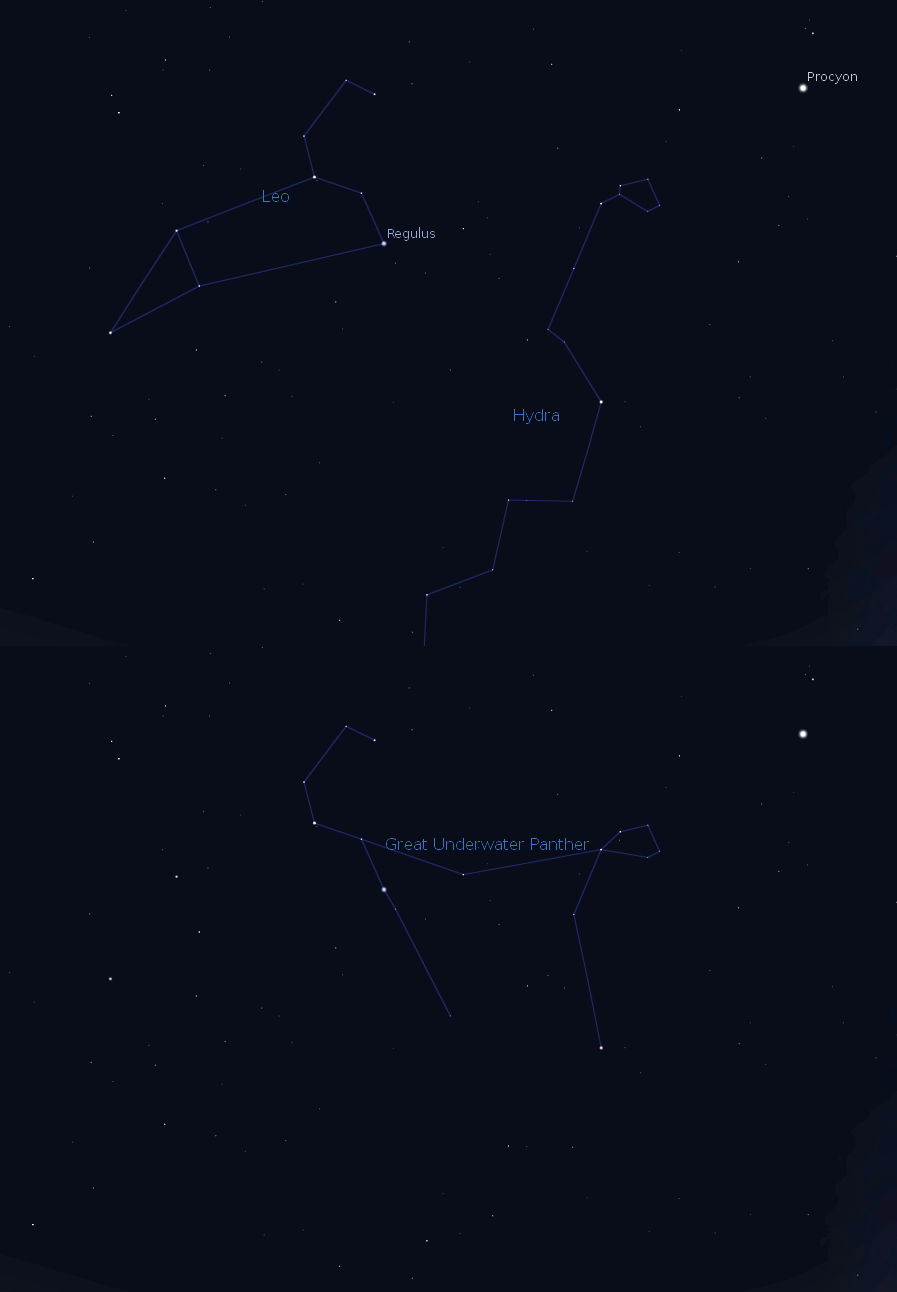
Alternately showing Leo and Hydra of our “Western” constellations and the Anishinabek constellation of the Great Underwater Panther. Created using Stellarium. The constellation drawing of the panther is mine after Michael Wassegijig Price.

The constellation Great Underwater Panther screen shot taken from the YouTube video “Stellar Connections: Explorations in Cultural Astronomy – Pt. 2” by Michael Wassegijig Price.
Below is the video source for the above image.
Here is a link to the video.
11/07/2013 – Ephemeris – The Big Dipper’s lowest appearance in the north
Ephemeris for Thursday, November 7th. The sun will rise at 7:28. It’ll be up for 9 hours and 54 minutes, setting at 5:23. The moon, 3 days before first quarter, will set at 9:32 this evening.
The entire Big Dipper is at its lowest in the sky at 9 p.m. with the Dipper’s bowl centered due north under the pole star Polaris. The southernmost star of the Big Dipper is the star at the tip of the handle, named Alkaid. Alkaid will be at its lowest at 11:20 this evening, 4 degrees above the horizon for Traverse City, so is circumpolar, meaning it doesn’t set in the IPR (Interlochen Public Radio) listening area. The star name is Arabic and means something like the Chief of the daughters mourning at the Bier. The bier is the bowl of the dipper supporting, I suppose, the body of their father or mother. To the Anishinabek native peoples around here the Big Dipper was the Fisher or Fisher Star, a weasel like creature, whose bloody tail swept over the maple trees, turning their leaves red.
Times are for the Traverse City/Interlochen area of Michigan. They may be different for your location.
Addendum
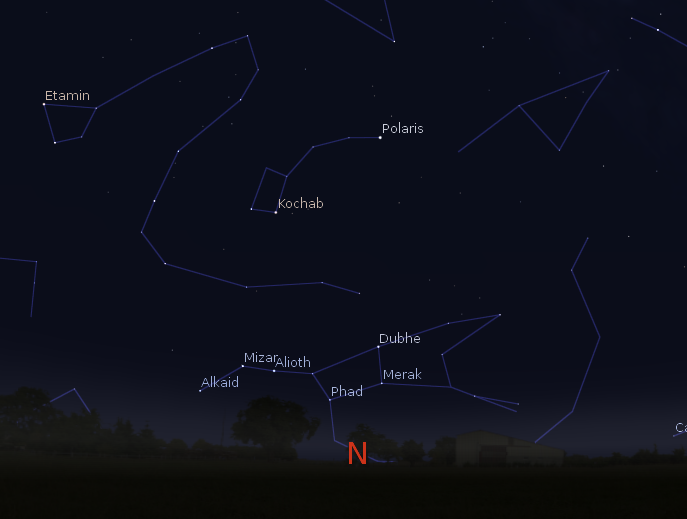
The Big Dipper low in the north at 9 p.m. November 7, 2013. Created using Stellarium.
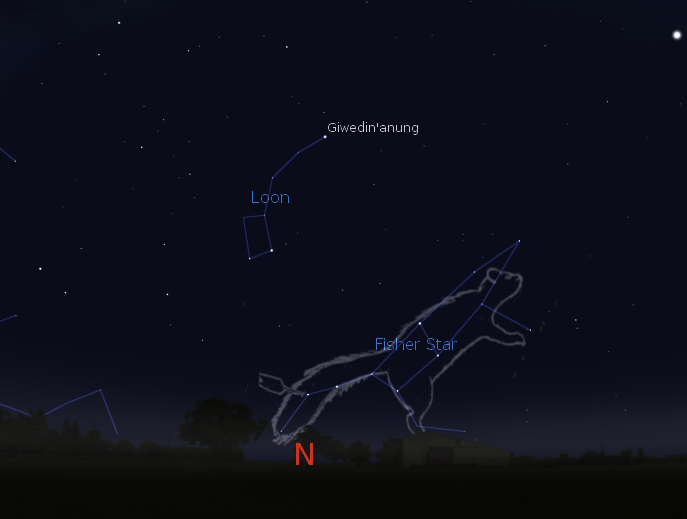
Fisher Star paints the autumn trees red at 11:20 p.m. November 7, 2013. Created using Stellarium.
For the story of the Fisher Star click here.
04/15/2013 – Ephemeris – The Big Dipper and the Fisher
Ephemeris for Tax deadline day* Monday, April 15th. The sun rises at 6:57. It’ll be up for 13 hours and 29 minutes, setting at 8:27. The moon, 3 days before first quarter, will set at 1:32 tomorrow morning.
The Big Dipper is nearly overhead in the evening now. The Big Dipper is not a constellation but part of the Great Bear for most peoples, and is enshrined by the International Astronomical Union as Ursa Major. To some of the Anishinabek peoples native to our region the stars of the Big Dipper belonged to a small weasel like animal call the Fisher. In a story I can’t relate here Fisher brought summer to the earth, and for his trouble was killed by an arrow to his only vulnerable spot, his tail. The Great Spirit would not let Fisher fall to earth, but placed him in the sky. His rising in the northeast signals the coming of spring, and when his bloody tail brushes the horizon in autumn his blood paints the autumn leaves red.
Times are for the Traverse City/Interlochen area of Michigan. They may be different for your location.
Addendum
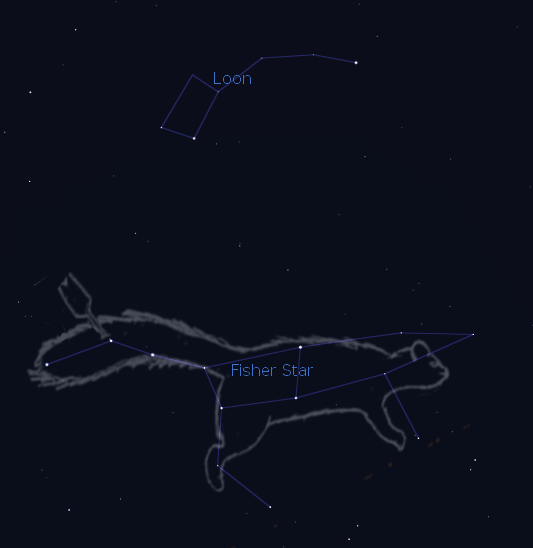
The Fisher or Fisher Star as seen Overhead and the Big Dipper. Created using Stellarium and some other help.
The story of the Fisher Star
The Anishinaabe peoples have lived in the Great Lakes area since way before the coming of the Europeans. They are comprised of the Ojibwe, Ottawa, Chippewa and even Algonquin tribes. While some did see a bear in the stars and around the Big Dipper sans tail. Most of the stories concern the Fisher or Fisher Star.
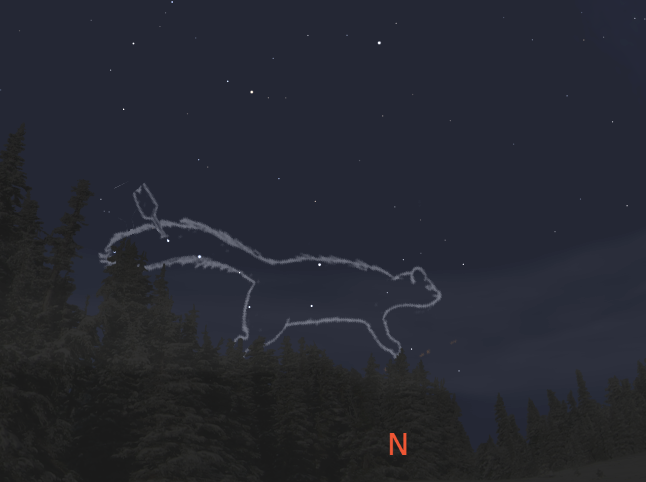
The Fisher Star in Autumn painting the leaves with his tail. Created using Stellarium and other sources.
By the way, the thee stars of the handle of the Big Dipper were hunters that were following the bear. The hunter denoted by the star Mizar at the bend in the handle of the dipper had a dog with him, the star we call Alcor, that make it an intriguing double for folks with good eyesight.
Fisher is supposed to be a weasel-like animal, intelligent, and a great hunter. He lived in a world that was snow covered and cold year round, where food was scarce. Perhaps this story is a cultural remembrance of the last glaciation period. Contrary to his name Fisher didn’t fish.
One day his son came to him with a request to bring summer, for he was cold and hungry. Fisher decided to somehow get to Skyland and tap into its warmth. He brought together his three bravest friends for the journey: Otter, Lynx, and Wolverine. They set out to seek the tallest mountains so they could reach Skyland.
When they had climbed the tallest mountain they found that Skyland was just out of reach. If they could only crack through. Otter tried first. He jumped first and bounced off. He fell back and slid completely down the mountain on his belly. It was so much fun that this is what otters do to this day. The lynx tried. He jumped up and hit his head and was knocked unconscious.
The wolverine was persistent. He jumped time after time and was finally able to chew a hole in the base of Skyland. When it was large enough he scampered through. Fisher was sure the hole wasn’t large enough, and that the inhabitants of Skyland would soon cover it up. So he chewed and chewed, enlarging the hole so the Skyland people couldn’t cover it for more than half the year.
As he was finishing up the hole the Skyland people discovered him. He boasted to them; “I am Fisher, the great hunter, you cannot catch me.” he jumped to the nearest tree and climbed to the top. The sky people shot arrows at him, but he had a special power making him impervious to arrows except for a particular spot on his tail. Kind of an Achilles tail, to mix my legends. Well, after some time the sky people got wise to Fisher’s protections and an arrow found the vulnerable spot in his tail and he fell out of the tree. Before Fisher’s body could fall to the ground the Great Spirit, Gitchee Manitou, caught him and placed him in the night sky to herald the seasons Fisher had created for the earth. In the sky Fisher’s tail is the handle of the Big Dipper. Tiny Alcor signifies the spot where the arrow hit. Every fall as Fisher’s tail passes over the northern horizon the blood in his wound paints the autumn leaves red. In late winter as he rises again in the northeast it is time to begin tapping the maple trees.
Sources: Keepers of the Earth, by Michael Caduto and Joseph Bruchac, and Anishinaabe Star Knowledge by Michael Wassegijig Price. Thanks also to Nodwese Red Bear.
06/18/2012 – Ephemeris – The Little Dipper
Ephemeris for Monday, June 18th. Today the sun will be up for 15 hours and 33 minutes, setting at 9:30. The moon, 1 day before new, will rise at 6:03 tomorrow morning. Tomorrow the sun will rise at 5:57.
11 p.m. is the best time now to spot the Little Dipper. It is difficult to spot, being mush smaller and dimmer than the Big Dipper. However it is the Big Dipper that points to it, by the two stars at the front of the bowl of the Big Dipper to point to the North Star Polaris, the star that doesn’t appear to move. That is the tip of the handle of the Little Dipper. The handle is seen in a curve of the stars upwards and a bit to the left to a small box of stars that is its bowl. The two stars at the front of the bowl are called the Guard Stars because they guard the pole. The Little Dipper is not an official constellation, but is Ursa Minor the lesser bear. To the Anishinabek native peoples of this area it represents a loon.
Times are for the Traverse City/Interlochen area of Michigan. They may be different for your location.
Addendum
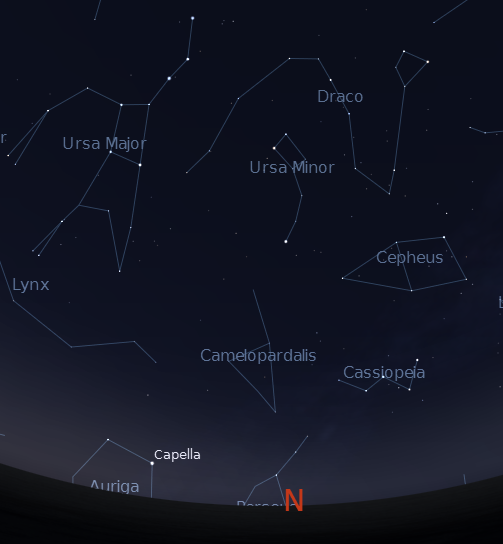
Little Dipper (Ursa Minor) and the Big Dipper (Ursa Major). Created using Stellarium.
 Bob Moler's Ephemeris Blog