Archive
10/27/2014 – Ephemeris – The Pleiades in Greek and Native American mythology
Ephemeris for Monday, October 27th. The sun will rise at 8:13. It’ll be up for 10 hours and 25 minutes, setting at 6:38. The moon, 3 days before first quarter, will set at 9:38 this evening.
Visible low in the east at 10 in the evening sky can be spotted a small group of stars. It’s called the Pleiades or Seven Sisters. The Pleiades are really spectacular when seen in binoculars. It is remarkable that both the Greeks and the American Plains Indians saw this group as female stars fleeing from danger. In the former case they were fleeing the constellation Orion the giant hunter of the winter sky who will soon rise over the eastern horizon, and in the latter case a giant bear. Legend has it that the maidens fled to the top of Devils Tower in Wyoming. It’s said that the claw marks of this bear are seen in the walls of the tower. The maidens were then spirited from the top of the tower to the heavens, where we see them today. Whichever story you like the Pleiades is worth searching for.
Times are for the Traverse City/Interlochen area of Michigan. They may be different for your location.
Addendum
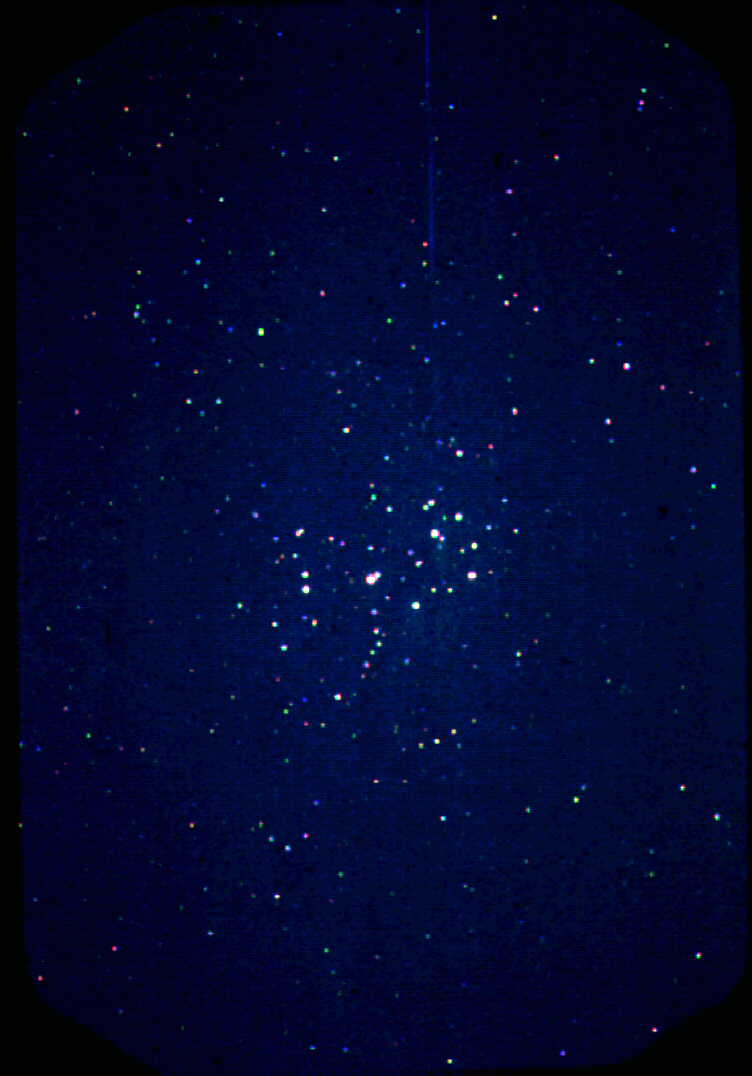
The Pleiades, about what you’d see in binoculars.
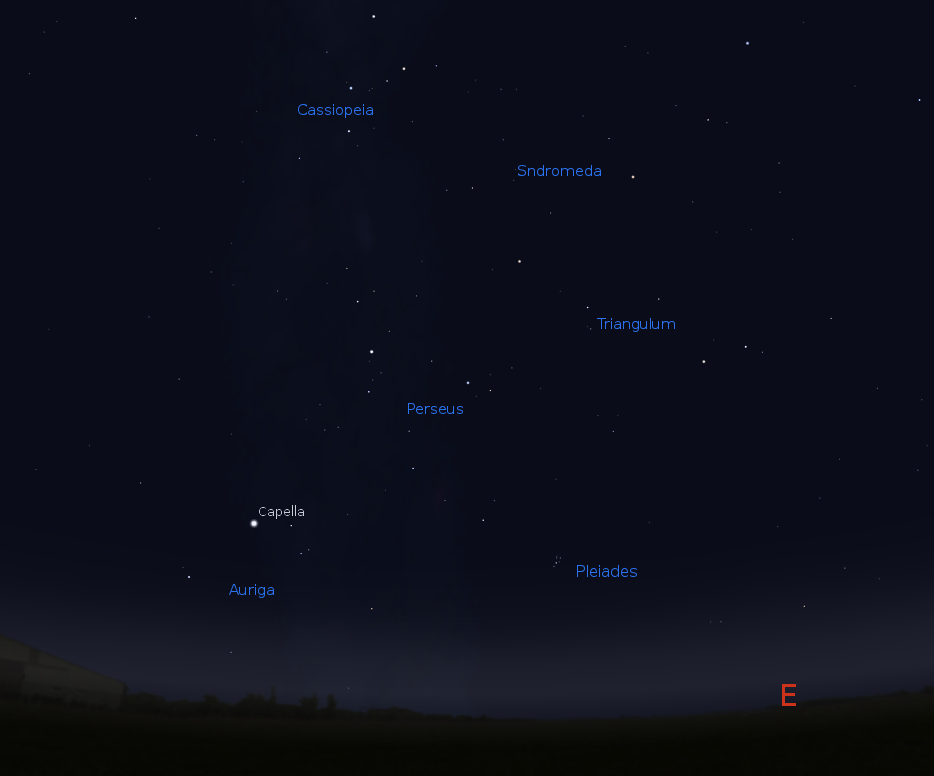
Looking to the east northeast at the Pleiades: 9 p.m. on October 27th. Created using Stellarium,
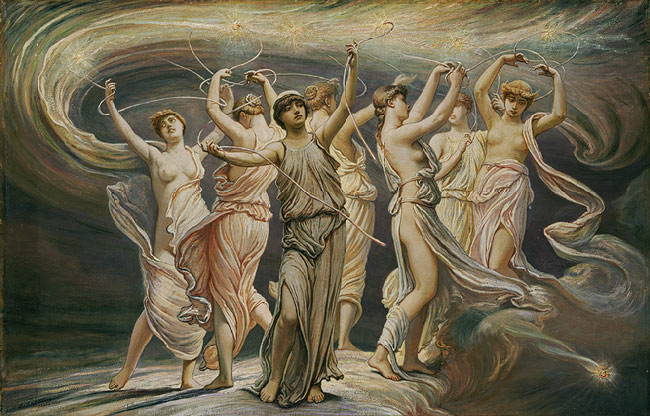
The Greek Pleiades a painting by Elihu Vedder in the Metropolitan Museum of Art, New York City. Public Domain.

Legend of Devils Tower Credit: Indian Country Today Media Network
This is the illustration from http://indiancountrytodaymedianetwork.com/article/the-legend-of-devils-tower-3273
06/23/2014 – Ephemeris – It’s summer, so where is the Summer Triangle?
Ephemeris for Monday, June 23rd. Today the sun will be up for 15 hours and 33 minutes, setting at 9:31. The moon, half way from last quarter to new, will rise at 4:09 tomorrow morning. Tomorrow the sun will rise at 5:58.
Now that it’s summer it’s time to look for the Summer Triangle in the sky. It’s seen rising in the east as it gets dark. Highest of the three bright stars is Vega in the constellation Lyra the harp, whose body is seen in a narrow parallelogram nearby. The second star of the triangle is Deneb lower and left of Vega, It appears dimmer than Vega because it is by far the most distant of the three. The third star of the Summer Triangle is seen farther below and a right of Vega. It is Altair in Aquila the eagle, and the closest. Altair is 16.5 light years away, Vega is 27 light years while Deneb actually one of the brighter stars known, is a whopping 2600 light years away, give or take. It’s distance is not well-known. (24 08:54 Venus 1.3°N of Moon)
Times are for the Traverse City/Interlochen area of Michigan. They may be different for your location.
Addendum
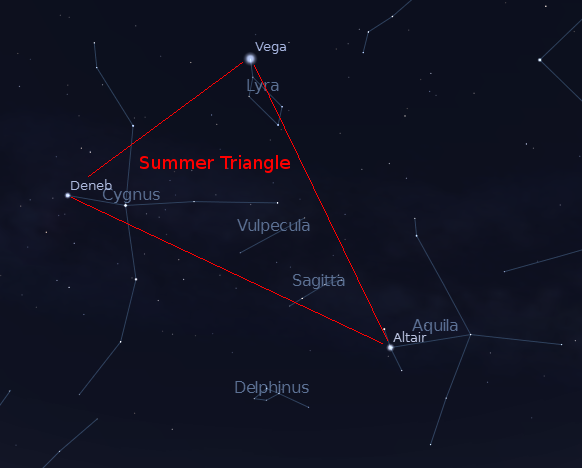
The Summer Triangle. Created using Stellarium and The Gimp.
04/17/2014 – Ephemeris – Leo and the bright star Regulus
Ephemeris for Thursday, April 17th. The sun rises at 6:54. It’ll be up for 13 hours and 34 minutes, setting at 8:29. The moon, 2 days past full, will rise at 11:19 this evening.
High in the south at 10 p.m. is a pattern of stars that’s in the shape of a backward question mark. This informal star group or asterism, is also called the sickle. It is the head and mane of the official zodiacal constellation of Leo the lion. To the left is a triangle of stars is his hind end. The bright star at the bottom of the question mark, or end of the sickle’s handle is Regulus, the “Little King Star”, alluding to the lion’s status as the king of the jungle. Regulus is about 79 light years away and is a 4 star system that exists as two star pairs. The bright star Regulus itself and a companion too close to be imaged directly in telescopes, and a nearby pair of dim stars make up the system. The Moon often passes in front of Regulus, since it’s close its path.
Times are for the Traverse City/Interlochen area of Michigan. They may be different for your location.
Addendum
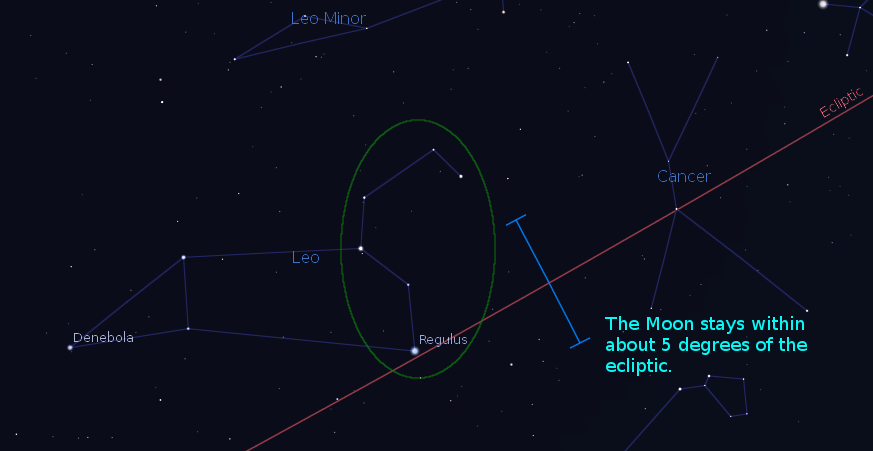
Leo’s sickle and backward question mark asterisms circled in green. Note that it is within the range of the moon’s orbit so it can be covered or occulted by the Moon. Created using Stellarium.
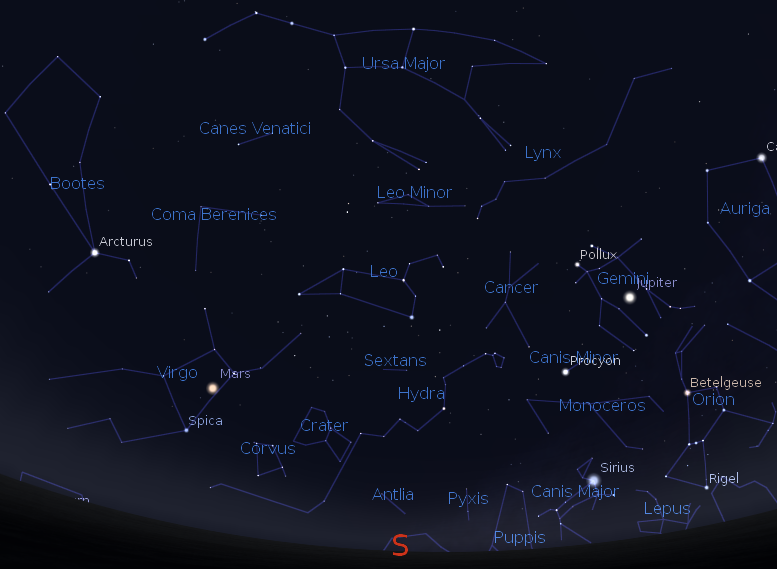
Leo finder chart for 10 p.m. April 17, 2014. Created using Stellarium.
02/20/2014 – Ephemeris – Winter Circle plus 1
Ephemeris for Thursday, February 20th. The sun will rise at 7:34. It’ll be up for 10 hours and 43 minutes, setting at 6:18. The moon, 2 days before last quarter, will rise at 12:27 tomorrow morning.
The winter skies are blessed with more first magnitude stars than any other season. Six of these stars lie in a large circle centered on the seventh. This circle is up at 9 p.m. Starting high overhead is Capella in Auriga the charioteer. Moving down clockwise is Aldebaran in the face of Taurus the Bull. Then down to Orion’s knee we find Rigel. Down and left is the brightest star of all Sirius the Dog Star in Canis Major, lowest of these stars in the south-southeast. Moving up and left is Procyon in Canis Minor, Above Procyon is Pollux in Gemini the twins. All these are centered on Betelgeuse the bright red star in Orion’s shoulder. The interloper this year is Jupiter which is situated in Gemini and outshines them all.
Times are for the Traverse City/Interlochen area of Michigan. They may be different for your location.
Addendum
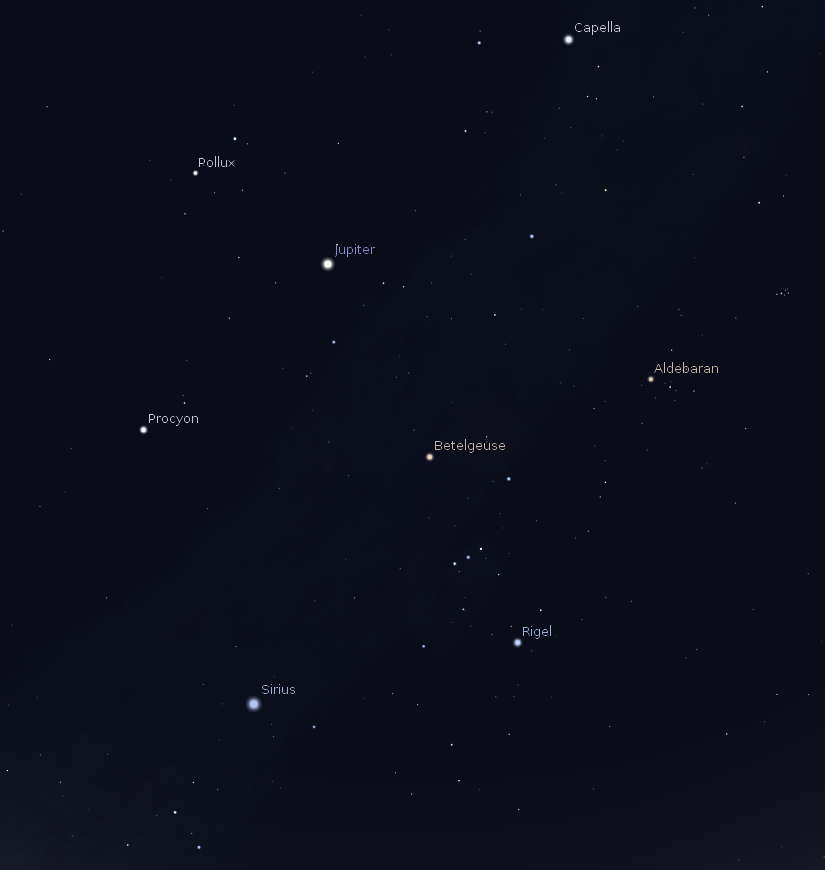
The Winter Circle plus Jupiter at 9 p.m. on February 20, 2014. Created using Stellarium.

