Archive
Ephemeris: 12/23/2024 – What was the Star of Bethlehem? Part 1
This is Ephemeris for Monday, December 23rd. Today the Sun will be up for 8 hours and 48 minutes, setting at 5:06, and it will rise tomorrow at 8:18. The Moon, 1 day past last quarter, will rise at 2:05 tomorrow morning.
The most popular solution to what the Star of Bethlehem may have been, is a triple conjunction of Jupiter and Saturn that occurred in 7 BCE, where Jupiter passed Saturn three times in a few months time. So the event should more probably be called a celestial sign, rather than a star. The conjunction occurred against the constellation of Pisces the fish which was thought to represent the Jews or whoever lived in that area. Such a series of conjunctions against a particular zodiacal constellation would occur only about once every 800 to 900 years. Triple conjunctions aren’t super rare, if you don’t care which constellation it’s happening in front of. We had one in 1981, but it was against the constellation of Virgo.
The astronomical event times given are for the Traverse City/Interlochen area of Michigan (EST, UT – 5 hours). Times will be different for other locations.
Addendum
Ephemeris: 06/11/2024 – The man who first mapped the Moon
This is Bob Moler with Ephemeris for Tuesday, June 11th. Today the Sun will be up for 15 hours and 31 minutes, setting at 9:28, and it will rise tomorrow at 5:56. The Moon, 3 days before first quarter, will set at 1:31 tomorrow morning.
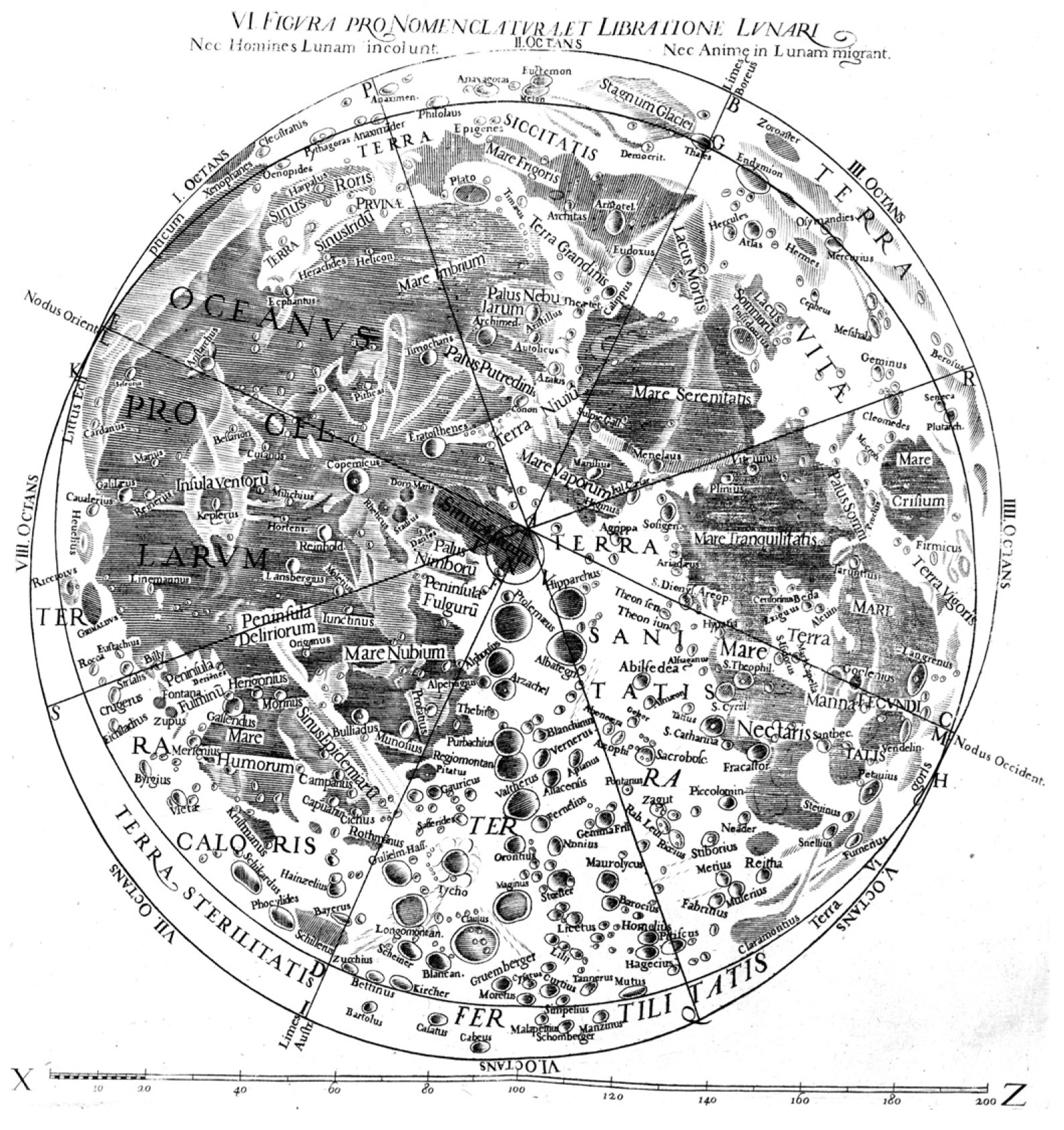
Ever wonder where the names of the features of the Moon come from? Most of the large features on the Moon were named by Giovanni Battista Riccioli, a Jesuit priest of the 17th century. He created the first accurate map of the Moon in 1651, and he named the features he drew including the Sea of Tranquility (Mare Tranquillitatis), the craters Tycho, Plato, Clavius and many others that I talk about. Even though he professed the Earth centered universe, he gave the heliocentrists Copernicus, Kepler and Aristarchus prominent craters, but in the Ocean of Storms, Oceanus Procellarum, denoting the controversy of the day. Riccioli’s nomenclature became the standard for the Moon and other planets and moons.
The astronomical event times given are for the Traverse City/Interlochen area of Michigan (EDT, UT–4 hours). They may be different for your location.
Addendum

Ephemeris: 06/06/2024 – 80 years ago, D-Day’s astronomical connection
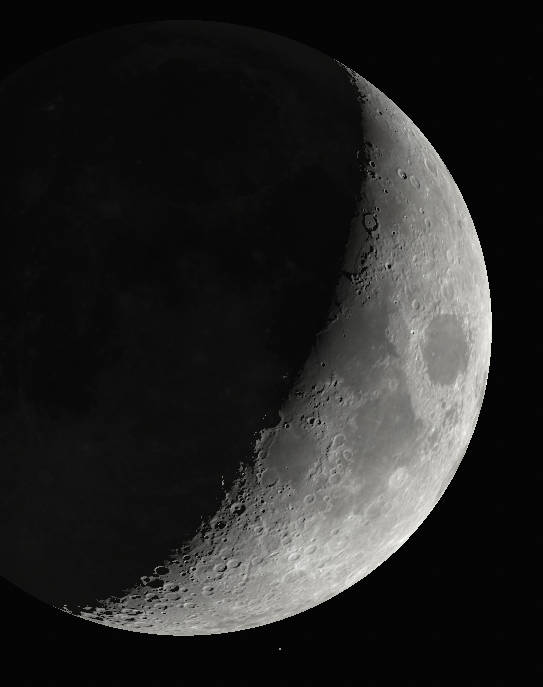
This is Ephemeris for Thursday, June 6th. Today the Sun will be up for 15 hours and 27 minutes, setting at 9:25, and it will rise tomorrow at 5:57. The Moon is new today, and won’t be visible.
Today is the 80th anniversary of the greatest battle of World War II was the Allied invasion of Mainland Europe at Normandy on D-Day, a date governed by the phase of the Moon. The full moon on June the 6th, 1944 gave light for the gliders and paratroopers to carry out their operations at midnight. Plus the high tides were near noon and midnight and the low tides near dawn. The idea was to hit the beach at low tide to enable the landing craft to operate without hitting the obstacles the Germans had planted in the tidal zone. It was great for the landing craft, but the troops had a lot of open beach to run through to get to any sort of shelter. The best days for the invasion were the 5th, 6th and 7th of June. Bad weather on the 5th caused a one day postponement.
The astronomical event times given are for the Traverse City/Interlochen area of Michigan (EDT, UT–4 hours). They may be different for your location.
Addendum

Ephemeris: 05/17/2024 – The famous Big Dipper stars Mizar and Alcor
This is Ephemeris for Friday, May 17th. Today the Sun will be up for 14 hours and 55 minutes, setting at 9:07, and it will rise tomorrow at 6:10. The Moon, 2 days past first quarter, will set at 4:01 tomorrow morning.
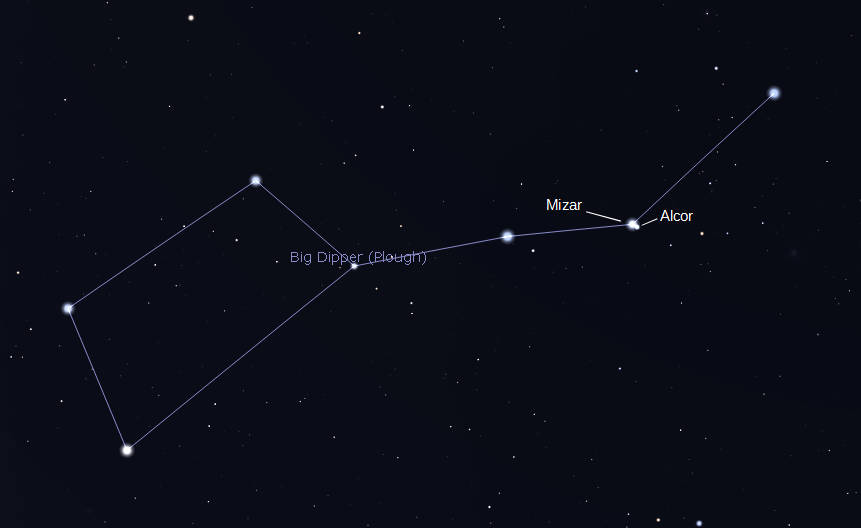
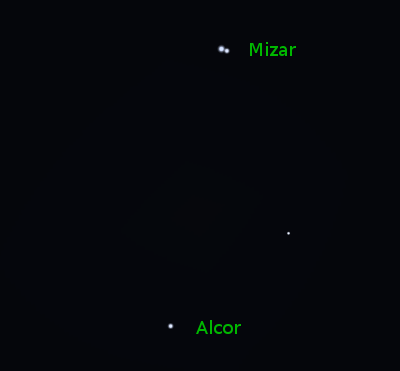
In tonight’s sky, the Big Dipper is nearly overhead. In its handle is a star or two that are interesting. It’s the star at the bend in the handle. It’s called Mizar. Next to it, for those with good eyesight, is a dimmer star, called Alcor. The name Mizar is from the Arabic, meaning apron or cover, while Alcor means the forgotten one. Before optometrists, the ability to actually see both stars was a test for good eyesight, especially for Arabic warriors. The pair is also known as the “Horse and the Rider”. I’ve been told that some Native American tribes saw the handle stars as hunters following the Great Bear, Ursa Major, of which the Big Dipper is a part, rather than its very unnatural tail. Dim Alcor became a hunting dog.
The astronomical event times given are for the Traverse City/Interlochen area of Michigan (EDT, UT–4 hours). They may be different for your location.
Addendum
Ephemeris: 04/15/2024 – How the Ancient Greeks tried to measure the distance to the Sun
This is Bob Moler with Ephemeris for Monday, April 15th. Today the Sun will be up for 13 hours and 31 minutes, setting at 8:28, and it will rise tomorrow at 6:55. The Moon, at first quarter today, will set at 4:15 tomorrow morning.
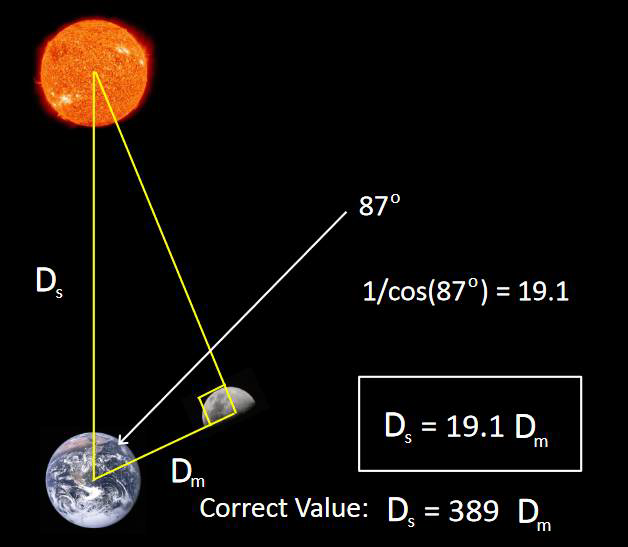
The first quarter Moon tonight reminds me of how the Greeks used the quarter Moon to attempt to determine the distance to the Sun. The idea was to determine when the Moon was exactly at first or last quarter, so the angle of the Sun-Moon-Earth was exactly 90°. The next thing to do was to measure the actual angle between the Sun and the Moon at that instant. It’s a difficult observation. Aristarchus tried and got a result that the Sun was about 19 times the distance of the Moon. The Sun-Earth-Moon angle he got was 87°. Hipparchus measured the Moon to be 60 earth radii away which is near the Moon’s actual distance from the Earth. In actuality the Sun is about 400 times the distance to the Moon.
The astronomical event times given are for the Traverse City/Interlochen area of Michigan (EDT, UT–4 hours). They may be different for your location.
Addendum
Ephemeris: 03/21/2024 – Three lunar craters named for heliocentrists by a geocentrist
This is Ephemeris for Thursday, March 21st. Today the Sun will be up for 12 hours and 14 minutes, setting at 7:57, and it will rise tomorrow at 7:41. The Moon, halfway from first quarter to full, will set at 6:59 tomorrow morning.
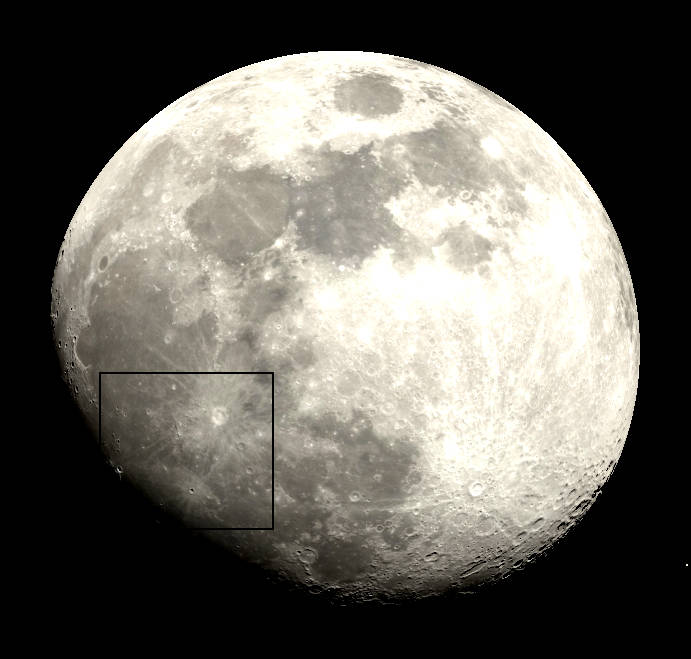
The gibbous moon tonight is exhibiting, over the last three days, three craters named for those who promoted the heliocentric or Sun centered solar system. The largest crater of the three, Copernicus, can be seen to the lower left of the center of the Moon. The asteroid that hit it made a big splash, which can be seen in its rays of ejecta being round and full. Then about halfway between it and the terminator is a small crater named for Johannes Kepler, and then nearby and on the terminator tonight is the crater named for the Greek philosopher who first proposed the Sun centered solar system, or in his case the universe, Aristarchus. He was a contemporary of and overshadowed by Aristotle, so his ideas were never adopted.
The astronomical event times given are for the Traverse City/Interlochen area of Michigan (EDT, UT–4 hours). They may be different for your location.
Addendum
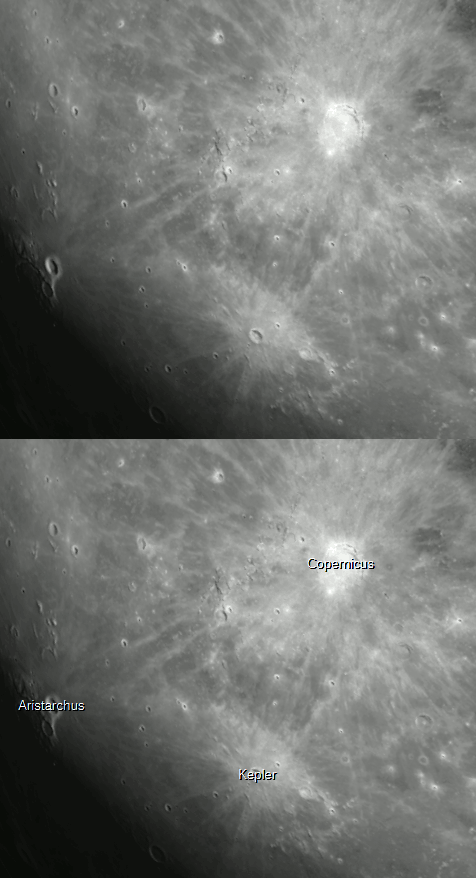
These craters were named by Giovanni Battista Riccioli, an astronomer and Jesuit priest. He established the lunar nomenclature we have today and named many of the largest craters. Being a 17th century Catholic, he bought the Roman Catholic line that the universe was geocentric, that is earth centered, yet he honored these heliocentrists with their own craters. He tended to group crater names by their relationship in life or their ideas, so the three proponents of the Sun centered solar system were given craters near each other in one section of the Moon.

Aristarchus of Samos was a Greek philosopher who lived between 310 and 230 BCE. He proposed a heliocentric solar system or universe, where Earth and all the planets revolved about the Sun. However, the work that he proposed it in has been lost. We know of his idea only referenced in the writings of others who attempted to debunk it.
Copernicus (Mikola Kopernik 1473-1543), was a Polish Catholic Canon, who was a mathematician, astronomer and translator, among other talents. He came up with the theory of the Sun centered or heliocentric solar system or in his day, universe.
Johannes Kepler (1571–1630) was an astronomer, astrologer and mathematician who discovered the laws of planetary motion. While Copernicus kept the circular orbits of the planets, they still didn’t match the motions of the planets in the sky. So he had to add some epicycles to make it all work. He actually had more epicycles than Ptolemy had. Kepler was able to figure out that he didn’t need epicycles if he assumed that the orbits were elliptical. He developed his Three Laws of Planetary Motion.
Galileo also has a crater there (Galilaei). It’s a tiny crater right on the terminator, below Kepler in the images above, and not visible. The Virtual Moon Atlas does not give an origin of the naming of the crater. Back in 1651, when Riccioli was giving craters names, Galileo was still on the outs with the Vatican, and the church.
Ephemeris: 02/19/2024 – A Kilonova may have exploded close to the Earth 3.5 million years ago
This is Ephemeris for President’s Day, Monday, February 19th. Today the Sun will be up for 10 hours and 38 minutes, setting at 6:16, and it will rise tomorrow at 7:36. The Moon, 3 days past first quarter, will set at 6:00 tomorrow morning.
One wouldn’t think that astronomy can be studied by taking samples of sediments from the ocean floor, but it can. One of the rare isotopes of iron is found there, iron 60, it is radioactive and has a half-life of about 2.5 million years. That means in 2.5 million years half of it would decay, and in another 2.5 million years half of the remaining half would decay, and so on. So its presence means it would have arrived relatively recently, compared to the four and a half billion year age of the Earth. One of the thoughts about its origin is that it came from a nearby kilonova, which is a collision of two neutron stars that occurred about 3.5 million years ago. A kilonova is brighter than a nova by about a thousand times, hence its name, but not as bright as a supernova.
The astronomical event times given are for the Traverse City/Interlochen area of Michigan (EST, UT –5 hours). They may be different for your location.
Addendum

And https://phys.org/news/2023-12-scientists-evidence-nearby-kilonova-million.html
Ephemeris: 12/22/2023 – Jupiter and Venus as the Star of Bethlehem
This is Ephemeris for Friday, December 22nd. Today the Sun will be up for 8 hours and 48 minutes, setting at 5:05, and it will rise tomorrow at 8:17. The Moon, 3 days past first quarter, will set at 4:53 tomorrow morning.
Many writers of the 2nd and 3rd centuries AD place Jesus’ birth around 2 BC, which had to be before Herod the Great’s death, which I suggest was in 1 BC marked by a total lunar eclipse. So the Star of Bethlehem could appear several years later than the triple conjunction of Jupiter and Saturn in 7 BC that’s been popular. In 3 and again in 2 BC there were star-like conjunctions or apparent joining of the planets Jupiter and Venus against the backdrop of the constellation of Leo the Lion. A lion is related to Judah, son of Jacob by a blessing the latter gave his 12 sons in Genesis. The first conjunction occurred in August of 3 BC in the morning sky. On June 16th of the next year the two planets got together again, this time in the evening sky, a month or more after Jesus would have been born in the lambing season of spring.
The astronomical event times given are for the Traverse City/Interlochen area of Michigan (EST, UT –5 hours). They may be different for your location.
Addendum
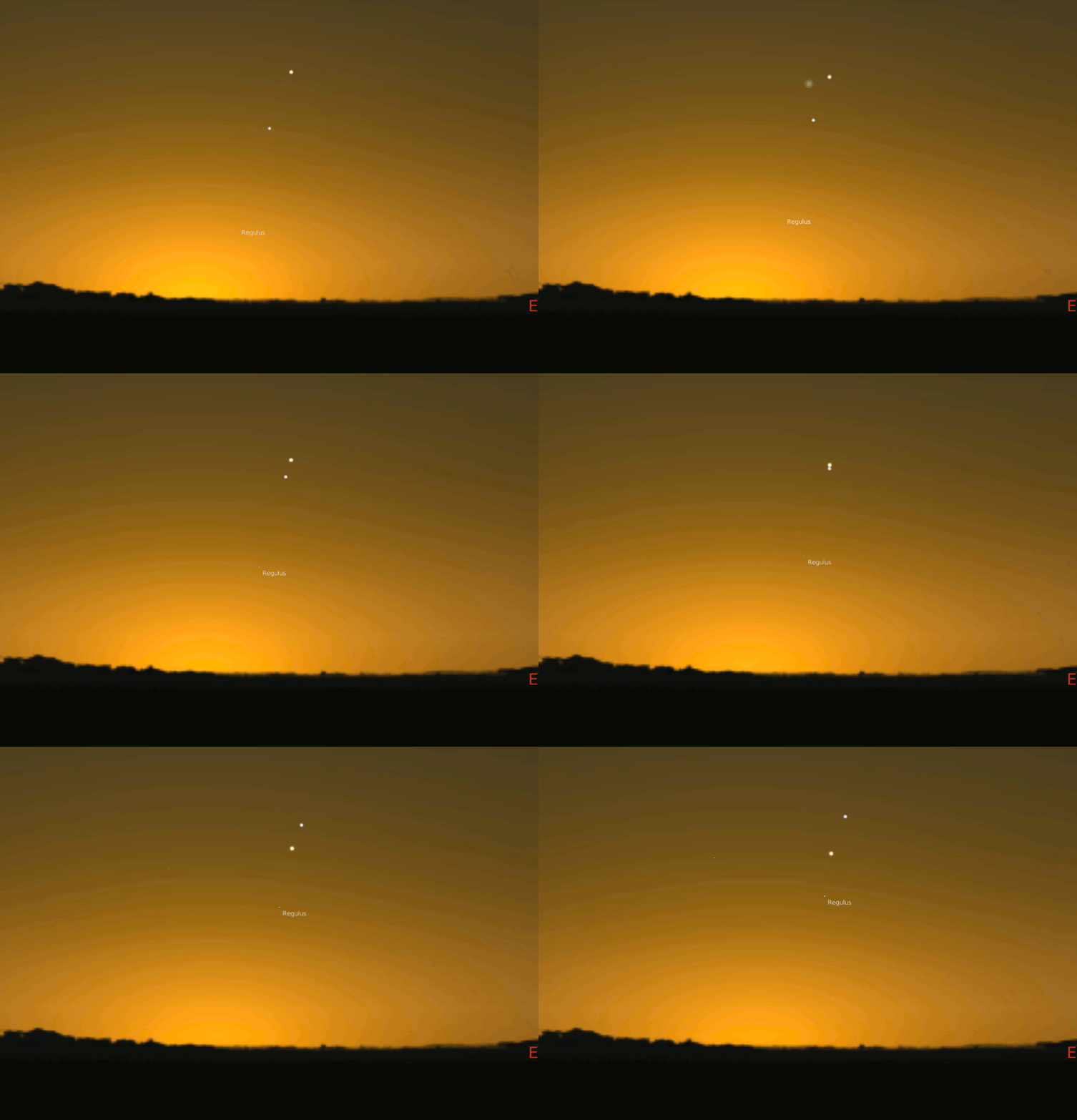
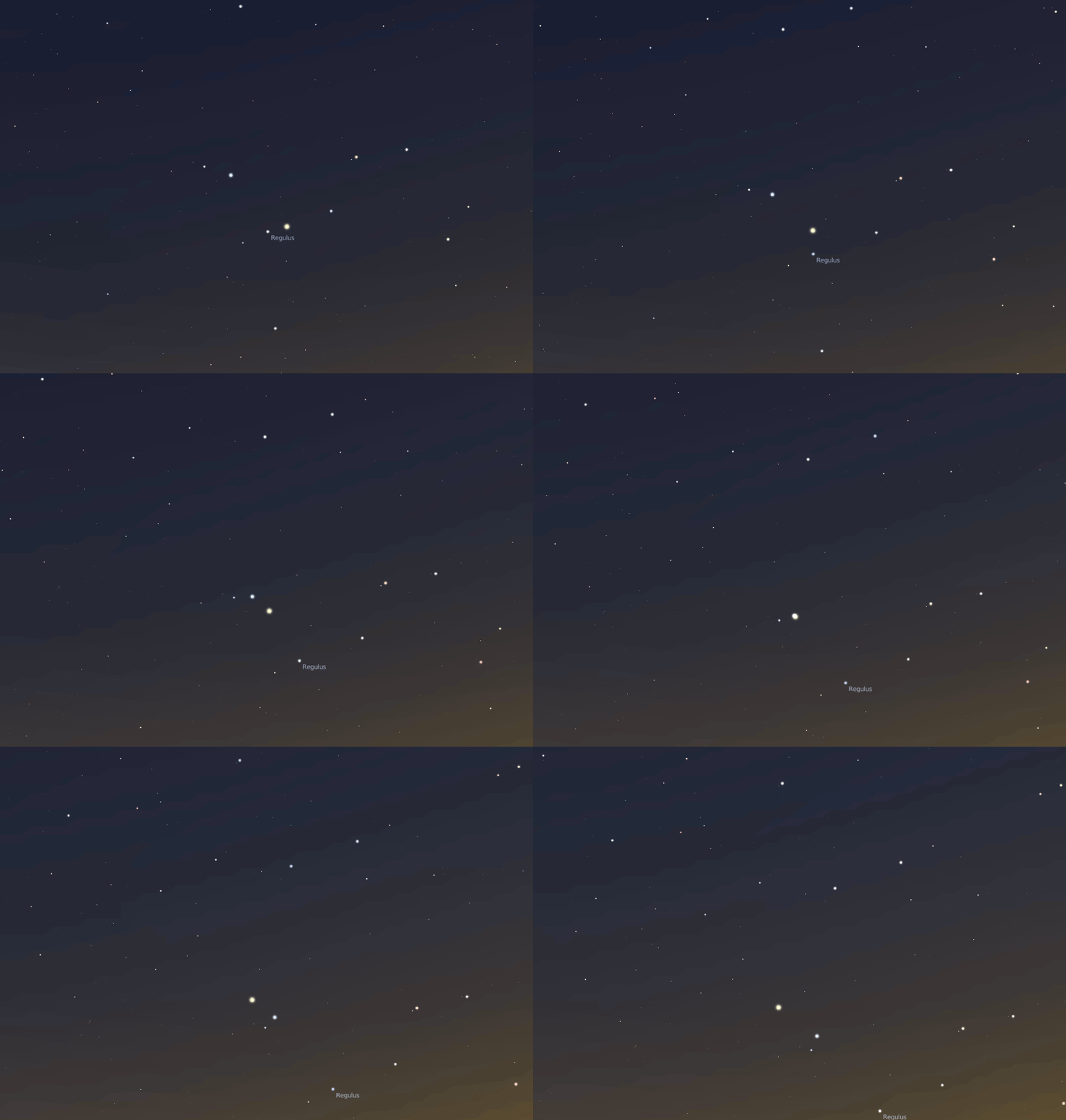
Ephemeris: 12/19/2024 – Jupiter is our bright evening Christmas star but what about 7 BC?
This is Bob Moler with Ephemeris for Tuesday, December 19th. Today the Sun will be up for 8 hours and 48 minutes, setting at 5:04, and it will rise tomorrow at 8:16. The Moon, at first quarter today, will set at 1:06 tomorrow morning.
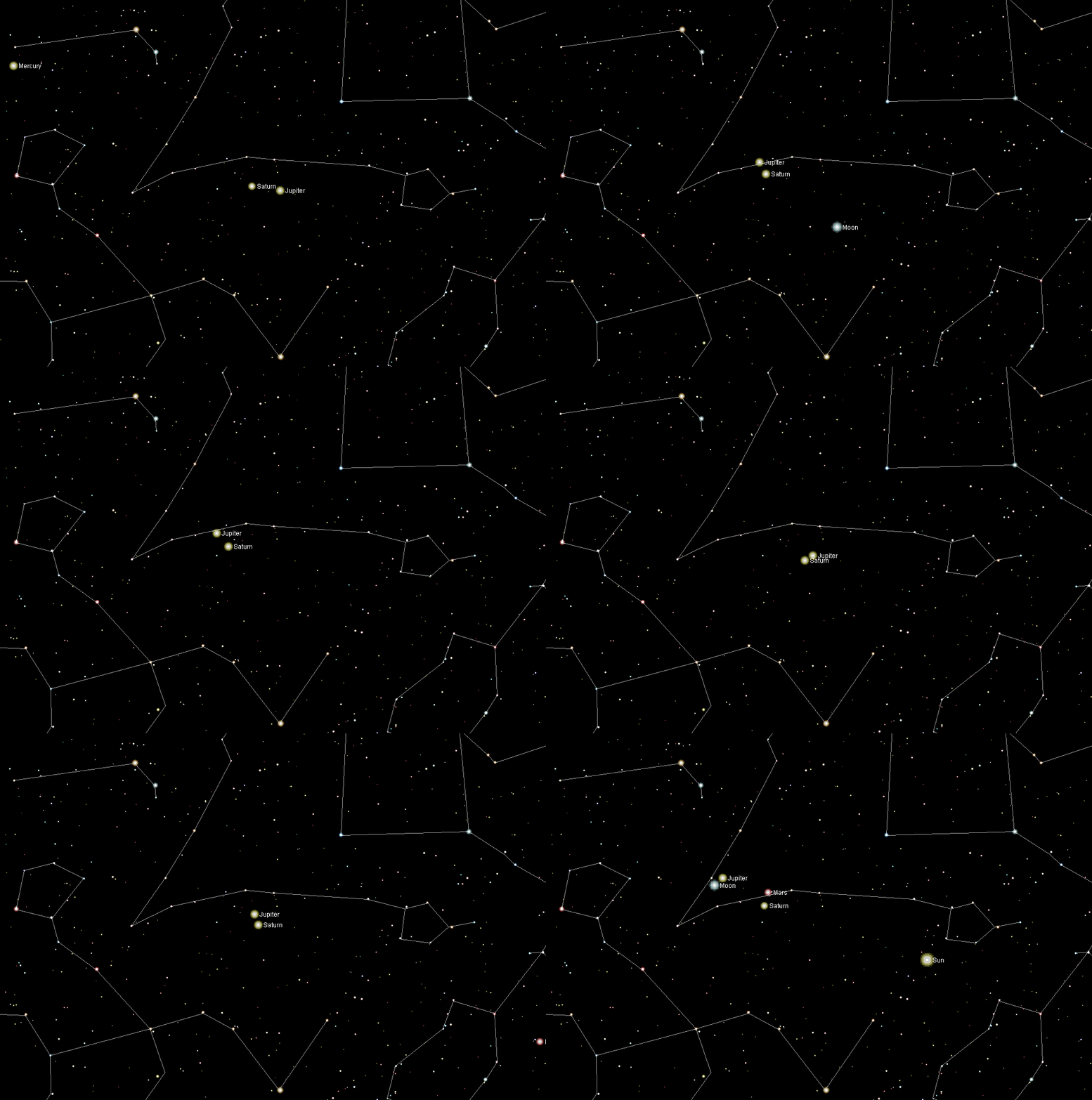
This year Jupiter is our bright evening Christmas star. But what about the one described in the Bible, in the Gospel of Matthew? We will look today at the first of two events that may have been recorded as the Star of Bethlehem. In 7 BC there was a rare event over 8 months when three times the planet Jupiter passed Saturn against the stars of the constellation Pisces. Could the Persian astrologer priests called Magi, have read into the event enough significance to start the journey to Jerusalem in search of the newborn King of the Jews? It was the scribe’s readings that then sent them to Bethlehem. It is thought that Pisces was associated with the Hebrews, Jupiter with the Messiah or world ruler, and Saturn with the peoples of Palestine.
The astronomical event times given are for the Traverse City/Interlochen area of Michigan (EST, UT –5 hours). They may be different for your location.
Addendum
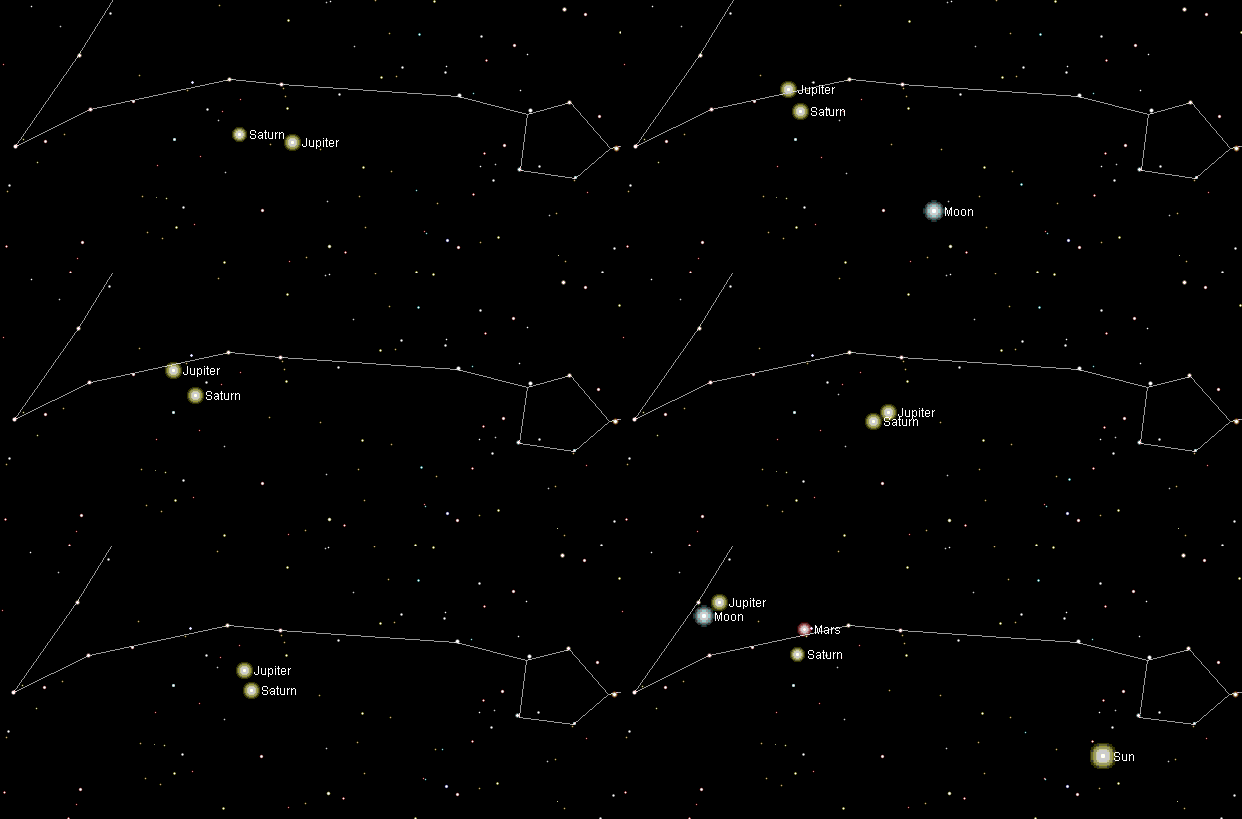
The normal motion of the sun, moon and planets in the sky is to the east, or to the left in this diagram. Jupiter takes a bit less than 12 years to orbit the sun while Saturn takes a bit less than 30 years, so Jupiter will pass Saturn about every 20 years. However, when they are both at opposition of the sun when they do that and closest to the earth, they will appear to move backwards for a time. This is called retrograde motion from their normal eastward motion. Jupiter being closest to us and closer to the Earth’s speed makes a bigger retrograde loop than Saturn does. So when they’re both at opposition when they cross paths we get a triple conjunction like this.
Ephemeris: 12/04/2023 – Our Alphabet begins with Taurus, and that’s no Bull!
This is Ephemeris for Monday, December 4th. Today the Sun will be up for 8 hours and 59 minutes, setting at 5:02, and it will rise tomorrow at 8:04. The Moon, 1 day before last quarter, will rise at 12:08 tomorrow morning.
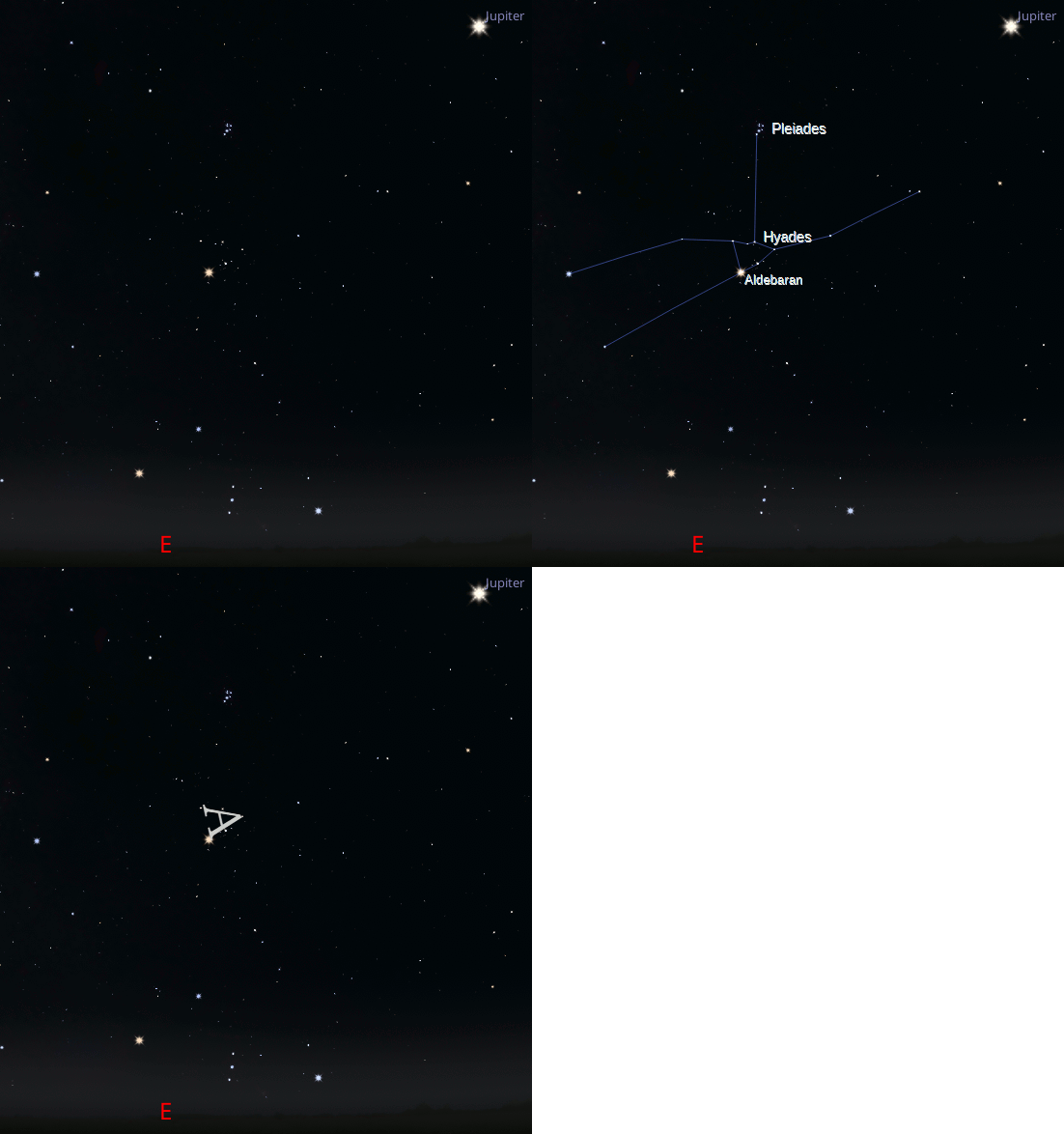
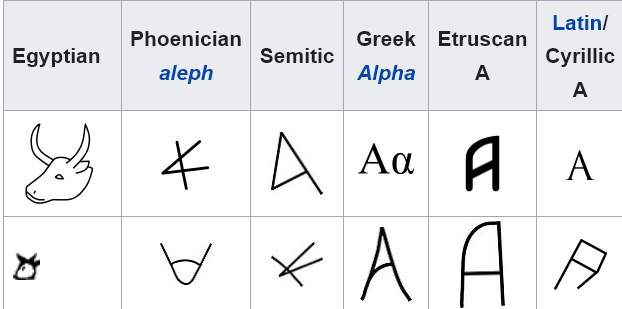
In the eastern part of the sky at 8 pm tonight, above the rising constellation of Orion the hunter, with its three belt stars nearly vertical and its two brightest stars Betelgeuse and Rigel, is an orange star called Aldebaran at one end of a letter V shape of stars which is the face of the constellation Taurus the bull. The V shape of stars is called the Hyades which were the half sisters of the Pleiades above them, according to Greek myth. Back 4,000 or so years ago when alphabets were being invented the vernal equinox or the beginning of spring where the sun was entering was Taurus, rather than Aries, or Pisces as it does today. The Mesopotamians took the shape of the head of Taurus to be the first letter of their alphabet, Aleph, which was an A lying on its side. In early Egyptian hieroglyphics it was the head of a bull. Over time the A got turned around so it was standing on its two legs with its apex on top and a bar across it to become the A we know today.
The astronomical event times given are for the Traverse City/Interlochen area of Michigan (EST, UT –5 hours). They may be different for your location.
Addendum
 Bob Moler's Ephemeris Blog