Archive
09/19/2016 – Ephemeris – How did the pirates of long ago navigate?
Aye matey, Barnacle Bob here with Ephemeris for Talk Like a Pirate Day, Monday, September 19th. The Sun will rise at 7:26. It’ll be up for 12 hours and 17 minutes, setting at 7:44. The Moon, 3 days past full, will rise at 9:47 this evening.
We tend to romanticize things of the past like the Pirates of the 16th, 17th and 18th century, not so much the Somali pirates of today. The problems of getting around and finding your way around were difficult in the seas and oceans before the use of the Harrison Chronometer made the precise determination of longitude possible in the late 18th century. It did require an almanac of star and planet positions plus the chronometer must be set to some time standard of a particular place of known longitude. Among the Islands of the Caribbean I imagine, though don’t know for certain, that one could dead recon between the islands and crudely navigate that way. Latitude determination was easy using the Sun.
Times are for the Traverse City/Interlochen area of Michigan. They may be different for your location.
Addendum
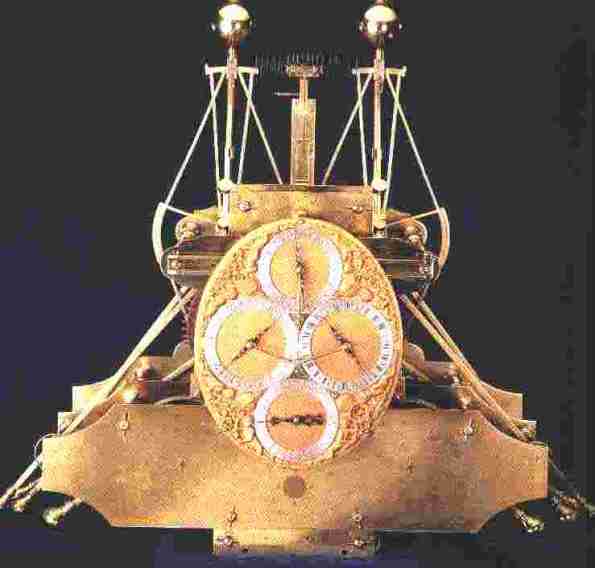
John Harrison’s (1693-1776) First attempt at a chronometer (1735), which he called H1. Credit: Solarnavigator.net.

John Harrison’s (1693-1776) fourth attempt at a chronometer (1759), which he called H4. It passed its sea trials. It’s not much bigger than a pocket watch. Credit: Solarnavigator.net.
03/31/2016 – Ephemeris – Tomorrow night’s Astronomy Society meeting
Ephemeris for Thursday, March 31st. The Sun will rise at 7:24. It’ll be up for 12 hours and 45 minutes, setting at 8:09. The Moon, at last quarter today, will rise at 3:39 tomorrow morning.
Tomorrow night the Grand Traverse Astronomical Society will hold it’s monthly meeting with a program featuring a graduate from Northwestern Michigan College and the astronomy program: Becky Shaw who will present a talk on Women in Astronomy. This is a third presentation of female astronomers, who have made important breakthroughs in astronomy. I especially recommend this for girls interested in the STEM fields, that is Science, Technology, Engineering and Math to find out the wonderful contributions these women have made. Astronomy, by the way encompasses all the STEM fields. The meeting starts at 8 p.m. and the observatory is located on Birmley Road, south of Traverse City. At 9 p.m. there will also be star party if it’s clear, viewing the planet Jupiter, the Great Orion Nebula, and other wonders of the heavens.
Times are for the Traverse City/Interlochen area of Michigan. They may be different for your location.
02/15/2016 – Ephemeris – President Lincoln’s visit to the Naval Observatory
Ephemeris for President’s Day, Monday, February 15th. The Sun will rise at 7:43. It’ll be up for 10 hours and 26 minutes, setting at 6:10. The Moon, at first quarter today, will set at 2:44 tomorrow morning.
In August of 1863, during the height of the Civil War, President Abraham Lincoln and his secretary John Hay rode out to the Naval Observatory where it was back then in Foggy Bottom. The astronomer there Asaph Hall showed them the moon and the star Arcturus through the observatory’s telescope. A couple of nights later Lincoln came out alone to ask the astronomer some questions about what he saw, in including why the Moon was upside down in the observatory telescope while the telescope he used gave a right side up image. Fourteen years later Asaph Hall, still at the Naval Observatory, discovered the two satellites of Mars through the observatory’s then larger telescope.
Times are for the Traverse City/Interlochen area of Michigan. They may be different for your location.
Addendum
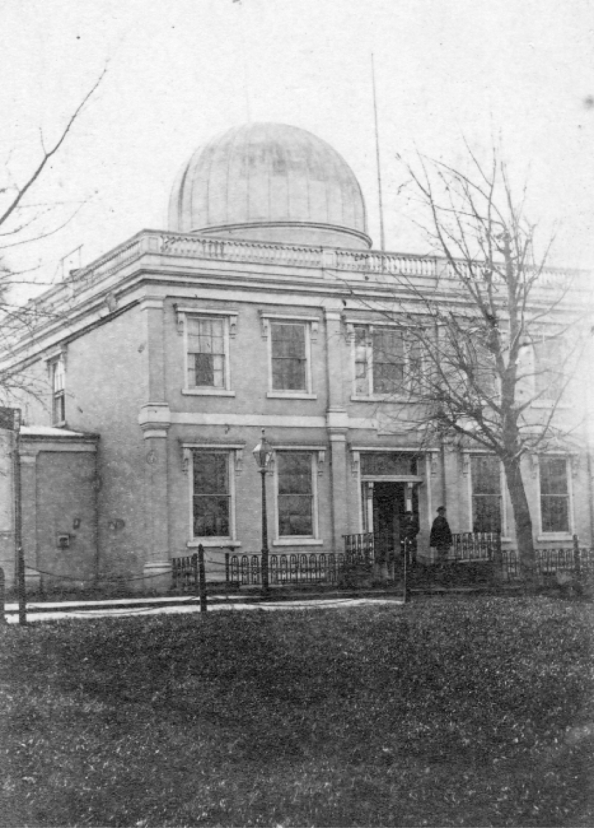
The old Naval Observatory. From the Astronomy.com web site.
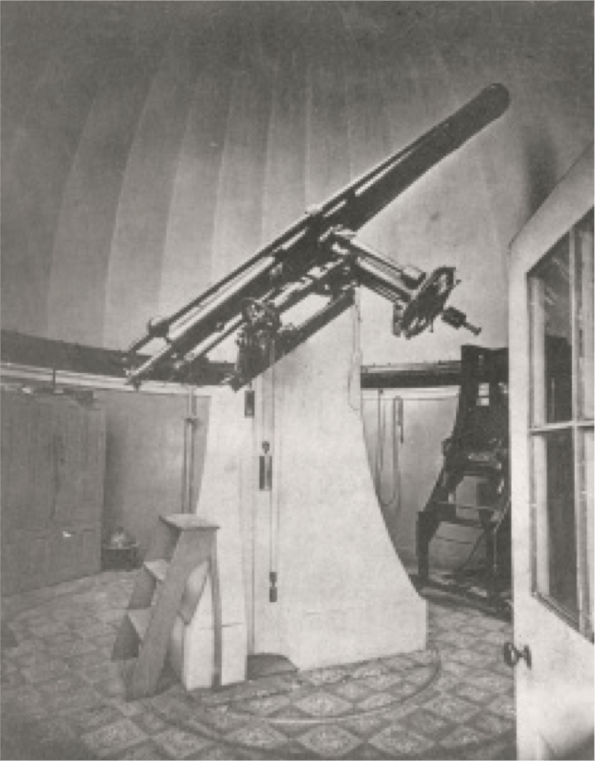
The 9.6 inch telescope through which Lincoln viewed the Moon and Arcturus on the night of August 22, 1863. From the Astronomy.com website.
The above images are from the excellent post Lincoln and the cosmos by Kirk R. Benson, USN Ret. on the Astronomy Magazine website.
02/05/2016 – Ephemeris – Women in astronomy night at the GTAS tonight
Ephemeris for Friday, February 5th. The Sun will rise at 7:57. It’ll be up for 9 hours and 58 minutes, setting at 5:56. The Moon, 3 days before new, will rise at 6:12 tomorrow morning.
Tonight there will be a meeting of the Grand Traverse Astronomical Society at Northwestern Michigan College’s Rogers Observatory, featuring a graduate from NMC and the astronomy program: Becky Shaw who will present a talk Women in Astronomy. This is a second presentation of more female astronomers, the last was in November I especially recommend this for girls in school interested in the STEM fields, that is Science, Technology, Engineering and Math to find out the wonderful contributions these women have made. Astronomy, by the way encompasses all the STEM fields. The meeting starts at 8 p.m. and the observatory is located on Birmley Road, south of Traverse City. At 9 p.m. the will also be star party if it’s clear.
Times are for the Traverse City/Interlochen area of Michigan. They may be different for your location.
Addendum
Appropriate to our speaker’s topic: In the news now is Smith’s Cloud, discovered by Gail Smith (now Gail Bieger-Smith) in 1963 as an astronomy student at Leiden University in the Netherlands. In new studies with the Green Bank (Radio) Telescope and the Hubble Space Telescope the velocity and composition of the cloud has been measured. It somehow was ejected from the Milky Way some 70 million years ago, but it’s coming back! In 30 million years it will crash back in, hitting the Milky Way’s other gas clouds and will probably cause a burst of star formation of maybe 2 million new stars.
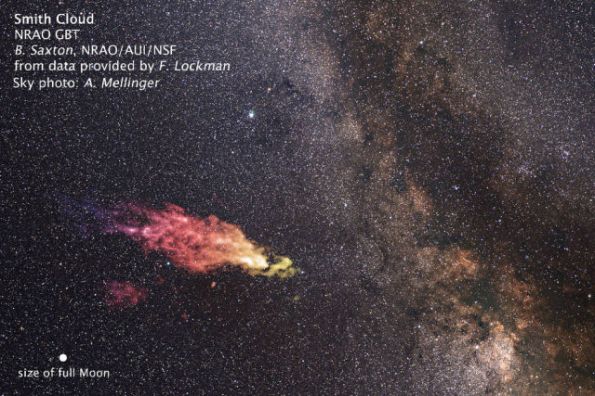
Smith’s cloud superimposed on the Milky Way. Smith’s Cloud is only visible at radio wavelengths, while the Milky Way shown is a visible photograph. Credit: Saxton/Lockman/NRAO/AUI/NSF/Mellinger.
01/25/2016 – Ephemeris – Sirius the Dog Star
Ephemeris for Monday, January 25th. The Sun will rise at 8:09. It’ll be up for 9 hours and 31 minutes, setting at 5:41. The Moon, 2 days past full, will rise at 7:43 this evening.
While we’re waiting for the bright Moon to leave the evening sky, let’s look at another bright star. This one is the brightest of all, Sirius the Dog Star. The Dog Star name comes from its position at the heart of the constellation Canis Major, the great dog of Orion the hunter. The three stars of Orion’s belt tilt to the southeast and point to Sirius. The name Sirius means ‘Dazzling One’, a reference to its great brilliance and twinkling. The Romans thought Sirius added its heat to that of the Sun in summer to bring on the scorching Dog Days of July and August. Its ancient Egyptian name was Sothis, and its first appearance in the morning twilight in late June signaled the flooding of the Nile, and the beginning of the Egyptian agricultural year.
Times are for the Traverse City/Interlochen area of Michigan. They may be different for your location.
Addendum
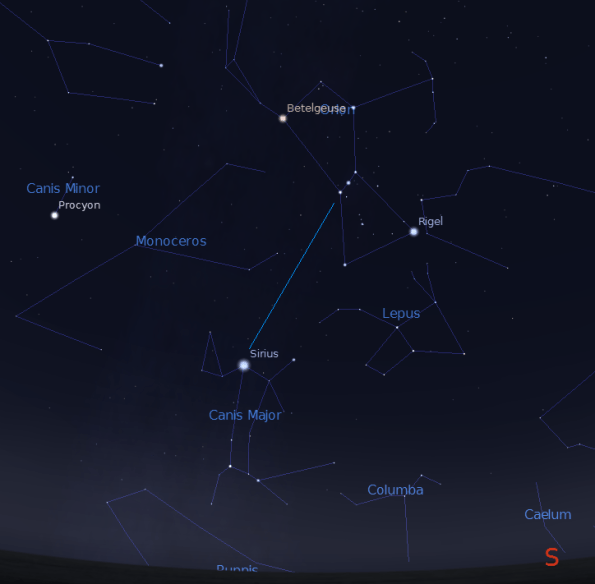
Orion’s Belt points to Sirius. Created using Stellarium.
12/24/2015 – Ephemeris – Jupiter and Venus the “Star” of Bethlehem?
Ephemeris for Christmas Eve, Thursday, December 24th. The Sun will rise at 8:18. It’ll be up for 8 hours and 48 minutes, setting at 5:06. The Moon, 1 day before full, will set at 8:02 tomorrow morning.
Last year August and earlier this year in June we had a near repeat of two very close conjunctions of Jupiter and Venus that occurred in 3 and 2 BC. These two conjunctions spaced by a month more than the human gestation period and seen against the constellation of Leo the lion, symbol of Judah could have brought the Magi, who were Persian astrologer-priests to Jerusalem, capital of Judea. The events could have signified the them the birth of a king of Judea. It was the interpretation of the scriptures by the scribes that actually sent them to Bethlehem. This version of the Star of Bethlehem seems to be the one that’s being accepted more and more by those who believe the Star has a physical reality.
Times are for the Traverse City/Interlochen area of Michigan. They may be different for your location.
Addendum
Jupiter and Venus Conjunctions August 2014 and June 2015
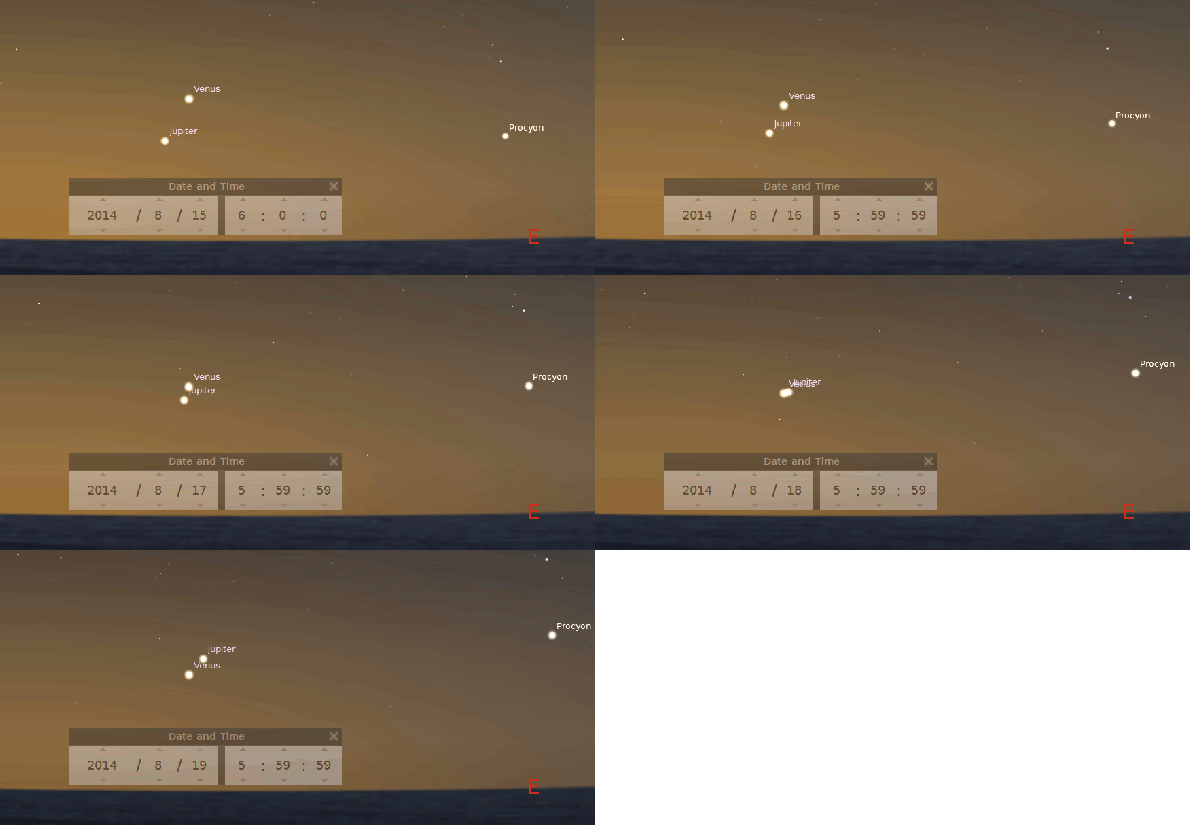
Watch Jupiter and Venus approach each other and separate. From August 15 to August 19, 2018. Created using Stellarium and GIMP.
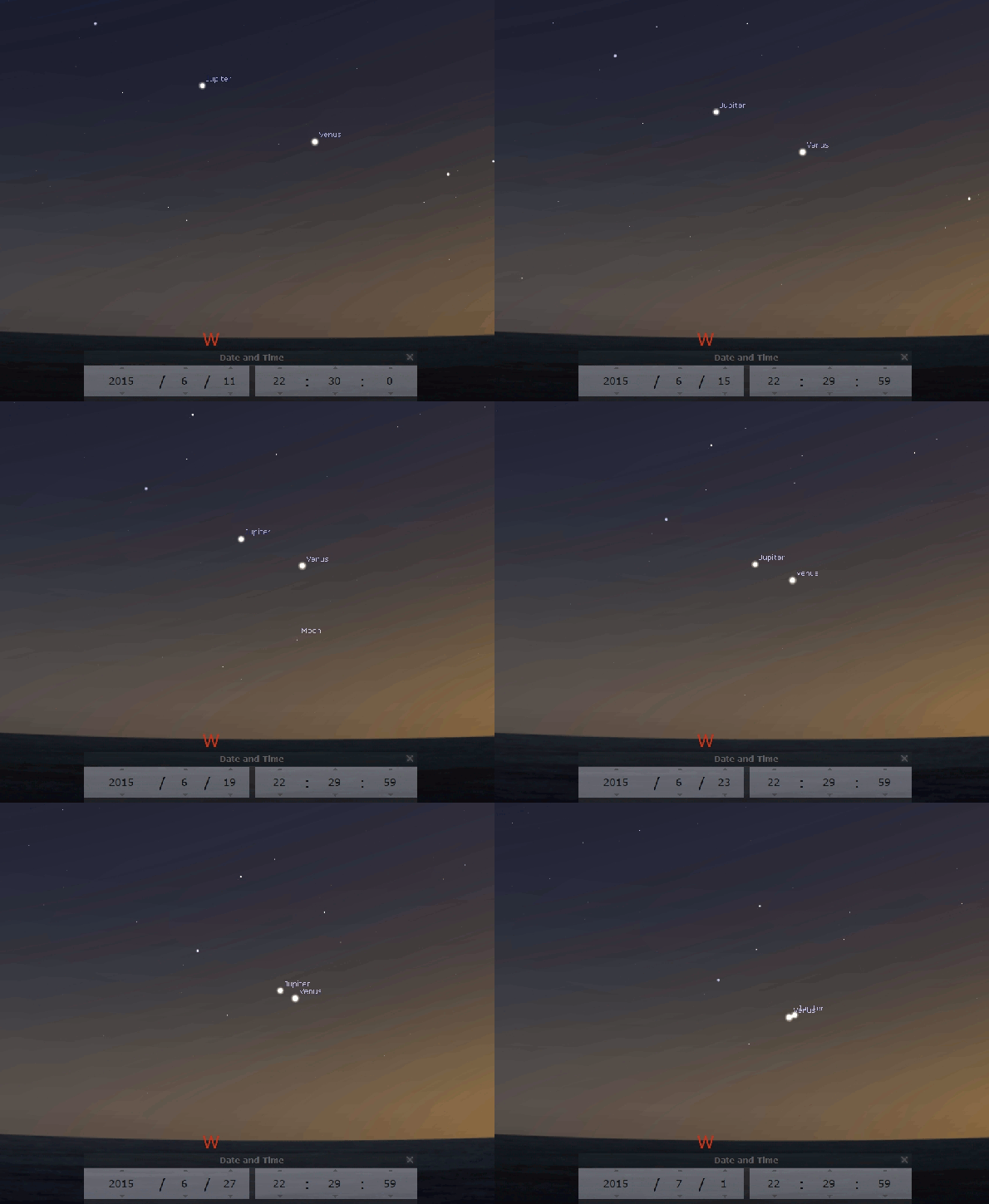
Jupiter-Venus approach animation June 11 to July 1, 2015 at 10:30 p.m. Created using Stellarium and GIMP. Click on image to enlarge.
Jupiter and Venus Conjunctions August 3 BC and June 2 BC
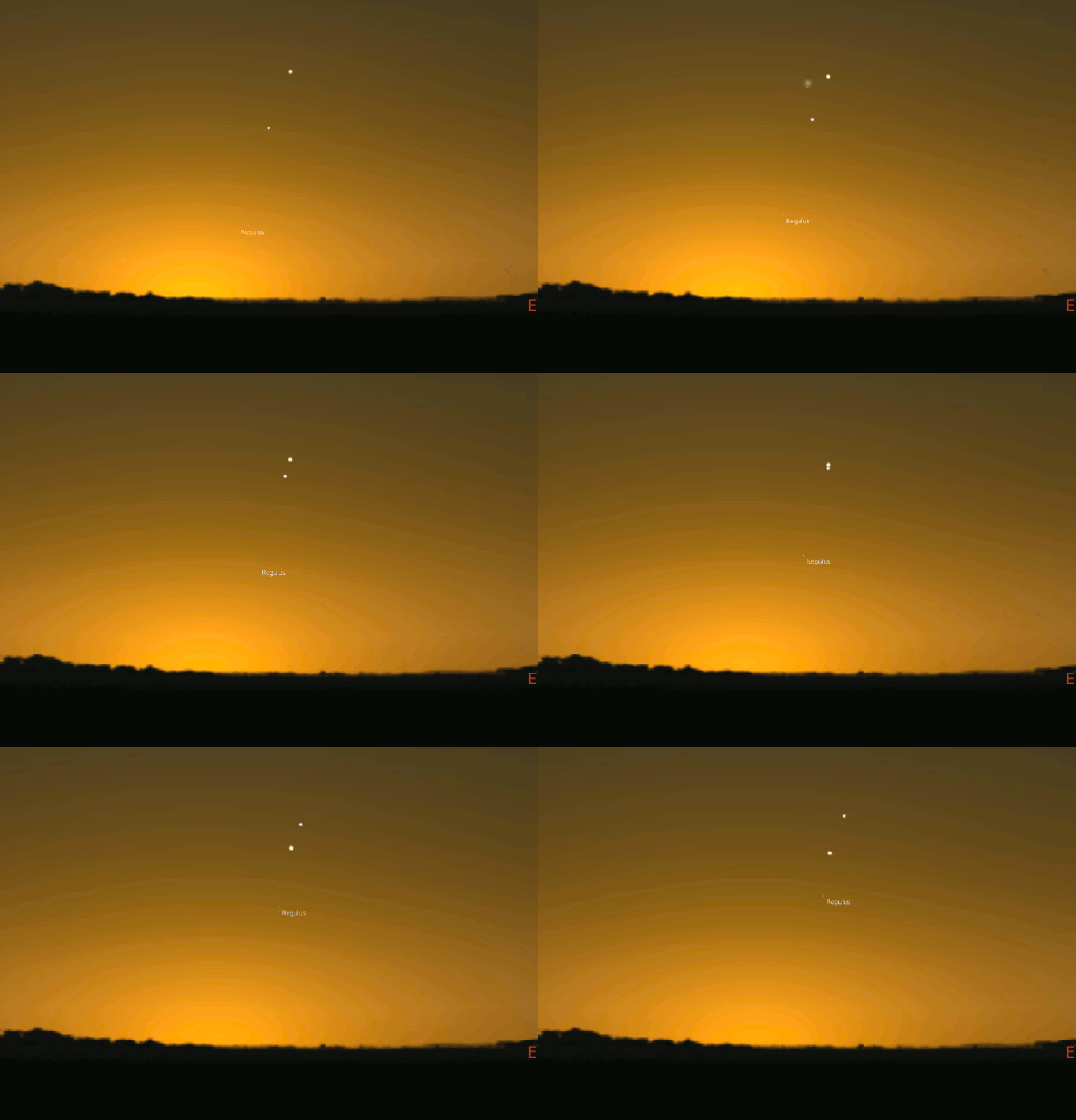
Animation of the Jupiter-Venus conjunction of August 3, 3 BC. in the morning twilight. Created using Stellarium.
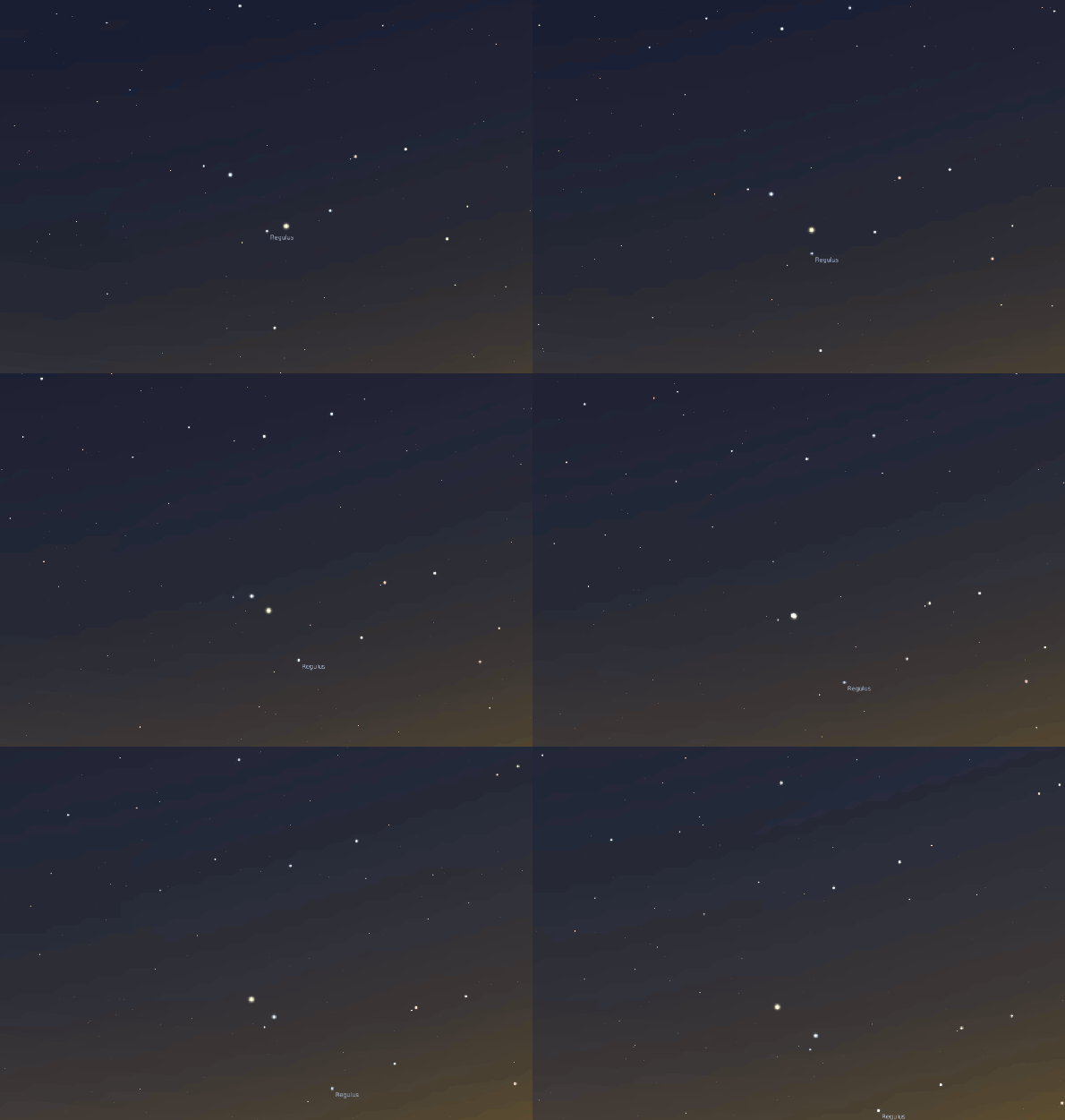
June of 2 BC just after sunset Jupiter and Venus again cross paths. Created using Stellarium.
10/13/2015 – Ephemeris – Columbus was wrong!
Ephemeris for Tuesday, October 13th. The Sun will rise at 7:55. It’ll be up for 11 hours and 6 minutes, setting at 7:02. The Moon, 1 day past new, will set at 7:35 this evening.
Yesterday I recounted that Christopher Columbus was able to extort supplies from the native Jamaicans by using an eclipse table to predict a lunar eclipse. But let’s face it Columbus was lost. He wasn’t in India as he thought. He based his voyage on the erroneous belief that the Earth was less than 19,000 miles in circumference, when it’s actually 25,000 miles, which was the prevailing view of the day. That the Earth was round was known from the 3rd century BC, and measured quite accurately by Eratosthenes. Of course with the varieties of distance units of the day it was no wonder an error of that magnitude could be made. Of course did anyone think to remeasure the circumference of the Earth? Apparently not. Nowadays no scientist thinks of taking only one measurement. Columbus was lucky a continent was here, or no one would have heard from him again.
Times are for the Traverse City/Interlochen area of Michigan. They may be different for your location.
Addendum
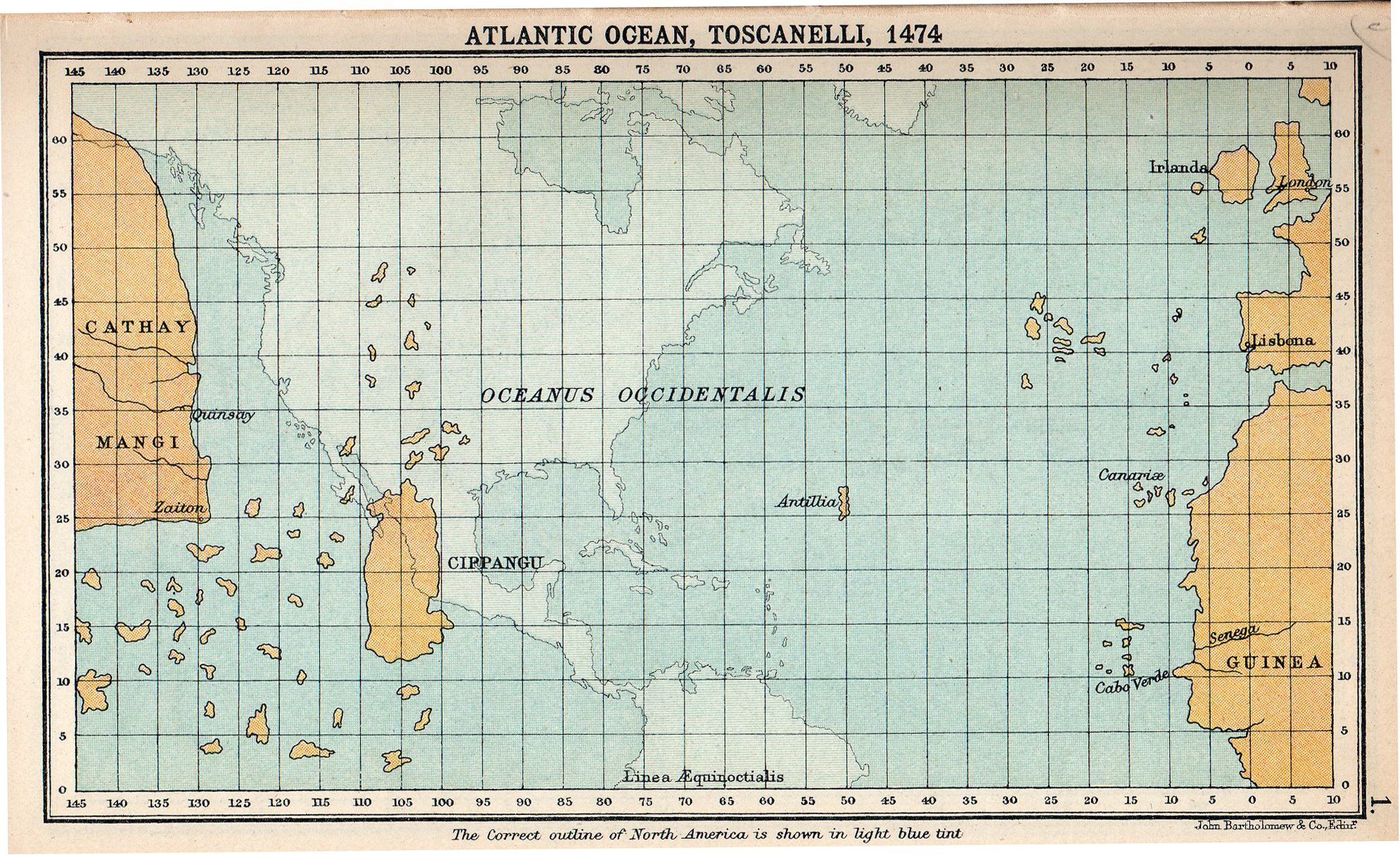
A map of the western ocean (Atlantic Ocean) by Paolo dal Pozzo Toscanelli about 1474 which may have influenced Columbus. North America is superimposed at the proper longitudes. Credit: A literary and historical atlas of America, by Bartholomew, J. G. via Wikipedia. Click to enlarge.
Note that Cathay is China and Cippangu represents Japan. It was thought back then that the Eurasian continent spanned 180 degrees of longitude at the latitude of Spain, rather than 130 degrees it actually does Japan was thought to be bigger and farther off the Chinese coast. The phantom island of Antillia seems to date back to stories from Spain of the 8th century.
Ephemeris for the real Columbus Day for once, Monday, October 12th. The Sun will rise at 7:54. It’ll be up for 11 hours and 9 minutes, setting at 7:03. The Moon is new today, and won’t be visible.
On Columbus’ 4th voyage to the Caribbean he was stranded on Jamaica. For a while the natives of the island fed Columbus and his men. However due to the thievery of some of his crew, these people no longer trusted Columbus any refused them any more supplies. Columbus consulted a table of eclipses and found that a lunar eclipse was to occur on February 29th that year (1504), and that at his location the moon would rise in eclipse. He went to the leader of the people and said that they had displeased their god by refusing his crew food, and that the god would turn the Moon red in anger. It worked. As Arthur C. Clarke once wrote: “Any sufficiently advanced technology is indistinguishable from magic.”
Times are for the Traverse City/Interlochen area of Michigan. They may be different for your location.
Addendum
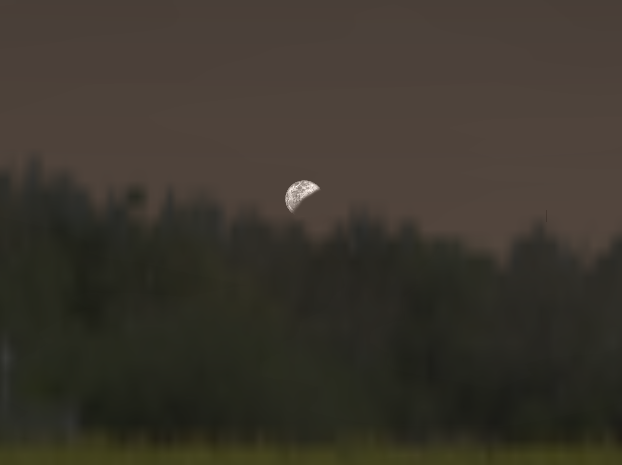
The moon rising from Jamaica February 29, 1504 as shown by Stellarium with some additional shadow darkening by myself.
Tomorrow I’ll look at what Columbus got wrong… Beside being lost.
I note for the record that Stellarium calendar dating includes what I call the Gregorian discontinuity. It drops the 10 days between October 4, 1582 and October 15th, which was the adjustment the Gregorian calendar makes to move ahead the actual vernal equinox from March 11 to the 21st. Christian churches always use the tabular value of March 21 as the vernal equinox for the calculation of the date of Easter. The old Julian calendar let that slip back about 3/4 of a day every century.
07/20/2015 – Ephemeris – July 20th anniversaries
Ephemeris for Monday, July 20th. Today the Sun will be up for 15 hours and 5 minutes, setting at 9:21. The Moon, 4 days before first quarter, will set at 11:34 this evening, and tomorrow the Sun will rise at 6:16.
July 20th is a special date for this country’s space program and a personal one. On July 20, 1969 Apollo 11 landed on the Moon, the greatest achievement in the history of space flight. Seven years later the robot lander Viking 1 landed on Mars. NASA wanted it to be July 4th, 1976, the Bicentennial, but couldn’t find a smooth landing site in time. My own connection to the date came in 1963, my first total solar eclipse. We traveled to Quebec province along side the St. Maurice River. To view 60 seconds of totality. It was the first of four successful total solar eclipse trips I’ve been on.. I’m looking forward to my 5th on August 21st 2017, two years from now which is related to my first, I’ll tell you about that in my blog.
Times are for the Traverse City/Interlochen area of Michigan. They may be different for your location.
Addendum
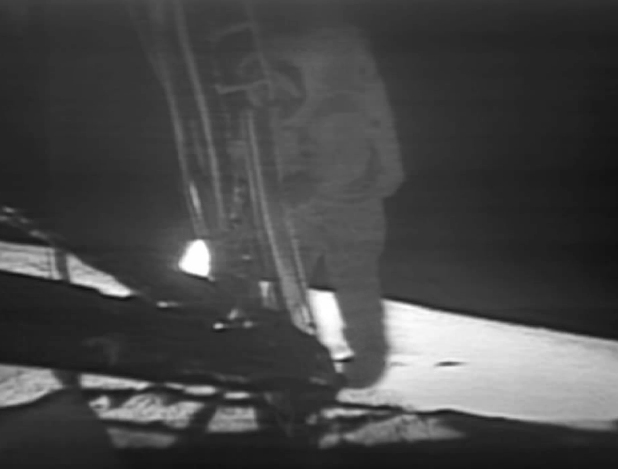
Neil Armstrong about to step off the LM onto the surface of the moon, July 20, 1969. Credit: NASA.
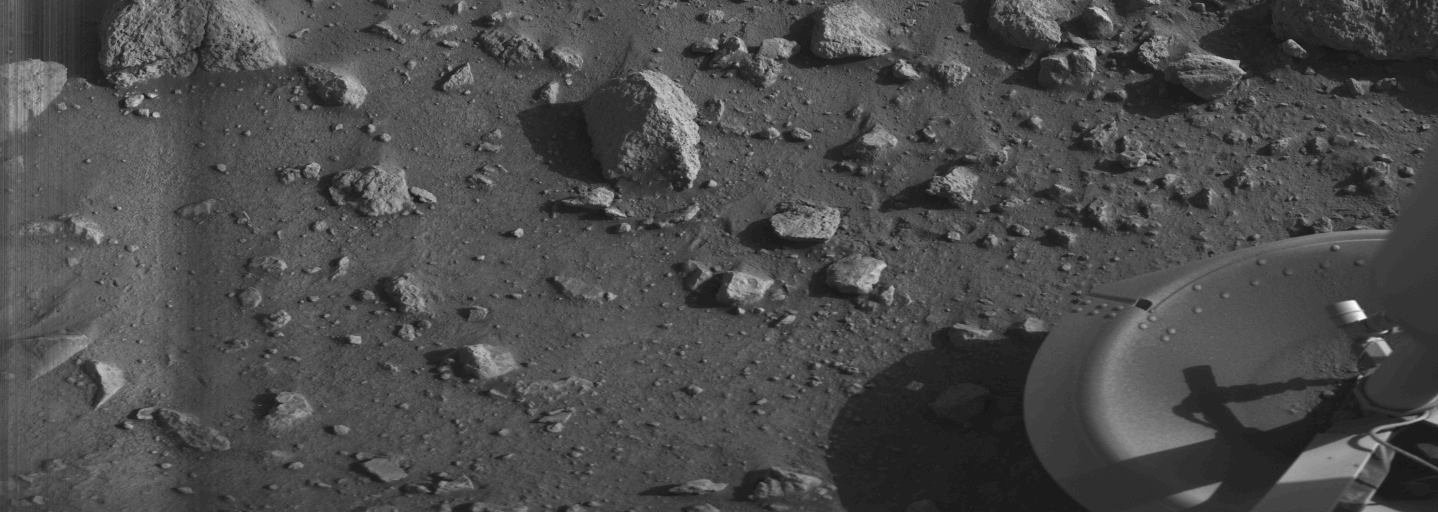
First image sent back from Viking 1 after landing on Mars, July 20, 1976. Credit: NASA/JPL. Click on image to enlarge.
Video of July 20, 1963 eclipse from the air. I got only one picture of the eclipse and it wasn’t very good. https://www.youtube.com/watch?v=OT3EW0KIjCc.
The date on the YouTube page is incorrect. It is July 20, 1963. I remember the corona being somewhat wedge-shaped, wider to one side than the other. Other than that it was a typical quiet sun corona.
In the program above I mentioned that the August 21, 2017 solar eclipse was related to my first total solar eclipse. This is the relationship: A couple of centuries BC the Chaldean astronomers of ancient Babylonia discovered that eclipses repeated in a cycle lasting 6,585 1/3 days. That’s 18 years 10 or 11 and 1/3 days depending on the number of leap years spanned. That period was called the Saros by Sir Edmund Halley or comet fame. So each eclipse would be visible 1/3 of the Earth farther west. Note that there are many Saros cycles occurring at the same time, and that eclipses of a particular Saros gradually move northward or southward. So to have an eclipse recur at the approximate same longitude one must wait 3 Saros cycles. or 54 years and one month approximately. Thus the third Saros of the July 20, 1963 total solar eclipse will be August 21, 2017. This Saros series (145) is moving southward. In 1963 it crosses the US at Alaska and Maine. Quebec was closer for us, s we went there. Good thing too. Maine was clouded and rained out. For us the clouds parted at the beginning of the eclipse. The 2015 eclipse will cross the continental US from Oregon to South Carolina.
A squished image of the July 20, 1963 eclipse path. Right click on the image and select view image to get a correct image. (works in Firefox).

A squished image of the August 21, 2017 eclipse path. Right click on the image and select view image to get a correct image. (works in Firefox).

06/29/2015 – Ephemeris – Did tomorrow’s conjunction between Venus and Jupiter happen before?
Ephemeris for Monday, June 29th. Today the Sun will be up for 15 hours and 32 minutes, setting at 9:32. The Moon, 2 days before full, will set at 4:56 tomorrow morning and tomorrow the Sun will rise at 6:00.
Tonight the planet Jupiter will be a bit more than the width of the Moon away from Venus. Tomorrow that distance will be cut in half as Jupiter will pass directly above Venus. This is a second of two conjunctions that are a near repeat of two conjunctions that some, including myself have speculated as being what the Magi reported as the Star of Bethlehem in 3 and 2 BC. On August 12th 3 BC in the predawn sky Jupiter and Venus were a third of a moon width apart, Then on June 17th 2 BC they were in conjunction again but even closer . Last year we had a close conjunction of the two on August, 18th and the two will be in conjunction, and again tomorrow. Neither are as close as they were in 3 and 2 BC.
Times are for the Traverse City/Interlochen area of Michigan. They may be different for your location.
Addendum
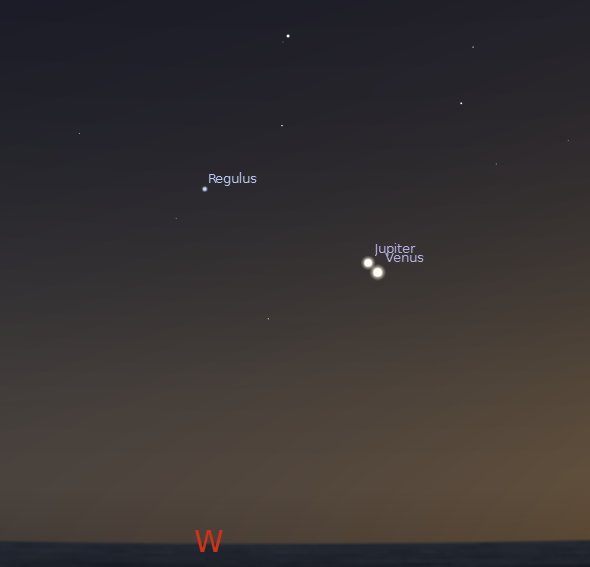
Jupiter and Venus at 10:30 tonight June 29, 2015, one day before their conjunction. Created using Stellarium.
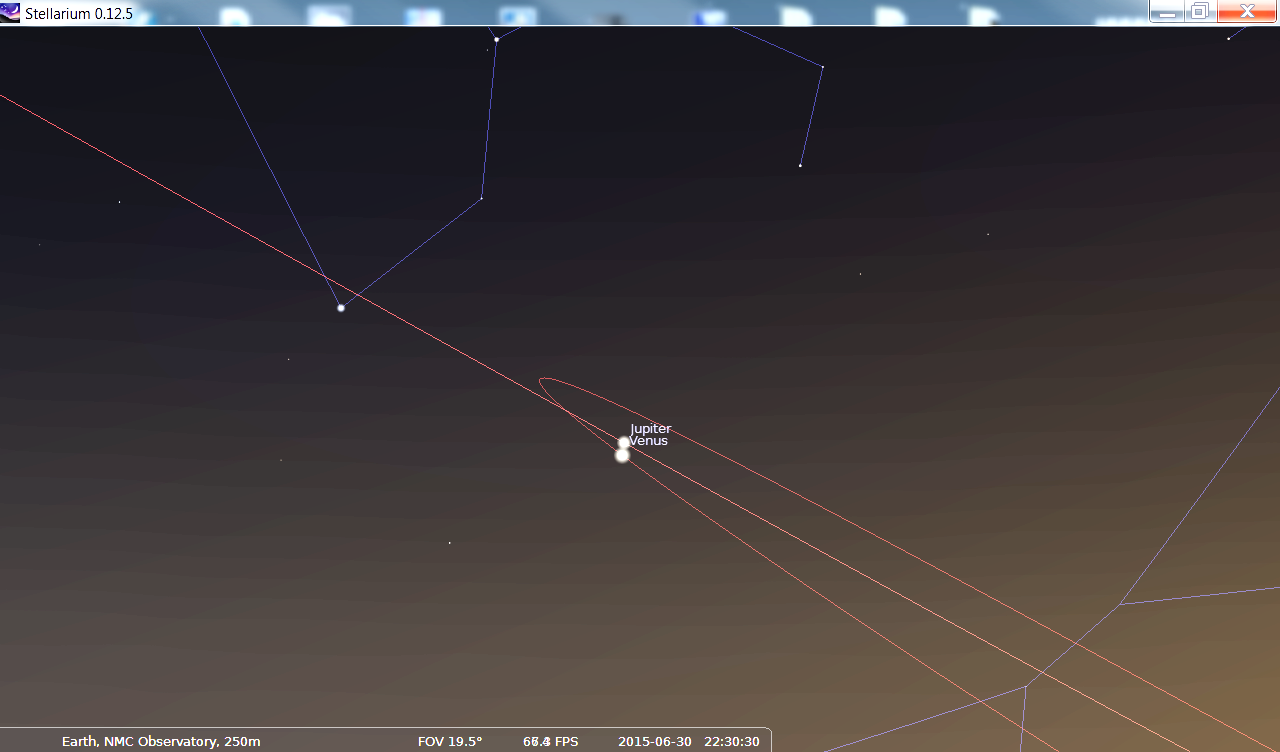
The orbits of Venus and Jupiter for the conjunction of June 30, 2015. The bright star to the upper left is Regulus. Created using Stellarium.
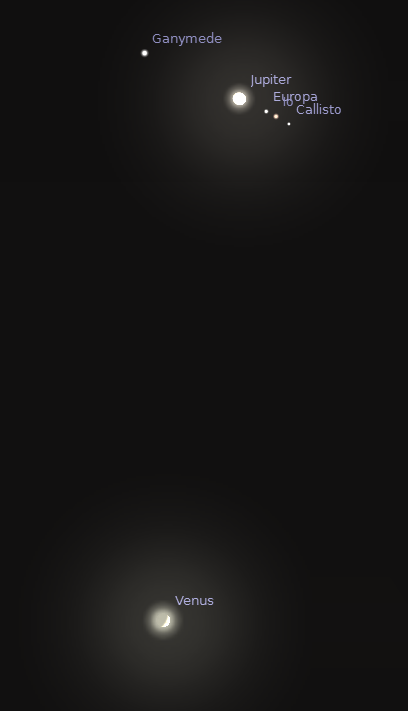
A telescopic view of what we expect the positions of Jupiter and Venus at 10:30 p.m. EDT June 30, 2015 (2:20 UT July 1, 2015). Created using Stellarium.
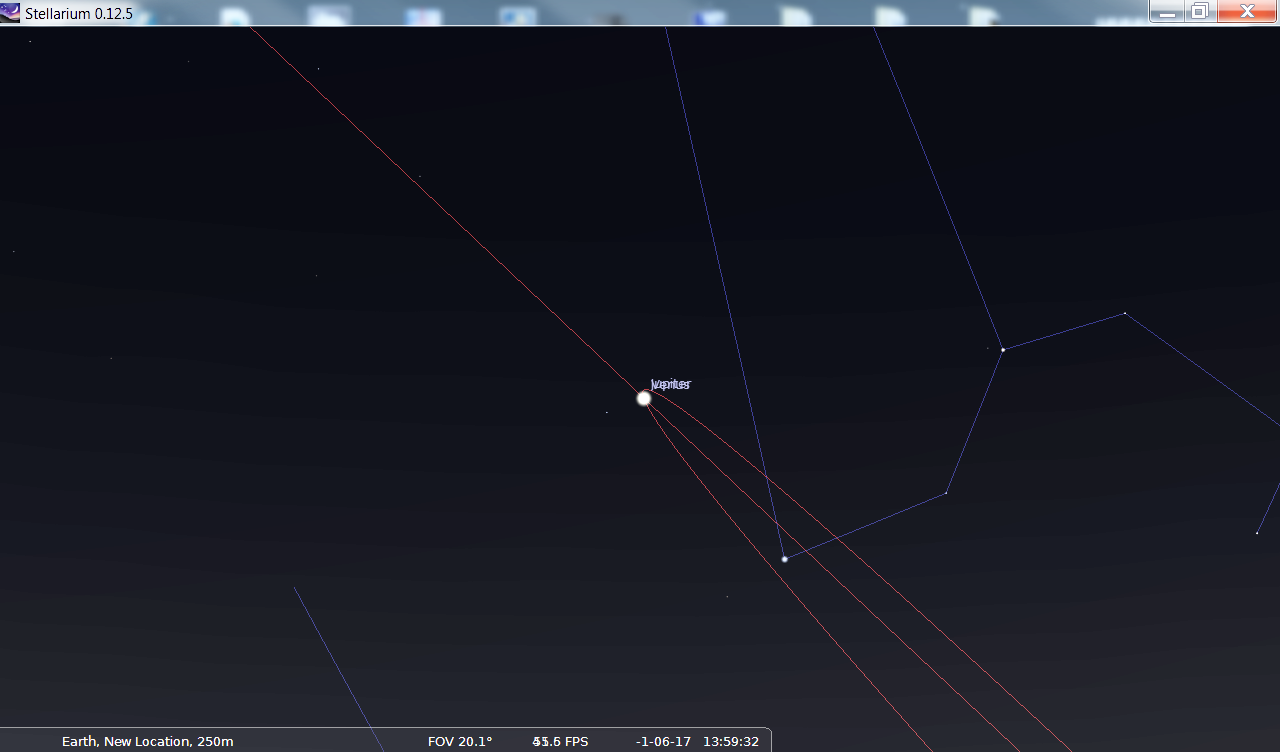
The orbits of Venus and Jupiter for the conjunction of June 17, 2 BC. The bright star to the lower right is Regulus. Created using Stellarium.
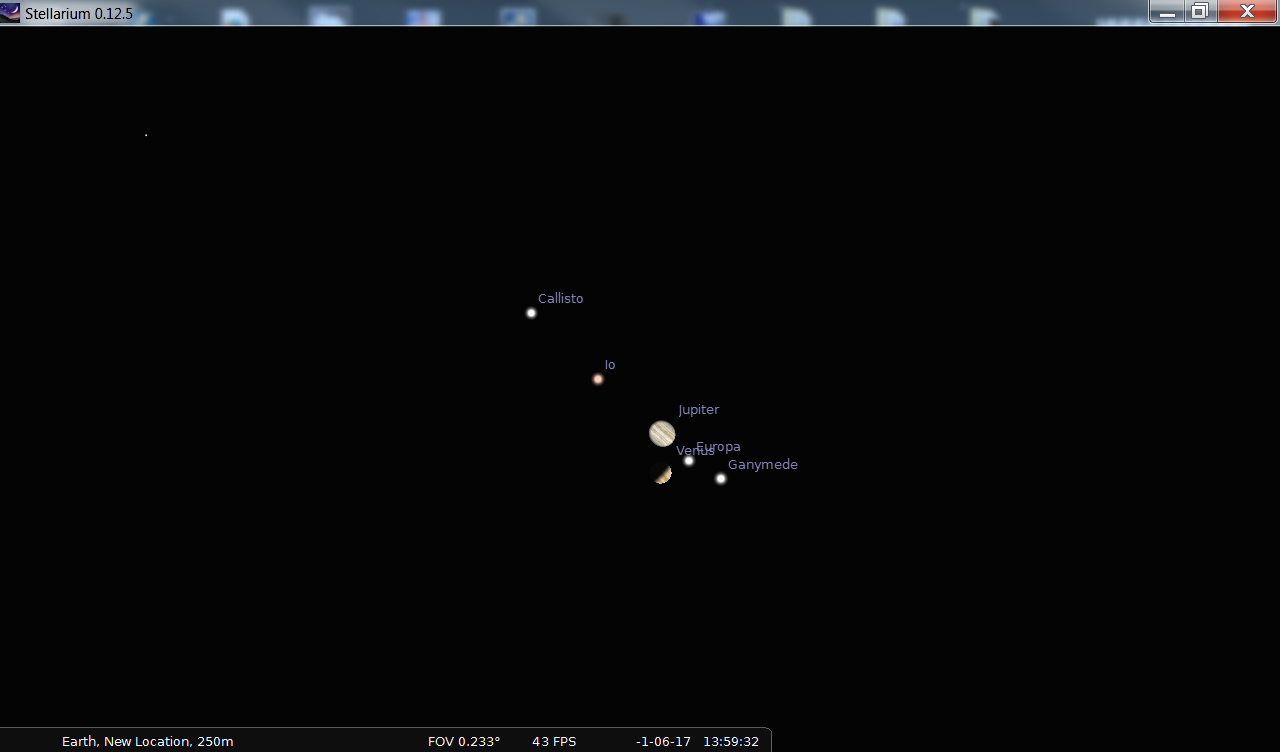
Venus appeared among Jupiter’s moons on August 12, 3 BC. Of course no one had a telescope back then. Created using Stellarium.
I’ve written about the Jupiter-Venus conjunctions of 3 and 2 BC. You can see it here from my Ephemeris website..
 Bob Moler's Ephemeris Blog