Archive
12/20/2019 – Ephemeris – The Star of Bethlehem, the problem of when
Ephemeris for Thursday, December 20th. The Sun will rise at 8:16. It’ll be up for 8 hours and 48 minutes, setting at 5:04. The Moon, 2 days before full, will set at 6:46 tomorrow morning.
In looking at the possible origin of the Star of Bethlehem, the latest Jesus could have been born is before the death of Herod the Great. The Jewish historian Josephus says that Herod died between a lunar eclipse and Passover, with most Star investigators pointing to the partial eclipse of March 13, 4 BC, one month before Passover that year. Problem is that Josephus devotes 4 chapters of the 17th book of Jewish Antiquities to the events in that span. I think they chose that eclipse to fit in with the triple conjunction of Jupiter and Saturn in 7 BC that was the big favorite for the star. There is another, better total lunar eclipse on January 10, 1 BC that is 3 months before Passover that would better fit Josephus’ narrative and a different Star possibility. More Monday.
The times given are for the Traverse City/Interlochen area of Michigan. They may be different for your location.
Addendum
The passage about Herod’s death from the eclipse of the Moon to Passover is in Josephus’ Antiquities of the Jews is in Book 17, Chapter 6, Paragraph 4 through Chapter 9, paragraph 3.
In doing some additional research since recording the program, the footnotes in William Whiston’s translation suggests a period between the eclipse and Passover at 13 months. Antiquities of the Jews can be found here: https://www.gutenberg.org/files/2848/2848-h/2848-h.htm. Of course I could extend the time frame of Herod’s death for the 1 BC eclipse to the Passover 16 months later. That would solve one of the problems I had with the timing of the visit of the Magi. But you’ll have to wait until Monday to find out what that is.
07/24/2018 – Ephemeris – What about those martian canals
Ephemeris for Tuesday, July 24th. The Sun rises at 6:20. It’ll be up for 14 hours and 57 minutes, setting at 9:17. The Moon, 3 days before full, will set at 4:25 tomorrow morning.
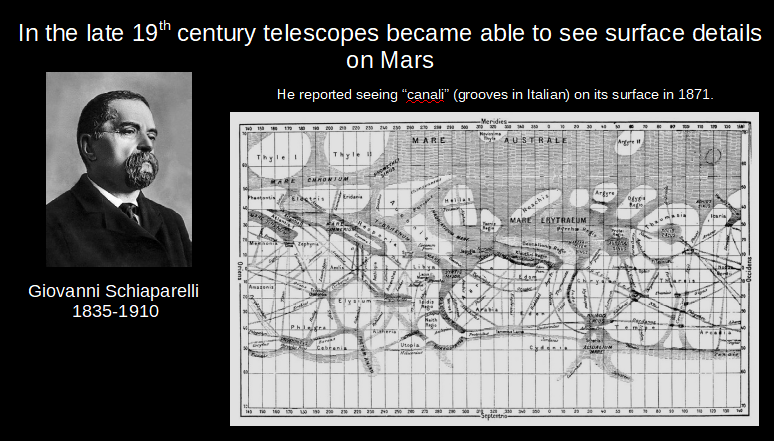
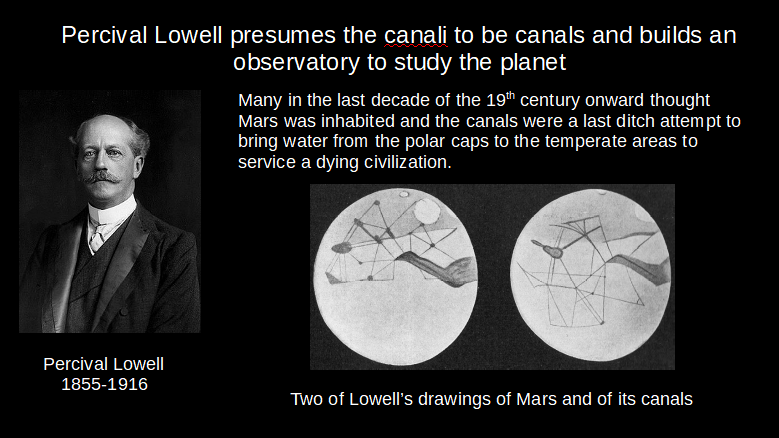
The greatest mystery of the late 19th and early 20th century of Mars was the discovery of fine linear marking seen by visual observers of Mars. They were first reported by an Italian astronomer Giovanni Schiaparelli in 1871 as grooves, canali in Italian. It was turned into canals by the English language newspapers of the day. Canals are artificial constructions. Thus one Percival Lowell of Massachusetts built an observatory in Flagstaff Arizona to observe and map Mars for himself, dying in 1916 still believing in an ancient martian civilization bringing water from the polar caps to the equatorial region by canals in order to survive. Alas, there are no canals. Mars is a barren world, whose secrets we now probe below its red dust.
The times given are for the Traverse City/Interlochen area of Michigan. They may be different for your location.
Addendum
The source if the images below is the talk “Mars 2018” I gave at the Betsie Valley District Library, July, 20, 2018.
***
07/23/2018 – Ephemeris – The importance of Mars in determining the nature of the solar system
Monday, July 23rd. The Sun rises at 6:19. It’ll be up for 14 hours and 59 minutes, setting at 9:18. The Moon, half way from first quarter to full, will set at 3:41 tomorrow morning.
The accurate observational positions of Mars by Tycho Brahe allowed Johannes Kepler in the early 17th century to discover his three laws of planetary motion. Tycho was the last and greatest of the naked eye astronomers. Kepler befriended Tycho who jealously guarded his observations. It was only after his death in 1601 that Kepler took possession of Tycho’s data. Until then it was believed that planets moved with uniform circular motion, even though they didn’t look like it. Astronomers added circle after circle, called epicycles, to attempt to make their system work. Mars was the worst case. Kepler finally determined that Mars, and indeed all the planets, orbited the Sun in elliptical orbits. That was his first law of planetary motion.
The times given are for the Traverse City/Interlochen area of Michigan. They may be different for your location.
Addendum
The source if the images below is the talk “Mars 2018” I gave at the Betsie Valley District Library, July, 20, 2018.
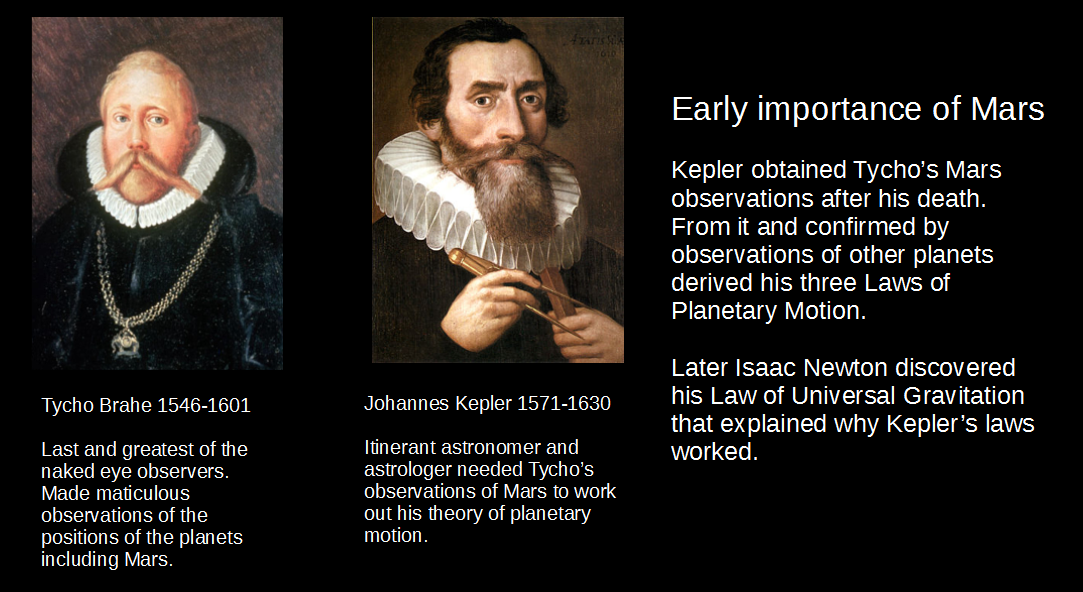
Tycho and Kepler. Artist for Tycho: Eduard Ender (1822-1883). Artist for Kepler, unknown. Source: Wikipedia.
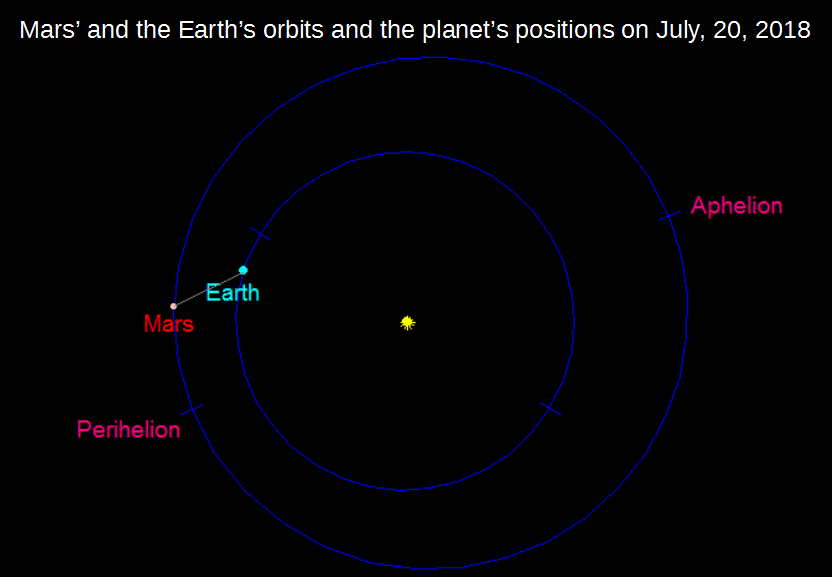
Mars’ and Earth’s orbits to scale and positions of the Earth and Mars July 20, 2018, one week before opposition. Note that Mars’ orbit is decidedly not circular. Credit my LookingUp program.
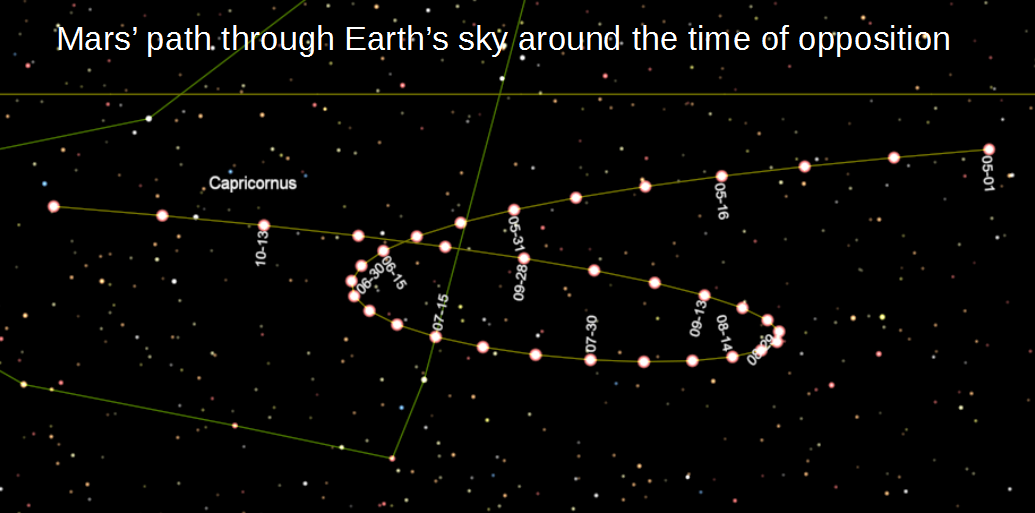
Created using Cartes du Ciel (Sky Charts).
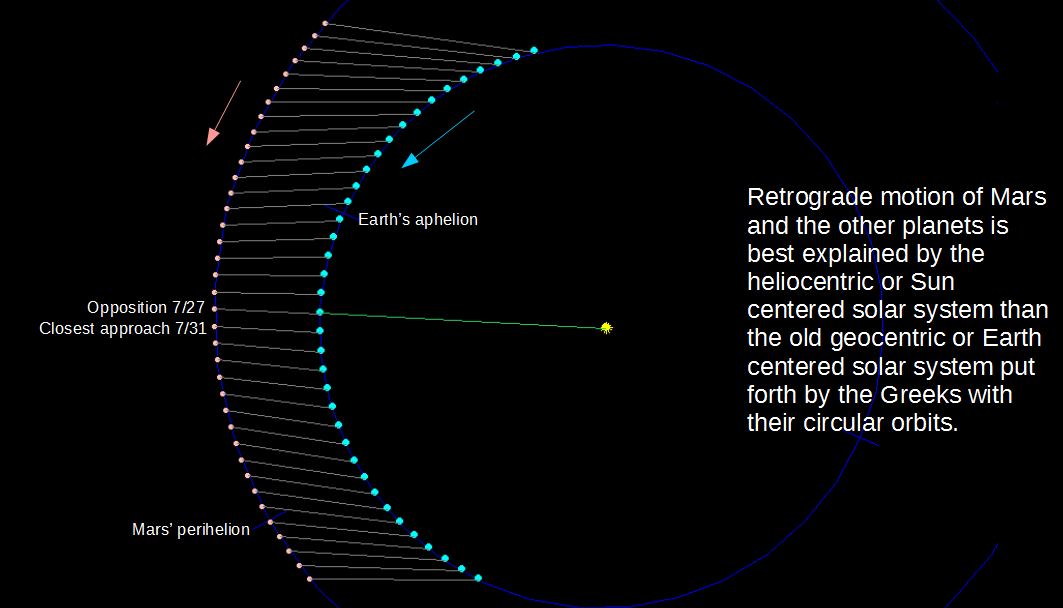
Created using Cartes du Ciel (Sky Charts).
06/24/2018 – Ephemeris Extra – Mars Summers
This is a reprint of “Mars Summer” which I wrote for the Grand Traverse Astronomical Society newsletter Stellar Sentinel’s June 2018 issue.
The planet Mars has oppositions from the Sun about every 26 months more or less. These oppositions are a time when Mars is closest to the Earth for its position in orbit. It’s distance at these times range from 34.6 to almost 63 million miles, a range of almost 2 to 1. This is because Mars has a very elliptical orbit as can be seen below.
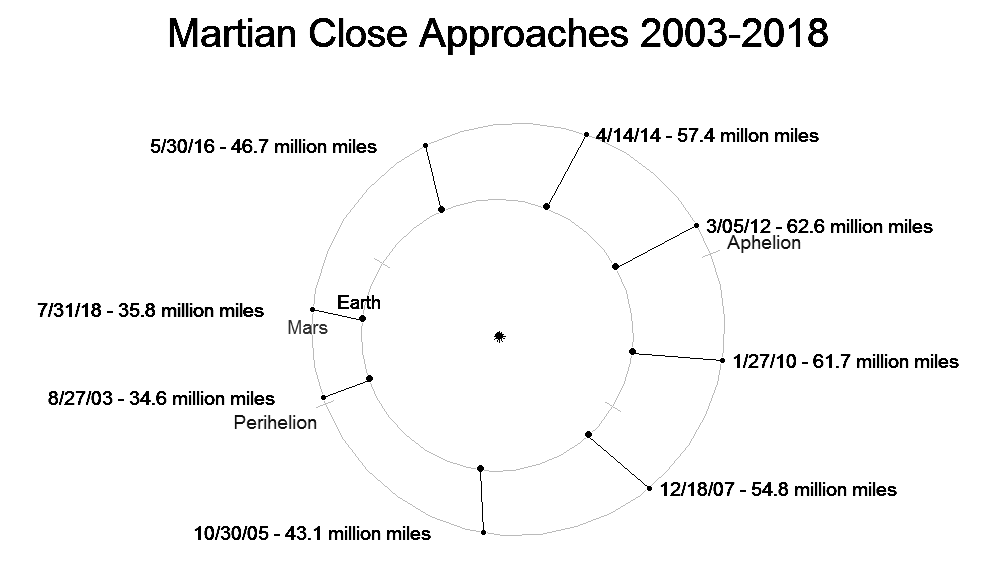
Mars closest approaches to the Earth from August 27, 2003 to July 31, 2018. Diagram created using Bob Moler’s LookingUp program.
Especially close approaches to the Earth occur every 15 or 17 years in the latter half of summer in those years. My first close approach was September 7, 1956. It was a famous one for the time. Professional astronomers of that time were pretty sure that Mars didn’t have canals, features that were ‘discovered’ by Giovanni Schiaparelli in 1877. To him the features were grooves or channels. Unfortunately the Italian word for them was canali. The world press proclaimed that there were “canals” on Mars. Canals by definition are artificial and require canal builders, Martians by inference.
Like I said, professional astronomers had discounted them by 1956. But science fiction read by young impressionable amateur astronomers like myself talked about old races of Martians hoarding every last drop of water. So maybe we believed. With my 5 inch reflector I observed the polar cap and the large dark feature Syrtis Major.
My next close approach of Mars was August 12, 1971. That summer I was working out of town and in the midst of a move from Grand Rapids to Traverse City, so was unable to observe Mars properly.
In the summer and autumn of 1973 I was able to do an observing program of Mars when it was almost as close as in 1971, drawing its features. I found out that to really observe a planet it takes time to educate the eye and brain to see faint, fuzzy detail. And since I didn’t believe in canals by this time, I didn’t see them.
The next close approach was September 22, 1988. The first “Mars Night” held by the society. We had a great turnout. But Mars was tiny as seen in telescopes. At best it was 23.81 seconds of arc in diameter. The Moon and Sun are about 1,800 seconds in diameter. It would be a bit larger than half the apparent diameter of Jupiter at average distance.
On August 27, 2003 Mars came closer than at any time in 50,000 years some astronomers said. The society held its second “Mars Night” at the Rogers Observatory, and wow, the lines of people ran down the drive and onto the shoulder of the road. As in 1988, I was stationed on the lawn at the front of the observatory with the portable Celestron 11 telescope, which actually gave clearer views than the 14 inch telescope in the dome. (Hot bodies in dome make for lousy seeing.)
2003 is also memorable or rather infamous for the “Mars Hoax” email. Proclaiming that Mars would appear as large as the Moon on August 27th. This hoax has been propagated every two years since. I expect 2018 to be a banner year for the resurrection of the hoax.
We come to this year, 2018, 15 years after the 2003 closest approach. Mars will reach opposition on July 27th. It’s closest approach to the Earth will be on July 31st, at the distance of 35,784,000 miles. The reason the dates aren’t the same is that Mars will still be a month before reaching perihelion, its closest to the Sun, so it’s getting even closer than at the time of opposition.
The Mars oppositions of October 2020, December 2022, January 2025 and February 2027 will be of increasing distances up to 63.0 million miles. This will be followed by oppositions of decreasing distances in March 2029, May 2031, and July 2033 leading to another close approach on September 11, 3035 at 35.4 million miles.
However by 2035 there may be humans on Mars waving back at us. It’s odd that anyone on Mars at the time probably wouldn’t be able to see the Earth at that time. Martian oppositions for us, are the time of inferior conjunctions of Earth with the Sun. We’d be lost in the Sun’s glare.
For the very closest views of Mars get on the Internet and search for Mars Curiosity, Mars Opportunity and Mars Hirise. No telescope required.
05/21/2018 – Ephemeris – 408 years ago Galileo discovered that Jupiter had moons
Ephemeris for Monday, May 21st. Today the Sun will be up for 15 hours and 2 minutes, setting at 9:10, and it will rise tomorrow at 6:07. The Moon, at first quarter today, will set at 2:55 tomorrow morning.
Jupiter is the bright star-like object in the southeast in the evening. In telescopes and even in binoculars the observer can spot up to four stars nearby. These aren’t stars, but moons or satellites of Jupiter. Galileo discovered them 408 years ago with his small telescope. Jupiter has 69 satellites in all at last count, but the rest are tiny objects. Of the four ‘Galilean’ satellites all but one is larger than the Moon. They are, in order from Jupiter Io, a volcano riddled world which is constantly resurfacing itself. Next is Europa an icy moon with a good probability of a salty ocean beneath. Giant Ganymede is next, larger than Mercury, it is also icy with the possibility of an ocean. Last is Callisto a dark moon with bright craters.
The times given are for the Traverse City/Interlochen area of Michigan. They may be different for your location.
Addendum
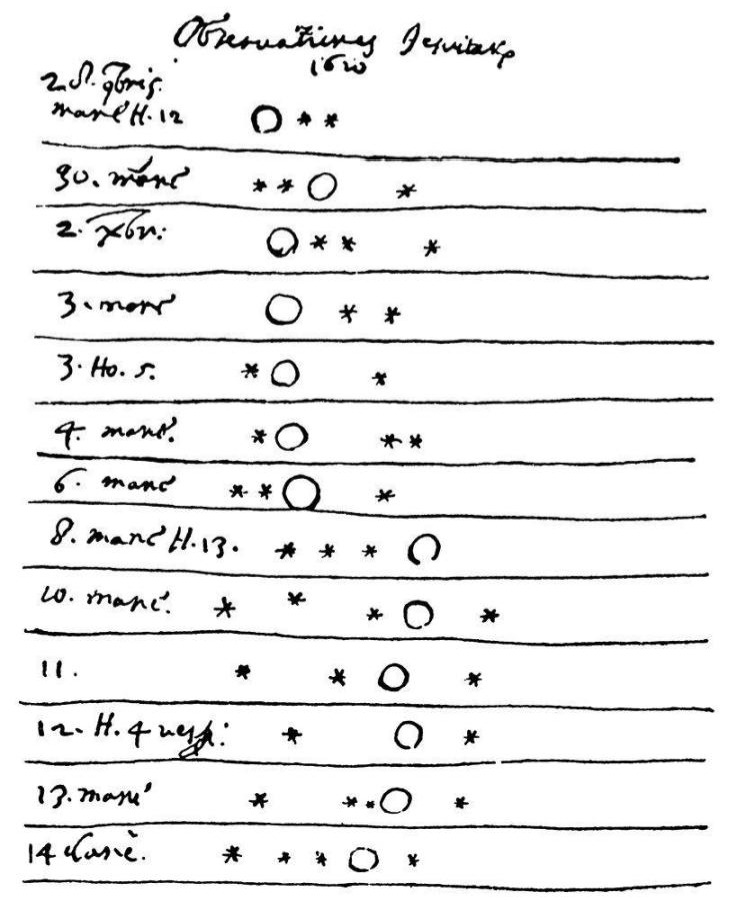
Multiple night sightings of Jupiter’s moons by Galileo.
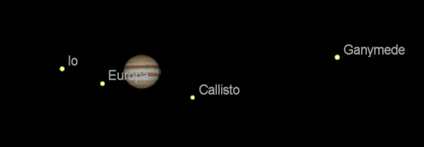
Jupiter and its moons tonight, May 21, 2018. Created using Cartes du Ciel (Sky Charts).
05/04/2018 – Ephemeris – Tonight I present Venus from the mists of time to today
Ephemeris for Friday, May 4th. The Sun rises at 6:28. It’ll be up for 14 hours and 23 minutes, setting at 8:51. The Moon, 3 days before last quarter, will rise at 1:15 tomorrow morning.
The planet Venus is our evening star now. I’ve been talking about it on this program lately. Want to hear and see more? Tonight at 8 p.m. at the May meeting of the Grand Traverse Astronomical Society at Northwestern Michigan College’s Rogers Observatory, I will be giving an illustrated talk: Venus from the mists of time to today. To the early Greeks it was two planets. To the Maya it was a calendar. In the 18th century it was a way to measure the size of the solar system. Today, it could be what our future looks like. After the meeting, at 9 p.m. the society will host a star party to view the planets Venus and Jupiter. The observatory is located south of Traverse City on Birmley Road between Garfield and Keystone roads.
The times given are for the Traverse City/Interlochen area of Michigan. They may be different for your location.
Addendum

5 Pages of the Dresden Codex produced by the Maya tracking Venus’ appearances in the skies over the Yucatan. for 104 years. The Dresden Codex is one of only 4 surviving Mayan Codices.
12/22/2017 – Ephemeris – The joining of a god and goddess, a second possibility of the Star of Bethlehem
Ephemeris for Friday, December 22nd. The Sun will rise at 8:16. It’ll be up for 8 hours and 48 minutes, setting at 5:05. The Moon, half way from new to first quarter, will set at 9:21 this evening.
On Tuesday I talked about what I said was one of two possible physical explanations for the Star of Bethlehem. Here is the second. On August 13th of 3 BC Jupiter and Venus briefly merged in the pre-dawn skies against the constellation of Leo the lion. A month later Jupiter was in conjunction with Regulus the bright star in Leo, the little king star. Then 9 months later, after sunset on June 16th of 2 BC the two planets again joined as one in Leo. The king of the planets twice mating with Venus as Ishtar, the Babylonian goddess of fertility, against the constellation of the lion signifying Judah in Genesis? One might find meaning in all that, especially the Magi, who were Zoroastrian astrologer-priests from Persia.
The times given are for the Traverse City/Interlochen area of Michigan. They may be different for your location.
Addendum
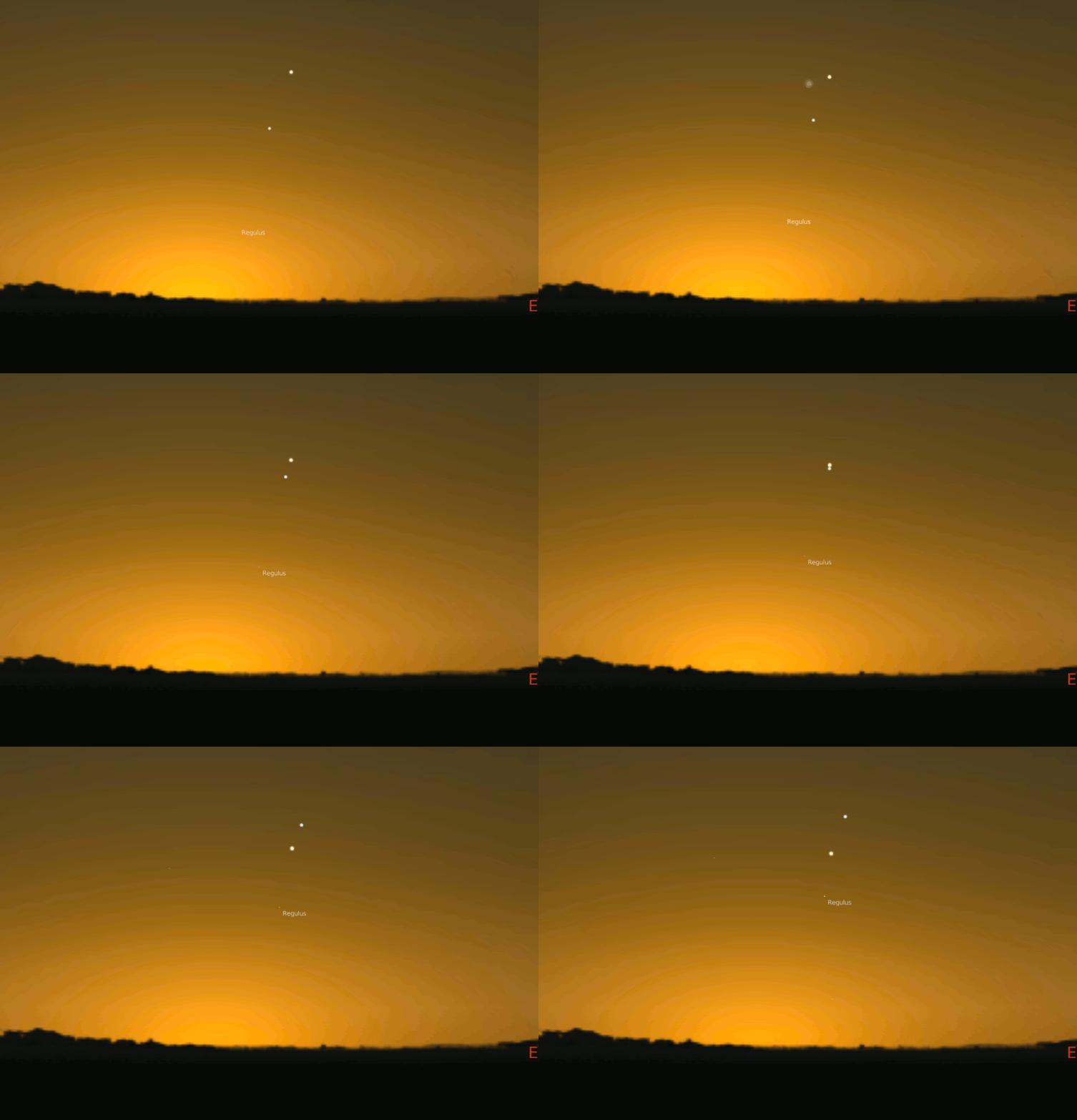
Animation of the Jupiter-Venus conjunction of August 13, 3 BC. in the morning twilight. Created using Stellarium.
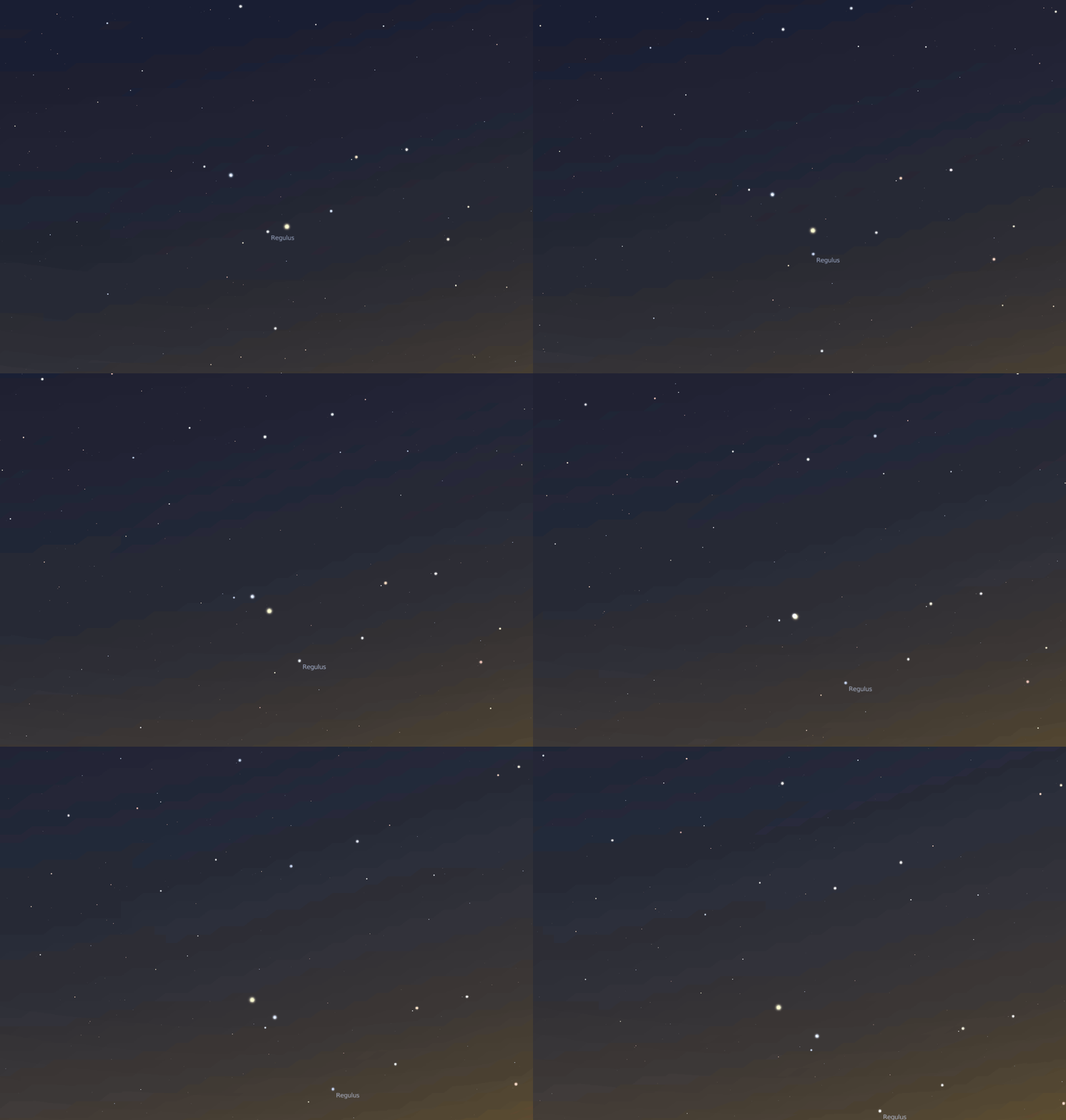
June 16, 2 BC just after sunset Jupiter and Venus again cross paths, at one point too close to be separated with the naked eye. Created using Stellarium.
03/17/2017 – Ephemeris – When Ireland had the largest telescope in the world
Ephemeris for St. Patrick’s Day, Friday, March 17th. The Sun will rise at 7:50. It’ll be up for 12 hours even, setting at 7:51. The Moon, 3 days before last quarter, will rise at 1:01 tomorrow morning.
In the 19th century Ireland laid claim to having the largest telescope in the world. It was a reflecting telescope with a mirror diameter of 72 inches. It was built by William Parsons the Third Earl of Rosse. The base of the telescope tube rested in a pit between two massive walls and could only look in a north-south direction. It saw first usage in 1847. The telescope was called the Leviathan of Parsonstown, and was in use until 1890. Mirrors in those days was made of a silvery alloy called speculum. Two mirrors were used alternately because speculum tarnished. The mirror not in use would have to be re-polished and swapped in from time to time. It was the largest telescope until the 100 inch at Mt. Wilson was put in service in 1917.
Times are for the Traverse City/Interlochen area of Michigan. They may be different for your location.
Addendum

The 72 inch Leviathan of Parsonstown. source: http://www.klima-luft.de/steinicke/ngcic/persons/rosse3.htm
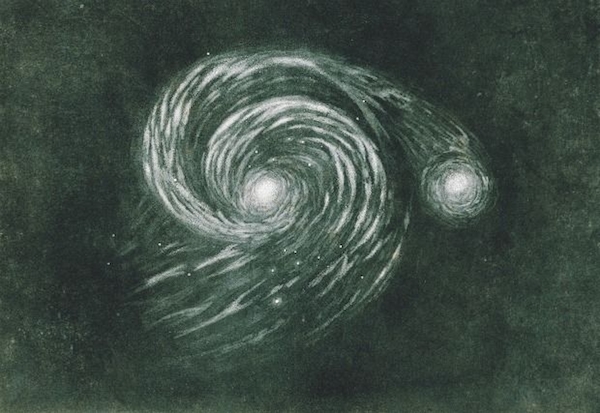
A drawing of the Whirlpool Galaxy, M51 (NGC 5194 & 5195) by Lord Rosse with the 72 inch telescope. Public Domain.
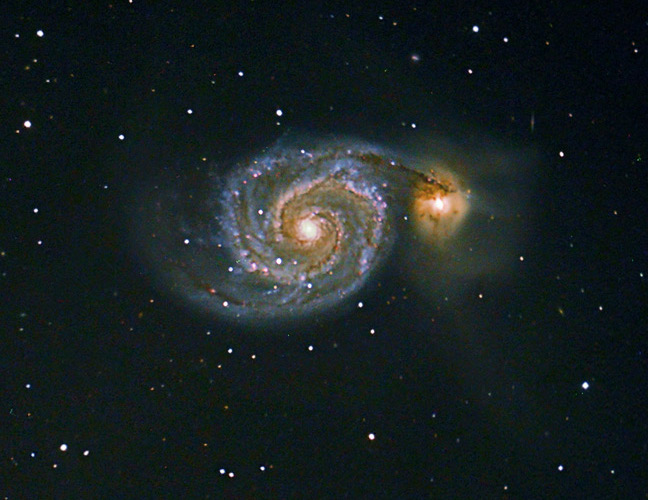
The Whirlpool Galaxy, M51. Credit Scott Anttila.
The Whirlpool Galaxy is the only galaxy that I’ve actually visually seen spiral arms on. It was seen using a Celestron 14″ telescope at Northwestern Michigan’s Joseph H. Rogers Observatory. That was a looong time ago.
02/13/2017 – Ephemeris – The brightest night-time star has a tiny stellar companion
Ephemeris for Monday, February 13th. The Sun will rise at 7:45. It’ll be up for 10 hours and 23 minutes, setting at 6:08. The Moon, 3 days past full, will rise at 9:16 this evening.
Sirius is the brightest night-time star and is located in the south at 9 p.m. below and a bit left of Orion the Hunter. We’ve visited Sirius last week. But there is another star in the Sirius system that is practically invisible due to Sirius’ dazzling glare. It’s Sirius B, nicknamed the Pup, alluding to Sirius’ Dog Star title. The tiny star was suspected as far back as 1834 due to Sirius’ wavy path in the sky against the more distant stars. Sirius is only 8 light years away. Sirius A and the Pup have 50 year orbits of each other. The star was first seen by Alvan Clark in 1862 while testing a new telescope. The Pup was the first of a new class of stars to be discovered, white dwarfs. The Pup is about the size of the Earth, with the mass of our Sun; its out of fuel and slowly collapsing.
Times are for the Traverse City/Interlochen area of Michigan. They may be different for your location.
Addendum
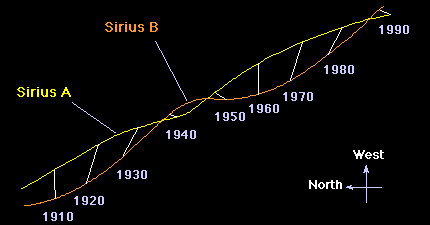
Sirius A & B’s path in the sky showing the wobble that betrayed the Pup’s presence. Credit Mike Guidry, University of Tennessee.
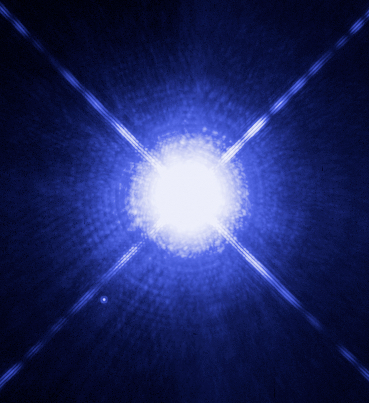
Sirius A and B (near the diffraction spike to the lower left), A Hubble Space Telescope photograph. Credit NASA, ESA.
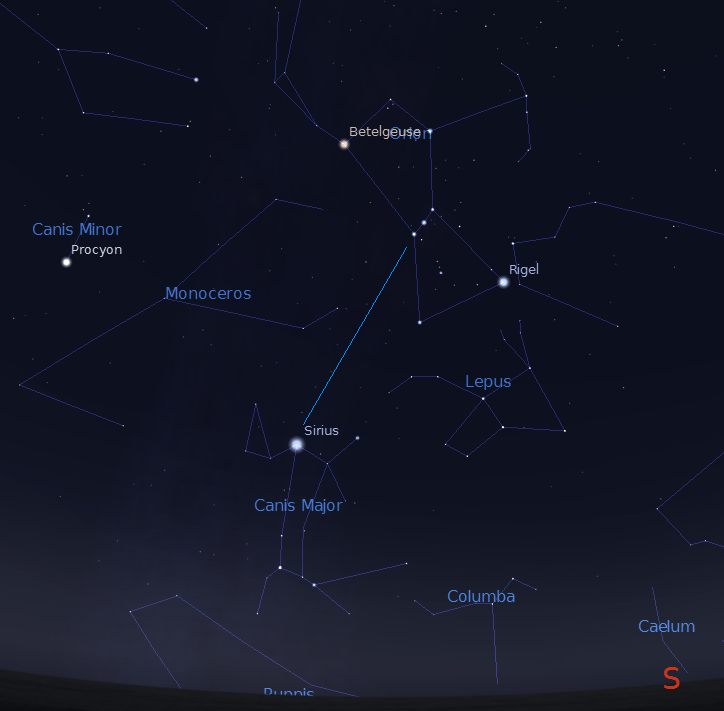
Orion’s Belt points to Sirius. Created using Stellarium.
02/07/2017 – Ephemeris – Sirius: an important star in history
Ephemeris for Tuesday, February 7th. The Sun will rise at 7:53. It’ll be up for 10 hours and 6 minutes, setting at 6:00. The Moon, 3 days before full, will set at 5:53 tomorrow morning.
The brightest star-like object in the evening sky is Sirius, also known as the Dog Star. It also is the brightest night-time star in our skies period. Tonight at 9 p.m. it’s located in the southeastern sky. The Dog Star name comes from its position at the heart of the constellation Canis Major, the great dog of Orion the hunter. The three stars of Orion’s belt tilt to the southeast and point to Sirius. The name Sirius means ‘Dazzling One’, a reference to its great brilliance and twinkling. Its Egyptian name was Sothis, and its appearance in the dawn skies in late June signaled the flooding of the Nile, and the beginning of the Egyptian agricultural year. Sirius owes much of its brightness to the fact that it lies quite close to us, only about 8 light years away.
Times are for the Traverse City/Interlochen area of Michigan. They may be different for your location.
Addendum
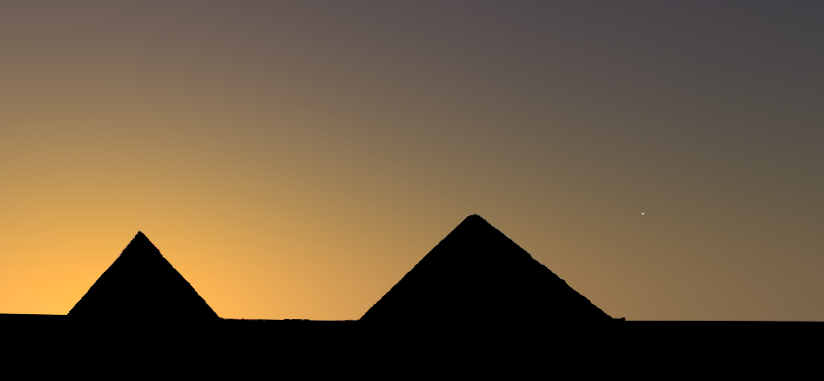
A simulation of the heliacal rising of Sothis (Sirius) with the Egyptian Pyramids circa 2000 BC. Note that Sirius is just visible to the right of the nearest Pyramid. Created using Stellarium and GIMP.
A heliacal rising is the first appearance of a star or planet in the morning after disappearing weeks or months before in the evening twilight.
 Bob Moler's Ephemeris Blog