Archive
Ephemeris: 12/29/2025 – 3I/ATLAS, Comet of the Year
This is Ephemeris for Monday, December 29th. Today the Sun will be up for 8 hours and 50 minutes, setting at 5:10, and it will rise tomorrow at 8:19. The Moon, 2 days past first quarter, will set at 4:04 tomorrow morning.
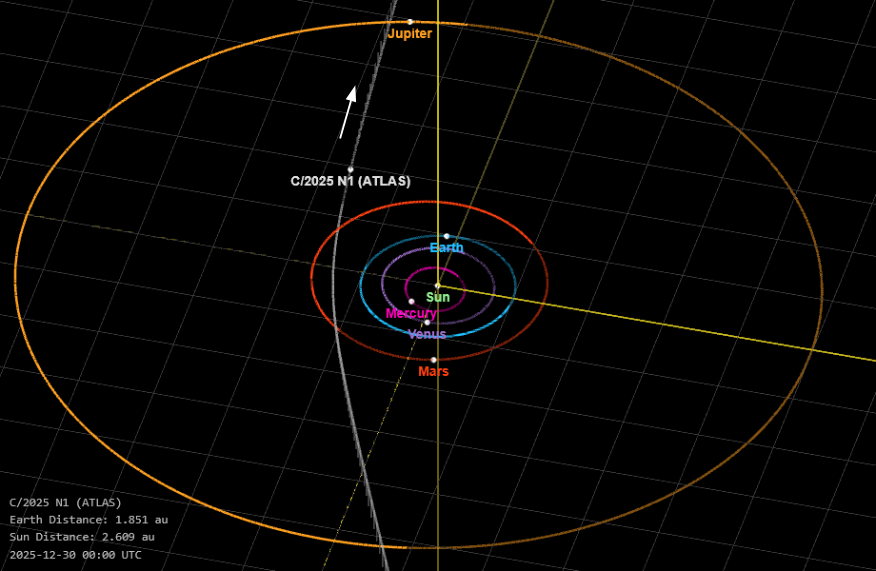
One of the more interesting events that occurred this year was the discovery at midyear of an interstellar visitor to the solar system, a comet called 3I/ATLAS. Last week as I heard in breathless news reports that the comet came its closest to the Earth. Well yeah, it was its closest to the Earth, but it wasn’t all that close. It was actually farther from us than the Sun is. We were nowhere close to the comet at anytime in its orbit, passing through the inner solar system. The closest it ever got to anything was to Mars, in October. Now as 3I/ATLAS is moving out of the inner solar system the Hubble and James Webb space telescopes can take a good look at it. Despite what the cranks say, it’s still just a comet, but from another solar system.
The astronomical event times given in this blog are for the Traverse City/Interlochen area of Michigan (Lat 44.7° N, Long 85.7° W; EST, UT – 5 hours) unless stated otherwise. Times will be different for other locations.
Addendum
Ephemeris: 12/02/2025 – Not the famous Comet ATLAS is breaking up
This is Bob Moler with Ephemeris for Tuesday, December 2nd. Today the Sun will be up for 9 hours and 1 minute, setting at 5:03, and it will rise tomorrow at 8:02. The Moon, 2 days before full, will set at 6:32 tomorrow morning.
I have a story about another comet ATLAS. This one is not the famous 3I/ATLAS, the interstellar interloper that is cruising through the inner solar system right now. It is another Comet ATLAS C/2025 K1, discovered in May, a little over a month before the famous one was. What we’re finding is that with comets, breaking up is not hard to do. It’s nucleus, the solid part of a comet, has broken into at least three separate pieces which are slowly separating. A comet’s nucleus is only a few miles in diameter. It is not tightly packed like a planet would be. One might think of them as kind of fluffy, especially this one, which is probably having it’s first go round close to the Sun. It appears to be an Oort cloud comet, who’s orbital period is thousands of years long.
The astronomical event times given in this blog are for the Traverse City/Interlochen area of Michigan (Lat 44.7° N, Long 85.7° W; EDT, UT – 4 hours) unless stated otherwise. Times will be different for other locations.
Addendum
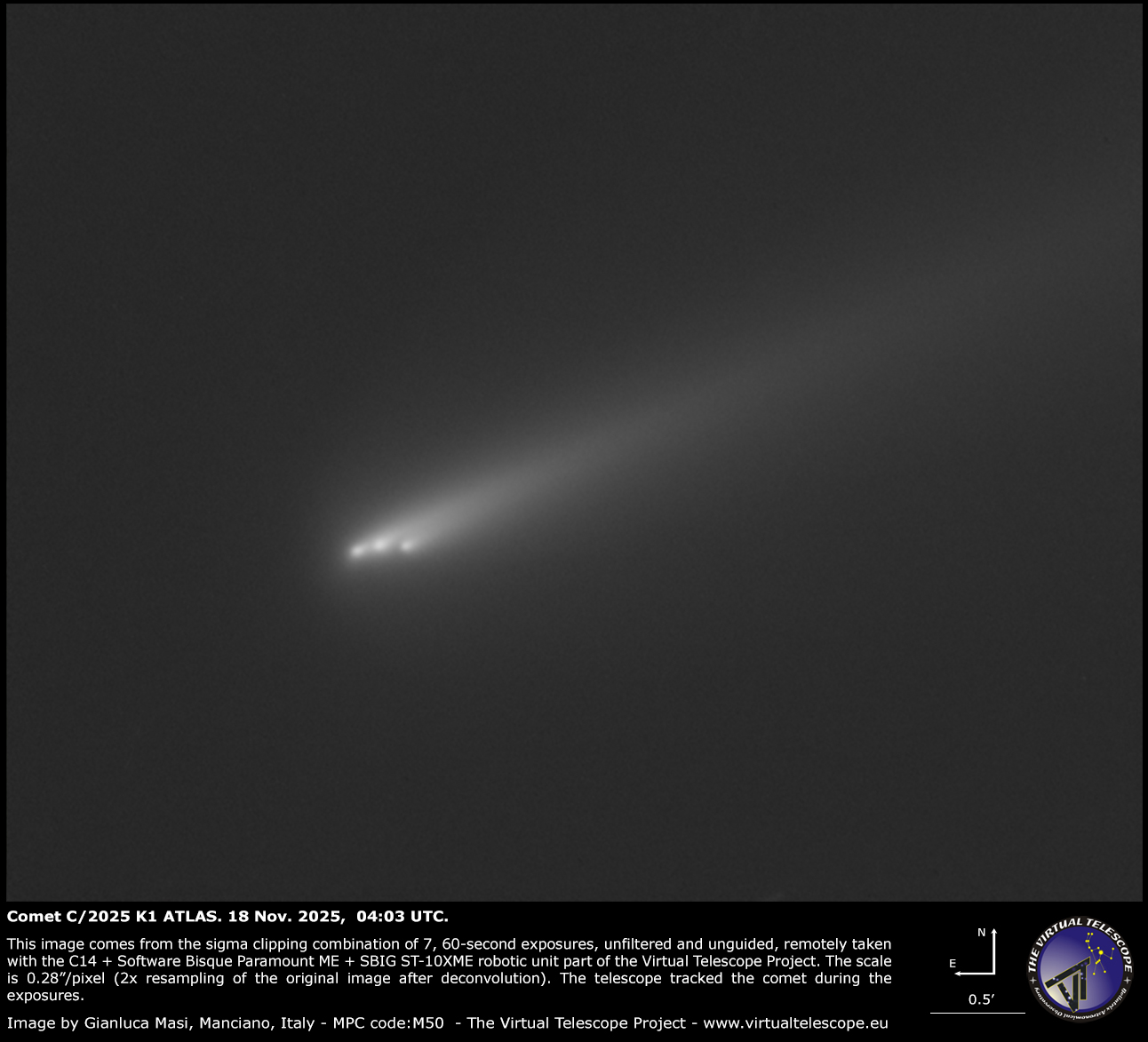
Comets are named for the person or organization that discovered it. ATLAS is the Asteroid Terrestrial-Impact Last Alert System (ATLAS) search program. There’s a lot of comet ATLASes running around out there.
Ephemeris: 09/09/2025 – 3I/ATLAS, a minority view
This is Ephemeris for Tuesday, September 9th. Today the Sun will be up for 12 hours and 49 minutes, setting at 8:04, and it will rise tomorrow at 7:16. The Moon, 2 days past full, will rise at 8:51 this evening.
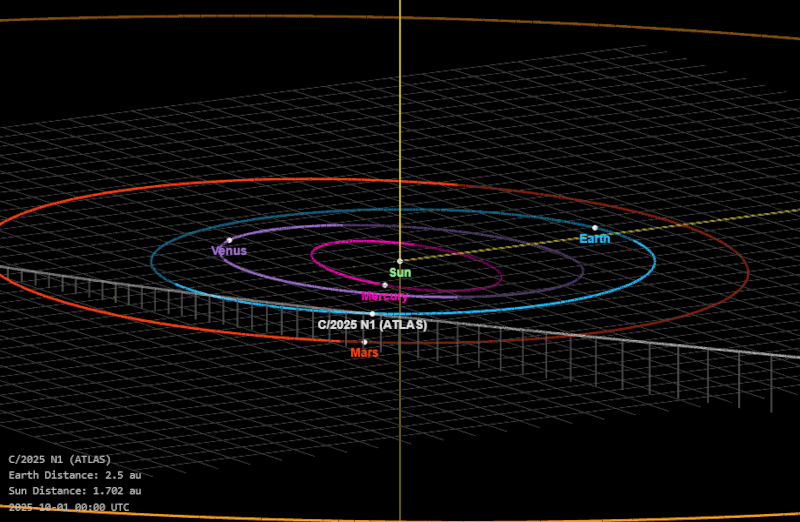
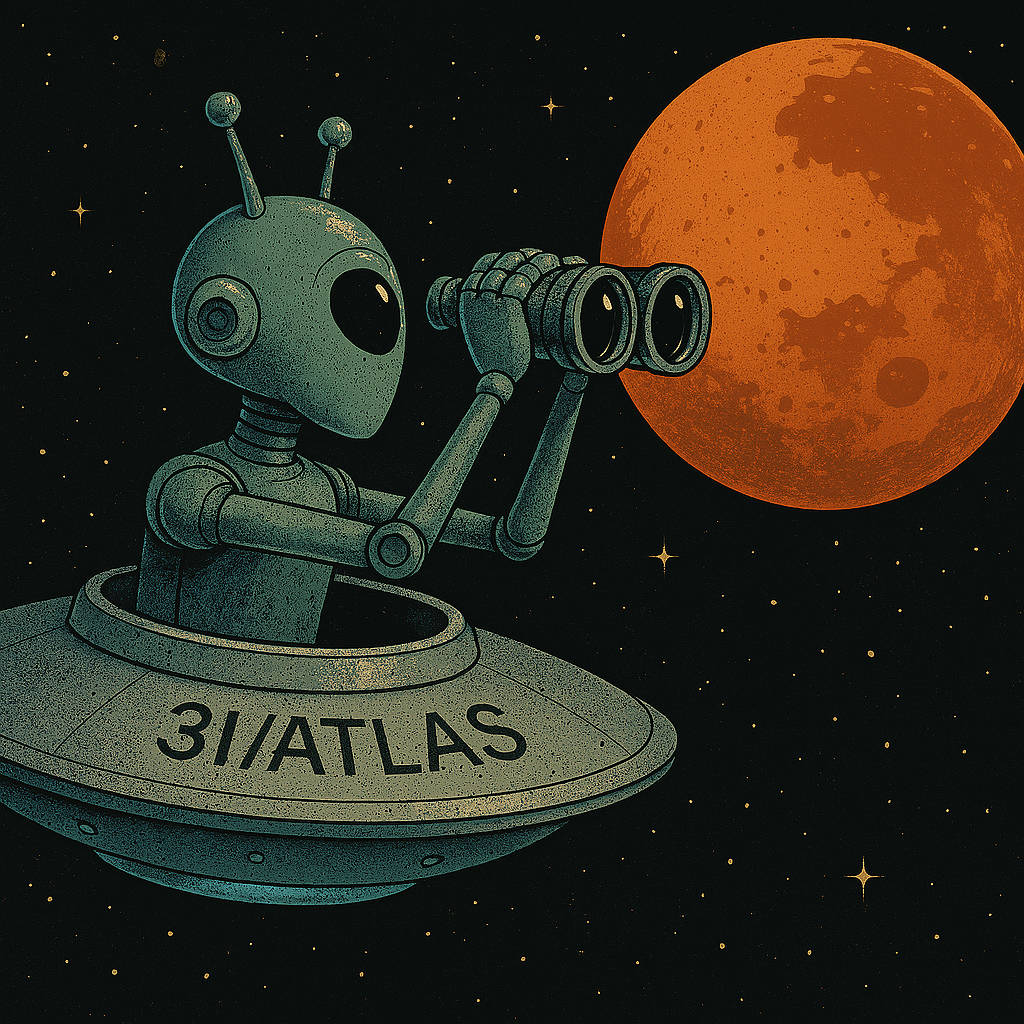
Interstellar object 3I/ATLAS is closing in on the planet Mars, which it will reach nearest to on October 1st. Some speculate, including one Harvard professor, that maybe it’s an alien probe. This object is much too slow to traverse the interstellar medium between stars with a biological crew, who are short-lived like us. More likely it would be crewed by robots run by artificial intelligence, like which we are beginning to perfect. 3I/ATLAS will not get very close to the Earth, but will get close to Mars. That got me to speculating, tongue in cheek of course, that being a machine intelligence they would be more interested in Mars. The reason being, that Mars is the only planet that’s entirely inhabited by robots, like themselves.
The astronomical event times given in this blog are for the Traverse City/Interlochen area of Michigan (Lat 44.7° N, Long 85.7° W; EDT, UT – 4 hours) unless stated otherwise. Times will be different for other locations.
Addendum
Ephemeris: 09/02/2025 – 3I/ATLAS, interstellar visitor
This is Ephemeris for Tuesday, September 2nd. Today the Sun will be up for 13 hours and 10 minutes, setting at 8:17, and it will rise tomorrow at 7:07. The Moon, 2 days past first quarter, will set at 1:54 tomorrow morning.
Interstellar visitor 3I/ATLAS was discovered a couple of months ago. We are lucky because it was discovered on its way into the inner solar system. The first interstellar visitor, 1I/‘Oumuamua, we didn’t spot until it had already passed and on its way out. It turns out that the chemical composition of this interstellar visitor, which astronomers think is a comet, has a great deal of carbon dioxide in its atmosphere compared to water. In the universe water is the third most common molecule after diatomic hydrogen and diatomic oxygen. But this comet appears to have about 8 times more carbon dioxide than water. Some astronomers think the 3I/ATLAS is 3 billion years older than the solar system making it 7 1/2 billion years old.
The astronomical event times given in this blog are for the Traverse City/Interlochen area of Michigan (Lat 44.7° N, Long 85.7° W; EDT, UT – 4 hours) unless stated otherwise. Times will be different for other locations.
Addendum
Ephemeris: 07/08/2025 – A third interstellar visitor discovered
This is Bob Moler with Ephemeris for Tuesday, July 8th. Today the Sun will be up for 15 hours and 23 minutes, setting at 9:29, and it will rise tomorrow at 6:06. The Moon, 2 days before full, will set at 4:20 tomorrow morning.
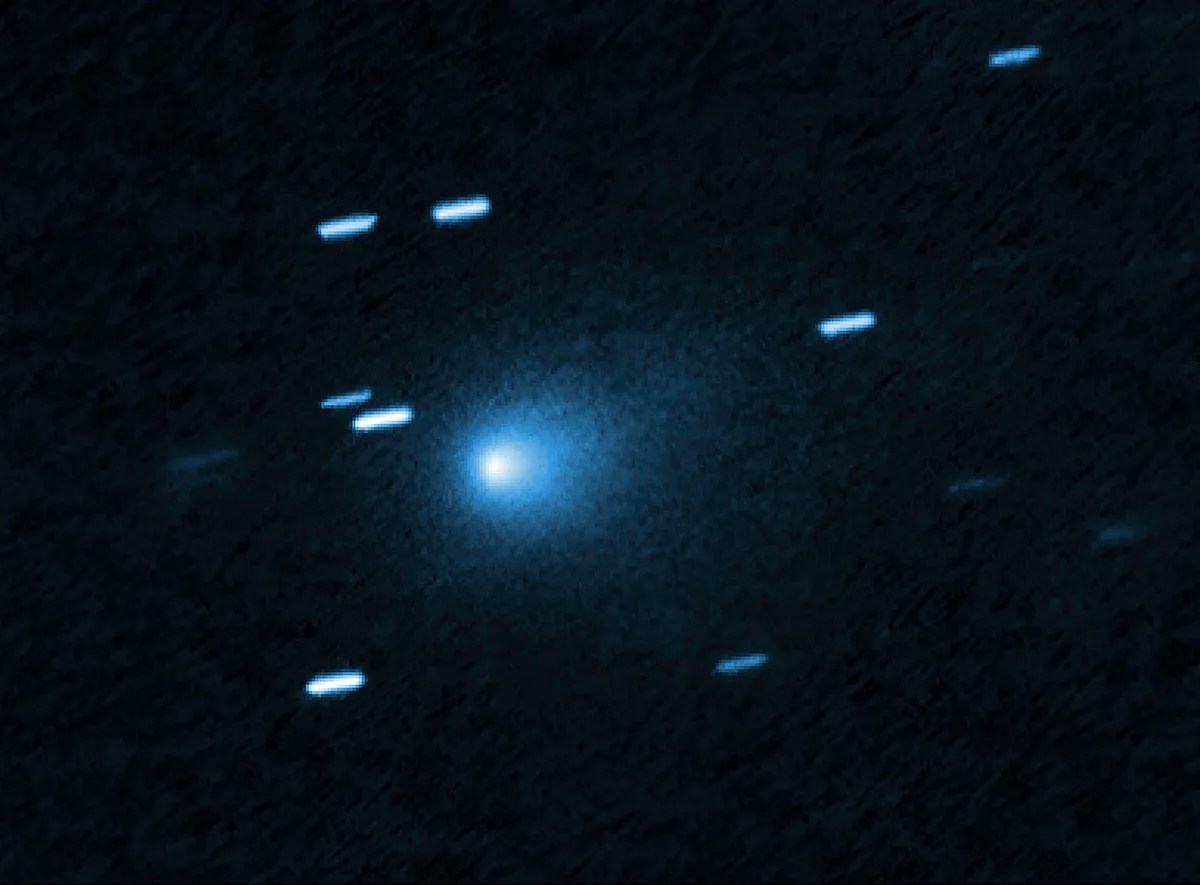
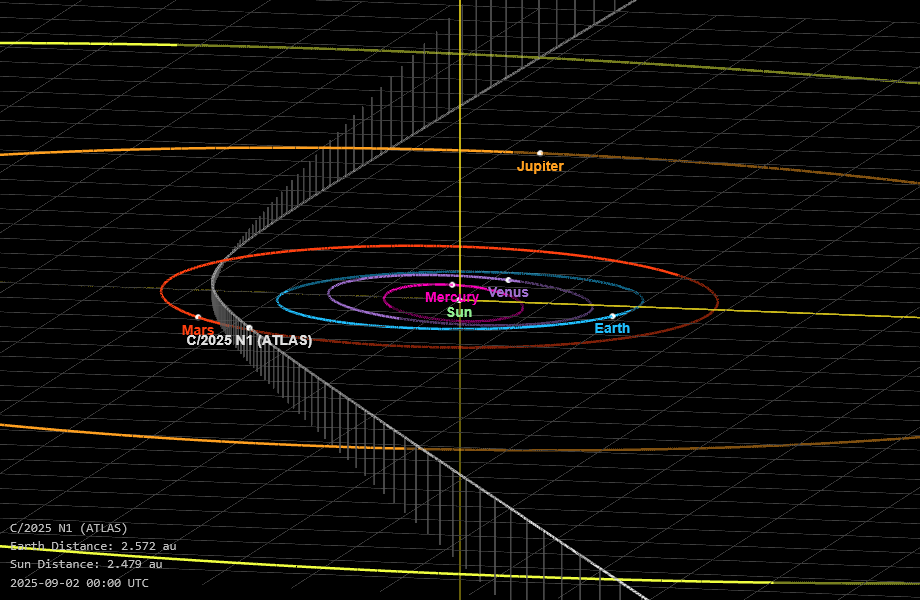
One week ago the third interstellar interloper to the solar system was discovered. It’s known as 3I/ATLAS. The “I” means interstellar. That is, it came from another star system. It is heading in now, crossing the asteroid belt. It will reach its closest to the Sun on October 29th, at about the distance of Mars, which it will get very close to by the way, and head out into interstellar space. This is an incredibly fast object, far exceeding the escape velocity of the Sun, and its path is only deflected by 17° by its encounter by the Sun’s gravitational force. Due to it high speed, it was first thought to be a Near Earth Object. Pre-discovery photographs showed that it was much more distant. With the new Rubin Observatory coming online we’ll discover many more.
The astronomical event times given in this blog are for the Traverse City/Interlochen area of Michigan (Lat 44.7° N, Long 85.7° W; EDT, UT – 4 hours) unless stated otherwise. Times will be different for other locations.
Addendum
Ephemeris: 10/30/2024 – Our weekly look at the whereabouts of the naked-eye planets
This is Ephemeris for Wednesday, October 30th. Today the Sun will be up for 10 hours and 14 minutes, setting at 6:33, and it will rise tomorrow at 8:20. The Moon, 2 days before new, will rise at 7:28 tomorrow morning.
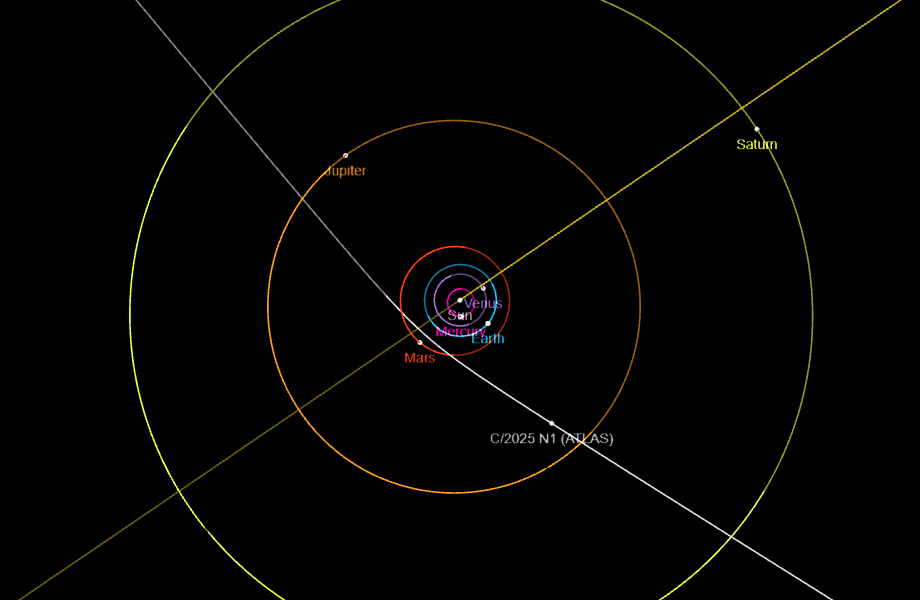
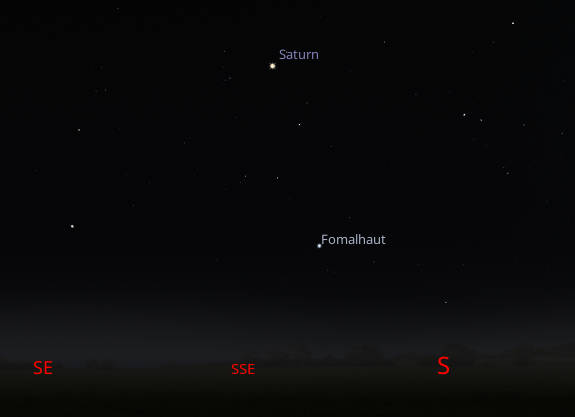
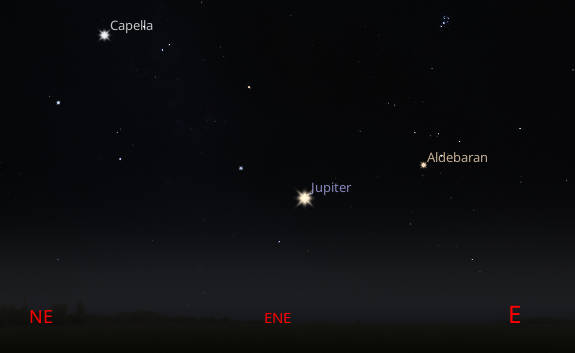
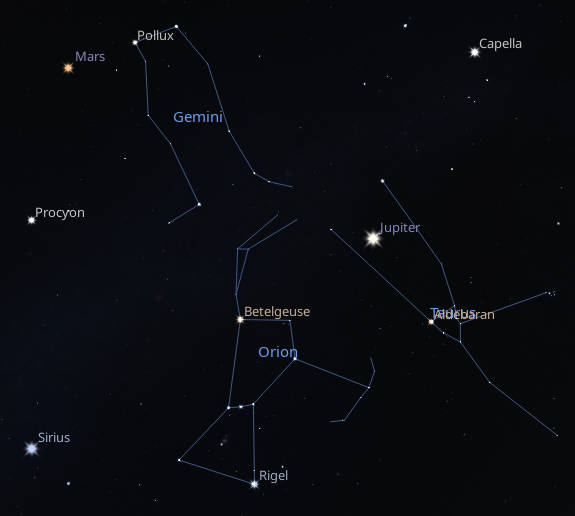
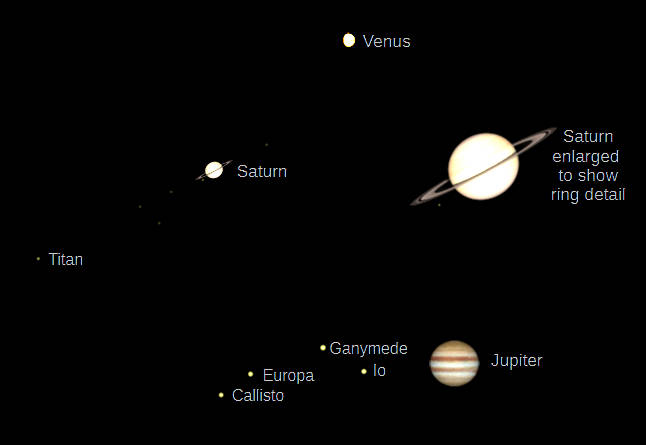
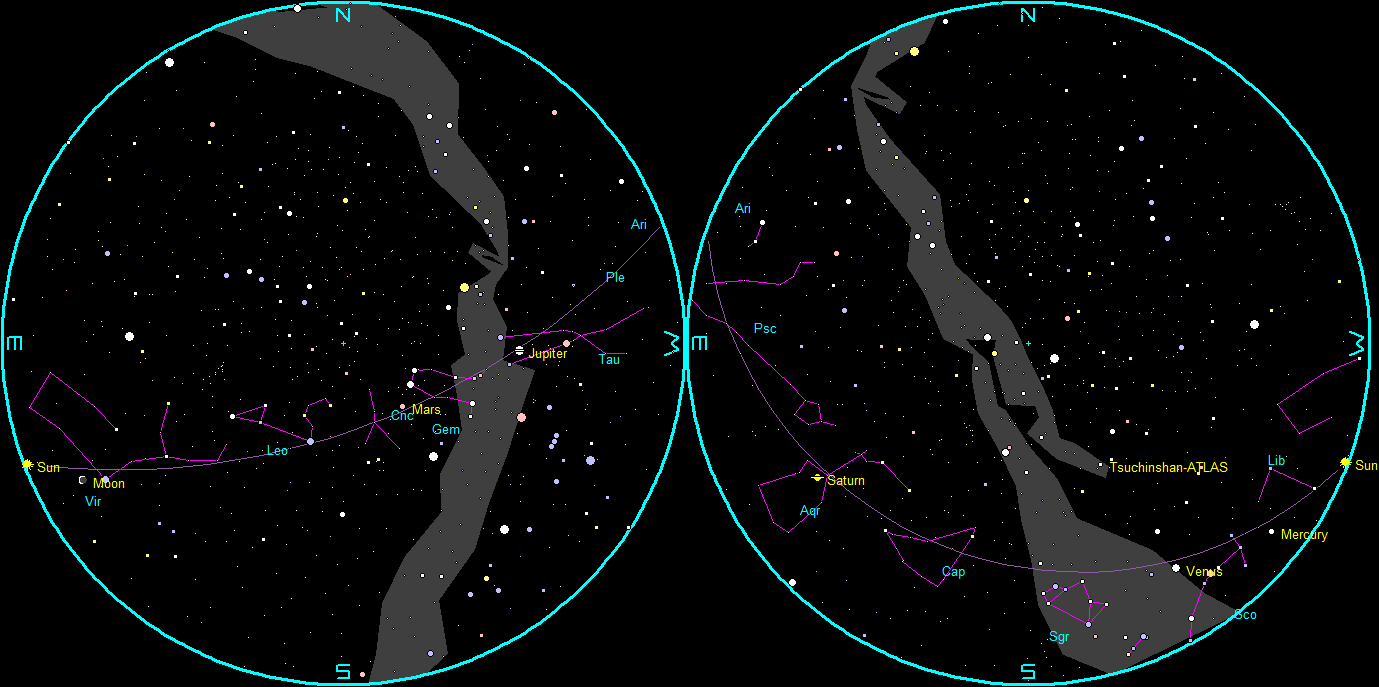
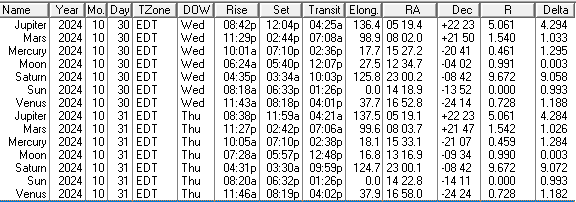
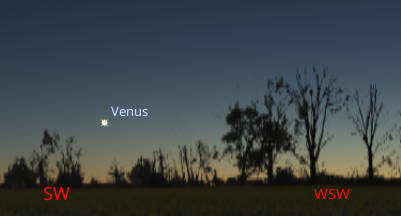
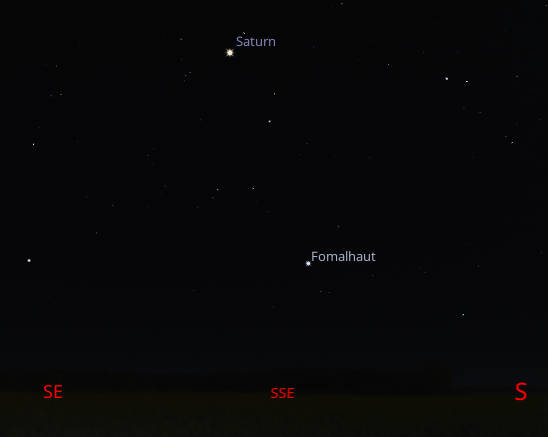
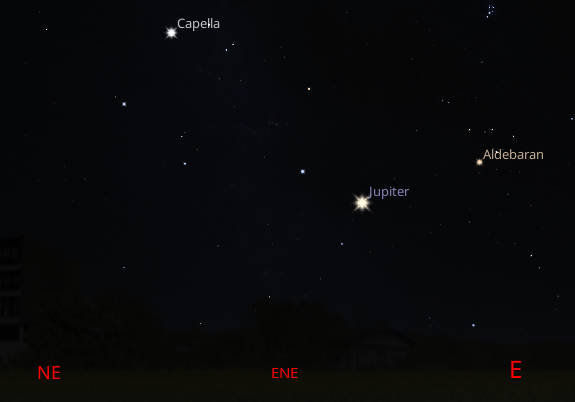
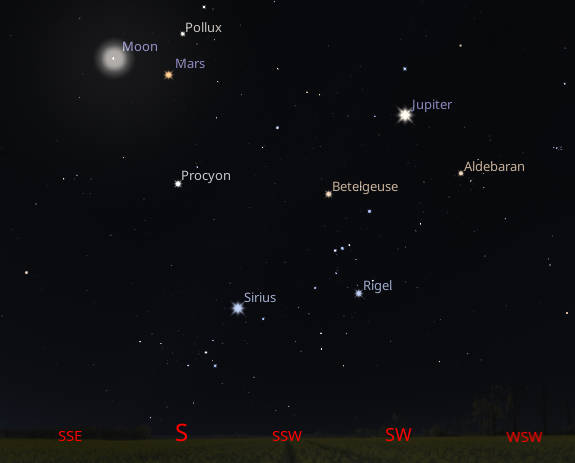
Let’s take our weekly look at the whereabouts of the naked-eye planets. Venus can be spotted low in the southwestern sky by 7 PM, about half an hour after sunset. It will set at 8:18. Comet Tsuchinshan-ATLAS is definitely a binocular object and will be a third of the way up to the zenith in the southwest around 8 PM. It will set at 11:17 PM. Saturn will be in the southeast at 8 PM. Jupiter will rise at 8:42 PM in the east northeast, and be a good object for the small telescope about an hour later. By 7:00 AM tomorrow Jupiter will be high in the west southwest, among the winter stars, while Mars, which rises tonight near 11:30, will be high in the south.
The astronomical event times given are for the Traverse City/Interlochen area of Michigan (EDT, UT – 4 hours). Times will be different for other locations.
Addendum
Ephemeris: 10/24/2024 – Looking at Comet Tsuchinshan-ATLAS for the rest of the month
This is Ephemeris for Thursday, October 24th. Today the Sun will be up for 10 hours and 31 minutes, setting at 6:42, and it will rise tomorrow at 8:12. The Moon, at last quarter today, will rise at 1:01 tomorrow morning.
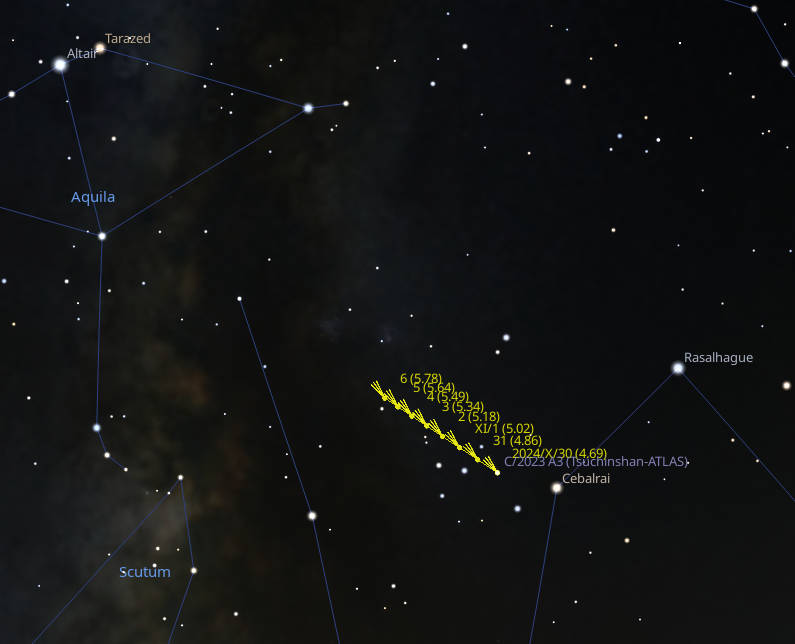
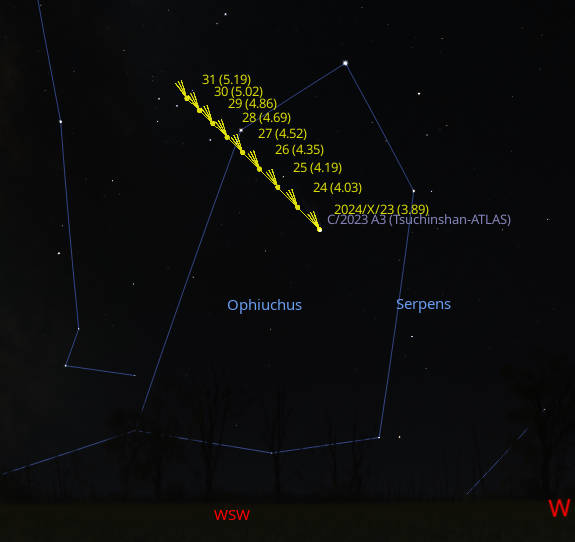
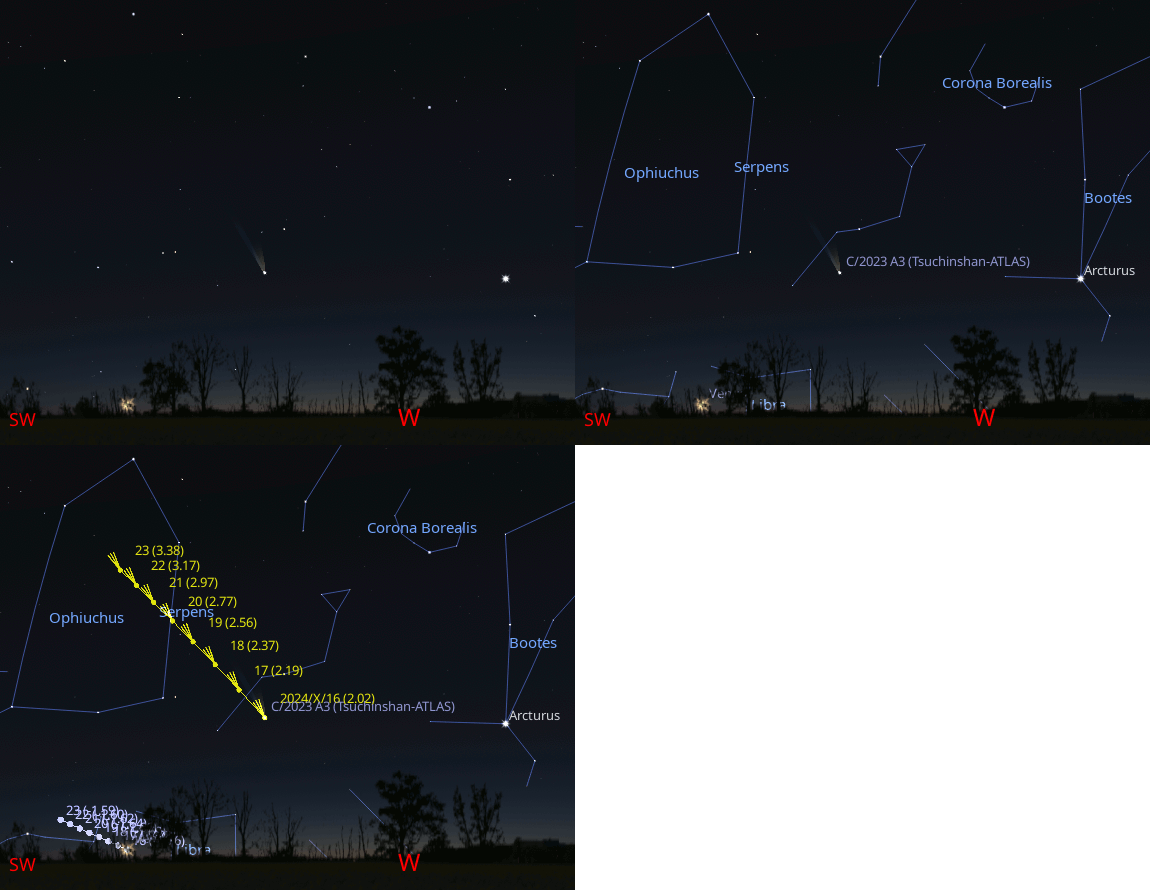
Looking at the rest of the month in viewing Comet Tsuchinshan-ATLAS in dark skies, we find it moving away from us and dimming rapidly. It will be moving across the constellation of Ophiuchus and it will be mostly in the west southwestern sky, And will need a pair of binoculars or a small telescope to spot. The comet has an easily seen tail, even when it becomes dim and only visible in binoculars. It should still have a tail. Comets sport two tails, a dust tail the bright tail that we see on comets, and a narrower ion tail. The ionized gas of the ion tail is driven back by the solar wind while the dust tail is predominantly affected by the pressure of sunlight itself. When close to the Sun it is moving more sideways, so the tails will appear to separate.
The astronomical event times given are for the Traverse City/Interlochen area of Michigan (EDT, UT – 4 hours). Times will be different for other locations.
Addendum
Ephemeris: 10/23/2024 – Taking a look at this week’s brighter solar system bodies
This is Ephemeris for Wednesday, October 23rd. Today the Sun will be up for 10 hours and 34 minutes, setting at 6:44, and it will rise tomorrow at 8:10. The Moon, 1 day before last quarter, will rise at 11:50 this evening.
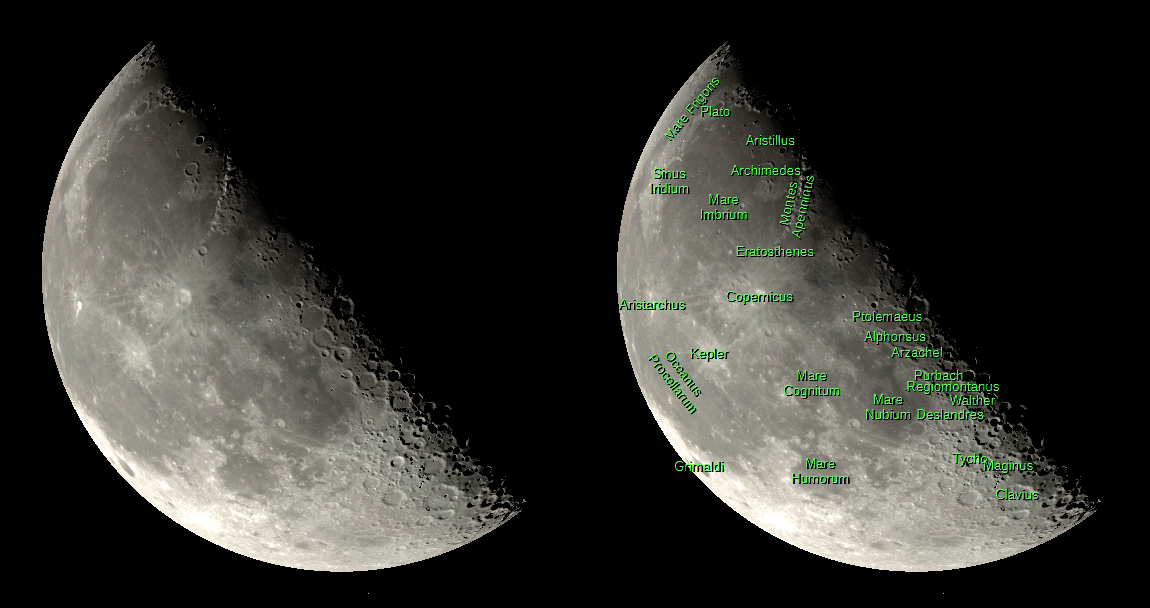
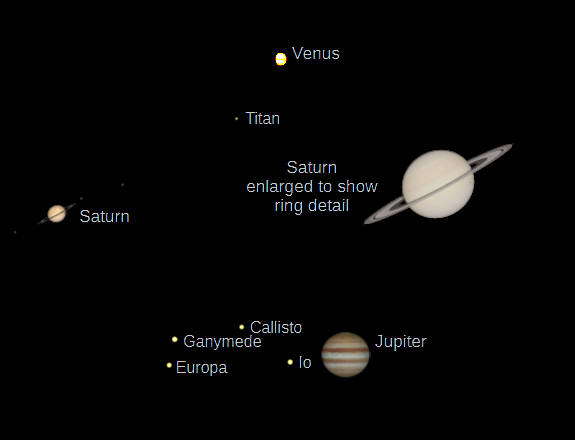
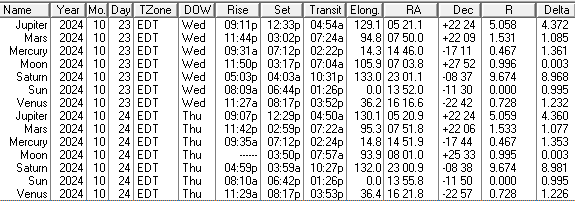
Let’s take our weekly look at the whereabouts of the naked-eye planets. Venus might be spotted in the West southwest low on the horizon at 7:15 PM, 29 minutes after sunset. It will set at 8:17. Comet Tsuchinshan-ATLAS will be west after 8:30 PM the end of astronomical twilight. It will set at 10:55 PM. Saturn will be in the southeast at 8 PM. Jupiter will rise at 9:11 PM this evening in the east northeast, and be a good object for the small telescope about an hour later. By 7:00 AM tomorrow Jupiter will be high in the southwest while Mars will be high in the south to the right of the Moon.
The astronomical event times given are for the Traverse City/Interlochen area of Michigan (EDT, UT – 4 hours). Times will be different for other locations.
Addendum
Ephemeris: 10/22/2024 – Reviewing last week’s showing of Comet Tsuchinshan-ATLAS
This is Ephemeris for Tuesday, October 22nd. Today the Sun will be up for 10 hours and 37 minutes, setting at 6:45, and it will rise tomorrow at 8:09. The Moon, 2 days before last quarter, will rise at 10:40 this evening.
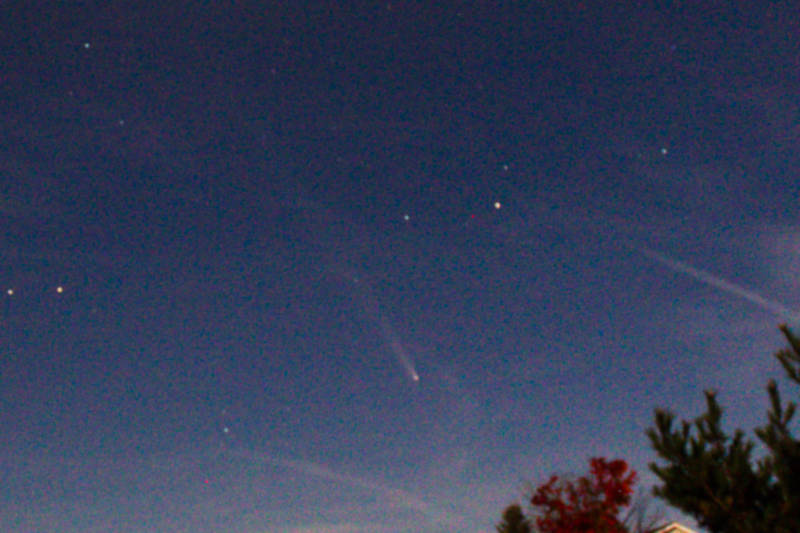
Comet Tsuchinshan-ATLAS continues to head out away from the Sun and the Earth, heading back to the Oort Cloud from whence it came. It’s best showing for us came last week. Unfortunately, it was cloudy the weekend before and the first part of the week when the comet was its brightest. However, by Wednesday evening I was able to spot the comet, but not with the naked eye. I could see it in binoculars and I photographed it. Between the twilight and bright moonlight my poor eyes were not able to spot it. Now that the Moon is leaving the evening sky, and the comet is moving up above the horizon in the west, it should be easily spotted with binoculars towards 9 pm. It has faded significantly and will continue as it speeds away from us.
The astronomical event times given are for the Traverse City/Interlochen area of Michigan (EDT, UT – 4 hours). Times will be different for other locations.
Addendum
Wednesday, October 16th
October 17th
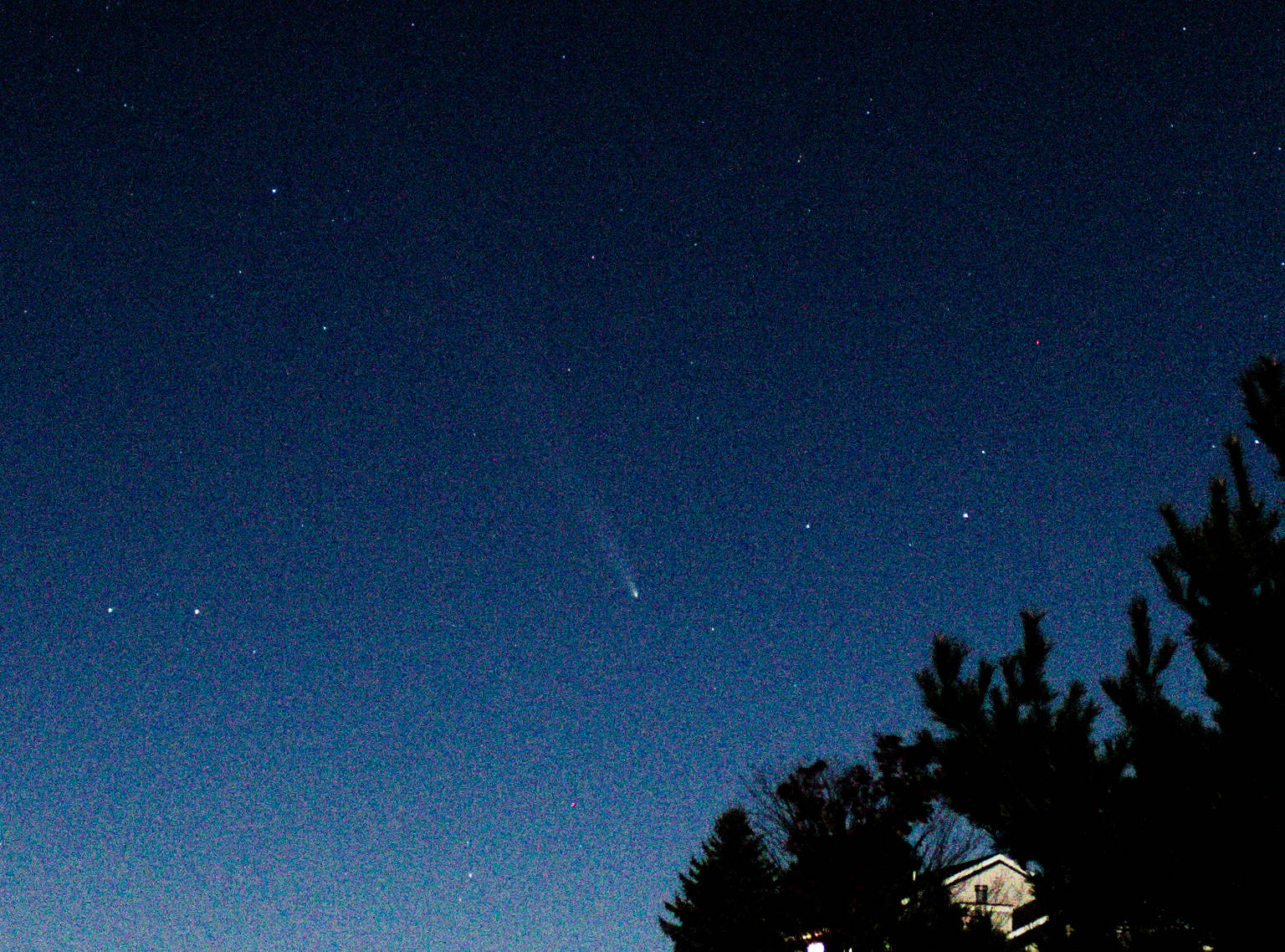
Comet track
Ephemeris: 10/21/2024 – Comets and meteors
This is Bob Moler with Ephemeris for Monday, October 21st. Today the Sun will be up for 10 hours and 40 minutes, setting at 6:47, and it will rise tomorrow at 8:08. The Moon, 3 days before last quarter, will rise at 9:35 this evening.
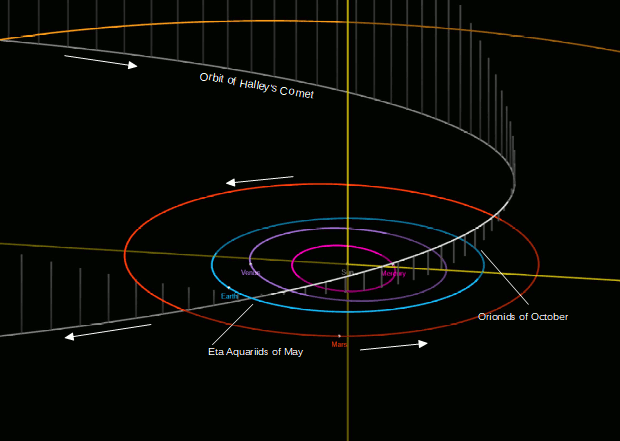
Comet Tsuchinshan-ATLAS it’s now far enough away from the sun so it stays up most of the evening, setting at 10:44 PM. It will be seen in the west southwestern sky for the most part. And now that it is dimming, it is probably best seen with binoculars. Last night was the peak of the Orionid meteor shower. The shower had to compete with a bright Moon. Meteor showers are caused by comets shedding their material as they pass close to the Sun, as the gases sublimate liberating dust and rocks. Dust and gases are blown back into the tails of a comet. The bits of rock end up in much the same orbit as the comet. If the comet’s orbit crosses the Earth’s orbit We have a meteor shower. The Orionids are caused by debris from Halley’s comet.
The astronomical event times given are for the Traverse City/Interlochen area of Michigan (EDT, UT – 4 hours). Times will be different for other locations.
Addendum
 Bob Moler's Ephemeris Blog