Archive
11/27/2015 – Ephemeris – C/2013 US10 (Catalina)
Ephemeris for Friday, November 27th. The Sun will rise at 7:54. It’ll be up for 9 hours and 10 minutes, setting at 5:05. The Moon, 2 days past full, will rise at 7:12 this evening.
This Comet Catalina, and there are many Comet Catalinas has the unique designation C/2013 US10. This comet was found by the Catalina Sky Survey which looks for near Earth objects called NEOs, so there are lots of little Comet Catalinas running around. I’ll just refer to it as US10 in honor of the downstate highway. It’s like the comet with the unpronounceable name that the Rosetta spacecraft is orbiting is now known as 67P, and that new Kuiper Belt object 2012VP113 is known as Biden, because Joe Biden is our VP or Vice President. See we astronomers do have a sense of humor. We were hoping that US10 would reach naked eye brightness, but it’s under performing now appearing about half as bright as we thought it should be.
Times are for the Traverse City/Interlochen area of Michigan. They may be different for your location.
Addendum
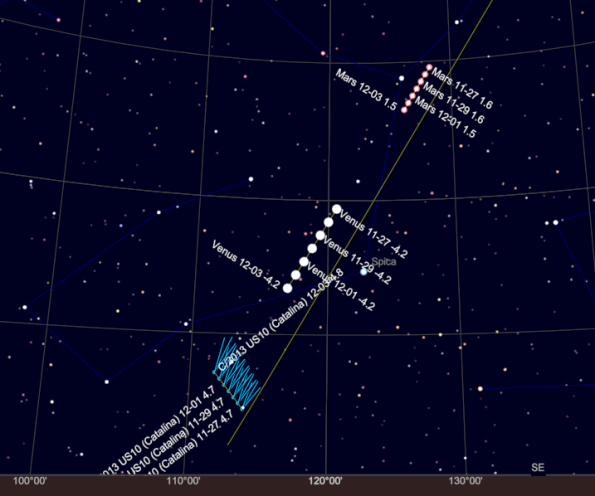
Comet Catalina, Venus and Mars tracking for 7 days starting November 27, 2015 for 7 days. The at 6 a.m. or about 2 hours before sunrise at around +45 degrees latitude. Created using Cartes du Ciel. Note that the comet magnitudes are still at least two magnitudes too bright. JPL Horizons Ephemeris shows the current estimates. Altitude and Azimuth grids are at 10 degree intervals.
º
º
11/26/2015 – Ephemeris – A new comet is becoming visible for binoculars or telescopes
Happy Thanksgiving, this is Bob Moler with Ephemeris for Thursday, November 26th. The Sun will rise at 7:53. It’ll be up for 9 hours and 12 minutes, setting at 5:06. The Moon, 1 day past full, will rise at 6:16 this evening.
There is a new comet becoming visible in the morning sky. It’s designation is C/2013 US10 (Catalina). While Catalina may remind you of an island off the coast of California, the comet was found by a NASA program based in the Catalina Mountains north of Tucson, Arizona that was looking for near Earth asteroids. Comet Catalina was discovered on Halloween night 2013 as a very faint object. As it approached the Sun it’s hyperbolic orbit took it into the southern hemisphere skies. It reached its closest point to the sun, called perihelion on November 15th, 11 days ago and is now climbing into our northern morning skies. By mid January it will be far enough north to be visible all night. The downside however is that it isn’t very bright.
Times are for the Traverse City/Interlochen area of Michigan. They may be different for your location.
Addendum
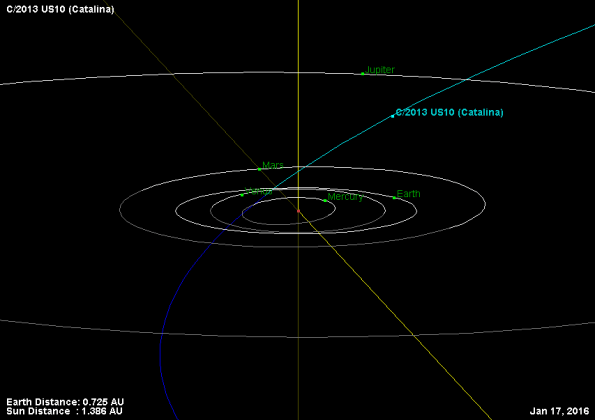
Comet C/2013 US10 (Catalina) at its closest approach to the Earth on January 17, 2016 of 0.725 AU, 67 million miles or 108 million kilometers. Credit NASA/JPL.
10/26/2015 – Ephemeris – RIP Robert Farquhar interplanetary navigator extraordinaire
Ephemeris for Monday, October 26th. The Sun will rise at 8:12. It’ll be up for 10 hours and 28 minutes, setting at 6:40. The Moon, 1 day before full, will set at 8:10 tomorrow morning.
This morning Jupiter and Venus appear close together in the morning sky. They are said to be in conjunction. Also Venus is at its greatest separation from the Sun today. It will slowly begin to fall back toward the Sun. Last week Sunday Robert Farquhar died. He developed the technique of orbiting the L1 point between the Sun and the earth where the Earth nullifies the Sun’s gravity, so a spacecraft can stay there between the Earth and the Sun. He designed the trajectory for the ISEE-3 spacecraft that acted as an early warning for particles coming from the Sun. He also liberated it in 1982 and through a series of ingenious maneuvers worked it into a solar orbit that flew it through the tail of Comet Giacobini-Zinner.
Times are for the Traverse City/Interlochen area of Michigan. They may be different for your location.
Addendum
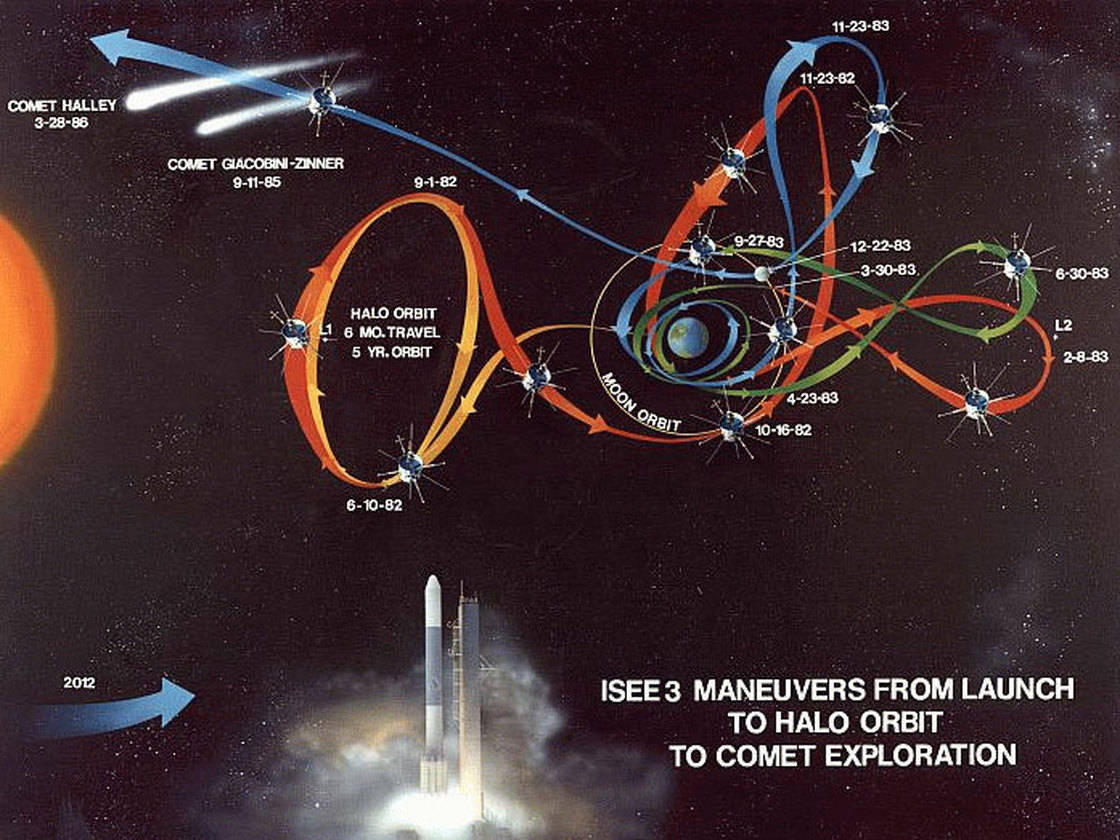
ISEE-3’s orbital path to the halo orbit at the Earth-Sun Lagrangian L1 point and out to cross the path of Comet Ziacobini-Zinner ahead of the fleet heading to Comet Halley. It was renamed ICE (International Comet Explorer). Credit: NASA/GSFC
Here’s a link to a page that recounts the quest to return the spacecraft to its L1 position by Farquhar and his band of “rouges” last year.
10/16/2015 – Ephemeris – The topic this Saturday will be comets (Updated)
Ephemeris for Friday, October 16th. The Sun will rise at 7:59. It’ll be up for 10 hours and 57 minutes, setting at 6:56. The Moon, half way from new to first quarter, will set at 9:20 this evening.
Tomorrow I have a treat for youngsters of all ages. From 10 a.m. to noon ( Update: noon to 2 p.m.) I’ll be talking about and helping to make comets at the Betsie Valley District Library in Thompsonville. First we’ll explore comets as seen in our skies then travel along with the Rosetta space mission to get up close to Comet 67P/Churyumov–Gerasimenko to see what it’s made of and what happens when it comes close to the Sun. Then we’ll make our own comet nucleus using many of the ingredients that are found in actual comets, though we’ll leave out all the poisonous ones, and we’ll see if it survives this close to the Sun. If you want to help make a comet, bring your winter gloves. I do have extras, but yours will probably work better.
Times for astronomical events are for the Traverse City/Interlochen area of Michigan. They may be different for your location.
06/16/2015 – Ephemeris – Philae phones home
Ephemeris for Tuesday, June 16th. Today the Sun will be up for 15 hours and 33 minutes, setting at 9:30. The Moon is new today, and won’t be visible.
Tomorrow the Sun will rise at 5:56. | As Comet 67P/Churyumov-Gerasimenko (Comet 67P for short, or the Rubber Duckie Comet) nears the orbit of Mars a couple of months from perihelion, its closest to the Sun, the Rosetta spacecraft, which has been orbiting it received welcome news from its lander Philae which fell silent 5 months ago. The lander woke up and has enough power to take measurements and transmit data to the Rosetta spacecraft. This is something the folks at the European Space Agency had hoped for. The comet has moved in its orbit around the Sun, so the Sun’s light now can fall on Philae’s solar panels long enough during the comet’s daily rotation to recharge its batteries. They are hoping that Philae can resume its surface mission. This is just amazing!
Times are for the Traverse City/Interlochen area of Michigan. They may be different for your location.
Addendum
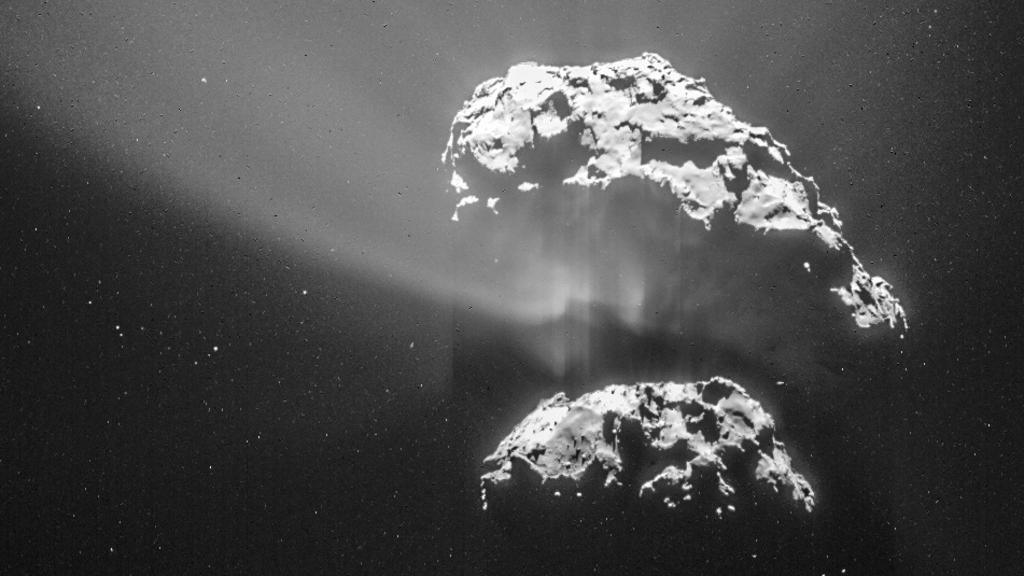
Comet 67P and jets of dust, carried by sublimating ices. Credit: ESA/Rosetta
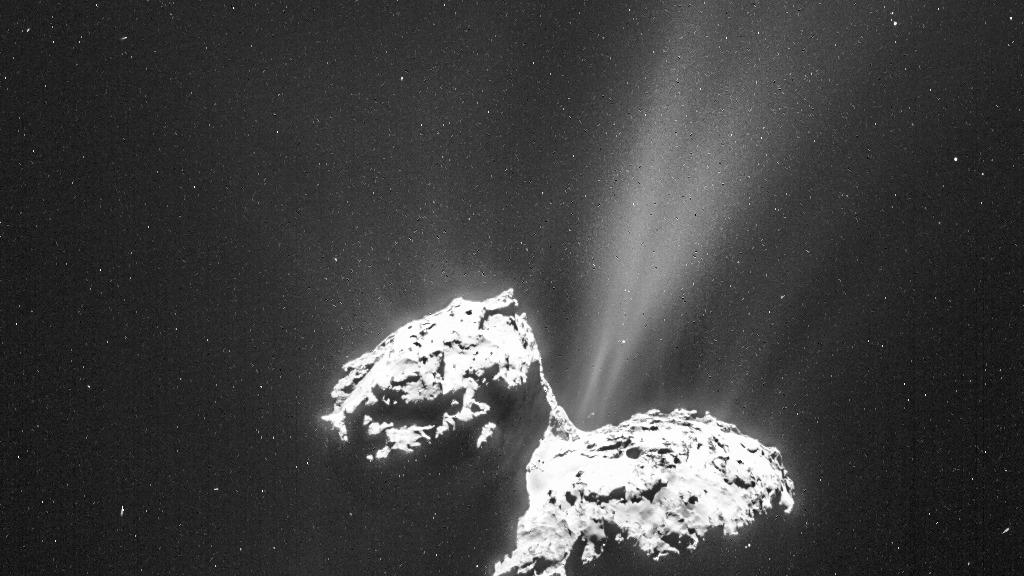
Comet 67P and jets of dust, carried by sublimating ices from another angle. Credit: ESA/Rosetta
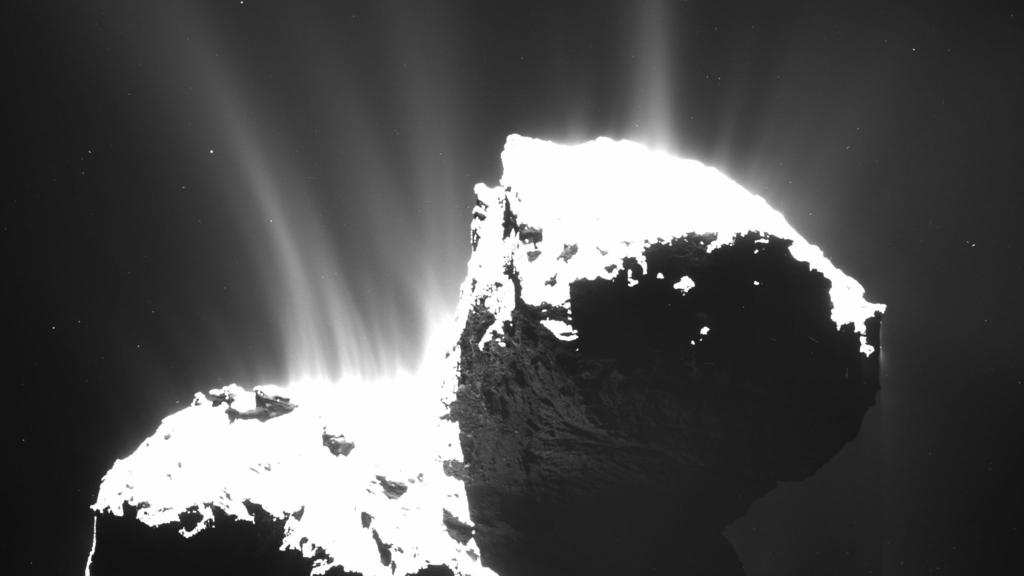
Comet 67P and jets of dust, carried by sublimating ices from yet another angle. Credit: ESA/Rosetta
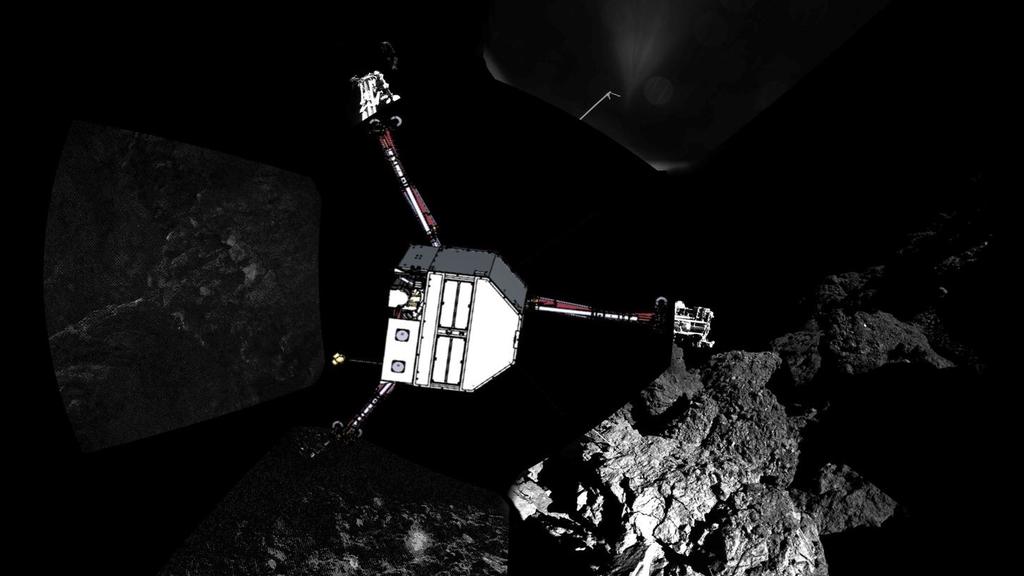
An image of the Philae lander superimposed on its panorama photographs where it was wedged between ice and a hard place in the shadows last November. Credit: ESA/Rosetta.
05/05/2015 – Ephemeris – Eta Aquariids, an early visit of Halley’s Comet
Ephemeris for Tuesday, May 5th. Today the Sun will be up for 14 hours and 24 minutes, setting at 8:52. The Moon, 2 days past full, will rise at 10:29 this evening. Tomorrow the Sun will rise at 6:26.
The Eta Aquariid meteor shower will reach peak tomorrow morning. But the Moon will be bright, so only the brightest of them will be seen. However if you’re waiting to see the return of Halley’s Comet, you needn’t wait until the main body of the comet returns in 2061. Halley’s Comet has made many passes of the inner solar system in recorded history, and many more before that, returning to the inner solar system every 76 years or so, before returning to its frigid home beyond Neptune. It’s closest to the Sun, called perihelion is inside Venus’ orbit. On the way in and out it passes close to the Earth’s orbit. It has left a trail of debris, which we pass through in May and again in October.
Times are for the Traverse City/Interlochen area of Michigan. They may be different for your location.
Addendum
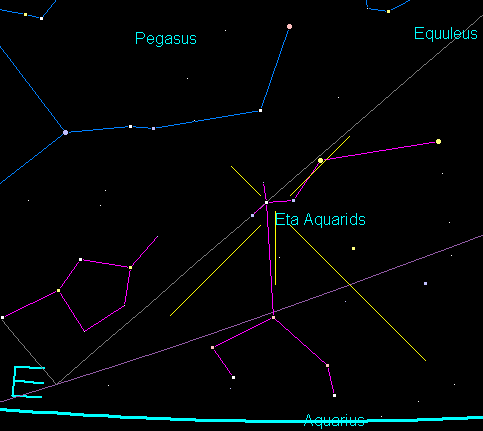
The Eta Aquariid radiant at 5 a.m. The radiant moves slowly to the east with time. Credit: My LookingUp program.
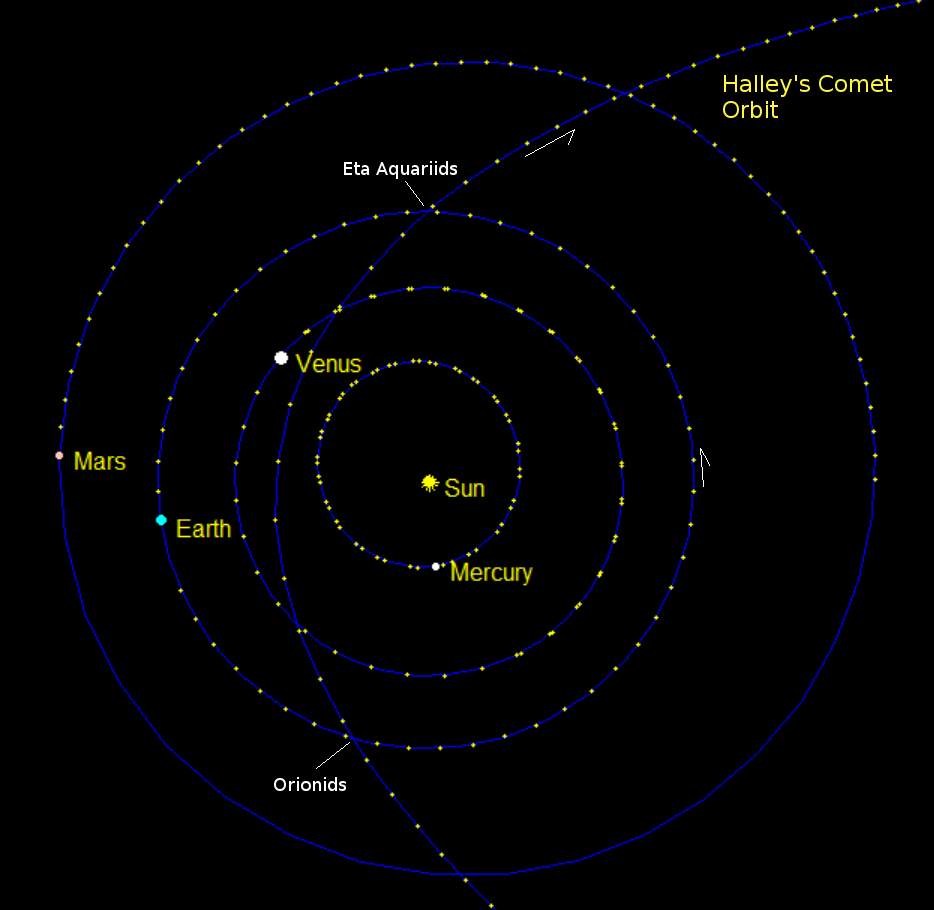
We get two meteor showers from Halley’s Comet. The Orionids, when Halley is approaching the inner solar system, and the Eta Aquariids when it’s leaving. Credit: My LookingUp program.
03/06/2015 – Ephemeris – Learn about this year’s adventures in exploring the soiar system tonight
Ephemeris for Friday, March 6th. The Sun will rise at 7:12. It’ll be up for 11 hours and 24 minutes, setting at 6:36. The Moon, 1 day past full, will rise at 7:47 this evening.
This evening yours truly will be giving a program at the monthly meeting of the Grand Traverse Astronomical Society at 8 p.m. at Northwestern Michigan College’s Rogers Observatory. It’s entitled Asteroids and Dwarf Planets and Comets, oh my! It’s about the three solar system bodies being visited this year by spacecraft from NASA and the European Space Agency. The asteroid is Ceres, which the Dawn spacecraft entered orbit of today. The dwarf planet is Pluto which is the target of a summer flyby by the New Horizon spacecraft. The comet is 67P/Churyumov–Gerasimenko orbited by ESA’s Rosetta spacecraft. There will be a star party at 9 p.m. following the meeting.
Times are for the Traverse City/Interlochen area of Michigan. They may be different for your location.
Addendum
Apologies to MGM.
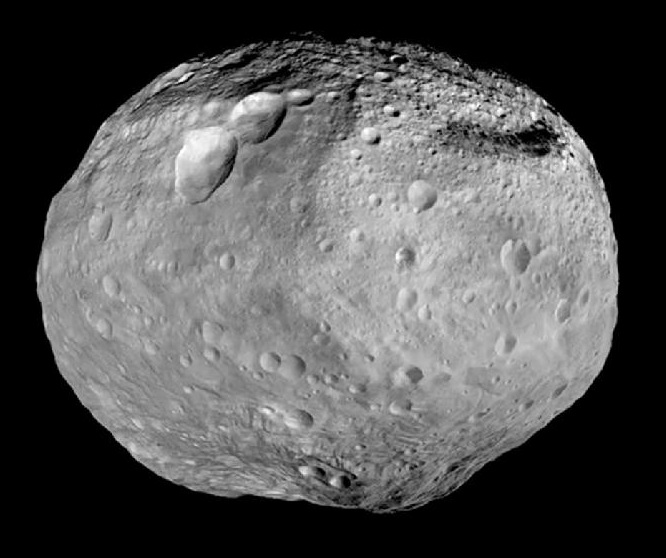
Looking back at Vesta as Dawn headed off to Ceres. Credit: NASA/JPL-Caltech/UCAL/MPS/DLR/IDA
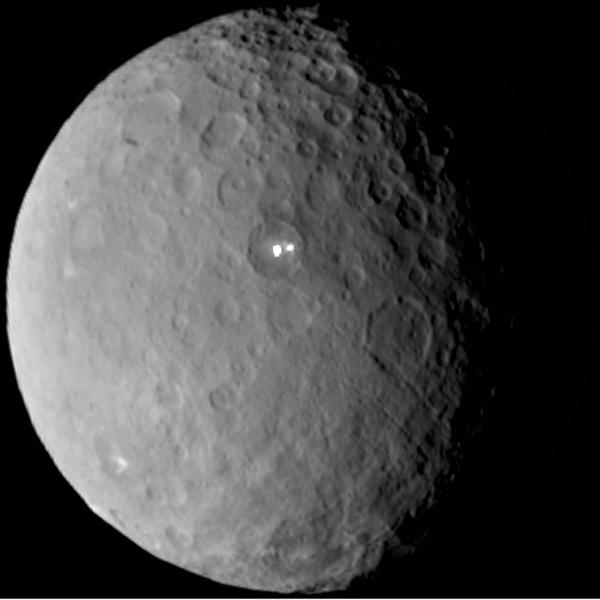
The bright spot is two. Picture taken February 19, 2015 from 29,000 miles (46,700 km). Credit: NASA/JPL-Caltech/UCLA/MPS/DLR/IDA.
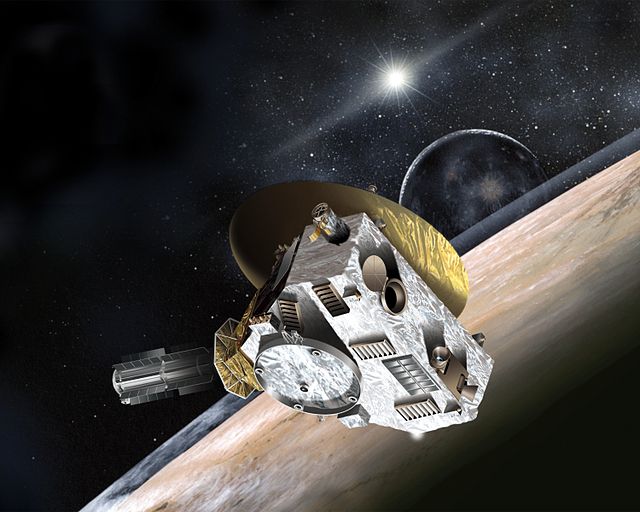
Artist conception of the New Horizons spacecraft at Pluto. Credit: NASA/Johns Hopkins University Applied Physics Laboratory/Southwest Research Institute
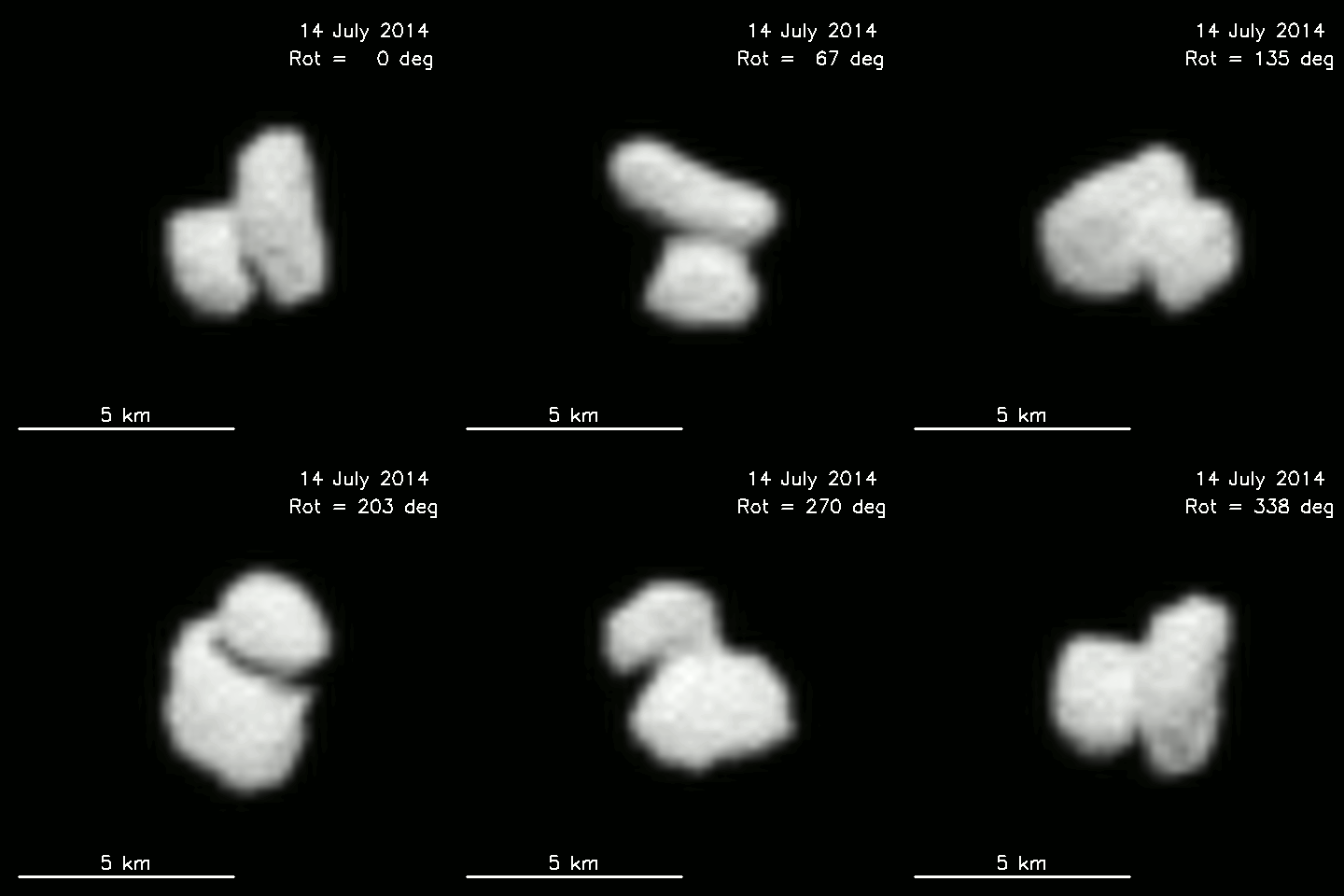
An animation of Comet 67p/Churyumov–Gerasimenko rotation on July 14, 2014. The 30 pixel wide image has been smoothed. The Rotation rate is 1 rotation every 12.4 hours. Credits: ESA/Rosetta/MPS for OSIRIS Team MPS/UPD/LAM/IAA/SSO/INTA/UPM/DASP/IDA
Look quick! A new comet escapes the Sun
A sun grazing comet was discovered in SOHO chronograph images. And unlike Comet ISON 15 months ago which checked in but didn’t check out. This one escaped to possibly become visible in our evening sky. It was the 2875th comet discovered on SOHO chronograph images. Usually it ends there, but the comet, now named C/2015 D1 (SOHO).
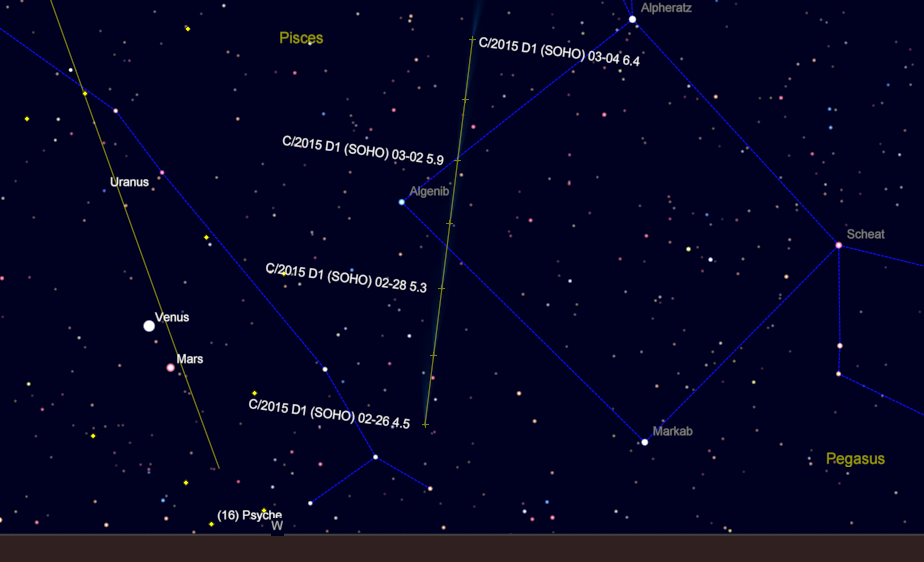
Hot off the press. Comet 2015 D1 was part of the download of comet elements this afternoon. Here’s the track with estimated magnitudes for tonight and the next week. Created using Cartes du Ceil (Sky Charts).
A more comprehensive post from Universe Today is here.
02/25/2015 – Ephemeris – It’s planet day on Ephemeris
Ephemeris for Wednesday, February 25th. The sun will rise at 7:27. It’ll be up for 10 hours and 57 minutes, setting at 6:24. The moon, at first quarter today, will set at 2:28 tomorrow morning.
Lets take a look at the bright planets and a fading binocular comet for this week. Brilliant Venus is in the west-southwest by 7 p.m. It will set at 8:55 p.m. It’s separating from Mars which appears below and right of it. The Red Planet will set tonight at 8:46 p.m. Jupiter will appear In the southeastern sky in the evening. It will be up just about all night, and will set at 6:44 a.m. It’s near the sickle-shaped head of Leo the lion, and it’s the brightest star-like object in the sky. Early risers will be able to spot Saturn which will rise in the east-southeast at 1:48 a.m. It’s in the south at 6 a.m. Comet Lovejoy, visible in binoculars, is about half way from the star at the end of Andromeda, called Almaak and the “W” of Cassiopeia.
Times are for the Traverse City/Interlochen area of Michigan. They may be different for your location.
Addendum
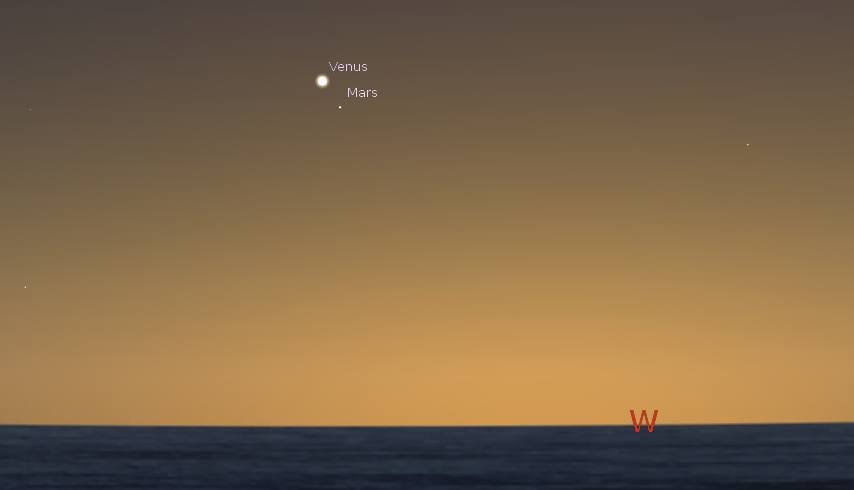
Venus and Mars low in the west after sunset. This is 7 p.m., February 25, 2015. Created using Stellarium.
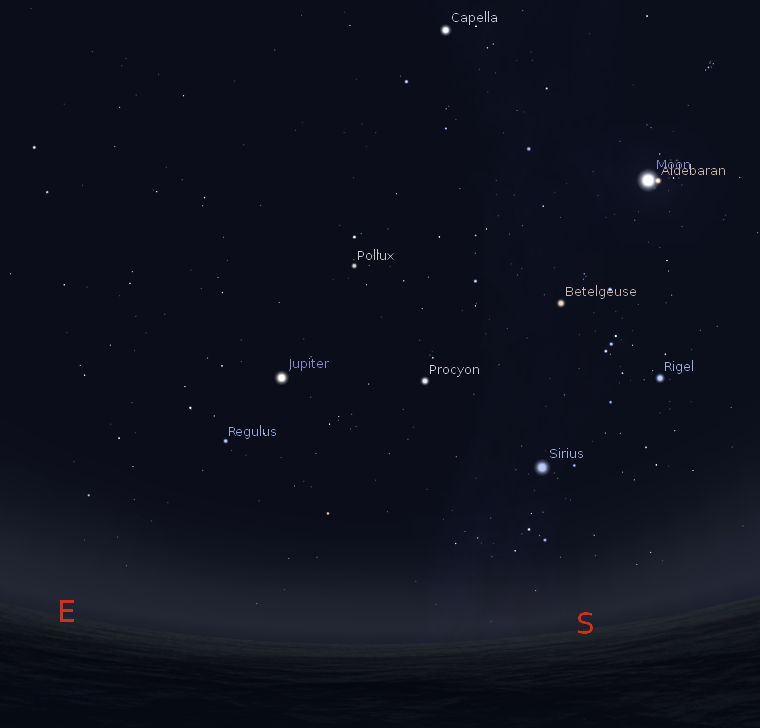
Jupiter with the first quarter moon and the winter stars at 9 p.m., February 25, 2015. Created using Stellarium.
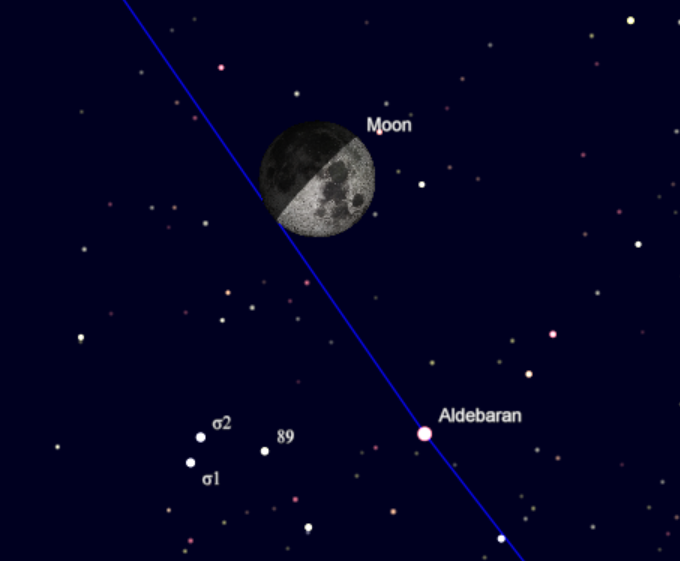
Closeup of the Moon and Aldebaran at 9 p.m. on February 25, 2015. They appeared their closest at 6 p.m. They might be glimpsed with binoculars or a small telescope at that time.
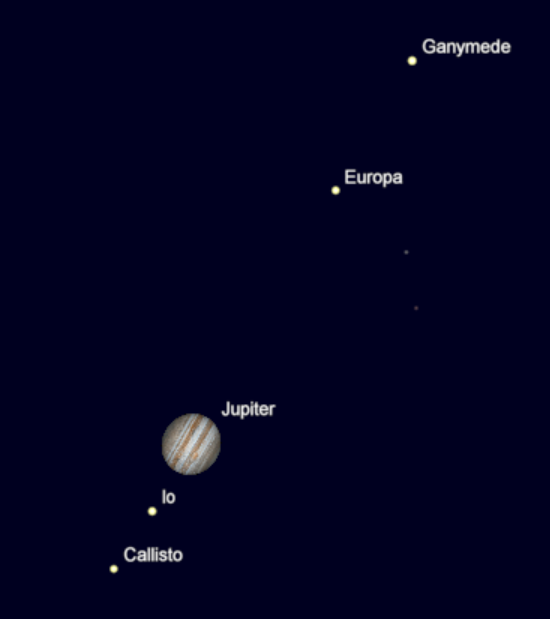
Jupiter and it’s moons at 9 p.m. February 25, 2015. Note that at this time the Great Red Spot is on the face if Jupiter. Created using Cartes du Ciel (Sky Charts).
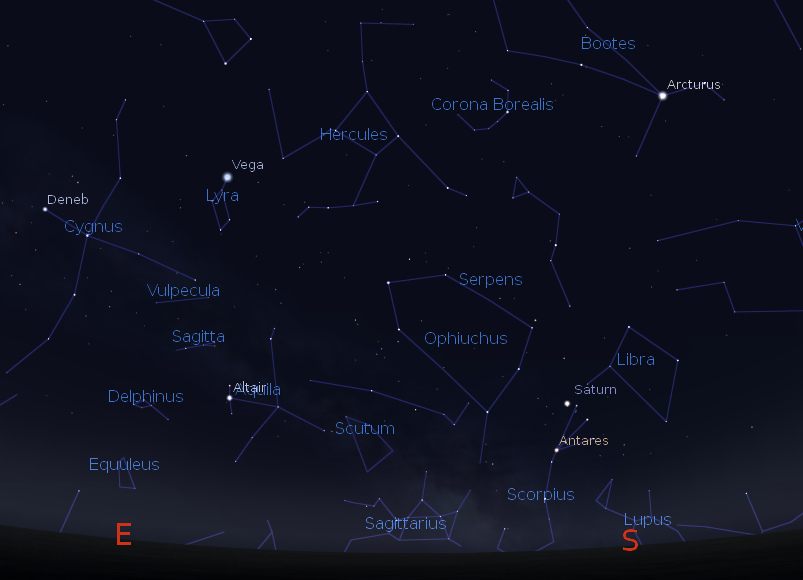
Looking southward at Saturn and a preview of the summer constellations at 6 a.m. February 26, 2015. Created using Stellarium.
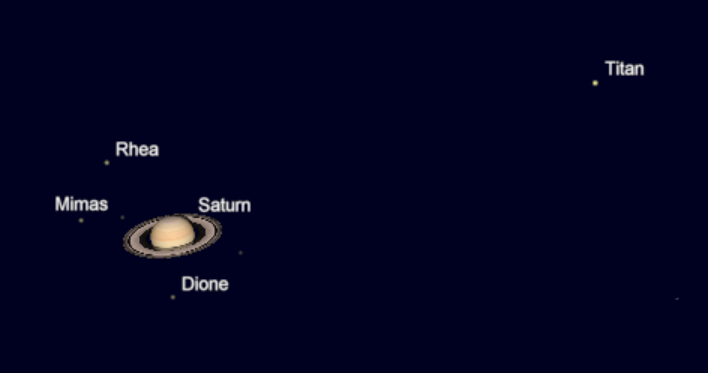
What Saturn and its moons might appear like in a telescope at 6 a.m., February 26, 2015. Small telescopes will show only the moon Titan. Created using Cartes du Ceil (Sky Charts).
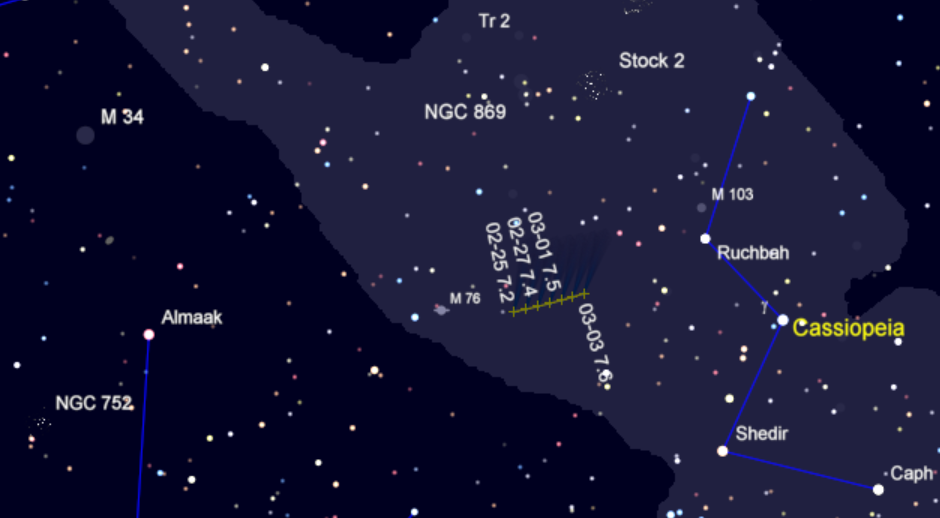
The track of Comet 2014 Q2 (Lovejoy) from 2/25/15 to 03/03/15 which will appear high in the west at 9 p.m. The comet is approaching Cassiopeia. The comet is dropping below binocular visibility, so this is the last time I will cover it on this blog. Created using Cartes du Ceil (Sky Charts).
02/18/2015 – Ephemeris – Wednesday is bright planet day (or night) on Ephemeris
Ephemeris for Ash Wednesday, Wednesday, February 18th. The sun will rise at 7:38. It’ll be up for 10 hours and 36 minutes, setting at 6:15. The moon is new today, and won’t be visible.
Lets take a look at the bright planets and a fading binocular comet for this week. Brilliant Venus is in the west-southwest by 7 p.m. It will set at 8:37 p.m. It’s nearing Mars which appears above and left of it. They will be at their closest on the 22nd. The Red Planet will set tonight at 8:45 p.m. Jupiter will appear In the southeastern sky in the evening. It will be up all night, and will set at 7:14 a.m. It’s near the sickle-shaped head of Leo the lion, and it’s the brightest star-like object in the sky. Early risers will be able to spot Saturn which will rise in the east-southeast at 2:15 a.m. Comet Lovejoy, visible in binoculars, is about half way from the star at the end of Andromeda, called Almaak and the “W” of Cassiopeia.
Times are for the Traverse City/Interlochen area of Michigan. They may be different for your location.
Addendum
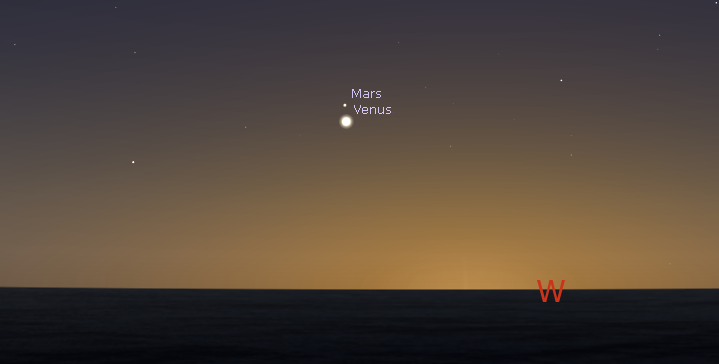
Venus and Mars low in the west after sunset. This is 7 p.m., February 18, 2015. Created using Stellarium.
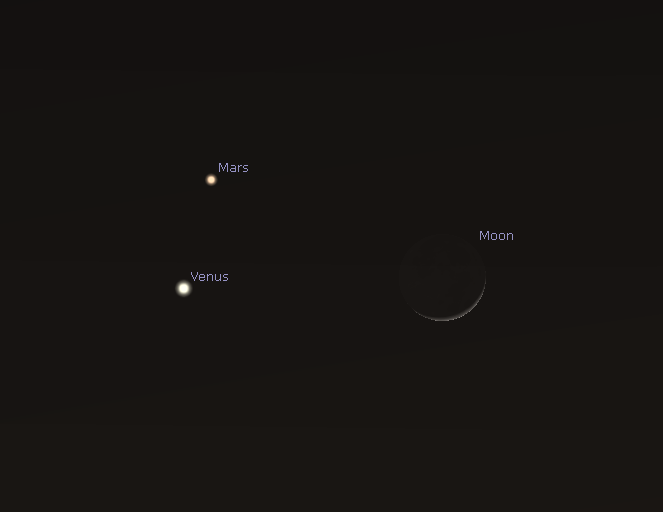
Venus, Mars and the moon on Friday night at 7 p.m. (2/20/15). Created using Stellarium.
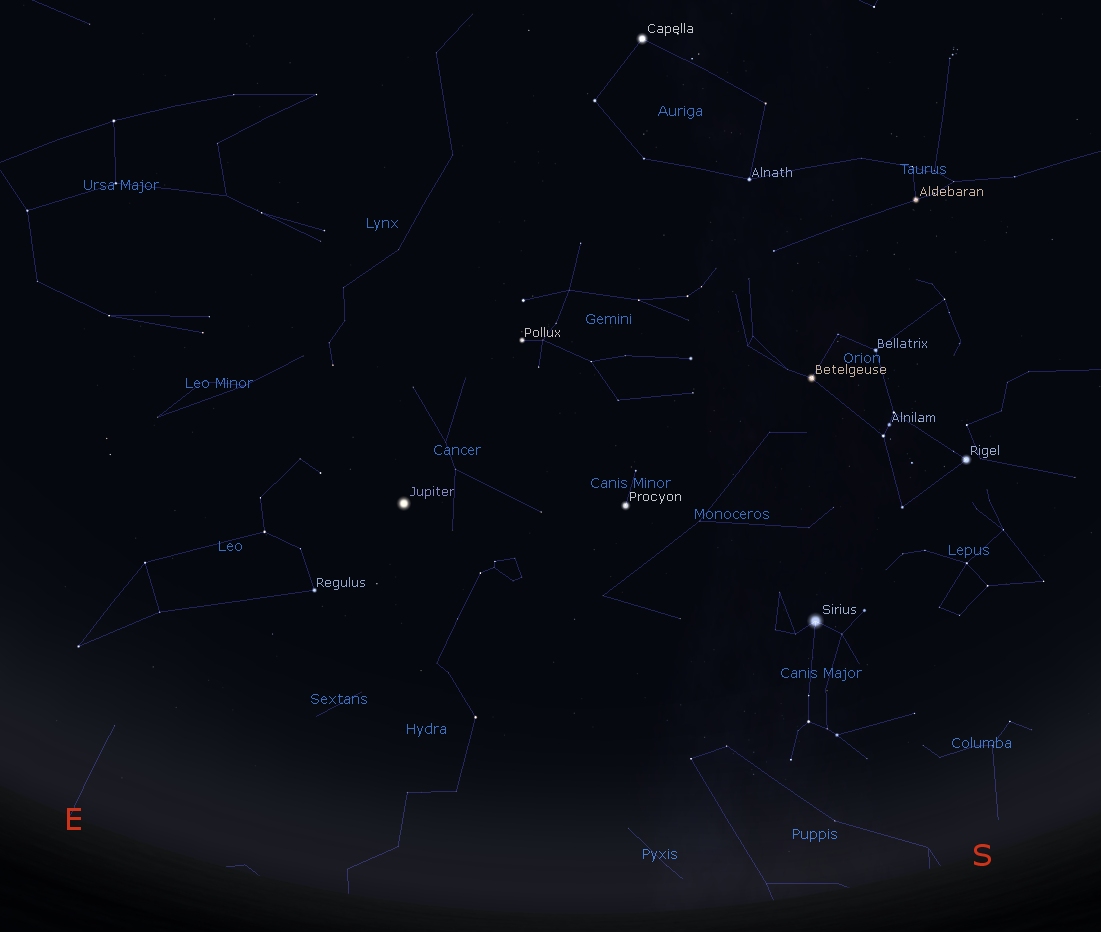
Jupiter with the winter constellations at 9 p.m., February 18, 2015. Created using Stellarium.
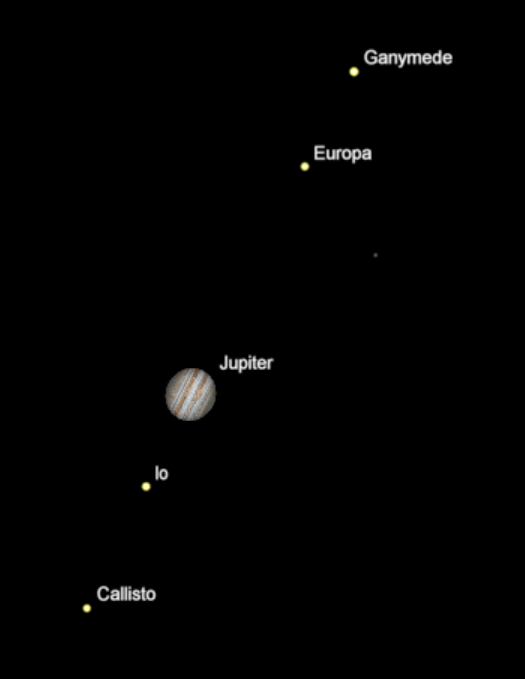
Jupiter and it’s moons at 9 p.m. February 18, 2015. Note that at this time the Great Red Spot is on the face if Jupiter. Created using Cartes du Ciel (Sky Charts).
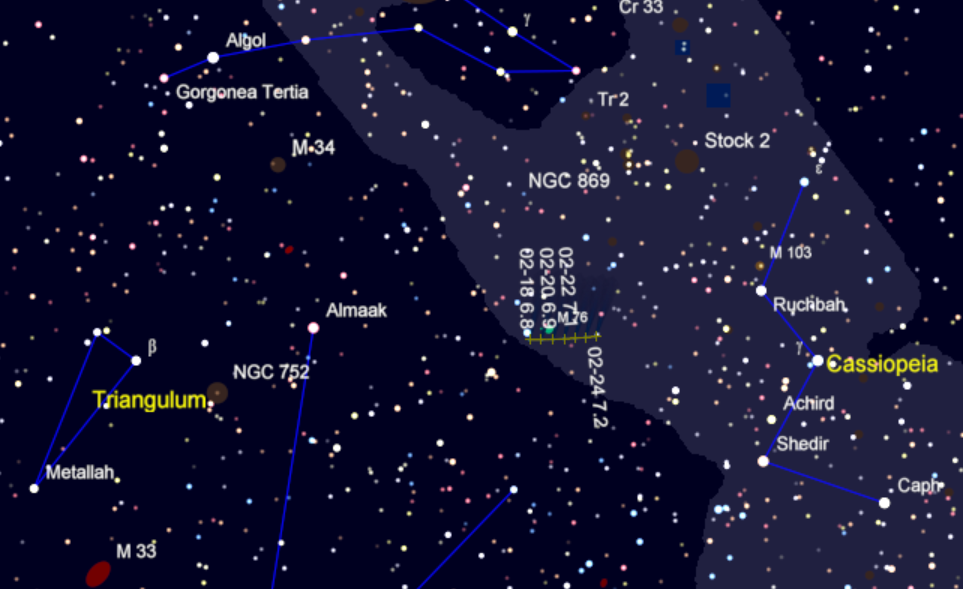
The track of Comet 2014 Q2 (Lovejoy) from 2/18/15 to 02/24/15 which will appear high in the west at 9 p.m. On the 20th the comet will pass near M76, a 10th magnitude planetary nebula. It will be much dimmer than the comet. Created using Cartes du Ceil (Sky Charts).
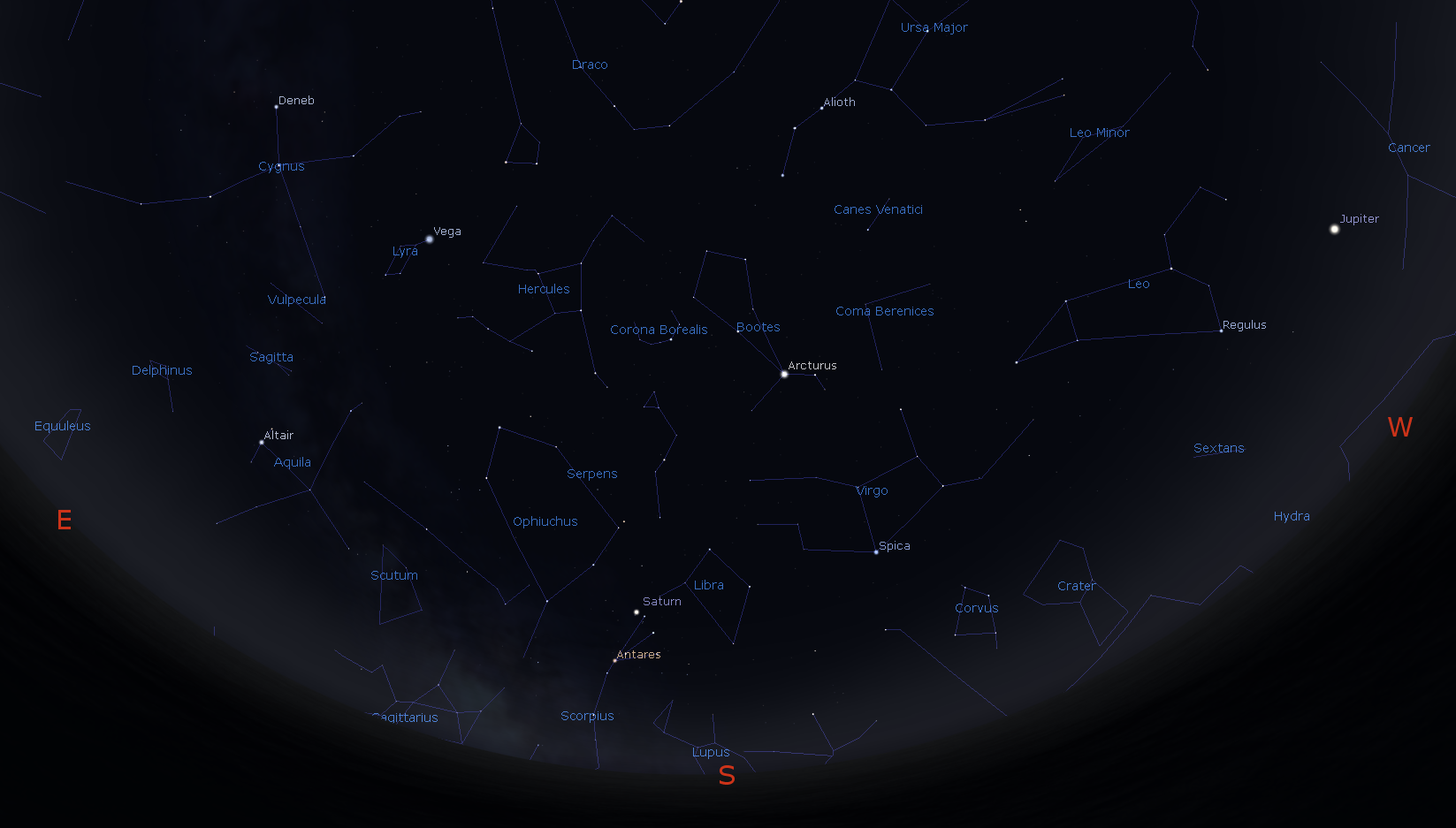
Looking southward at 6 a.m. February 19, 2015 to a preview of the constellations of summer with Saturn in the south and Jupiter setting in the west. Click to enlarge.
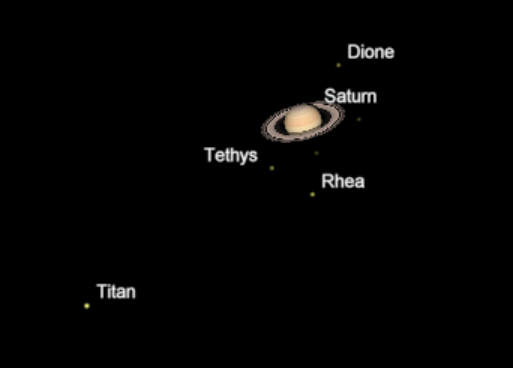
What Saturn and its moons might appear like in a telescope at 6 a.m., February 19, 2015. Small telescopes will show only the moon Titan. Created using Cartes du Ceil (Sky Charts).
 Bob Moler's Ephemeris Blog