Archive
10/16/2013 – Ephemeris – Where are the bright planets and Comet ISON this week
Ephemeris for Wednesday, October 16th. The sun will rise at 7:59. It’ll be up for 10 hours and 56 minutes, setting at 6:55. The moon, 2 days before full, will set at 6:30 tomorrow morning.
Time again to check out the bright planets. Venus is brilliant in the west southwest after sunset it will set at 8:46 p.m.. We are losing Saturn in the sun’s glare for a few months. The rest of the planetary action will be in the morning sky, though the giant planet Jupiter will rise before midnight at 11:47 a.m. in the east northeast. It’s cruising against the stars of Gemini now. By 6 a.m it will be high in the southeast, the brightest object in that direction. Mars will rise at 3:19 a.m. also in the east northeast. It’s near Leo’s brightest star Regulus at the bottom of the constellation’s backward question mark. It’s in the east at 6 a.m. Comet ISON is about two moon width’s to the upper left of Mars, but the bright moon will interfere with spotting it.
Times are for the Traverse City/Interlochen area of Michigan. They may be different for your location.
Addendum
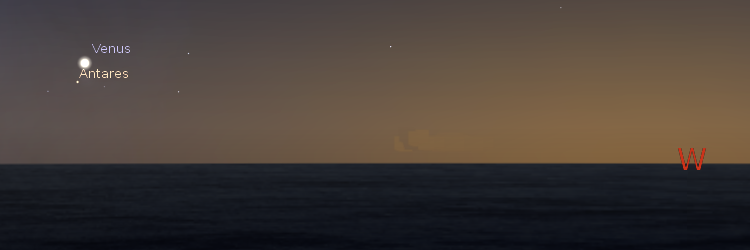
Venus low in the west southwest at 7:45 p.m. on October 16, 2013. Created using Stellarium.
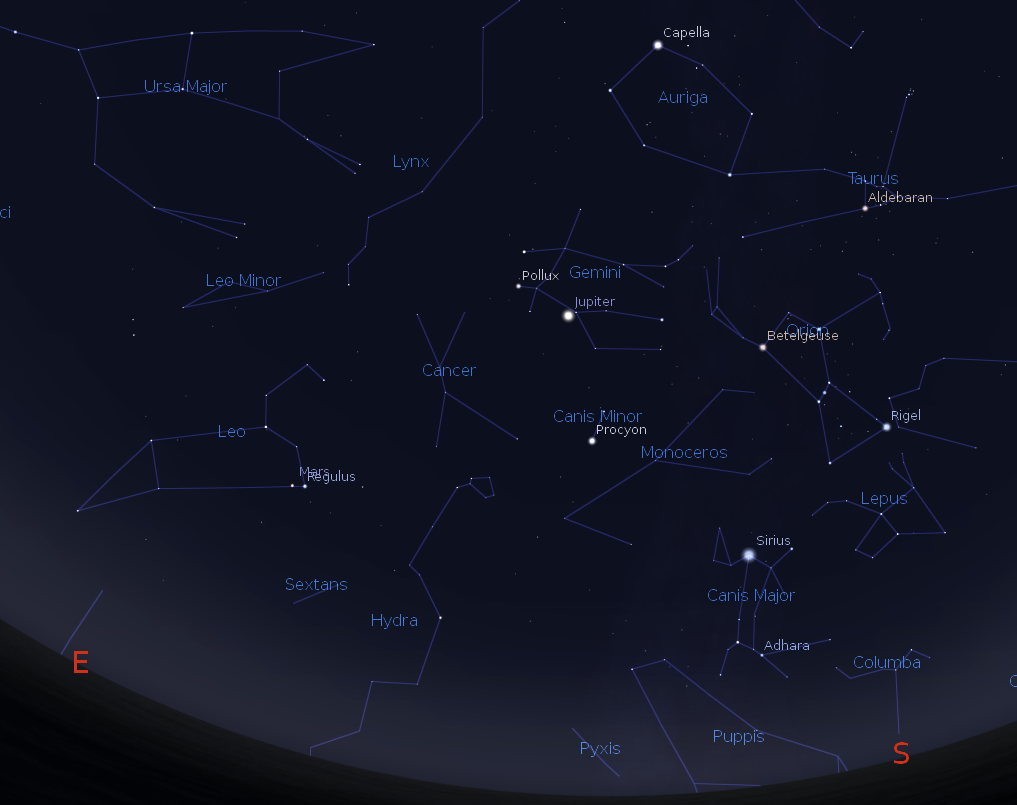
Jupiter and Mars with the winter stars and constellations at 6 a.m., October 17, 2013. Created using Stellarium.
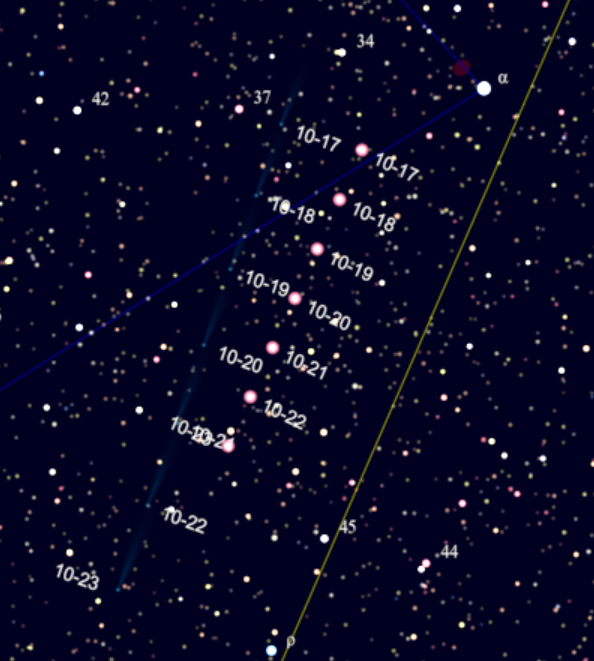
Mars and Comet ISON at 6 a.m. from October 17 to October 23, 2013. Star magnitude limit is 12. Created using Sky Charts (Cartes du Ciel)
10/15/2013 – Ephemeris – Correction to last Thursday’s Comet ISON program
Ephemeris for Tuesday, October 15th. The sun will rise at 7:58. It’ll be up for 10 hours and 59 minutes, setting at 6:57. The moon, 3 days before full, will set at 5:21 tomorrow morning.
Last week I went out to verify the statement that Comet ISON was visible in binoculars that I talked about last Thursday. That turned out to be incorrect. After two failed attempts last Tuesday and Wednesday mornings from my back yard. I had to find a darker location to out flank Traverse City and try to spot the comet with my 11 inch telescope. The comet turned out to be a faint smudge in the indicated spot. The sky wasn’t even dark in that direction, almost due east due to zodiacal light, visible on autumn mornings due to dust in the inner solar system. Zodiacal light is usually hard to spot until it becomes a nuisance. Advanced amateurs have indeed photographed it, tail and all, but visually the comet isn’t much at this stage.
Times are for the Traverse City/Interlochen area of Michigan. They may be different for your location.
Addendum
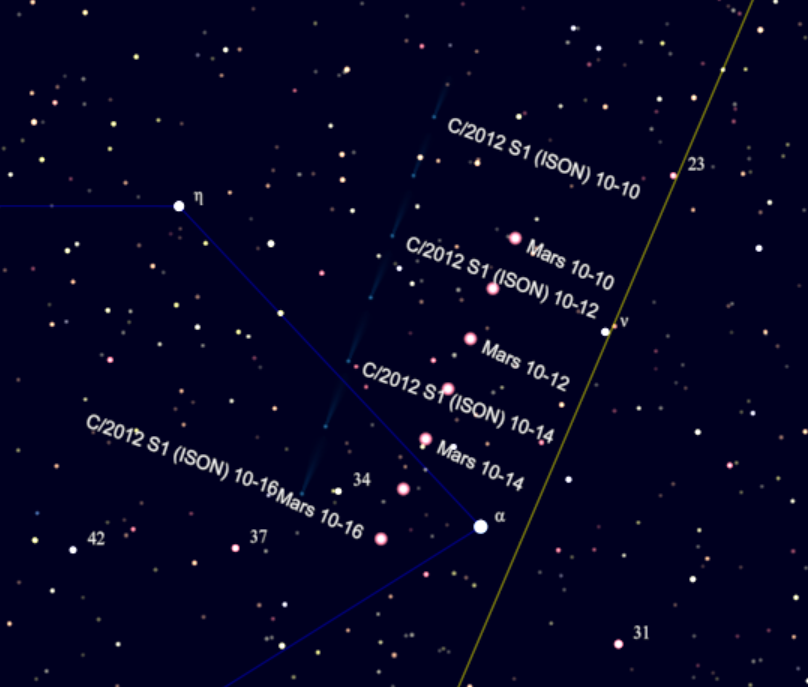
Comet ISON and Mars at 6 a.m. for 7 days starting October 10, 2013. Created using SkyCharts (Cartes du Ciel).
I’ll have a new weekly chart tomorrow. Mars and Comet ISON are sliding past Regulus now. See spaceweather.com for images of Comet ISON. By the end of this week the Moon’s light will interfere.
10/10/2013 – Ephemeris – Comet ISON is becoming visible in binoculars
Ephemeris for Thursday, October 10th. The sun will rise at 7:51. It’ll be up for 11 hours and 14 minutes, setting at 7:06. The moon, 1 day before first quarter, will set at 11:34 this evening.
Comet ISON is finally bright enough to possibly spot in binoculars. It seems to be between 10th and 11th magnitude, at the very limit of a pair of binoculars. Since it’s physically close to Mars, it’s close to Mars in our sky. Tomorrow morning it will be less than a binocular’s field of view to the upper left of Mars. Also don’t confuse Mars with the brighter star Regulus below Mars. In color photographs Comet ISON is showing a green coma or head a sign that the nucleus is spewing, among other things, cyanogen, a poison gas and/or diatomic carbon. Don’t worry, Comet ISON will not get anywhere close to the earth. The last comet I saw with a green head was Comet Hyakutake which came within 10 million miles of the earth in 1996. The comet’s head is pretty much a vacuum. We’ve flown spacecraft through them before. It’s the dust grains we worry about.
Times are for the Traverse City/Interlochen area of Michigan. They may be different for your location.
Addendum
Tuesday morning (Oct 8) I went out to try to spot Comet ISON with my 10X50 binoculars at 5:30 a.m. and was unsuccessful. I think I had two problems. First I am located 5 miles southwest of Traverse City, and though I had a good view to the east, I was hampered by the lights of the city. Also there may have been some zodiacal light. It’s the prime time for zodiacal light in the morning and the inbound comet is following close to the ecliptic line where the zodiac constellations reside. Wednesday morning I’m setting up my 11″ Dobsonian reflector. Let’s see what I can see.
Wednesday morning (Oct 9) I had my 11 inch Dobsonian trained on the comet’s location. But the light from Traverse City south was overpowering. Let’s see plan C is to go south to outflank Traverse City. We have a member of the Grand Traverse Astronomical Society who lives about 9 miles south of me. The only town he has to the east, in the direction of the comet is 9 1/2 miles, the little town of Kingsley. So that’s where I’m going tomorrow morning if it stays clear. It’s expected to be.
Comet ISON and Mars at 6 a.m. for 7 days starting October 10, 2013. Created using SkyCharts (Cartes du Ciel).
Don’t expect a tail. The head if Comet ISON will be hard enough to see. The yellow line is the ecliptic, the projection of the earth’s orbit on the sky. Most planet orbital planes lie close to the earth’s orbital plane, so are usually seen near it. The star marked α is Regulus the brightest star in the constellation of Leo, and about the brightness of Mars.
Spaceweather.com has images of the comet.
10/09/2013 – Ephemeris – The Bright planets and Comet ISON for this week
Ephemeris for Wednesday, October 9th. The sun will rise at 7:50. It’ll be up for 11 hours and 17 minutes, setting at 7:08. The moon, 2 days before first quarter, will set at 10:32 this evening.
Time again to check out the bright planets. Mercury has an unfavorable greatest elongation from the sun today. It’s too close to the horizon for all but the best observers to spot. Almost the same can be said of Saturn, right of and a bit below Venus tonight. Binoculars may be needed to it. Saturn will set at 8:15 while Venus will set at 8:50 p.m.. We are losing Saturn in the sun’s glare for a few months. The rest of the planetary action will be in the morning sky. The giant planet Jupiter will rise at 12:12 a.m. in the east northeast. It’s cruising against the stars of Gemini now. By 6 a.m it will be high in the southeast, the brightest object in that direction. Mars will rise at 3:25 a.m. also in the east northeast. It’s nearing Leo.
Times are for the Traverse City/Interlochen area of Michigan. They may be different for your location.
Addendum
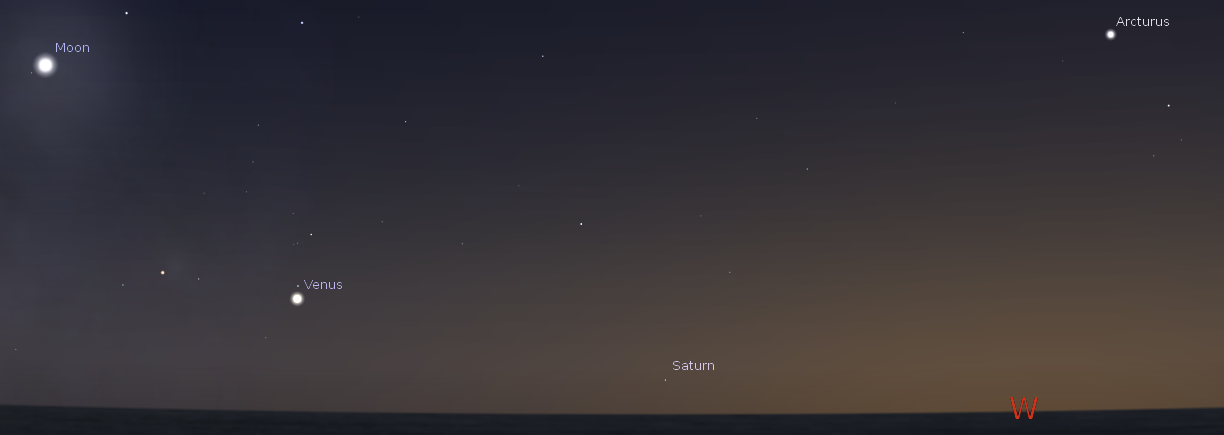
Venus, Saturn and the Moon in the west southwest at 8 p.m. October 9, 2013. Created using Stellarium.
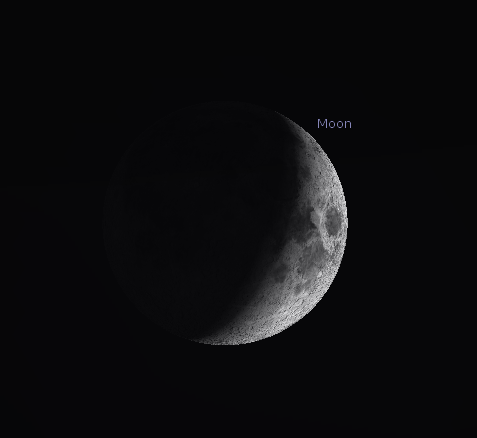
Closeup of the moon. Created using Stellarium.
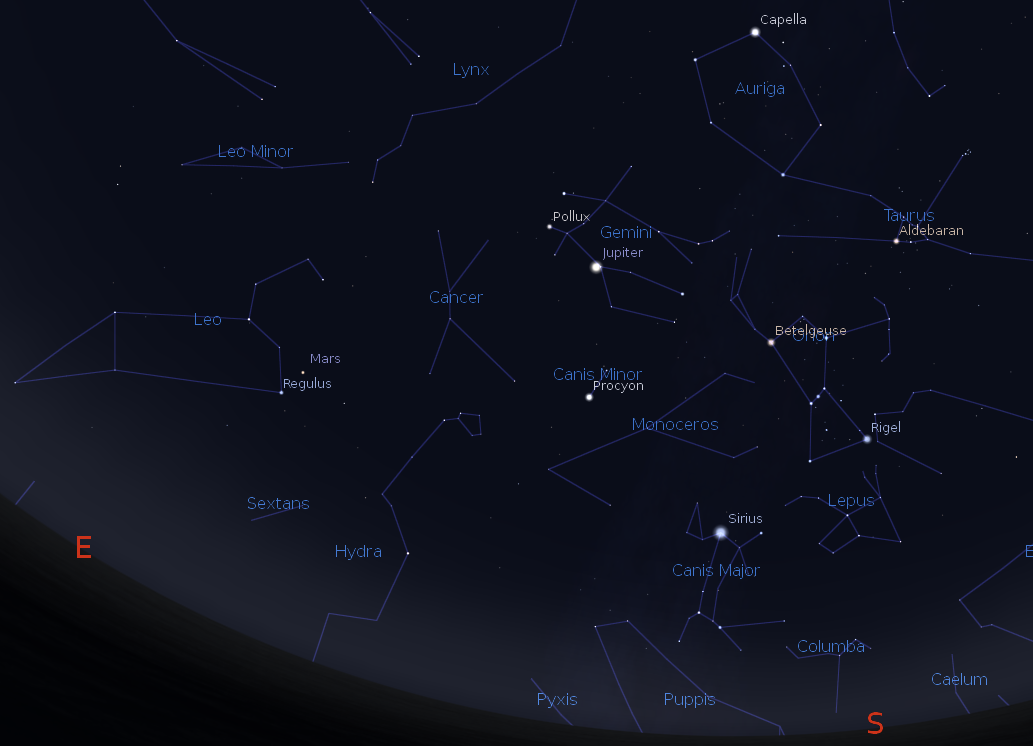
Jupiter and Mars with the winter stars and constellations at 6 a.m., October 10, 2013. Created using Stellarium.
Comet ISON and Mars at 6 a.m. for 7 days starting October 10, 2013. Created using SkyCharts (Cartes du Ciel).
Note that the comet is somewhat dimmer than predicted and barely visible in binoculars. The tail may not be visible except in photographs. I can’t really say since I haven’t seen it yet.
10/08/2013 – Ephemeris – Comet ISON spotted from Mars
Ephemeris for Tuesday, October 8th. The sun will rise at 7:49. It’ll be up for 11 hours and 20 minutes, setting at 7:09. The moon, 3 days before first quarter, will set at 9:36 this evening.
Tonight look in the southwest at 8 p.m. or so to see the crescent moon to the upper left of Venus. In other news last week Sunday the Mars Reconnaissance Orbiter took photographs of Comet ISON. These have been posted on the Internet. Google ISON Mars. The Satellite’s HiRISE camera wasn’t built for the task, and only revealed a faint blob of light. Earth bound amateur astronomers can do a lot better. The images are posted on the University of Arizona’s web site and are not affected by government shutdown. Any images of the comet from the Curiosity rover will have to wait until the shutdown is over to be posted. Operators of the Opportunity and Curiosity rovers are still at work since ongoing space operations are deemed essential.
Times are for the Traverse City/Interlochen area of Michigan. They may be different for your location.
Addendum
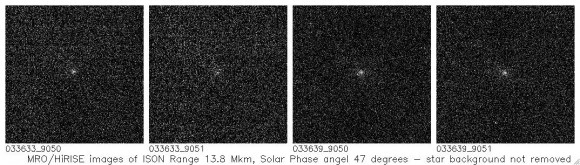
HiRISE images of Comet ISON on Sept. 29, 2013. Credit: NASA/JPL/University of Arizona.
10/02/2013 – Ephemeris – Where are the bright planets and one dim comet?
Ephemeris for Wednesday, October 2nd. The sun will rise at 7:41. It’ll be up for 11 hours and 38 minutes, setting at 7:20. The moon, 2 days before new, will rise at 6:14 tomorrow morning.
Time again to check out the bright planets. Saturn and Venus will be at the same height above the west southwestern horizon. Dimmer Saturn will be to the right of Venus by one and a half widths of a fist held at arm’s length. Binoculars may be needed to Saturn. Saturn will set at 8:40, while Venus will set at 8:56 p.m.. We are losing Saturn in the sun’s glare for a few months. The rest of the planetary action will be in the morning sky. The giant planet Jupiter will rise at 12:36 a.m. in the east northeast. It’s cruising against the stars of Gemini this viewing season. By 6 a.m it will be high in the southeast, the brightest object in that direction. Mars will rise at 3:30 a.m. also in the east northeast. It’s in the east at 6 a.m.
Times are for the Traverse City/Interlochen area of Michigan. They may be different for your location.
Addendum
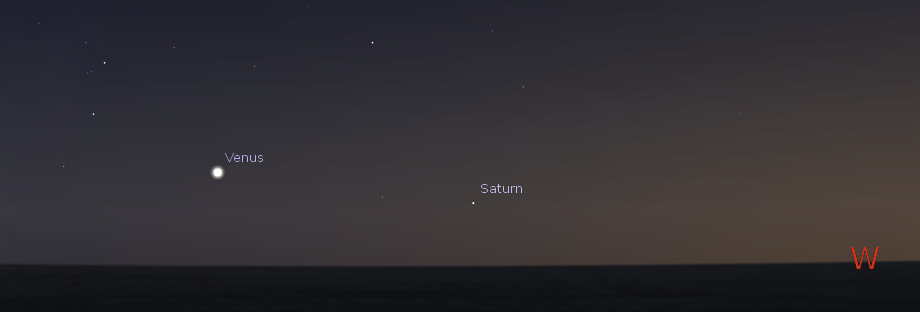
Venus and Saturn low on the west southwestern horizon along with Saturn at 8:15 p.m. on October 2, 2013. Created using Stellarium.
I was out at the Lanphier Observatory of the Leelanau School in Glen Arbor Michigan Monday evening about this time, to show Venus to the audience for Andrea Wulf’s talk about some of her book Chasing Venus. If the book is like her talk, it should be fabulous. It’s about the 18th century expeditions of many nation to view a pair of transits of Venus in order to determine the size of the solar system. Anyway the sky was like this with Venus setting over the low Sleeping Bear Dunes across Sleeping Bear Bay.
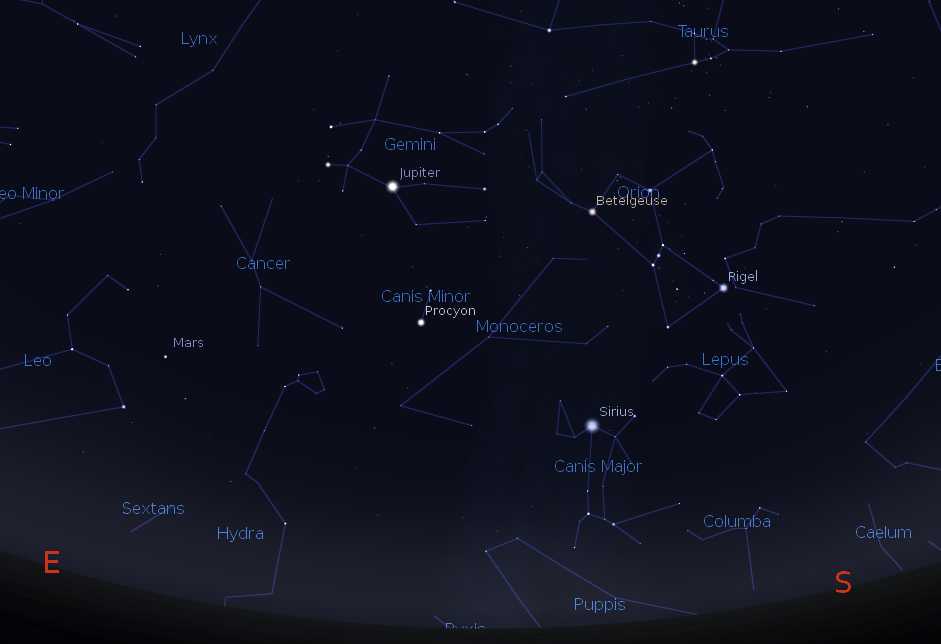
Jupiter, Mars with the winter stars and constellations at 6 a.m. on October 3, 2012. Created using Stellarium.
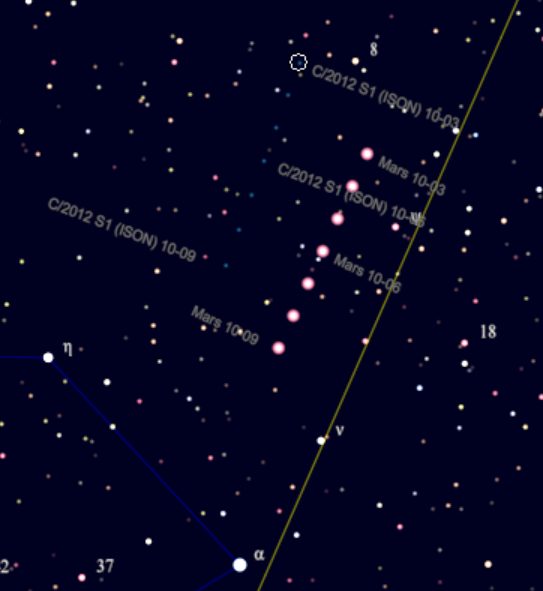
The tracks of Mars and Comet ISON at 6 a.m. from October 3 to 9, 2013. The comet may still be too faint to view in binoculars. Chart created using Cartes duCiel.
The yellow line is the ecliptic. The blue line is the constellations lines for Leo. Comet ISON positions are blue dots. It’s too far away for the software to show a tail.
Links to other sites for Comet ISON information as it approaches perihelion
C/2012 S1 (ISON) is the official designation for Comet ISON, which will pass close to Mars on its inbound leg of its orbit of the sun.
Universe Today has two links on what to expect as Comet ISON nears the sun.
The Comet ISON, a Viewing Guide From Now to Perihelion: http://www.universetoday.com/104818/comet-ison-a-viewing-guide-from-now-to-perihelion/
The comet’s coma (head) is turning green as it approaches. That’s a good thing: http://www.universetoday.com/105087/comet-ison-goes-green/
Here’s another site: The NASA Comet ISON Observing Campaign: http://www.isoncampaign.org/ which answers some of your questions and details some of the world-wide and solar system wide attempts to observe Comet ISON as it makes its mad dash to and from the sun.
As Comet ISON approaches the Sun it is doing so close to the ecliptic plane (plane of the earth’s orbit). Situated in the morning sky, it will follow fairly close to the ecliptic, passing Mars and Saturn on the way in from our point of view. It will physically pass close to Mars this week. Expect photos of the comet from Mars by the end of the week. What Martians are taking the photos? Why we are. NASA and the Europeans have assets on and around Mars who will, in their robotic way photograph and possibly analyze the comet as it passes by. The apparent passage by Saturn is apparent from our point of view from the earth. It is far in the background. Comet Encke, the shortest of the periodic comets with a 3.3 year orbit will be in some of the photographs from earth.
Around the end of October Comet ISON will cross the earth’s orbit heading to perihelion on November 28th. Comet will stay a morning comet after leaving the sun heading northward from the earth’s point of view. We expect the comet be at its brightest, but rapidly fade in December. But who knows. I will be reporting what I know and see about the time the comet becomes visible in binoculars or a small telescope. Stay tuned.
08/19/2013 – Ephemeris – Comet ISON, final approach!
Ephemeris for Monday, August 19th. The sun rises at 6:50. It’ll be up for 13 hours and 51 minutes, setting at 8:41. The moon, 1 day before full, will set at 6:22 tomorrow morning.
Comet ISON is beginning to become visible from the earth after spending a few month’s behind the sun. It has shown earlier this year that it had not been brightening as predicted, but soon will be visible for better measurements. Tomorrow it the Mars Reconnaissance Orbiter will take its first image of ISON. The Curiosity and Opportunity rovers will also soon take photo’s of Comet ISON in the martian sky. When ISON becomes visible from Mercury, the MESSENGER spacecraft orbiting Mercury will get its chance. All available instruments on earth and deployed in the solar system will track the comet to see how it evolves and to see if it will survive its brush with the sun’s corona to become a bright autumn comet.
Times are for the Traverse City/Interlochen area of Michigan. They may be different for your location.
Addendum
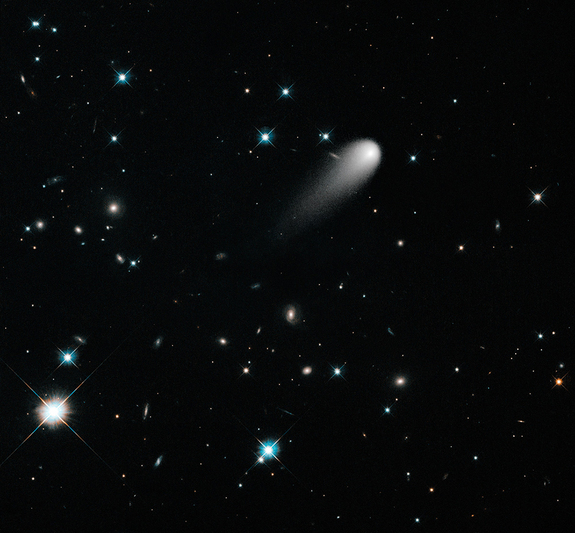
Hubble Space Telescope image of Comet ISON against a field of distant galaxies, April 30, 2013. Credit NASA.
04/24/2013 – Ephemeris – Where are the two bright planets this week?
Ephemeris for Wednesday, April 24th. The sun rises at 6:43. It’ll be up for 13 hours and 55 minutes, setting at 8:38. The moon, 1 day before full, will set at 6:24 tomorrow morning.
It’s time to check out the two remaining bright planets for this week. Jupiter is located in the constellation of Taurus, above the V shape of stars, the face of the bull and is in the west during the evening. It will set at 12:10 a.m. In the west northwest. Jupiter is still high enough as it gets dark to get a very good view of its cloud bands and satellites. The four moons that Galileo found are easy targets for small telescopes or even sharp-eyed binocular observers. The other bright planet Saturn will rise at 8:43 p.m. in the east southeast. It’s located in eastern Virgo, but us moving back a bit toward the bright star Spica to its right. Tonight the bright moon will be near Spica, so it may make both Saturn and Spica hard to spot.
Times are for the Traverse City/Interlochen area of Michigan. They may be different for your location.
Addendum
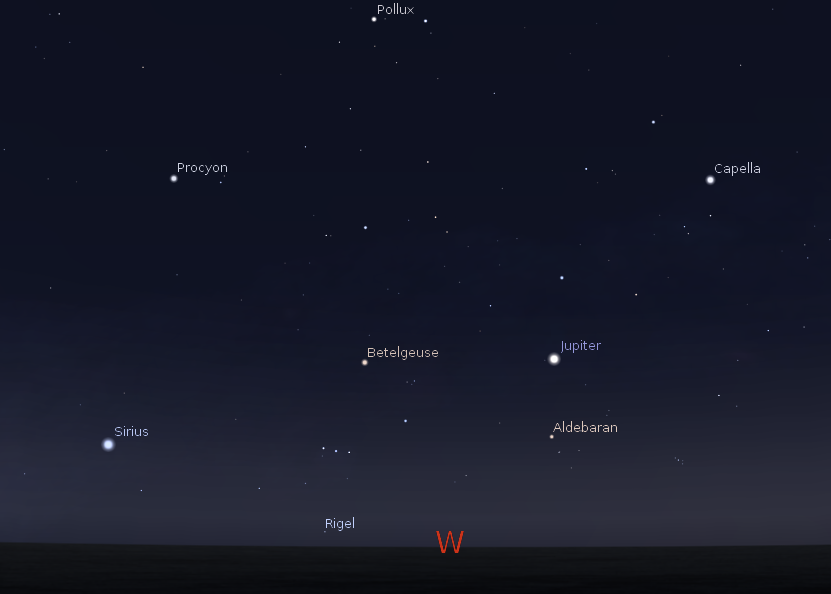
Jupiter and the fleeing stars of winter at 10 p.m. on April 24, 2013. Created using Stellarium.
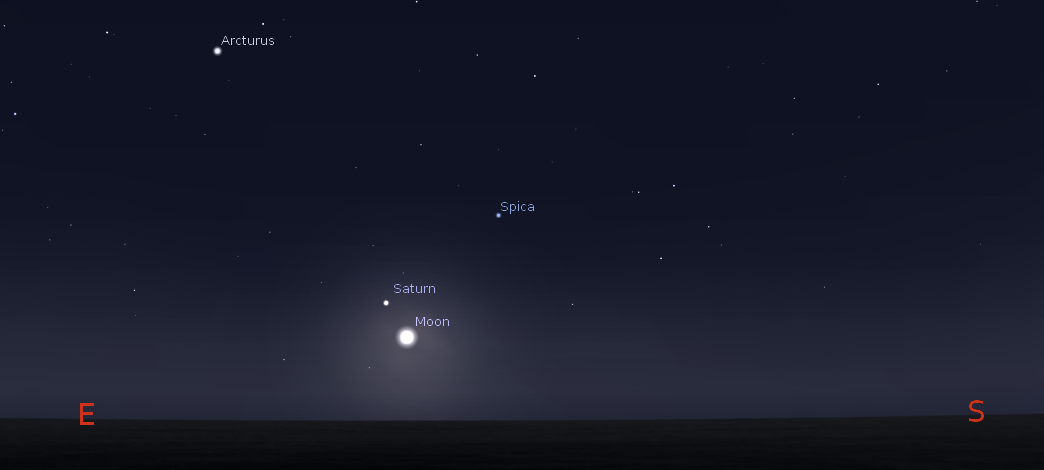
Saturn and the moon at 10 p.m. on April 24, 2013. Created using Stellarium.
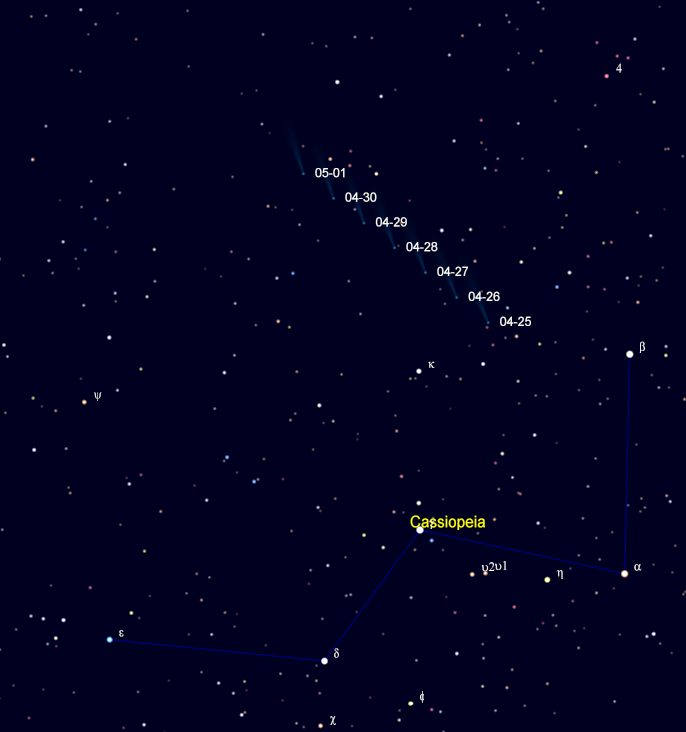
Our last look at Comet PanSTARRS at 5 a.m. on April 25 to May 1, 2013. Created using Cartes du Ciel (Sky Charts).
04/17/2013 – Ephemeris – Where are the bright planets this week?
Ephemeris for Wednesday, April 17th. The sun rises at 6:54. It’ll be up for 13 hours and 35 minutes, setting at 8:30. The moon, 1 day before first quarter, will set at 2:49 tomorrow morning.
It’s time to check out the two remaining bright planets for this week. I’m no longer going to cover Comet PanSTARRS here, since it has dropped below naked eye visibility, but I will provide finder charts in the Ephemeris blog at bobmoler.wordpress.com for the next few weeks. Jupiter is located in the constellation of Taurus, above the V shape of stars, the face of the bull and is in the west during the evening. It will set at 12:27 a.m. The other bright planet Saturn will rise at 9:13 p.m. in the east southeast. It’s located in eastern Virgo. It will pass due south at 2:27 a.m. Both planets are wonderful sights in telescopes. Jupiter with its cloud bands and moons, Saturn with those fantastic rings.
Times are for the Traverse City/Interlochen area of Michigan. They may be different for your location.
Addendum
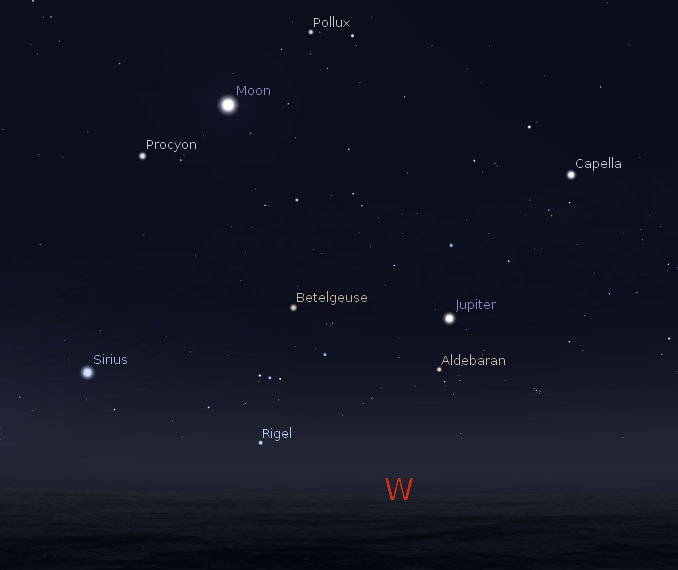
Jupiter and the setting stars of winter at 10 p.m., April 17, 2013. Created using Stellarium.
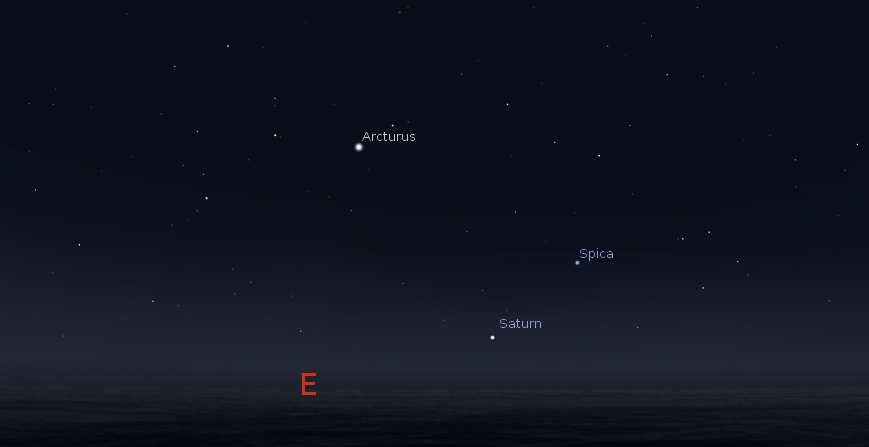
Saturn rising with the bright stars of late spring at 10 p.m., April 17, 2013. Created using Stellarium.
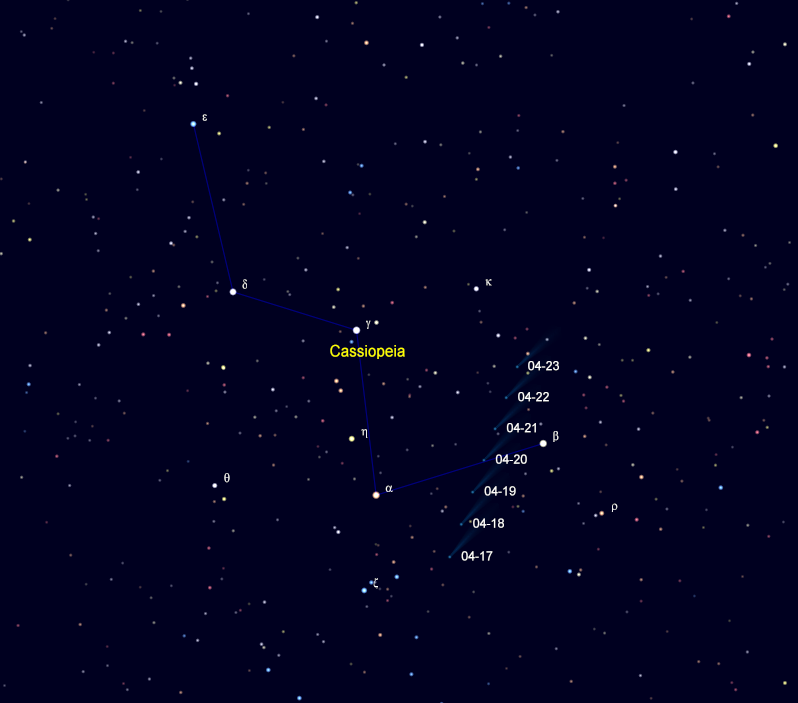
Comet PanSTARRS is moving through Cassiopeia from 04/17/13 to 4/23/13 at 11 p.m. low in the north north-east. Created using Cartes du Ciel (Sky Charts). It requires binoculars or telescope to spot.
 Bob Moler's Ephemeris Blog