Archive
Ephemeris:04/02/2026 – Determining the date of Easter
This is Ephemeris for Thursday, April 2nd. Today the Sun will be up for 12 hours and 50 minutes, setting at 8:11, and it will rise tomorrow at 7:19. The Moon, 1 day past full, will rise at 9:14 this evening.
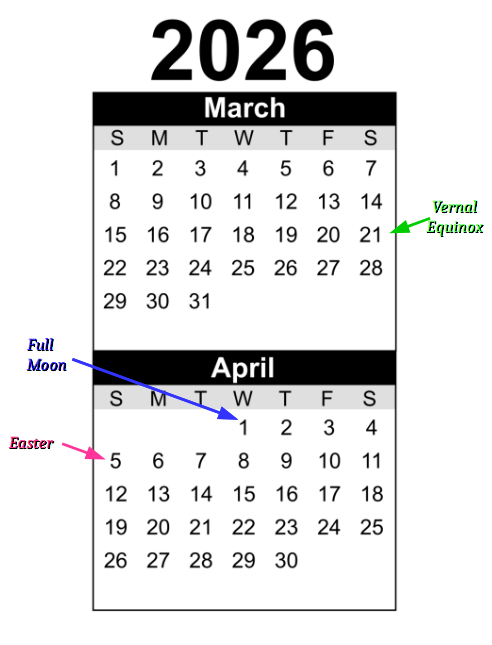
Easter will be celebrated by Western Christian churches this Sunday. Easter is a movable feast in that it falls on a different date each year following the first full moon of spring. It was an attempt to follow the Jewish Passover, which starts on the 15th of the month of Nisan. The Jewish calendar being a lunar calendar, the 15th generally begins at sundown on the night of the full moon. And since the Last Supper was a Seder, according to at least one Gospel, the Christian church wanted to link Easter with Passover as closely as possible using the Roman solar based (Julian) calendar. That’s not always the case, especially with our current Gregorian Calendar. Passover this year began last night at sunset, so this year it is nearly in agreement with the Gospel narrative.
The astronomical event times given in this blog are for the Traverse City/Interlochen area of Michigan (Lat 44.7° N, Long 85.7° W; EST, UT – 5 hours) unless stated otherwise. Times will be different for other locations.
Addendum
*Our Gregorian Calendar will correct for this by making the year 2100, normally a leap year of 366 days, an ordinary year of 365 days. The rule is that century years not divisible by 400 get clipped.
Ephemeris: 03/17/2026 – It’s also an equilux day
This is Bob Moler with Ephemeris for St. Patrick’s Day, Tuesday, March 17th. Today the Sun will be up for 12 hours and to the minute, setting at 7:51, and it will rise tomorrow at 7:49. The Moon, 1 day before new, will rise at 7:33 tomorrow morning. | This upcoming Saturday will be the vernal equinox, the first day of spring. Equinox means equal night, meaning that day and night are equal. Geometrically that’s correct, but, that’s not actually true. Today is the day when the sun is up for 12 hours and of course set for 12 hours. The name for this day has come to be called equilux day. Lux being the Latin for light. The difference is, because the Earth has an atmosphere, plus we have a different definition of sunrise and sunset that puts the sun a little bit below the horizon at the rise and set moment. So enjoy a few extra minutes of sunlight before the official equinox date. Think of it as a St Patrick’s Day bonus.
The astronomical event times given in this blog are for the Traverse City/Interlochen area of Michigan (Lat 44.7° N, Long 85.7° W; EST, UT – 5 hours) unless stated otherwise. Times will be different for other locations.
Addendum
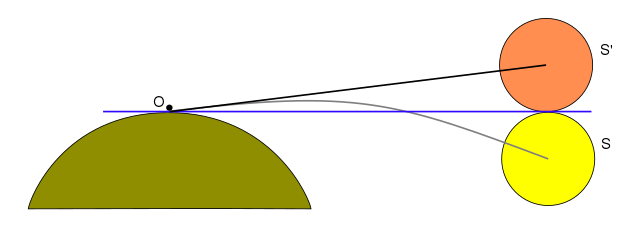
A note: This is equilux day for folks a 45 degrees north latitude. The actual date may vary by a day or so depending on one’s latitude, which affects the angle the Sun appears to cross the horizon.
Ephemeris: 03/13/2026 – Precession of the equinoxes
This is Ephemeris for Friday, March 13th. Today the Sun will be up for 11 hours and 47 minutes, setting at 7:46, and it will rise tomorrow at 7:56. The Moon, 2 days past last quarter, will rise at 6:01 tomorrow morning.
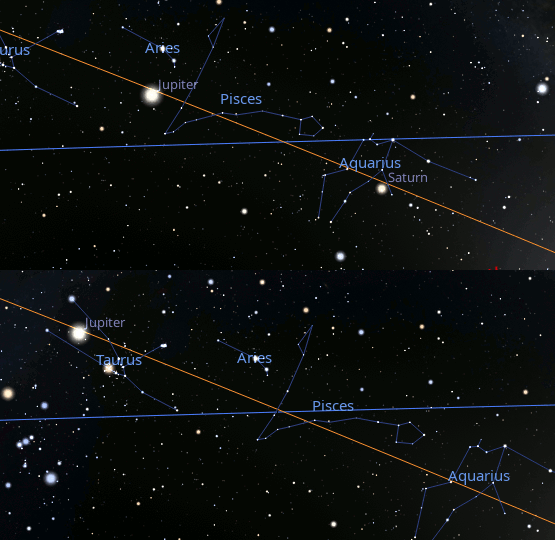
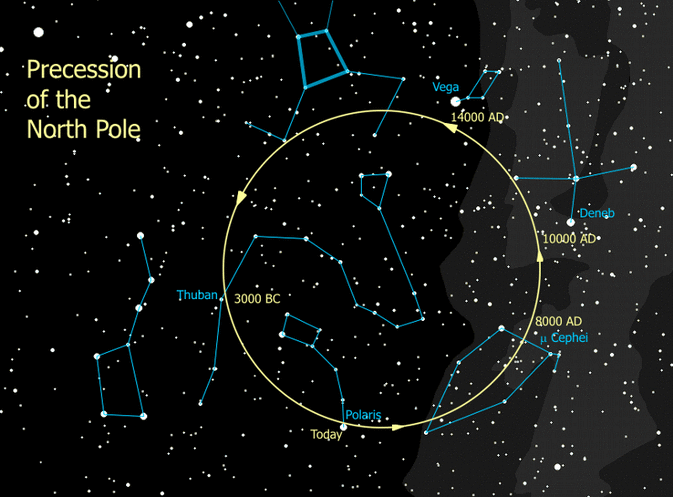
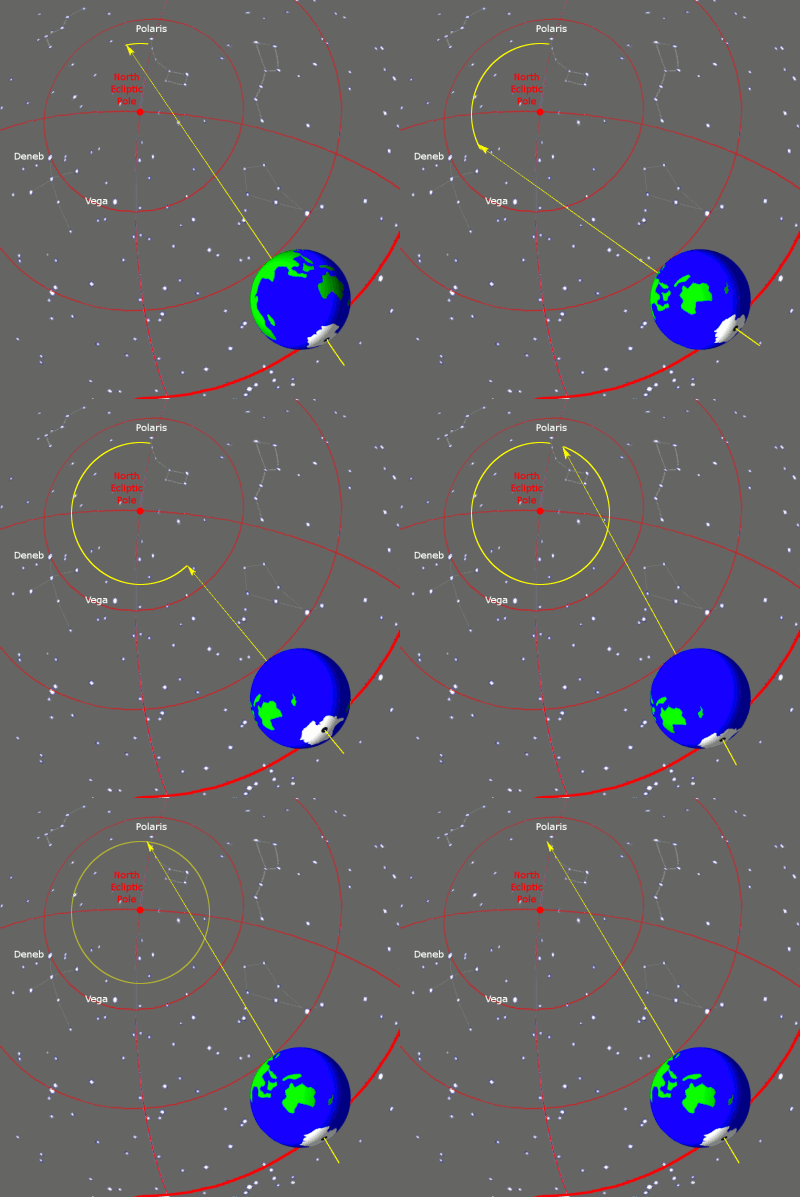
Yesterday I talked about the fact that the constellation of Cancer the crab is no longer the northernmost constellation of the zodiac, where the Sun is positioned on the first day of summer. There’s been a slow change in the position of the earth’s axis, in that it wobbles slowly in a period of nearly 26,000 years. The inclination of the Earth’s axis to its orbit is around 23 1/2 degrees, and the gravitational pull of the Moon and the Sun on the Earth’s equatorial bulge, wants to straighten it up. But because the Earth is spinning, it wobbles instead, slowly sliding the actual zodiacal constellations eastward about one constellation in 2,150 years. So the actual constellations are off one constellation from the astrological signs.
The astronomical event times given in this blog are for the Traverse City/Interlochen area of Michigan (Lat 44.7° N, Long 85.7° W; EST, UT – 5 hours) unless stated otherwise. Times will be different for other locations.
Addendum
Ephemeris: 03/12/2026 – Cancer the crab used to welcome summer
This is Ephemeris for Thursday, March 12th. Today the Sun will be up for 11 hours and 44 minutes, setting at 7:45, and it will rise tomorrow at 7:58. The Moon, 1 day past last quarter, will rise at 5:25 tomorrow morning.
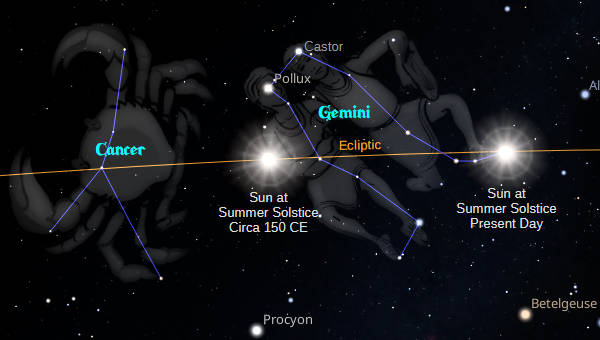
There’s a line on some globes and maps at approximately 23 1/2° north latitude called the Tropic of Cancer. It’s related to the constellation Cancer the crab. However, Cancer no longer fits that role that it was named to a couple of thousand years ago, when the sun entered the constellation of Cancer on the first day of summer. That’s the latitude on the Earth where the Sun was directly overhead on the first day of summer. Now that an honor goes to Gemini. The way we draw the figure of that constellation, the Sun is right near Castor’s big toe on the first day of summer. But I don’t think they’re going to change the name anytime soon. The reason for the change is that the Earth’s axis slowly wobbles like a top or gyroscope as they slow down. The effect is called precession.
The astronomical event times given in this blog are for the Traverse City/Interlochen area of Michigan (Lat 44.7° N, Long 85.7° W; EST, UT – 5 hours) unless stated otherwise. Times will be different for other locations.
Addendum
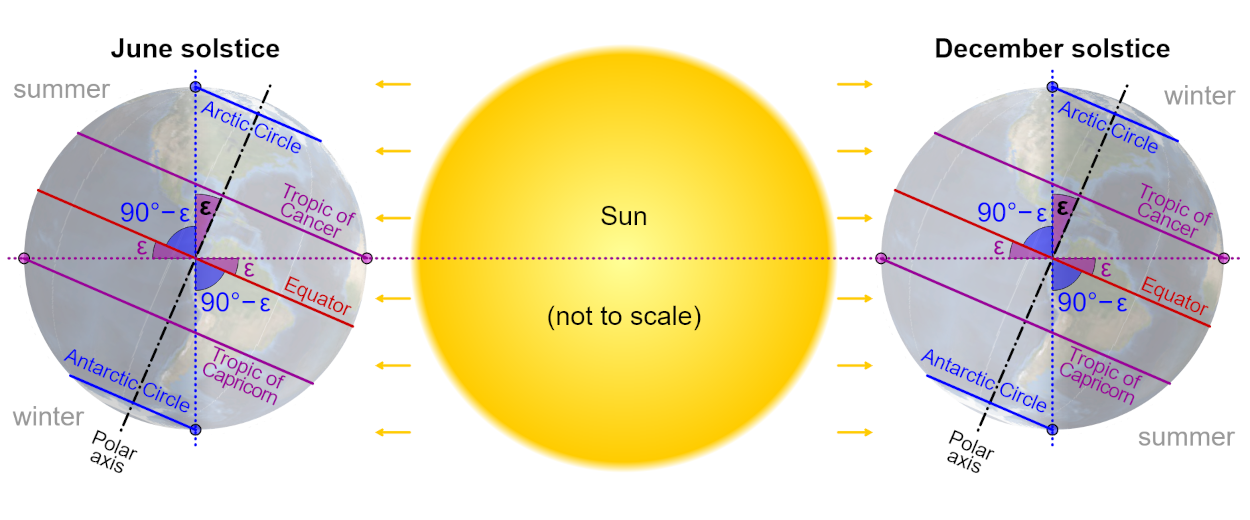
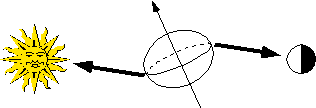
The Greek letter epsilon in the image above represents the tilt of the Earth’s axis of around 23.5°. Astronomers call it the obliquity of the ecliptic, the angle between the ecliptic and the celestial equator as seen in the illustration below.
Ephemeris: 02/17/2026 – There’s an annular solar eclipse today… if you’re a penguin
This is Ephemeris for Fat Tuesday, February 17th. Today the Sun will be up for 10 hours and 34 minutes, setting at 6:14, and it will rise tomorrow at 7:38. The Moon is new today, and won’t be visible.
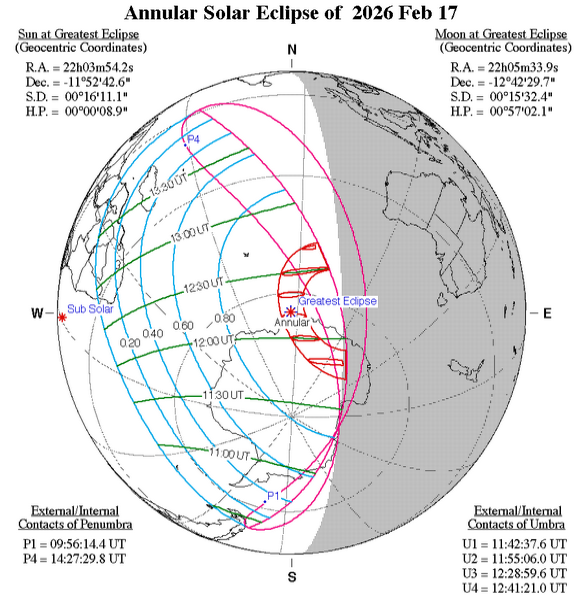
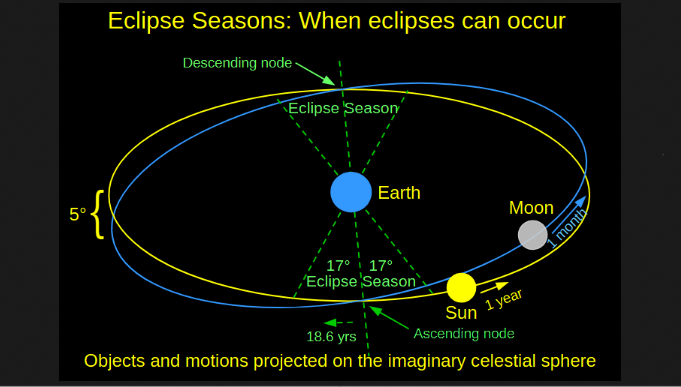
This morning there is an annular solar eclipse occurring. Don’t run outside to see it, especially if you’re here in northern Michigan. The eclipse is only visible in the Southern Ocean and Antarctica. However, this eclipse marks the beginning of an eclipse season, and we will have an eclipse that will be visible for our location in two weeks: a total lunar eclipse, which will be visible before sunrise on Tuesday morning, March 3rd. There are two periods were eclipses will occur in a year, with at least one of the sun and the moon. These periods are separated by a little less than six months, and last about 35 days. That’s about 5 1/2 days longer than a lunar month, so it is possible to squeeze in another eclipse, though not this time.
The astronomical event times given in this blog are for the Traverse City/Interlochen area of Michigan (Lat 44.7° N, Long 85.7° W; EST, UT – 5 hours) unless stated otherwise. Times will be different for other locations.
Addendum
Ephemeris: 02/13/2026 – The real cause of a planet’s retrograde motion
This is Ephemeris for Friday, February 13th. Today the Sun will be up for 10 hours and 22 minutes, setting at 6:08, and it will rise tomorrow at 7:44. The Moon, halfway from last quarter to new, will rise at 6:30 tomorrow morning.
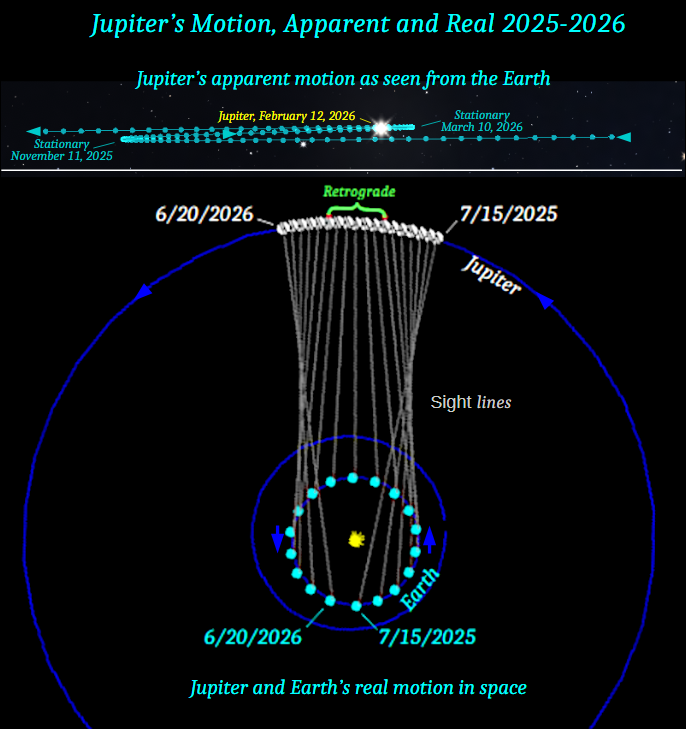
So what is the real reason that Jupiter is currently moving westward for a while in retrograde motion? Retrograde motion occurs in outer planets because the Earth is actually passing them. A simple analogy would be, if you were in a car that was passing another, the car you are passing would seem to move backwards compared to you. And that is exactly what’s happening. The Earth moves faster than the outer planets. Since the solar system is like a racetrack, and we get to lap these outer planets repeatedly when they are closest to us. For the inner planet it’s opposite. They go retrograde or backwards when they are passing us. This is a much simpler answer than all these circles upon circles the ancients invented.
The astronomical event times given in this blog are for the Traverse City/Interlochen area of Michigan (Lat 44.7° N, Long 85.7° W; EST, UT – 5 hours) unless stated otherwise. Times will be different for other locations.
Addendum
Ephemeris: 02/12/2026 – Why do planets stop and move backward for a time? Part 1
This is Ephemeris for Darwin Day, Thursday, February 12th. Today the Sun will be up for 10 hours and 19 minutes, setting at 6:07, and it will rise tomorrow at 7:45. The Moon, 3 days past last quarter, will rise at 5:49 tomorrow morning.
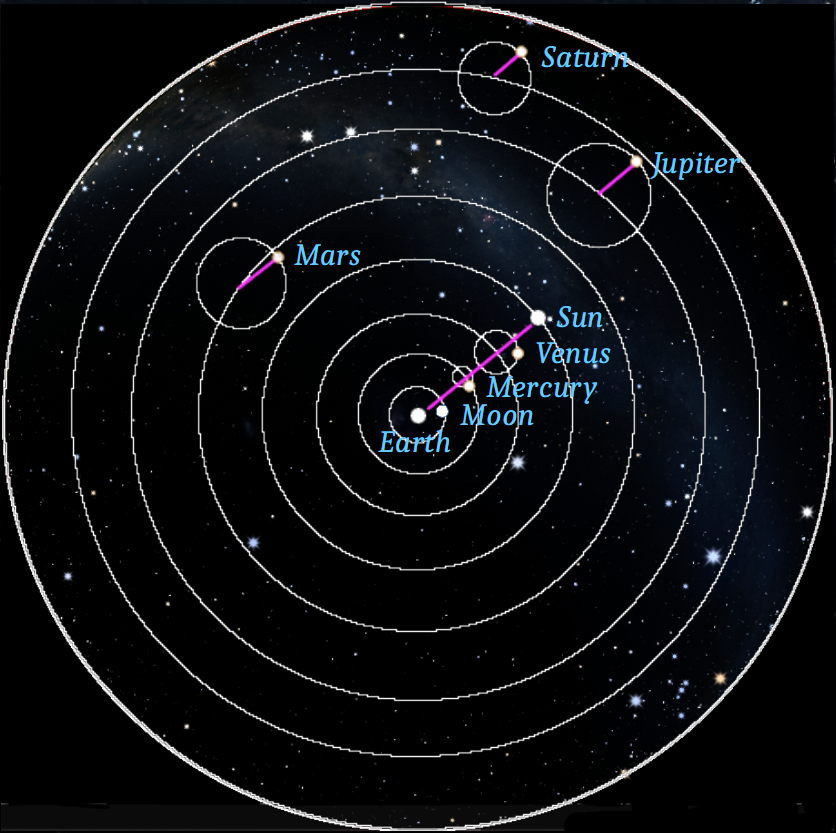
For the last month or so I’ve been talking about Jupiter in its retrograde or westward motion against the stars of Gemini. This motion isn’t due to just Jupiter itself. Jupiter orbits smoothly around the sun in one direction, in a little less than 12 years. The ancients thought that the earth was stationary, and everything in the sky orbited the earth. They thought that the planets orbited the earth in the same time that the planet orbits the sun, however every year and depending on where the planet was in the sky it would stop, reverse itself for a while and then resume its eastward motion through the sky. They thought that the planet moved on a small circle called an epicycle that rode on the larger circle called the deferent.
The astronomical event times given in this blog are for the Traverse City/Interlochen area of Michigan (Lat 44.7° N, Long 85.7° W; EST, UT – 5 hours) unless stated otherwise. Times will be different for other locations.
Addendum
Tomorrow, we’ll find out what’s really going on.
Ephemeris: 01/05/2026 – We just passed perihelion… Can’t you feel the warmth?
This is Ephemeris for Monday, January 5th. Today the Sun will be up for 8 hours and 57 minutes, setting at 5:16, and it will rise tomorrow at 8:19. The Moon, 2 days past full, will rise at 8:10 this evening.
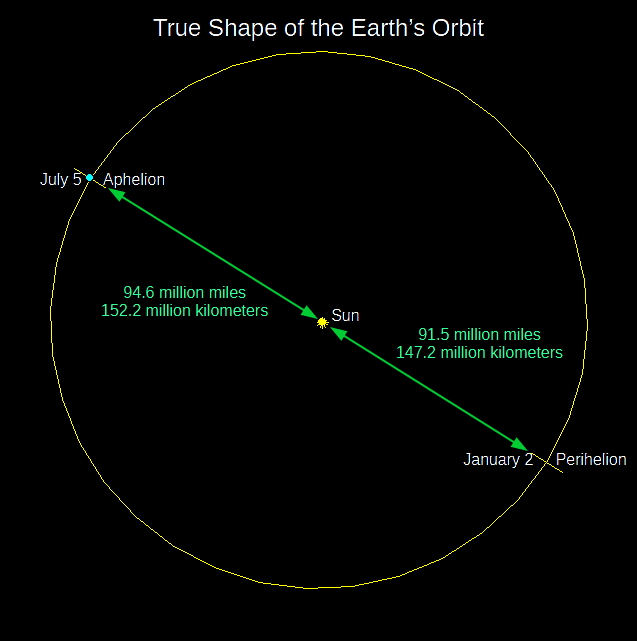
While we were busy with other matters, several astronomical events happened over the weekend. First, on Friday we had our latest sunrise, so our lengthening days are beginning to show up in the morning now. On Saturday the Earth passed perihelion, that is its closest point in its orbit to the Sun. That doesn’t make things any warmer, but it does make winter the shortest season by about four days shorter than summer. Not that you could tell in Northern Michigan. The distance of the Earth from the Sun is still hanging around 91.4 million miles. The earth is moving faster so we move through winter quicker. Also, there was a meteor shower, the Quadrantids, which peaked on Saturday, but was pretty much wiped out by the full moon.
The astronomical event times given in this blog are for the Traverse City/Interlochen area of Michigan (Lat 44.7° N, Long 85.7° W; EST, UT – 5 hours) unless stated otherwise. Times will be different for other locations.
Addendum
Ephemeris: 12/26/2025 – Conjunctions, eclipses, transits and occultations, oh my!
This is Ephemeris for Friday, December 26th. Today the Sun will be up for 8 hours and 49 minutes, setting at 5:08, and it will rise tomorrow at 8:19. The Moon, 1 day before first quarter, will set at 12:13 tomorrow morning.
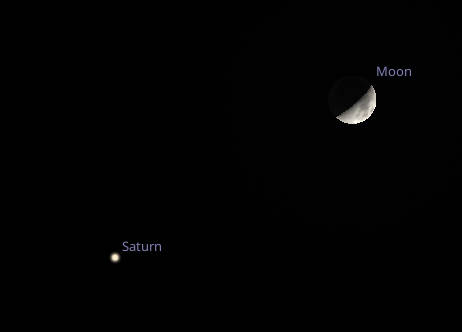
Tonight the Moon will pass north of the planet Saturn. That will mean in that location in the southwestern sky, the planet will appear just below and left of the Moon. When two solar system objects appear to pass each other, it’s called a conjunction. To astronomers, it’s no big deal unless one passes directly in front of the other. If a smaller appearing one crosses the disc of a larger one, it’s called a transit, If one is completely hidden by another it’s an occultation. Occultations and transits of Jupiter and its satellites are common. Also, Jupiter’s satellites are eclipsed by passing through the planet’s shadow. We are in a period now when Jupiter’s moons occult and eclipse each other occasionally.
The astronomical event times given in this blog are for the Traverse City/Interlochen area of Michigan (Lat 44.7° N, Long 85.7° W; EST, UT – 5 hours) unless stated otherwise. Times will be different for other locations.
Addendum
Ephemeris: 12/19/2025 – Winter begins Sunday
This is Ephemeris for Friday, December 19th. Today the Sun will be up for 8 hours and 48 minutes, setting at 5:04, and it will rise tomorrow at 8:16. The Moon is new today, and won’t be visible.
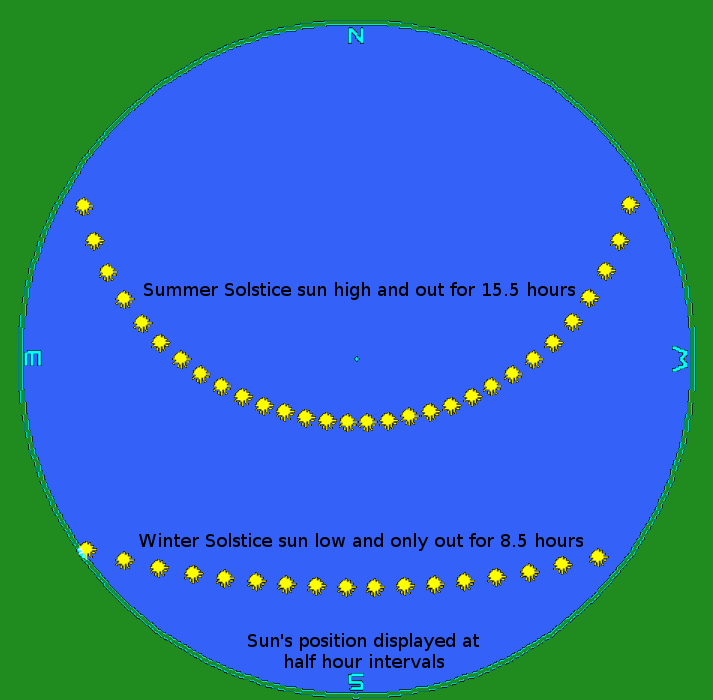
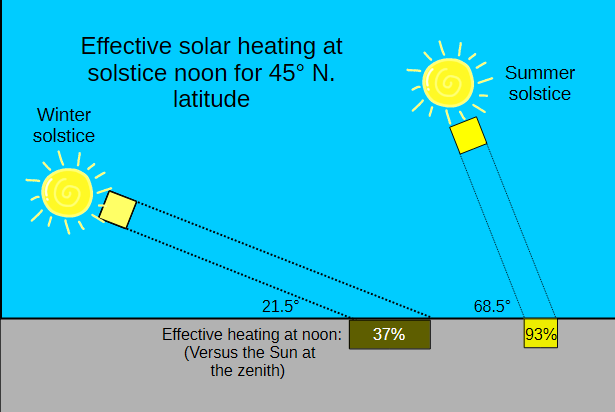
The thermometer and snowfall tell us that winter ought to be here. Well, it will be at 10:03 Sunday morning. At that point, the winter solstice, the Sun will be directly over the Tropic of Capricorn at 23 ½ degrees south latitude. It’s an odd name because 2,000 years ago the Sun was in indeed entering Capricornus. Now it will be entering Sagittarius, right above the spout of the teapot asterism we know so well in summer. From then on the Sun will be climbing up the sky each noon until June 21st next year when summer will start. To which I say: Go Sun Go! The Sun will almost make it up to 22 degrees above the southern horizon at local noon, which is 12:40 pm, in Interlochen and be out for only 8 hours and 48 minutes. If it stayed that low all year, we’d be in a deep freeze, possibly colder than Antarctica.
The astronomical event times given in this blog are for the Traverse City/Interlochen area of Michigan (Lat 44.7° N, Long 85.7° W; EST, UT – 5 hours) unless stated otherwise. Times will be different for other locations.
Addendum
 Bob Moler's Ephemeris Blog