Archive
07/25/2016 – Ephemeris – Hermes’ Harp
Ephemeris for Monday, July 25th. The Sun rises at 6:21. It’ll be up for 14 hours and 54 minutes, setting at 9:16. The Moon, 1 day before last quarter, will rise at 12:34 tomorrow morning.
High up in the eastern sky at 11 p.m. can be found a bright star just north of a small, narrow, but very distinctive parallelogram of stars. They are the stars of the constellation Lyra the harp. The bright star is Vega, one of the twenty-one brightest stars, first magnitude stars. Vega is actually the 5th brightest night-time star. The harp, according to Greek mythology, was invented by the Greek god Hermes. The form of the harp in the sky, is as he had invented it: by stretching strings across a tortoise shell. Hermes gave it to his half-brother Apollo, who in turn gave it to the great musician Orpheus. In binoculars, near Vega, two stars appear together. They barely appear to the unaided eye as one star, called Epsilon Lyrae.
Times are for the Traverse City/Interlochen area of Michigan. They may be different for your location.
Addendum
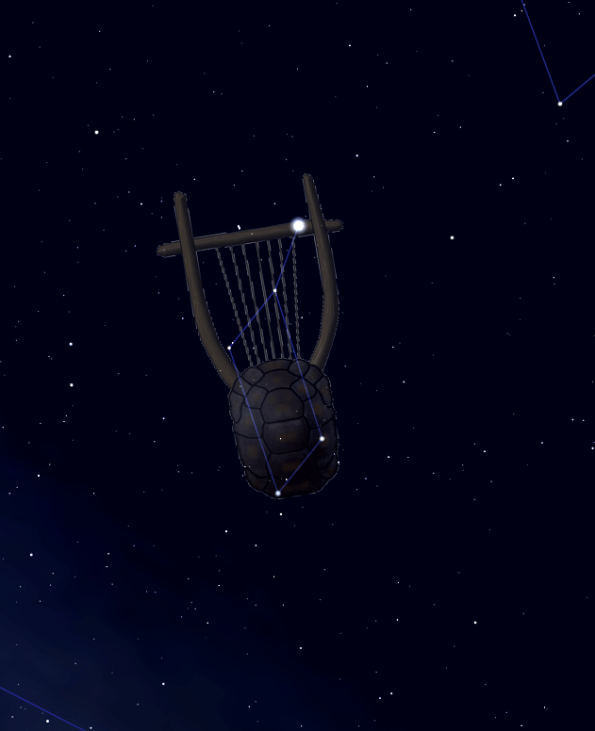
Lyra as a tortoise shell harp. Created using Stellarium and free clip art.
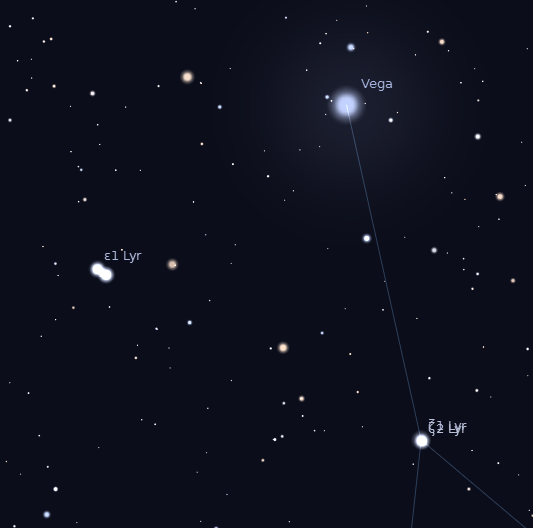
Closeup on Vega and Epsilon Lyrae. Created using Stellarium.
07/07/2016 – Ephemeris – The snake handler in the sky
Ephemeris for Thursday, July 7th. Today the Sun will be up for 15 hours and 24 minutes, setting at 9:30, and it will rise tomorrow at 6:06. The Moon, 3 days past new, will set at 11:31 this evening.
Saturn and the red star Antares shine in the south at 11 p.m. In the area of sky above it lies a large constellation of faint stars called Ophiuchus, the serpent bearer. Ophiuchus represent the legendary physician Aesculapius. The constellation shape is like a large bell, which reminds me of the head, shoulders and arms of a fellow that’s holding the snake-like a weight lifter struggling to pull up a heavy barbell. Serpens, the constellation of the serpent is in the sky in two sections. The front end lies to the right as Serpens Caput, and wends its way up towards Corona Borealis, the Northern Crown. Serpens Cauda, the tail rises to the left of Ophiuchus. It’s a rewarding sight, and not that hard to spot.
Times are for the Traverse City/Interlochen area of Michigan. They may be different for your location.
Addendum
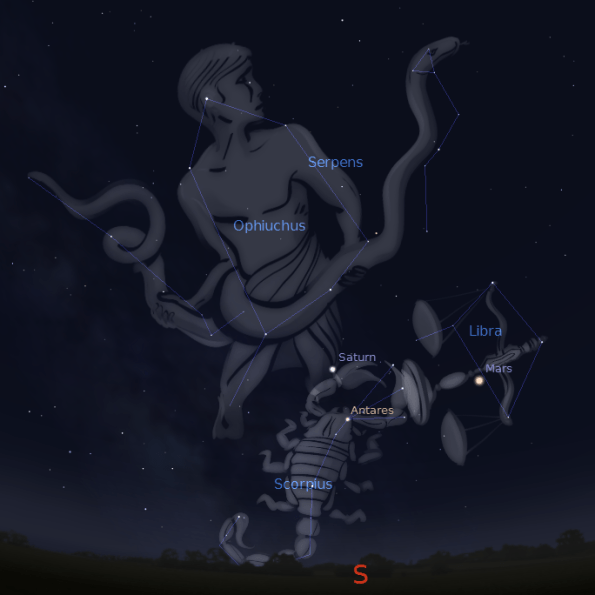
The figure of Ophiuchus with Saturn and Mars nearby at 11 p.m. July 7, 2016. Created using Stellarium.
07/05/2016 – Ephemeris – Poor Hercules
Ephemeris for Tuesday, July 5th. Today the Sun will be up for 15 hours and 26 minutes, setting at 9:30, and it will rise tomorrow at 6:04. The Moon, 1 day past new, will set at 10:17 this evening.
Orion, an obscure Greek hero gets a splashy constellation in the winter sky, but the greatest hero of all, Hercules, gets a dim group of stars on the border between the spring and summer stars. At 11 p.m. Hercules is high and nearly overhead. It’s located above and right of the bright star, Vega, high in the east. Hercules’ central feature is a keystone shaped box of stars, called the Keystone, which represents the old boy’s shorts. From each top corner extend lines of stars that are his legs, from the bottom stars, the rest of his torso and arms extend. So in one final indignity he’s upside down in our sky. Some see him crouched down, club upraised holding the multi-headed Hydra about to throttle it.
Times are for the Traverse City/Interlochen area of Michigan. They may be different for your location.
Addendum
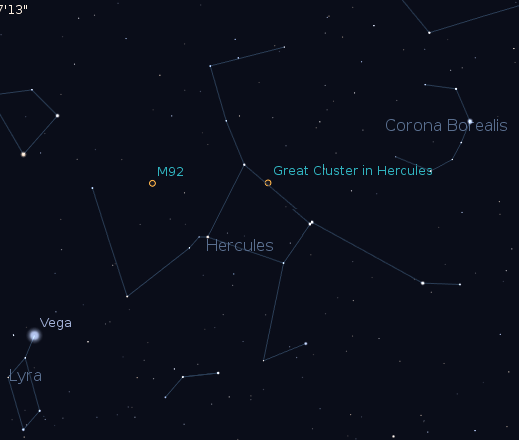
The constellation Hercules and his neighbors. Created with Stellarium.
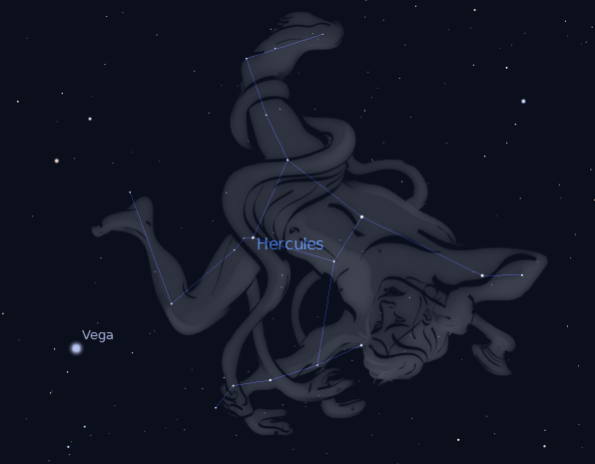
Hercules, visualized by Johan Meuris of the Stellarium development team.
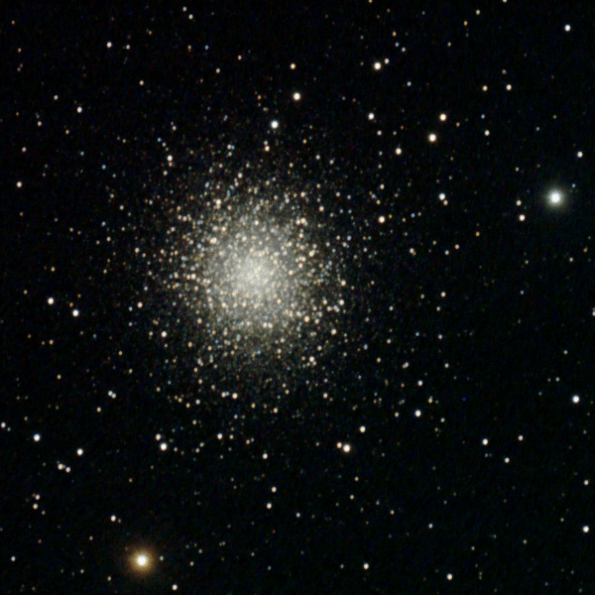
M13, the Great Globular Star Cluster in Hercules. Credit: Scott Anttila.
06/28/2016 – Ephemeris – Corona Borealis, the Northern Crown
Ephemeris for Tuesday, June 28th. Today the Sun will be up for 15 hours and 32 minutes, setting at 9:32, and it will rise tomorrow at 6:00. The Moon, 1 day past last quarter, will rise at 2:31 tomorrow morning.
High in the south at 11 p.m. can be found a small but easily spotted constellation of Corona Borealis, the Northern Crown. It is located just east or left of the kite shaped constellation of Boötes, with its bright star Arcturus at the bottom. The Northern Crown is a three-quarters circle of stars, like a tiara, with a brighter star Alphecca or Gemma at the bottom. Alphecca in Arabic means “Bright star of the broken ring of stars”. Gemma could mean gem or a bud or blossom, so Corona Borealis could represent a floral crown. According to Greek mythology it belonged to Princess Ariadne, daughter of King Minos of Crete who helped Theseus escape from the Labyrinth of the Minotaur, only to be abandoned by him on an island.
Times are for the Traverse City/Interlochen area of Michigan. They may be different for your location.
Addendum
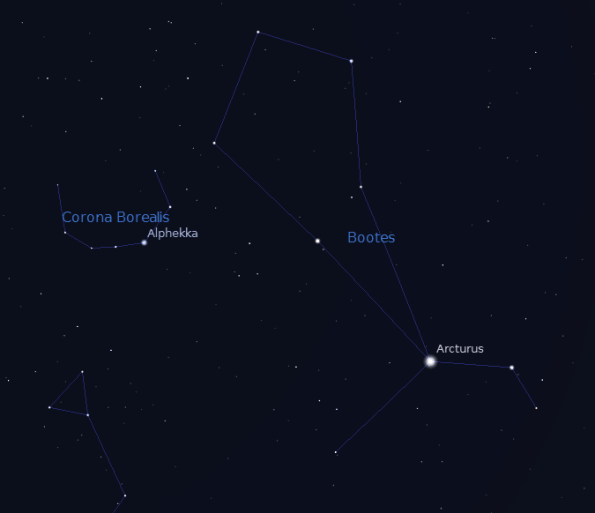
Corona Borealis tonight, June 28, 2016. Alphekka is the alternate spelling, European, of Alphecca. Created using Stellarium.
04/28/2016 – Ephemeris – The adventures of Corvus, Apollo’s pet crow
Ephemeris for Thursday, April 28th. The Sun rises at 6:36. It’ll be up for 14 hours and 8 minutes, setting at 8:44. The Moon, 1 day before last quarter, will rise at 2:20 tomorrow morning.
The small constellation of Corvus the crow is located low in the south at 11 this evening. It’s made of 5 dim stars, but the pattern is a distinctive distorted box with two stars at the upper left marking that corner. To the right is a fainter constellation of a thick stemmed goblet called Crater. Both appear above the long constellation of Hydra the water snake who is slithering just above the southern horizon.. In Greek mythology Corvus, then white, was the god Apollo’s pet. Apollo once bid Corvus to take a cup and fetch him some water. Corvus however dallied and waited for a green fig to ripen. Corvus grabbed a snake and returned with a story as to how the snake had delayed him. The angry Apollo turned the crow and all crows to this day black.
Times are for the Traverse City/Interlochen area of Michigan. They may be different for your location.
Addendum
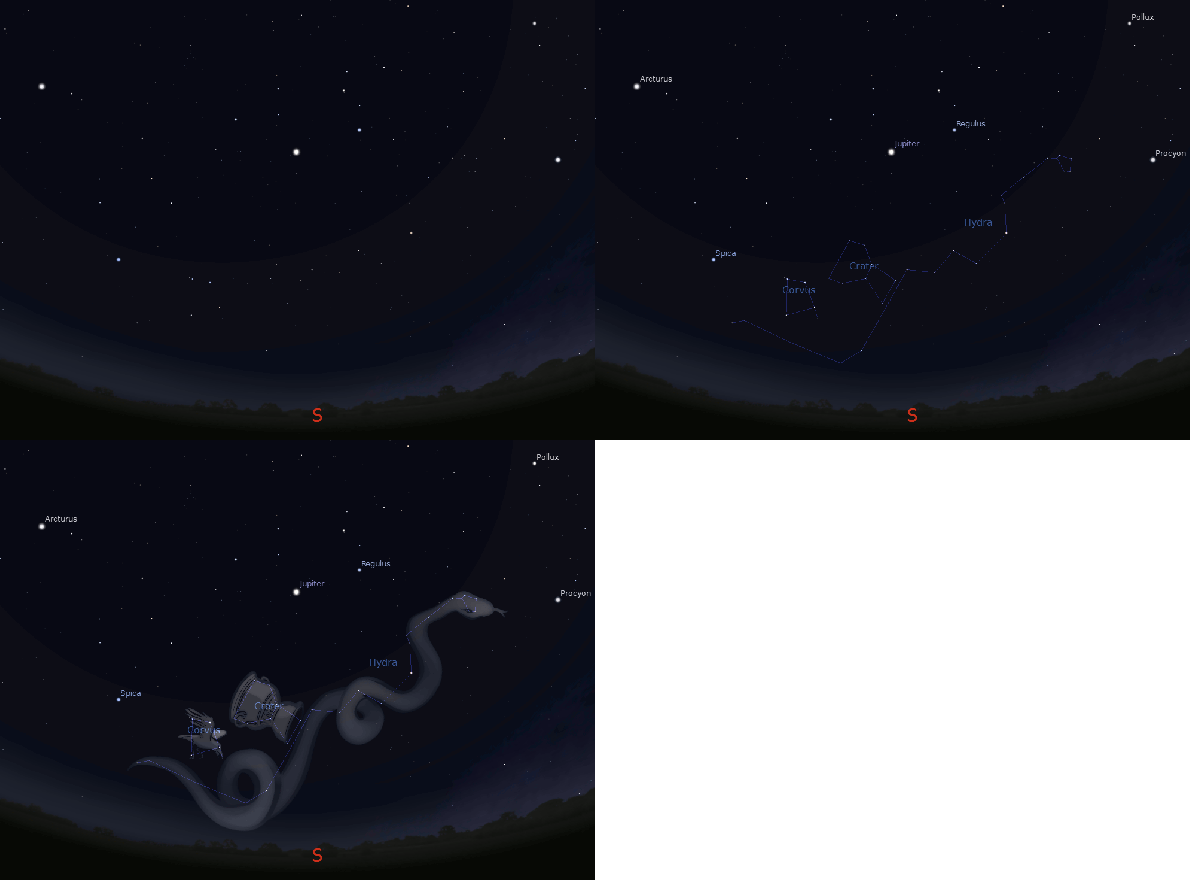
Corvus the crow, Crater the cup and Hydra the water snake along with Jupiter and the other spring stars at 10 p.m. April 28, 2016. Created using Stellarium.
04/25/2016 – Ephemeris – Arcas and Callisto
Ephemeris for Monday, April 25th. The Sun rises at 6:41. It’ll be up for 13 hours and 59 minutes, setting at 8:40. The Moon, 3 days past full, will rise at 11:56 this evening.
Appearing mid way up the sky in the east at 10 p.m. is the kite shaped constellation of Boötes the herdsman. The bright star Arcturus is at the bottom of the kite, pointed to by the arc of the handle of the Big Dipper, above it. In one story Boötes represents a young hunter named Arcas, son of Callisto, a beautiful young lady who had the misfortune of being loved by Zeus the chief of the Greek gods. Zeus’ wife Hera, found out about the affair, and since she couldn’t punish Zeus, turned the poor woman into an ugly bear. Arcas, unaware of the events surrounding his mother’s disappearance was about to kill the bear when Zeus intervened and placed them both in the sky to save her. To this day Boötes continues to chase the great bear Ursa Major around the sky each night.
Times are for the Traverse City/Interlochen area of Michigan. They may be different for your location.
Addendum
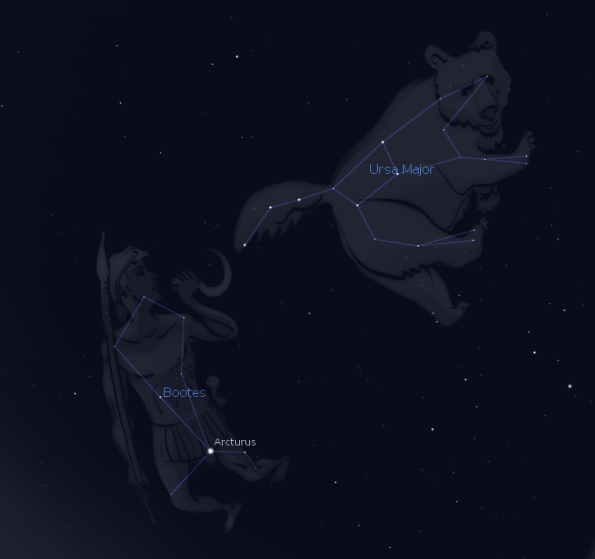
Bootes and Ursa Major aka Arcas chasing Callisto around the pole of the sky. Created using Stellarium.
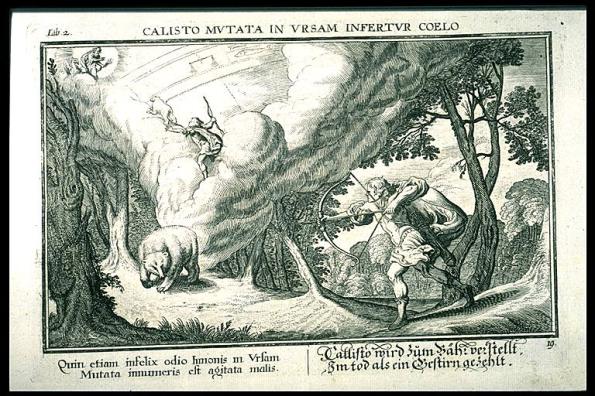
Arcas about to slay the bear by the 17th century artist Baur. Source: University of Virginia Electronic Text Center
04/07/2016 – Ephemeris – The Big Dipper, the Great Bear and the Fisher Star
Ephemeris for Thursday, April 7th. The Sun will rise at 7:11. It’ll be up for 13 hours and 6 minutes, setting at 8:18. The Moon is new today, and won’t be visible.
The constellation of Ursa Major, or great bear was well-known to the ancient Greeks and Native Americans. Today, however, many of us can recognize only part of it as the Big Dipper. The bear can be easily seen only in a dark sky, at 10 p.m. it’s high just north of the zenith with feet to the south. The stars in front of the bowl are the front part of his body and head. The bowl of the Big Dipper is his rump, and the handle his long tail. The Native Americans, saw those three stars as three hunters following the bear. The tribes of the Great Lakes region saw it as the Fisher Star, who brought summer to the Earth. These stars here do make a convincing bear, except for the tail, when seen on a dark night. The weasel-like Fisher Star fits the stars completely.
Times are for the Traverse City/Interlochen area of Michigan. They may be different for your location.
Addendum

Animation of 4 views of Ursa Major. 1. with no added imagery, emphasizing the Big Dipper, 2. added lines for Ursa Major, 3. image of the bear, 4. image of Fisher Star. Created using Stellarium and GIMP.
Note: The Fisher Star illustration is an unattributed drawing from the Internet with a minor change.
03/15/2016 – Ephemeris – Spotting the celestial Horse and Rider
Ephemeris for, the Ides of March, Tuesday, March 15th. The Sun will rise at 7:54. It’ll be up for 11 hours and 55 minutes, setting at 7:49. The Moon, at first quarter today, will set at 3:36 tomorrow morning.
In the handle of te Big Dipper rising high in the east northeast is an easily seen double star. It’s the star second from the end of the handle where it makes a bend. The bright star is Mizar. It has a dim companion star that folks with good eyesight can easily spot, named Alcor. The Arabs of old, before optometrists used the pair as an eye test. I would have failed. Even with my glasses on I can’t spot Alcor. I must resort to binoculars. The pair is known as the Horse and Rider, while the indigenous peoples of North America, see the stars of the handle of the Big Dipper not as the great Bear’s tail, but hunters following the bear. In this case Alcor is either a hunting dog, or a cooking pot to cook the bear in.
Times are for the Traverse City/Interlochen area of Michigan. They may be different for your location.
Addendum
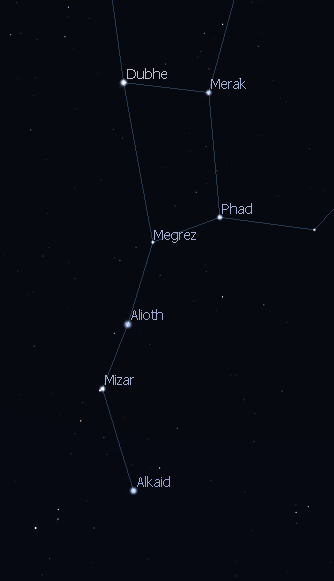
The Big Dipper, part of Ursa Major the Great Bear, is poised on its handle in the northeast. Can you spot Alcor? Created using Stellarium.
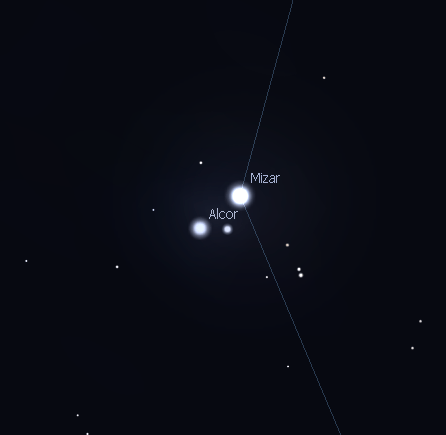
A closeup view of Mizar and Alcor and a dimmer star that lies in the background. Created using Stellarium.
A telescope with low power will also split Mizar intro a bright and dim companion named Mizar A and Mizar B. By observing Mizar A, B and Alcor have determined that all three are binary. There’s six stars there.
02/02/2016 – Ephemeris – Hard luck Orion
Ephemeris for Ground Hog Day, Tuesday, February 2nd. The Sun will rise at 8:01. It’ll be up for 9 hours and 50 minutes, setting at 5:52. The Moon, 2 days past last quarter, will rise at 3:31 tomorrow morning.
The large and bright constellation of Orion is now in the south at 9 p.m. It is seen as an upright rectangle of bright stars, with a belt of three stars in the center. Orion is a minor character in Greek mythology. Orion was the son of Neptune, and was a hunter. He had an ill-fated romance with Merope whose father King Oenopion had him blinded. After having his sight restored, Orion became a companion of Diana goddess of the hunt and they wanted to marry. In one story Apollo, Diana’s brother disapproved of Orion also and was able to trick Diana into accidentally killing Orion with her bow. The heart-broken Diana then placed Orion in the sky with his hunting dogs, were we see him to this day.
Times are for the Traverse City/Interlochen area of Michigan. They may be different for your location.
Addendum
Actually this isn’t the only story of Orion’s death. The other was that he was stung by a scorpion, also by the urging of Apollo. This is the explanation as to why Orion and Scorpius the scorpion are never in the sky at the same time. However south of the equator that is no longer true, but the Greeks and Romans never ventured that far south enough to see it.
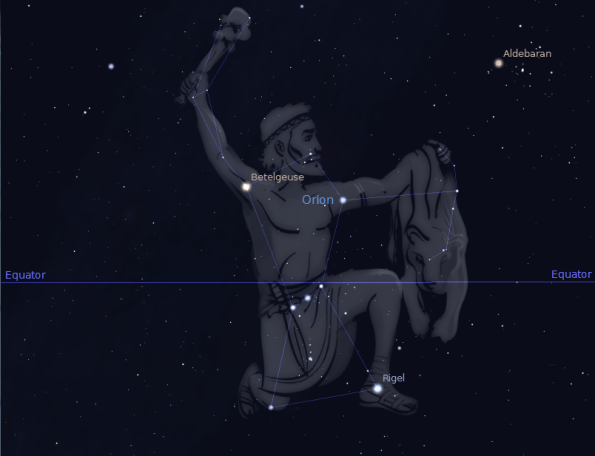
Orion from mid latitudes north of the equator. Orion would be upside down if viewed south of the equator. Created using Stellarium.
01/25/2016 – Ephemeris – Sirius the Dog Star
Ephemeris for Monday, January 25th. The Sun will rise at 8:09. It’ll be up for 9 hours and 31 minutes, setting at 5:41. The Moon, 2 days past full, will rise at 7:43 this evening.
While we’re waiting for the bright Moon to leave the evening sky, let’s look at another bright star. This one is the brightest of all, Sirius the Dog Star. The Dog Star name comes from its position at the heart of the constellation Canis Major, the great dog of Orion the hunter. The three stars of Orion’s belt tilt to the southeast and point to Sirius. The name Sirius means ‘Dazzling One’, a reference to its great brilliance and twinkling. The Romans thought Sirius added its heat to that of the Sun in summer to bring on the scorching Dog Days of July and August. Its ancient Egyptian name was Sothis, and its first appearance in the morning twilight in late June signaled the flooding of the Nile, and the beginning of the Egyptian agricultural year.
Times are for the Traverse City/Interlochen area of Michigan. They may be different for your location.
Addendum
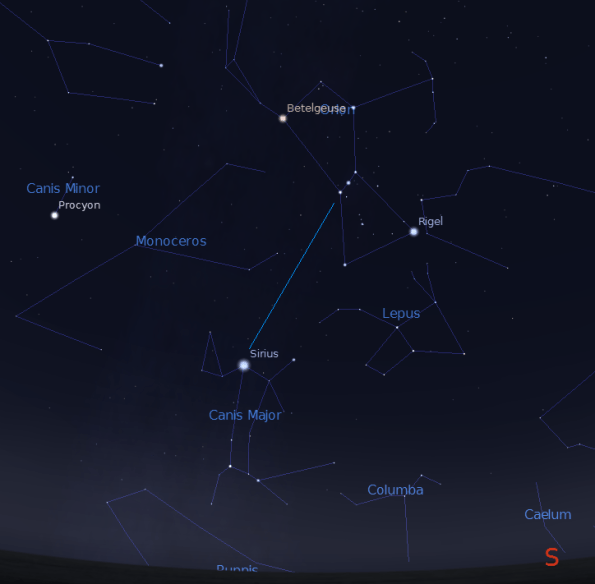
Orion’s Belt points to Sirius. Created using Stellarium.
 Bob Moler's Ephemeris Blog