Archive
Ephemeris: 02/04/2024 – The rabbit at the feet of Orion
This is Ephemeris for Tuesday, February 6th. Today the Sun will be up for 10 hours and 1 minute, setting at 5:57, and it will rise tomorrow at 7:55. The Moon, 3 days before new, will rise at 6:44 tomorrow morning.
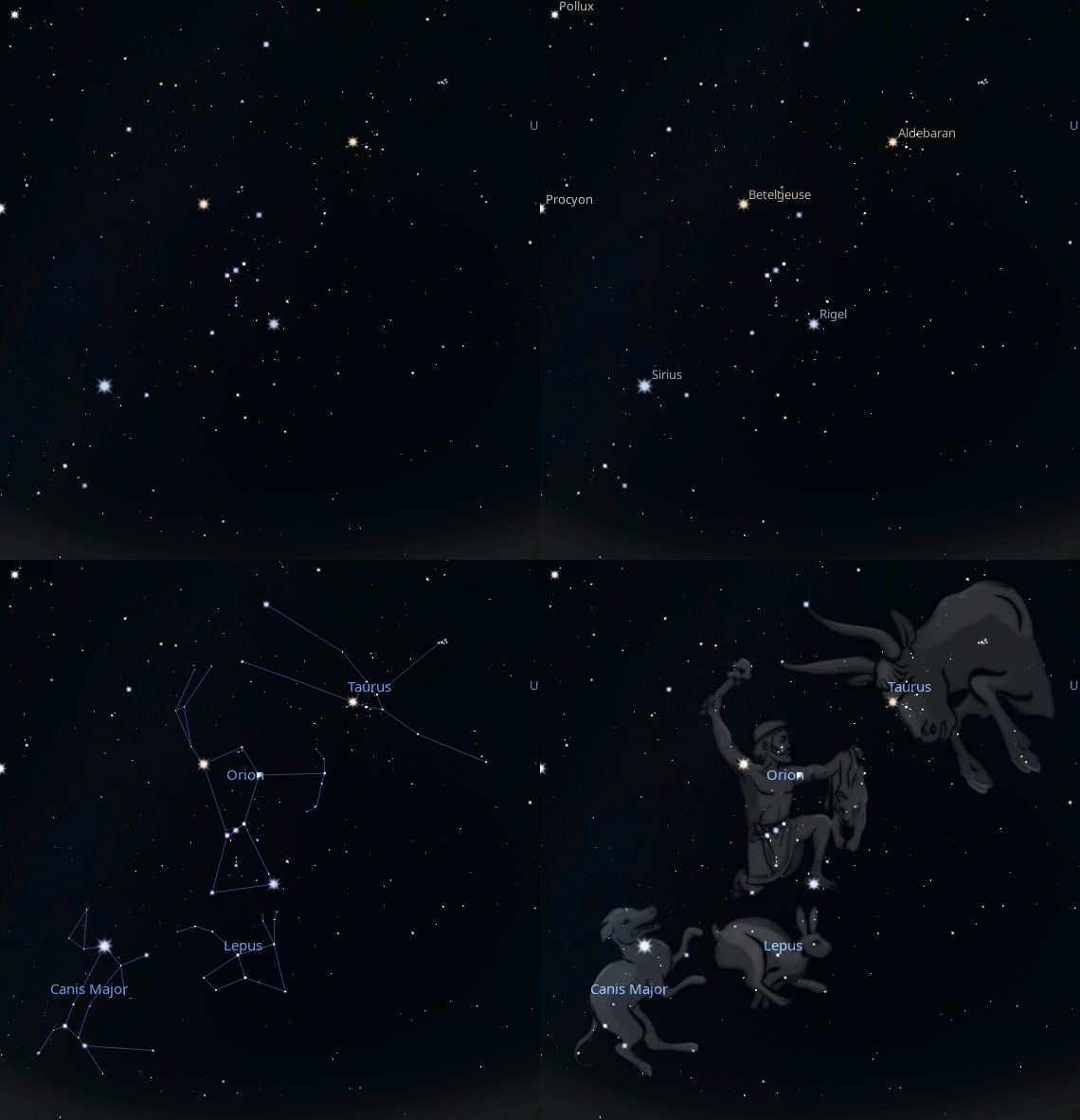
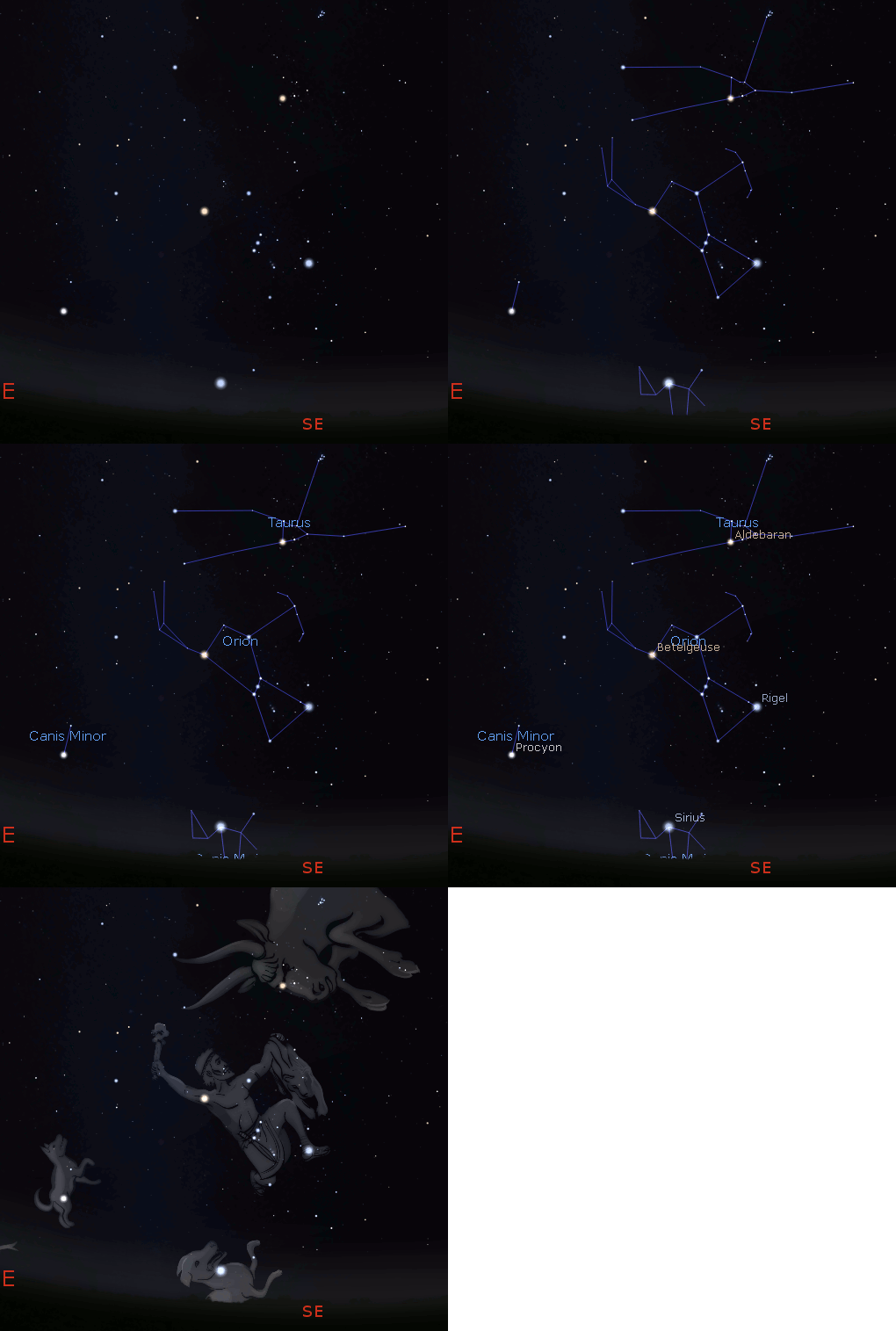
The constellation of Orion the hunter is in the south in the evening, and he seems to be preoccupied with the charge of Taurus the bull to his upper right. Unnoticed by him and below him is a small constellation called Lepus the hare, made of very dim stars. Good luck trying to make a rabbit out of those stars. In the constellation art that comes with the free application Stellarium. It displays the sky like a planetarium. The artistic constellation of the figure of Canis Major, Orion’s large hunting dog seems to be taking notice of Lepus and is beginning to chase it Lepus the hare is a nice addition to the tableau presented in the winter sky. Stellarium-web.org is a web based version of Stellarium that doesn’t have to be installed on your device.
The astronomical event times given are for the Traverse City/Interlochen area of Michigan (EST, UT –5 hours). They may be different for your location.
Addendum
Ephemeris: 02/05/2024 – Looking at the star Procyon
This is Ephemeris for Monday, February 5th. Today the Sun will be up for 9 hours and 59 minutes, setting at 5:56, and it will rise tomorrow at 7:56. The Moon, 3 days past last quarter, will rise at 5:44 tomorrow morning.
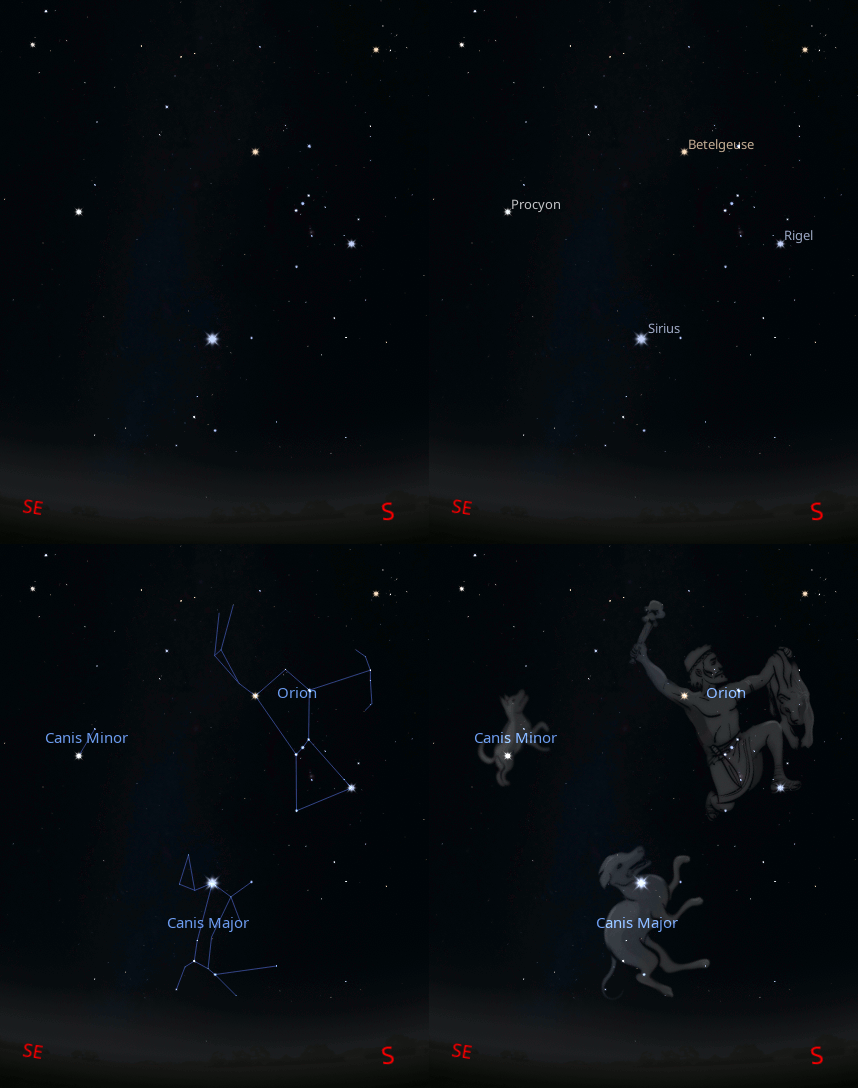
The star Procyon is in Orion’s little hunting dog Canis Minor, which contains only one other star. It can be found by using the shoulder stars of Orion, Bellatrix and Betelgeuse, pointing to the left and down a bit to Procyon in the evening. The word Procyon appears to mean “Before the Dog” meaning that rises before the Dog Star, Sirius, even though it is east of it. Procyon is also north of Sirius, which for observers above 30° north latitude does indeed rise before the Dog Star. It is a star like Sirius, though it’s not as bright, or white. Procyon is 11.5 light years away while Sirius is 8.4 light years away. Both have tiny white dwarf companion stars.
The astronomical event times given are for the Traverse City/Interlochen area of Michigan (EST, UT –5 hours). They may be different for your location.
Addendum
Ephemeris: 01/30/2024 – The Winter Maker moves to center stage at midwinter
This is Bob Moler with Ephemeris for Tuesday, January 30th. Today the Sun will be up for 9 hours and 43 minutes, setting at 5:48, and it will rise tomorrow at 8:03. The Moon, 3 days before last quarter, will rise at 10:53 this evening.
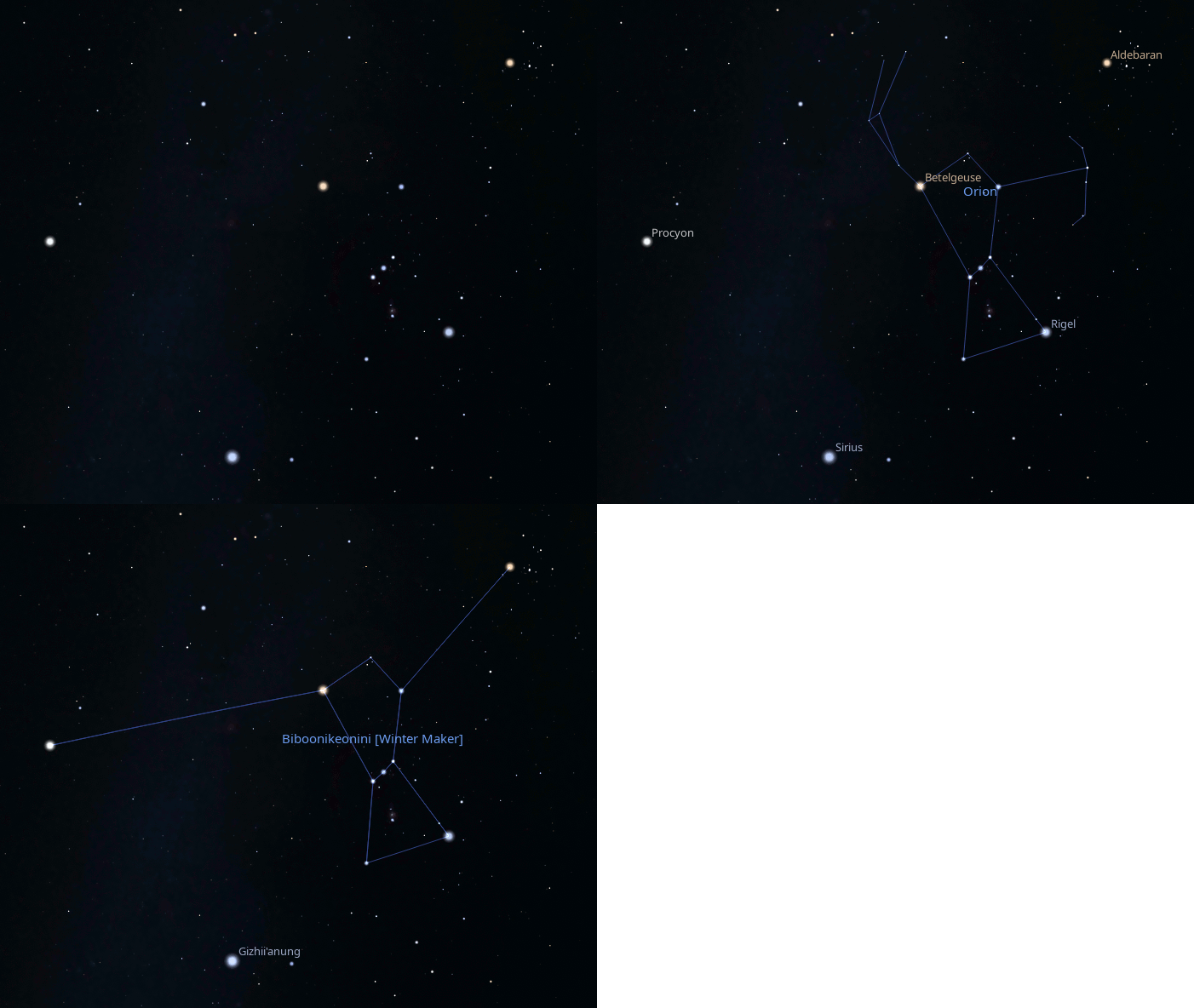
As we approach midwinter looking in the south at about 9 pm we see the great constellation of Orion the hunter. For the Anishinaabek people, who are native to our Great Lakes area, that constellation is the Wintermaker. Instead of holding a club and a shield, as Orion does, he has his arms outstretched from Aldebaran in Taurus to Procyon in Canis Minor embracing all the winter constellations. I’ve first seen him as morning twilight started when I’ve stayed up all night to watch the Perseid meteor shower in August. We begin to see him on late November evenings, rising in the east, to herald the coming of winter, and we will lose him in April when he descends into the West in the evening twilight.
The astronomical event times given are for the Traverse City/Interlochen area of Michigan (EST, UT –5 hours). They may be different for your location.
Addendum
Ephemeris: 01/29/2024 – Canis Major, Orion’s larger hunting dog
This is Ephemeris for Monday, January 29th. Today the Sun will be up for 9 hours and 41 minutes, setting at 5:46, and it will rise tomorrow at 8:04. The Moon, halfway from full to last quarter, will rise at 9:50 this evening.
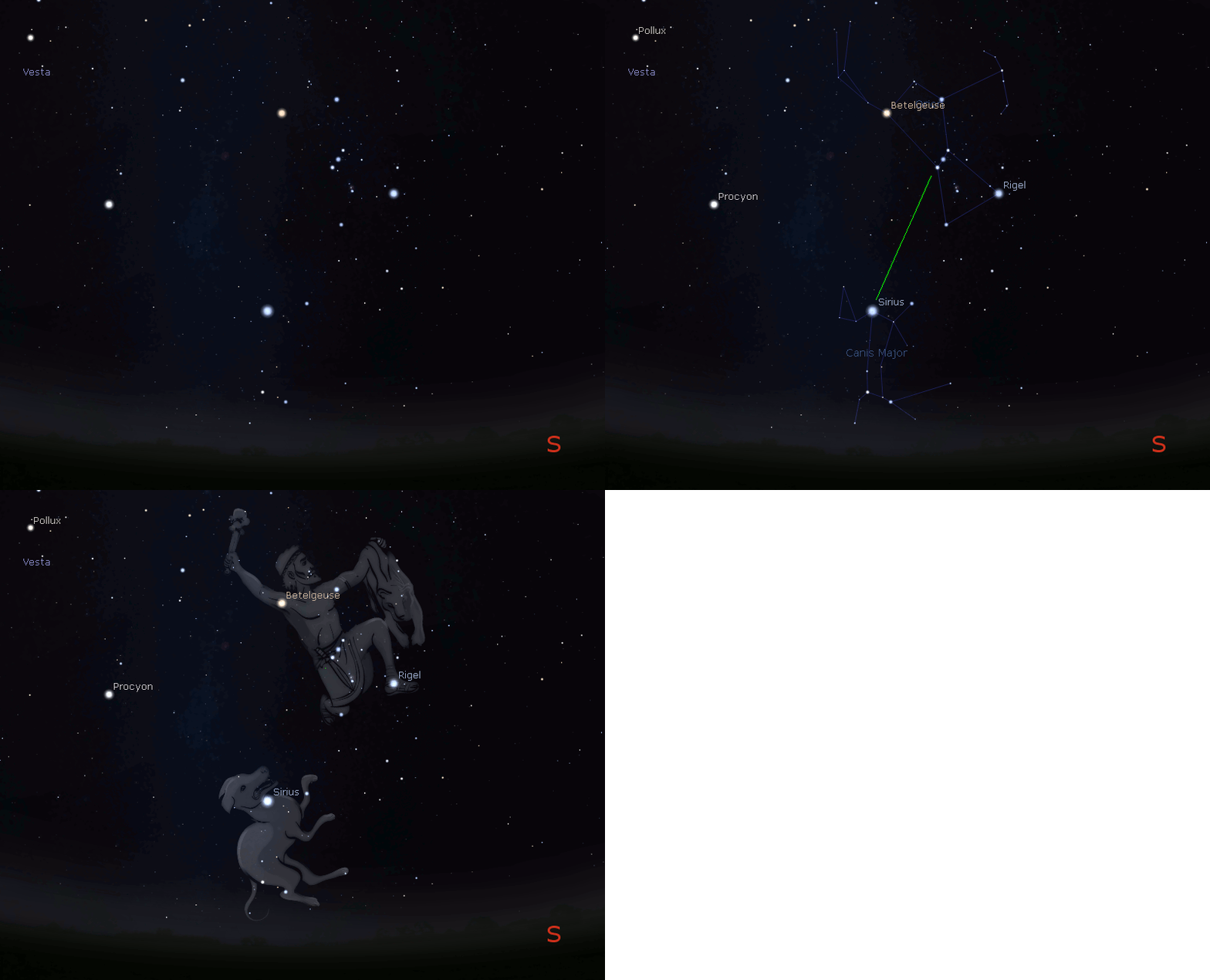
The great winter constellation or star group, Orion the hunter, is located in the south-southeastern sky at 9 p.m. His elongated rectangle of a torso is nearly vertical. In the center of the rectangle are three stars in a line that make his belt. As a hunter, especially one of old, he has two hunting dogs. The larger, Canis Major, can be found by following the three belt stars of Orion down and to the left. They point to Sirius, the brightest nighttime star, also known as the Dog Star. It’s in the heart of a stick figure dog low in the southeast facing Orion that appears to be begging. There’s a fine star cluster, called Messier 41, or M41, the Little Beehive Cluster, at the 5 o’clock position from Sirius. It’s easily visible in binoculars or a small telescope.
The astronomical event times given are for the Traverse City/Interlochen area of Michigan (EST, UT –5 hours). They may be different for your location.
Addendum
Ephemeris: 01/11/2024 – Rigel, the star in Orion’s knee or is it his foot?
This is Bob Moler with Ephemeris for Thursday, January 11th. Today the Sun will be up for 9 hours and 4 minutes, setting at 5:23, and it will rise tomorrow at 8:18. The Moon is new today, and won’t be visible.
Orion’s second first magnitude star is Rigel in the lower right corner of the constellation this is a blue-white star in contrast to Betelgeuse which is a reddish star. The name Rigel is part of a phrase that means Left foot of Jauzah. Jauzah being the old name of the constellation Orion. It’s where we place Orion’s left knee now. In older drawings of the constellation, Orion has his left foot raised as if charging towards Taurus who’s charging at him. Rigel is about the same mass as Betelgeuse, though it’s nearly twice as far away at nearly 900 light years. Rigel is a quadruple star system. The bright Rigel A itself has what looks like a companion in small telescopes. That companion is actually three stars orbiting each other.
The astronomical event times given are for the Traverse City/Interlochen area of Michigan (EST, UT –5 hours). They may be different for your location.
Addendum
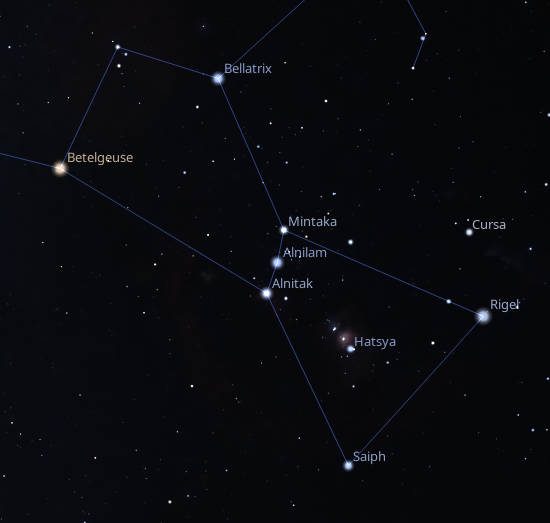
right-most bright star Is Rigel, a bluish white star, in contrast to Betelgeuse which has a ruddy glow. Here it looks like Betelgeuse and Bellatrix are in Orion’s shoulders and Saiph and Rigel are in his knees, with the belt star halfway in between. The word Rigel, however, means foot, and Saiph means sword. Check out the star chart below. Created using Stellarium.
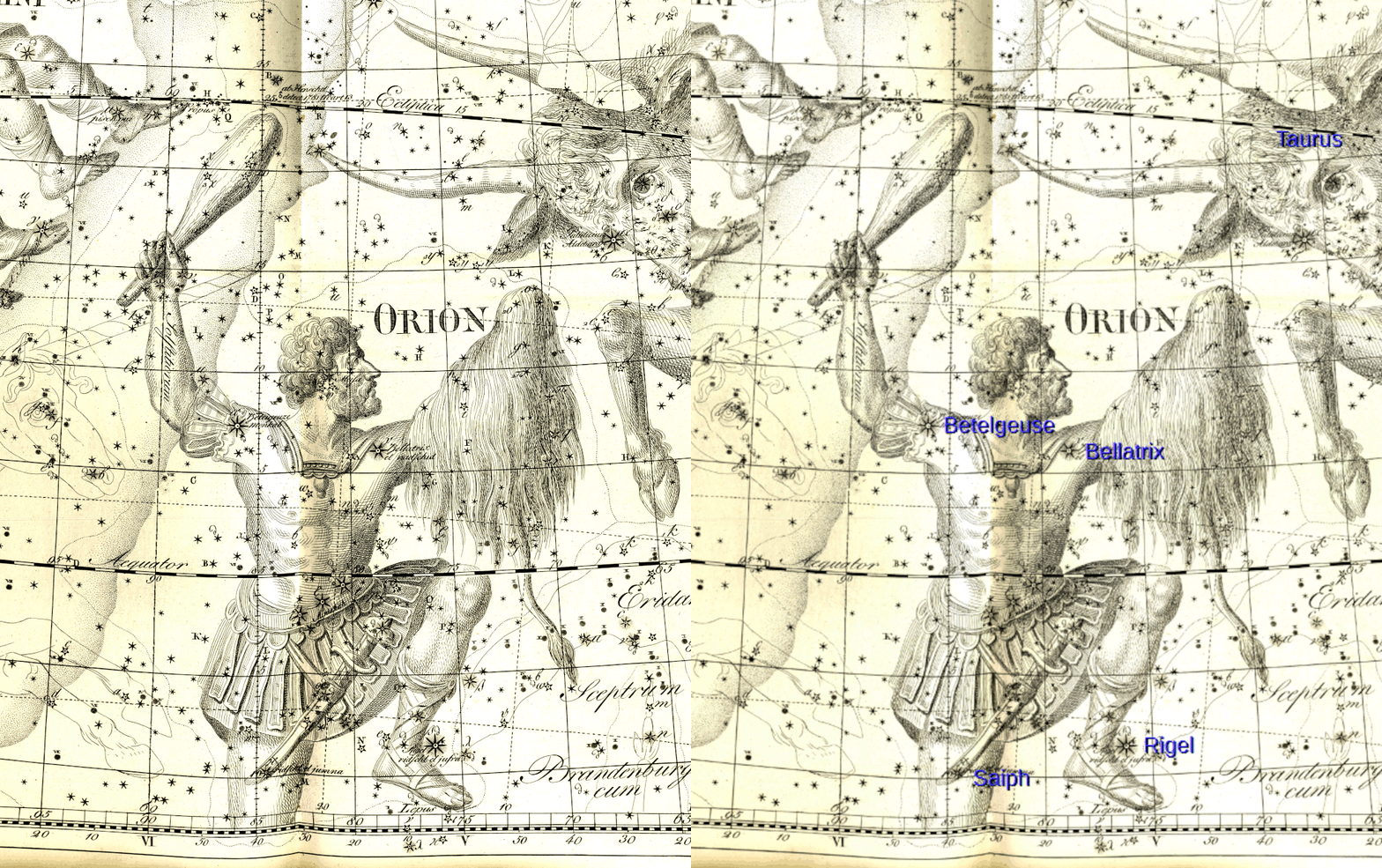

Ephemeris: 01/08/2024 – Orion vs Taurus: conflict for the ages
This is Ephemeris for Monday, January 8th. Today the Sun will be up for 9 hours even, setting at 5:19, and it will rise tomorrow at 8:19. The Moon, 3 days before new, will rise at 6:58 tomorrow morning.
There are several instances in the Greek heavens where constellations appear to interact with one another. This is true with Orion the hunter and Taurus the bull. Taurus, whose face is the letter V of stars with orangish Aldebaran as his angry bloodshot eye is charging down on Orion, who has raised a lion skin shield on one arm and an upraised club in the other, ready to strike. They have been frozen in this pose for millennia. Stars below and right of the letter V of the Bull’s face suggest the front part of his body and his front legs charging at Orion. Orion also has two hunting dogs, Canis Major and Canis Minor. Canis Major with its dazzling star Sirius will rise around 7:30 on a line extended down from Orion’s belt.
The astronomical event times given are for the Traverse City/Interlochen area of Michigan (EST, UT –5 hours). They may be different for your location.
Addendum
Ephemeris Extra: Taurus and its two bright star clusters
Based on an article published in the November 2023 issue of the Stellar Sentinel the newsletter of the Grand Traverse Astronomical Society.
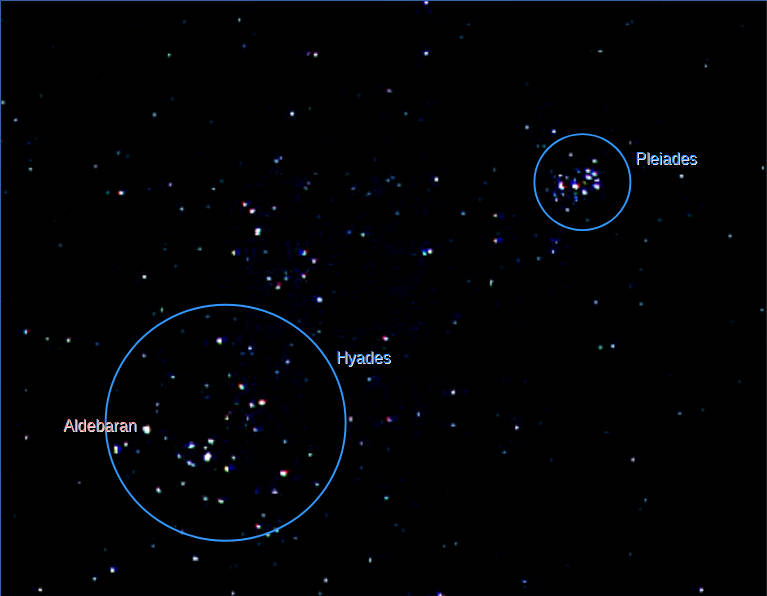
In my October presentation to the society I talked about the stars of autumn, moving generally from the constellations close to summer and ending pretty much against the constellations of winter ending with the constellation of Taurus and with the wonderful Pleiades or Seven Sisters. In this article I’ll take a little bit closer look at the Pleiades and especially the Hyades, the face of Taurus the bull.
On the previous page is a family portrait of the Pleiades and Hyades. Yes, family portrait. In Greek mythology, the Hyades are the half sisters of the Pleiades. The god Atlas is their father, Pleione seems to be the mother of the Pleiades, and Aethra is the mother of the Hyades. In astronomical terms the Hyades would then be the older sisters of the Pleiades.
The Hyades is a star cluster that is 153 light years away. It is the closest star cluster to us and somewhat over 6 times the age of the Pleiades. The younger and splashier Pleiades are around 444 light years away, and only 100 million years old. Whereas the Hyades are over 600 million years old. The Pleiades still contain hot blue-white stars which have died out by the time of the age of the Hyades. The brightest star of the letter V of stars is Aldebaran, Taurus’ angry bloodshot eye. It doesn’t belong to the Hyades, being about half the distance.
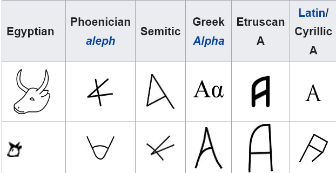
While the Hyades is not as splashy as the Pleiades are and has less of a role in mythology. However, it did play an important part in history when Taurus was the first constellation of the Zodiac some 4,000 years ago, due to precession of the equinoxes. This is because the letter A, the first letter of our alphabet is taken from the stars of the face of Taurus the bull in what looks to us like a V. But it was turned around to be the A we have today. Back then it was called Aleph the first letter of the alphabet for middle eastern cultures.
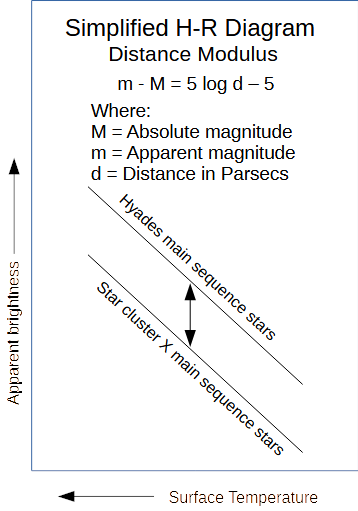
The Hyades is also important in astronomical history in that it helps us measure distances to more distant star clusters. The Hyades was the only star cluster close enough to measure its distance by the parallax method before the advent of the European Space Agency’s Hipparcos and Gaia satellites. If one matches stars on the Hertzsprung-Russell diagram of intrinsic brightness versus surface temperature with other star clusters the stars of the main sequence, where stars spend most of their lives burning hydrogen. The difference in the brightness of the main sequence stars gives the measure of how other star clusters measure up as far as distance since the main sequence is a relatively narrow distribution of stars. This works only with star clusters because there are many stars at the same distance which happen to be about the same age. And enough stars to establish the main sequence since stars at later stages of life may have the same temperature, but vastly different brightnesses.
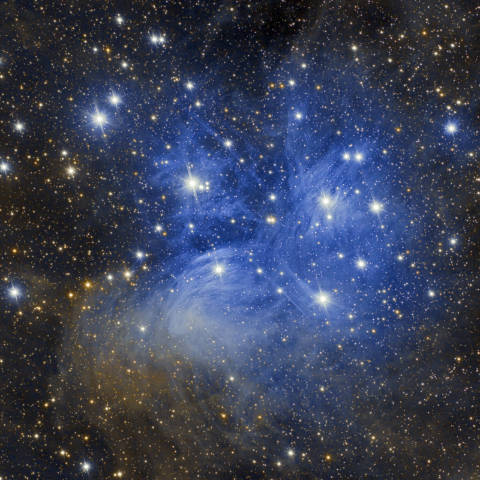
The Pleiades are so large that most telescopes will not allow one to see all the brighter stars at once, so binoculars are the best way to view them. At a dunes star party a few years ago, before COVID, I used my 11-inch (279 mm) Newtonian telescope, which has a 55 inch (1,397 mm) focal length, with a 40 millimeter eyepiece to view the Pleiades. A 40 millimeter eyepiece in that scope gives too low a magnification to use the entire diameter of the primary mirror. All the light doesn’t make it into the eye. That eyepiece gave me about 35 times magnification, so the main stars of the cluster fit into the field of view. The photograph above is nice and all that, but looking with the eye visually at the Pleiades, even with binoculars, you’ll notice something quite different from the photographs. In photographs to make a star brighter you make it bigger. But the eye has a much greater dynamic range. The stars are incredibly brilliant blue white-points of light in the case of the Pleiades. Absolutely beautiful, much more beautiful than any photograph. Not to disparage photographs, but photographs can do what the eye cannot. That is, store light to bring out very faint objects and details. So, let’s take a final look at the Pleiades in a photograph by GTAS member Dan Dall’Olmo.
Ephemeris: 01/04/2024 – Viewing Orion’s Belt
This is Ephemeris for Thursday, January 4th. The Sun will rise at 8:20. It’ll be up for 8 hours and 55 minutes, setting at 5:15. The Moon, 1 day past last quarter, will rise at 2:10 tomorrow morning.
Orion’s belt of three stars is one of the most noticeable star groupings in the sky. There are no other groups of three bright stars in a straight line visible anywhere else in the sky. The star’s names from left to right are Alnitak, Alnilam and Mintaka. They are actually a bit farther away than the other bright stars of Orion. Alnilam, the center star, is over three times the distance of red giant Betelgeuse above them and over twice as far as blue white giant star Rigel below them. Alnilam is 375 thousand times brighter than the Sun. These three stars were also known as Frigga’s Spindle by the Norsemen. Frigga, also known as Freya, is the goddess from which we get the name of the day of the week we call Friday.
The astronomical event times given are for the Traverse City/Interlochen area of Michigan (EST, UT –5 hours). They may be different for your location.
Addendum
Ephemeris: 12/15/2023 – Jupiter is seen in Aries this year, also precession
This is Bob Moler with Ephemeris for Friday, December 15th. Today the Sun will be up for 8 hours and 49 minutes, setting at 5:02, and it will rise tomorrow at 8:13. The Moon, 3 days past new, will set at 7:50 this evening.
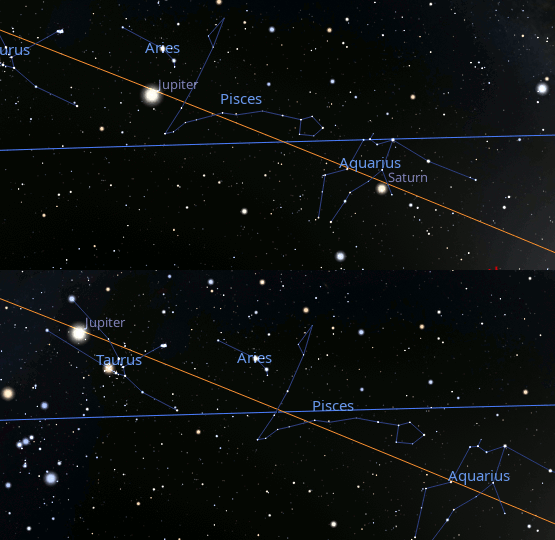
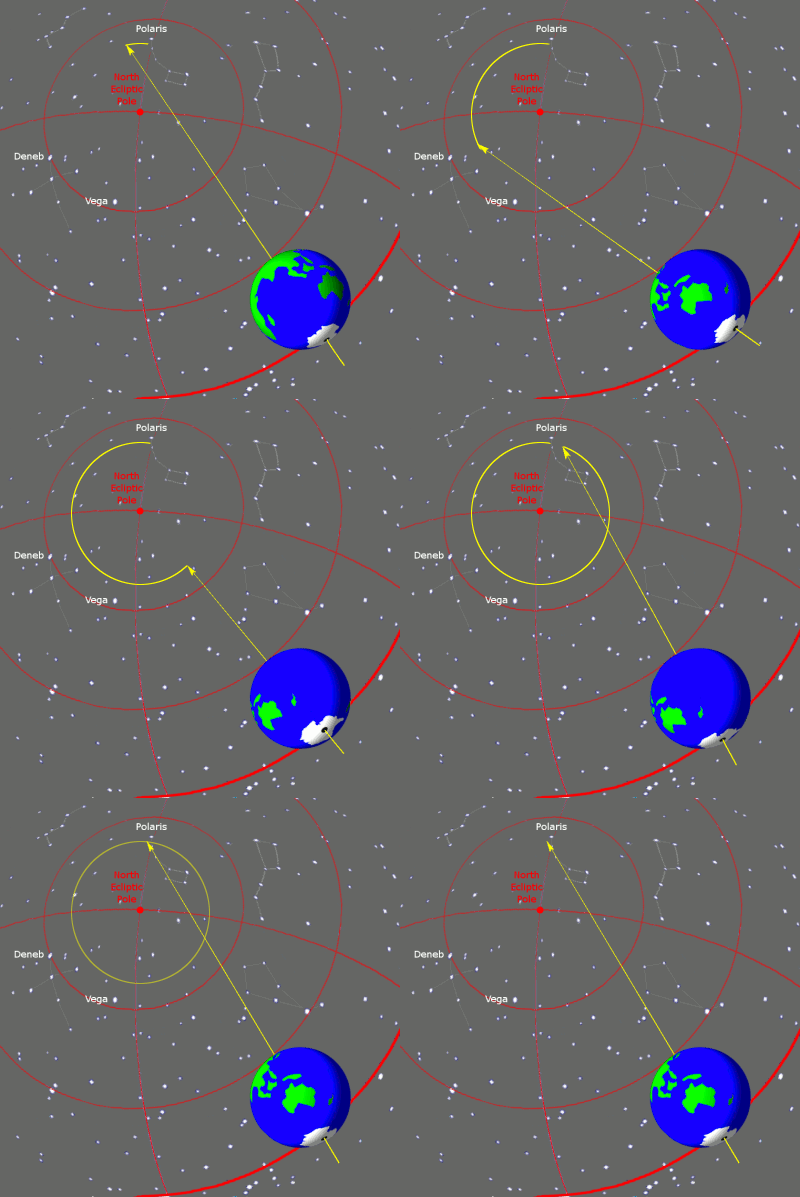
The planet Jupiter is seen against the stars of the constellation Aries the ram this year. The four stars of the constellation are seen above it, two of which are bright enough to be fairly easily seen. The other two are quite dim. The brightest is the star called Hamal. It is as bright as one of the stars of the Big Dipper. Aries used to be the constellation at the beginning of the Zodiac, where the Sun entered on the first day of spring. That honor has now moved westward to the western part of Pisces, the fish. The reason it has changed in the 1900 years since Ptolemy set up the Zodiac in the second century is that the Earth’s axis wobbles and the astrological signs of the Zodiac move with the seasons rather than the stars.
The astronomical event times given are for the Traverse City/Interlochen area of Michigan (EST, UT –5 hours). They may be different for your location.
Addendum
Ephemeris: 12/07/2023 – Auriga, the charioteer
This is Ephemeris for Thursday, December 7th. Today the Sun will be up for 8 hours and 56 minutes, setting at 5:02, and it will rise tomorrow at 8:07. The Moon, 2 days past last quarter, will rise at 3:20 tomorrow morning.
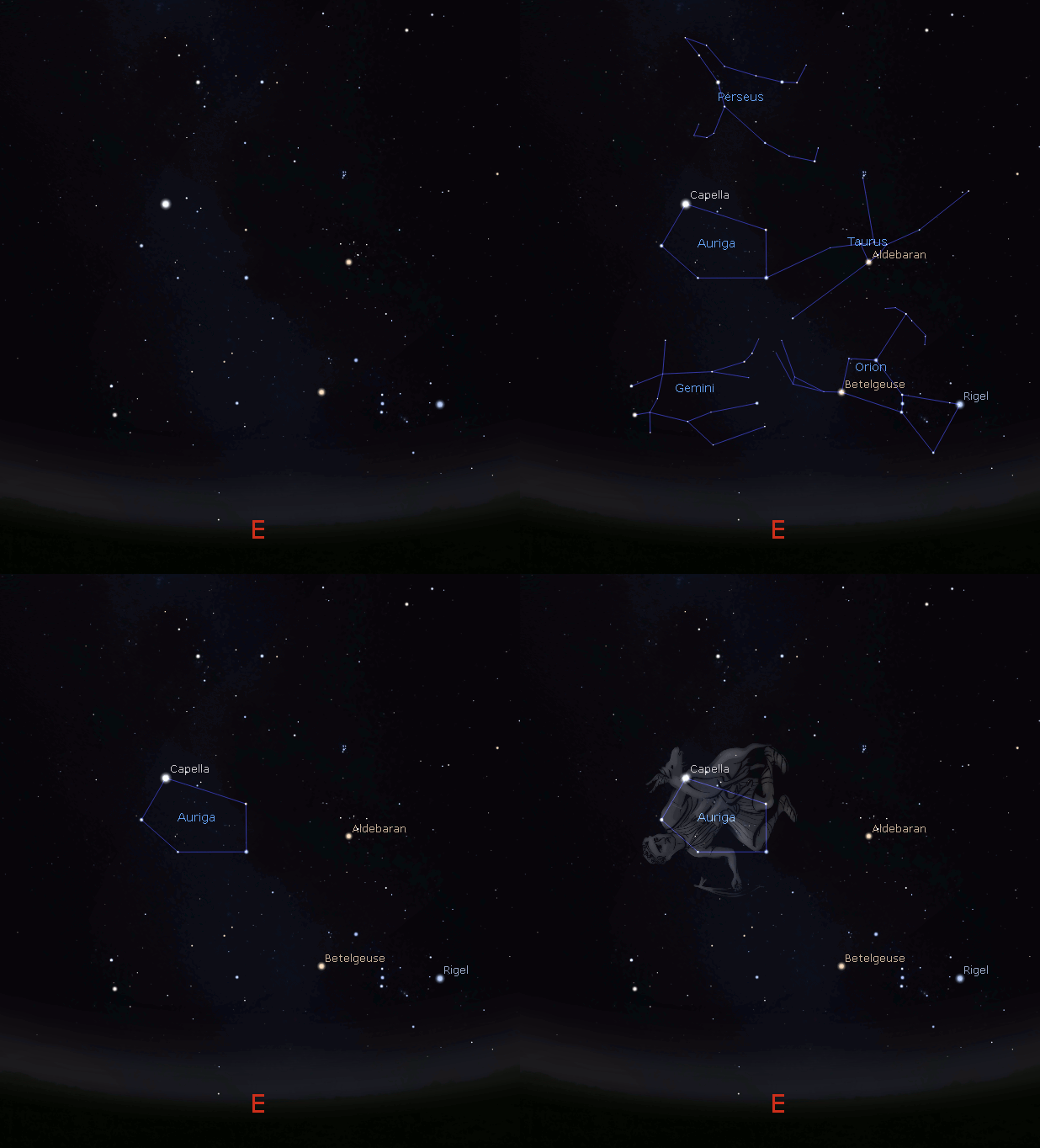
The first constellation of winter is in the northeastern sky, called Auriga the charioteer. It’s to the upper left of Orion and directly left of Taurus. Auriga actually never really quite leaves us, because its brightest star, Capella is the star that never leaves us even in the heat of summer, Though for most of us it’s in the trees in the north. Auriga is a pentagon of stars with the Capella on top. Just right of Capella is a thin triangle of three faint stars, an asterism or informal constellation called the Kids, baby goats. Capella is their mother. For some reason they are all held by a charioteer, who is without his chariot. And from all the Hollywood Biblical epic movies I’ve seen, it takes two hands to drive a chariot, and it doesn’t have a rumble seat.
The astronomical event times given are for the Traverse City/Interlochen area of Michigan (EST, UT –5 hours). They may be different for your location.
Addendum
 Bob Moler's Ephemeris Blog