Archive
04/09/2020 – Ephemeris – How to find the constellation of Leo the lion
This is Ephemeris for Thursday, April 9th. Today the Sun will be up for 13 hours and 12 minutes, setting at 8:21, and it will rise tomorrow at 7:06. The Moon, 2 days past full, will rise at 10:36 this evening.
At 10 p.m. the spring constellation of Leo the lion will be high in the south-southeast. It can be found by locating the Big Dipper high in the northeast and imagining that a hole were drilled in the bowl to let the water leak out. It would drip on the back of this giant cat. The Lion is standing or lying facing westward. His head and mane are seen in the stars as a backwards question mark. This group of stars is also called the sickle. The bright star Regulus is at the bottom, the dot at the bottom of the question mark. A triangle of stars, to the left of Regulus, is the lion’s haunches. Leo contains some nice galaxies visible in moderate sized telescopes. The stars in Leo’s part of the sky are fewer than those in the winter sky.
The event times given are for the Traverse City/Interlochen area of Michigan. They may be different for your location.
Addendum
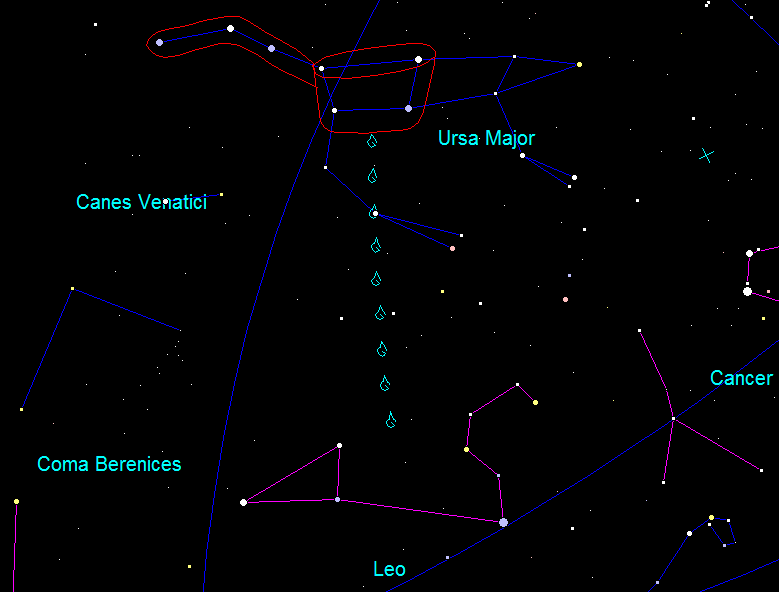
Leaky Big Dipper drips on Leo. Created using my LookingUp program.
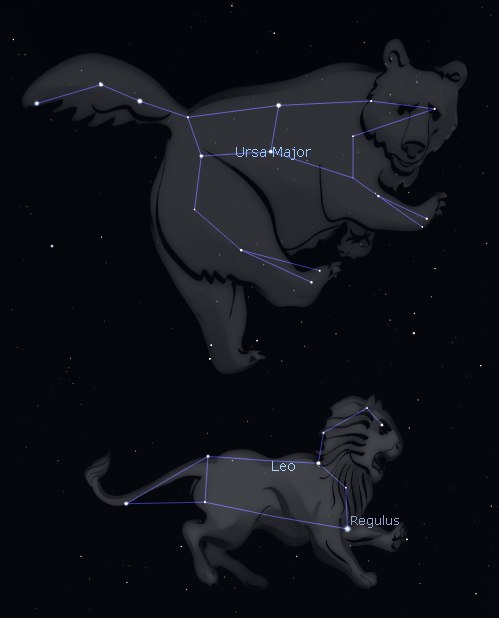
Ursa Major with the Big Dipper in her hind end and Leo. Created using Stellarium and GIMP.
03/13/2020 – Ephemeris – Looking for Cancer the crab
Ephemeris for Friday, March 13th. Today the Sun will be up for 11 hours and 49 minutes, setting at 7:47, and it will rise tomorrow at 7:56. The Moon, 3 days before last quarter, will rise at 1:01 tomorrow morning.
Between the stars Castor and Pollux in Gemini high in the southeast and the star Regulus in Leo the Lion in the east-southeast lies the dimmest constellation of the zodiac, Cancer the crab. To me its 5 brightest stars make an upside down Y. There’s the stars in the center of the constellation Asellus Borealis and Asellus Australis, the north and south donkeys. There’s a fuzzy spot between and just west of them called Praesepe, the manger from which they are supposedly eating. In binoculars it resolves into a cluster of stars called the Beehive cluster. We amateur astronomers also know it as M44, the 44th object on 18th century comet hunter Charles Messier’s list of fuzzy objects that might be mistaken for comets.
The event times given are for the Traverse City/Interlochen area of Michigan. They may be different for your location.
Addendum

Cancer the crab finder chart. Note the beehive cluster, also known to amateur astronomers as M44, along with other catalog names. Prior to the invention of the telescope this cluster was known as Praesepe which means “Manger”. Click on the image to enlarge. Created using Stellarium and GIMP.
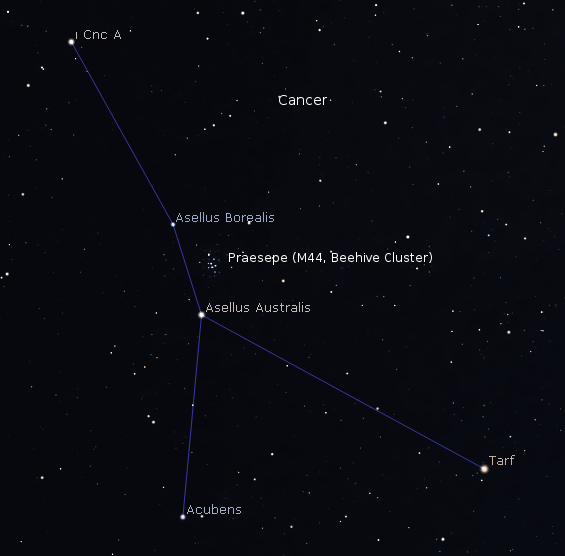
The constellation Cancer with star names and Praesepe. Asellus Borealis, the Northern Donkey; and Asellus Australis, the Southern Donkey are next to Praesepe the manger. Created using Stellarium.
We only hear about a manger at Christmas time. It is simply a trough that horses, donkeys, and cattle eat from.
03/12/2020 – Ephemeris – The mythology behind the constellation of Gemini
Ephemeris for Thursday, March 12th. Today the Sun will be up for 11 hours and 46 minutes, setting at 7:45, and it will rise tomorrow at 7:57. The Moon, 3 days past full, will rise at 11:45 this evening.
Lets look at the next to last of the winter constellations, and member of the Zodiac. The constellation Gemini, the Twins is visible high in the southeast, above and left of Orion the hunter at 9 p.m. The namesake stars of the two lads, will be at the left end of Gemini, nearly vertically aligned. Castor is above, Pollux below. From them can be traced two lines of stars extending toward Orion that outline the two. In Greek mythology the lads were half brothers, Castor was fathered by a mere mortal, while Pollux was fathered by Zeus in the famous Leda and the swan affair and immortal, but were born together as twins. When Castor was killed during the quest for the Golden Fleece, Pollux pleaded with Zeus to let him die also, so he placed them together in the sky so they could be together forever.
The event times given are for the Traverse City/Interlochen area of Michigan. They may be different for your location.
Addendum
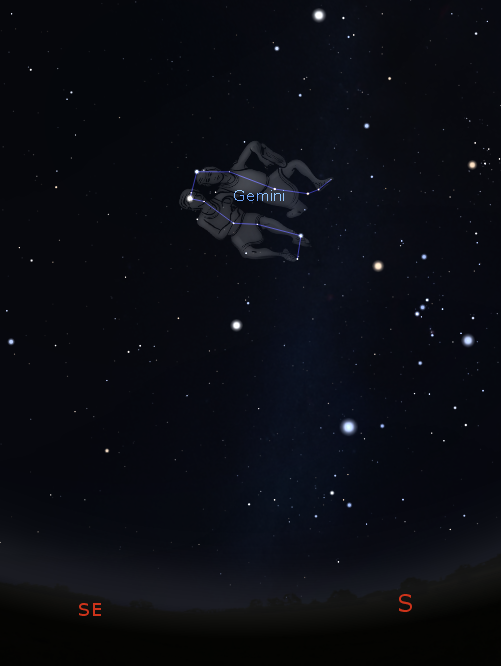
Gemini finder looking south-southeast around 9 p.m. March 10th, 2020. Created using Stellarium.
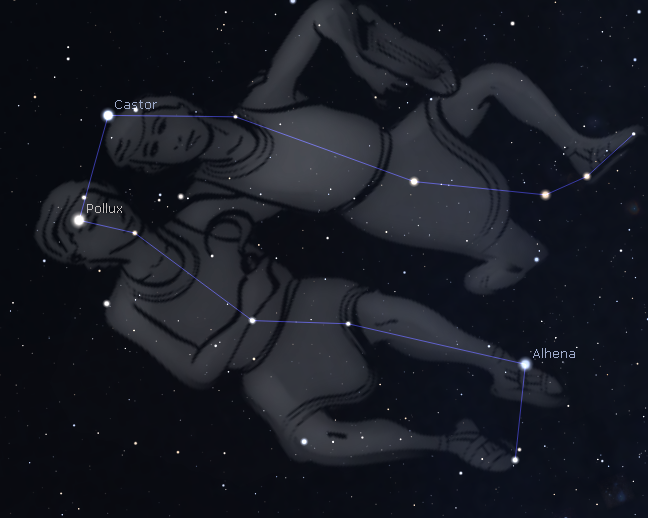
Castor and Pollux namesakes of the twins of Gemini in its position around 9 p.m. EDT March 12th. Created using Stellarium.
02/24/2020 – Ephemeris – Conflict in the skies: Orion vs. Taurus
Ephemeris for Monday, February 24th. Today the Sun will be up for 10 hours and 53 minutes, setting at 6:23, and it will rise tomorrow at 7:27. The Moon, 1 day past new, will set at 7:26 this evening.
The classical constellation figures of Orion the hunter and Taurus the bull appear to be interacting in the sky. Orion is in the south at 9 p.m. An angry Taurus, a bit above him in the southwest, appears to be charging at Orion who appears to be facing him with lion skin shield and an upraised club. Orion’s two hunting dogs, canes major and minor, appear to be unconcerned. The face of Taurus the bull is a letter V shape of faint stars with a bright reddish star at the upper left tip of the V called Aldebaran the bull’s angry bloodshot eye. There’s no mythological story that goes with this. Both Orion and Taurus have their own myths associated with them separate from their apparent clash in the heavens.
The times given are for the Traverse City/Interlochen area of Michigan. They may be different for your location.
Addendum
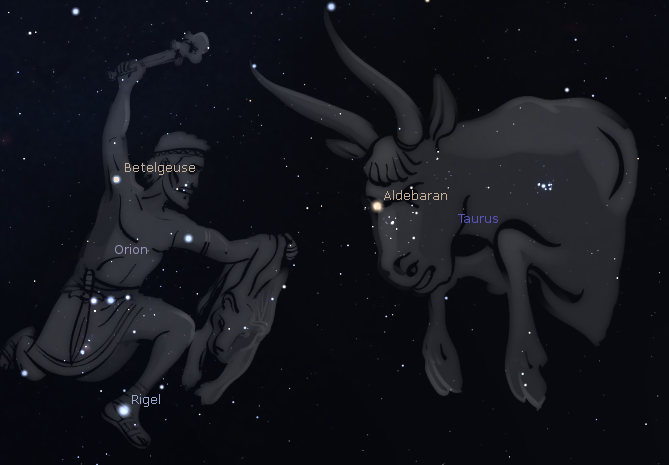
Conflict in the skis: Taurus is charging Orion. Seen at 9 p.m. in late February. Created using Stellarium and the dimming of Betelgeuse in GIMP.
022/21/2020 – Ephemeris – The almost invisible unicorn
Ephemeris for Friday, February 21st. Today the Sun will be up for 10 hours and 44 minutes, setting at 6:19, and it will rise tomorrow at 7:32. The Moon, 2 days before new, will rise at 7:27 tomorrow morning.
Among all the constellations in the sky of animals real and mythical, there is also a unicorn. It’s called Monoceros, and inhabits the southern sky at 9 p.m. bounded by Orion on the right, Canis Major, the great dog below and Canis Minor, the little dog to the left. Unfortunately for observers without optical aid Monoceros, though large, is devoid of any but the faintest stars. Maybe that’s why no one sees unicorns anymore. It has many faint stars because the Milky Way runs through it. To the telescope it is a feast of faint nebulae or clouds of gas and dust, the birth place of stars, including the red rose of the Rosette Nebula, and the strange and tiny Hubble’s Variable Nebula. It contains no bright stars, but a wealth of wonders below naked eye visibility.
The times given are for the Traverse City/Interlochen area of Michigan. They may be different for your location.
Addendum
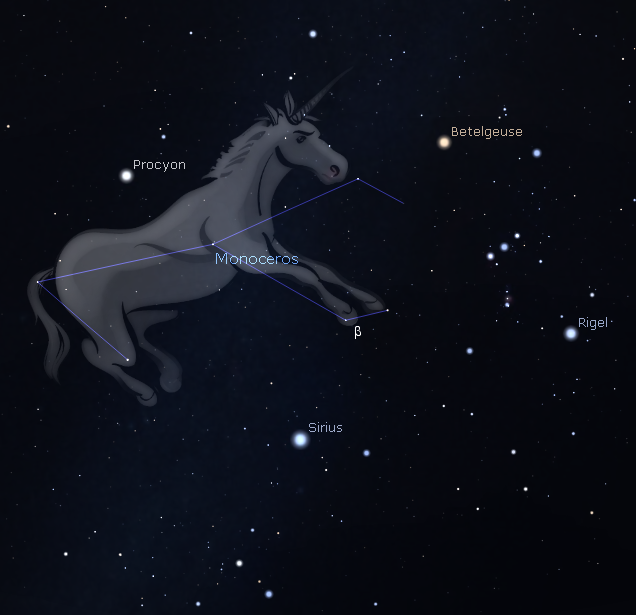
Monoceros the unicorn seen mostly inside the Winter Triangle of Betelgeuse, Sirius and Procyon. Note the star in the unicorn’s right hoof denoted with a funny B. That’s Beta Monocerotis,a triple star visible in small telescopes. Created using Stellarium with additions.

Rosette Nebula in the infrared from the Spitzer Space Telescope. Credit: NASA/JPL/Caltech

Hubble’s Variable Nebula photographed appropriately enough by the Hubble Space Telescope. Credit: NASA/ESA and The Hubble Heritage Team (AURA/STScI).
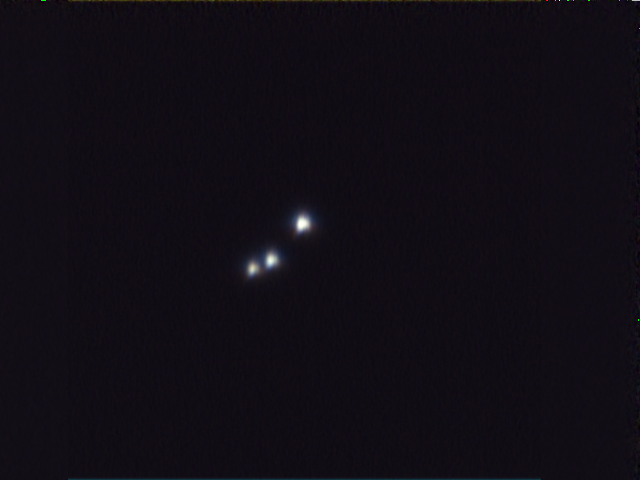
Telescopic Beta Monocerotis. William Hershel, discoverer of Uranus, said that it was “One of the most beautiful sights in the heavens.” Credit: F. Ringwald, Fresno State.
02/20/2020 – Ephemeris – The Winter Triangle
Ephemeris for Thursday, February 20th. Today the Sun will be up for 10 hours and 41 minutes, setting at 6:17, and it will rise tomorrow at 7:34. The Moon, 3 days before new, will rise at 6:53 tomorrow morning.
I usually talk about the Winter Circle of bright stars, but some other astronomers talk about the Winter Triangle. The stars involved are Betelgeuse in the hunter Orion, Sirius in Canis Major, Orion’s large hunting dog, and Procyon in Canis Minor, his other small hunting dog. These three stars enclose a rather blank piece of sky with the faint Milky Way running through it and the equally invisible constellation of Monoceros the unicorn. The Summer Triangle has three bright stars with no other close competition. The Winter Triangle has 4 other bright stars near it. Any three of these would make a nice triangle. One of these stars, Betelgeuse has been the news recently because it is dimming to an unprecedented degree.
The times given are for the Traverse City/Interlochen area of Michigan. They may be different for your location.
Addendum
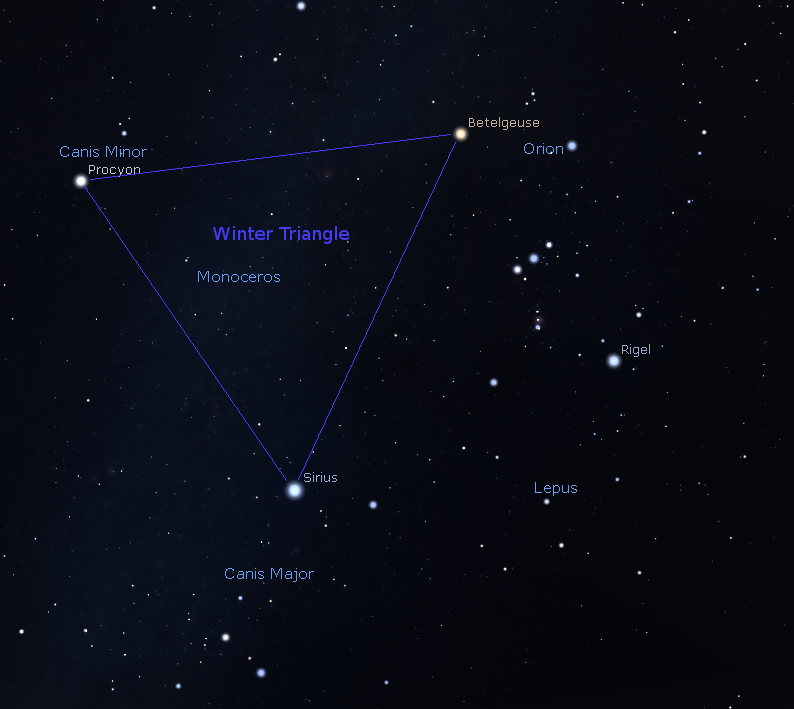
The Winter Triangle. It enclose a pretty blank space where Monoceros the unicorn lies. Created using Stellarium with my annotations for the Winter Triangle. By the way, Betelgeuse is currently only as bright as Bellatrix, the star next to the “n” in Orion.
02/18/2020 – Ephemeris – Orion in three cultures
Feb 18. This is Bob Moler with Ephemeris for Tuesday, February 18th. Today the Sun will be up for 10 hours and 35 minutes, setting at 6:14, and it will rise tomorrow at 7:37. The Moon, 3 days past last quarter, will rise at 5:24 tomorrow morning.
We observe the constellation of Orion in the south at 9 p.m. and think of the hapless Greek hero. To the Hebrews it was Kesil, the fool who built the tower of Babel hoping to reach heaven. To the Anishinaabe native peoples of this place it is the Wintermaker whose rising in the evening announces the coming of winter. Where Orion’s arms carry a lion skin shield and a club, the Wintermaker’s arms are exaggerated and extend from Aldebaran in Taurus to Procyon in Canis Minor, embracing just about all of the winter sky. Two other Anishinaabe constellations are entering the skies at this time in the east and northeast, to announce the coming of spring. One the pleasures and the other the dangers.
The times given are for the Traverse City/Interlochen area of Michigan. They may be different for your location.
Addendum
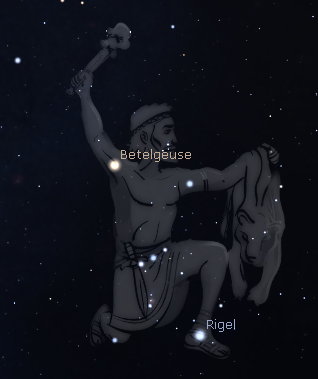
Orion as he is seen tonight at 9 p.m. Created using Stellarium.

The Wintermaker stretches his arms wide to embrace the winter stars. Created using Stellarium. Wintermaker figure from Ojibwe Sky Star Map by A. Lee, W. Wilson, C. Gawboy. Stellarium contains the constellation art from many cultures.
02/17/2020 – Ephemeris – A look at Orion and his hunting dogs
Ephemeris for President’s Day, Monday, February 17th. Today the Sun will be up for 10 hours and 32 minutes, setting at 6:13, and it will rise tomorrow at 7:39. The Moon, 2 days past last quarter, will rise at 4:27 tomorrow morning.
The great winter constellation or star group Orion the Hunter, is located in the southern sky at 9 p.m. His elongated rectangle of a torso is vertical. In the center of the rectangle are three stars in a line that make his belt. As a hunter, especially one of old, he has two hunting dogs. The larger, Canis Major can be found by following the three belt stars of Orion down and to the left. There lies the brilliant star called Sirius, also known as the Dog Star. It’s in the heart of a stick figure dog lower in the south facing Orion that appears to be begging. Canis Minor is just two stars found by extending Orion’s shoulder stars eastward where we find bright Procyon, the little dog star in the southeast.
The times given are for the Traverse City/Interlochen area of Michigan. They may be different for your location.
Addendum
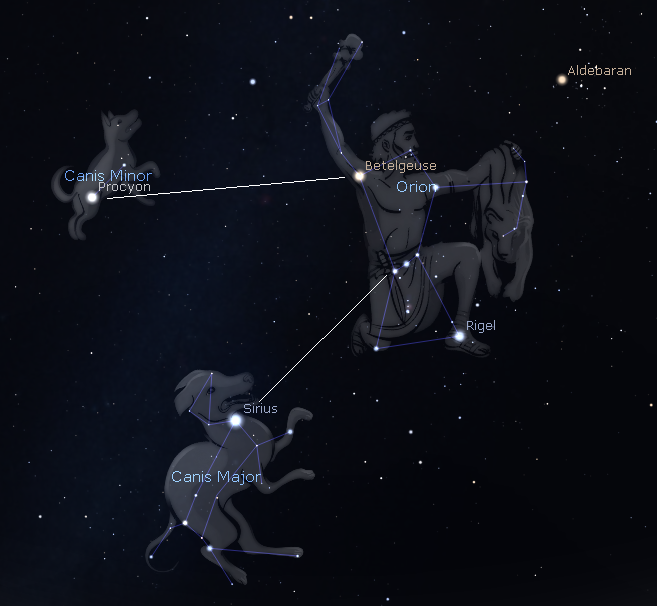
Orion and his hunting dogs with pointers as seen at 9 p.m. in mid February. Created using Stellarium.
02/13/2020 – Ephemeris – Orion’s Belt stars
This is Ephemeris for Thursday, February 13th. Today the Sun will be up for 10 hours and 21 minutes, setting at 6:07, and it will rise tomorrow at 7:45. The Moon, 2 days before last quarter, will rise at 11:48 this evening.
Orion’s belt of three stars is one of the most noticeable star groupings in the sky. There are no other group of three bright stars in a straight line visible anywhere else in the sky. The star’s names from left to right are Alnitak, Alnilam and Mintaka. They are actually a bit farther away than the other bright stars of Orion. Alnilam, the center star, is over three times the distance of red giant Betelgeuse above them and over twice as far as blue white giant star Rigel below them. Alnilam is 375 thousand times brighter than the Sun according to the SIMBAD Astronomical Database. These three stars were also known as Frigga’s Spindle by the Norsemen. Frigga also known as Freya is the goddess from which we get the name of the day of the week Friday.
The times given are for the Traverse City/Interlochen area of Michigan. They may be different for your location.
Addendum
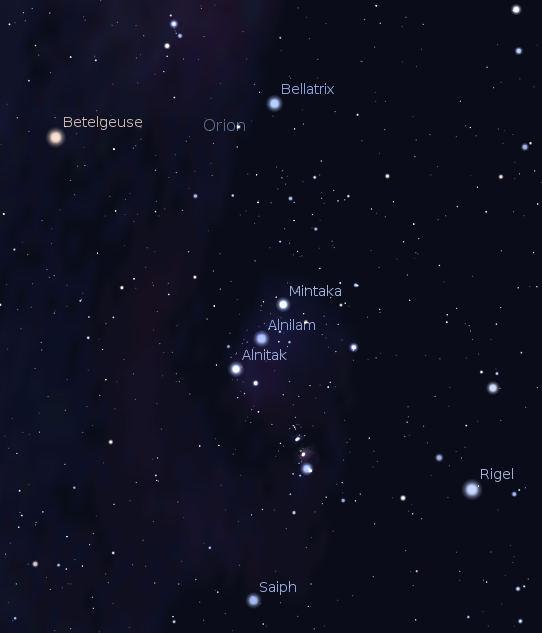
Torso of Orion centered on his belt. The torso of Orion is more upright this month. But I’m leaving it tilted so the star names don’t over print the stars. Created using Stellarium.
12/23/2019 – Ephemeris – Orion, rising even higher now
Ephemeris for Monday, December 23rd. Today the Sun will be up for 8 hours and 48 minutes, setting at 5:05, and it will rise tomorrow at 8:18. The Moon, 3 days before new, will rise at 6:34 tomorrow morning.
The large and bright constellation of Orion the hunter is in the southeast at 9 p.m., with the bright star Sirius below it near the horizon. The equally spaced line of three stars of Orion’s belt are nearly vertical and point down to Sirius, also known as the Dog Star in Canis Major, Orion’s greater dog. Those three belt stars are in the center of an elongated rectangle of stars that tilt to the left. At the top left of Orion’s shoulder stars is the red giant star Betelgeuse. The right shoulder star is Bellatrix. Both Bellatrix and Sirius along with the names of other stars and constellations should be familiar to fans of the Harry Potter novels and movies, as members of the house of Black. The knee stars at the bottom of the rectangle are, from left to right Saiph and the brilliant blue giant star Rigel. Between his belt and knees are stars of his sword.
The times given are for the Traverse City/Interlochen area of Michigan. They may be different for your location.
Addendum
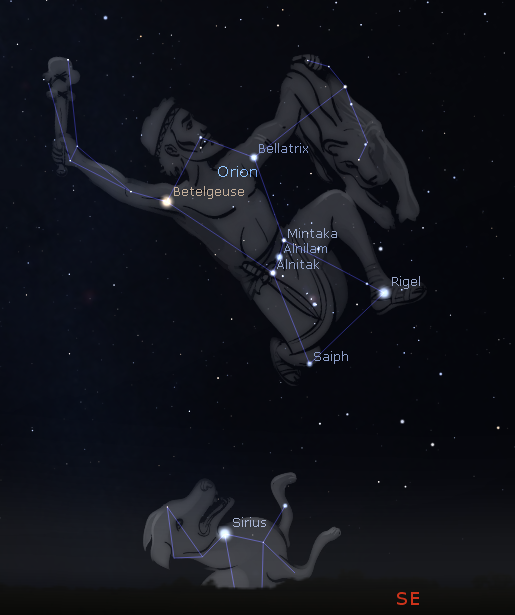
The named bright stars of Orion and Canis Major, the dog rising below Orion with Sirius. Beside the stars mentioned in the program are the stars of Orion’s belt that have their own program later on in winter. Created using Stellarium.
In this season of Biblical stories it’s nice to note that Orion is mentioned four times in the Old Testament. In Isaiah, Amos and twice in Job. In Hebrew his name is “Kesîl”, meaning Fool.
 Bob Moler's Ephemeris Blog