Archive
10/18/2019 – Ephemeris – Capella rising
Ephemeris for Friday, October 18th. Today the Sun will be up for 10 hours and 51 minutes, setting at 6:53, and it will rise tomorrow at 8:03. The Moon, 3 days before last quarter, will rise at 9:59 this evening.
For those with the advantage of a low northeastern horizon, will see a bright star slowly rising, much slower than the stars in the east, or notice its change in position from night to night, moving in the northeast. The star is Capella, northernmost of the bright winter stars. It never quite sets for locations north of the latitude of Ludington (44° N), meaning it’s circumpolar like the Big Dipper. It’s slow motion, due to its position close to the north pole of the sky sometimes makes it seem odd. I’ve gotten several calls about it over the years. Capella is the brightest star in the constellation Auriga the charioteer, a constellation I see as a pentagon, with a small triangle of three stars on one side.
The times given are for the Traverse City/Interlochen area of Michigan. They may be different for your location.
Addendum
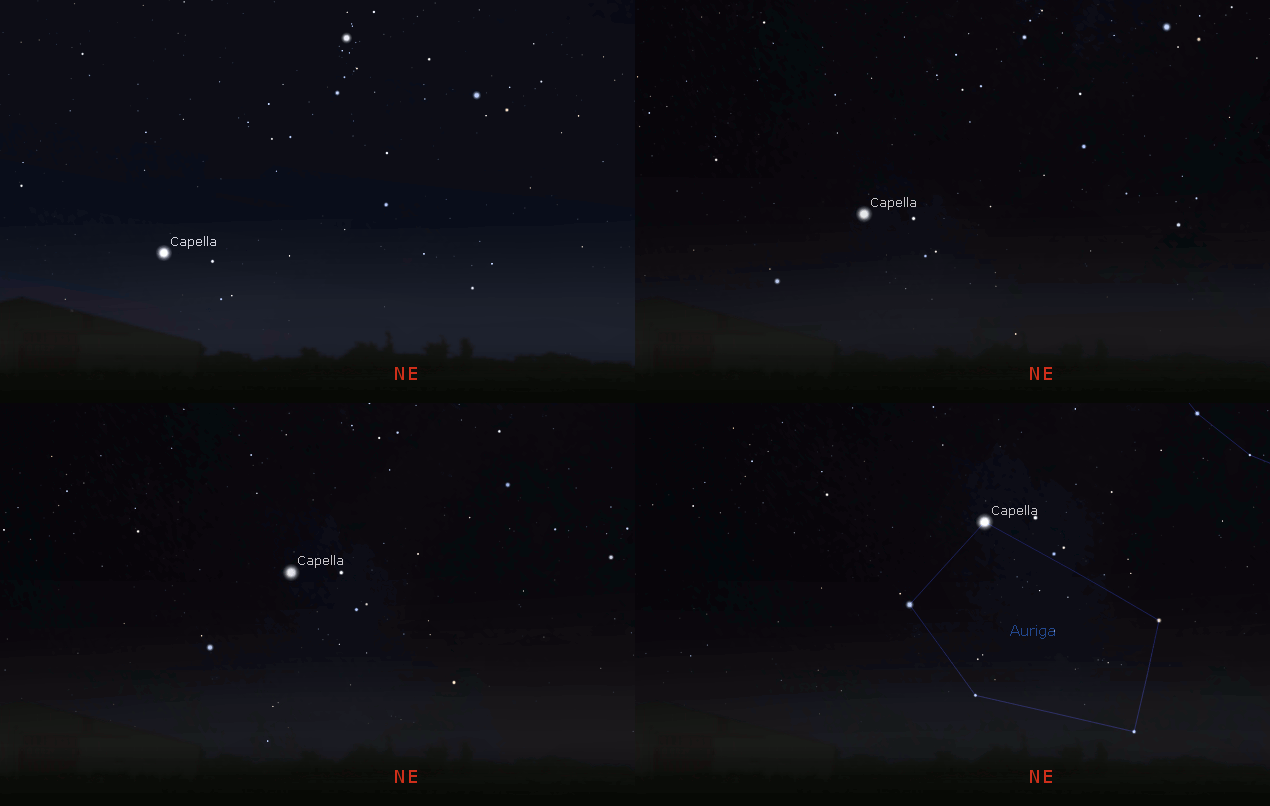
Capella rising animation at half hour intervals from 8 p.m. to 9:30 p.m. October 18th. Created using Stellarium and GIMP.
10/15/2019 – Ephemeris – The celestial Fisher paints the fall colors
Ephemeris for Tuesday, October 15th. Today the Sun will be up for 11 hours even, setting at 6:58, and it will rise tomorrow at 7:59. The Moon, 2 days past full, will rise at 8:14 this evening.
The tree leaves are turning to reds and yellows as we advance into autumn. The native Anishinaabe peoples, whose homeland we share, have a story about how that came to be. Of how a magical weasel-like creature called the Fisher or in the native language, Ojiig, brought summer to the Earth from Skyland. For his trouble he was shot with an arrow in his only vulnerable spot, the tip of his tail. As he fell to Earth the Great Spirit, Manitou caught him and placed him in the sky where we see the Great Bear (Ursa Major) and the Big Dipper. Every autumn late at night we see his tail, the handle of the dipper, swoop down to the ground where his tail paints the leaves with his blood.
The times given are for the Traverse City/Interlochen area of Michigan. They may be different for your location.
Addendum
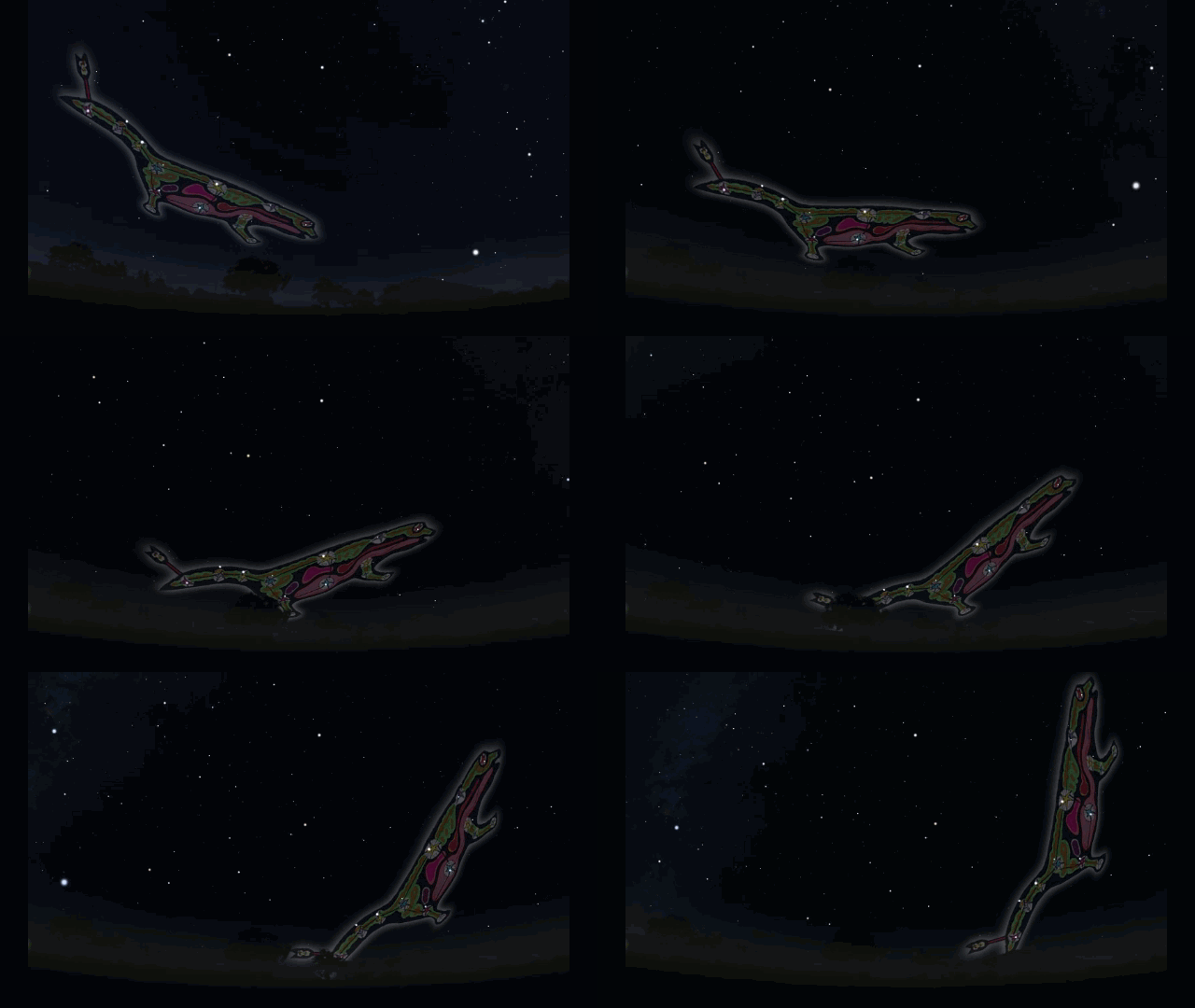
An animation of Fisher brushing his tail along the horizon on autumn nights. Created using Stellarium.
The constellation art is part of the latest versions of Stellarium. Ojibwe (Anishinaabe) constellation art by Annette S Lee and William Wilson from Ojibwe Sky Star Map Constellation Guide, ISBN 978-0-615-98678-4.
See the version of the story I learned: The story of the Fisher Star.
There are other variations of the story, and other adventures of the Fisher. Perform an Internet search for: Fisher or Fisher Star or Ojiig.
09/26/2019 – Ephemeris – Looking for Andromeda
Ephemeris for Thursday, September 26th. Today the Sun will be up for 11 hours and 58 minutes, setting at 7:33, and it will rise tomorrow at 7:35. The Moon, 2 days before new, will rise at 5:49 tomorrow morning.
In the east at 9 this evening can be found a large square of stars, the Great Square of Pegasus the flying horse. The square is standing on one corner. What look like its hind legs stretching to the left from the left corner star is another constellation, Andromeda the chained maiden. She is seen in the sky as two diverging curved strings of stars that curve upward. She was rescued by the hero Perseus, a nearby constellation, riding his steed Pegasus. Andromeda’s claim to astronomical fame is the large galaxy seen with the unaided eye just above the upper line of stars, the Great Andromeda Galaxy, about 2 and a half million light years away. To the unaided eye the galaxy appears as a small smudge of light. In binoculars the galaxy is a delicate spindle of light.
The times given are for the Traverse City/Interlochen area of Michigan. They may be different for your location.
Addendum
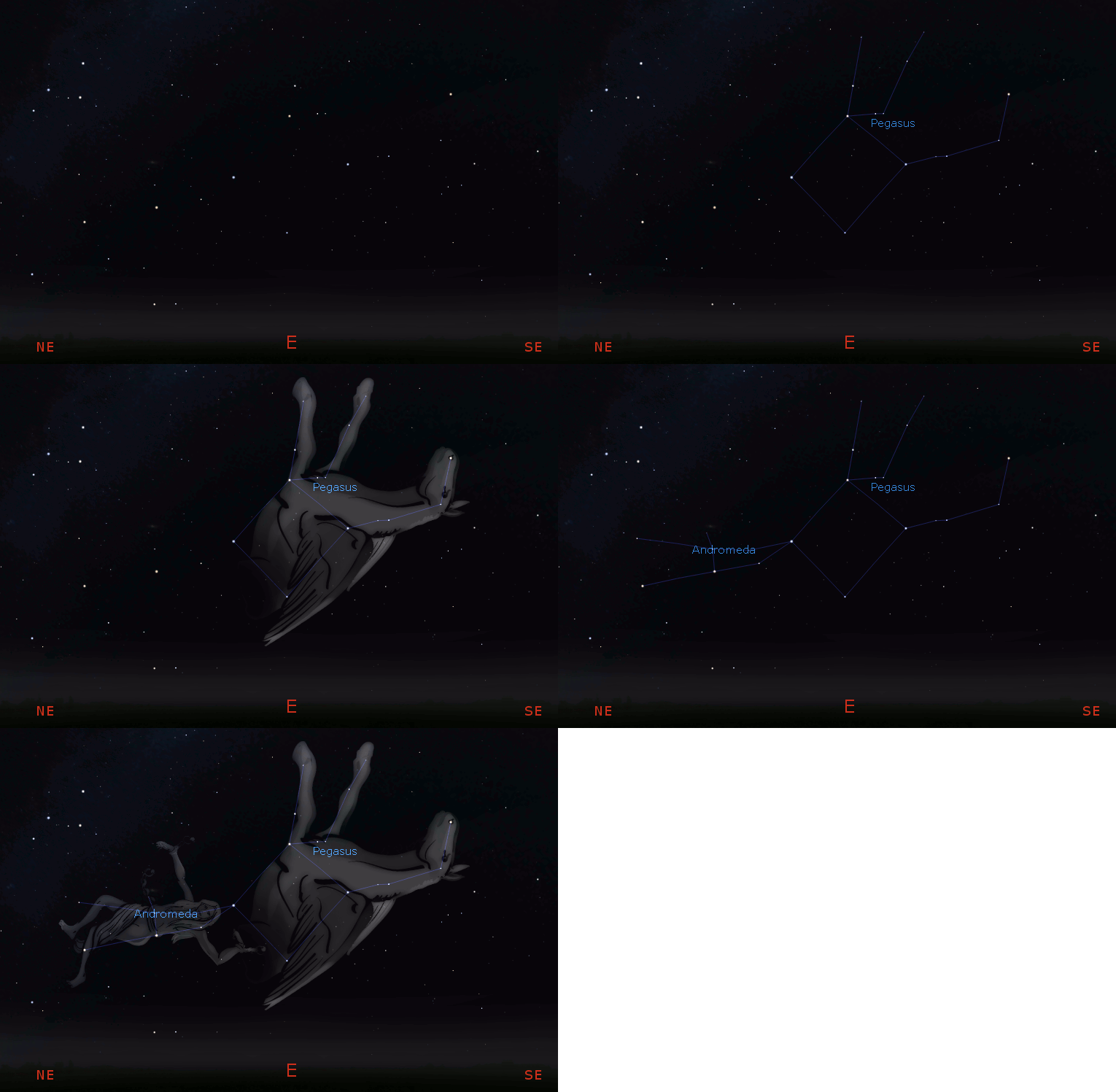
Pegasus & Andromeda animated finder chart for 9 p.m. in late September. Created using Stellarium and GIMP.
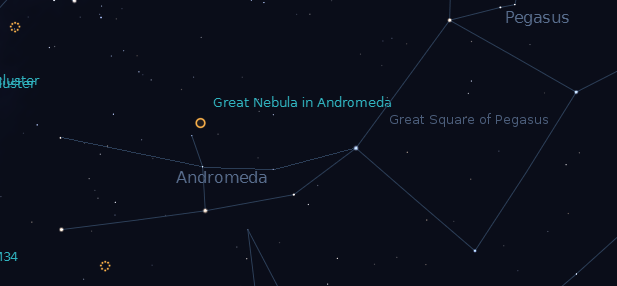
Andromeda at 9 p.m. with the Great Andromeda Galaxy. Created using Stellarium.
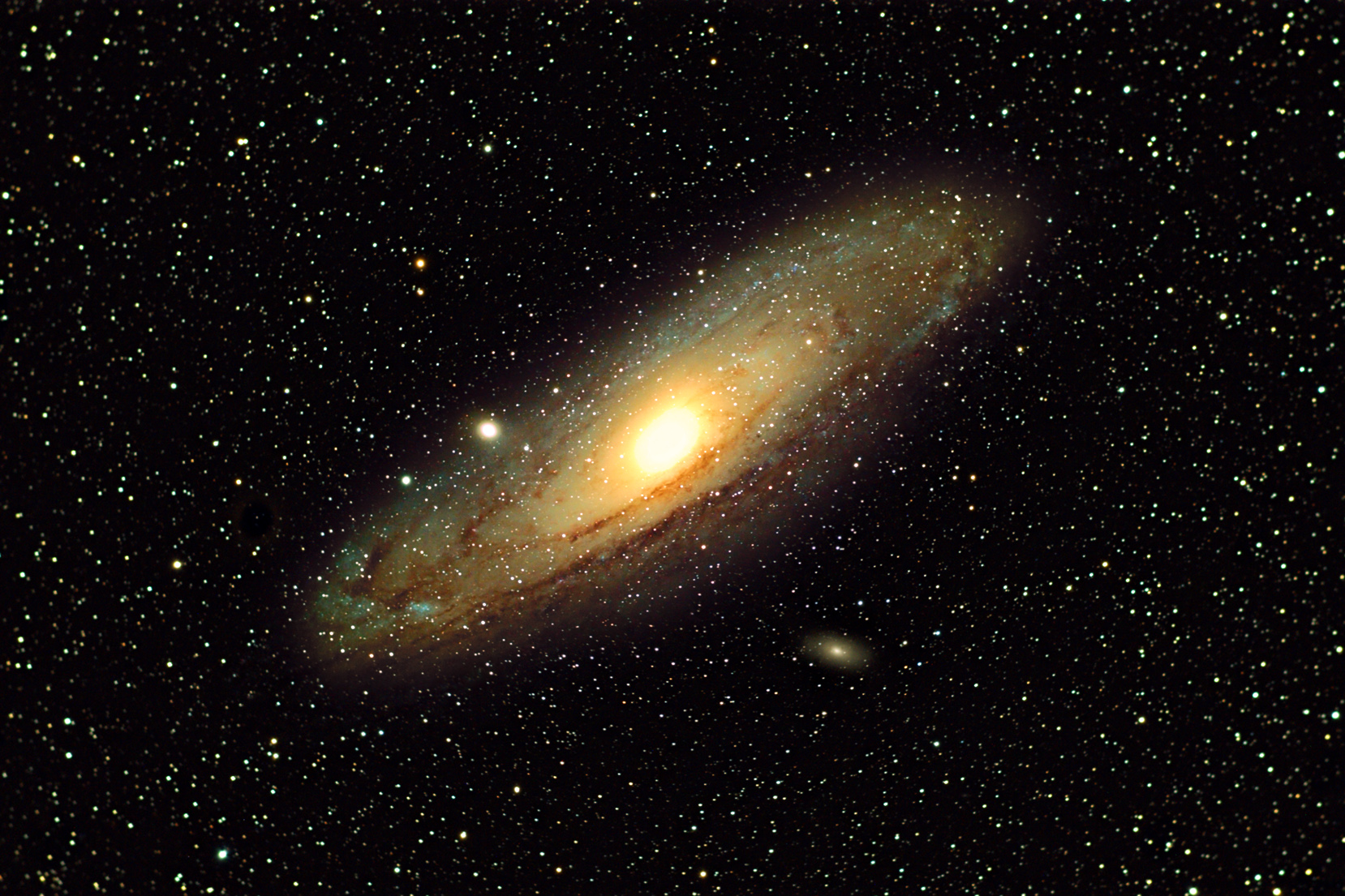
The Great Andromeda Galaxy (M31). Image taken by Scott Anttila.
09/24/2019 – Ephemeris – Cassiopeia the “W” shaped constellation
Ephemeris for Tuesday, September 24th. Today the Sun will be up for 12 hours and 4 minutes, setting at 7:36, and it will rise tomorrow at 7:33. The Moon, 3 days past last quarter, will rise at 3:13 tomorrow morning.
The stars of the autumn skies slowly are replacing the summer stars from the east. Look in the northeastern sky by 9 p.m. and you can find the W shaped constellation of Cassiopeia the queen. Cassiopeia is so far north that it never sets for us in Michigan. It is opposite the pole star Polaris from the Big Dipper. There’s a dim star that appears above the middle star of the W which turns the W into a very crooked backed chair. Cassiopeia, in Greek mythology, represents a queen of ancient Ethiopia, the W represents the profile of her throne. She enters in to the great autumn story whose other characters are also seen in the stars as the constellations Andromeda, Pegasus, Perseus, Cetus and her husband Cepheus.
For my retelling of the Greek myth that links these autumn constellations click here.
The times given are for the Traverse City/Interlochen area of Michigan. They may be different for your location.
Addendum
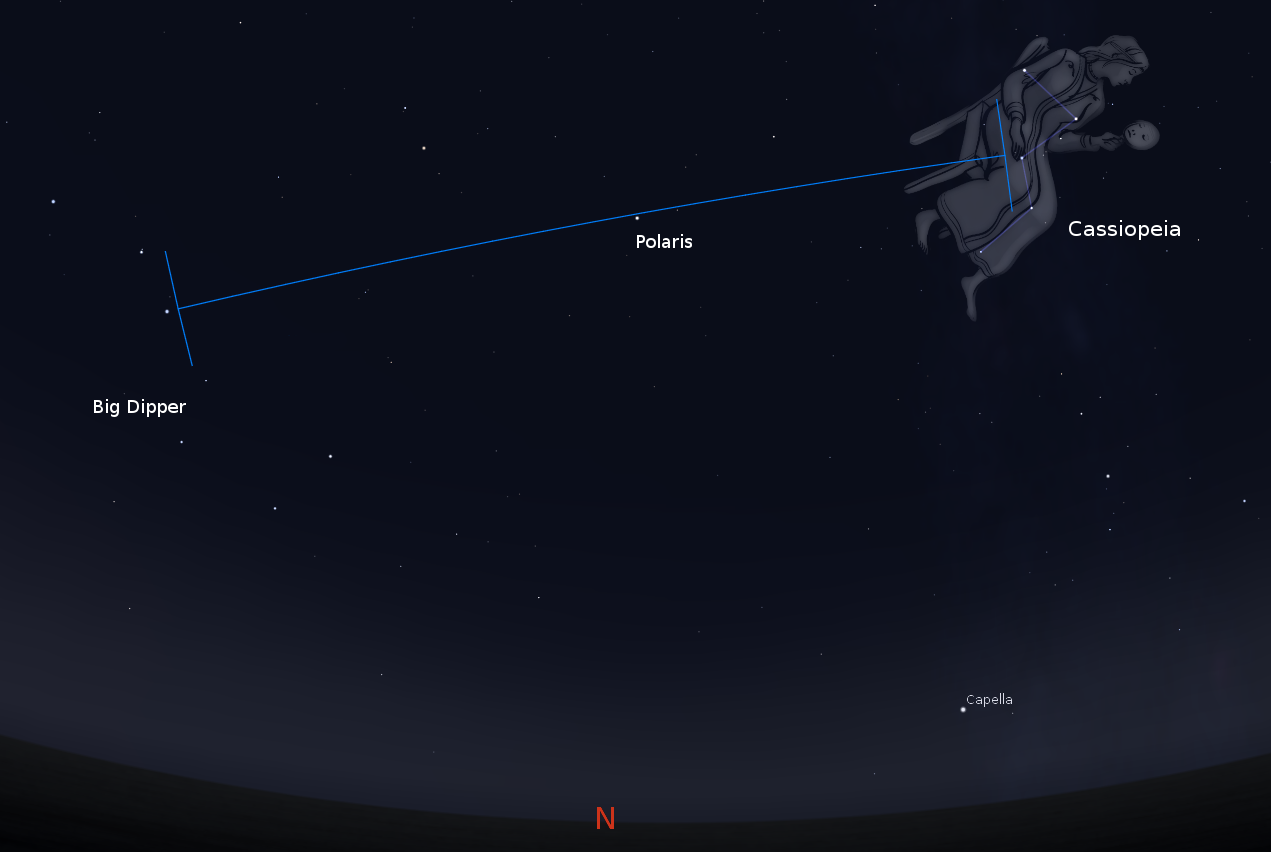
Cassiopeia, in the northeast is opposite Polaris from the Big Dipper. For 9 p.m. in late September. Created using Stellarium. Artistic credit: Johan Meuris.
09/19/2019 – Ephemeris – The celestial upside down flying horse
Ephemeris for Thursday, September 19th. Today the Sun will be up for 12 hours and 20 minutes, setting at 7:46, and it will rise tomorrow at 7:27. The Moon, 2 days before last quarter, will rise at 10:42 this evening.
Rising and almost half way up the sky in the east at as it gets dark around 9 p.m. can be found one of the great autumn constellations: Pegasus the flying horse of Greek myth. Its most visible feature is a large square of four stars, now standing on one corner. This feature, called the Great Square of Pegasus, represents the front part of the horse’s body. The horse is quite aerobatic, because it is seen flying upside down. Remembering that fact, the neck and head is a bent line of stars emanating from the right corner star of the square. Its front legs can be seen in a gallop extending to the upper right from the top star of the square. From the left star extend, not hind legs but the constellation of Andromeda, rescued with the help of Pegasus.
For my retelling of the Greek myth that links these two and other autumn constellations click here.
The times given are for the Traverse City/Interlochen area of Michigan. They may be different for your location.
Addendum
Pegasus & Andromeda animated finder chart for 9 p.m. September 19, 2019. Click on the iamge to enlarge. Created using Stellarium and GIMP.
Ephemeris Extra – The Great Star Story of Autumn
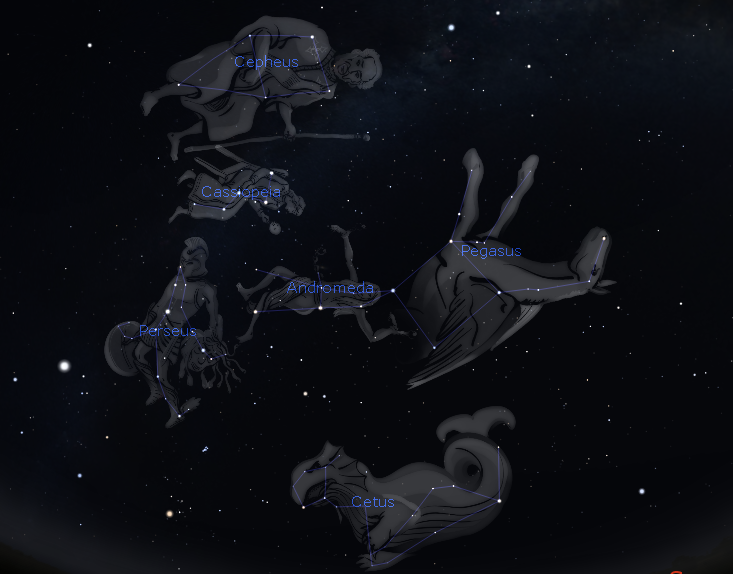
The constellations of the great star story of autumn. Looking southeast on October 31 at 10 p.m. Created using Stellarium.
The great star wheel of the sky rolls on. In the evening sky gone are the stars of spring, and going are the southern stars of summer. In the morning sky before sunrise the stars of an early winter evening.
A constant in both skies are the stars of autumn: rising in the evening and setting in the morning. In no other part of the sky do so many constellations take part in a single story
The constellations, as seen above are Cepheus, Cassiopeia, Andromeda, Perseus, Pegasus, and Cetus. And their story goes like this:
In distant Ethiopia a crisis was brewing. King Cepheus and Queen Cassiopeia were at wits end as how to stop it. A giant sea monster named Cetus was ravaging the country’s coastal cities destroying them and devouring the inhabitants.
The king and queen consulted the temple oracle as to what happened and what could be done to save their country. The oracle intoned gravely that the fault was Cassiopeia’s. Suddenly the queen knew what happened. Cassiopeia was very beautiful and she had vainly boasted to all who could hear that she was more beautiful than even the sea nymphs, the lovely daughters of the sea god Poseidon.
The sea nymphs had heard of Cassiopeia’s boast and complained to their father. Poseidon, like any father, was angered, and being a god was able to do something about. Being a god means never having to say your sorry when you do something really mean. He loosed the monster Cetus upon the Ethiopians.
The oracle said that to appease the monster and Poseidon Cassiopeia would have to sacrifice her daughter the Princess Andromeda to the monster. That is how young Andromeda was chained to the rocks on the sea shore to await her doom…
Far away in ancient Greece a wedding was about to take place between the beautiful Princess Danaë and King Polydectes. Danaë’s son Perseus, fathered by Zeus, but that’s another story, wasn’t too happy about the proposed union, and Polydectes wanted the boy gone.
When Perseus asked Polydectes what he wanted for a wedding gift, he said, “I want the head of Medusa.” The boy immediately and foolhardedly agreed to get it for him.
Merdusa, it turns out, was one of three sisters, the Gorgons, who had snakes for hair. They were so ugly that one glimpse of them would turn the beholder to stone. Medusa was the only mortal one.
Luckily Perseus had the favor of the god Hermes and Athene. They armed him with Hermes’ winged sandals, a helmet that made him invisible, a pouch that would expand to hold an object of any size, a shiny mirror shield, and a sword.
Thus armed Perseus was told to find the Graiae or the gray women, who could tell him where the lair of the Gorgons was. They were three in number and shared but one eye and one tooth among them which they passed from one to another to use.
The Graiae refused to help Perseus. But he was able to force them to help by snatching their one eye while it was being passed from one to another. They told him that the Gorgons dwelt in the shore of the river Ocean at the edge of the world in perpetual twilight.
In approaching the lair of the Gorgons Perseus put on the helmet of invisibility. He approached Medusa stepping backwards, cautiously peering only at Medusa’s indistinct image in his shield. Perseus then swept his sword in a backhanded way and managed to sever Medusa’s head. It is said that Athene guided his hand.
Amazingly, springing full grown from Medusa’s blood was the winged white stallion Pegasus. After placing Medusa’s head in the pouch, Perseus mounted Pegasus for the trip home.
Cruising high in the sky over the Ethiopian coast Perseus spotted a horrific sight. There far below the beautiful Andromeda, in chains; her screams reaching his ears. Then he spotted why she was screaming. A short distance away, crawling out of the surf was the monster Cetus, heading towards Andromeda. Perseus immediately sizes up the situations and swooped with Pegasus down to a spot between Andromeda and the monster. Then, burying his head in his shoulder drew out the head of Medusa from the pouch and held it in front of Cetus. The head was as lethal in death as in life, and the monster was promptly turned to stone. Replacing the head in the pouch, Perseus freed Andromeda. They flew off to, well supposedly, live happily ever after.
Oh yes. Perseus did present the head of Medusa to his step father Polydectes. He, of course, was also turned to stone when he laid eyes on it.
There you have it a story connecting the autumn constellations of Cepheus, Cassiopeia, Andromeda, Perseus, Pegasus and Cetus.
Cepheus is a dim church steeple of a constellation. Its dim star Delta is a variable star, the prototype of an important class of distance measuring stars called Cephieds in its honor. Cassiopeia is the famous W shaped constellation that along with Cepheus doesn’t set at our latitude.
Perseus looks to me more like the cartoon roadrunner than a hero. As the ancients saw him, he is holding the head of Medusa, whose still glittering eye is the star Algol, a variable star which ghastly winks at us every 2 days and 21 hours.
Andromeda’s modern claim to fame is the great galaxy that lies beyond her stars, the Great Andromeda Galaxy which has the designation M31. The galaxy is faintly visible to the unaided eye on dark nights. The farthest you can see without optical aid. The galaxy lies some 2.5 million light years away.
Pegasus can be easily found by the square of stars the form his body. It’s called the Great Square of Pegasus.
What can be said about Cetus. It now represents a whale, not a monster. Its star Mira, which means “Wonderful”, slowly varies in brightness over 330 days from a star barely visible in binoculars to a 2nd or 3rd magnitude star.
Look up on an autumn evening and recapture the wonder the ancients had as they looked upward at the stars.
08/29/2019 – Ephemeris – To astronomers constellations are just areas of the sky
Ephemeris for Thursday, August 29th. Today the Sun will be up for 13 hours and 23 minutes, setting at 8:25, and it will rise tomorrow at 7:02. The Moon, 1 day before new, will rise at 7:00 tomorrow morning.
What are constellations? I talk about them all the time on this program. There are 88 officially recognized constellations by the International Astronomical Union. Most, in the northern sky come from the ancient Greeks, and are given Latin names. For professional astronomers the constellations mark out specific areas of the sky in an interlocking set of puzzle pieces. In some cases it looks like there’s some gerrymandering with the shapes. Some star to star lines drawn do seem to represent the namesake, like Scorpius the scorpion. Most don’t. Stars of a constellation generally are not near one another, they’re just in the same direction from us. Asterisms, or informal star groups, like the Big Dipper however do look like what they represent.
The times given are for the Traverse City/Interlochen area of Michigan. They may be different for your location.
Addendum
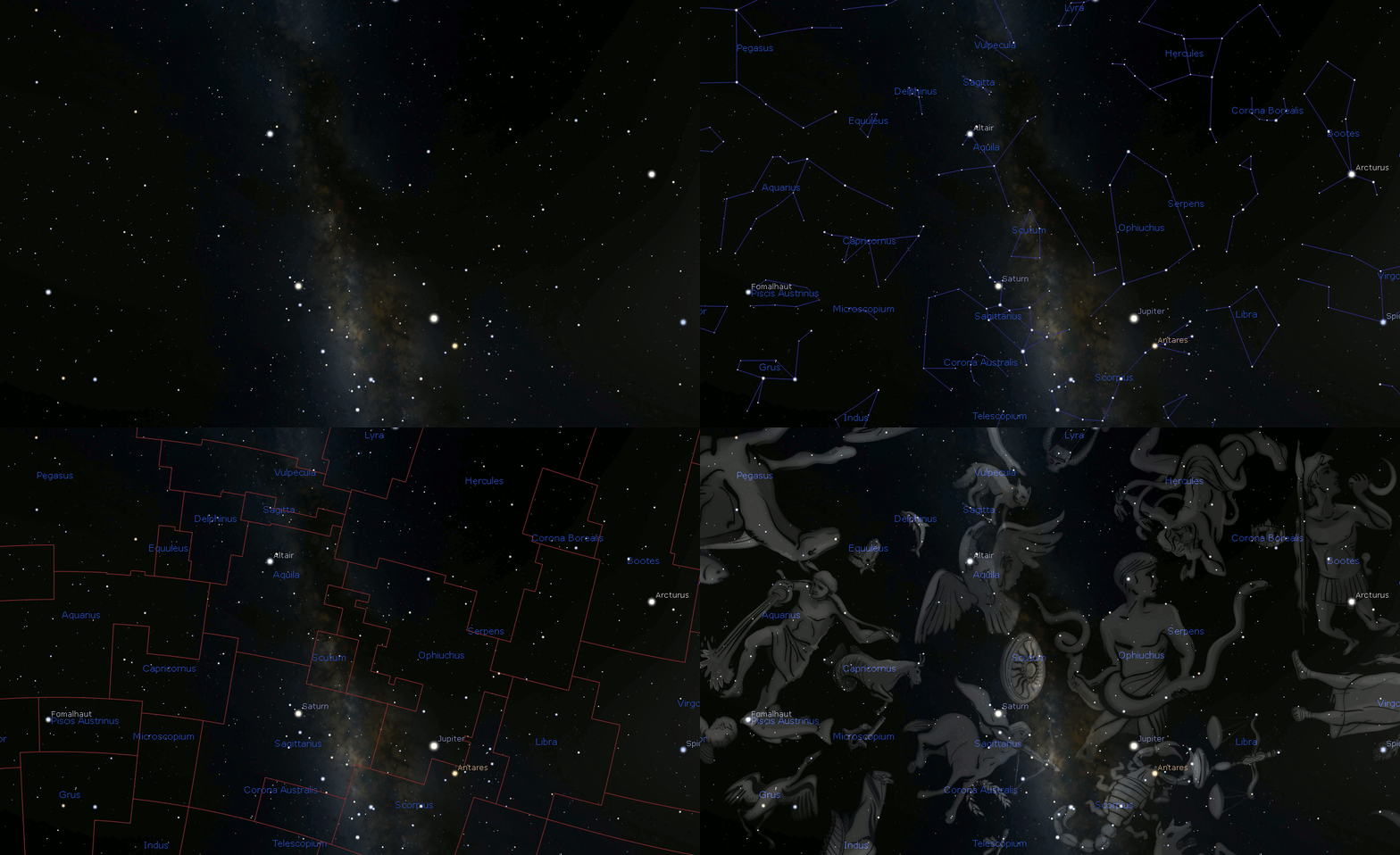
Summer constellations showing stars, lines, boundaries, and figures in succession. Click on the image to enlarge. Here you can see that Jupiter is in Ophiuchus, not Scorpius. Created using Stellarium and GIMP.
08/27/2019 – Ephemeris – The obscure constellation of Scutum the shield
Ephemeris for Tuesday, August 27th. Today the Sun will be up for 13 hours and 29 minutes, setting at 8:28, and it will rise tomorrow at 7:00. The Moon, 3 days before new, will rise at 4:23 tomorrow morning.
In the southern sky between the Teapot of Sagittarius below and Aquila the Eagle with its southernmost star of the Summer Triangle lies Scutum the shield of John Sobieski the Polish king who stopped the advance of the Turks at Kalenberg in 1683. The Polish half of me is very proud. Scutum is one of two official constellations which are related to real persons. The other one is Coma Berenices, a hank of the Egyptian Queen Berenice’s hair. However the stars here are so dim and embedded in the glow of the Milky Way as to be nearly impossible to discern. Scutum lies in one of the richest portions of the Milky Way, wonderful to scan with binoculars and telescopes for star clusters and nebulae or clouds of dust and gas.
The times given are for the Traverse City/Interlochen area of Michigan. They may be different for your location.
Addendum
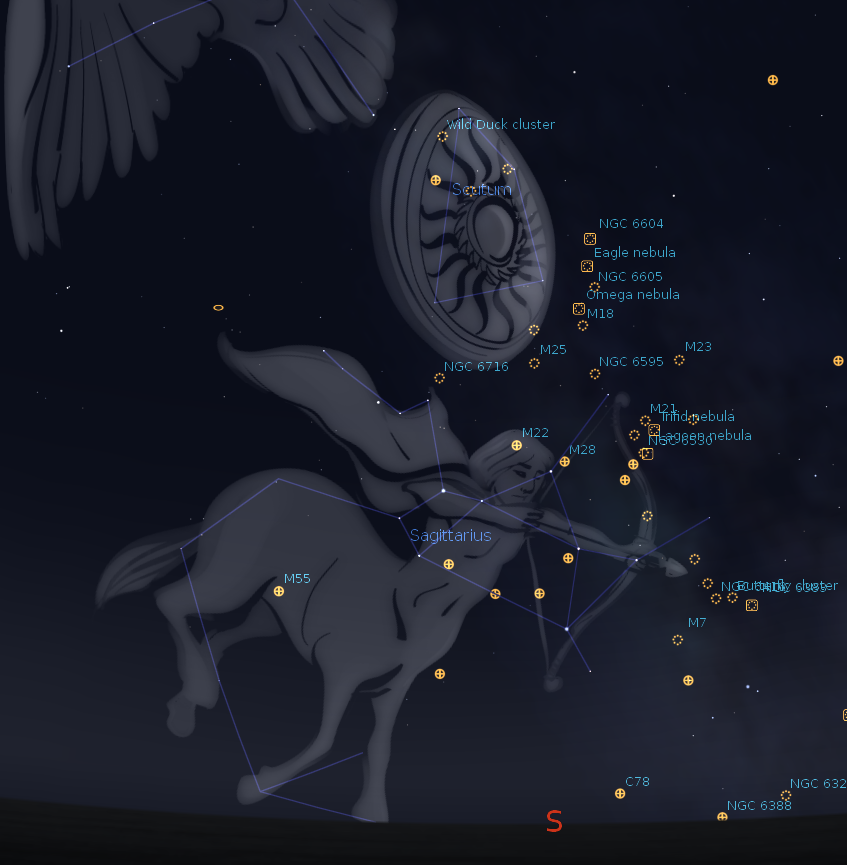
Binocular and telescope deep sky objects in Scutum and Sagittarius. Created using Stellarium.
08/23/2019 – Ephemeris – Two small constellations around the Summer Triangle
Ephemeris for Friday, August 23rd. Today the Sun will be up for 13 hours and 41 minutes, setting at 8:35, and it will rise tomorrow at 6:55. The Moon, at last quarter today, will rise at 12:43 tomorrow morning.
Located below the eastern edge of the Summer Triangle of three of the brightest stars in the sky, which is overhead in our sky at 10 p.m., is the tiny constellation of Delphinus the dolphin. Delphinus’ 6 stars in a small parallelogram with a tail, really does look like a dolphin leaping out of the water. The parallelogram itself has the name Job’s Coffin. The origin of this asterism or informal constellation is unknown. Of the dolphin itself: the ancient Greeks appreciated this aquatic mammal as we do, and told stories of dolphins rescuing shipwrecked sailors. There’s another tiny constellation to the right of Delphinus, Sagitta the arrow a small thin group of 5 stars, which represents Cupid’s dart. Above-right of Sagitta binoculars will find a little star group called the Coat hanger.
The times given are for the Traverse City/Interlochen area of Michigan. They may be different for your location.
Addendum
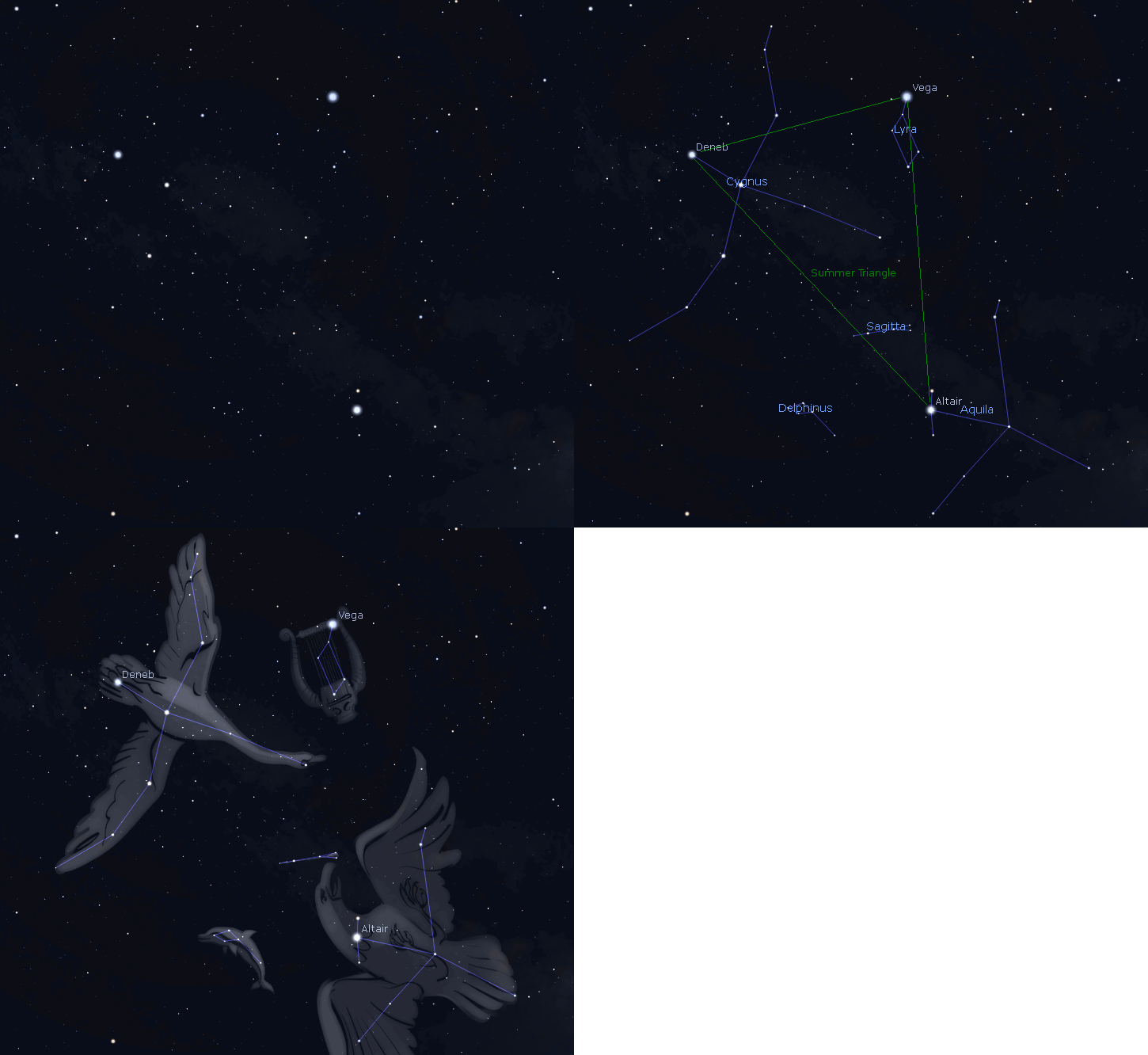
Delphinus and Sagitta finder animation. Created using Stellarium and GIMP.
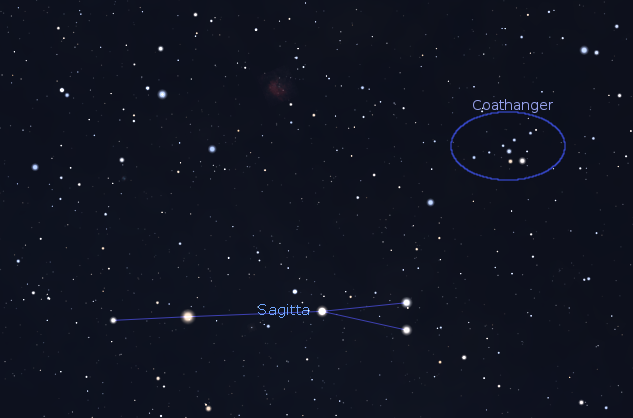
Closeup of Sagitta and the binocular asterism the Coathanger. Created using Stellarium.
08/20/2019 – Ephemeris – To find Sagittarius, look for the Teapot
Ephemeris for Tuesday, August 20th. Today the Sun will be up for 13 hours and 49 minutes, setting at 8:40, and it will rise tomorrow at 6:51. The Moon, 3 days before last quarter, will rise at 11:16 this evening.
Due south and low in the sky at 10:30 p.m. now is one of my favorite asterisms the Teapot of the constellation Sagittarius. Sagittarius classically represents a centaur with a bow and arrow aimed at the heart of the constellation Scorpius to its west. I can find the bow and arrow here, but the half man half horse figure of the centaur eludes me. However the stout little teapot of the children’s song is quite obvious, with its base, lid on top, handle to the left and the spout to the right. To make things more realistic the bright Milky Way seems to rise like steam from its spout. As the night goes on the Teapot slides westward and appears to tilt, pouring its tea on the southwestern horizon. Saturn this year is above and left of it.
The times given are for the Traverse City/Interlochen area of Michigan. They may be different for your location.
Addendum
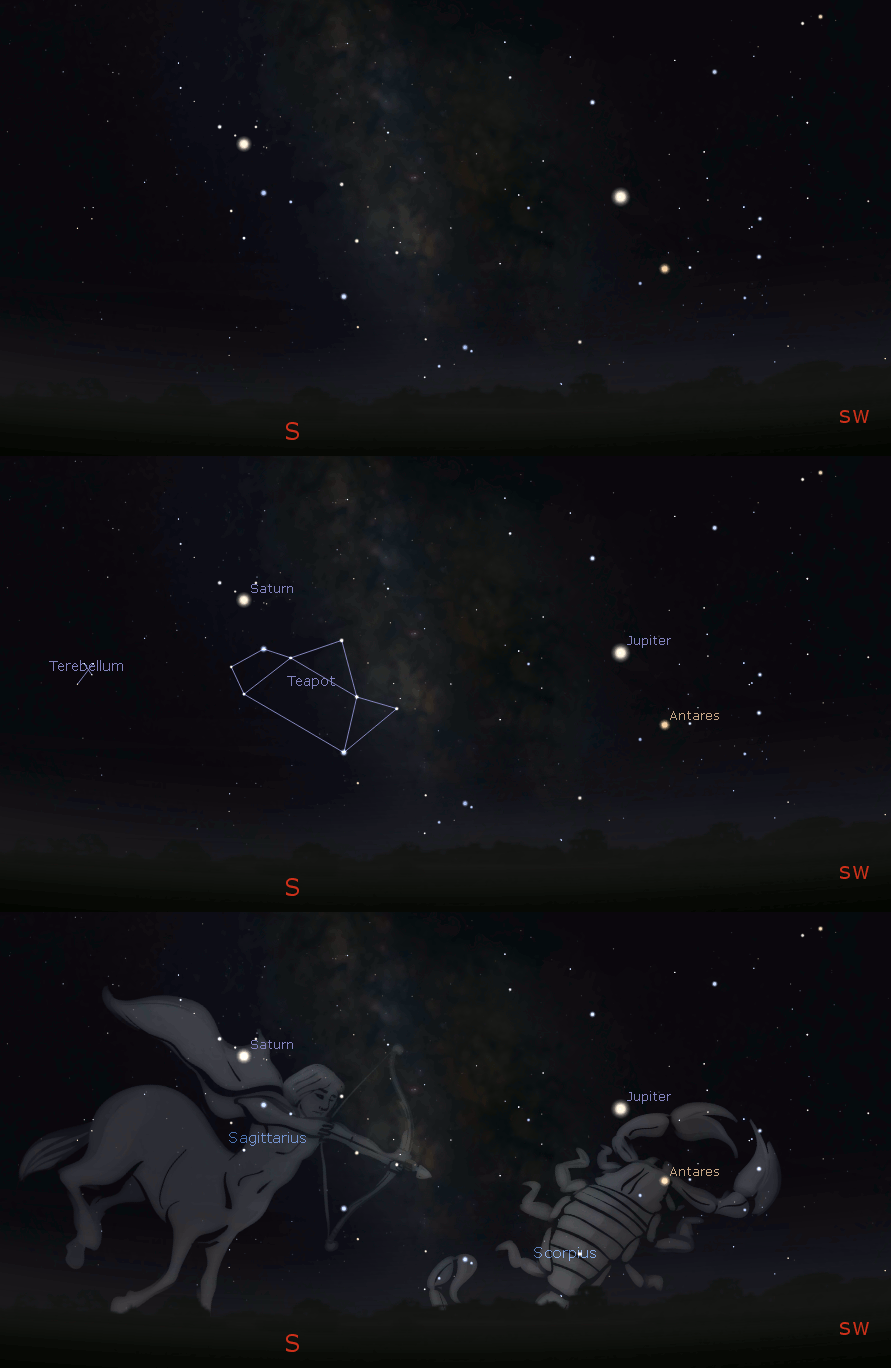
Sagittarius Teapot finder animation based of August 20, 2019 at 10:30 p.m. It includes the tiny asterism Terebellum, Latin for auger. It’s made to faint 4th and 5th magnitude stars. Created using Stellarium and GIMP.
 Bob Moler's Ephemeris Blog