Archive
02/13/2020 – Ephemeris – Orion’s Belt stars
This is Ephemeris for Thursday, February 13th. Today the Sun will be up for 10 hours and 21 minutes, setting at 6:07, and it will rise tomorrow at 7:45. The Moon, 2 days before last quarter, will rise at 11:48 this evening.
Orion’s belt of three stars is one of the most noticeable star groupings in the sky. There are no other group of three bright stars in a straight line visible anywhere else in the sky. The star’s names from left to right are Alnitak, Alnilam and Mintaka. They are actually a bit farther away than the other bright stars of Orion. Alnilam, the center star, is over three times the distance of red giant Betelgeuse above them and over twice as far as blue white giant star Rigel below them. Alnilam is 375 thousand times brighter than the Sun according to the SIMBAD Astronomical Database. These three stars were also known as Frigga’s Spindle by the Norsemen. Frigga also known as Freya is the goddess from which we get the name of the day of the week Friday.
The times given are for the Traverse City/Interlochen area of Michigan. They may be different for your location.
Addendum
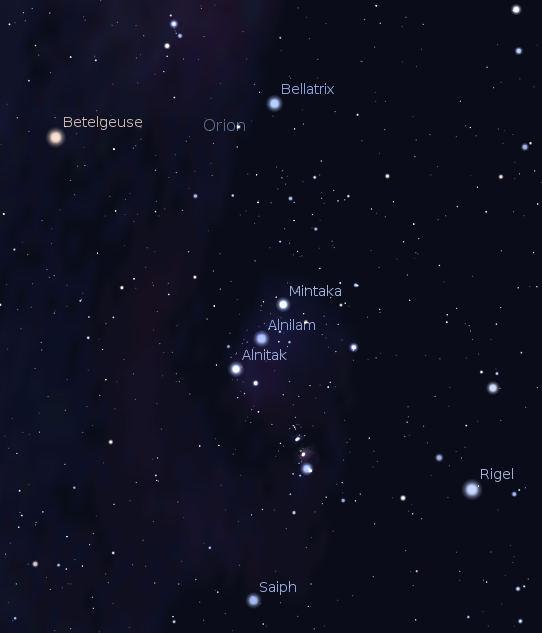
Torso of Orion centered on his belt. The torso of Orion is more upright this month. But I’m leaving it tilted so the star names don’t over print the stars. Created using Stellarium.
12/23/2019 – Ephemeris – Orion, rising even higher now
Ephemeris for Monday, December 23rd. Today the Sun will be up for 8 hours and 48 minutes, setting at 5:05, and it will rise tomorrow at 8:18. The Moon, 3 days before new, will rise at 6:34 tomorrow morning.
The large and bright constellation of Orion the hunter is in the southeast at 9 p.m., with the bright star Sirius below it near the horizon. The equally spaced line of three stars of Orion’s belt are nearly vertical and point down to Sirius, also known as the Dog Star in Canis Major, Orion’s greater dog. Those three belt stars are in the center of an elongated rectangle of stars that tilt to the left. At the top left of Orion’s shoulder stars is the red giant star Betelgeuse. The right shoulder star is Bellatrix. Both Bellatrix and Sirius along with the names of other stars and constellations should be familiar to fans of the Harry Potter novels and movies, as members of the house of Black. The knee stars at the bottom of the rectangle are, from left to right Saiph and the brilliant blue giant star Rigel. Between his belt and knees are stars of his sword.
The times given are for the Traverse City/Interlochen area of Michigan. They may be different for your location.
Addendum
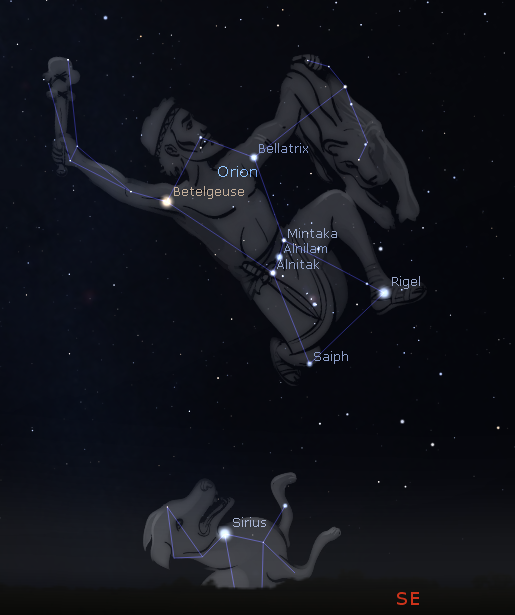
The named bright stars of Orion and Canis Major, the dog rising below Orion with Sirius. Beside the stars mentioned in the program are the stars of Orion’s belt that have their own program later on in winter. Created using Stellarium.
In this season of Biblical stories it’s nice to note that Orion is mentioned four times in the Old Testament. In Isaiah, Amos and twice in Job. In Hebrew his name is “Kesîl”, meaning Fool.
12/17/2019 – Ephemeris – Hyades, the face of Taurus the Bull
Ephemeris for Tuesday, December 17th. Today the Sun will be up for 8 hours and 48 minutes, setting at 5:03, and it will rise tomorrow at 8:15. The Moon, 2 days before last quarter, will rise at 11:14 this evening.
The face of the constellation Taurus the bull looks like the letter V sideways above the rising Orion the Hunter in the east at 9 p.m. The bright star at the tip of a letter V of stars is Aldebaran. Look with binoculars at the letter V shape and you will see the stars of the Hyades star cluster The Hyades is the closest star cluster to us, at about 153 light years. And is important for that reason. Before satellites like Hipparcos and Gaia. The Hyades was the only star cluster to be directly measured by a technique called parallax, using the radius of the Earth’s orbit as one side of a surveyors enormous triangle. Its many stars at the same distance were used to determine distances of star clusters even farther away. Additional techniques based on the distance of the Hyades allowed us to measure distances to the galaxies.
The times given are for the Traverse City/Interlochen area of Michigan. They may be different for your location.
Addendum
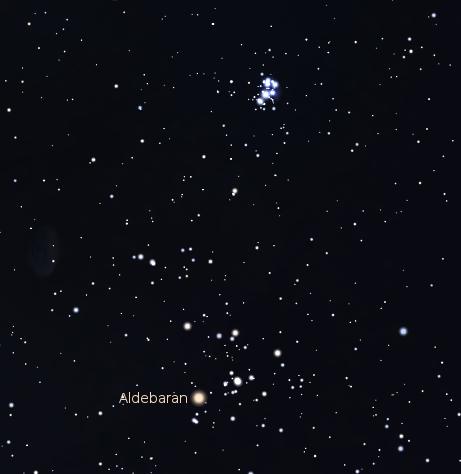
Aldebaran in the ‘V’ shape of the Hyades (The face of Taurus the bull) with the Pleiades above. Created using Stellarium.
12/16/2019 – Ephemeris – Taurus Treasures
Ephemeris for Monday, December 16th. Today the Sun will be up for 8 hours and 49 minutes, setting at 5:03, and it will rise tomorrow at 8:14. The Moon, 3 days before last quarter, will rise at 9:59 this evening.
Rising in the east-southeast now is the bright star Aldebaran an orange star that’s at one end of the sideways letter V of stars that is the head of Taurus the bull. Above it is the jewel-like Pleiades or Seven Sisters star cluster. There’s more to Taurus, like it’s freakishly long horns and front part of its body. But you can say you’ve seem Taurus, if you can spot his face. That V of stars is actually a star cluster called the Hyades, the closest to the Earth, and in Greek Myth were the half-sisters of the Pleiades, also fathered by the god Atlas. Both the Hyades and Pleiades are being pursued by Orion, which is below it. He isn’t the only one following the Pleiades, the name Aldebaran means “The Follower”.
The times given are for the Traverse City/Interlochen area of Michigan. They may be different for your location.
Addendum
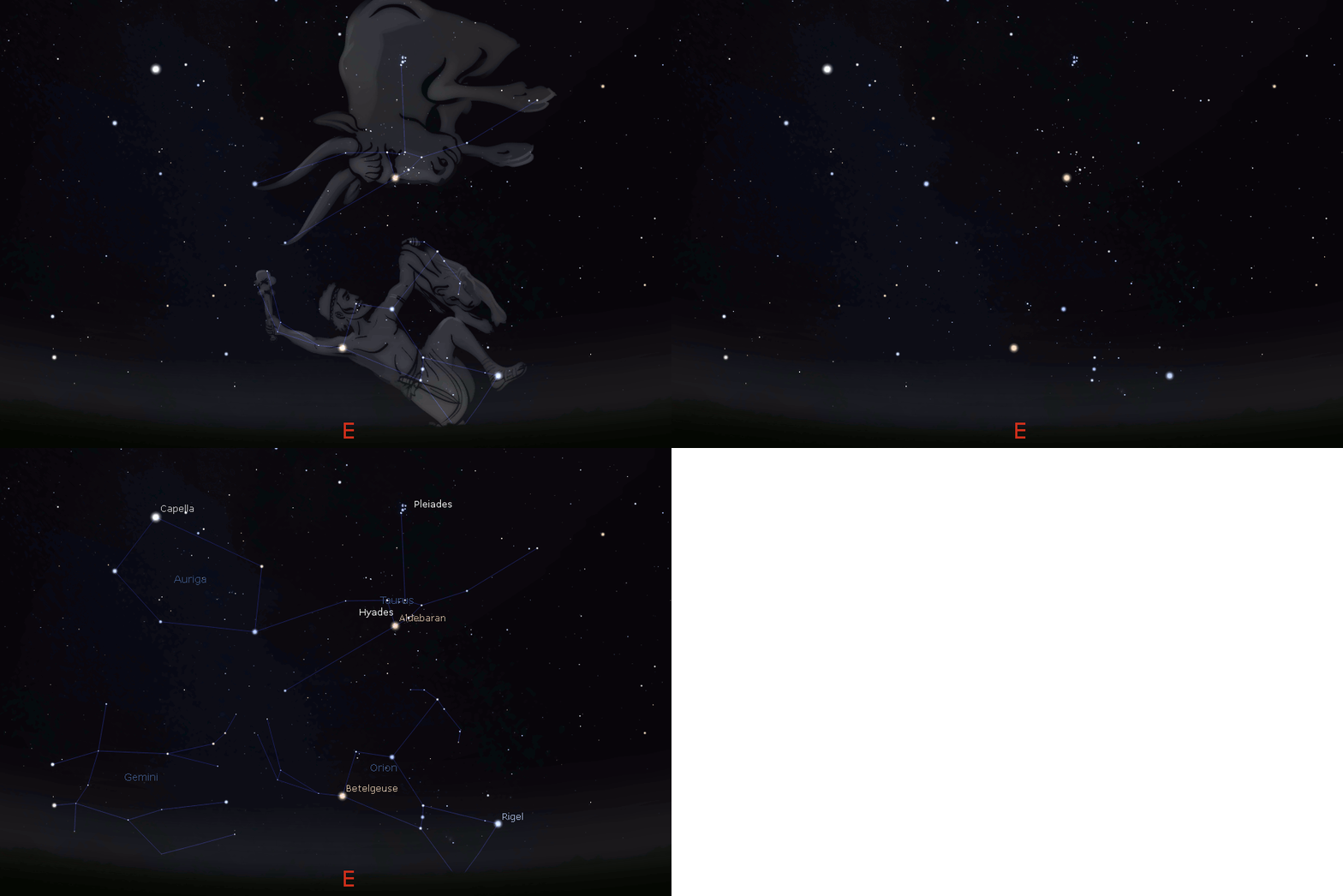
An animation showing the Hyades, Taurus, Orion and the Pleiades. Click on the image to enlarge. Created using Stellarium and GIMP.
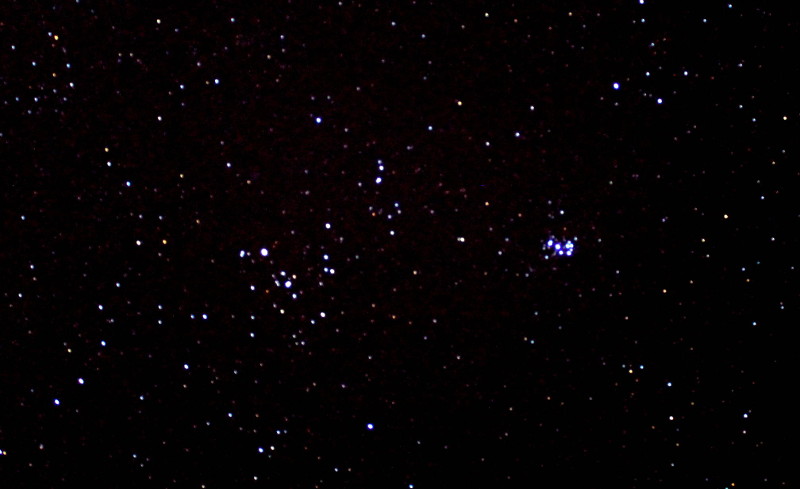
The Pleiades (right) and the Hyades (left) in this photograph I took January 4, 2016.
12/02/2019 – Ephemeris – Orion rising
Ephemeris for Monday, December 2nd. Today the Sun will be up for 9 hours and 2 minutes, setting at 5:03, and it will rise tomorrow at 8:01. The Moon, 2 days before first quarter, will set at 10:58 this evening.
We have a fat crescent of a Moon tonight. However it shouldn’t affect the constellation now rising. In the east the central winter constellation Orion the hunter throws a leg over the horizon between 8 and 9 p.m. as Robert Frost told in his poem Star-Splitter. The upright rectangle that is his body on December evenings is tilted to the left as he rises, with bright red star Betelgeuse at the top left of the rectangle, his shoulder. At the opposite corner is blue-white Rigel, a knee. In the center of the rectangle is a line of three stars nearly vertically aligned, which represents Orion’s belt. Above Orion is another bright orange star at one end of a letter V shape of stars. That’s Aldebaran the angry eye in the face of Taurus the bull who apparently is none too happy with Orion.
The times given are for the Traverse City/Interlochen area of Michigan. They may be different for your location.
Addendum
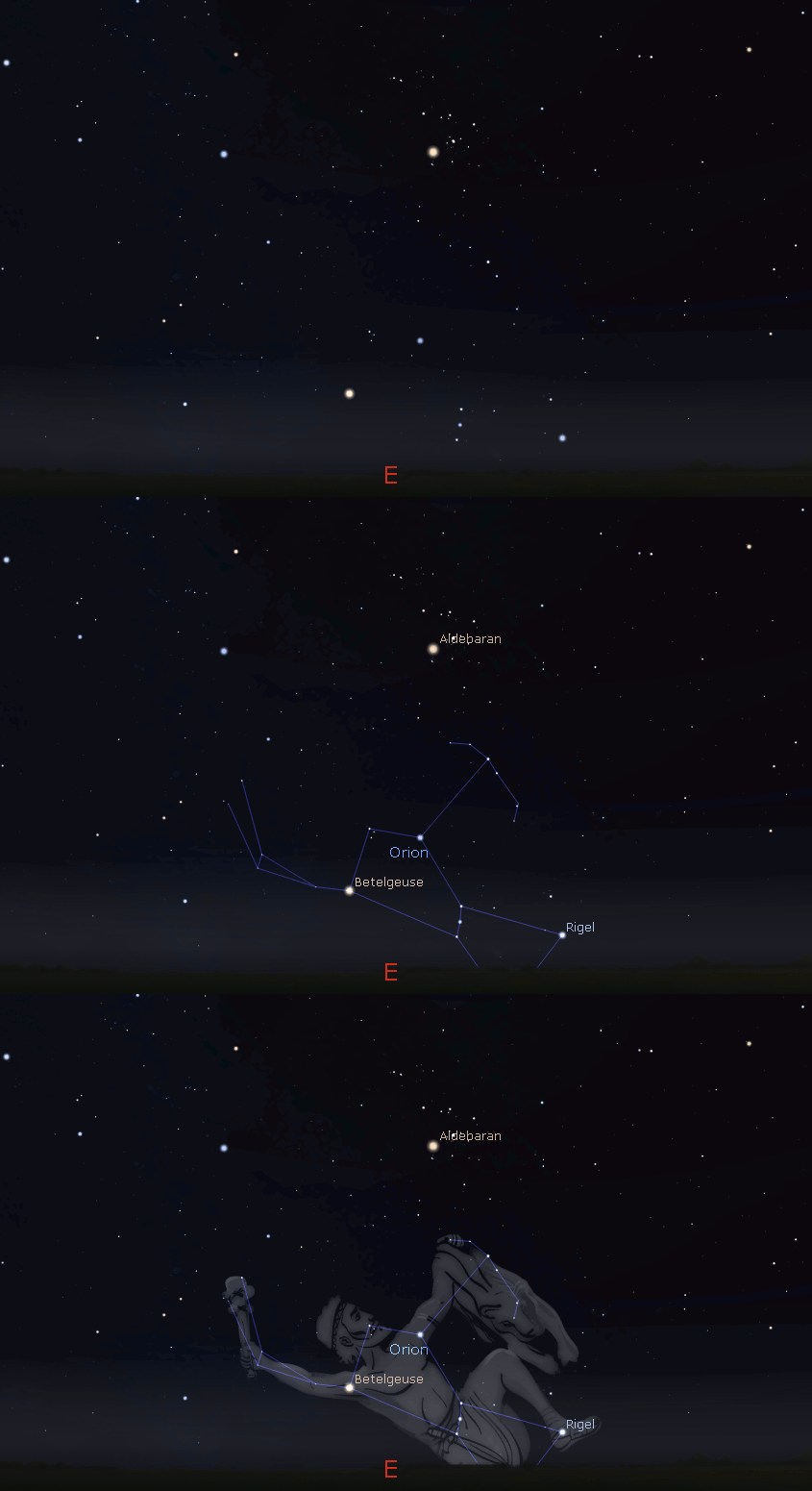
Finder chart for the rising Orion at 8 p.m. December 2nd. Click on the image to enlarge. Created using Stellarium and GIMP.
11/26/2019 – Ephemeris – The Pleiades in mythology
Ephemeris for Tuesday, November 26th. Today the Sun will be up for 9 hours and 12 minutes, setting at 5:06, and it will rise tomorrow at 7:54. The Moon is new today, and won’t be visible.
Let’s look at how some other cultures saw the Pleiades, the star cluster that is seen in the eastern sky these evenings. To the Anishinaabe native peoples around here the Pleiades is the “Hole in the Sky” or the seven stones that are heated for the sweat lodge ceremony. To the Kiowa these were sister stars that had been whisked into the sky from the top of Devils Tower in Wyoming where they were threatened by a huge bear. In Norse mythology these were the goddess Freya’s hens. The name we know them by has rather misty origins. Some think the Greek name is from the mother of the seven sisters, Pleione. The Greek word for sail is similar to Pleiades, and some suggested that the appearance of the Pleiades in the morning sky signaled the best sailing weather in the Mediterranean region. (12/16/2016 – Ephemeris – The Pleiades in the mythology of many cultures)
The times given are for the Traverse City/Interlochen area of Michigan. They may be different for your location.
Addendum
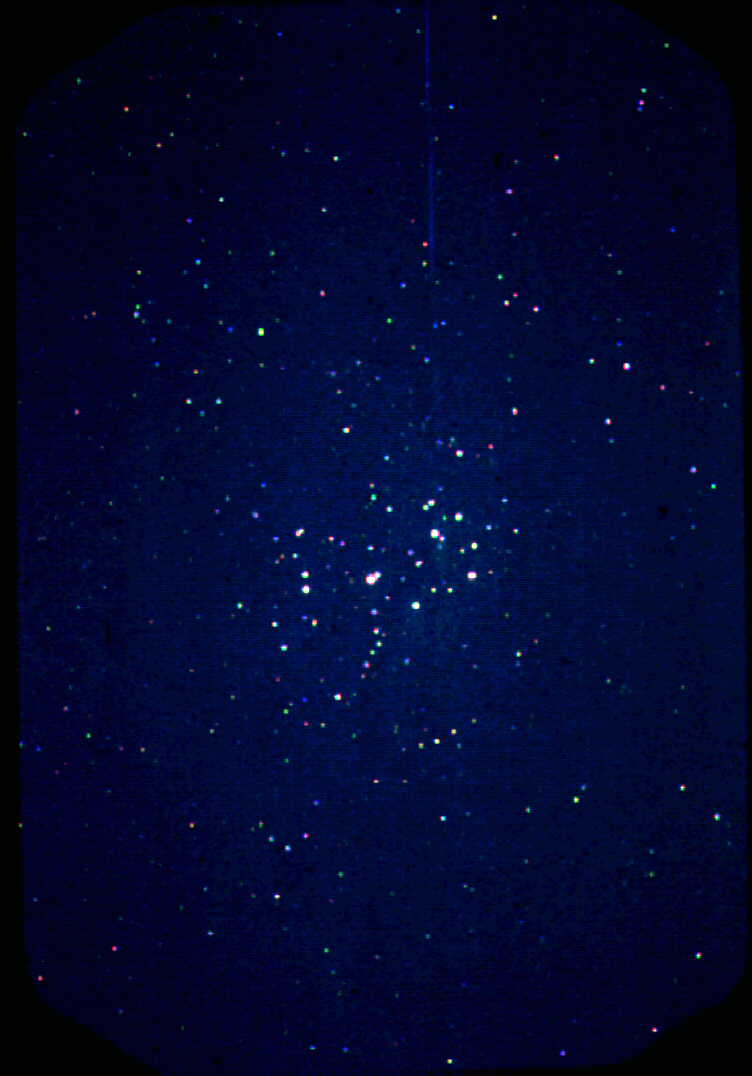
The Pleiades, about what you’d see in binoculars.
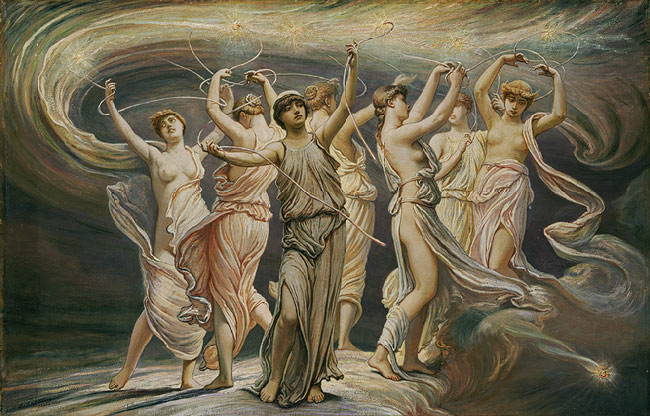
The Greek Pleiades a painting by Elihu Vedder in the Metropolitan Museum of Art, New York City. Public Domain.

Seven maidens being attacked by a giant bear, having fled to the top of Devil’s Tower in Wyoming. Painting by Herbert Collins, http://www.nps.gov/deto
11/19/2019 – Ephemeris – Spying Capella low in the northeast
Ephemeris for Tuesday, November 19th. Today the Sun will be up for 9 hours and 26 minutes, setting at 5:11, and it will rise tomorrow at 7:46. The Moon, at last quarter today, will rise at 12:09 tomorrow morning.
As I was driving northward in the country at 6:15 Saturday night under partly cloudy skies I spied a bright star low in the north-northeast. It was Capella, the northernmost of the 21 first magnitude stars, and the 4th brightest star visible from our earthly location near 45 degrees north latitude. It’s in the pentagon shaped constellation of Auriga the Charioteer, which I couldn’t make out due to the clouds and the fact I was driving. Capella has the same color as the Sun, but there the similarity ends. Capella is made up of two massive stars that are so close that they appear as one. Capella is 43 light years away. At that distance a star the brightness of the Sun would barely be visible to the naked eye.
The times given are for the Traverse City/Interlochen area of Michigan. They may be different for your location.
Addendum
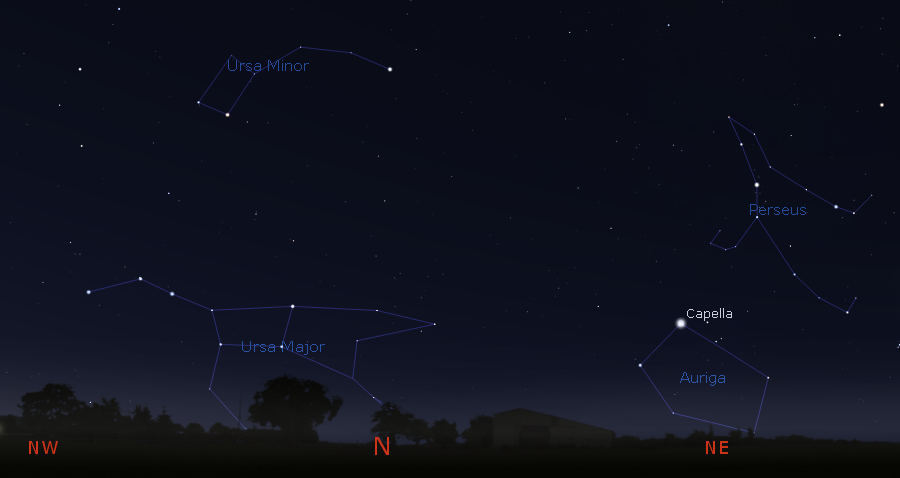
Low northern stars about an hour after sunset on November 19, 2019. Click on the image to enlarge. Created using Stellarium.
10/29/2019 – Ephemeris – Finding the Pleiades or Seven Sisters
Ephemeris for Tuesday, October 29th. Today the Sun will be up for 10 hours and 19 minutes, setting at 6:36, and it will rise tomorrow at 8:17. The Moon, 2 days past new, will set at 7:57 this evening.
A marvelous member of the autumn skies can be found low in the east northeast after 9 in the evening. It is the famous star cluster called the Pleiades or the Seven Sisters. I might also add the ‘Tiny Dipper’. Many people can spot a tiny dipper shape in its six or seven stars, and mistake it for the Little Dipper. When I was nearsighted, though corrected, I never had been able to see more than a few stars and a bit of fuzz. However with binoculars, even I can see over a hundred stars appear along with the dipper shape of the brightest. The fuzz I saw was unresolved stars, but in photographs the Pleiades actually contain wisps of the gas they are passing through currently. In Greek mythology the sisters were daughters of the god Atlas.
The times given are for the Traverse City/Interlochen area of Michigan. They may be different for your location.
Addendum
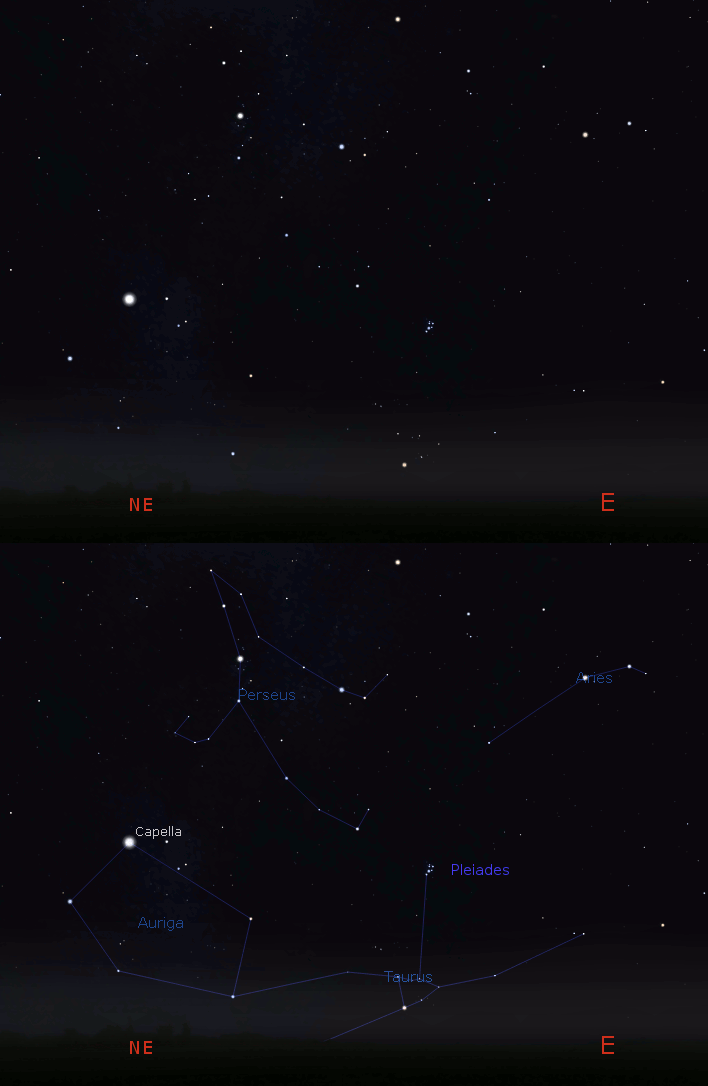
Finding the Pleiades animation for 9 p.m. October 29, 2019. The Pleiades is surrounded by constellations I’ve described earlier this year and one yet to be described, Taurus the bull of which the cluster is a part. The V of stars near the horizon is Taurus’ head and is another star cluster, the Hyades, the half sisters to the Pleiades. Created using Stellarium and GIMP.
The Pleiades, about what you’d see in binoculars, though not as brilliant. One of my old photographs. With my 11 inch f/4.5 Dobsonian using a 40mm eyepiece that gives a field of view that encompasses the Pleiades, all I can say is Wow!
The Greek Pleiades a painting by Elihu Vedder in the Metropolitan Museum of Art, New York City. Public Domain.
10/28/2019 – Ephemeris – The constellations of Triangulum and Aries the ram
Ephemeris for Monday, October 28th. Today the Sun will be up for 10 hours and 22 minutes, setting at 6:37, and it will rise tomorrow at 8:16. The Moon, 1 day past new, will set at 7:22 this evening.
High in the east-southeast at 9 p.m. can be seen the Great Square of Pegasus. From the top left star of the square diverge two curved lines of stars that is Andromeda the chained princess. Just below and left of Andromeda is a slender triangle of stars, none particularly bright. It has a name you can easily see in the stars, Triangulum, the triangle. Early Christians saw it as the Mitre of Saint Peter or the Trinity. Another small constellation seen below Triangulum is the much better known constellation Aries the ram, a small hockey stick of a constellation, not that hard to spot. It is the first constellation of the Zodiac, where the Sun is supposed to enter on the first day of spring. Due to the wobble of the Earth’s axis, that honor is now given to Pisces.
The times given are for the Traverse City/Interlochen area of Michigan. They may be different for your location.
Addendum
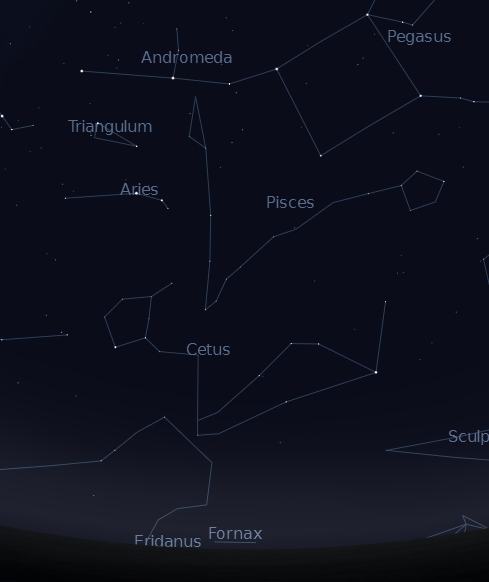
Cetus, Triangulum, Aries and surrounding constellations. Created using Stellarium.
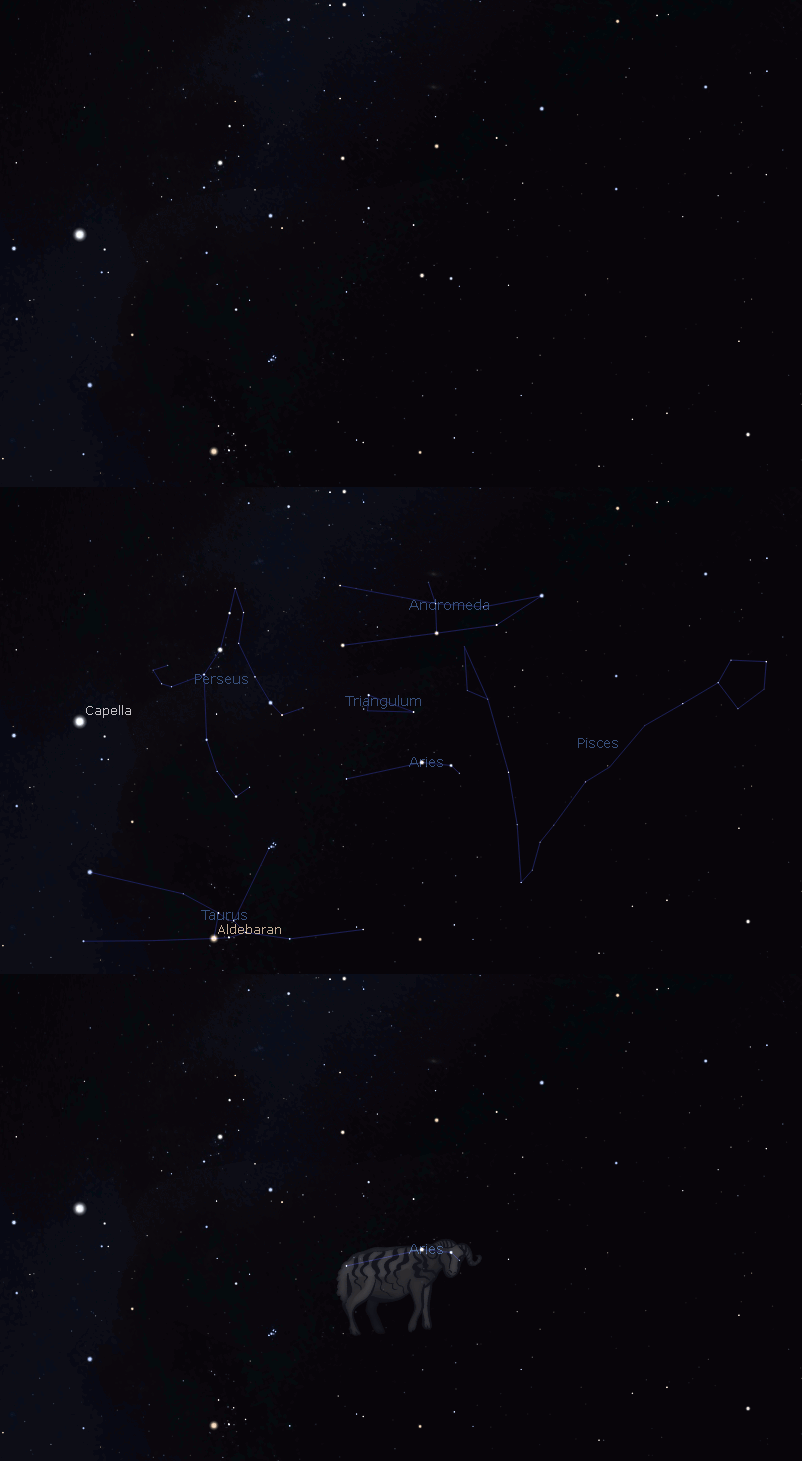
Aries the ram animated finder chart. Created using Stellarium and GIMP.
10/25/2019 – Ephemeris – Finding Pisces the fish
Ephemeris for Friday, October 25th. Today the Sun will be up for 10 hours and 31 minutes, setting at 6:42, and it will rise tomorrow at 8:12. The Moon, 2 days before new, will rise at 6:00 tomorrow morning.
High in the southeast at 9 p.m. are the four bright stars of the Great Square of Pegasus, the upside down flying horse. Lying along the left and bottom sides of the great square is the constellation of Pisces the fish, one of the 12 constellations of the Zodiac that lie along the path of the sun, moon and planets. Even though the constellation is called the fish, the fish themselves are not well represented in the stars. What can be traced in the stars is the rope, that’s tied to their tails, anchored at the extreme southeastern part of the constellation that is seen in the stars. The right or western end of Pisces is the asterism, or informal constellation, of the Circlet. It’s the loop of 5 stars, the rope around the tail of one of the two fish.
The times given are for the Traverse City/Interlochen area of Michigan. They may be different for your location.
Addendum
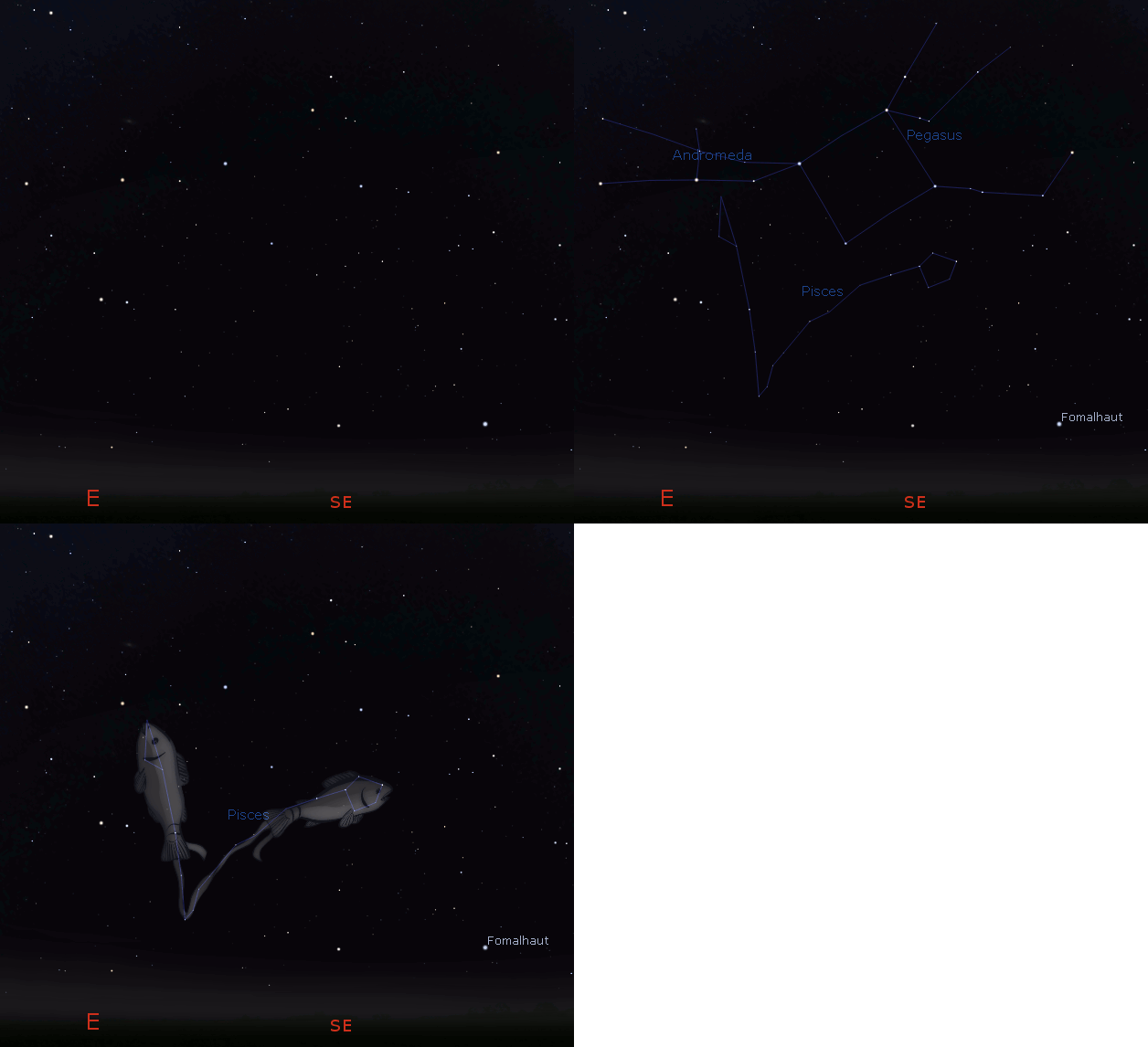
Pisces finder animation for 9 p.m. tonight October 25, 2019. Created using Stellarium and GIMP.
 Bob Moler's Ephemeris Blog