Archive
05/23/2019 – Ephemeris – A look at the constellation of Corona Borealis
Ephemeris for Thursday, May 23rd. Today the Sun will be up for 15 hours and 5 minutes, setting at 9:12, and it will rise tomorrow at 6:06. The Moon, 3 days before last quarter, will rise at 1:37 tomorrow morning.
High in the east-southeast at 11 this evening can be seen a small nearly circular constellation of Corona Borealis, the Northern Crown. It is just below Boötes, the kite shaped constellation off the handle of the Big Dipper. According to Greek myth the crown was given by the gods to the princess Ariadne, daughter of King Minos of Crete. The crown is more like a tiara with the bright star Alphecca at the front. To the Anishinaabe people, who are natives of our region it is the Sweat Lodge. Part of what we call Hercules next to it is the Exhausted Bather, who is lying on the ground after the ceremony. The seven stones that are heated for the Sweat Lodge are the Pleiades, now too close to the Sun to be seen.
The times given are for the Traverse City/Interlochen area of Michigan. They may be different for your location.
Addendum

Animated Corona Borealis Finder Chart looking to the east-southeast at 11 p.m. May 23rd Click on the image to enlarge. Created using Stellarium and GIMP.
05/20/2019 – Ephemeris – Dark evening skies again and a look at Virgo
Ephemeris for Monday, May 20th. Today the Sun will be up for 15 hours even, setting at 9:09, and it will rise tomorrow at 6:08. The Moon, 2 days past full, will rise at 11:10 this evening.
One of the large constellations we see in the south at 11 p.m. can be found using the Big Dipper overhead, follow the arc of the handle to the bright star Arcturus, the straighten the arc to a spike to reach Spica, a bright blue-white star in the south. Spica is the brightest star in the constellation Virgo the virgin. She represents the goddess of the harvest, Virgo is holding a sheaf of wheat in depictions of her, and Spica is placed at the head of the sheaf. In the space between Spica and Leo the lion to her upper right is, a great cluster just below naked eye visibility. The Virgo cluster of galaxies. Inside that cluster is galaxy M87 in whose center lies a black hole with the mass of 6.5 billion suns that was imaged last month.
The times given are for the Traverse City/Interlochen area of Michigan. They may be different for your location.
Addendum
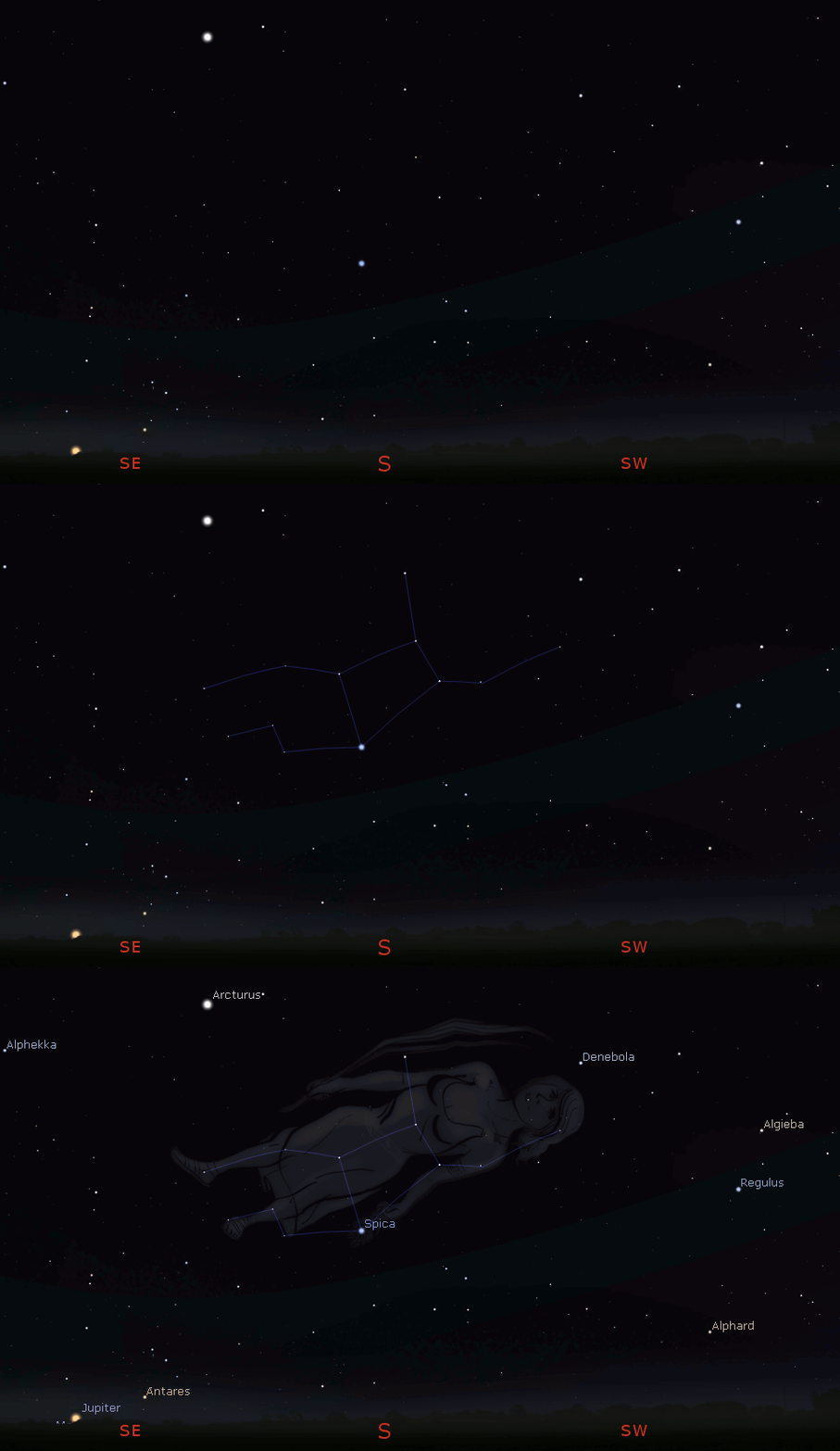
Virgo finder animation for 11 p.m. May 20, 2019. Click on the image to enlarge. Created using Stellarium.
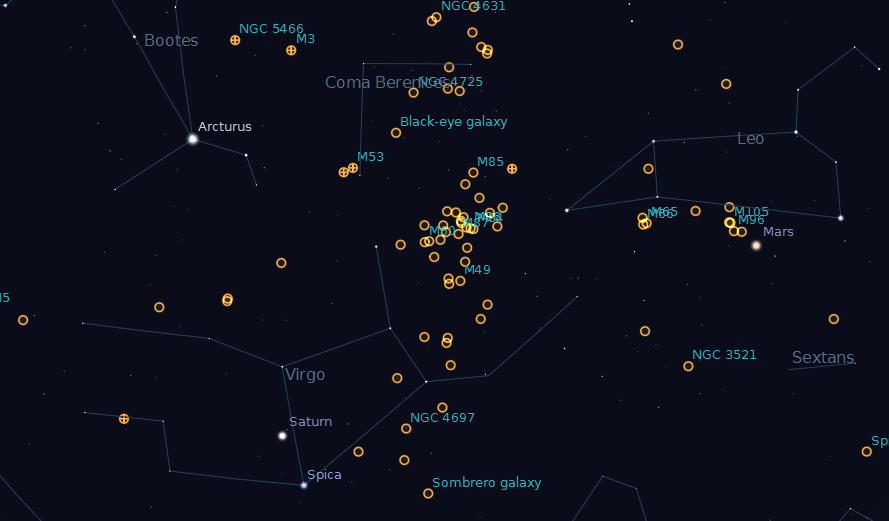
Brighter members of the Virgo Cluster. Created using Stellarium. Open circles are galaxies, circles with crosses are globular star clusters, outlying members of our Milky Way galaxy. M87 is just above center in that knot of galaxies. Created using Stellarium.
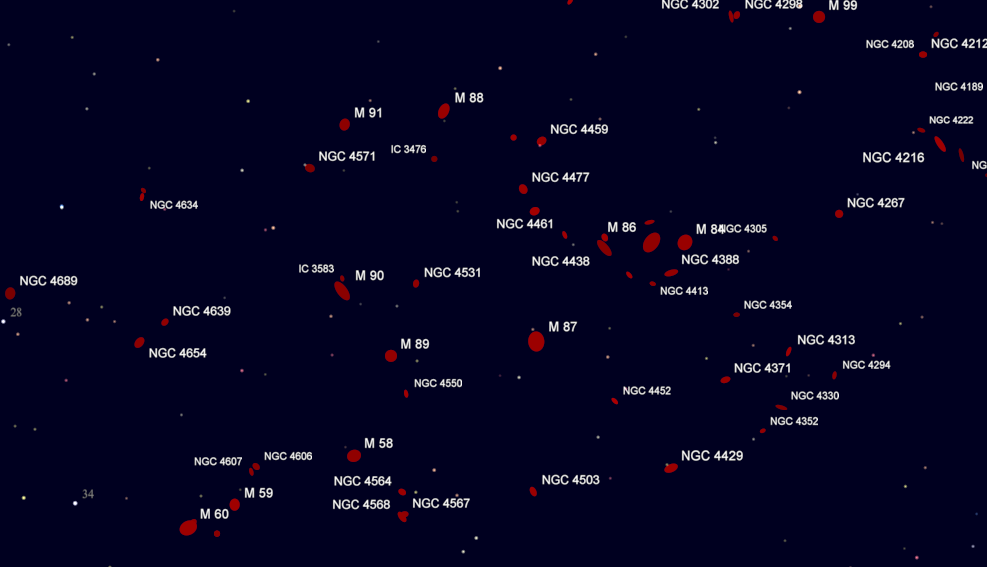
A closer look at some of the galaxies in the heart of the Virgo Cluster. M87 is near the center. Created with Cartes du Ciel (Sky Charts).
05/02/2019 – Ephemeris – Apollo and the constellations of Corvus, Crater and Hydra
Ephemeris for Thursday, May 2nd. Today the Sun will be up for 14 hours and 17 minutes, setting at 8:48, and it will rise tomorrow at 6:30. The Moon, 2 days before new, will rise at 6:18 tomorrow morning.
The small constellation of Corvus the crow is located low in the south at 10:30 this evening. It’s made of 5 dim stars, but the pattern is a distinctive distorted box with two stars at the upper left marking that corner. To the right is a fainter constellation of a thick stemmed goblet called Crater. Both appear above the long constellation of Hydra the water snake who is slithering just above the southern horizon. In Greek mythology Corvus, then white, was the god Apollo’s pet. He once bid Corvus to take a cup and fetch him some water. Corvus however dallied and waited for a green fig to ripen. Corvus grabbed a snake and returned with a story on how the snake had delayed him. The angry Apollo turned the crow and all crows to this day black.
The times given are for the Traverse City/Interlochen area of Michigan. They may be different for your location.
Addendum
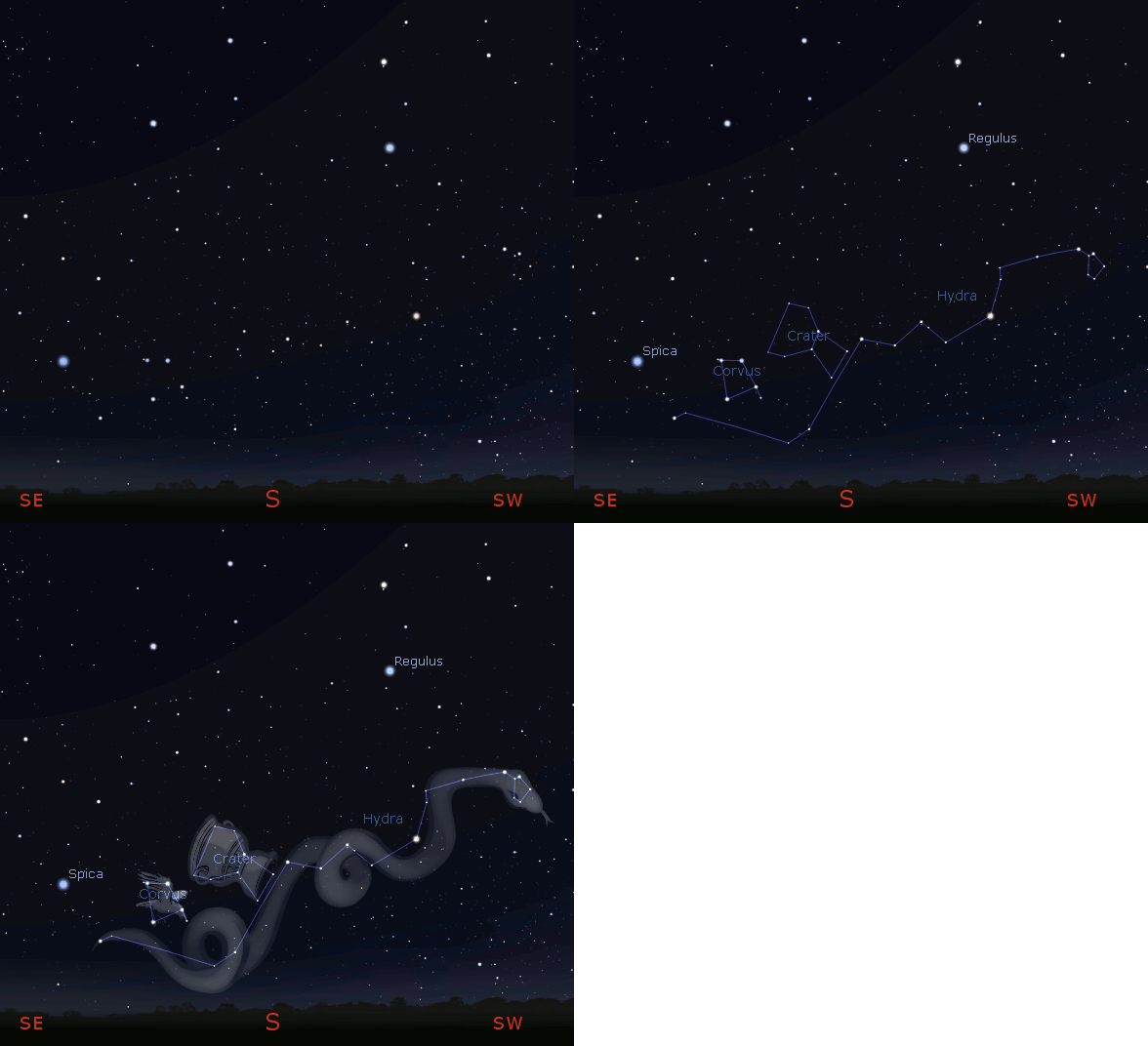
Corvus, Crater and Hydra finder chart for 10 p.m. May 2, 2019. Created using Stellarium and GIMP.
04/29/2019 – Ephemeris – Follow the arc to Arcturus
Ephemeris for Monday, April 29th. Today the Sun will be up for 14 hours and 8 minutes, setting at 8:45, and it will rise tomorrow at 6:34. The Moon, 3 days past last quarter, will rise at 5:06 tomorrow morning.
The Big Dipper, now nearing the zenith at 10 p.m. points to several stars and constellations. It’s handle points to two bright stars. First we follow the arc of the handle to the bright orange star Arcturus, the 4th brightest night-time star. The reason I say night-time is that the sun is a star also but by definition is not out at night. The arc to Arcturus is a how to find Arcturus and a clue to its name. Arcturus, midway up the sky in the east, lies at the base point of the kite shaped constellation of Boötes the herdsman. From Arcturus, straighten out the arc to a spike and one soon arrives at Spica a blue-white star in Virgo the virgin, now low in the southeast. Spica is also sometimes pronounced ‘Speeka’.
The times given are for the Traverse City/Interlochen area of Michigan. They may be different for your location.
Addendum
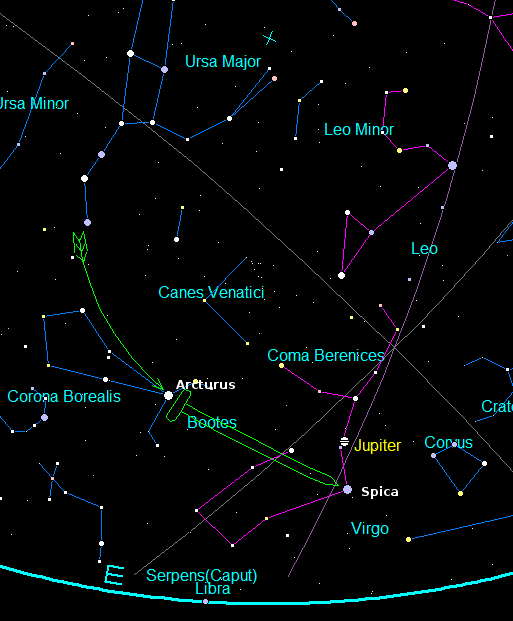
How to find the stars Arcturus and Spica from the Big Dipper in late April. Created using my LookingUp program.
04/26/2019 – Ephemeris – The story of Ursa Major and Boötes
Ephemeris for Arbor Day, Friday, April 26th. Today the Sun will be up for 14 hours even, setting at 8:41, and it will rise tomorrow at 6:39. The Moon, at last quarter today, will rise at 3:39 tomorrow morning.
Seen in the east at 10 p.m. tonight is the kite shaped constellation of Boötes the herdsman. The bright star Arcturus is at the bottom of the kite to the right. It is pointed to by the arc of the handle of the Big Dipper, higher in the east. Boötes represents a young hunter named Arcas, son of Callisto, a beautiful young lady who had the misfortune of being loved by Zeus the chief of the Greek gods. Zeus’ wife Hera, found out about it, and since she couldn’t punish Zeus, turned the poor woman into a bear. Arcas, many years later, unaware of the events surrounding his mother’s disappearance was about to kill the bear when Zeus intervened and placed them both in the sky to save her, as Arcas still pursues her across the sky nightly.
The times given are for the Traverse City/Interlochen area of Michigan. They may be different for your location.
Addendum
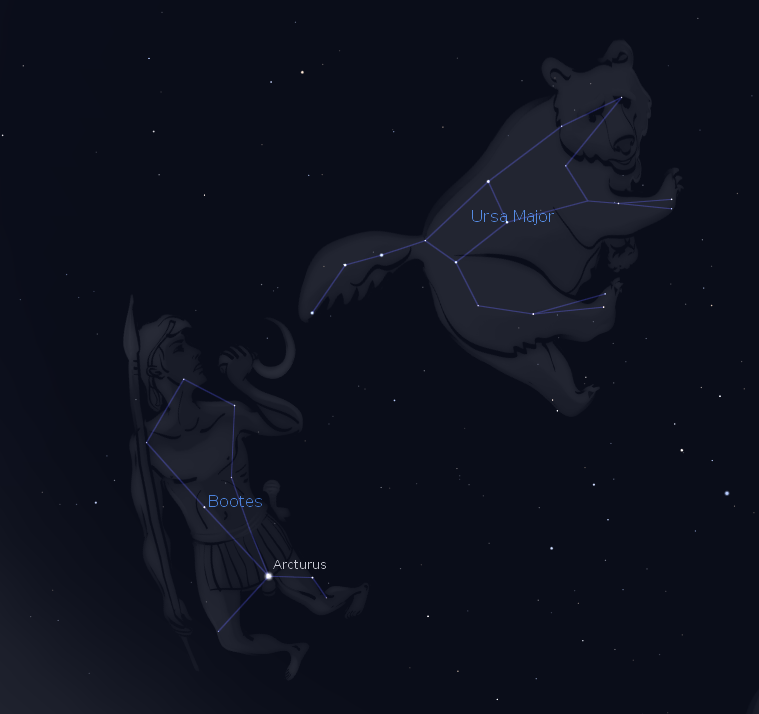
Bootes and Ursa Major aka Arcas chasing Callisto around the pole of the sky. Created using Stellarium.
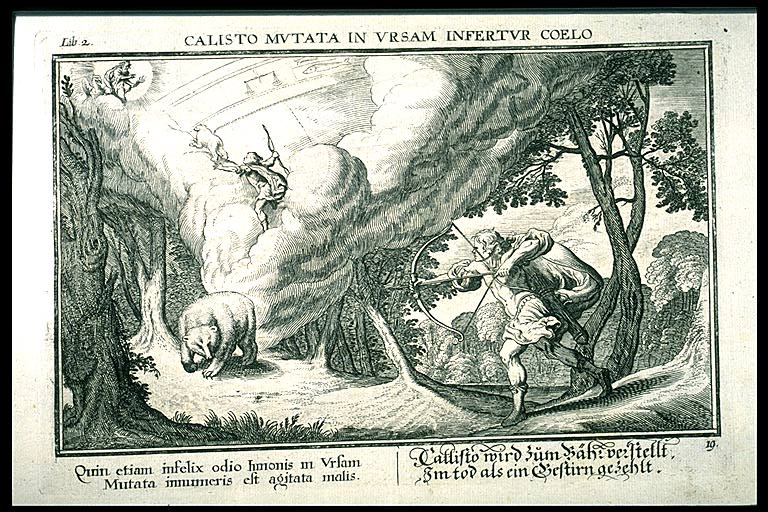
Arcas about to slay the bear by the 17th century artist Baur. Source: University of Virginia Electronic Text Center
04/25/2019 – Ephemeris – About Ursa Major
Ephemeris for Thursday, April 25th. Today the Sun will be up for 13 hours and 57 minutes, setting at 8:40, and it will rise tomorrow at 6:40. The Moon, 1 day before last quarter, will rise at 3:01 tomorrow morning.
The Big Dipper has many names to many peoples and countries around the world. Officially to the International Astronomical Union, it’s part of Ursa Major, the Great Bear, also recognized by many Native Americans, and Europeans. It’s even in the Bible. In the Book of Job the star Arcturus is a miss-translation. Arcturus means Guardian of the Bear. It should be the Bear itself, and most modern translations catch that mistake. Anyway, the Anishinaabe people around the Great Lakes say the stars of the bear are that of another creature, that of the Fisher, Ojiig, a mammal of the weasel family that brought summer to the Earth, and now heralds the seasons by his position in the sky.
The times given are for the Traverse City/Interlochen area of Michigan. They may be different for your location.
Addendum

An animation to visualize the Great Bear, Ursa Major and the Fisher, Ojiig, from the stars of and around the Big Dipper. Created using Stellarium.
04/23/2019 – Ephemeris – The story of Coma Berenices
Ephemeris for Tuesday, April 23rd. Today the Sun will be up for 13 hours and 52 minutes, setting at 8:37, and it will rise tomorrow at 6:43. The Moon, 3 days before last quarter, will rise at 1:24 tomorrow morning.
High in the southeast at 10 p.m. is a tiny and faint constellation of Coma Berenices, or Berenice’s hair. In it are lots of faint stars arrayed to look like several strands of hair. The whole group will fit in the field of a pair of binoculars, which will also show many more stars. The hank of hair was supposed to belong to Berenice, a real Queen of Egypt, of the 3rd century BCE. who cut off her golden tresses and offered them to the gods for the safe return of her husband from war. Her husband did return safe, and at that same time her hair disappeared from the temple. The oracle of the temple pointed to this constellation showing that her sacrifice was enshrined in the stars.
The times given are for the Traverse City/Interlochen area of Michigan. They may be different for your location.
Addendum
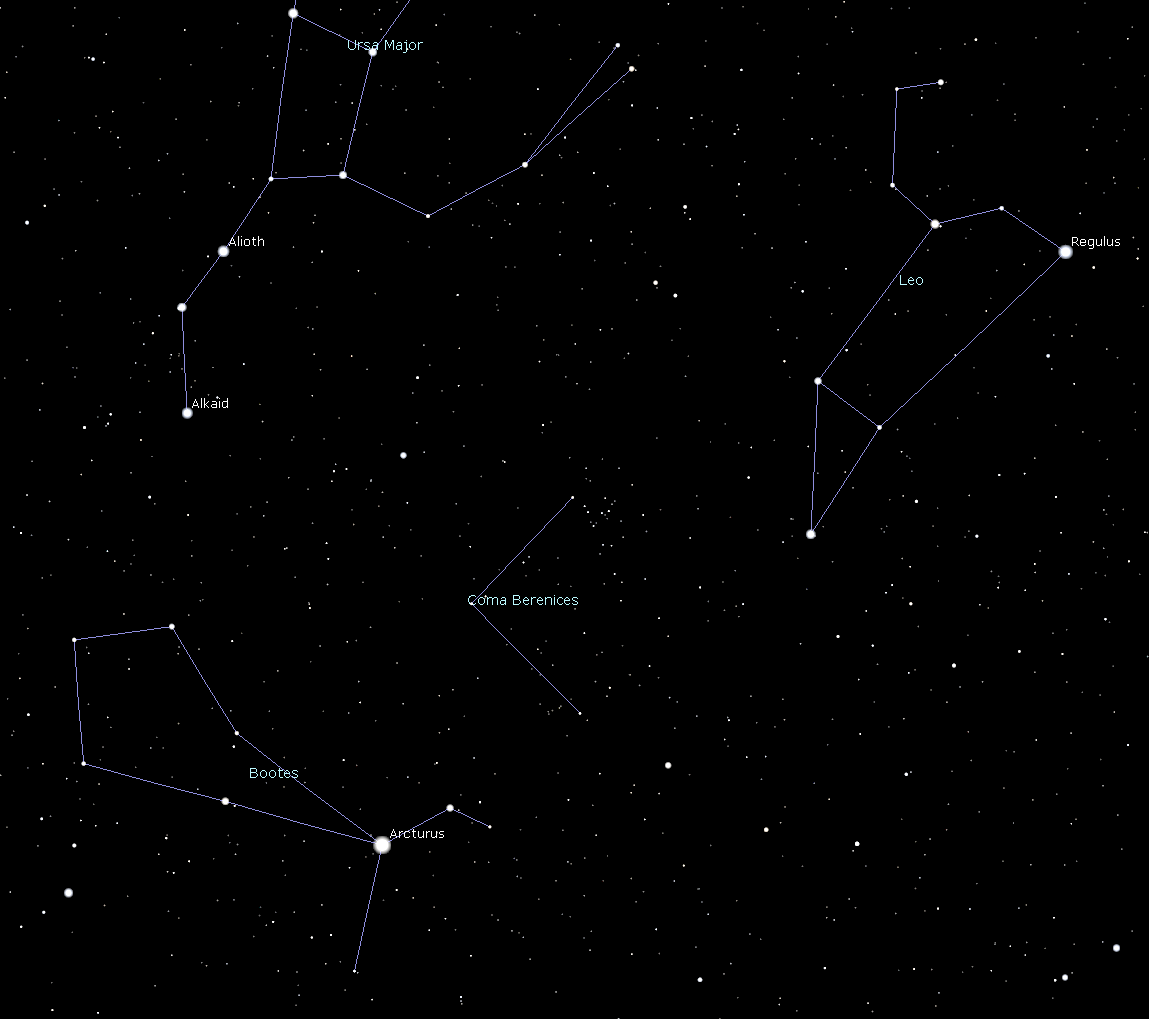
Coma Berenices and neighboring constellations at 10 p.m. on April 16, 2015. Note that only the upper right star of the upside down L shape actually belongs to the cluster. Created using Stellarium.

04/04/2019 – Ephemeris – A very hairy constellation
Ephemeris for Thursday, April 4th. Today the Sun will be up for 12 hours and 55 minutes, setting at 8:13, and it will rise tomorrow at 7:16. The Moon, 1 day before new, will rise at 7:51 tomorrow morning.
Midway up the sky in the east-southeast at 10 p.m. is a tiny sprinkle of faint stars arrayed to look like several strands of hair. It’s the constellation of Coma Berenices, or Berenice’s hair. The whole group will fit in the field of a pair of binoculars, which is the best way to see it, and will also show more stars. The cluster contains about 50 stars and lies at a distance of 280 light years from us, which makes it the second closest star cluster. The closest being the Hyades, that is the face of Taurus the bull now about to set in the west. The star cluster appears to be about 480 million years old. It is an open or galactic star cluster, born along the plane of the Milky Way. It appears away from the milky band due to its closeness to us.
The times given are for the Traverse City/Interlochen area of Michigan. They may be different for your location.
Addendum
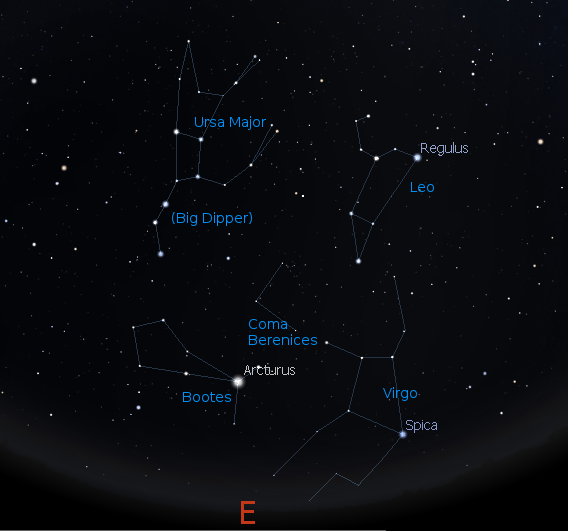
Coma Berenices finder chart 10 p.m., April 4th. Created using Stellarium.
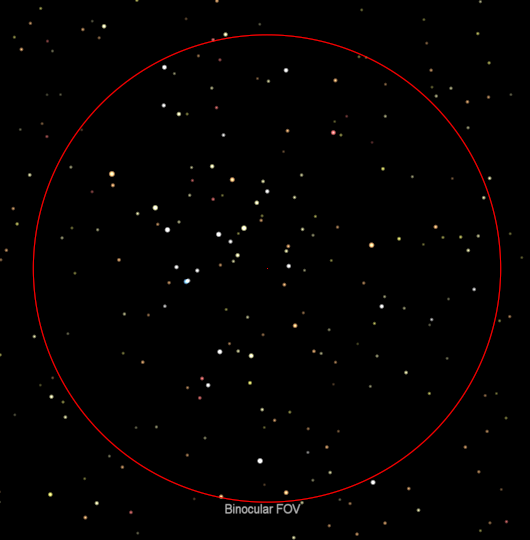
Approximate 7 power binocular field of view of the Coma Berenices Cluster. Created using Cartes du Ciel (Sky Charts).
04/02/2019 – Ephemeris – Hydra the longest constellation
Ephemeris for Tuesday, April 2nd. Today the Sun will be up for 12 hours and 49 minutes, setting at 8:11, and it will rise tomorrow at 7:20. The Moon, 3 days before new, will rise at 7:03 tomorrow morning.
In the south and southeastern sky at 10 p.m. can be found the constellation of Hydra the water snake. Unlike the monster of the same name this Hydra has but one head, which is its most distinctive part. At 10 p.m. look to the south. The head of Hydra is located below a line from the constellation Leo the Lion in the south and Gemini high in the west-southwest, and directly below Cancer the crab. Hydra’s head is a small but distinctive group of 6 stars that make a drooping loop to the right. The rest of Hydra wends its way diagonally to the southeastern horizon below the bright blue star Spica in Virgo. Some delineations of Hydra have the tail tickling the constellation Libra which is just about to rise at that time.
The times given are for the Traverse City/Interlochen area of Michigan. They may be different for your location.
Addendum
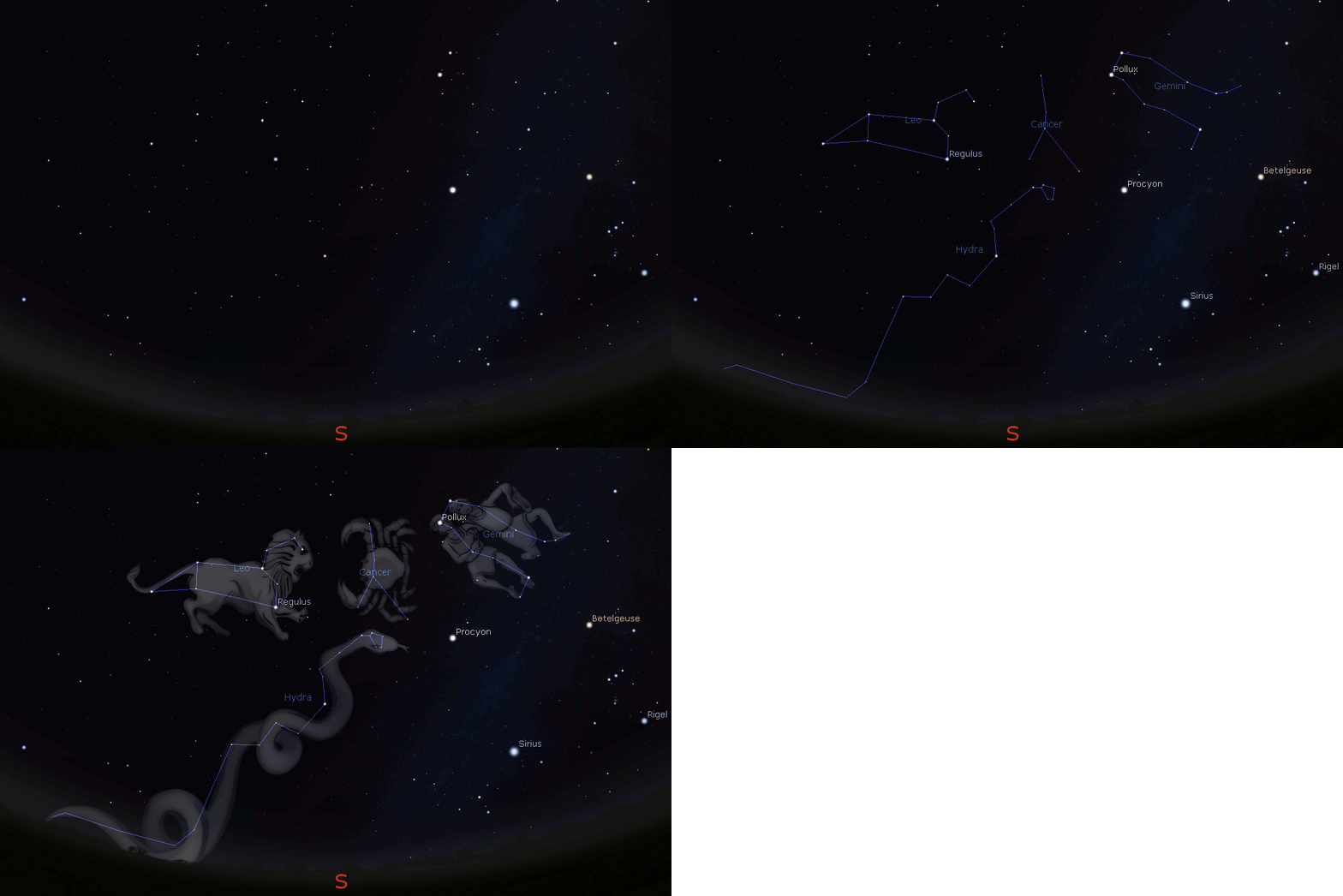
Hydra the water snake finder animation for 10 p.m. April 2nd.. Hydra is the longest of all the constellations. Click on the image to enlarge. Created using Stellarium and GIMP.
03/22/2019 – Ephemeris – The Great Underwater Panther
Ephemeris for Friday, March 22nd. Today the Sun will be up for 12 hours and 14 minutes, setting at 7:57, and it will rise tomorrow at 7:40. The Moon, 2 days past full, will rise at 10:07 this evening.
The Anishinabe peoples of the Great Lakes Region, which includes the Ottawa, Chippewa and Ojibwe Indians have one constellation of winter I know of. It is The Winter Maker which uses many of Orion’s stars and whose arms stretch from Aldebaran in Taurus the bull to Procyon the Little Dog Star, embracing the whole of the winter sky. Now that spring is here he is sinking into the west. The first constellation of spring is Curly Tail, or the Great Underwater Panther. Which uses the stars of Leo the lion’s backward question mark as its tail and the small knot of stars that are the head of Hydra the water snake below Cancer the crab as its head. Keep off the thinning ice or break through and be snatched by the great panther that lives below.
The times given are for the Traverse City/Interlochen area of Michigan. They may be different for your location.
Addendum
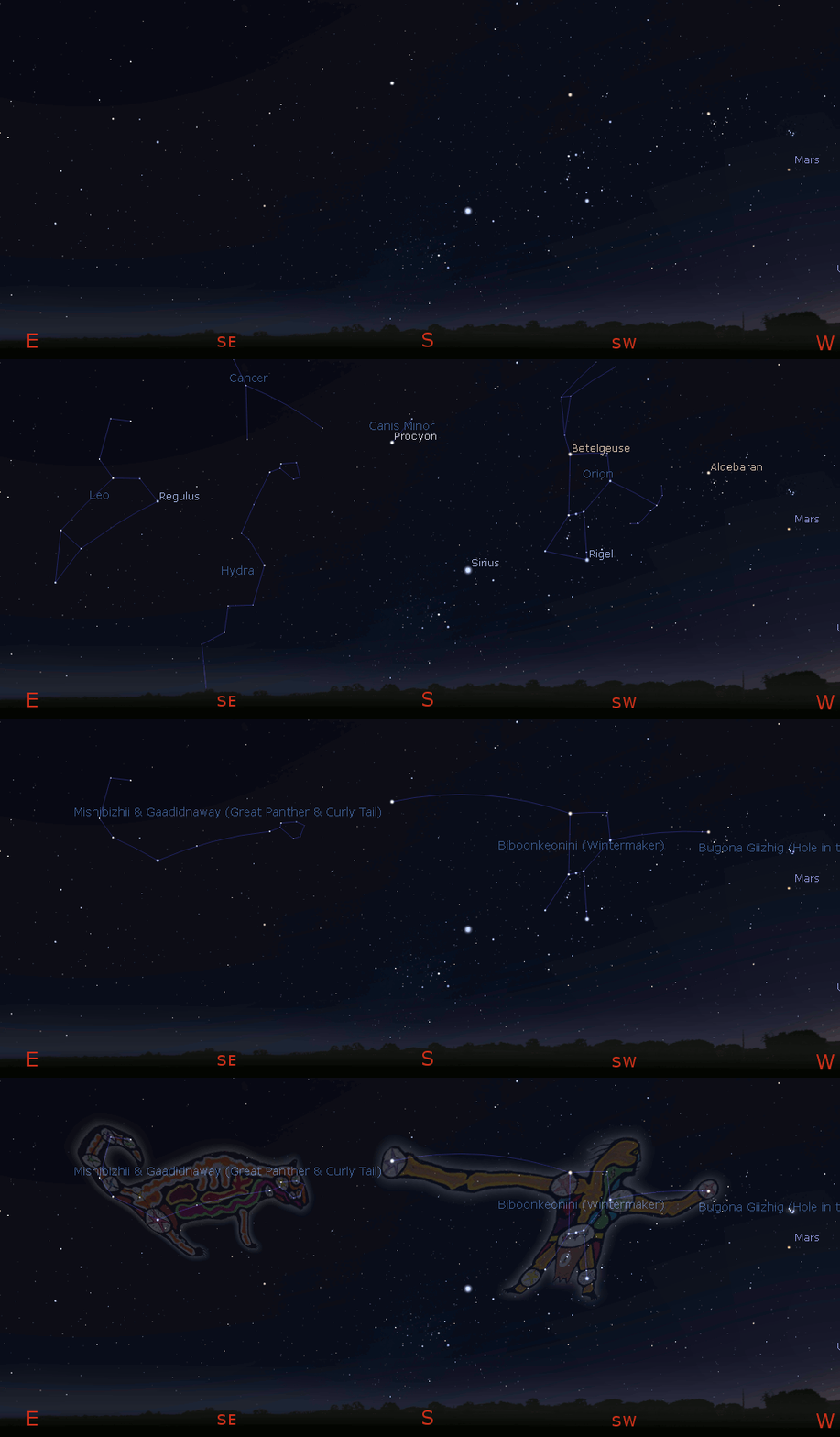
Great Underwater Panther finder animation relating western to Anishinaabe constellations for 9 p.m. March 22, 2019. Click on the image to enlarge. Created using Stellarium.
The constellation art is part of the latest versions of Stellarium. Ojibwe (Anishinaabe) constellation art by Annette S Lee and William Wilson from Ojibwe Sky Star Map Constellation Guide, by A. Lee, W Wilson, C Gawboy, J. Tibbetts. ISBN 978-0-615-98678-4.
 Bob Moler's Ephemeris Blog