Archive
04/16/2018 – Ephemeris – The Virgo cluster of galaxies
Ephemeris for Monday, April 16th. The Sun rises at 6:56. It’ll be up for 13 hours and 32 minutes, setting at 8:29. The Moon, 1 day past new, will set at 9:16 this evening.
The stars around the constellation Leo and Virgo below and left of it feature relatively few stars, compared to those around Orion and the other winter constellations. That isn’t just a lot of blank sky, but beyond what can be seen with the naked eye in the region of southwestern Virgo, just to the lower left of the tail star Denebola of Leo is a vast cluster of galaxies that outnumber the stars of the same brightness in that direction. It is the Virgo Galaxy Cluster. Astronomers shorten the name to the Virgo Cluster. Two centuries ago the comet hunter Charles Messier swept this region with his small telescope and found many fuzzy bodies that could be confused with comets. He didn’t know what they were, but they sure weren’t comets, because they didn’t move against the stars.
The times given are for the Traverse City/Interlochen area of Michigan. They may be different for your location.
Addendum
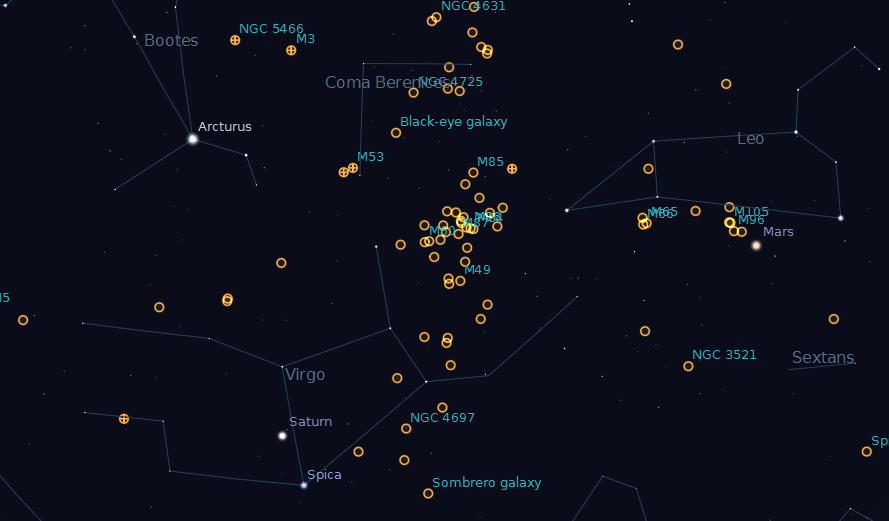
Brighter members of the Virgo Cluster. Created using Stellarium. Open circles are galaxies, circles with crosses are globular star clusters, outlying members of our Milky Way galaxy. This image is from a few years ago – Saturn, above Spica, has moved on.
04/13/2018 – Ephemeris – Regulus, in Leo the lion, the “Little King” star.
Ephemeris for Friday, April 13th. The Sun will rise at 7:01. It’ll be up for 13 hours and 23 minutes, setting at 8:25. The Moon, 2 days before new, will rise at 6:42 tomorrow morning.
The brightest star in the constellation Leo, which is high in the south these evenings is Regulus, whose name means “Little King”. It is appropriate due to its position in the heart of the king of beasts Leo the lion. Regulus is dead last in brightness of the 21 first magnitude stars, the brightest night-time stars. Even so, it is much brighter than the Sun. It is 79 light years away. The Sun would require a telescope to be spotted at that distance. Regulus appears to be a quadruple star system. The bright star itself is really two stars with a bright star orbited by a much dimmer star every 40 days. There are two dimmer stars much further out that share Regulus’ motion through space. There are an infinite variety of star system arrangements in the galaxy and beyond.
The times given are for the Traverse City/Interlochen area of Michigan. They may be different for your location.
Addendum
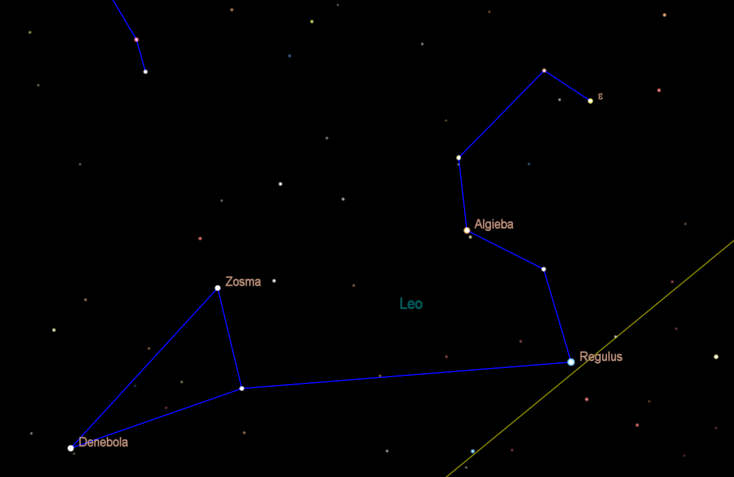
The naked eye stars of Leo, including Regulus at 10 p.m. April 13, 2018. Note that Algieba is a binary star that can be seen in small telescopes. The yellow line that passes Regulus is the ecliptic the apparent path of the Sun. The Moon and planets also hang out near that line. Created using Cartes du Ciel (Sky Charts).
Note: The original scheduled topic for today was the announcement of a star party at the Sleeping Bear Dunes National Lakeshore tomorrow, April 14th. It seems the weather gods have a different plan. There’s a winter storm watch from late Friday night (tonight) to noon Sunday with 3-6 inches of slushy snow.
04/10/2018 – Ephemeris – How Boötes and the Great Bear got into the sky
Ephemeris for Tuesday, April 10th. The Sun will rise at 7:07. It’ll be up for 13 hours and 14 minutes, setting at 8:21. The Moon, 2 days past last quarter, will rise at 5:14 tomorrow morning.
Appearing mid way up the sky in the east at 10 p.m. is the kite shaped constellation of Boötes the herdsman. The bright star Arcturus is at the bottom-right of the kite, pointed to by the arc of the handle of the Big Dipper, above it. In one Greek myth Boötes represents a young hunter named Arcas, son of Callisto, a beautiful young lady who had the misfortune of being loved by Zeus the chief of the Greek gods. Zeus’ wife Hera, found out about the affair, and since she couldn’t punish Zeus, turned the poor woman into an ugly bear. Arcas, unaware of the events surrounding his mother’s disappearance in his youth was about to kill the bear when Zeus intervened and placed them both in the sky to save her. To this day Boötes continues to chase the great bear Ursa Major around the pole of the sky each night.
The times given are for the Traverse City/Interlochen area of Michigan. They may be different for your location.
Addendum

Arcas about to slay the bear by the 17th century artist Baur. Source: University of Virginia Electronic Text Center
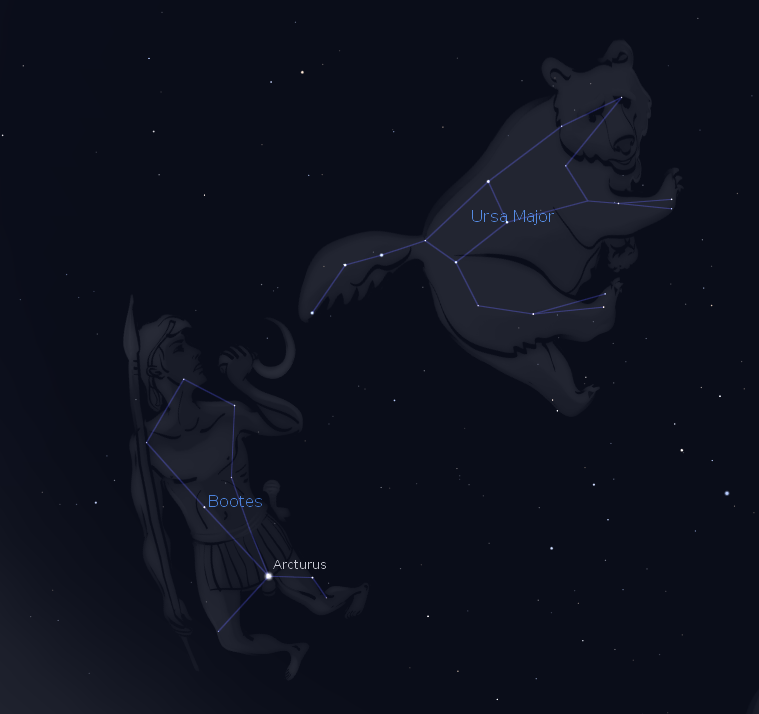
Bootes and Ursa Major aka Arcas chasing Callisto around the pole of the sky. Created using Stellarium.
04/05/2018 – Ephemeris – Hydra, a constellation for all of spring
Ephemeris for Thursday, April 5th. The Sun will rise at 7:16. It’ll be up for 12 hours and 59 minutes, setting at 8:15. The Moon, 3 days before last quarter, will rise at 1:41 tomorrow morning.
In the southern evening sky can be found the constellation of Hydra the water snake. Unlike the monster of the same name this Hydra has but one head, which is its most distinctive part. At 10 p.m. look to the south. The head of Hydra is located below a line from Gemini and Leo. It is directly below Cancer the crab, and left of the star Procyon. Hydra’s head is a small distinctive group of 6 stars that make a loop and the snake’s slightly drooping head. At that time the sinuous body of Hydra sinks below the horizon in the southeast. As it gets later in the evening the rest of Hydra will wend its way to eventually end beneath Libra the scales. This can also be seen in the next few months as Hydra slithers across the southern horizon.
The times given are for the Traverse City/Interlochen area of Michigan. They may be different for your location.
Addendum
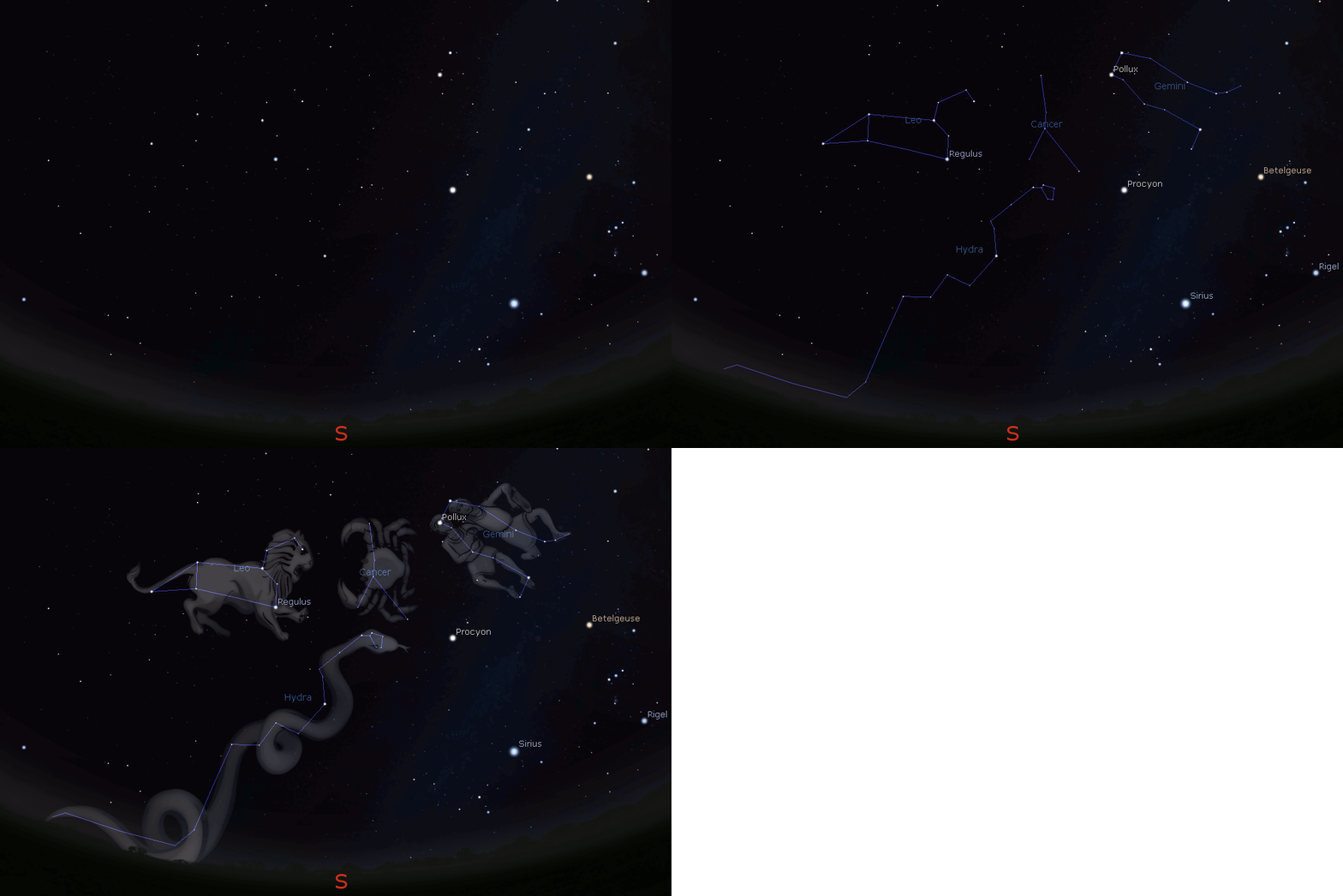
Hydra the water snake finder animation for 10 p.m. April 5th.. Hydra is the longest of all the constellations. Click on image to enlarge. Created using Stellarium and GIMP.
03/19/2018 – Ephemeris – The dim zodiacal constellation of Cancer the crab
Ephemeris for Monday, March 19th. The Sun will rise at 7:47. It’ll be up for 12 hours and 6 minutes, setting at 7:54. The Moon, 2 days past new, will set at 10:21 this evening.
At 10 this evening, the faint constellation, and member of the Zodiac, Cancer the crab is located in the south half way between the bright stars Castor and Pollux of the constellation Gemini, high in the south and the bright star Regulus in Leo the lion in the southeast. Cancer is very dim, looking like an upside-down Y or even a K if all its stars can be made out. In the center of Cancer is a fuzzy spot to the unaided eye. In binoculars or a low power telescope this fuzzy spot becomes a cluster of stars. It is the Beehive cluster. At 577 light years away, according to the latest measurements, it is one of the closest star clusters. A week from tonight the Moon will pass below this cluster, by about 4 of its diameters.
The times given are for the Traverse City/Interlochen area of Michigan. They may be different for your location.
Addendum
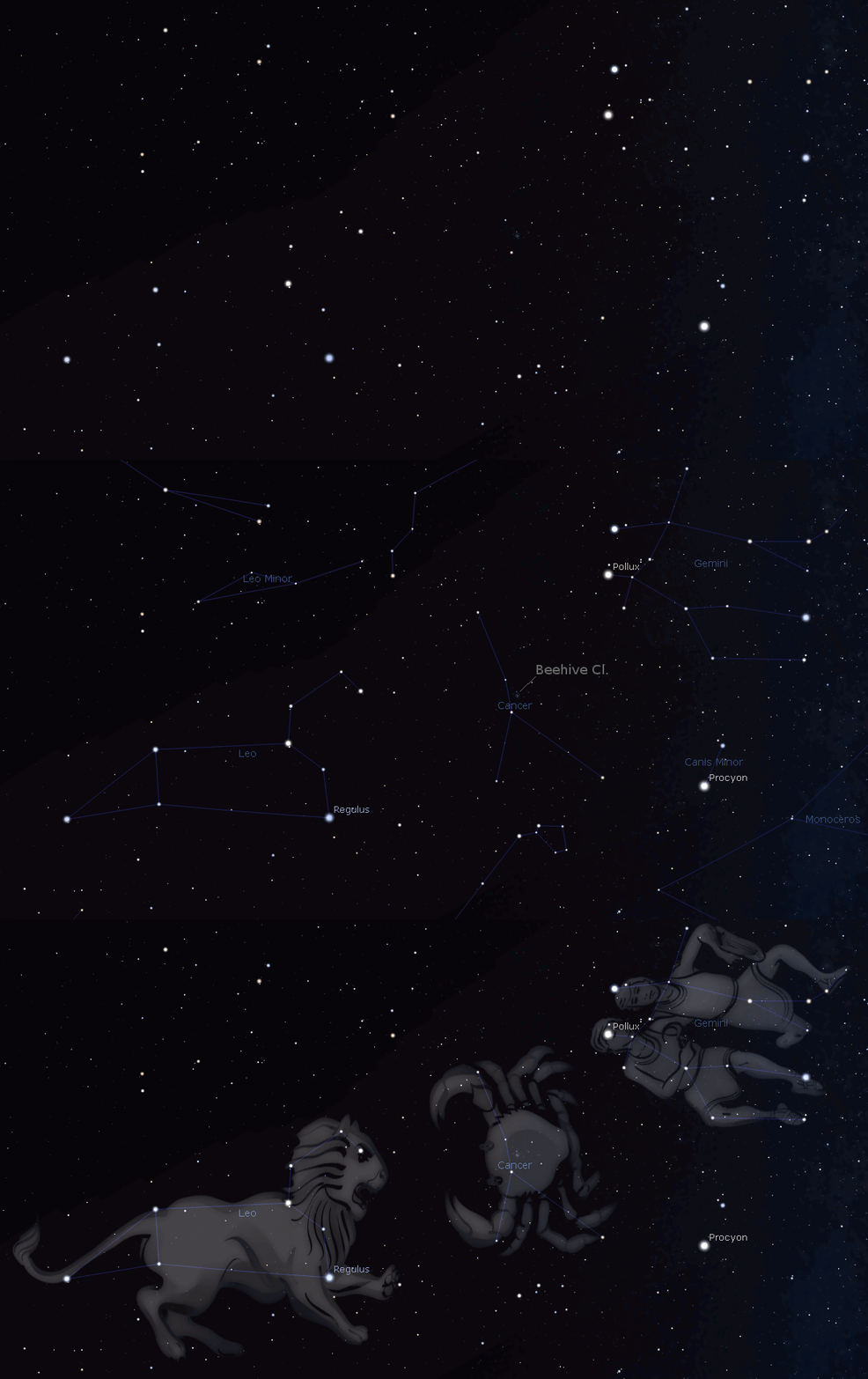
Cancer the crab finder chart. Note the beehive cluster, also known to amateur astronomers as M44, along with other catalog names. Prior to the invention of the telescope this cluster was known as Praesepe which means “Manger”. Created using Stellarium and GIMP.
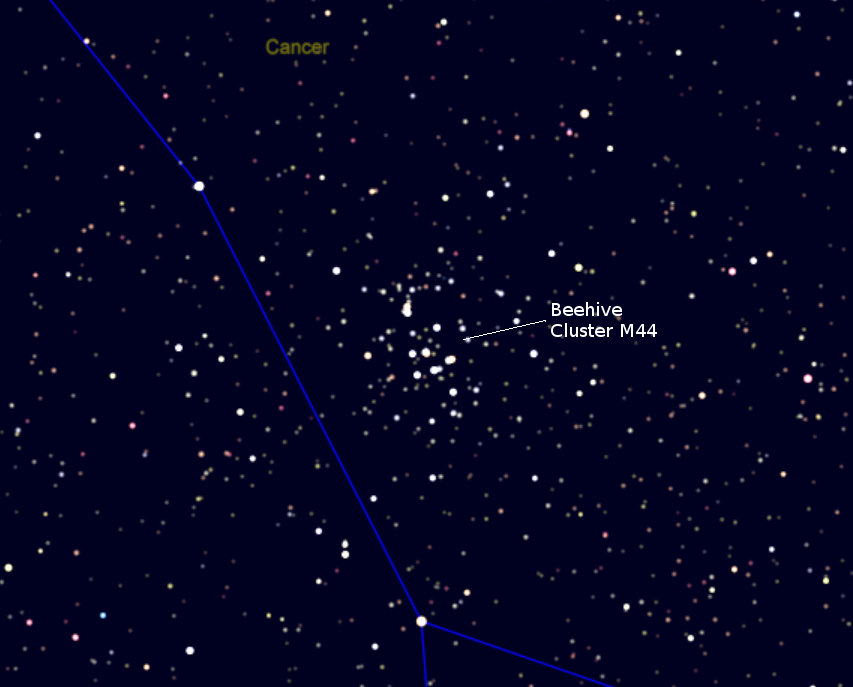
The Beehive star cluster, M44. Its ancient name was the Praesepe or manger when glimpsed by the naked eye. Created using Cartes du Ciel (Skycharts)
02/13/2018 – Ephemeris – The Big Dipper as a pointer to other stars and constellations
Ephemeris for Tuesday, March 13th. The Sun will rise at 7:58. It’ll be up for 11 hours and 47 minutes, setting at 7:46. The Moon, 4 days before new, will rise at 6:42 tomorrow morning.
With the Big Dipper up in the northeastern sky it is a sign that spring is coming. At 9 p.m. The Big Dipper can be used to find other stars and constellations. The Big Dipper’s most famous function is in locating Polaris the North Star. It’s a good way of finding directions at night. The altitude of Polaris, that is angle above the horizon, will give one’s approximate latitude north of the equator. Another constellation that can be found is Leo the lion. It is rising in the east in the evening, but it can also be found from the Big Dipper by imagining that a hole were drilled in the bottom of the bowl to let the water leak out. It would fall on Leo’s back. The Big Dipper can be used to find two more stars, but they have not yet risen.
The times given are for the Traverse City/Interlochen area of Michigan. They may be different for your location.
Addendum
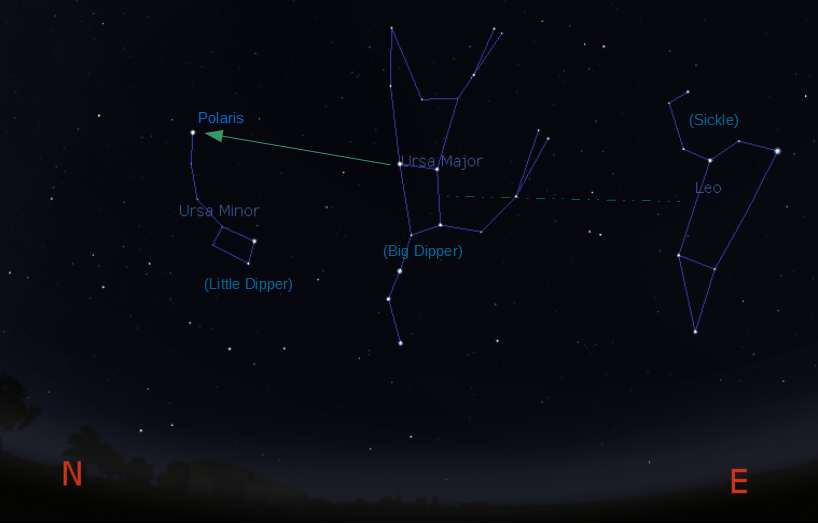
The Big Dipper points to Polaris, the, North Star, and to Leo the lion at 9 p.m., March 13th. In another hour the 4th brightest night-time star Arcturus will appear above the eastern horizon pointed to by the arc of the handle of the Big Dipper. We’ll revisit the Big Dipper next month when Arcturus and Spica will also be found by the use of the Big Dipper. Created using Stellarium and Libre Office.
03/09/2018 – Ephemeris – The good ship Argo
Ephemeris for Friday, March 9th. The Sun will rise at 7:06. It’ll be up for 11 hours and 35 minutes, setting at 6:41. The Moon, at last quarter today, will rise at 2:50 tomorrow morning.
Located south and east of Canis Major, the great hunting dog of Orion and it brilliant star Sirius in the south is a dim constellation of Puppis, the poop deck of the old constellation Argo Navis, the constellation that depicts the ship Jason and the Argonauts used in their search for the Golden Fleece. This huge constellation has been subdivided. Only Puppis and Pyxis the ship’s compass are visible from Michigan. The other parts of the ship are Carina the keel, and Vela the sails require traveling south at least to the southern most of the United States. Three other constellations also related to this expedition are Gemini with Castor, who died on the expedition and Pollux. Hercules was also aboard as was the physician of the constellation Ophiuchus.
The times given are for the Traverse City/Interlochen area of Michigan. They may be different for your location.
Addendum
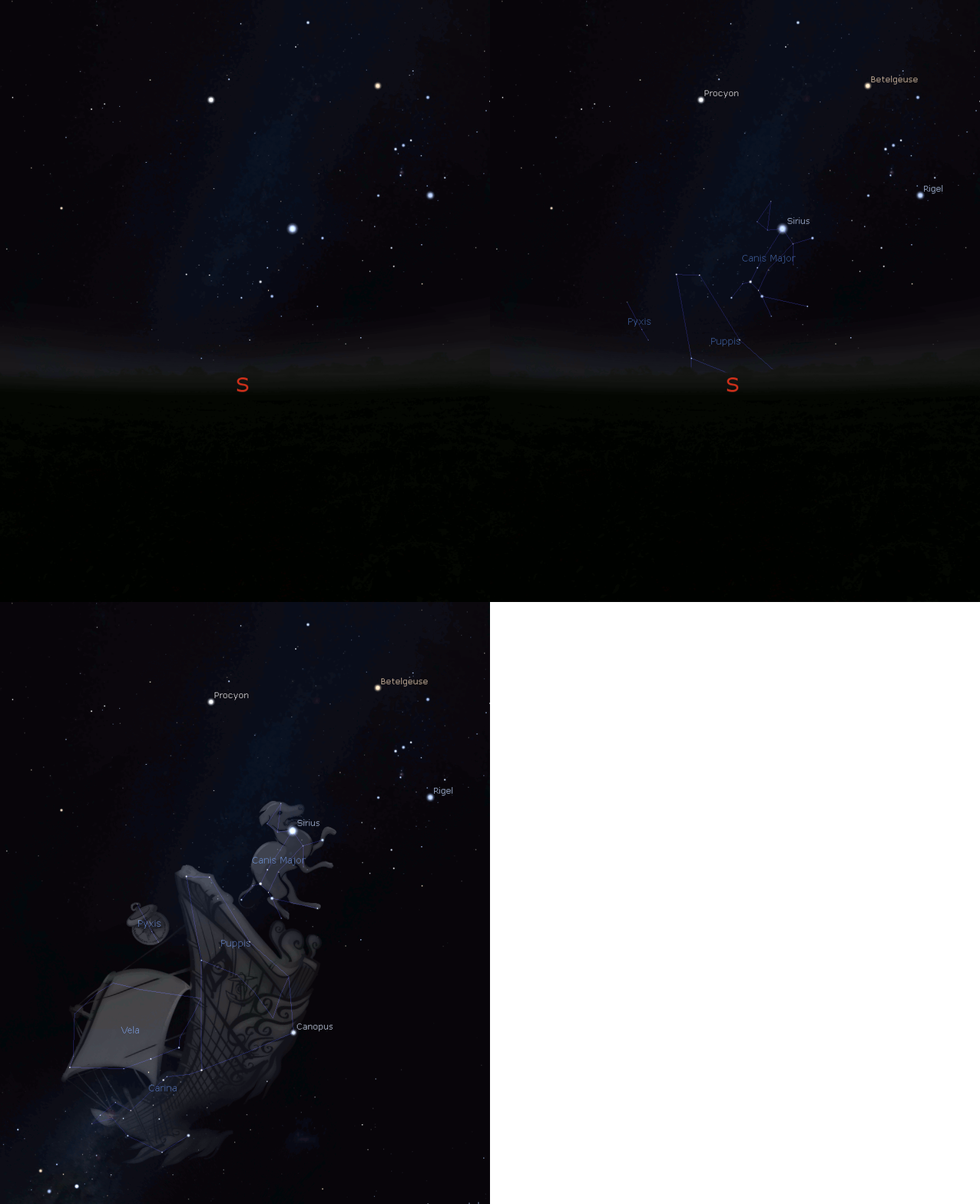
Puppis ans Pyxis; what we can see from Michigan, plus the rest of Argo Navis at 9 p.m., March 9, 2018. The Stellarium artist has the ship reversed. Puppis is the rear end, not the bow. Note that the Crux, the Southern Cross is below the ship. Click on the image to enlarge. Created using Stellarium and GIMP.
03/05/2018 – Ephemeris – Spring is coming: Leo is rising
Ephemeris for Monday, March 5th. The Sun will rise at 7:13. It’ll be up for 11 hours and 22 minutes, setting at 6:35. The Moon, half way from full to last quarter, will rise at 10:53 this evening.
The constellation Leo the lion is now rising in the east at 9 pm. It’s below and left of the Big Dipper higher up in the east-northeast. Leo is marked by two sets of easily recognizable stars. The front of him is a backward question mark of stars, also known as the Sickle that mark his head and mane, along with the front part of his body. Regulus is the star at the bottom of that backwards question mark. It’s the Little King Star. The hind end of him is a triangle of stars ending with another bright star, but not as bright as Regulus. It’s Denebola which means Lion’s tail. It is thought when the Sun was in this constellation long ago that the lions were driven by the heat to quench their thirst in the Nile river. Ancients physicians thought medicines were poison when the Sun was here also.
The times given are for the Traverse City/Interlochen area of Michigan. They may be different for your location.
Addendum
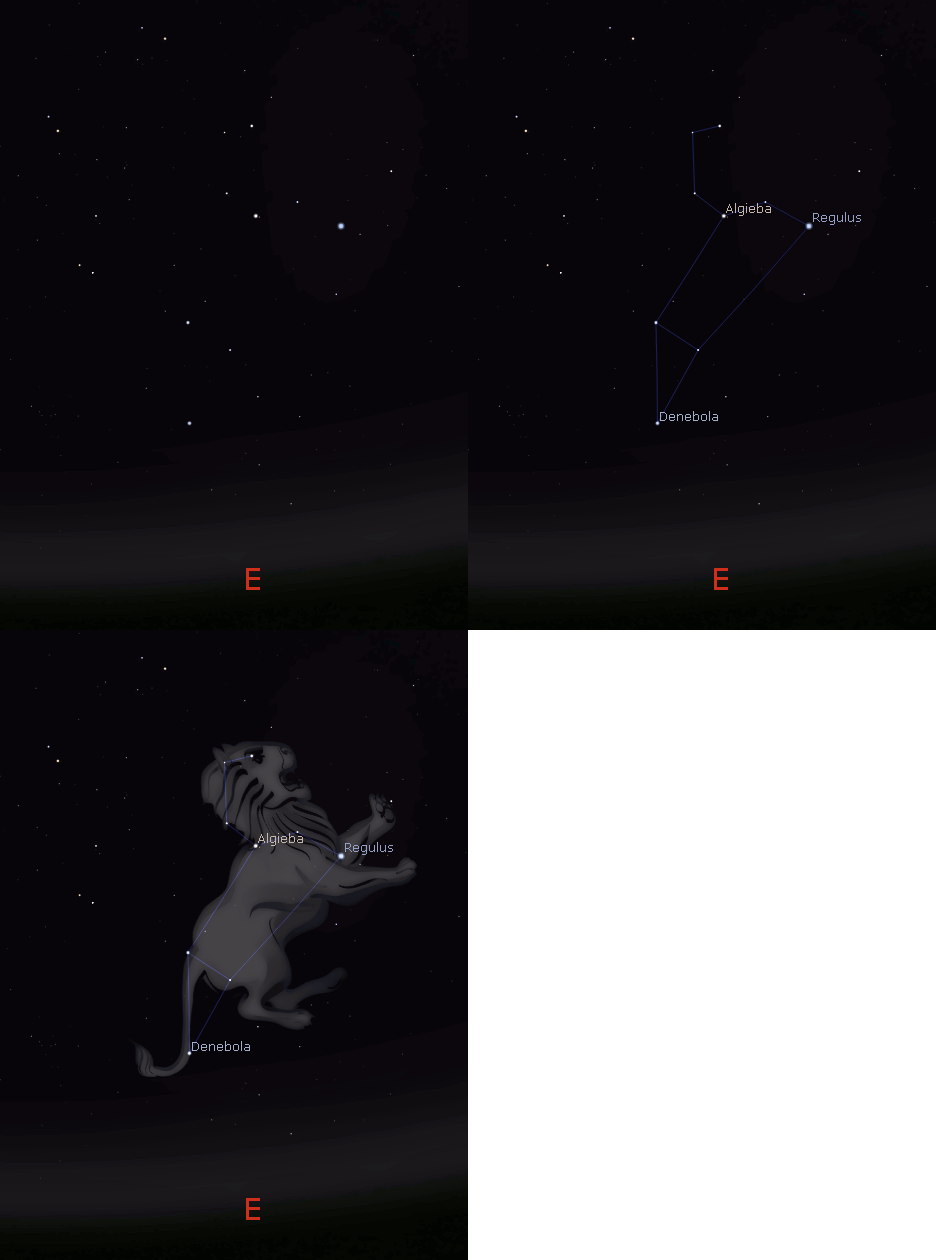
The constellation Leo animation. Created using Stellarium and GIMP.
Algieba is a binary star, which should be able to be split with any good telescope. The magnitude 2.4 and 3.6 components are separated by 4.6 arc seconds. Binary stars are one type of object that benefit from using high power to resolve. The stars are very close in temperature, so each appears a yellow-orange color offering no color contrast.
02/23/2018 – Ephemeris – Meet the stars Castor and Pollux
Ephemeris for Friday, February 23rd. The Sun will rise at 7:30. It’ll be up for 10 hours and 52 minutes, setting at 6:22. The Moon, at first quarter today, will set at 2:54 tomorrow morning.
The star Pollux is at the head of the same named brother of Gemini the twins. Castor is the slightly dimmer star right above it. Pollux is about 34 light years away. It’s twice as massive as the Sun, and has run out of hydrogen in its core and is in the process of evolving into a red giant star. One planet, recently given the name Thestias, has been detected around it. Castor is at 51 light years away. There are 6 stars in its system. The brightest three are visible in telescopes. Each is a spectroscopic binary, meaning that the companion stars are detected by the Doppler shifts of the lines in their spectra as the stars orbit each other. The Doppler shift is just one of the many pieces of information revealed by the spectroscope.
The times given are for the Traverse City/Interlochen area of Michigan. They may be different for your location.
Addendum
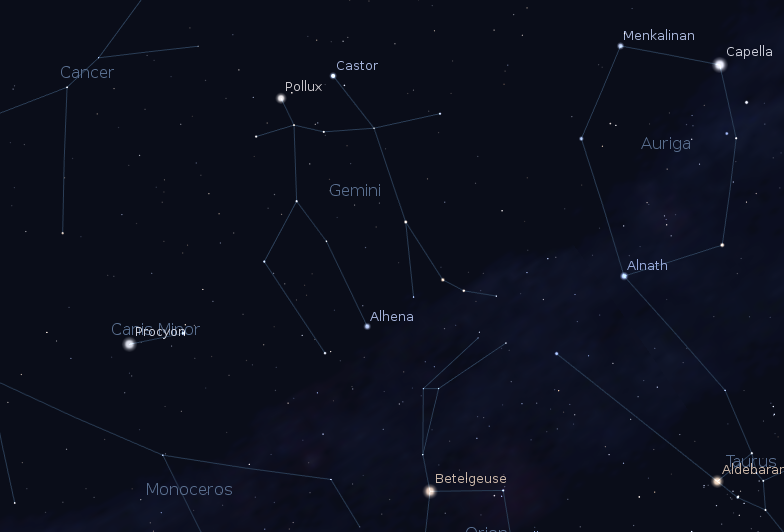
Gemini with the stars Castor and Pollux. Created using Stellarium.
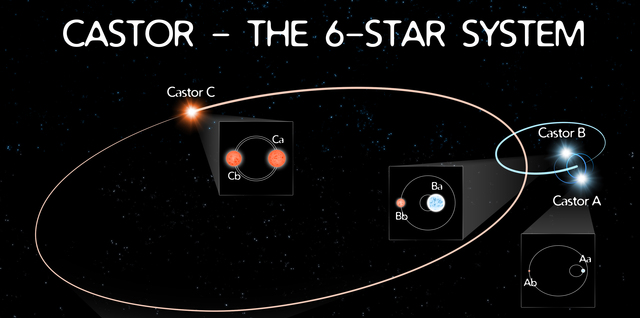
The Castor star system exploded in this JPL/NASA infographic.
02/12/2018 – Ephemeris – The Winter Circle
Ephemeris for Monday, February 12th. The Sun will rise at 7:47. It’ll be up for 10 hours and 19 minutes, setting at 6:07. The Moon, 3 days before new, will rise at 6:29 tomorrow morning.
The winter skies are blessed with more first magnitude stars than any other season. Six of these stars lie in a large circle centered on the seventh, It’s called the Winter Circle. This circle is up at 9 p.m. Starting high overhead is yellow Capella in Auriga the charioteer. Moving down clockwise is orange Aldebaran in the face of Taurus the Bull. Then down to Orion’s knee we find blue-white Rigel. Down and left is the brightest star of all the brilliant white Sirius the Dog Star in Canis Major, lowest of these stars in the south-southeast. Moving up and left is white Procyon in Canis Minor, Above Procyon is Pollux in Gemini the twins. All these are centered, well not quite, on Betelgeuse the bright red star in Orion’s shoulder.
The times given are for the Traverse City/Interlochen area of Michigan. They may be different for your location.
Addendum
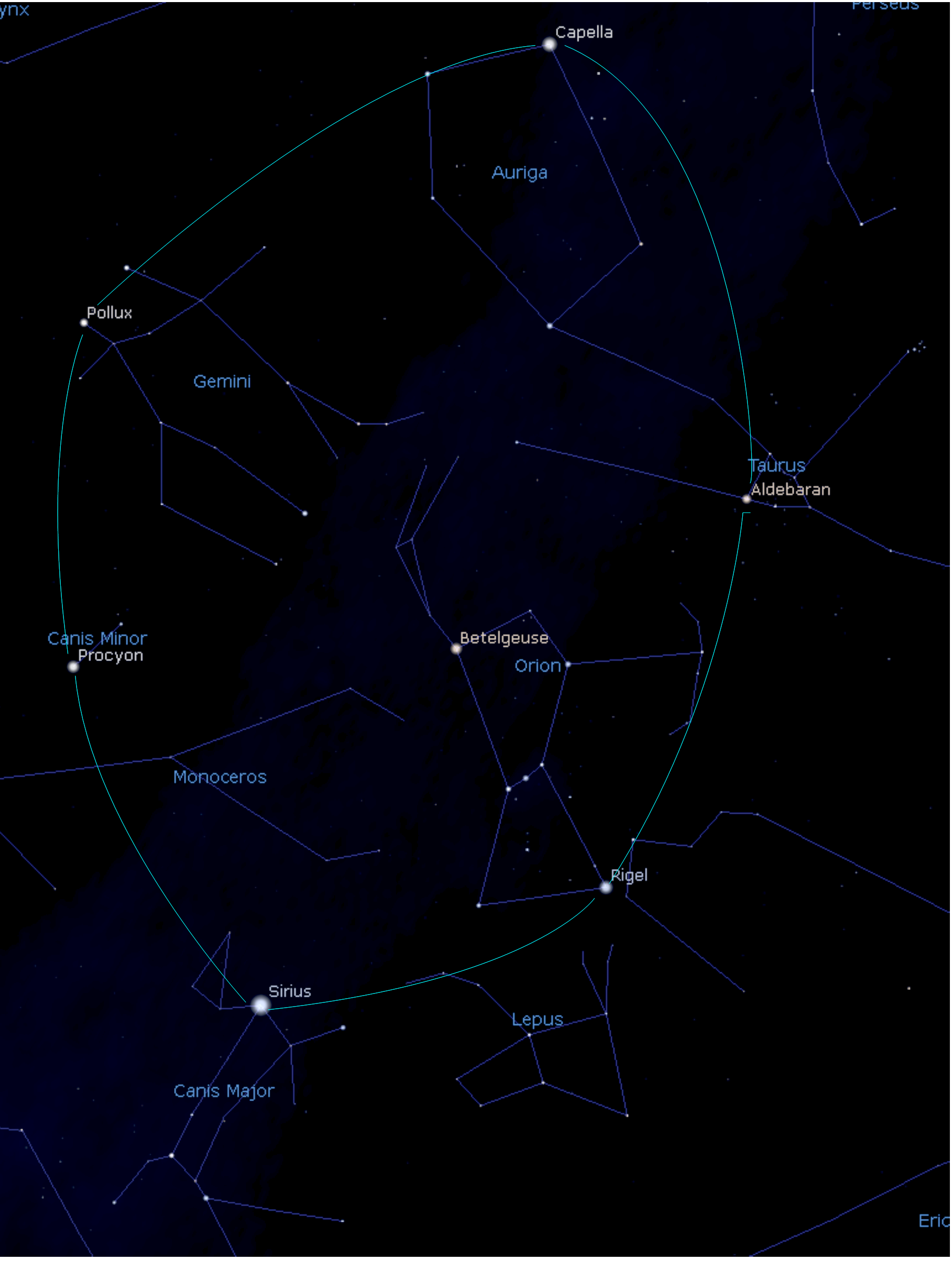
The bright stars of winter arrayed in a circle (well almost). Created using Stellarium.
 Bob Moler's Ephemeris Blog