Archive
06/23/2016 – Ephemeris – Tis the season to view the Summer Triangle
Ephemeris for Thursday, June 23rd. Today the Sun will be up for 15 hours and 34 minutes, setting at 9:32, and it will rise tomorrow at 5:58. The Moon, 3 days past full, will rise at 11:43 this evening.
Now that summer is here, the asterism or informal constellation called the Summer Triangle can be seen in the east as it gets dark. Highest of the three bright stars is Vega in the constellation Lyra the harp, whose body is seen in a narrow parallelogram nearby. The second star of the triangle is Deneb lower and left of Vega, It appears dimmer than Vega because its is by far the most distant of the three. The third star of the Summer Triangle is seen farther below and right of Vega. It is Altair in Aquila the eagle, and the closest. Altair is 16.7 light years away, Vega is 25 light years while Deneb may be a whopping 2600 light years away. With a light year at 6 trillion miles. That’s mind boggling to think in miles at least.
Times are for the Traverse City/Interlochen area of Michigan. They may be different for your location.
Addendum
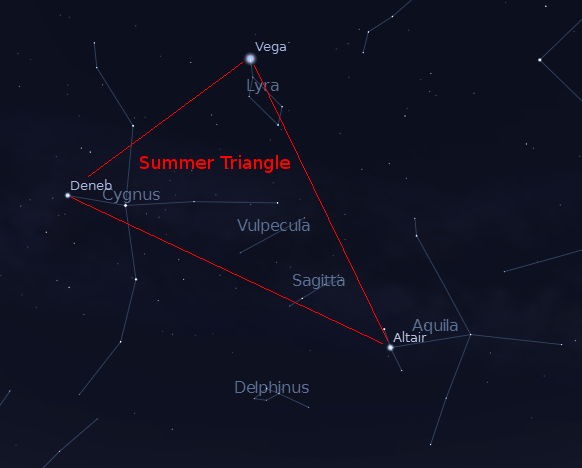
The Summer Triangle. Created using Stellarium and The Gimp.
04/28/2016 – Ephemeris – The adventures of Corvus, Apollo’s pet crow
Ephemeris for Thursday, April 28th. The Sun rises at 6:36. It’ll be up for 14 hours and 8 minutes, setting at 8:44. The Moon, 1 day before last quarter, will rise at 2:20 tomorrow morning.
The small constellation of Corvus the crow is located low in the south at 11 this evening. It’s made of 5 dim stars, but the pattern is a distinctive distorted box with two stars at the upper left marking that corner. To the right is a fainter constellation of a thick stemmed goblet called Crater. Both appear above the long constellation of Hydra the water snake who is slithering just above the southern horizon.. In Greek mythology Corvus, then white, was the god Apollo’s pet. Apollo once bid Corvus to take a cup and fetch him some water. Corvus however dallied and waited for a green fig to ripen. Corvus grabbed a snake and returned with a story as to how the snake had delayed him. The angry Apollo turned the crow and all crows to this day black.
Times are for the Traverse City/Interlochen area of Michigan. They may be different for your location.
Addendum
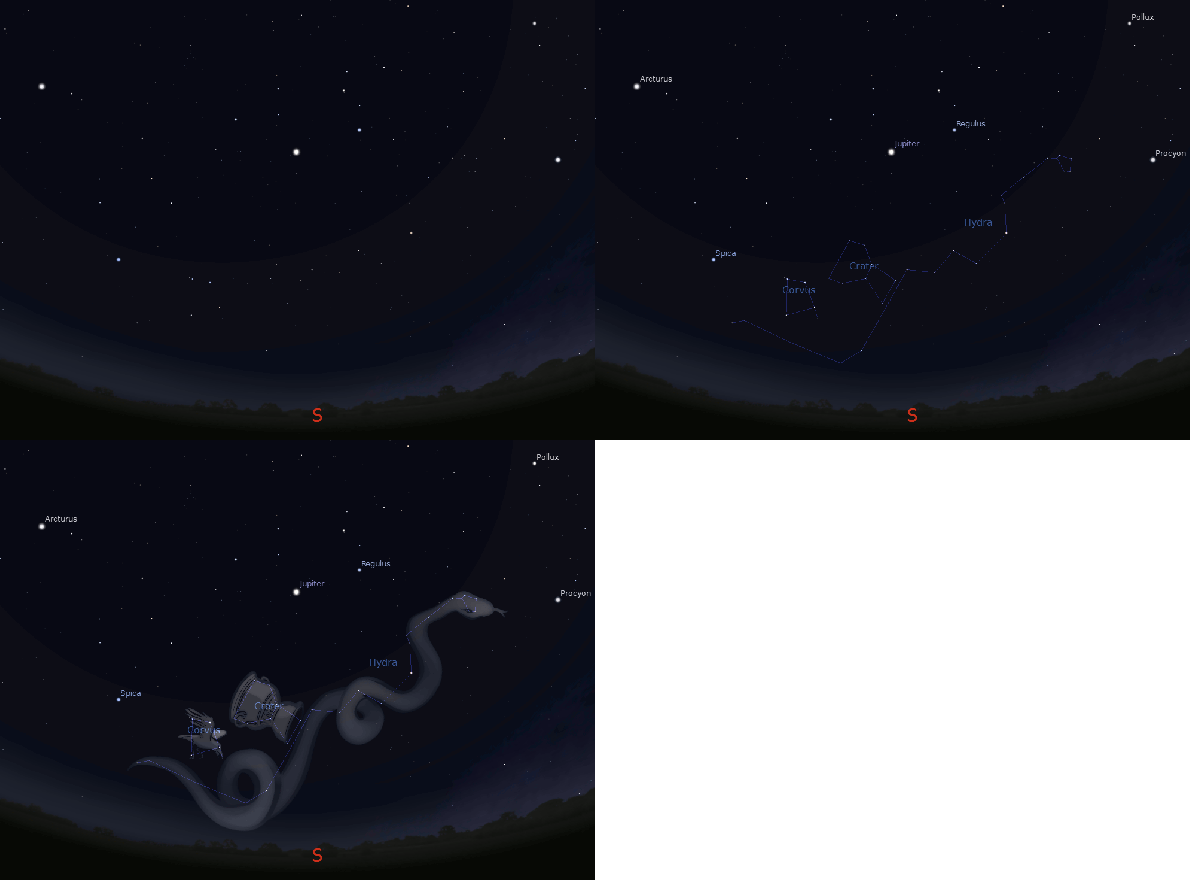
Corvus the crow, Crater the cup and Hydra the water snake along with Jupiter and the other spring stars at 10 p.m. April 28, 2016. Created using Stellarium.
04/25/2016 – Ephemeris – Arcas and Callisto
Ephemeris for Monday, April 25th. The Sun rises at 6:41. It’ll be up for 13 hours and 59 minutes, setting at 8:40. The Moon, 3 days past full, will rise at 11:56 this evening.
Appearing mid way up the sky in the east at 10 p.m. is the kite shaped constellation of Boötes the herdsman. The bright star Arcturus is at the bottom of the kite, pointed to by the arc of the handle of the Big Dipper, above it. In one story Boötes represents a young hunter named Arcas, son of Callisto, a beautiful young lady who had the misfortune of being loved by Zeus the chief of the Greek gods. Zeus’ wife Hera, found out about the affair, and since she couldn’t punish Zeus, turned the poor woman into an ugly bear. Arcas, unaware of the events surrounding his mother’s disappearance was about to kill the bear when Zeus intervened and placed them both in the sky to save her. To this day Boötes continues to chase the great bear Ursa Major around the sky each night.
Times are for the Traverse City/Interlochen area of Michigan. They may be different for your location.
Addendum
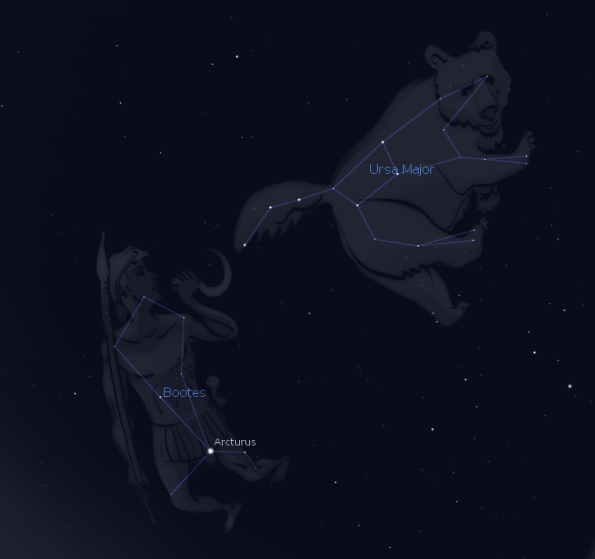
Bootes and Ursa Major aka Arcas chasing Callisto around the pole of the sky. Created using Stellarium.
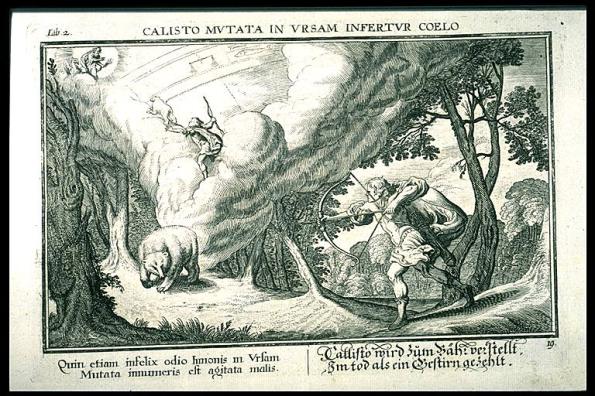
Arcas about to slay the bear by the 17th century artist Baur. Source: University of Virginia Electronic Text Center
04/07/2016 – Ephemeris – The Big Dipper, the Great Bear and the Fisher Star
Ephemeris for Thursday, April 7th. The Sun will rise at 7:11. It’ll be up for 13 hours and 6 minutes, setting at 8:18. The Moon is new today, and won’t be visible.
The constellation of Ursa Major, or great bear was well-known to the ancient Greeks and Native Americans. Today, however, many of us can recognize only part of it as the Big Dipper. The bear can be easily seen only in a dark sky, at 10 p.m. it’s high just north of the zenith with feet to the south. The stars in front of the bowl are the front part of his body and head. The bowl of the Big Dipper is his rump, and the handle his long tail. The Native Americans, saw those three stars as three hunters following the bear. The tribes of the Great Lakes region saw it as the Fisher Star, who brought summer to the Earth. These stars here do make a convincing bear, except for the tail, when seen on a dark night. The weasel-like Fisher Star fits the stars completely.
Times are for the Traverse City/Interlochen area of Michigan. They may be different for your location.
Addendum

Animation of 4 views of Ursa Major. 1. with no added imagery, emphasizing the Big Dipper, 2. added lines for Ursa Major, 3. image of the bear, 4. image of Fisher Star. Created using Stellarium and GIMP.
Note: The Fisher Star illustration is an unattributed drawing from the Internet with a minor change.
04/05/2016 – Ephemeris – Coma Berenices, the second closest star cluster
Ephemeris for Tuesday, April 5th. The Sun will rise at 7:15. It’ll be up for 13 hours and 1 minute, setting at 8:16. The Moon, 2 days before new, will rise at 6:53 tomorrow morning.
Midway up the sky in the east at 10 p.m. is a tiny sprinkle of faint stars arrayed to look like several strands of hair. It’s the constellation of Coma Berenices, or Berenice’s hair. The whole group will fit in the field of a pair of binoculars, which is the best way to see it, and will also show more stars. The cluster contains about 50 stars and lies at a distance of 280 light years from us, which makes it the second closest star cluster. The closest being the Hyades, that is the face of Taurus the bull now about to set in the west. The star cluster appears to be about 480 million years old. It is an open or galactic star cluster, born along the plane of the Milky Way. It appears away from the milky band due to its proximity to us.
Times are for the Traverse City/Interlochen area of Michigan. They may be different for your location.
Addendum
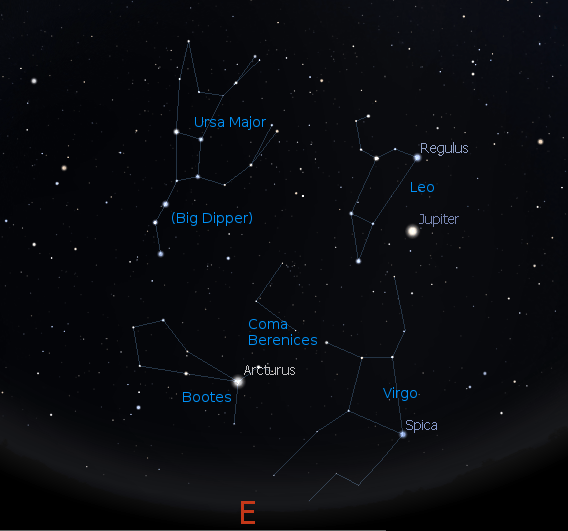
Coma Berenices finder chart 10 p.m., April 5, 2016. Created using Stellarium.
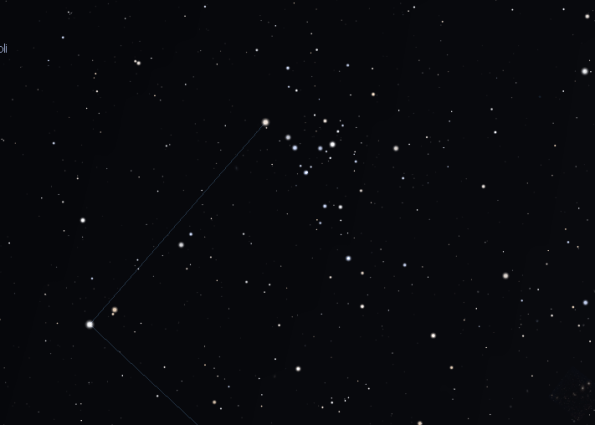
Coma Berenices as it might look in a pair of binoculars. Telescopes are too powerful. Created using Stellarium.
04/04/2016 – Ephemeris – Hydra the water snake will slither along the southern horizon this spring
Ephemeris for Monday, April 4th. The Sun will rise at 7:17. It’ll be up for 12 hours and 57 minutes, setting at 8:14. The Moon, 3 days before new, will rise at 6:18 tomorrow morning.
In the southeastern evening sky can be found the constellation of Hydra the water snake. Unlike the monster of the same name this Hydra has but one head, which is its most distinctive part. At 10 p.m. look to the south-southeast. The head of Hydra is located below a line from the constellation Leo the Lion in the southeast and Gemini high in the southwest. It is directly below Cancer the crab in the south. Hydra’s head is a small but distinctive group of 6 stars that make a loop and the snake’s slightly drooping head. The rest of Hydra wends its way to the southeastern horizon, and eventually ends near the late spring constellation Libra the scales. Over the next few months the rest of Hydra will slither across the southern horizon.
Times are for the Traverse City/Interlochen area of Michigan. They may be different for your location.
Addendum
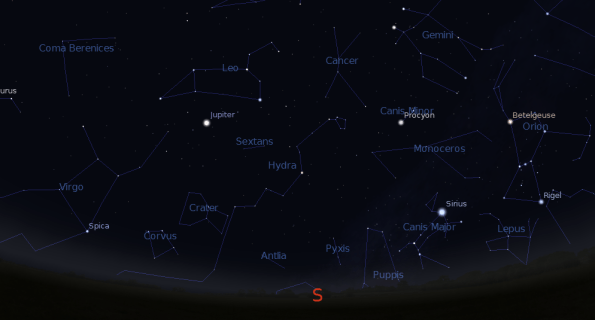
Hydra the water snake raising its head below Cancer at 10 p.m. April 4, 2016. Created using Stellarium.
03/29/2016 – Ephemeris – The Little King Star, Regulus
Ephemeris for Tuesday, March 29th. The Sun will rise at 7:28. It’ll be up for 12 hours and 39 minutes, setting at 8:07. The Moon, 2 days before last quarter, will rise at 2:00 tomorrow morning.
Regulus is the brightest star in the constellation of Leo the lion at the bottom of the backward question mark that is the head and mane of Leo. It’s in the southeast at 9 p.m. above the much brighter Planet Jupiter. Alluding to the lion’s status in the animal kingdom, Regulus is the little king star. It is dead last in order of brightness of the 21 brightest first magnitude stars, 1/13th the brightness of Sirius the brightest star low in the southwest at the same time. To the Babylonians it was the king, the 15th of their constellations that marked the passage of the sun. Regulus is about 79 light years away, and 288 times the brightness of the sun. It is a rapidly spinning ellipsoid 3 times the sun’s diameter, rotating in just under 16 hours.
Times are for the Traverse City/Interlochen area of Michigan. They may be different for your location.
Addendum
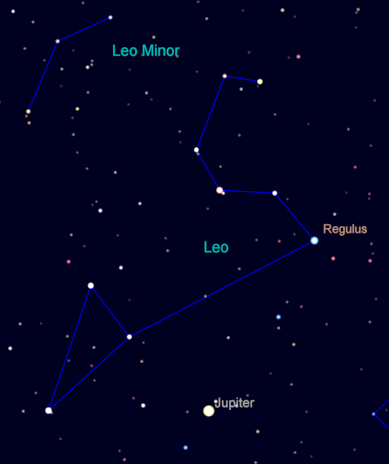
Regulus and Jupiter in the constellation of Leo at 10 p.m., March 29, 2016. Created using Cartes du Ciel (Sky Charts).
03/28/2016 – Ephemeris – The brightest spring star is now rising in the east
Ephemeris for Monday, March 28th. The Sun will rise at 7:30. It’ll be up for 12 hours and 35 minutes, setting at 8:06. The Moon, 3 days before last quarter, will rise at 1:07 tomorrow morning.
Rising in the eastern sky at 10 p.m. is the 4th brightest night-time star. It’s found off the curve of the handle of the Big Dipper above it in the northeast. It’s the tail end of a kite shaped constellation of Boötes the herdsman. Arcturus is an orange-colored giant star, 37 light years away. Its light was used open the 1933 Chicago Worlds Fair believing its light left the star in 1893 the year of the previous Chicago Worlds Fair. It turns out that Arcturus is 3 light years closer than what they thought. Arcturus is a rapidly moving star. It’s velocity is about 76 miles (122 km) per second. It’s at its nearest to the sun now. Arcturus is thought to be close to the sun’s mass, and much older. It may be a glimpse of what the sun will look like in 5 billion years.
Times are for the Traverse City/Interlochen area of Michigan. They may be different for your location.
Addendum
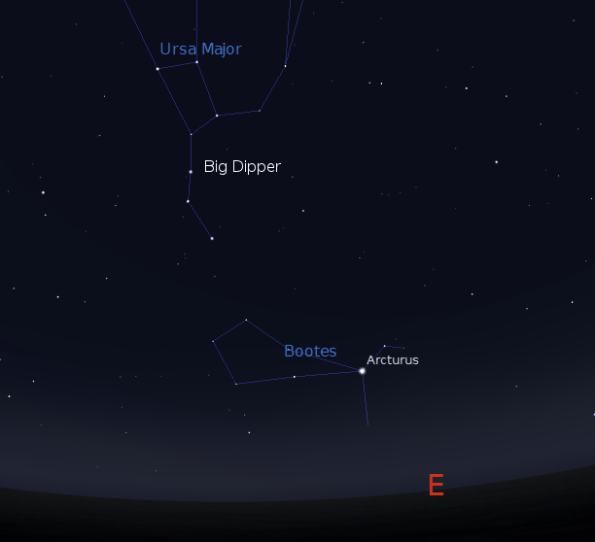
Arcturus off the handle of the Big Dipper rising. Created using Stellarium.
03/15/2016 – Ephemeris – Spotting the celestial Horse and Rider
Ephemeris for, the Ides of March, Tuesday, March 15th. The Sun will rise at 7:54. It’ll be up for 11 hours and 55 minutes, setting at 7:49. The Moon, at first quarter today, will set at 3:36 tomorrow morning.
In the handle of te Big Dipper rising high in the east northeast is an easily seen double star. It’s the star second from the end of the handle where it makes a bend. The bright star is Mizar. It has a dim companion star that folks with good eyesight can easily spot, named Alcor. The Arabs of old, before optometrists used the pair as an eye test. I would have failed. Even with my glasses on I can’t spot Alcor. I must resort to binoculars. The pair is known as the Horse and Rider, while the indigenous peoples of North America, see the stars of the handle of the Big Dipper not as the great Bear’s tail, but hunters following the bear. In this case Alcor is either a hunting dog, or a cooking pot to cook the bear in.
Times are for the Traverse City/Interlochen area of Michigan. They may be different for your location.
Addendum
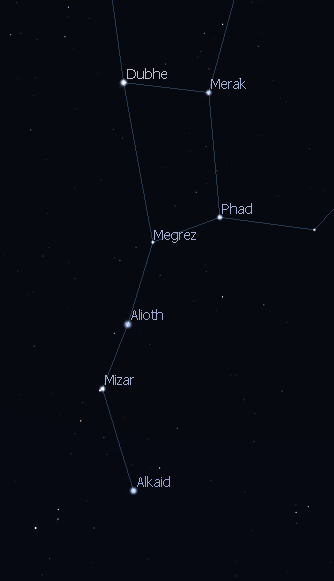
The Big Dipper, part of Ursa Major the Great Bear, is poised on its handle in the northeast. Can you spot Alcor? Created using Stellarium.
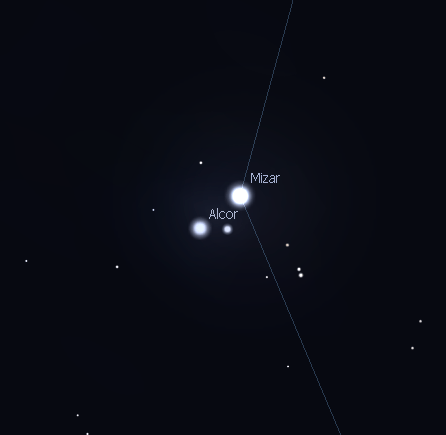
A closeup view of Mizar and Alcor and a dimmer star that lies in the background. Created using Stellarium.
A telescope with low power will also split Mizar intro a bright and dim companion named Mizar A and Mizar B. By observing Mizar A, B and Alcor have determined that all three are binary. There’s six stars there.
03/10/2016 – Ephemeris – The many faces of the Big Dipper and Ursa Major
Ephemeris for Thursday, March 10th. The Sun will rise at 7:03. It’ll be up for 11 hours and 39 minutes, setting at 6:43. The Moon, 2 days past new, will set at 8:59 this evening.
The Big Dipper has many names to many peoples and countries around the world, from the plough, Charles’ Wain, and many others. Officially to the International Astronomical Union, it’s part of Ursa Major, the Great Bear, also recognized by Native Americans, Europeans, it’s even in the Bible. In the Book of Job the star Arcturus is a miss-translation. Arcturus means Guardian of the Bear. It should be Bear itself, and most modern translations catch that mistake. Anyway, the Anishinaabe people around the Great Lakes say the stars of the bear are that of another creature, that of Fisher Star one small weasel-like mammal that brought summer to the Earth, and now heralds the seasons of spring and autumn by his position in the sky.
Times are for the Traverse City/Interlochen area of Michigan. They may be different for your location.
Addendum
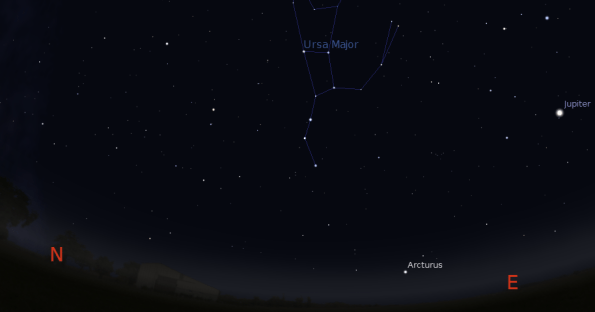
Ursa Major in the northeastern sky at 9 p.m., March 10, 2016. Created using Stellarium.
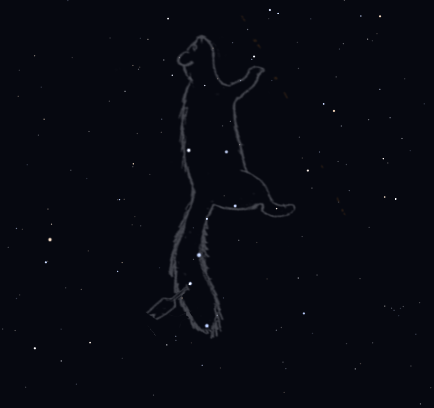
Fisher Star. Star field created by Stellarium.
 Bob Moler's Ephemeris Blog