Archive
12/10/2015 – Ephemeris – What’s a charioteer doing holding goats?
Ephemeris for Thursday, December 10th. The Sun will rise at 8:08. It’ll be up for 8 hours and 53 minutes, setting at 5:02. The Moon, 1 day before new, will rise at 7:59 tomorrow morning.
Rising now more than half way up the sky in the east at 9 p.m. will be the bright star Capella and its pentagonal constellation Auriga the Charioteer. Auriga appears to be hunched down sideways in the sky in his chariot carrying 4 goats. Capella is the mother goat, and a slim triangle of stars near her are her kids. Perhaps the kids in the chariot were such a distraction that he crashed. So maybe the gods placed them in the sky as a warning. In fact that triangle is an asterism widely known as the Kids. The Milky Way runs through Auriga and it is the home of several star clusters that appear as fuzzy spots in binoculars. Capella for us in northern Michigan never sets. It is a winter star that can be seen year round. It’s disconcerting to spot it scraping the northern horizon in July.
Times are for the Traverse City/Interlochen area of Michigan. They may be different for your location.
Addendum
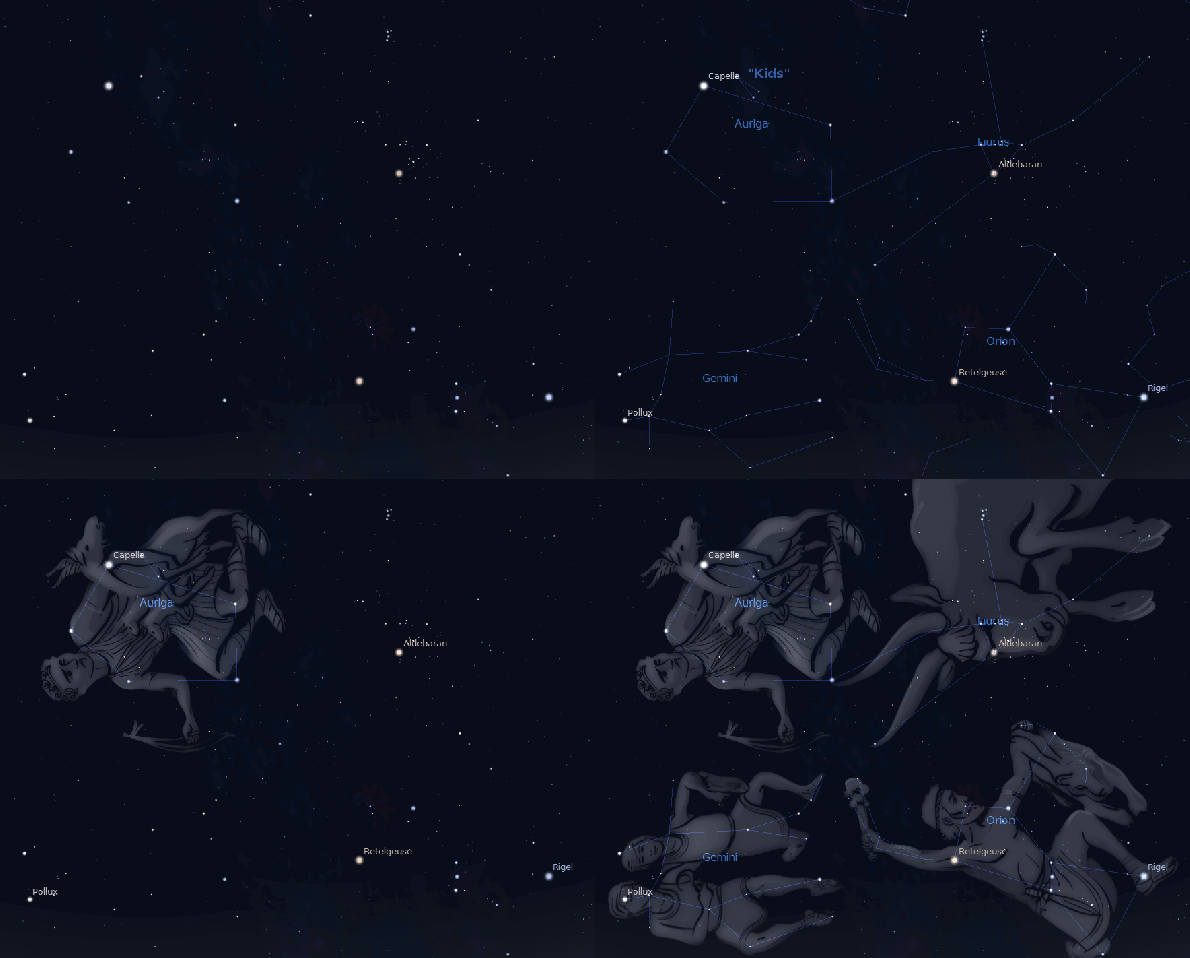
Auriga and neighboring constellations for 9 p.m. December 10, 2015. Created using Stellarium and GIMP.
12/08/2015 – Ephemeris – The hard charging Taurus the bull
Ephemeris for Tuesday, December 8th. The Sun will rise at 8:07. It’ll be up for 8 hours and 55 minutes, setting at 5:02. The Moon, 3 days before new, will rise at 6:03 tomorrow morning.
Low in the east at 9 p.m. is the constellation of Orion the giant hunter . Above him is Taurus the bull. His face is a letter V shape of stars lying on its side with the bright orange-red star Aldebaran at the bottom left tip of the V as its angry blood-shot eye. Orion is depicted in the sky facing with club in one hand and a shield in the other the approaching and in some depictions charging Taurus. The V of stars is a star cluster called the Hyades. The Pleiades are in his shoulder above. Taurus in Greek mythology was the guise the god Zeus when he carried off the maiden Europa. Europa’s still with him, sort of, as the intriguing satellite orbiting Zeus’ Roman equivalent Jupiter. In fact the moons around the planet Jupiter are generally named for Jupiter’s lovers and friends. His wife is missing from the entourage, and will be until the NASA spacecraft Juno reaches Jupiter next year.
Times are for the Traverse City/Interlochen area of Michigan. They may be different for your location.
Addendum
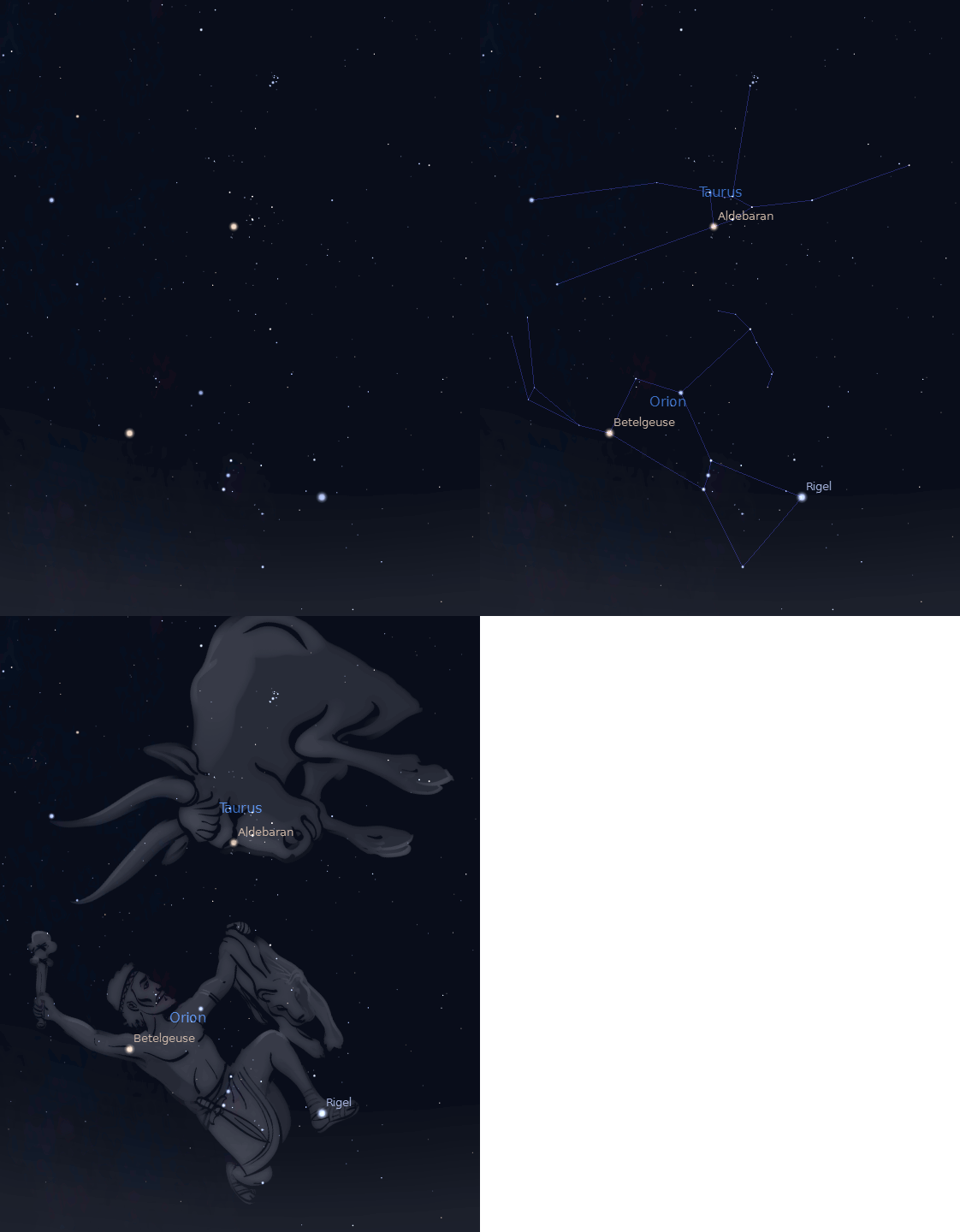
Three views of Taurus the bull and Orion the hunter for 9 p.m. on December 8, 2015. Created using Stellarium and GIMP.
11/30/2015 – Ephemeris – Orion Rising
Ephemeris for Monday, November 30th. The Sun will rise at 7:58. It’ll be up for 9 hours and 5 minutes, setting at 5:04. The Moon, 3 days before last quarter, will rise at 10:12 this evening.
We have a few hours of darkness tonight before the Moon comes up. In the east the central winter constellation Orion the hunter throws a leg over the horizon between 8 and 9 p.m. as Robert Frost told in his poem Star-Splitter. The upright rectangle that is his body on January evenings is tilted to the left as he rises, with bright red star Betelgeuse at the top left of the rectangle, his shoulder. At the opposite corner is blue-white Rigel, a knee. In the center of the rectangle is a line of three stars nearly vertically aligned, which represents Orion’s belt. Above Orion is another bright orange star at one end of a letter V shape of stars. That’s Aldebaran the angry eye in the face if Taurus the bull who apparently is none to happy with Orion.
Times are for the Traverse City/Interlochen area of Michigan. They may be different for your location.
Addendum
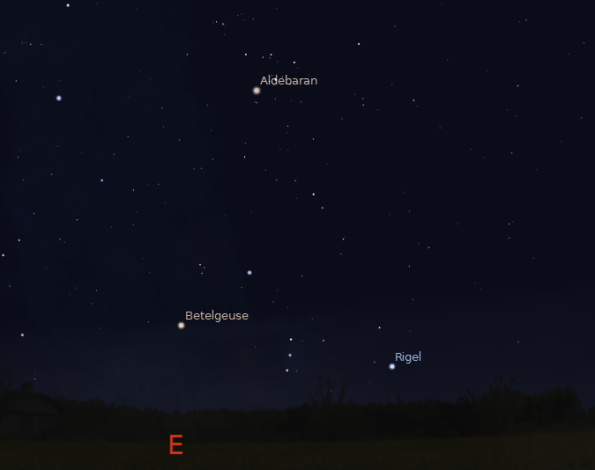
Orion Rising at 8:30 p.m. (3 1/2 hours after sunset) on November 30th. Created using Stellarium.
10/30/2015 – Ephemeris – The spookiest star
Ephemeris for Friday, October 30th. The Sun will rise at 8:17. It’ll be up for 10 hours and 16 minutes, setting at 6:34. The Moon, 3 days past full, will rise at 9:33 this evening.
Tomorrow night is the spookiest night of the year, so lets look at the spookiest star of all. It’s Algol, from Ghoul Star or Demon Star. The Chinese had a name for it that meant ‘piled up corpses’. It’s the second brightest star in the constellation Perseus the hero, rising in the northeast this evening. The star is located where artists have drawn the severed head of Medusa, whom he had slain. Medusa was so ugly that she turned all who gazed upon her to stone. Algol is her still glittering eye. Astronomers finally found out what was wrong with Algol. It does a slow 6 hour wink every two days 21 hours, because it is two stars that eclipse each other. It winked this morning and it will again centered on 11:45 p.m. Sunday night.
Times are for the Traverse City/Interlochen area of Michigan. They may be different for your location.
Addendum
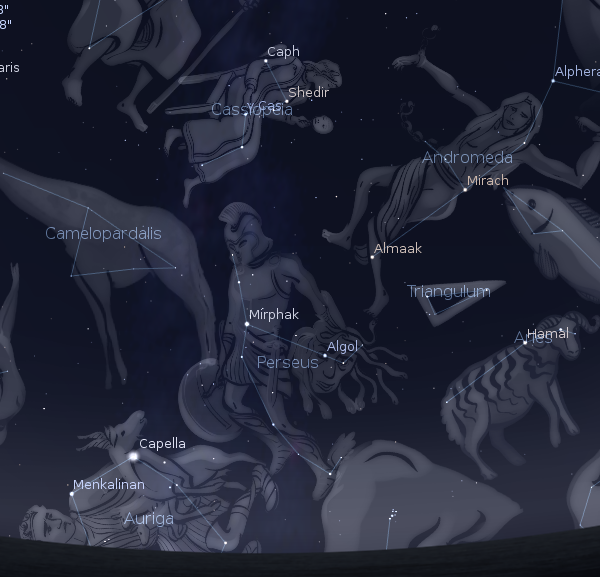
Algol at 7:30 p.m. on Halloween, in a modern portrayal. Created using Stellarium.
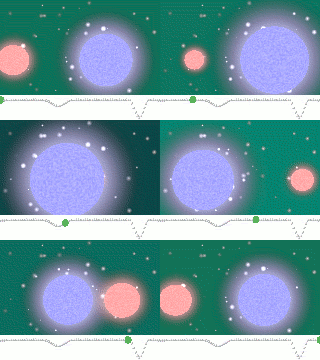
Animation of an eclipsing binary star like Algol. Credit: Wikimedia Commons h/t Earth and Sky
10/05/2015 – Ephemeris – The loneliest star
Ephemeris for Monday, October 5th. The Sun will rise at 7:45. It’ll be up for 11 hours and 31 minutes, setting at 7:16. The Moon, 1 day past last quarter, will rise at 1:38 tomorrow morning.
There’s a bright and lonely star that appears low in the south for only seven and a half hours a night on autumn evenings. It’s appearance is a sign as sure as the falling leaves that autumn is here At 10 p.m. tonight it’s low in the south-southeast. The star’s name is Fomalhaut, which means fish’s mouth. This is appropriate because it’s in the constellation of Piscis Austrinus, the southern fish. At our latitude it’s the fish that got away, because Fomalhaut appears to be quite alone. The dimness of the constellation’s other stars and location close to the horizon make the fainter stars hard to spot. The earth’s thick atmosphere near the horizon reduces the stars brightness by a factor of two or more, so Fomalhaut appears to keep a lonely vigil in the south.
Times are for the Traverse City/Interlochen area of Michigan. They may be different for your location.
Addendum
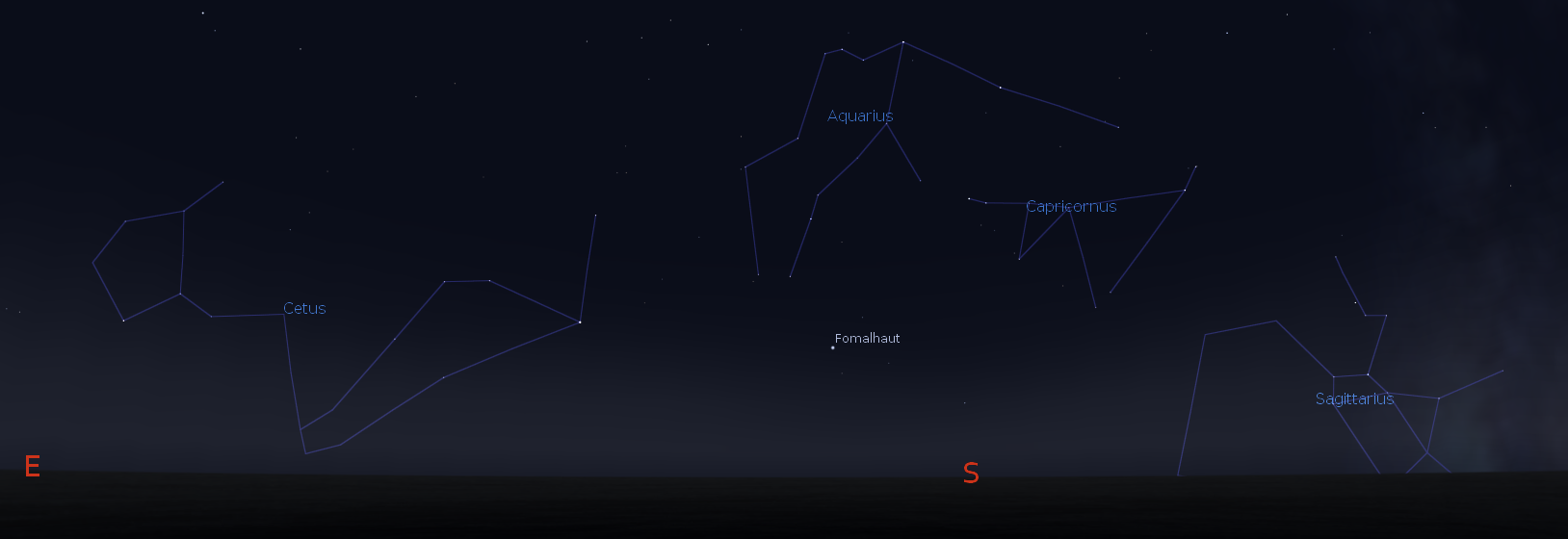
Fomalhaut appears quite alone in the south-southeast at about 10 p.m. Created using Stellarium.
Actually Fomalhaut isn’t all that alone, It apparently has a companion planet.
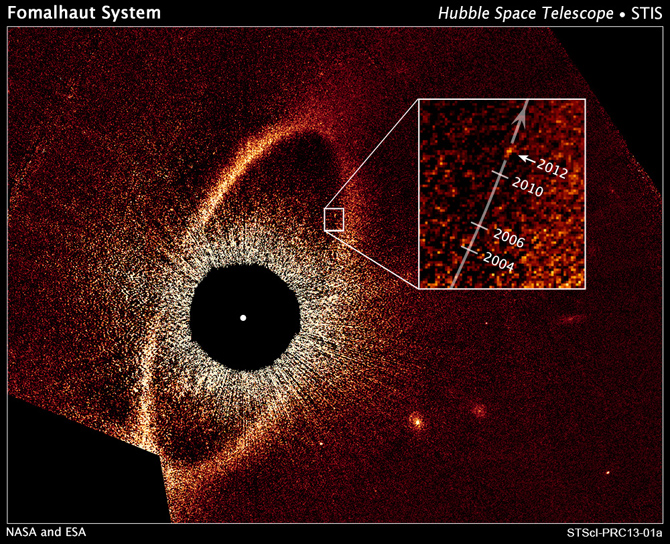
Fomalhaut b and it’s path around its star. Credit: NASA, ESA, and P. Kalas (University of California, Berkeley and SETI Institute)
09/14/2015 – Ephemeris – Another odd creature of the Zodiac, a sea-goat
Ephemeris for Monday, September 14th. The Sun will rise at 7:20. It’ll be up for 12 hours and 35 minutes, setting at 7:55. The Moon, 1 day past new, will set at 8:35 this evening.
As the Teapot of the constellation Sagittarius tilts and pours celestial tea on the southwestern horizon, it is followed in the south-southeast by the faint constellation of Capricornus the sea-goat. I’m not sure you’ll see a half goat with a fish’s tail here unless you’ve started Oktoberfest a bit early. To me, it looks like a big sagging triangle with the point down. Capricornus is a constellation of the zodiac, and its claim to fame is a latitude line on the globe at 23 and a half degrees south, called the Tropic of Capricorn. Back a couple of thousand years ago the sun entered Capricornus on the first day of winter, the winter solstice. Thus the latitude where the sun was overhead at that instant was called the Tropic of Capricorn. Due to the wobble of the earth’s axis, the line should now be called the Tropic of Sagittarius.
Times are for the Traverse City/Interlochen area of Michigan. They may be different for your location.
Addendum
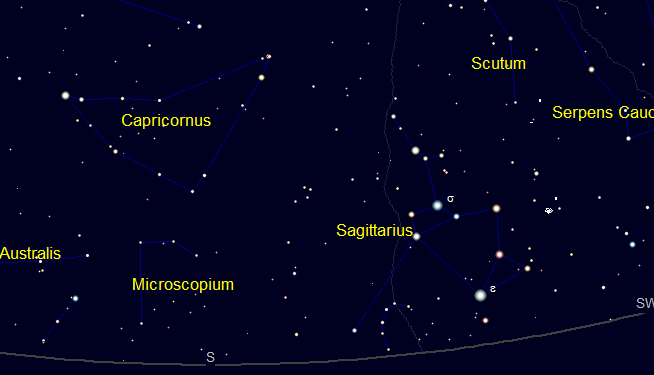
Capricornus represented in Cartes du Ciel
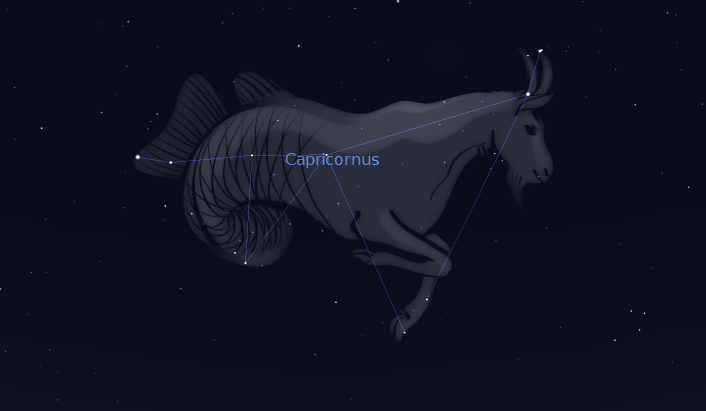
An artist’s rendering of Capricornus. A part of Stellarium’s functionality. The constellation lines are drawn differently than Cartes du Ciel
09/10/2015 – Ephemeris – Andromeda the chained maiden
Ephemeris for Thursday, September 10th. The Sun will rise at 7:15. It’ll be up for 12 hours and 47 minutes, setting at 8:03. The Moon, 3 days before new, will rise at 5:40 tomorrow morning.
In the east at 10 this evening can be found a large square of stars, the Great Square of Pegasus the flying horse. The square is standing on one corner. What look like its hind legs stretching to the left from the left corner star is another constellation, Andromeda the chained maiden. She is seen in the sky as two diverging curved strings of stars that curve upward. She was rescued by the hero Perseus, a nearby constellation, riding his steed Pegasus. Andromeda’s claim to astronomical fame is the large galaxy seen with the unaided eye just above the upper line of stars. The Great Andromeda Galaxy is two and a half million light years away. To the unaided eye the galaxy appears as a small smudge of light. In binoculars the galaxy is a delicate spindle of light. The galaxy is known as M31, the 31st object on Charles Messier’s list of fuzzy objects that aren’t comets.
Times are for the Traverse City/Interlochen area of Michigan. They may be different for your location.
Addendum
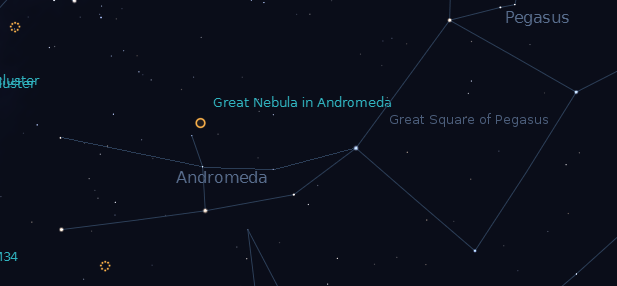
Andromeda at 10 p.m. with the Great Andromeda Galaxy. Created using Stellarium.
09/08/2015 – Ephemeris – Pegasus flies again
Ephemeris for Tuesday, September 8th. The Sun will rise at 7:13. It’ll be up for 12 hours and 53 minutes, setting at 8:07. The Moon, 3 days past last quarter, will rise at 3:44 tomorrow morning.
As summer wanes and the Sagittarius teapot tips its contents on the southwestern horizon the constellations of autumn rise in the east. I’ve already mentioned Cassiopeia, which is so far north it never really leaves us in northern Michigan. Pegasus the flying horse of Greek mythology is perhaps the most famous of the autumn constellations, and easiest to find. Its body, a large square of four stars, is in the east, standing on one corner. It is known as the Great Square of Pegasus. Only the front half of the horse is in the sky, and he’s flying upside down with his neck and head extending to the right from the rightmost star. His galloping front legs extend upward from the top star. Our Anishinaabek native peoples saw a moose here standing upright.
Times are for the Traverse City/Interlochen area of Michigan. They may be different for your location.
Addendum
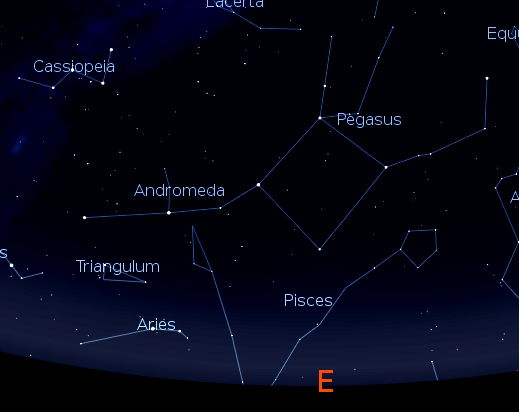
Pegasus at 10 p.m. Chart created using Stellarium.
09/07/2015 – Ephemeris – Small summer constellations
Ephemeris for Labor Day*, Monday, September 7th. The Sun will rise at 7:11. It’ll be up for 12 hours and 56 minutes, setting at 8:08. The Moon, 2 days past last quarter, will rise at 2:47 tomorrow morning.
Located below the eastern edge of the Summer Triangle of three of the brightest stars in the sky, which is overhead in our sky at 10 p.m., is the tiny constellation of Delphinus the dolphin. Delphinus’ 6 stars in a small parallelogram with a tail, really does look like a dolphin leaping out of the water. The parallelogram itself has the name Job’s Coffin. The origin of this asterism or informal constellation is unknown. Of the dolphin itself: the ancient Greeks told stories of dolphins rescuing shipwrecked sailors. There’s another tiny constellation to the right of Delphinus, Sagitta the arrow a small thin group of 5 stars, which represents Cupid’s dart. Behind Sagitta binoculars will find a little star group called the Coat hanger.
Times are for the Traverse City/Interlochen area of Michigan. They may be different for your location.
Addendum
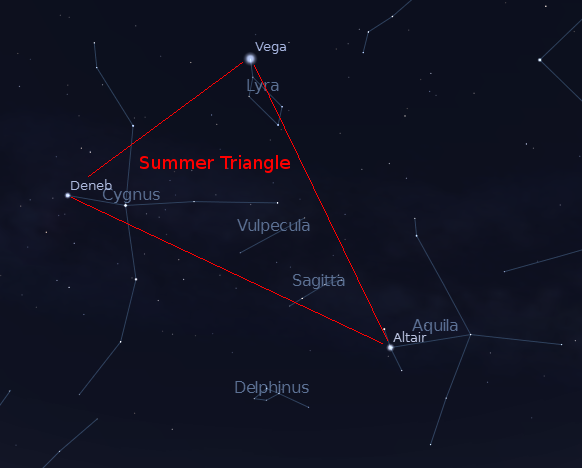
The Summer Triangle. Created using Stellarium and The Gimp.
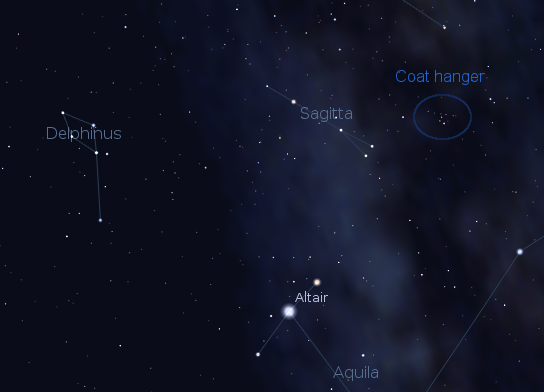
Delphinus, Sagitta and the Coat hanger. Diagram created using Stellarium.
* In the US Labor Day is celebrated on the first Monday in September and is considered the unofficial end of summer. The weather generally agrees. Last week we had a preview of fall weather. This week, except for today has been hot. The outlook for next week is looking decidedly cooler. Most schools in Michigan start the day after Labor Day. and end after June 1st. The unofficial start of summer is Memorial day, the last Monday in May.
09/03/2015 – Ephemeris – Jewels in the shield
Ephemeris for Thursday, September 3rd. The Sun will rise at 7:07. It’ll be up for 13 hours and 9 minutes, setting at 8:16. The Moon, 2 days before last quarter, will rise at 11:26 this evening.
The teapot pattern of stars that is the constellation of Sagittarius lies at the southern end of the Milky Way this evening. It appears that the Milky Way is steam rising from the spout. The area above Sagittarius in the brightest part of the Milky Way is the dim constellation of Scutum the shield. Don’t bother looking for the stars that make up the constellation; what’s important is the star clouds of the Milky Way. Scan this area with binoculars or small telescope for star clusters and nebulae or clouds of gas. In binoculars both clusters and nebulae will appear fuzzy, but a small telescope will tell most of them apart. Even if you’ve never been able to find anything in your telescope, you’ll find something here.
Times are for the Traverse City/Interlochen area of Michigan. They may be different for your location.
Addendum
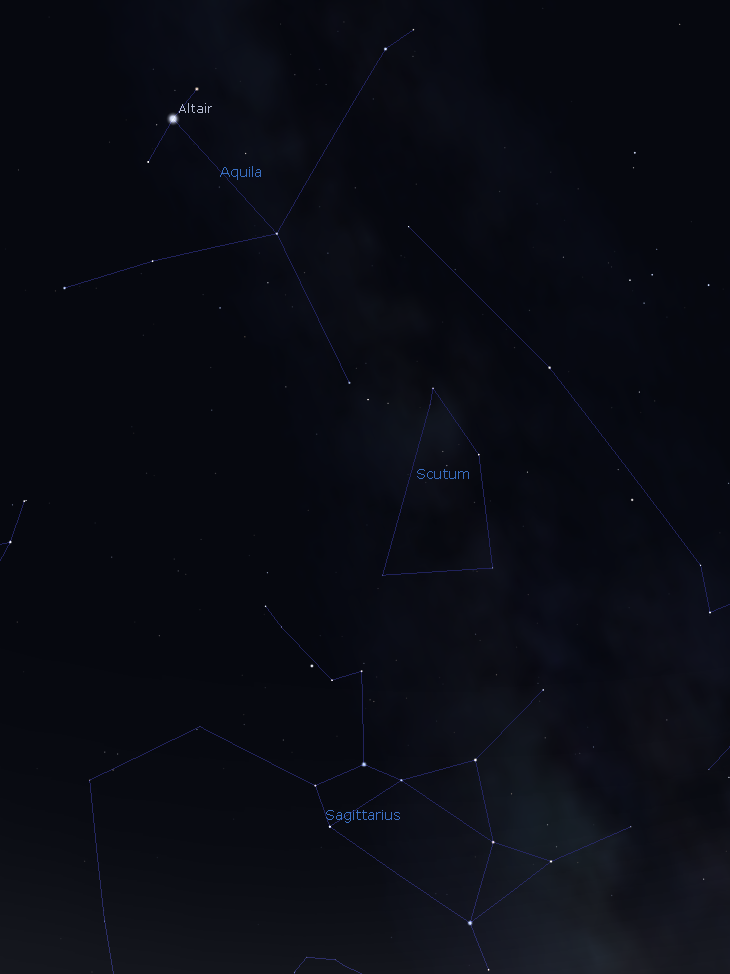
Scutum between Sagittarius below and Aquila above at 10 p.m. September 3, 2015. Created using Stellarium.
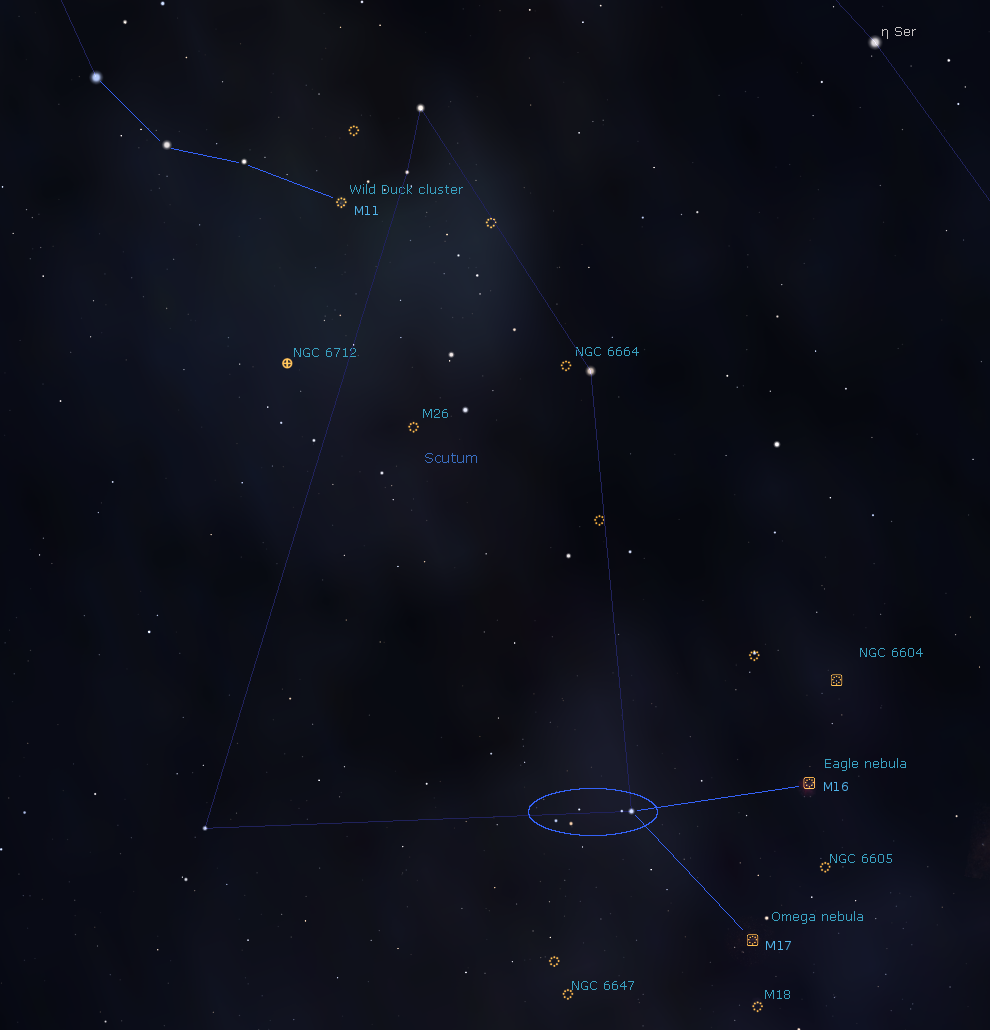
How to find the three brightest deep sky wonders around Scutum by star hopping. Created using Stellarium, annotated by myself.
Star hopping is a method to find objects from familiar star patterns. At the top my method to find M11, the wild duck cluster is to locate the three stars at the tail of Aquila the Eagle and follow them to M11. M11 takes a little bigger telescope to resolve. I remember having trouble resolving it is a 5″ telescope. It looks like a triangular cluster with all the stars of the same dimness except one brighter one.
At the bottom of Scutum, I locate that distinctive 5 star group circled. Directly west is M16, the Eagle Nebula and star cluster. The star cluster is easy to spot, the nebula is hard. The Hubble space telescope made the nebula famous in the 1990’s as the Pillars of Creation.
Below and west is M17, the Omega Nebula, or the Swan Nebula. To me it looks like a swan swimming or a check mark of nebulosity. The associated star cluster is much less noticeable.
Happy star hopping.
 Bob Moler's Ephemeris Blog