Archive
Ephemeris: 02/05/2026 – The celestial unicorn
Feb 5. This is Ephemeris for Thursday, February 5th. Today the Sun will be up for 10 hours even, setting at 5:57, and it will rise tomorrow at 7:55. The Moon, halfway from full to last quarter, will rise at 10:34 this evening.
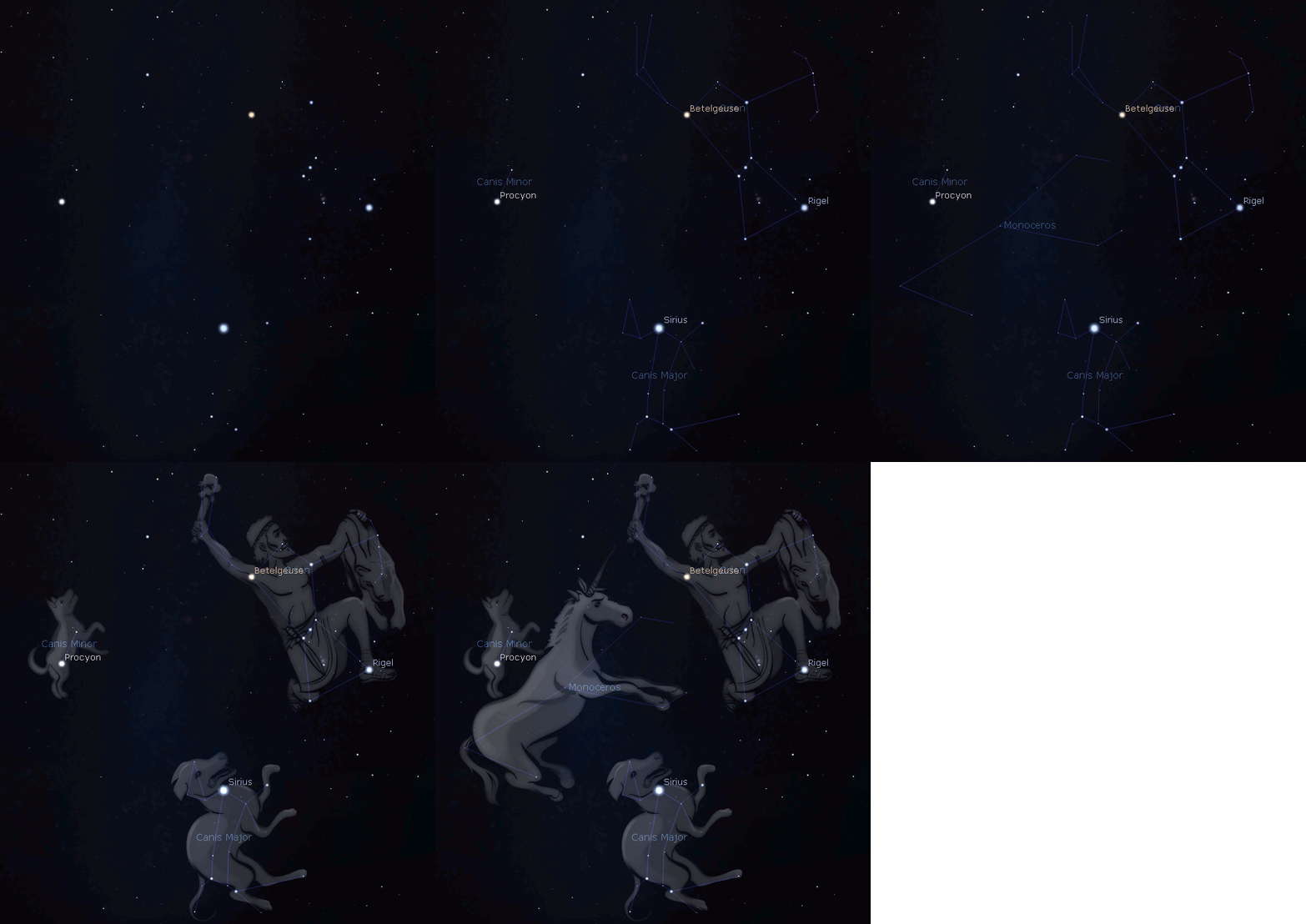
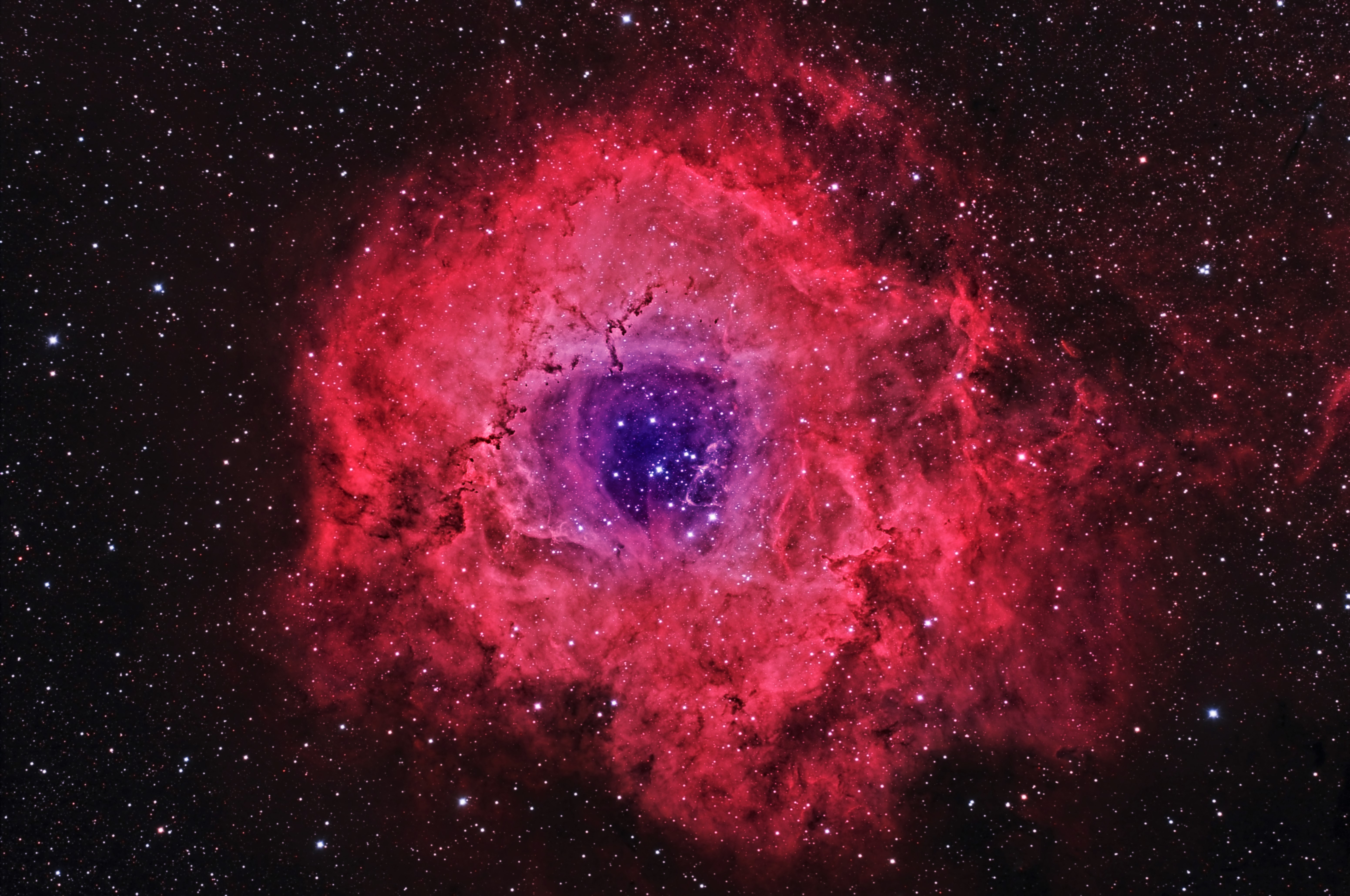
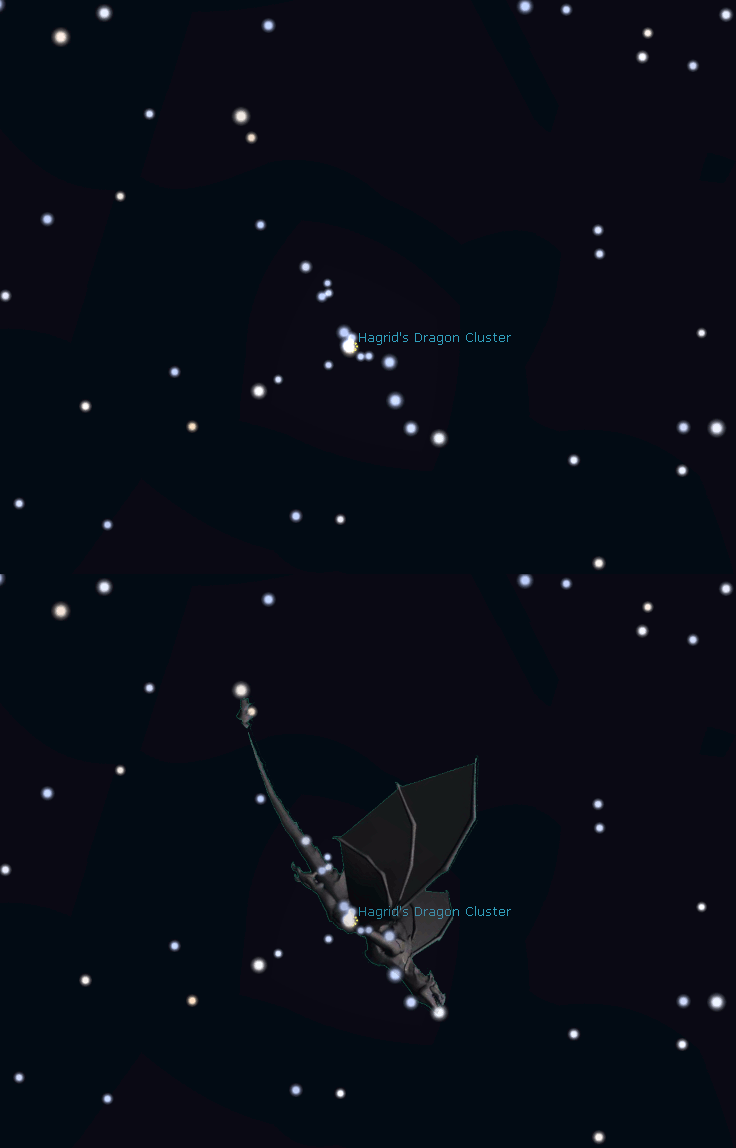
Among all the constellations in the sky of animals real and mythical, there is also a unicorn. It’s called Monoceros, and inhabits the southeastern sky at 8 p.m. mostly bounded by Orion on the right, Canis Major, the great dog below and Canis Minor, the little dog to the left and above. Unfortunately for observers without a telescope Monoceros, is devoid of any but the faintest stars. Maybe that’s why no one sees unicorns anymore. Though it lacks bright stars Monoceros is full of wonders revealed by telescopes and photography. A feast of faint nebulae or clouds of gas and dust, the birthplace of stars, including the red rose of the Rosette Nebula, and the more recently named Hagrid’s Dragon Cluster (NGC 2301).
The astronomical event times given in this blog are for the Traverse City/Interlochen area of Michigan (Lat 44.7° N, Long 85.7° W; EST, UT – 5 hours) unless stated otherwise. Times will be different for other locations.
Addendum
Ephemeris: 01/20/2026 – What’s happening inside the Great Orion Nebula
This is Bob Moler with Ephemeris for Tuesday, January 20th. Today the Sun will be up for 9 hours and 21 minutes, setting at 5:35, and it will rise tomorrow at 8:12. The Moon, 2 days past new, will set at 7:42 this evening.
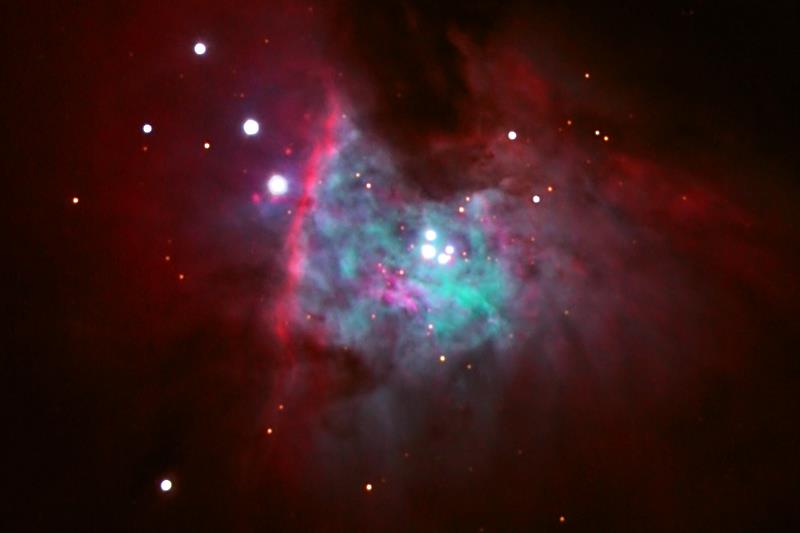
The closest star nursery to us, places where stars are being born, is the Great Orion Nebula, 1,300 light years away. A light year is about 6 trillion miles, if you want to pace it out. It’s located in the constellation Orion’s sword that hangs below his belt. It is seen in as little as a pair of binoculars, and shines by emission and reflection of the light of a tiny clutch of four stars at its heart, called the Trapezium. These extremely hot young massive stars are not destined to live long. Unlike the Sun’s 10 billion year lifetime, these stars lifespans will be measured in millions of years. Yet do not mourn for them, even now stars are forming within their dusty cocoons in the nebula. The Trapezium stars’ deaths will provide heavy elements for new stars and planets.
The astronomical event times given in this blog are for the Traverse City/Interlochen area of Michigan (Lat 44.7° N, Long 85.7° W; EST, UT – 5 hours) unless stated otherwise. Times will be different for other locations.
Addendum
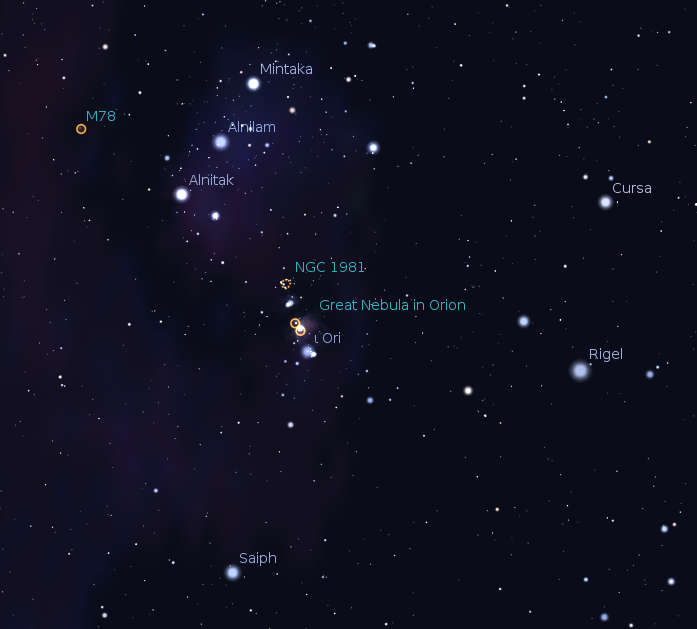
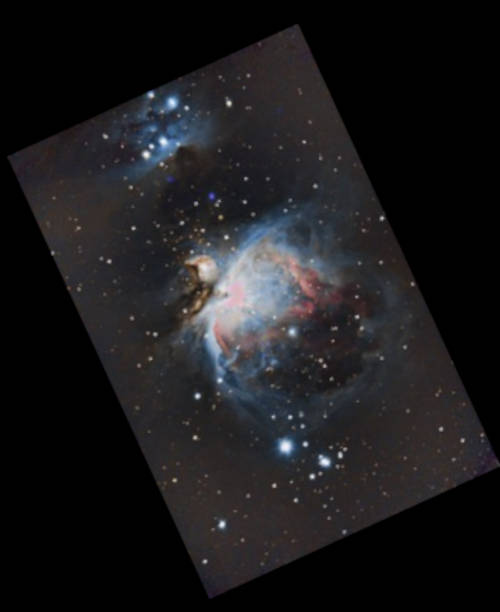
There are several videos produced by NASA, ESA and others of a fanciful trip through the Great Orion Nebula. I found them by typing: NASA trip through the Orion nebula into my Internet browser.
Ephemeris: 01/15/2026 – Orion’s great cloud
This is Ephemeris for Thursday, January 15th. Today the Sun will be up for 9 hours and 12 minutes, setting at 5:28, and it will rise tomorrow at 8:15. The Moon, 3 days before new, will rise at 7:09 tomorrow morning.
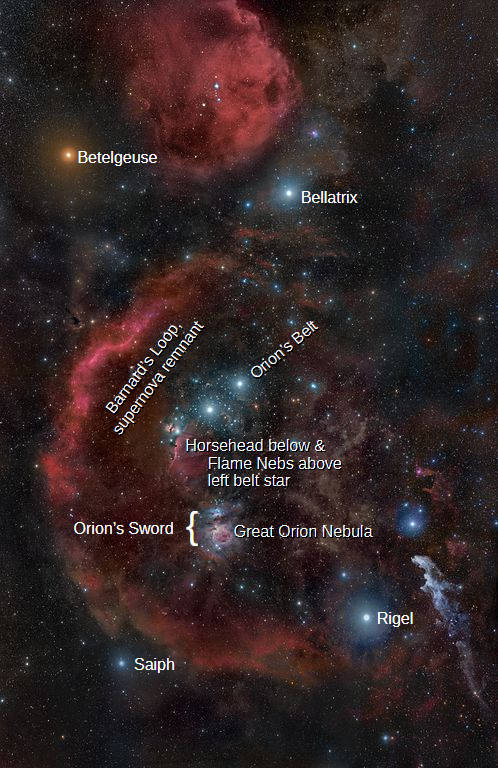
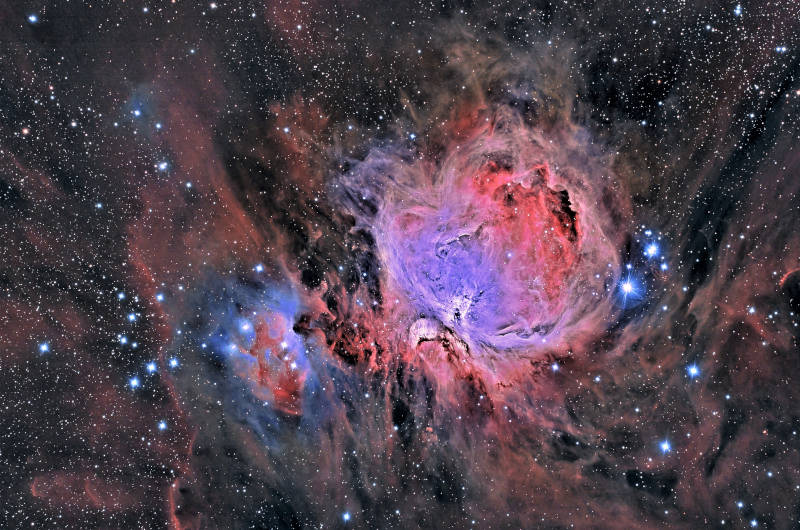
The brightest interstellar cloud visible in our skies is the Great Orion Nebula. The word nebula is from the Latin “nebulum” for cloud. The constellation of Orion is filled with nebulae, most of it are dim or dark. The Great Orion Nebula is in Orion’s sword. The sword is what looks like three stars that look dimmer than the three belt stars hanging from the belt. There are actually more than three stars here. Around the stars that appear as the center of the sword stars, to the eye, can be seen a haze in binoculars. A telescope with a wider aperture and low power can see detail in the cloud. With more magnification, a clutch of four baby stars can be spotted in the brightest part of the nebula. They light up the nebula and are called the Trapezium.
The astronomical event times given in this blog are for the Traverse City/Interlochen area of Michigan (Lat 44.7° N, Long 85.7° W; EST, UT – 5 hours) unless stated otherwise. Times will be different for other locations.
Addendum
Ephemeris: 05/02/2025 – GTAS meeting ~ Deep sky wonders for the small telescope
This is Ephemeris for Friday, May 2nd. Today the Sun will be up for 14 hours and 18 minutes, setting at 8:49, and it will rise tomorrow at 6:29. The Moon, 2 days before first quarter, will set at 2:47 tomorrow morning.
The Grand Traverse Astronomical Society will host its May meeting tonight at 9 PM at Northwestern Michigan College’s Joseph H Rogers Observatory. The talk for the evening will be given by Mary Gribbin presenting the program titled Exploring Deep Space Objects with Small Telescopes by Season. Deep Space Objects, better known as Deep Sky Objects or DSOs, are things that reside beyond the solar system which are generally only visible in telescopes, like star clusters, galaxies and nebulae, which are clouds. After the meeting, weather permitting, there will be viewing of the Moon and whatever we can find in the twilight. The observatory is located south of Traverse City on Birmley Rd. The meeting will also be available via Zoom, with instructions for joining the meeting on the society’s website, http://www.gtastro.org.
The astronomical event times given in this blog are for the Traverse City/Interlochen area of Michigan (Lat 44.7° N, Long 85.7° W; EDT, UT – 4 hours) unless stated otherwise. Times will be different for other locations.
Addendum
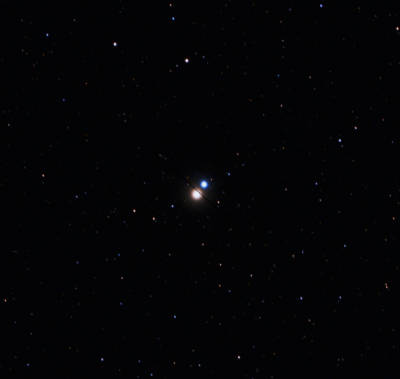
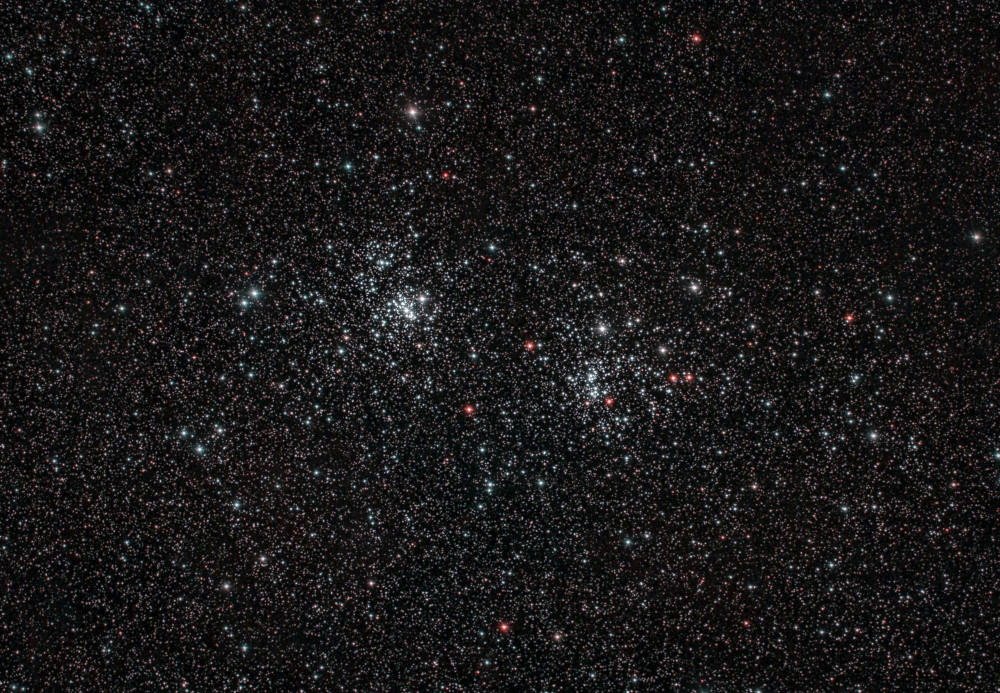
The above are two of the many wonders for owners of a small telescope.
Ephemeris: 09/30/2024 – Andromeda’s treasure, its great galaxy
This is Bob Moler with Ephemeris for Monday, September 30th. Today the Sun will be up for 11 hours and 43 minutes, setting at 7:24, and it will rise tomorrow at 7:41. The Moon, 2 days before new, will rise at 6:27 tomorrow morning. | For at least the last thousand or so years a fuzzy spot in the constellation of Andromeda has been known. It was known as the Great Andromeda Nebula until about 100 years ago. Nebula means cloud, and it belonged to the Milky Way. At that time it was finally recognized as another Milky Way just like ours. So the word to call it was galaxy, a word that means Milky Way. It looks to be among the stars of Andromeda, but it’s far beyond the stars that we make of the constellation Andromeda. Current estimates place it at about two and a half million light years away, well beyond the stars that we see in Andromeda that range to only a few thousand light years distance. It will collide with our galaxy in about 4 billion years.
The astronomical event times given are for the Traverse City/Interlochen area of Michigan (EDT, UT – 4 hours). Times will be different for other locations.
Addendum
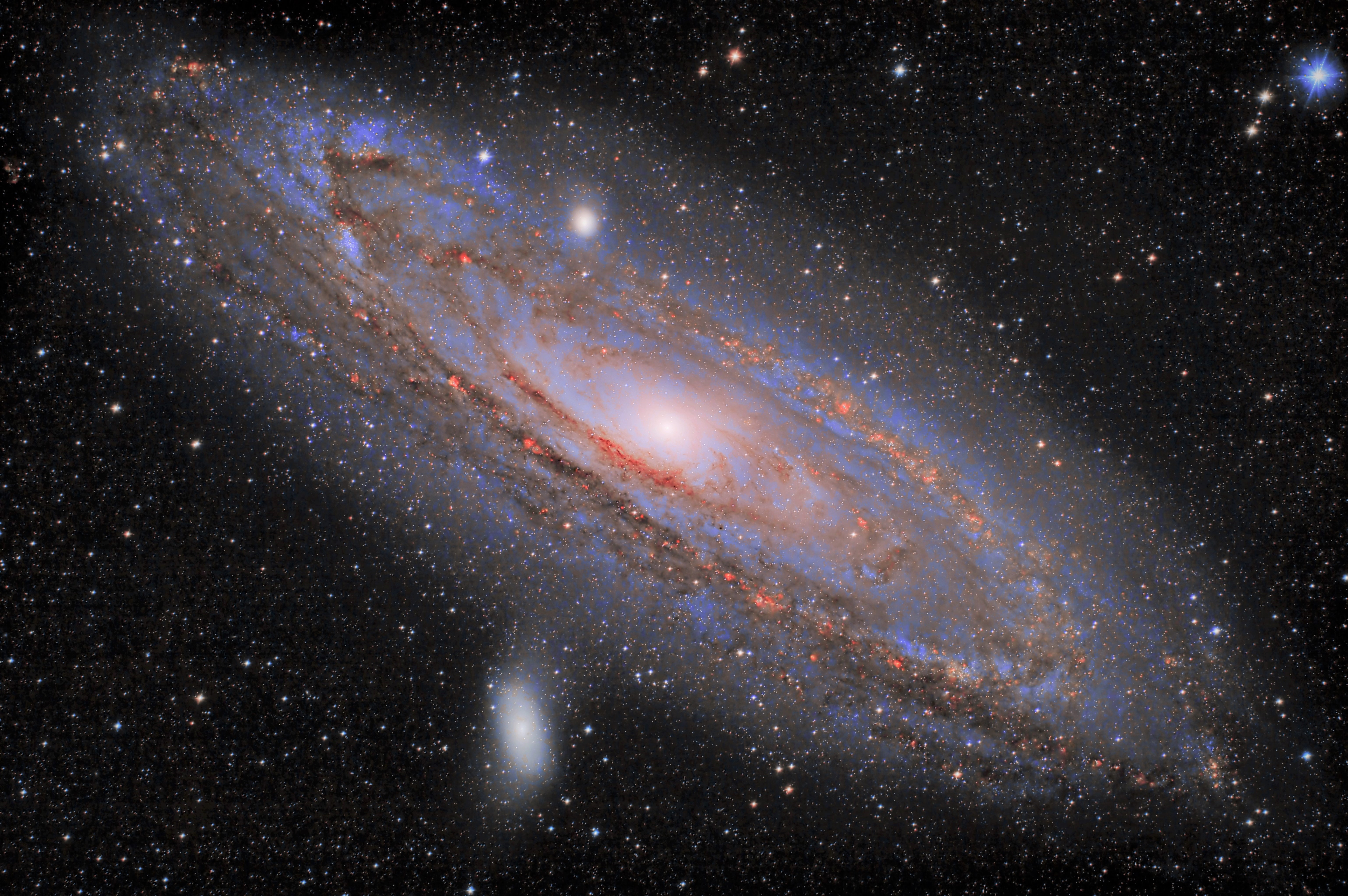
10/18/2022 – Ephemeris – The Great Andromeda Galaxy
Oct 18. This is Bob Moler with Ephemeris for Tuesday, October 18th. Today the Sun will be up for 10 hours and 50 minutes, setting at 6:52, and it will rise tomorrow at 8:03. The Moon, 1 day past last quarter, will rise at 1:22 tomorrow morning.
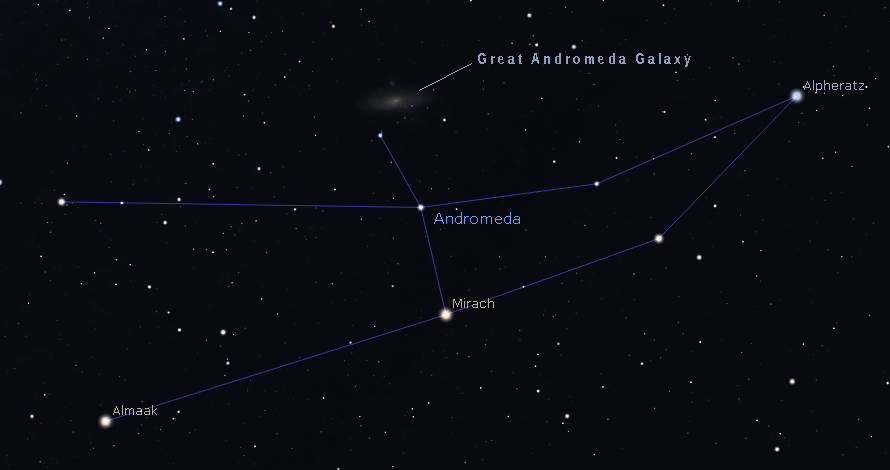
The closest large galaxy to our Milky Way galaxy is the Great Andromeda Galaxy, seen in the eastern sky when it gets dark. It is barely visible to the naked eye. To locate it, first find the Great Square of Pegasus high in the east, standing on one corner. The left star of the square is the head of the constellation Andromeda. Follow two stars to the left and a bit downward, then two stars straight up. The galaxy is near that last star as a small smudge of light. Binoculars are the best way to see it as a thin spindle of light. Visually through a telescope, one can see only the bright nucleus of the galaxy, that spans six Moon diameters in photographs. M 31* is its most well known catalog designation, and it’s two and a half million light years away.
The astronomical event times given are for the Traverse City/Interlochen area of Michigan (EDT, UT – 4 hours). They may be different for your location.
* M 31 is the 31st entry in French comet hunter Charles Messier’s catalog of fuzzy objects that can be mistaken for comets because they didn’t move in relation to the stars. It is a catalog of some of the brightest, what we call, deep sky objects: star clusters, nebulae, and galaxies. It is not a comprehensive catalog of these objects, since Messier was interested in comets.
Addendum
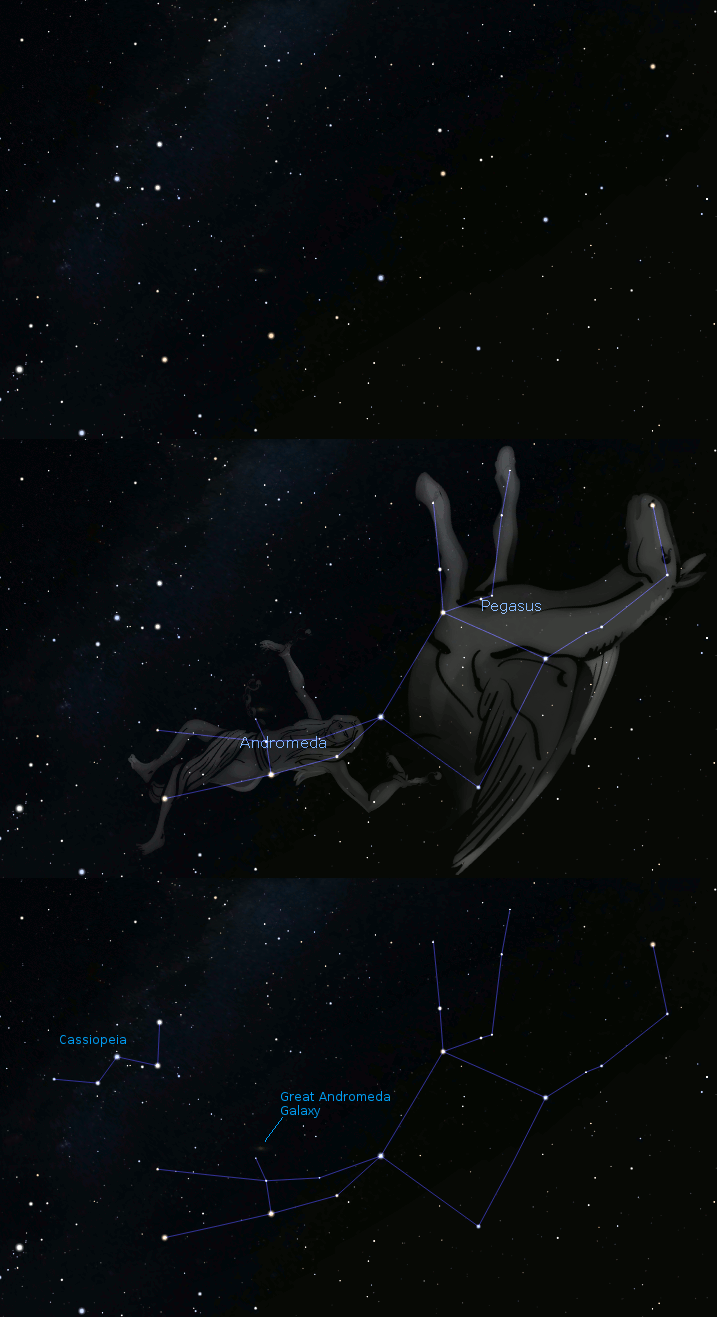
Andromeda animated finder, including the Great Andromeda Galaxy. I’ve added Cassiopeia that some folks use to find the galaxy. I start with the leftmost star of the Great Square of Pegasus that connects to Andromeda. I count off two stars on the lower curve because they are brighter than the upper curve. Then count two stars up. Next to that top star is a little smudge. That is the core of the Great Andromeda Galaxy. Click on the image to enlarge to full size. Created using Stellarium and GIMP.
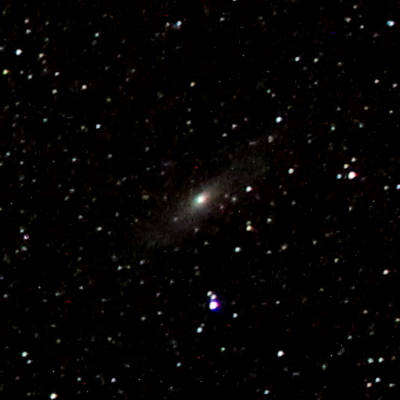
Low resolution and exposure view of M 31, the Great Andromeda Galaxy, simulating what it looks like in binoculars. Credit mine.
M 31, The Great Andromeda Galaxy. This image really shows the red H II Regions intermixed with the dark dust lanes that delineate the galaxy’s spiral arms. H II or ionized hydrogen regions are illuminated by hot young stars that were born within them. Click on the image to enlarge it. Credit: Dan Dall’Olmo.
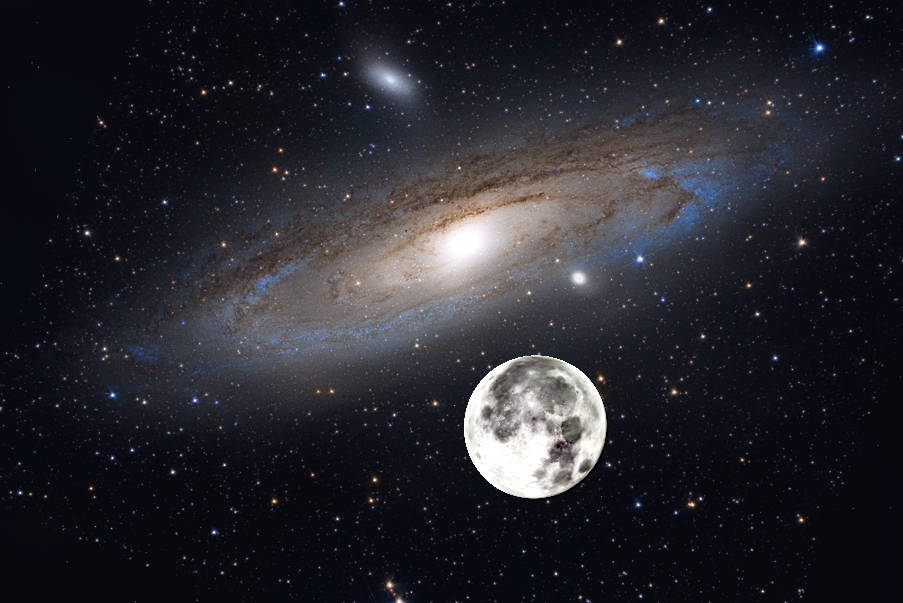
The moon superimposed on the Great Andromeda Galaxy, M31, for apparent size comparison. Created using Stellarium and the embedded image of the galaxy with that of the full Moon of October 31, 2020. M31 Image credit: Herm Perez: http://home.att.net/~hermperez/default.htm License: “Feel free to use these images, if you use them in a commercial setting please attribute the source.”
The Great Andromeda Galaxy is shown with two of its satellite galaxies, both elliptical. The nearly spherical one is M 32. The other one I knew and observed, in the 1950s, as NGC 205**. Even though Messier had described this object in 1773, he didn’t add it to his catalog. The suggestion that it be added as the last entry in Messier’s catalog was made in 1967 by Welsh amateur astronomer Kenneth Glyn Jones***
** NGC is the New General Catalogue of Nebulae and Clusters of Stars, and is not so new. It was published in 1888 by John Louis Emil Dreyer.
*** Source: messier-objects.com
10/17/022 – Ephemeris – Andromeda, damsel in distress
This is Ephemeris for Monday, October 17th. Today the Sun will be up for 10 hours and 53 minutes, setting at 6:54, and it will rise tomorrow at 8:02. The Moon, at last quarter today, will rise at 12:18 tomorrow morning
In the east at 9 this evening can be found a large square of stars, the Great Square of Pegasus the upside down flying horse. The square is standing on one corner. What looks like its hind legs stretching to the left from the left corner star is another constellation, Andromeda the chained princess. She is seen in the sky as two nearly horizontal but diverging curved strings of stars that curve upward. She was doomed due to her mother, Queen Cassiopeia’s boasting, which angered the god Poseidon. She was rescued by the hero Perseus, a nearby constellation, riding his steed Pegasus. Andromeda’s claim to scientific fame is the large galaxy seen as a faint fuzzy spot with the naked-eye just above the upper line of stars. The Great Andromeda Galaxy is two and a half million light years away.
The astronomical event times given are for the Traverse City/Interlochen area of Michigan (EDT, UT – 4 hours). They may be different for your location.
Addendum
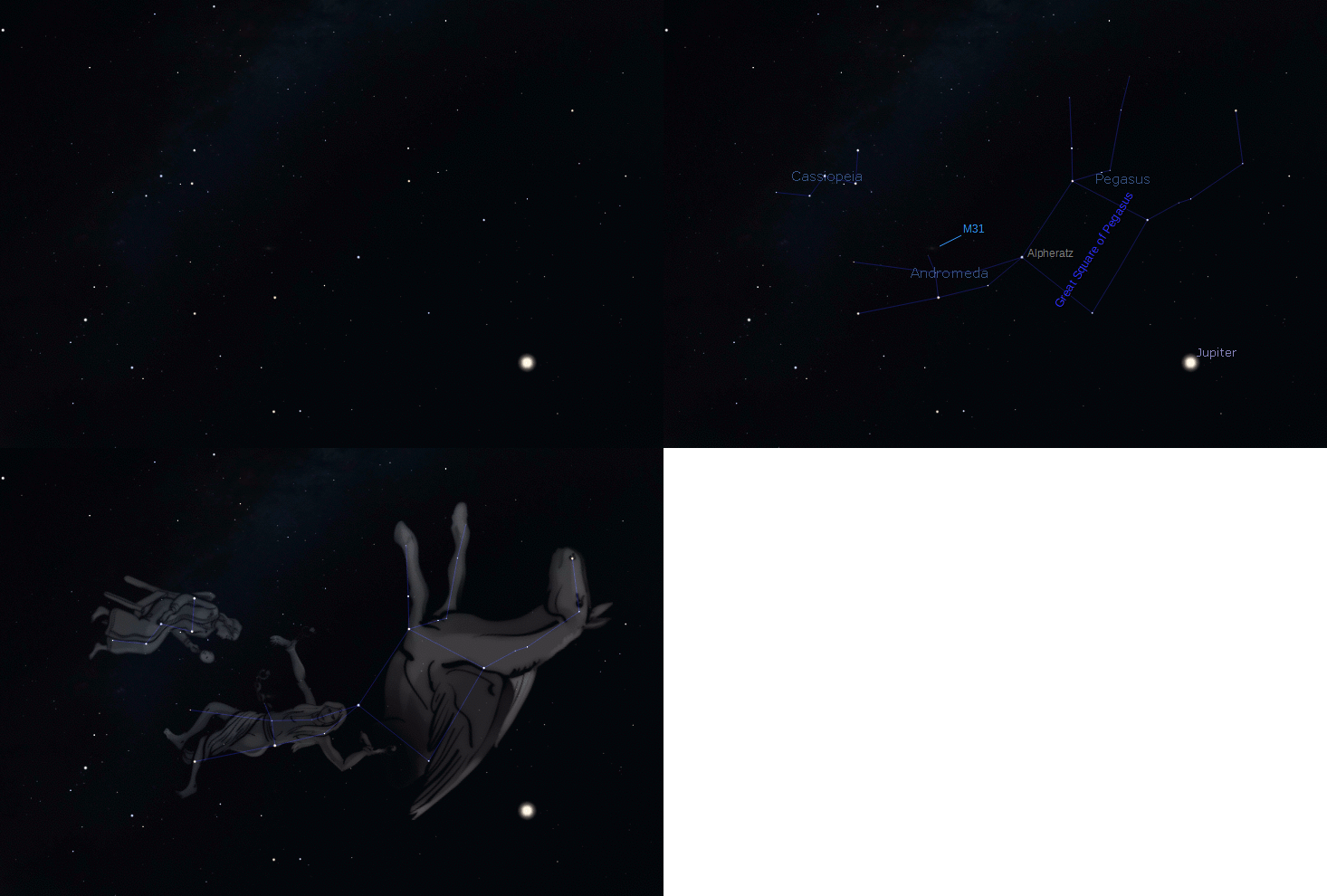
Andromeda finder animation looking east at 9 pm tonight, October 17, 2022. The left corner star of the Great Square of Pegasus is called Alpheratz, and actually belongs to Andromeda. The faint fuzzy spot labeled M31 is the Great Andromeda Galaxy, the Milky Way’s large neighbor. I’ll talk more about it tomorrow. Click on the image to enlarge it. Created using Stellarium and GIMP.
I’ve related Andromeda’s story in my post The Great Star Story of Autumn.
Ephemeris Extra – Wandering through Sagittarius
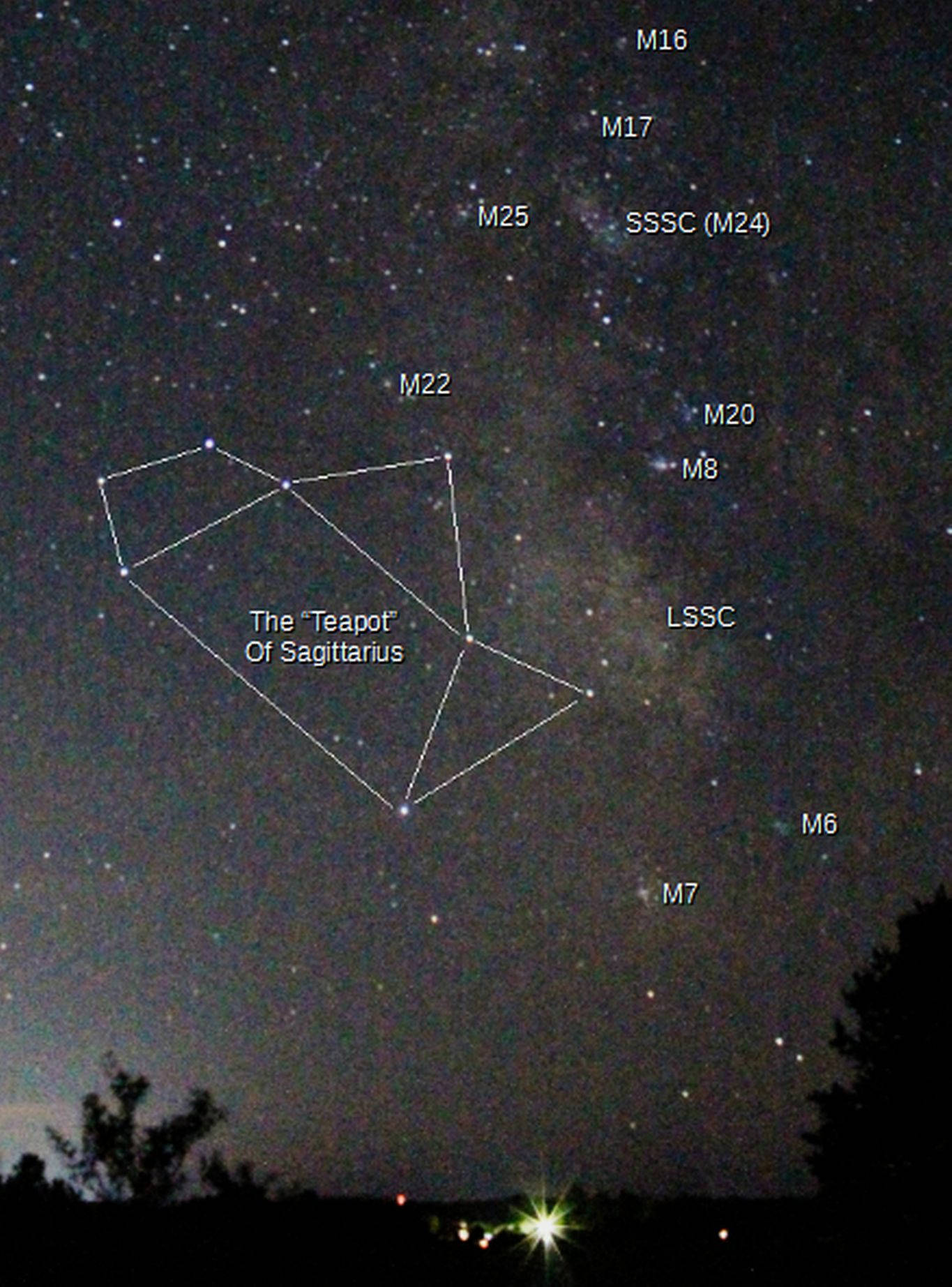
Sagittarius in a short time exposure with added annotations. The “M” designations are objects in Charles Messier’s catalog created in the latter half of the 18th century. LSSC is the Large Sagittarius Star Cloud, SSSC is the Small Sagittarius Star Cloud. Credit Bob Moler.
Sagittarius is seen low in the south in August. It’s between Scorpius to the west, and Capricornus, rising in the southeast. The name Sagittarius simply means archer. It doesn’t describe the fact that the archer isn’t just any old bloke with a bow and arrow, but is, indeed, a centaur, one of the two in the list of constellations. The other, Centaurus, is too far south to be seen from Michigan. And whose brightest star, Alpha Centauri, is in the closest star system to our solar system.
Centaurs, as a rule, were a rowdy bunch, the ancient Greek equivalent to a modern motorcycle gang. However, the centaur depicted by Sagittarius can be thought to be Chiron, though it can also be ascribed to Centaurus. Chiron was learned, a teacher and physician. I’ve noticed that in some artist’s depictions of Chiron, he is teaching Achilles how to use the bow and arrow. He also taught medicine to Asclepius, the great physician, who is seen in the heavens as the constellation Ophiuchus, above and right of Sagittarius.
What most of us see in the stars here is maybe a bow drawn to shoot at the heart of Scorpius, or a stout little teapot as in the children’s song. It even has the Milky Way seeming to rise from the spout like steam. The teapot rises in the southeast as if standing upright, and as the night wears on, it rises and move westward, slowly tilting to pour out its tea on the southwestern horizon.
The area of Sagittarius and the Milky Way is a fantastic part of the sky to explore with binoculars or a low power telescope on moonless nights. At the head of this post is a photograph of Sagittarius and the Milky Way taken from my home, with lines and labels. It’s somewhat spoiled by the sky glow from Chum’s Corner, a small commercial center 3.6 miles away, from the lower left. Most binoculars will show open or galactic star clusters as fuzzy spots like nebulae, which are fuzzy because they are clouds. The older globular star clusters require larger amateur telescopes to resolve.
I’ve only pointed out one in the image, that’s M22, whose designation, we have fun with at star parties at the Sleeping Bear Dunes National Lakeshore, since the road M22 runs through the park. Which came first? That’s easy, Charles Messier cataloged his 22nd object before Michigan was a state or even had roads. Well, maybe there were a few, around Detroit and Sault Ste. Marie, back when the major “roads” were the Great Lakes, and the rest Indian trails.
A telescope, even a small one, will resolve open clusters, showing individual stars. Telescopes will show the shapes of nebulae if they are bright enough.
One nebula with a distinctive shape is M17. The descriptive name I first knew it as was the Omega Nebula, and also the Horseshoe Nebula. To me, it never looked like either. It looked like a check mark, or a somewhat short necked swan. And it also goes by those names too. The planetarium program I use a lot, Stellarium, also calls it the Lobster nebula. I’m not much for seafood, but it doesn’t look like a lobster, or maybe I’m not hungry enough.
M16, is the Eagle Nebula. It has an associated star cluster. My eyes are drawn to the star cluster. The nebulosity is very faint, and I usually can’t see it. Part of the nebula was famously photographed by the Hubble Space Telescope and called the Pillars of Creation. In actuality, they are the Pillars of Destruction as they are being blown away by the stellar winds of the star cluster.
M8 is the Lagoon Nebula, it also has an associated star cluster. In telescopes, it is crossed by a narrow dust cloud suggestive of a lagoon. Nearby M20 is the Trifid nebula, which has a low surface brightness and can easily be missed. It is crossed by three narrow dust clouds dividing it into three, or on closer inspection, four wedges.
These just scratch the surface. So with or without optical aid wander through the celestial wonders and star clouds of Sagittarius. You have August and September to do it in the evening before they set for another year.
Based on an article I wrote for the August 2022 issue of the Stellar Sentinel, the Newsletter of the Grand Traverse Astronomical Society.
02/24/2022 – Ephemeris – The celestial unicorn
This is Ephemeris for Thursday, February 24th. Today the Sun will be up for 10 hours and 55 minutes, setting at 6:23, and it will rise tomorrow at 7:27. The Moon, 1 day past last quarter, will rise at 3:57 tomorrow morning.
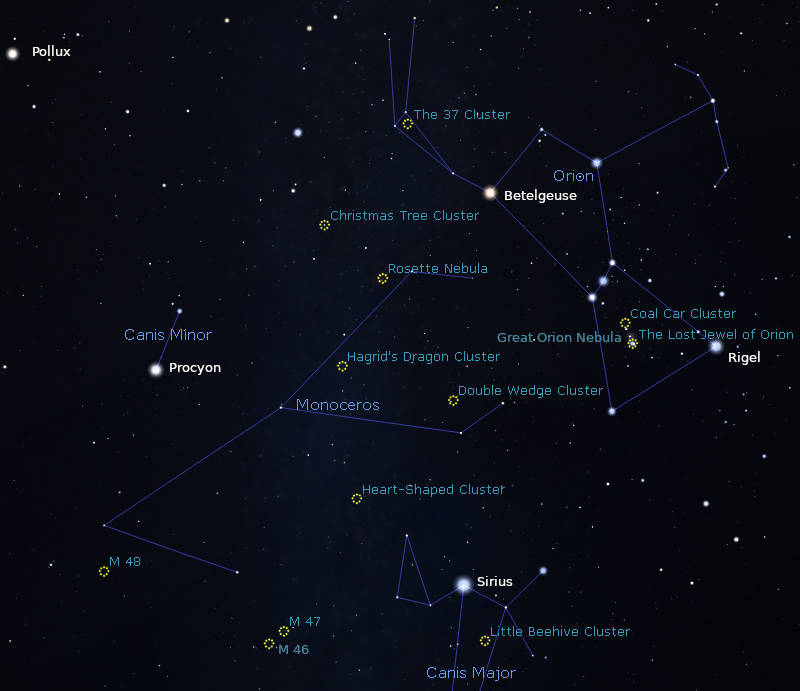
Among all the constellations in the sky of animals real and mythical, there is also a unicorn. It’s called Monoceros, and inhabits the south-southeastern sky at 8 p.m. mostly bounded by Orion on the right, Canis Major, the great dog below and Canis Minor, the little dog to the left and above. Unfortunately for observers without a telescope, Monoceros, is devoid of any but the faintest stars. Maybe that’s why no one sees unicorns anymore. It has many faint stars because the Milky Way runs through it. To the telescopic observer and astrophotographer it is a feast of faint nebulae or clouds of gas and dust, the birthplace of stars, including the red rose of the Rosette Nebula* (NGC 2237), and Hagrid’s Dragon Cluster (NGC 2301), which sounds suspiciously like it was recently, and unofficially, named. Monoceros also contains a beautiful telescopic triple star system, Beta (β) Monocerotis.
The astronomical event times given are for the Traverse City/Interlochen area of Michigan (EST, UT – 5 hours). They may be different for your location.
* The Rosette nebula surrounds the star cluster NGC 2244. This sparse star cluster is visible visually in telescopes. I’ve never been able to spot the nebula in a telescope, but it shows up, faintly, in my wide angle photographs of the area.
Addendum
Deep Sky Objects in and around Monoceros. Deep Sky Objects are telescopic objects that lie beyond the solar system. Click on the image to enlarge. Created using Stellarium.
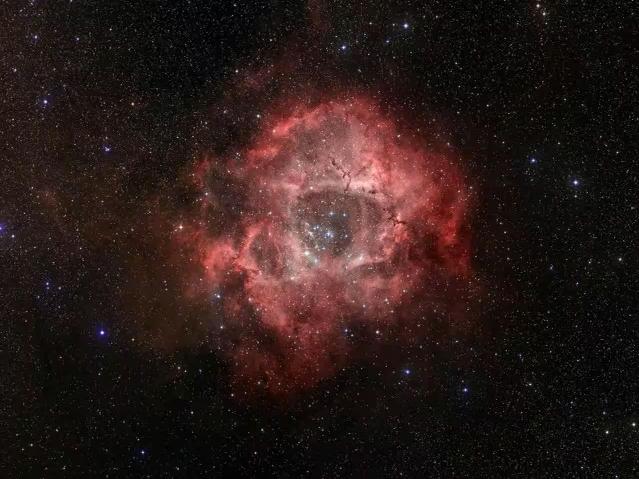
Rosette Nebula in the infrared from the Spitzer Space Telescope. Credit: NASA/JPL/Caltech
The brighter stars of NGC 2301 (Hagrid’s Dragon Cluster, AKA Great Bird Cluster and Copeland’s Golden Worm). It’s also in two other catalogs: Cr 119 and Mel 54. Created using Stellarium and GIMP. The dragon image is from “Dragon Flying Cycle” on YouTube by Simon Hussey.
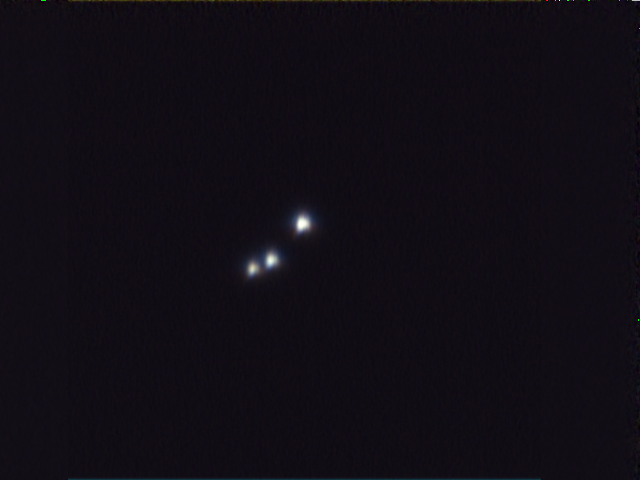
Telescopic Beta Monocerotis. William Hershel, discoverer of Uranus, said that it was “One of the most beautiful sights in the heavens.” Credit: F. Ringwald, Fresno State.
02/12/2021 – Ephemeris – Monoceros the unicorn
This is Ephemeris for Darwin Day, Friday, February 12th. Today the Sun will be up for 10 hours and 20 minutes, setting at 6:07, and it will rise tomorrow at 7:45. The Moon, 1 day past new, will set at 7:07 this evening.
Among all the constellations in the sky of animals real and mythical, there is also a unicorn. It’s called Monoceros, and inhabits the southeastern sky at 8 p.m. mostly bounded by Orion on the right, Canis Major, the great dog below and Canis Minor, the little dog to the left and above. Unfortunately for observers without a telescope Monoceros, is devoid of any but the faintest stars. Maybe that’s why no one sees unicorns anymore. It has many faint stars because the Milky Way runs through it. To the telescope it is a feast of faint nebulae or clouds of gas and dust, the birthplace of stars, including the red rose of the Rosette Nebula, and Hagrid’s Dragon Cluster (NGC 2301). It also contains a beautiful telescopic triple star system, Beta (β) Monocerotis.
The event times given are for the Traverse City/Interlochen area of Michigan. They may be different for your location.
Addendum
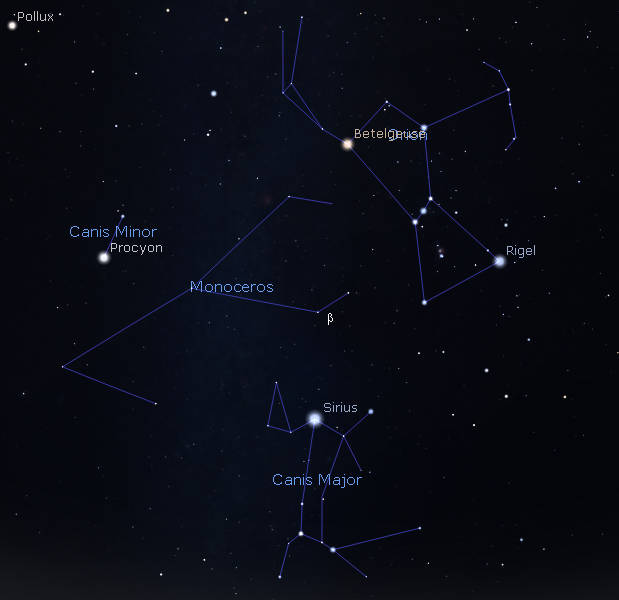
Monoceros finder chart showing neighboring constellations for about 8 pm in mid-February. Created using Stellarium.
The brighter stars of NGC 2301 (Hagrid’s Dragon Cluster, AKA Great Bird Cluster and Copeland’s Golden Worm). It’s also in two other catalogs: Cr 119 and Mel 54. Created using Stellarium and GIMP. Dragon from “Dragon Flying Cycle” on YouTube by Simon Hussey.
Deep Sky Objects in and around Monoceros. Click on the image to enlarge. Created using Stellarium.
Rosette Nebula in the infrared from the Spitzer Space Telescope. The star cluster in the center is visible in a telescope, but the nebula is strictly photographic. Credit: NASA/JPL/Caltech.
Telescopic Beta Monocerotis. William Hershel, discoverer of Uranus, said that it was “One of the most beautiful sights in the heavens.” Credit: F. Ringwald, Fresno State.
 Bob Moler's Ephemeris Blog