Archive
01/20/2019 – Ephemeris lunar Eclipse extra
For those of us who may be socked in tonight we have a link to the livestream of the eclipse.
I subscribe to their email notices, which explains the end of the URL.
You can go to their main site: http://griffithobservatory.org/ and scroll down to Upcoming Activities and Total Lunar Eclipse then Watch live online. That connection is real slow now.
Update 9:p.m. EST:
Looks like they are having clouds over LA. However we (Interlochen/Traverse City, MI) are partly cloudy with more clear spots than clouds, and the clouds seem to be thin. The GOES satellite is showing a thin lake effect flow from the north. So maybe we might pull this one off.
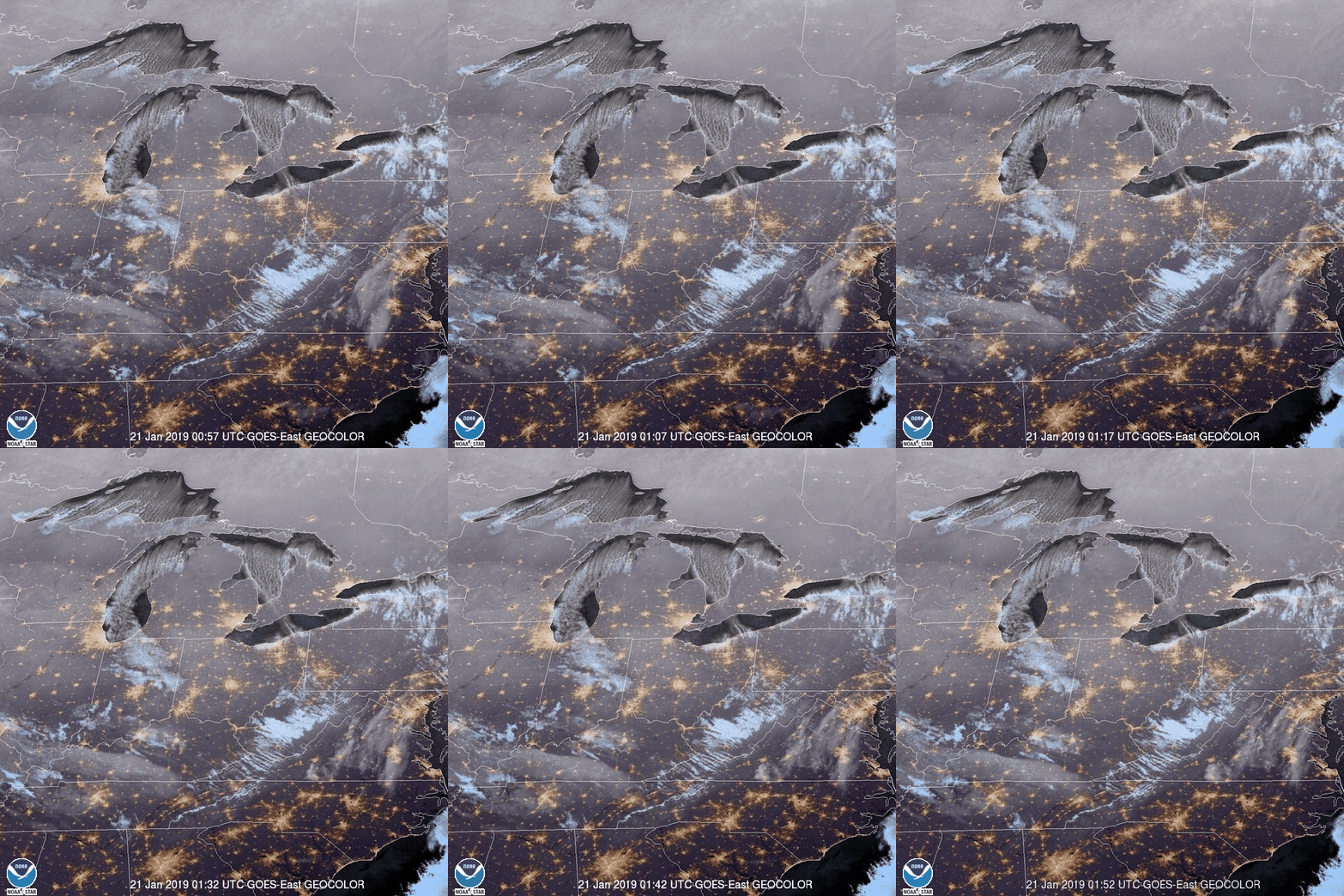
GOES Great Lakes cloud animation for 9 p.m. Credit NOAA.
12/15/2018 – Ephemeris Extra – Finally the skies cleared and I got a photograph of Comet Wirtanen
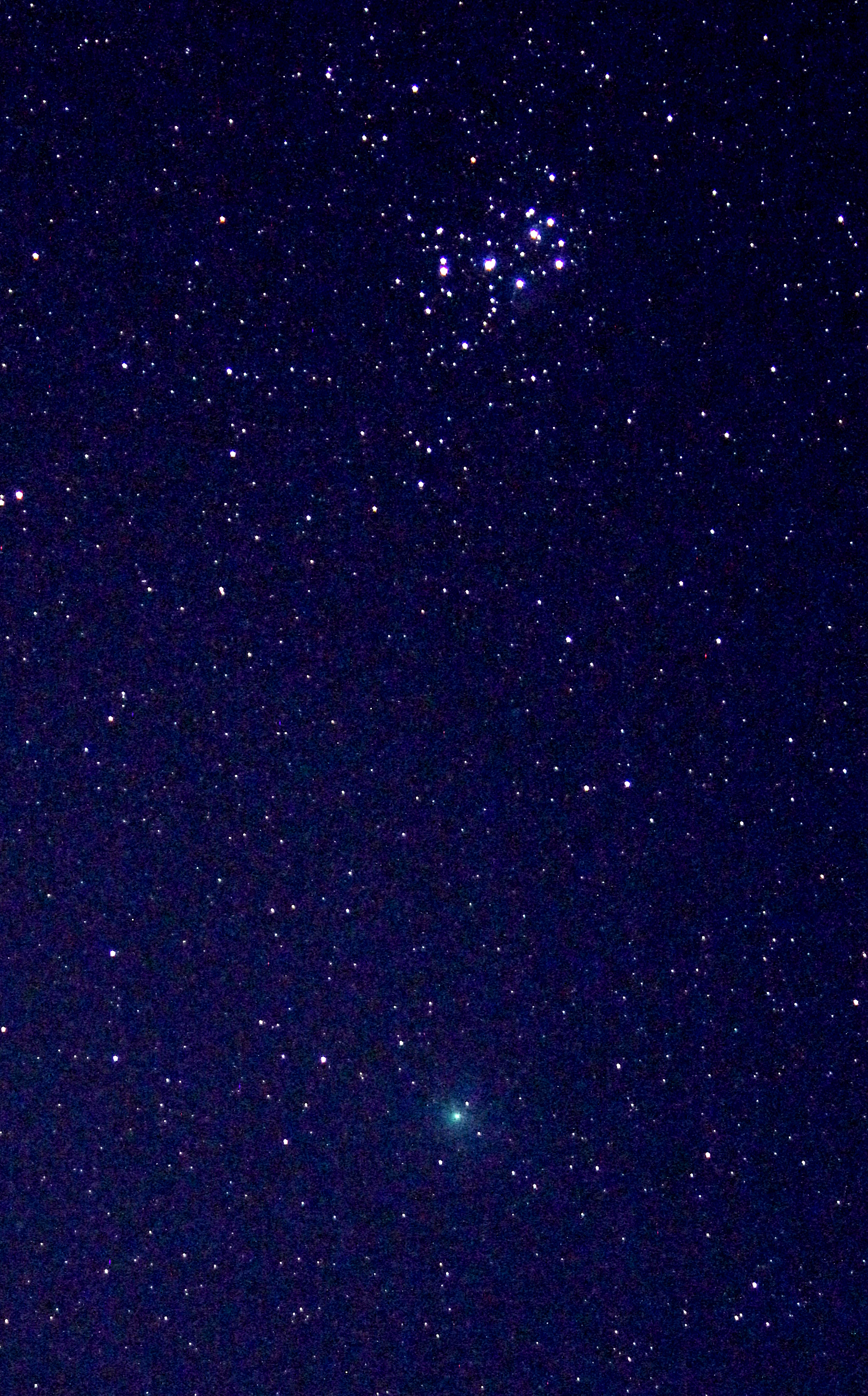
Comet 46P/Wirtanen and the Pleiades. 9:24 p.m. EST, December 14, 2018. Canon EOS Rebel T5, f/5.5, 30 sec., ISO-3200, fl 55mm, tracking. Click on the image to enlarge. Credit Bob Moler.
Finally, the skies cleared. The last time we had clear skies was early in the evening on the 8th. Our family went to the Ballet that evening at Interlochen Center for the Arts, and by the time I got back and dressed to go outside and observe the comet, it had clouded up. The Ballet was wonderful, by the way.
Anyway, Comet 46P/Wirtanen as a few hours ago was greatly hampered by the nearly first quarter Moon. And it’s going to get worse as the moon’s phase gets fuller. I thought I could see it in with the naked eye. It was visible in binoculars. As you can see it did photograph well. I processed the image with GIMP to increase contrast, and reduce the background moonlight. There is no discernible tail visually or in this photograph. Longer exposures in a dark sky do show a faint ion tail. Remember this is a short period comet, and has been around the Horn (perihelion) innumerable times. It orbits the Sun from just inside Jupiter’s orbit to just outside Earth’s orbit every 5.4 years.
Happy comet hunting!
11/25/2018 – Ephemeris Extra – Comet 46P/Wirtanen may be naked eye in December
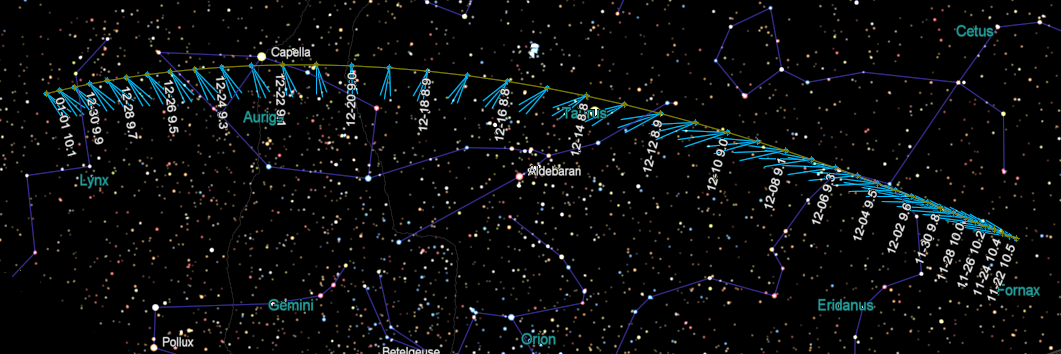
Comet 46P/Wirtanen will be well placed in the evening sky for observation. Though a small comet, it has a history of being active, which is not disappointing us now. It will be closest to the Earth on December16th at 7.1 million miles (11.4 million km).
On December 16th the comet will be closest to the Pleiades. On the 23rd it will appear close to the bright star Capella. After that it will become circumpolar.
Comet Wirtanen is a small short period comet of 5.44 years. It’s orbit doesn’t come as close to the Sun as the Earth. It’s closest to the Sun, called perihelion it which it reaches December 12th is about 98 million miles (158 million km). The orbit extends out to nearly Jupiter’s orbit.
Checkout photos and animations of this and other comets in http://www.spaceweather.com/’s Realtime Comet Gallery.
Also check out Seiichi Yoshida’s website and his weekly information about Bright Comets: http://www.aerith.net/comet/weekly/current.html.
A note about comet magnitudes
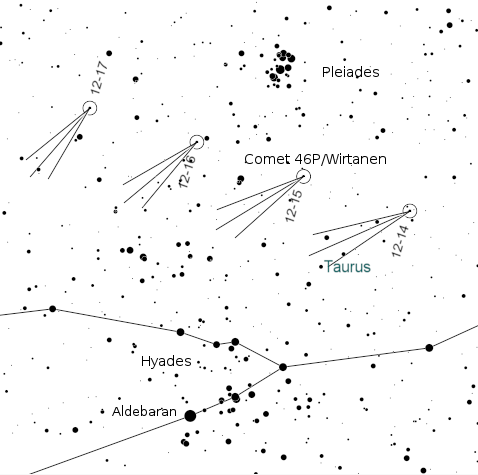
Comet magnitudes are always devilishly hard to estimate. A comet always appears dimmer than its magnitude suggests because one is comparing the brightness of a diffuse object with the point source of a star. One either has to reduce the size of the comet to almost a point or defocus the star to the size of the comet to make the comparison if it doesn’t have a tail.
A point about magnitudes. They’re like golf scores. The lower the number, the brighter the object, and the better the golf score. Blame the ancient Greek astronomer Hipparchus, who ranked star brightness from first magnitude for the brightest stars to sixth magnitude for the dimmest stars visible to the naked eye. Modern astronomers put a mathematical basis for the system saying that a magnitude difference of 5 equals a brightness difference of 100. So each magnitude step equals the 5th root of 100 or 2.512. So a 5thmagnitude star is about two and a half times brighter than a 6thmagnitude star, and so on.
11/04/2018 – Ephemeris Extra – Wintermaker rising
A chill is in the air, The Fisher, Ojiig’s bloody tail has swooped low in the north at midnight to paint the trees with their fall colors, and the leaves have fallen to the ground. Haven’t heard of the Fisher? I mention it from time to time here on my Ephemeris program on Interlochen Public Radio. It’s a constellation of the Anishinaabe peoples indigenous to this area of Michigan, of which the Chippewa, Ottawa, and Ojibwe are a part.
The Fisher occupies the stars which we know as the Big Dipper and the Great Bear, Ursa Major. And unlike the bear, a fisher really does have a long tail. The fisher is a real weasel-like animal whose diet apparently does not include fish. It is found across southern Canada and in the American West. I’ve related the story of the Fisher, and how he brought summer to the Earth, in these pages in the August 2012 issue and on my blog bobmoler.wordpress.com. Search for fisher. Like most legends, there are different versions of that story and others about the Fisher.
Fisher or not, summer is gone and the world seems darker and colder. Over in the east these evenings great winter constellation of Orion is rising. It brings to mind the Robert Frost poem Star-Splitter, and our star chart this month from the November 1st post:
“You know Orion always comes up sideways.

Throwing a leg up over our fence of mountains,

And rising on his hands, he looks in on me

Busy outdoors by lantern-light with something

I should have done by daylight, and indeed,

After the ground is frozen, I should have done

Before it froze, and a gust flings a handful

Of waste leaves at my smoky lantern chimney

To make fun of my way of doing things,

Or else fun of Orion's having caught me.

Has a man, I should like to ask, no rights

These forces are obliged to pay respect to?"
The rest of the poem is available on the Poetry Foundation website: https://www.poetryfoundation.org/poems/44273/the-star-splitter. The poem is about one Brad McLaughlin and his telescope. While I don’t approve of how he financed his telescope, I do share his enthusiasm.

The Wintermaker, Biboonikeonini’s, name literally means North Wind. While his torso is the same as Orion’s his arms stretch from Aldebaran in Taurus to Procyon in Canis Minor, just about spanning the entire winter sky. The pictographs, seen above of the Wintermaker, Curly Tail and Moose can only be seen from a canoe in the cliff face on one side of the narrows between North Hegman and Trease lakes, 15 miles north of Ely, Minnesota
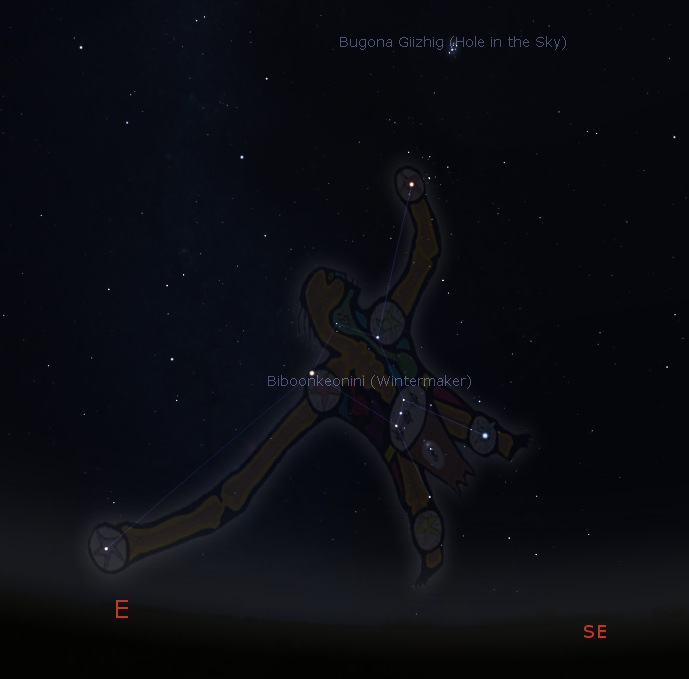
In late winter as Ojiig is rising in the northeast signaling the maple sugaring season, the Wintermaker is moving lower in the southwest. Some Ojibwe parents make bows for their children to shoot arrows at the Wintermaker to convince him to flee the skies so spring can begin as a way to teach them the old legends of their culture.
The Pleiades is an important group of stars for the Anishinaabe in several ways. It is the Hole-In-The-Sky, Bagone’giizhig, through which the Sky Woman fell and to give birth to the first humans on the Earth.
The Pleiades also represent the seven poles of the Shaking Tent Ceremony, and the seven sacred stones that are heated for the sweat lodge, which is also seen in the stars in the spring as Corona Borealis.

They are also the Seven Daughters of the Moon and Sun. They loved to dance and play, and when their father, the Moon was low in the sky, would descend to the Earth in a basket to do their thing. On one of their trips to the earth, one of them was captured by a human and she ended up falling in love with him, and married him. When father Moon found out he permanently dimmed her star, so now most people now only can spot 6 of the stars. This last bit seems to parallel the Greek story of the lost Pleiad.
Note: This is published as an article in the Grand Traverse Astronomical Society’s November 2018 newsletter Stellar Sentinel.
Ephemeris Extra – The great meteor shower of August
This post from the Grand Traverse Astronomical Newsletter “Stellar Sentinel” was written for August of 2018. The dates and times of the peak may change a bit from year to year.
The Perseid meteor shower is the second most active annual meteor shower. The most active is the Geminids of December during a period that’s cold and generally very cloudy here in Northern Michigan. Consequently, I’ve never seen a Geminid meteor.
The Perseid meteor shower is the most famous as the August meteor shower, coming on the warm summer month. In Northern Michigan the radiant of the shower, the point in the sky from which they appear to come, is circumpolar, which means they are visible anytime in dark skies from dusk to dawn.
The Perseids are so named because they appear to come from near the constellation of Perseus the hero, an autumn constellation that starts the evening low in the northeast and rises and moves to high in the east near dawn. In earlier times these meteors were called the Tears of St. Lawrence, who was martyred in AD 255. His Feast day is August 10th, the day he died, which falls very close to the peak activity of the shower.
The Perseid meteors are visible for over a month from about July 17th to August 24th, with peak activity between August 12th at 4 p.m. to August 13th at 4 a.m. EDT. So the peak activity will partially be during our night hours, and the one day old Moon will not interfere at all. The peak hourly rate may reach 100 per hour at times. All things being equal, the higher the radiant is in the sky the greater the numbers of meteors seen. The Perseid radiant will be rising all night, being highest as the first light of dawn appears. Even though the numbers of meteors are fewer I like to start looking by 10:30 p.m. With the radiant low in the sky, the meteoroid particles we see are almost skimming the atmosphere, lasting longer. There’s is nothing so cool as to see a bright Perseid meteor seeming to fly along the Milky Way. The radiant point is in the Milky Way between Perseus below, and Cassiopeia above.
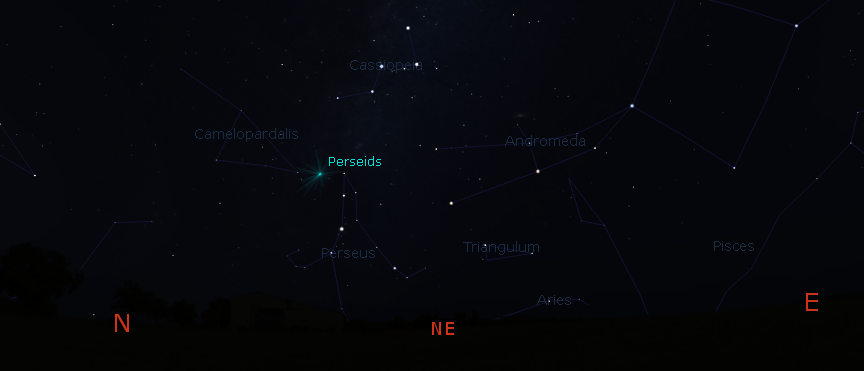
The Perseid radiant is located off the highest star is Perseus as it rises about 11 p.m. August 12, 2018. Click on the image to enlarge. Created using Stellarium.
Observing this meteor shower is very easy and one needs no special equipment. A blanket to lie on, mosquito repellent, warm clothes, some water and snacks, if staying the night, and a dark location. My preferred location is the Dune Climb at the Sleeping Bear Dunes National Lakeshore. It has no light, except the occasional car lights and has modern restroom facilities and a low horizon except in the west. I supposed one could climb up the dune to get rid of even the car lights. Even though the radiant is in the northeast, the meteors will appear all over the sky.
Binoculars are nice to take a break to explore the Milky Way and to observe the smoky train left by a particularly bright meteor. These can be viewed for a minute of more and deform and twist due to the different wind directions and speeds at different altitudes.
What causes the Perseid meteor shower and why does it occur at the same time every year?
The Perseid meteor shower, like all meteor showers are caused by the debris left along the orbits of comets. If the comet’s orbit crosses close to the Earth’s orbit we can get a meteor shower. Comets spend the majority of their time far from the Sun, where it’s very cold, and are in very elongated orbits.
Comets are made from rocky bits, dust and frozen gasses. As the comet comes into the inner solar system the Sun heats it up and the frozen gasses sublimate, are ionized by the Sun’s radiation and are caught into the thin ion tail. This liberates the comet’s fine dust which is blown away from the Sun by the pressure of sunlight into a broad dust tail. Larger particles end up traveling in the comet’s path, and are affected mainly by the Sun and the various gravitational tugs of the planets.
The comet responsible for the Perseids is 109P/Swift-Tuttle. It was independently discovered by L. Swift and P. Tuttle in 1862. It was recorded as being seen in 69 BC by, you guessed it, the Chinese. It’s a big comet, with a nucleus some 16 miles in diameter, and it crosses the Earth’s orbit, so it is a potentially hazardous object, and if it hit the Earth, would wreak more damage than the asteroid that killed the dinosaurs. From the 1862 appearance the comet was given a period of 120 years. It didn’t show in 1982. An observation of the previous appearance of the comet in 1737 allowed a recalculation of the orbit and a new return year of 1992. That was correct. The comet was recovered that year.
The comet will return in 2126. The calculations used to predict the 1992 return suggested that the comet could possible collide with the Earth. However observations of the 1992 appearance of the comet determined that the comet, though it would pass close to the Earth, is not a hazard. But it should be really bright. I can’t wait!
Ephemeris Extra – Occultation of Aldebaran visible from the Upper Peninsula and the tip of northern lower Michigan
In the early morning hours of July 10th the very northern part of the IPR listening area will have a chance to see the last occultation of the bright star Aldebaran for at last 15 years. An occultation is where the Moon in this case passes in front of or occults a planet or a star. In astronomy occult means to hide. The event is an occultation. There is no black magic involved. It will be a grazing event, with Aldebaran popping in and out of view at the mountains and valleys at the southern edge of the Moon along a line running south of Mackinaw City and across the eastern tip of the Upper Peninsula.

The Straits of Mackinac area showing the green southern graze line of the Occultation of Aldebaran. Credit Map Google Earth, Graze line by Occult 4.
It’s a clear miss for the Interlochen area, with the star skirting the Moon at it’s 5 o’clock position. The time of the event will be near 4:38 a.m. with the maximum time of the event increasing from west to east at nearly 2,000 miles an hour. At that time the Moon and Aldebaran will be low in the east-northeast and only 7 degrees above the horizon.
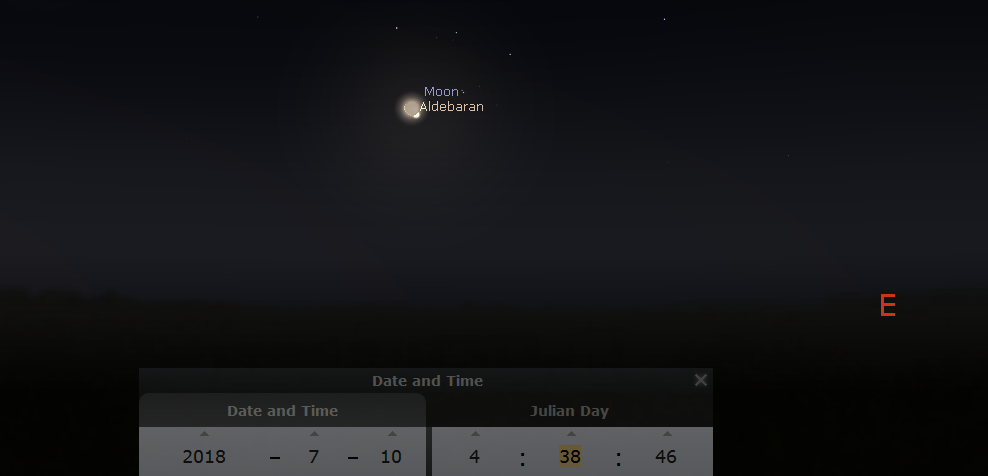
Location of the Moon and Aldebaran in the sky at 4:38 a.m. July 10, 2018 from the Interlochen/Traverse City area.
More information on this occultation from Sky and Telescope is here.
This will be the last occultation of Aldebaran visible from around here for the next 15 years. However starting in 5 years there will be a monthly series of occultations of the bright star Regulus, and the next year a series of occultations of the star Spica will begin. That’s just for the Moon with bright stars. The Moon occults many dimmer stars a month. A very important field of occultations is the observation of occultations of asteroids and Kuiper belt objects to discover their size, shape, any satellites and whether they have rings. Go to the International Occultation Timing Association https://occultations.org for more information.
Hat tip to Jerry Dobek, Director of the Joseph H. Rogers Observatory
06/24/2018 – Ephemeris Extra – Mars Summers
This is a reprint of “Mars Summer” which I wrote for the Grand Traverse Astronomical Society newsletter Stellar Sentinel’s June 2018 issue.
The planet Mars has oppositions from the Sun about every 26 months more or less. These oppositions are a time when Mars is closest to the Earth for its position in orbit. It’s distance at these times range from 34.6 to almost 63 million miles, a range of almost 2 to 1. This is because Mars has a very elliptical orbit as can be seen below.
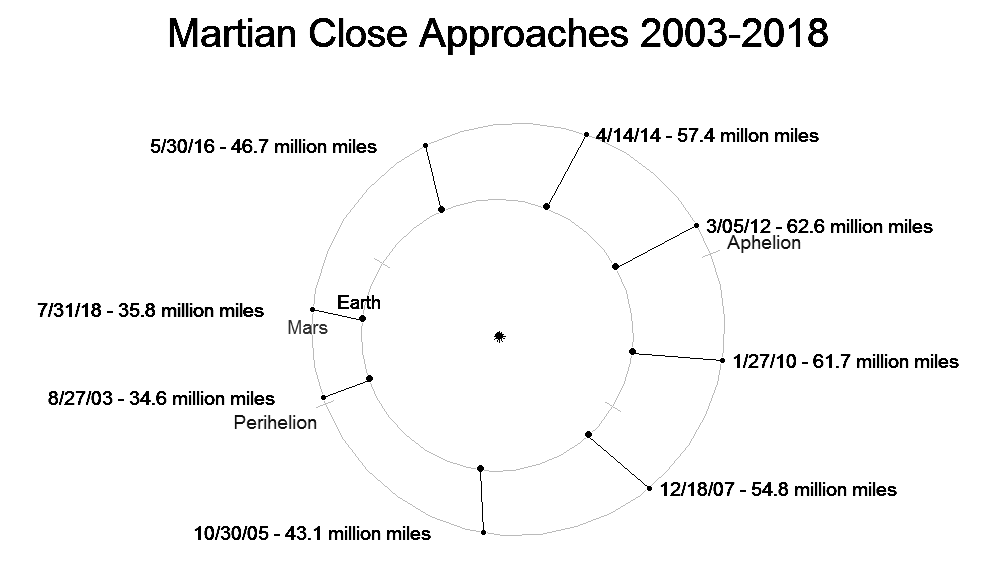
Mars closest approaches to the Earth from August 27, 2003 to July 31, 2018. Diagram created using Bob Moler’s LookingUp program.
Especially close approaches to the Earth occur every 15 or 17 years in the latter half of summer in those years. My first close approach was September 7, 1956. It was a famous one for the time. Professional astronomers of that time were pretty sure that Mars didn’t have canals, features that were ‘discovered’ by Giovanni Schiaparelli in 1877. To him the features were grooves or channels. Unfortunately the Italian word for them was canali. The world press proclaimed that there were “canals” on Mars. Canals by definition are artificial and require canal builders, Martians by inference.
Like I said, professional astronomers had discounted them by 1956. But science fiction read by young impressionable amateur astronomers like myself talked about old races of Martians hoarding every last drop of water. So maybe we believed. With my 5 inch reflector I observed the polar cap and the large dark feature Syrtis Major.
My next close approach of Mars was August 12, 1971. That summer I was working out of town and in the midst of a move from Grand Rapids to Traverse City, so was unable to observe Mars properly.
In the summer and autumn of 1973 I was able to do an observing program of Mars when it was almost as close as in 1971, drawing its features. I found out that to really observe a planet it takes time to educate the eye and brain to see faint, fuzzy detail. And since I didn’t believe in canals by this time, I didn’t see them.
The next close approach was September 22, 1988. The first “Mars Night” held by the society. We had a great turnout. But Mars was tiny as seen in telescopes. At best it was 23.81 seconds of arc in diameter. The Moon and Sun are about 1,800 seconds in diameter. It would be a bit larger than half the apparent diameter of Jupiter at average distance.
On August 27, 2003 Mars came closer than at any time in 50,000 years some astronomers said. The society held its second “Mars Night” at the Rogers Observatory, and wow, the lines of people ran down the drive and onto the shoulder of the road. As in 1988, I was stationed on the lawn at the front of the observatory with the portable Celestron 11 telescope, which actually gave clearer views than the 14 inch telescope in the dome. (Hot bodies in dome make for lousy seeing.)
2003 is also memorable or rather infamous for the “Mars Hoax” email. Proclaiming that Mars would appear as large as the Moon on August 27th. This hoax has been propagated every two years since. I expect 2018 to be a banner year for the resurrection of the hoax.
We come to this year, 2018, 15 years after the 2003 closest approach. Mars will reach opposition on July 27th. It’s closest approach to the Earth will be on July 31st, at the distance of 35,784,000 miles. The reason the dates aren’t the same is that Mars will still be a month before reaching perihelion, its closest to the Sun, so it’s getting even closer than at the time of opposition.
The Mars oppositions of October 2020, December 2022, January 2025 and February 2027 will be of increasing distances up to 63.0 million miles. This will be followed by oppositions of decreasing distances in March 2029, May 2031, and July 2033 leading to another close approach on September 11, 3035 at 35.4 million miles.
However by 2035 there may be humans on Mars waving back at us. It’s odd that anyone on Mars at the time probably wouldn’t be able to see the Earth at that time. Martian oppositions for us, are the time of inferior conjunctions of Earth with the Sun. We’d be lost in the Sun’s glare.
For the very closest views of Mars get on the Internet and search for Mars Curiosity, Mars Opportunity and Mars Hirise. No telescope required.
11/12/2017 – Ephemeris Extra – Venus and Jupiter will appear together tomorrow morning
Just a quick note. I’ll talk about it in more detail tomorrow on the program, but this post will get you a full day heads up. Venus and Jupiter have been approaching one another, at least from the Earth’s point of view for some time. Monday morning their path’s will seem to cross, with Jupiter heading away from the Sun and Venus heading toward the Sun.
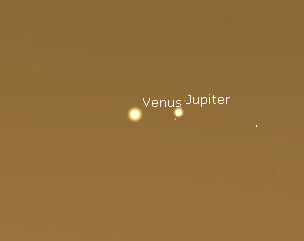
Venus and Jupiter in conjunction at 7 a.m. November 13, 2017. Venus will be 6 times brighter than Jupiter. They will appear half the width of the Moon apart. Created using Stellarium.
These planets will rise at 6:22 a.m., a bit more than an hour before sunrise, at 7:36 a.m.
The times given are for the Traverse City/Interlochen area of Michigan. They may be different for your location.
11/05/2017 – Ephemeris Extra – There will be an Occultation of Aldebaran tonight*
This posting will not be broadcast.
* Or tomorrow morning, depending where you are.
Ephemeris extra for Sunday, November 5th. The Sun will rise at 7:25. It’ll be up for 10 hours and 5 minutes, setting at 5:25. The Moon, 2 days past full, will rise at 7:01 this evening.
Tonight just after 8 p.m. the bright star Aldebaran will disappear at the left edge of the Moon. Aldebaran is angry red eye of Taurus the bull. The star will reappear at the dark upper right edge of the Moon. Start looking at 8 p.m. or before. Use binoculars or a small telescope to spot the star against the glare of the bright Moon. The star is nowhere as bright as shown in the illustrations below. Star appearances and disappearances appear instantaneous, unlike what the illustrations show.
Aldebaran Occultation begins at 8:07 p.m. EST (1:07 UTC Nov 6th)
Aldebaran Occultation ends at 9:00 p.m. EST (02:00 UTC Nov 6th)
Note the times are for the Traverse City/Interlochen area. It will vary by a few minutes for northern lower Michigan. The position angles of the entrance and exit points of Aldebaran will also be different.
Otherwise use a planetarium program like Stellarium to preview the event. However, set the program for topocentric coordinates. In Stellarium that’s in the Configuration window, Tools Tab and check the Topocentric coordinates box. Topocentric coordinates are the apparent positions for your location on the Earth. So also make sure your location is correct. The geocentric conjunction of the two bodies will be November 6, 2:42.9 UTC, so it will occur after midnight on the morning of November 6th for locations in northern Europe and Asia.
Addendum
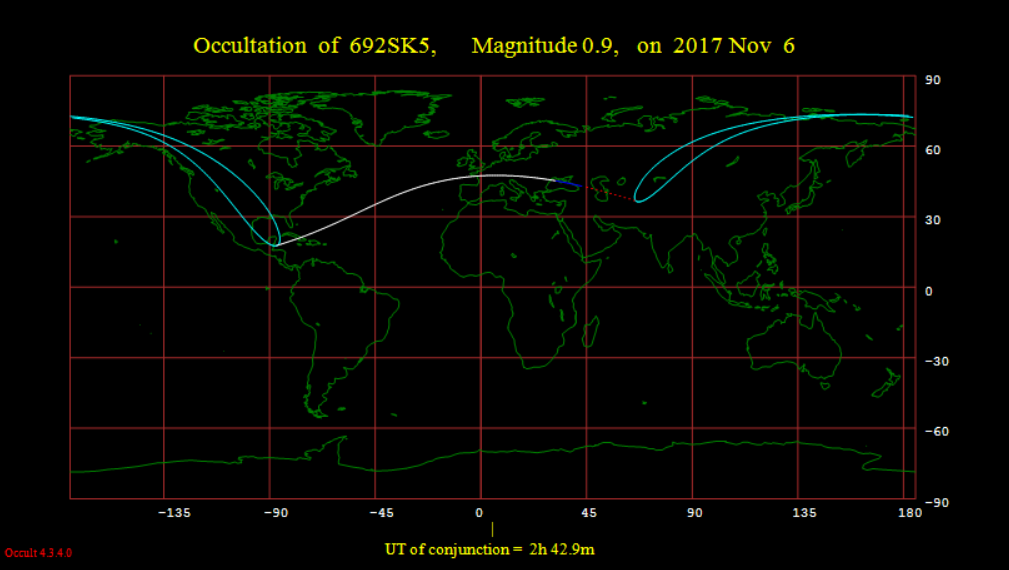
Occultation Map for the occultation of Aldebaran by the Moon . Credit Occult 4 program from IOTA.org.
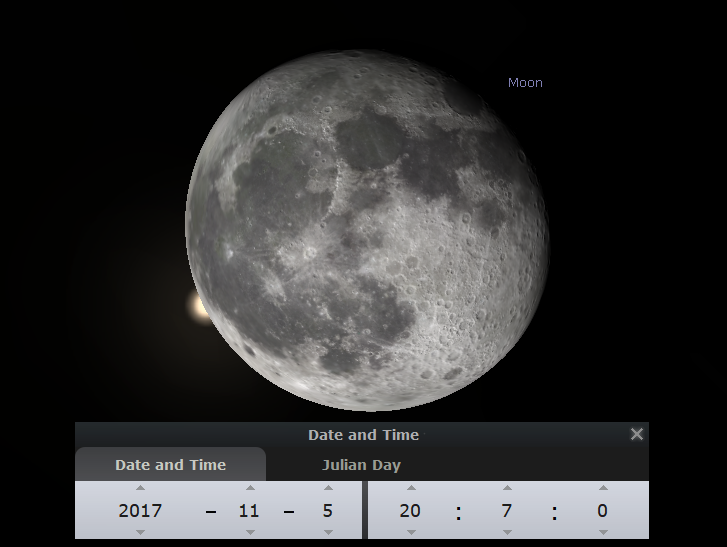
Aldebaran at the start of the occultation at 8:07 p.m. for the Traverse City/Interlochen area. Created using Stellarium.
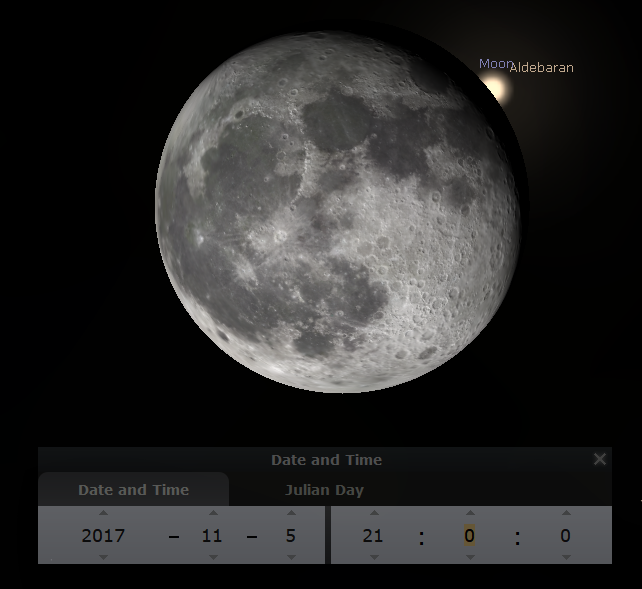
Aldebaran at the end of the occultation at 9:00 p.m. for the Traverse City/Interlochen area. Created using Stellarium.
10/05/2014 – Ephemeris – The Harvest Moon
This is Bob Moler with Ephemeris for Thursday, October 5th. The Sun will rise at 7:45. It’ll be up for 11 hours and 29 minutes, setting at 7:15. The Moon, at full today, will rise at 7:38 this evening.
This is the day of the Harvest Moon. It will rise just before sunset and colored like a huge pumpkin. The huge size is an optical illusion, and the coloring is courtesy of our Earth’s atmosphere selectively bleeding out the blue from the Moon’s light. The reason the Harvest Moon is so special is that during this period the Moon rises for quite a few days just before and in twilight, effectively lengthening the hours of light that farmers can have to harvest their crops. Tomorrow the Moon will rise 32 minutes later than tonight, rather than the average 50 minutes. The effect is a bit diminished this year because the Moon is nearing perigee, its closest to the Earth and is traveling a bit faster than average. The Moon can get down to a 25 minute day-to-day difference.
The times given are for the Traverse City/Interlochen area of Michigan. They may be different for your location.
Addendum
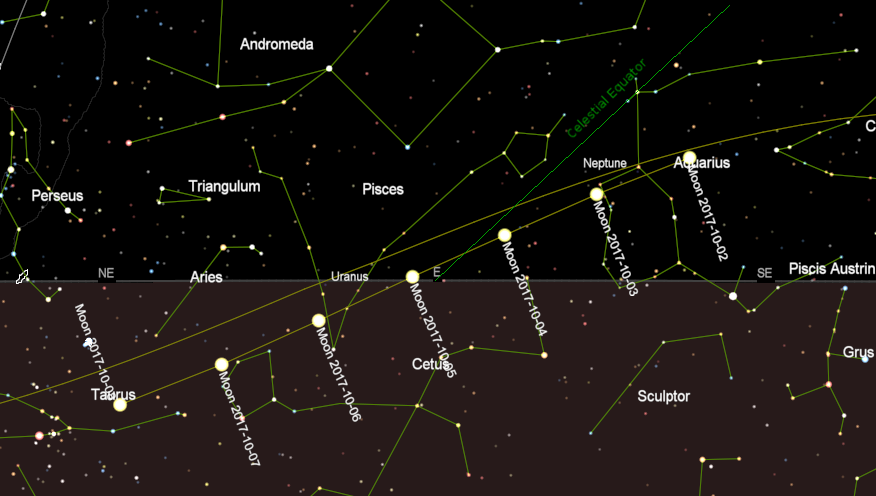
The position of the Moon for 7 nights centered on moon rise tonight (10/04/2017). The rotation of the Earth carries the Moon to rise parallel to the green celestial equator line. The brown area at the bottom is below the horizon. Click on the image to enlarge. Created using Cartes du Ciel (Sky Charts).
 Bob Moler's Ephemeris Blog