Archive
9/24/10 – Ephemeris – Jupiter’s moons
Ephemeris for Friday, September 24th.* The sun will rise at 7:31. It’ll be up for 12 hours and 4 minutes, setting at 7:36. The moon, 1 day past full, will rise at 7:43 this evening.
Jupiter is the bright star-like object in the east and southeast in the evening. In telescopes and even in binoculars the observer can spot up to four stars nearby. These aren’t stars, but moons or satellites of Jupiter. Galileo discovered them 400 years ago with his small telescope. Jupiter has 63 satellites in all, but the rest are tiny objects. Of the four ‘Galilean’ satellites all but one is larger than the moon. They are, in order from Jupiter Io, a volcano riddled world which is constantly resurfacing itself. Next is Europa an icy moon with a good probability of a salty ocean beneath. Giant Ganymede is next, larger than Mercury, it is also icy with the possibility of an ocean. Last is Callisto a dark moon with bright craters.
*Times are for the Grand Traverse Area of Northern Michigan, USA.
9/23/10 – Ephemeris – Jupiter the planet
Ephemeris for Thursday, September 23rd.* The sun will rise at 7:30. It’ll be up for 12 hours and 7 minutes, setting at 7:38. The moon, at full today, will rise at 7:21 this evening. It’s the Harvest Moon.
Jupiter is the largest planet. It’s volume could contain 1,300 earths. It however is only 318 times the earth’s mass. Still, Jupiter contains the mass of two and a half times all the other planets put together. Jupiter is basically a huge ball of hydrogen. It has a rocky/metallic core several timed the size of the earth. Above that is hot liquid metallic hydrogen to generate Jupiter’s incredibly strong magnetic field. Above that is a deep ocean of liquid hydrogen that gradually becomes the hydrogen atmosphere. What we see of the face of Jupiter are clouds of methane and ammonia. Jupiter doesn’t rotate as a solid body. It rotates faster at the equator than the poles. Astronomers have reduced this to three rotational periods, the shortest is less than 10 hours.
*Times are for the Grand Traverse Area of Northern Michigan, USA.
9/22/10 – Ephemeris – The bright planets this week
Ephemeris for Wednesday, September 22nd.* The sun will rise at 7:29. It’ll be up for 12 hours and 10 minutes, setting at 7:39. The moon, 1 day before full, will set at 7:51 tomorrow morning. | Lets take a look at the bright planets for this week. Venus and Mars are very low in the twilight. Venus is the brightest. It’s 40.3 million miles away and slowly approaching, and appears as a thin crescent. It will set at 8:34 p.m. Mars is right and above Venus, and much dimmer. I doubt if you could spot it. The planet Jupiter is up at sunset and will move due south at 1:30 a.m.. It’s located in Pisces this year. Mercury is visible low in the east before sunrise. It will rise tomorrow morning at 5:53 a.m. Mercury is visible in the morning twilight in the east. 6:30 to 7 a.m. is the best time to spot it. Tonight at 11:09 p.m. the sun will cross the celestial equator heading south. For us in the northern hemisphere autumn will begin.
*Times are for the Grand Traverse Area of Northern Michigan, USA.
9/21/10 – Ephemeris – Mercury
Ephemeris for Tuesday, September 21st.* The sun will rise at 7:28. It’ll be up for 12 hours and 13 minutes, setting at 7:41. The moon, 2 days before full, will set at 6:49 tomorrow morning.
The planet Mercury is a mysterious place. It is the closest planet to the sun. It’s really close now because it’s at its closest part of the elliptical orbit of the sun. Mercury’s distance from the sun today is 28.6 million miles, and it’s 91.2 million miles from us. Being the closest planet from the sun has made it very difficult to study with a telescope. It’s always close to the horizon where the atmosphere raises havoc with the image, and is never visible out of twilight, at least for observers north of the earth’s equator. It’s a hard planet to get to as seen by the MESSENGER’s long travel time of nearly seven years. That’s near an end. In six months MESSENGER is to enter orbit of Mercury. We’ll get exquisite images and data from this elusive planet.
*Times are for the Grand Traverse Area of Northern Michigan, USA.
9/20/10 – Ephemeris – Mercury and Jupiter
Ephemeris for Monday, September 20th.* The sun will rise at 7:27. It’ll be up for 12 hours and 16 minutes, setting at 7:43. The moon, 3 days before full, will set at 5:48 tomorrow morning.
Yesterday Mercury was at it greatest angular separation from the sun. It is now best seen between 6:30 and 7 a.m. low in the east. Over the next week it will move back a bit toward the sun and will actually get brighter and its illuminated face gets wider, as its phase increases from half illuminated to gibbous. It looks very tiny in telescopes. Farther from the sun the giant planet Jupiter will appear opposite the sun in the sky, rising at sunset. Jupiter is that bright ‘star’ seen in the east and southeastern sky in the evening. Today it is at its closest to the earth. Because Jupiter is 5 times the earth’s distance from the sun, subtracting the earth’s solar distance from Jupiter; it will be 4 times the earth-sun distance or 368 million miles away. We’ll visit Jupiter later this week.
*Times are for the Grand Traverse Area of Northern Michigan, USA.
9/17/10 – Ephemeris – observing events including International Observe The Moon Night
September 17: This is Ephemeris for Friday, September 17th.* The sun will rise at 7:23. It’ll be up for 12 hours and 25 minutes, setting at 7:49. The moon, 2 days past first quarter, will set at 2:41 tomorrow morning.
Tonight the Grand Traverse Astronomical Society will host a public viewing night at Northwestern Michigan College’s Rogers Observatory starting at 9 p.m. On tap will be the moon, and the planets Jupiter and Uranus which will appear near Jupiter. The observatory is located south of Traverse City, on Birmley Road between Garfield and Keystone roads. Tomorrow, being International Observe the Moon Night, the society will bring its and its members telescopes to the Clinch Park Marina to view the moon. That is, only if it’s clear. The start time for that event will be 8 p.m. The waxing moon is leading up to the Harvest Moon which will occur only a bit more than 6 hours after the official beginning of autumn.
*Times are for the Grand Traverse Area of Northern Michigan, USA.
9/16/10 – Ephemeris – the moon
September 16: This is Ephemeris for Thursday, September 16th.* The sun will rise at 7:22. It’ll be up for 12 hours and 28 minutes, setting at 7:51. The moon, 1 day past first quarter, will set at 1:38 tomorrow morning.
We’re looking at the moon this week leading up to International Observe the Moon Night Saturday night. We’ll have some telescopes at the Clinch Park Marina Saturday if it’s clear. The moon tonight is special for those with telescopes. With lots of features that will be revealed by the moon’s sunrise terminator, the sunrise line of the east edge of the visible part of the moon. Starting at the north or top of the moon is the strange square crater Barrow. Below that is the ringed plane, the crater Plato. It’s cool watching the shadows of the crater walls recede as the sun rises. There’s a gash in the mountains nearby called the Alpine Valley. On the southern half of the moon there’s a thin line of a shadow, the straight wall a 900 foot high and 67 mile long cliff.
*Times are for the Grand Traverse Area of Northern Michigan, USA.
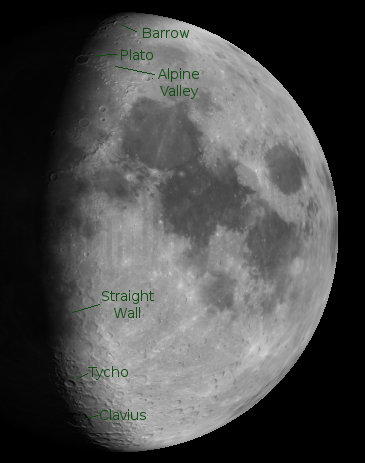
Moon 1 day past first quarter. Created using Virtual Moon Atlas.
Is crater Barrow really square? You be the judge.
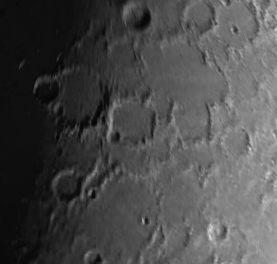
Overhead view of the crater Barrow. Created using Virtual Moon Atlas.
9/15/10 – Ephemeris – the planets this week
September 15: This is Ephemeris for Wednesday, September 15th.* The sun will rise at 7:21. It’ll be up for 12 hours and 31 minutes, setting at 7:53. The moon, at first quarter today, will set at 12:37 tomorrow morning. | Lets take a look at the bright planets for this week. Venus and Mars are very low in the twilight. Venus is the brightest. It’s 45 million miles away and slowly approaching, and appears as a tiny crescent. It will set at 8:57 p.m. Mars is right of Venus and a bit above, and much dimmer. I doubt if you could spot it. Mars will set at 9:13 p.m. The star Spica is just right of Venus and Mars. The planet Jupiter now rises just about due east at 8:06 p.m., moving due south at 2:01 a.m.. It’s located in Pisces this year. Mercury is becoming visible low in the east before sunrise It will rise tomorrow morning at 5:53 a.m. Mercury is becoming more and more visible in the morning twilight. 6:30 to 7 a.m. is the best time to spot it.
*Times are for the Grand Traverse Area of Northern Michigan, USA.
9/14/10 – Ephemeris – the moon
September 14: This is Ephemeris for Tuesday, September 14th.* The sun will rise at 7:20. It’ll be up for 12 hours and 34 minutes, setting at 7:55. The moon, 1 day before first quarter, will set at 11:38 this evening. | We’re looking at the moon this week leading up to International Observe the Moon Night Saturday night. We’ll have some telescopes at the Clinch Park Marina Saturday if it’s clear. The moon, even to the unaided eye shows bright and dark areas. The largest bright area to the bottom or south part of the moon is the highlands, a rugged area saturated with craters. The dark areas are generally nearly circular and flat with few craters. These are the maria which is Latin for seas. Which early telescopic viewers thought were really water filled. The seas are gigantic impact basins created by asteroids impacting the moon and their floors are filled with lava from the moon’s interior. They have relatively few craters that occurred later on.
*Times are for the Grand Traverse Area of Northern Michigan, USA.
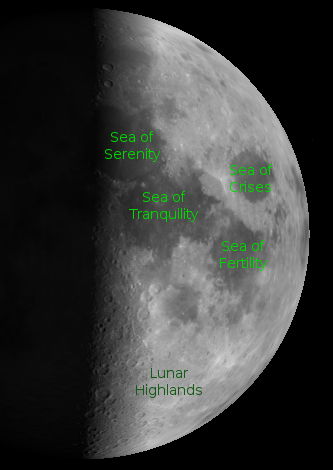
Moon 1 day before first quarter. Created using Virtual Moon Atlas.
9/13/10 – Ephemeris – the moon
September 13: This is Ephemeris for Monday, September 13th*. The sun will rise at 7:18. It’ll be up for 12 hours and 37 minutes, setting at 7:56. The moon, 2 days before first quarter, will set at 10:46 this evening. | We’re going to look at the moon this week leading up to International Observe the Moon Night Saturday night. We’ll have some telescopes at the Clinch Park Marina Saturday if it’s clear. Looking at the moon tonight in binoculars or a small telescope you can see gray areas of the Sea of Crises nearest the bright edge, the Sea of Fertility and toward the center the Sea of Tranquility, where the Apollo 11 astronauts landed. Looking south near the terminator, the line between light and dark on the moon are three prominent craters in a seeming chain. The most prominent is Theophilus with a nice central peak, If you’re interested in a computer based moon map google “Virtual Moon Atlas” for a free download. It allows you to move around the moon, has a wealth of facts and images too.
*Times are for the Grand Traverse Area of Northern Michigan, USA.
Update:

The moon 2 days before first quarter. Image produced using Virtual Moon Atlas

