Archive
06/06/2016 – Ephemeris – Venus passes behind the Sun today
Ephemeris for Monday, June 6th. Today the Sun will be up for 15 hours and 27 minutes, setting at 9:25, and it will rise tomorrow at 5:57. The Moon, 2 days past new, will set at 10:52 this evening.
Today the planet Venus will be in superior conjunction with the Sun, and indeed will pass directly behind the Sun. That event will be completely unobservable due to the Sun’s brilliance. Fours years ago we observed the transit of Venus across the Sun. June 6, 2012. It got me thinking. Transits of Venus occur in pairs 8 years apart followed by a very long interval of over 100 years. It turns out the Venus orbits the Sun 13 times in approximately the same time that the earth orbits the Sun 8 times. In 4 years Venus goes around the Sun 6 ½ times and put’s Venus behind the Sun 4 years after 2012. Today to be precise. In another 4 years we’ll have Venus between the Earth and the Sun again, except Venus will be a bit too far north to transit the Sun.
Times are for the Traverse City/Interlochen area of Michigan. They may be different for your location.
Addendum
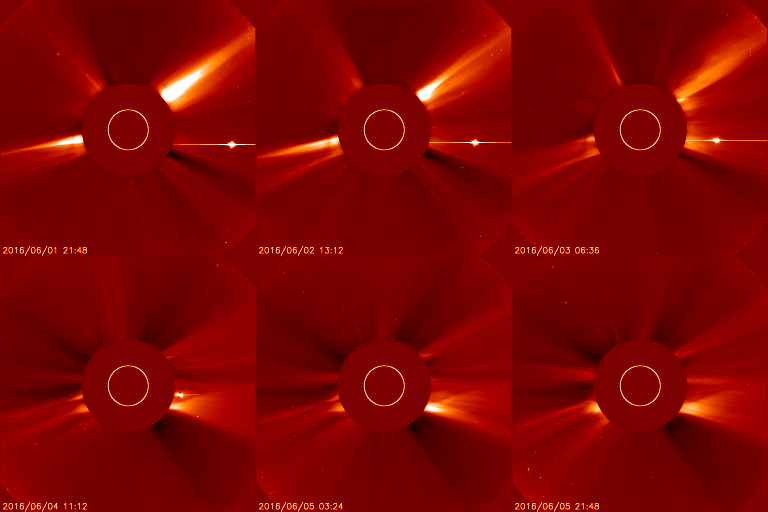
SOlar and Heliospheric Observatory (SOHO) stationed at the Earth-Sun Lagrangian point 1 (L1) a million miles sunward of the Earth. Sent back this animated GIF of Venus approaching the Sun in the last few days. In the LASCO C2 coronagraph the large disk at the center blocks the brightest part of the Sun’s image. The white circle represents the Sun’s disk size. Credit ESA/NASA.
Aldebaran Occultation November 26, 2015 from Northern Michigan
On the early morning of November 26th, that’s Thanksgiving morning here in the US, The Moon will pass in front of, or occult, the bright star Aldebaran in Taurus the bull. The event is called an occultation.
Three first magnitude stars can be occulted by the Moon, Aldebaran, Regulus in Leo the lion, Antares in Scorpius the Scorpion, and Spica in Virgo the virgin, since these stars lie within 5 1/2 degrees of the ecliptic, the plane of the Earth’s orbit. The Moon’s orbit is inclined to it by 5º 14′. Also because the Moon’s orbit precesses over a period 18.6 years they occur over the Earth in monthly series every 18.6 years. There are 43 monthly occultations that will occur in this series, which actually started in January. This is the best of them so far. We’ll have another on the evening of January 19th next year. Below is a chart of the event from the Astronomical Almanac Online which can be accessed here: http://asa.usno.navy.mil/.
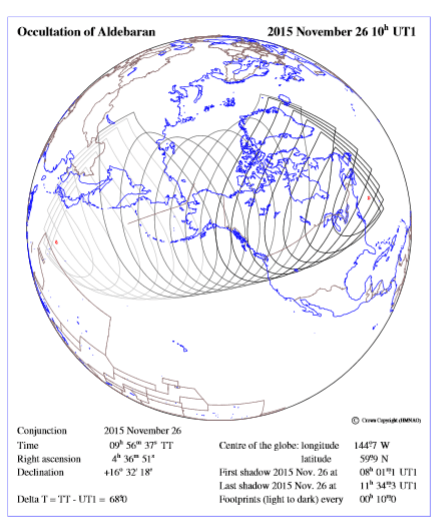
Map of the area where the occultation of Aldebaran is visible. Credit: Astronomical Almanac Online – U.S. Nautical Almanac Office, United States Naval Observatory (USNO), in the United States and Her Majesty’s Nautical Almanac Office (HMNAO), United Kingdom Hydrographic Office (UKHO), in the United Kingdom.
The occultation will be visible for locations within the nested grid of curved lines.
The two important events of the occultation is the star’s disappearance and reappearance. The times of these two events depend on your location, and are scientifically useful in determining the precise position of the Moon.
I’ve worked out the timings for my location about half way between Traverse City and Interlochen, so they should be within a couple of minutes of your observed time if you’re within 30 or so miles. Go out early, the earlier the better. The Moon will be especially bright, being only 12 hours after the instant the Moon will be full. Binoculars or a small telescope will be necessary to spot Aldebaran. The farther away Aldebaran is away from the Moon the easier it can be picked up. Note as a rule of thumb, the Moon moves its own diameter against the stars in about an hour.
For the Traverse City/Interlochen area I calculate the disappearance of Aldebaran at 5:38 a.m.
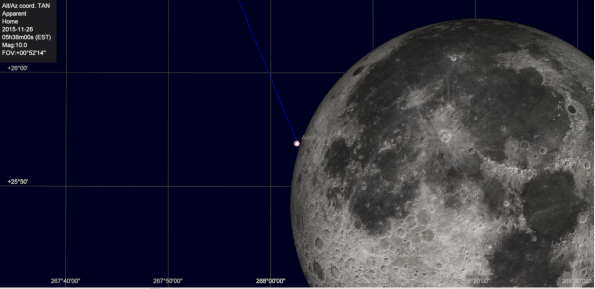
Aldebaran just prior to it’s disappearance behind the Moon from Interlochen/Traverse City. Created using Cartes du Ciel (Sky Charts).
For the Traverse City/Interlochen area I calculate the reappearance of Aldebaran at 6:29 a.m.
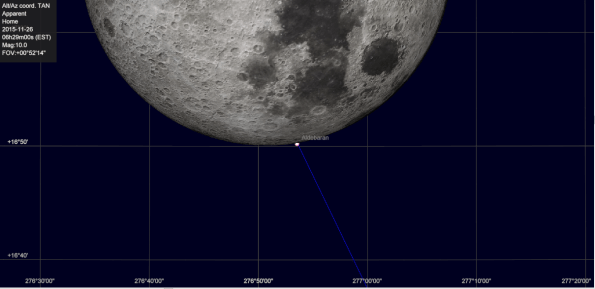
Aldebaran just after it’s reappearance from behind the Moon from Interlochen/Traverse City. Created using Cartes du Ciel (Sky Charts).
The Moon will be low in the western sky.
Timings for 3 locations in Michigan
This can be used to approximate the occultation time for other locations in Michigan.
City(s)                    Disappears  Reappears Location
Ironwood          5:33 a.m.   6:25 a.m. Northwestern corner of the
                                        Upper Peninsula (UP) of
                                        Michigan
Interlochen/      5:38 a.m.   6:29 a.m. Northwestern lower Michigan
   Traverse City
Monroe            5:45 a.m.   6:29 a.m. Southeastern corner of Michigan
Estimating timings for your location
I used Cartes du Ciel the free software that I have a link to on the right. Make sure that the program is set for topocentric positions under Setup/Solar System. And you have entered your position under Setup/Observatory. You can find your location in Google Earth.
You can also use Stellarium. Just make sure the Moon is normal sized.
In both programs you can lock the Moon or Aldebaran in the center of the screen Pick a time in advance of the occultation and using the set time window walk the star towards the Moon, mark the time. Then walk the star out from the Moon and record the reappearance time. That’s it.
This should work with other planetarium programs too.
03/19/2015 – Ephemeris – A remarkable solar eclipse tomorrow, however we, in the US, won’t see it.
Ephemeris for Thursday, March 19th. The Sun will rise at 7:48. It’ll be up for 12 hours and 5 minutes, setting at 7:53. The Moon, 1 day before new, will rise at 7:50 tomorrow morning.
There will be a rare solar eclipse tomorrow. The bad news is that it won’t be visible from here. Be that as it may, it is total for a circle of ocean near Greenland, and because tomorrow is also the vernal equinox the it is also sunrise at the north pole. As it happens the path of the eclipses totality tracks to the north pole, so the eclipse, partial and total will be visible from there. I’m not sure how long it’s been since an eclipse totality was visible at the pole on an equinox. The next solar eclipse visible from the United States will be on August 21, 2017. This is an eclipse, whose path of totality crosses the continental United States. In about 2 weeks we’ll have a lunar eclipse whose first stages can be seen from northern Michigan in morning twilight.
Times are for the Traverse City/Interlochen area of Michigan. They may be different for your location.
Addendum
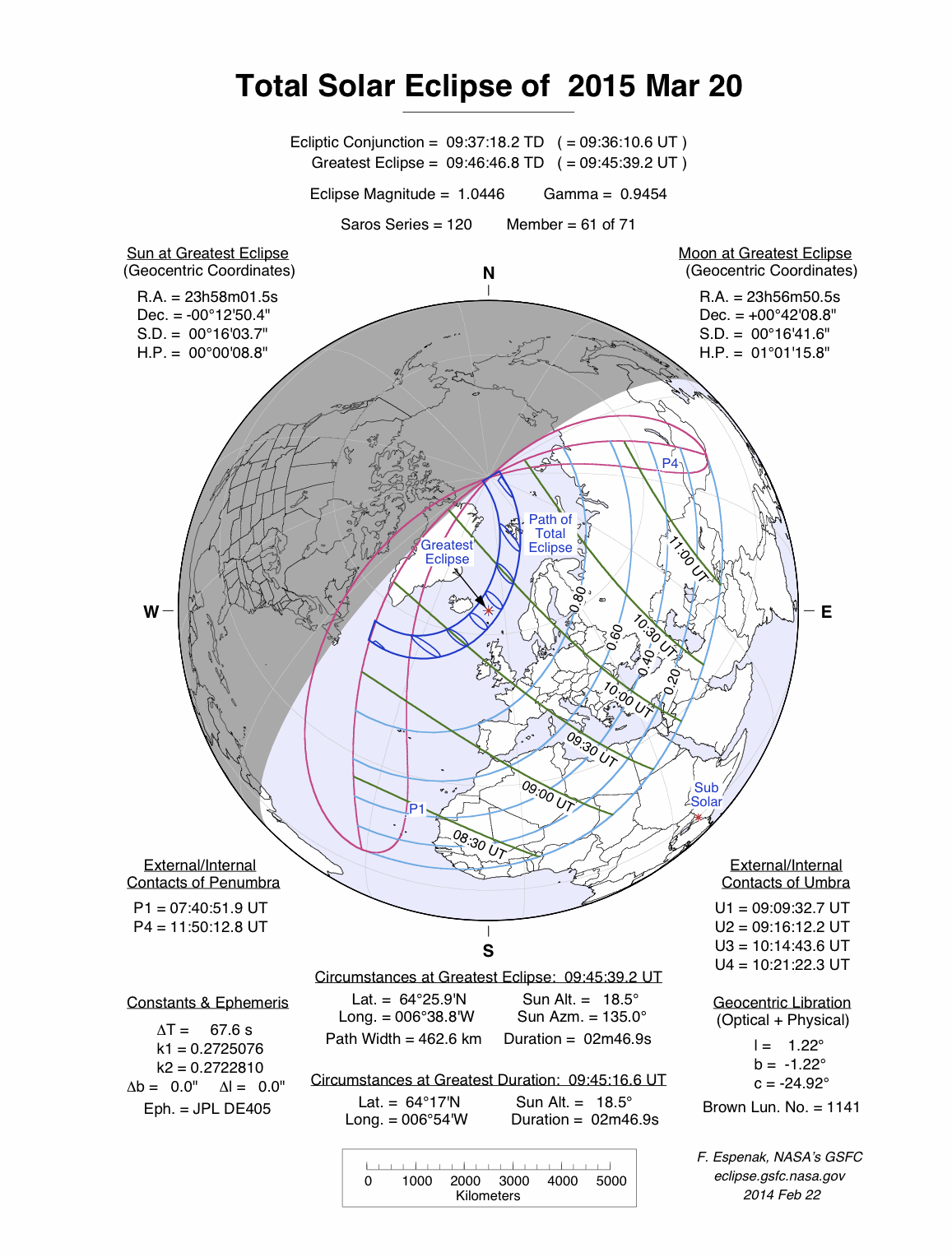
Pertinent section of the March 20, 2015 total solar Eclipse map. Click on image above for the entire image. Credit: Fred Espenak, NASA’s GSFC.
01/26/2015 – Ephemeris – First quarter Moon, a telescopic asteroid misses the Earth tonight and a Jupiter shadow recap
Note: Ephemeris program generally features objects in the sky that are visible to the naked eye or binoculars. However in the blog, with the ability to expand in both content and illustrations I can add information for telescopic observers and expand postings.
Ephemeris for Monday, January 26th. The sun will rise at 8:08. It’ll be up for 9 hours and 34 minutes, setting at 5:42. The moon, at first quarter today, will set at 1:30 tomorrow morning.
The Moon will be perfectly half illuminated by the sun at 11:48 p.m. The gray patches that appear on the Moon’s surface were called by early telescopic astronomers: seas; because they thought they were bodies of water. The Moon is pretty much bone dry, except for some eternally shadowed craters at the poles, which still aren’t wet because the water is frozen. Anyway the seas or maria on the moon are indeed low spots. The seas, from the top center of the moon down to the lower right are Serenity, Tranquility, Nectar and Fertility. To the upper right all by itself is the Sea of Crises. From Serenity to Fertility some can imagine an upside down rabbit, with ears of unequal sizes. In a few more days we’ll see the face of the man in the Moon.
Times are for the Traverse City/Interlochen area of Michigan. They may be different for your location.
Addenda
First Quarter Moon
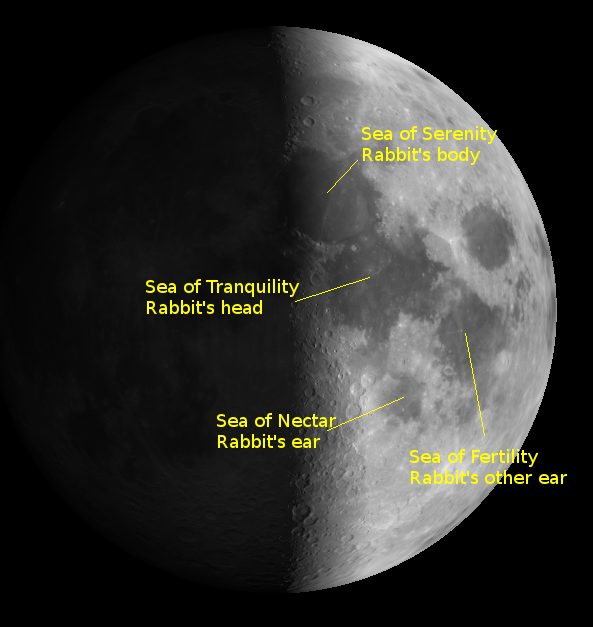
Rabbit in the first quarter Moon. Created using Virtual Moon Atlas.
Tonight Asteroid 2004 BL86 will pass three times the Moon’s distance from the Earth
This evening a rather large asteroid for a Near Earth Object or NEO will pass three-quarters of a million miles from the Earth. The asteroid has the designation 2004 BL86. The cool thing is that this asteroid is half a kilometer or so meters across, that’s 5 soccer or football fields in diameter. Radar from this close passage should nail down the size and shape. Between Goldstone Tracking Station and Arecibo Observatory in Puerto Rico the asteroid should be mapped down to 2 to 4 meters. It would be definitely not cool if this asteroid ever hit the Earth. It will be 9th magnitude, and so will be visible in small telescopes, and it will cross the east or left side of the Beehive star cluster also designated M44 starting about midnight tonight.
If you want to observe the event and don’t have the equipment head on over to www.slooh.com. This is the site for Slooh (pronounced “slew”) Community Observatory which has observatories in the Canary Islands and Chile, and partners with others. Besides these events, members can schedule time and use the telescopes via the internet. Check the above link for more information.
The chart below is from NASA/JPL’s Near Earth Object Program: Updated Charts for Asteroid 2004 BL86 Earth Flyby on Jan 26, 2015
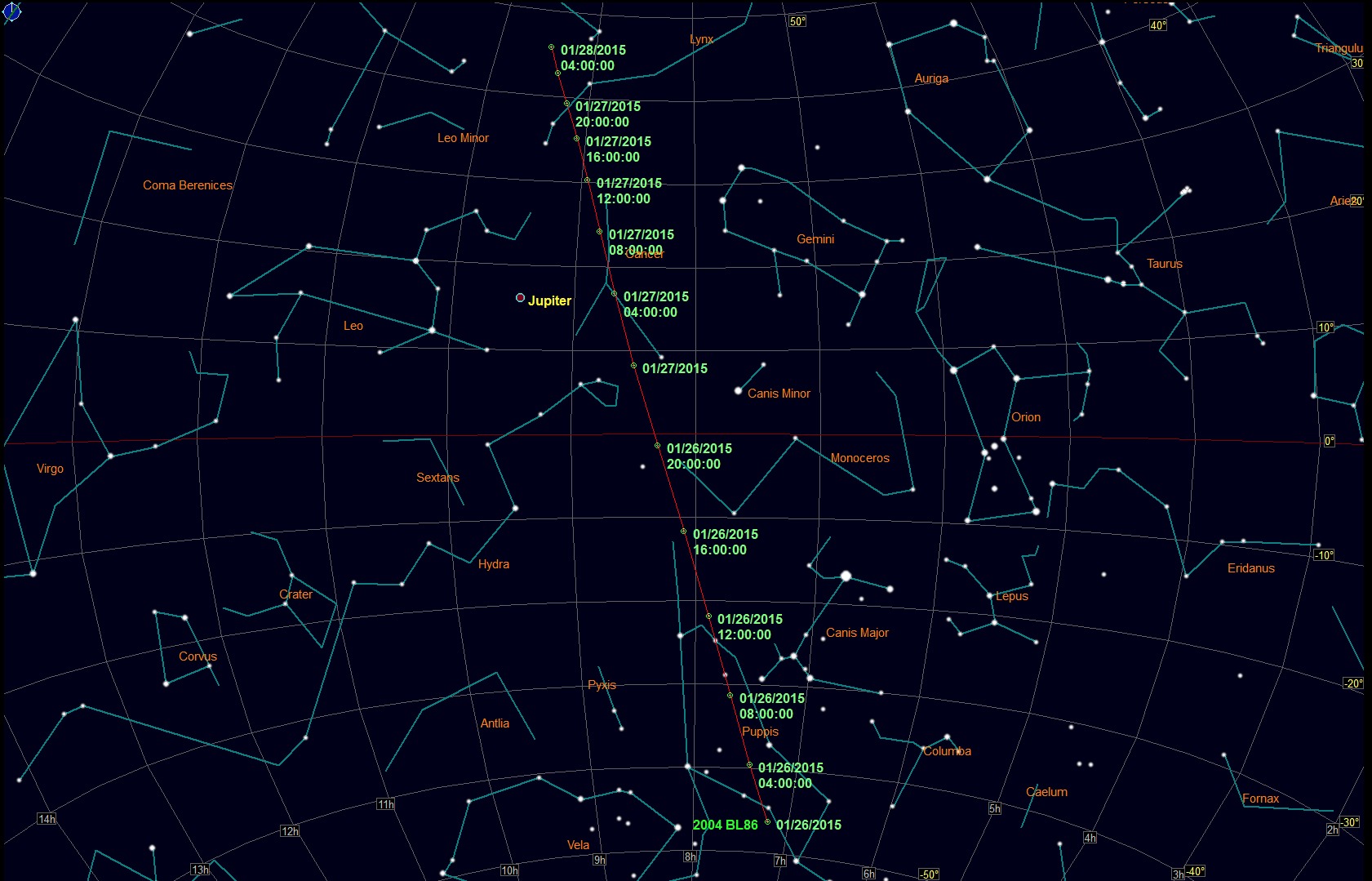
The track of asteroid 2004 BL86 as viewed from the Earth, plotted on a star chart with an equatorial coordinate grid. The asteroid location is shown at four-hour intervals from January 26 to 28. The indicated times are Universal Time; subtract 5 hours for Eastern Standard Time (EST), 6 hours for CST, and 8 hours for PST. On January 26, the asteroid will pass within 11 degrees of Jupiter, now shining brightly in the east in the evening sky. Image and caption credit: NASA/JPL-Caltech. JPL orbit solution #43, with star chart graphics produced using C2A. Click to enlarge.
Below is a chart from Universe Today. Here’s a link to their web page.
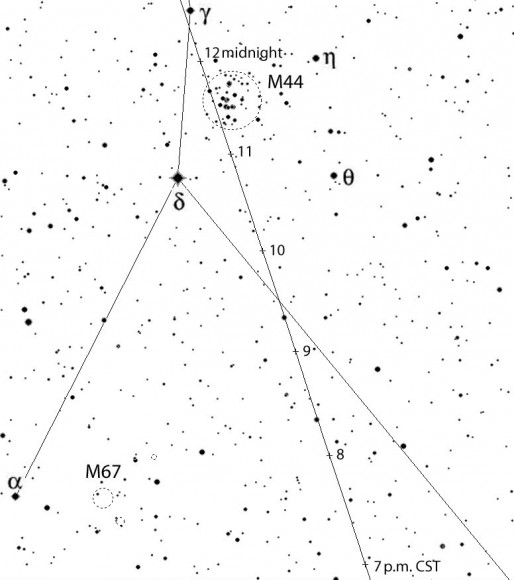
A Black on white chart of asteroid 2004 BL86 crossing to the right of M44. Note that the actual path depends on your location since the chart is based on the center of the Earth. The closer to your horizon the greatest deviation from the path shown. Time Ticks are for CST. Add one hour to them for EST. The Midnight tick mark is 0 h UT or GMT the 27th. Credit Universe Today and created with Chris Marriott’s SkyMap software.
Sky and Telescope has charts that have BL86’s track plotted about 15 minutes ahead of the track above. It is a newer chart, so the asteroid’s position may have been updated. The Sky and Telescope narrative and charts are here.
Results from Jupiter’s early Saturday satellite shadow play
The video live feed from the Griffith Planetarium in Los Angeles was a bust. It suffered from what astronomers call bad seeing. I mean really horrible seeing. Astronomers ascribe at least two qualities to the sky, other than brightness due to the moon or light pollution. That is transparency and seeing. Seeing is the steadiness of the sky. What Jupiter looked like was looking at a small disk at the bottom of a swimming pool while the kids are still playing in it. At first I ascribed it to Jupiter being low in the LA sky, being 3 hours west of here. But it didn’t get better as the night progressed. I could occasionally make out Callisto’s shadow, just because I knew where it’s supposed to be. But that’s it.
However my friend from the Detroit area, Scott Anttila, blessed at least for a while with clearer and calmer skies got some wonderful pictures of the first part of the multiple shadow event.
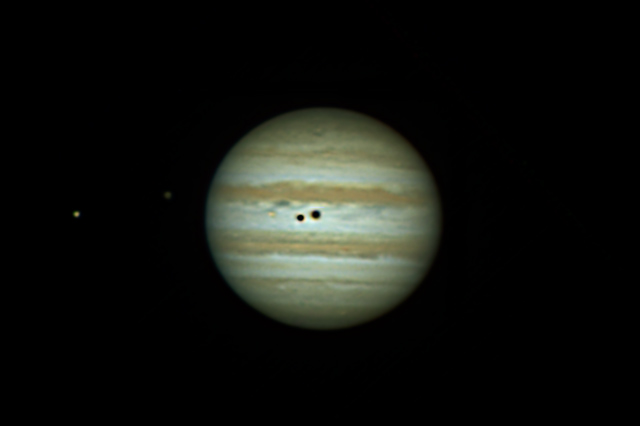
Left to right the shadows of Io and Callisto crossing the face of Jupiter at 12:52 a.m. January 24, 2015. Credit Scott Anttila.
Note that Callisto has a larger shadow than Io. That’s mainly due to it’s greater distance from Jupiter that makes its shadow larger and fuzzier than the closer Io.
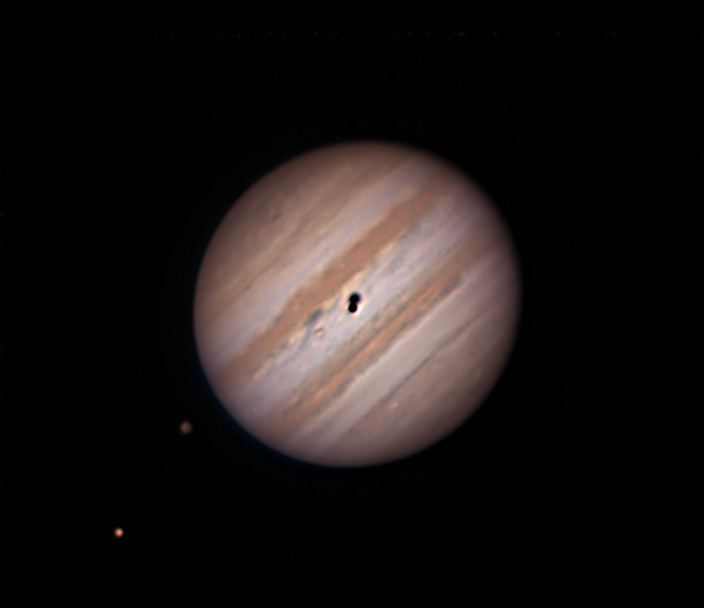
In this picture Io’s shadow has just caught up with Callisto’s shadow. Credit: Scott Anttila.
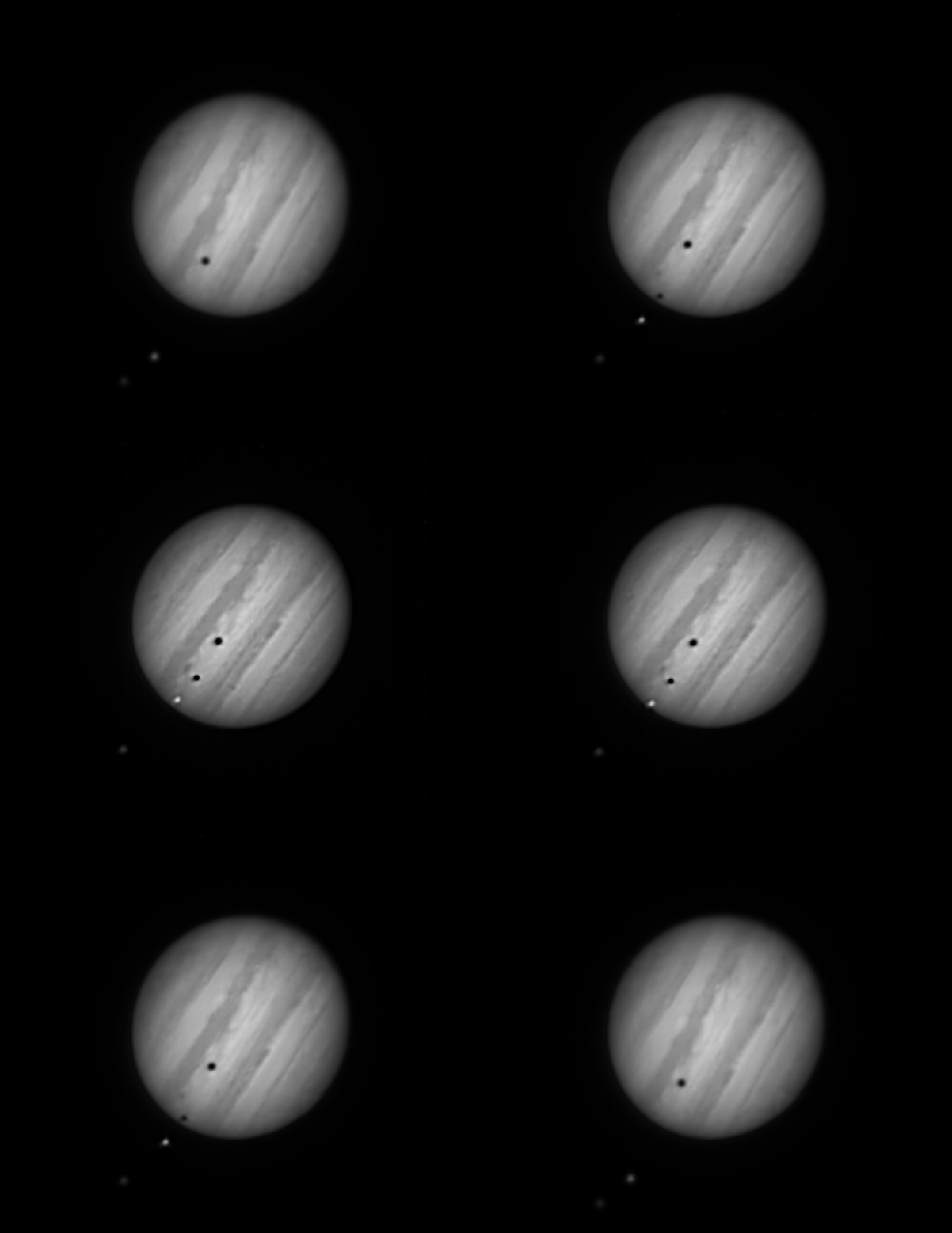
Rocking animation of the early stages of the shadow show on Jupiter. Callisto’s shadow already on the planet while Io’s shadow is just entering. Also Io’s transit is starting, following its shadow on the planet. Credit: Scott Anttila
01/23/2015 – Jupiter will experience three simultaneous total solar eclipses tonight!
Total solar eclipses on Jupiter are nearly a daily occurrence on Jupiter. However what we’ll see is the shadows of the moons crossing the face of the planet. Shadows of the Jovian moons on the fave of Jupiter are difficult to see with small telescopes. The look like tiny inky black dots.
Another way to watch the event is via Griffith Observatory in Los Angeles. The link is here. Their event starts at 11:30 p.m. EST because Jupiter rises later there. The email I received from them says the next triple shadow event on Jupiter won’t occur until 2032,
Here’s the schedule: Moons: I = Io, II = Europa, IV = Callisto; SHA = Shadow, Tra = Transit (a moon crossing disk of Jupiter)
Moon Event      UT Date    hh:mm  EST Date    Time
 IV: Sha start: 24 Jan 2015 3:11  23 Jan 2015  10:11 p.m.
  I: Sha start: 24 Jan 2015 4:36  23 Jan 2015  11:36 p.m.
  I: Tra start: 24 Jan 2015 4:56  23 Jan 2015  11:56 p.m.
 IV: Tra start: 24 Jan 2015 6:20  24 Jan 2015   1:20 a.m.
 II: Sha start: 24 Jan 2015 6:28  24 Jan 2015   1:28 a.m.
 I:  Sha end  : 24 Jan 2015 6:53  24 Jan 2015   1:53 a.m.
 II: Tra start: 24 Jan 2015 7:08  24 Jan 2015   2:08 a.m.
 I:  Tra end  : 24 Jan 2015 7:13  24 Jan 2015   2:13 a.m.
 IV: Sha end  : 24 Jan 2015 8:02  24 Jan 2015   3:02 a.m.
 II: Sha end  : 24 Jan 2015 9:23  24 Jan 2015   4:23 a.m.

Note: All three shadows will be on Jupiter at the same time from 1:28 to 1:53 a.m. EST.
Times provided by the Jevent.exe DOS program downloaded from http://www.projectpluto.com/
Here’s an animation of what the event might look like at half hour intervals look like starting at 9:45 p.m.
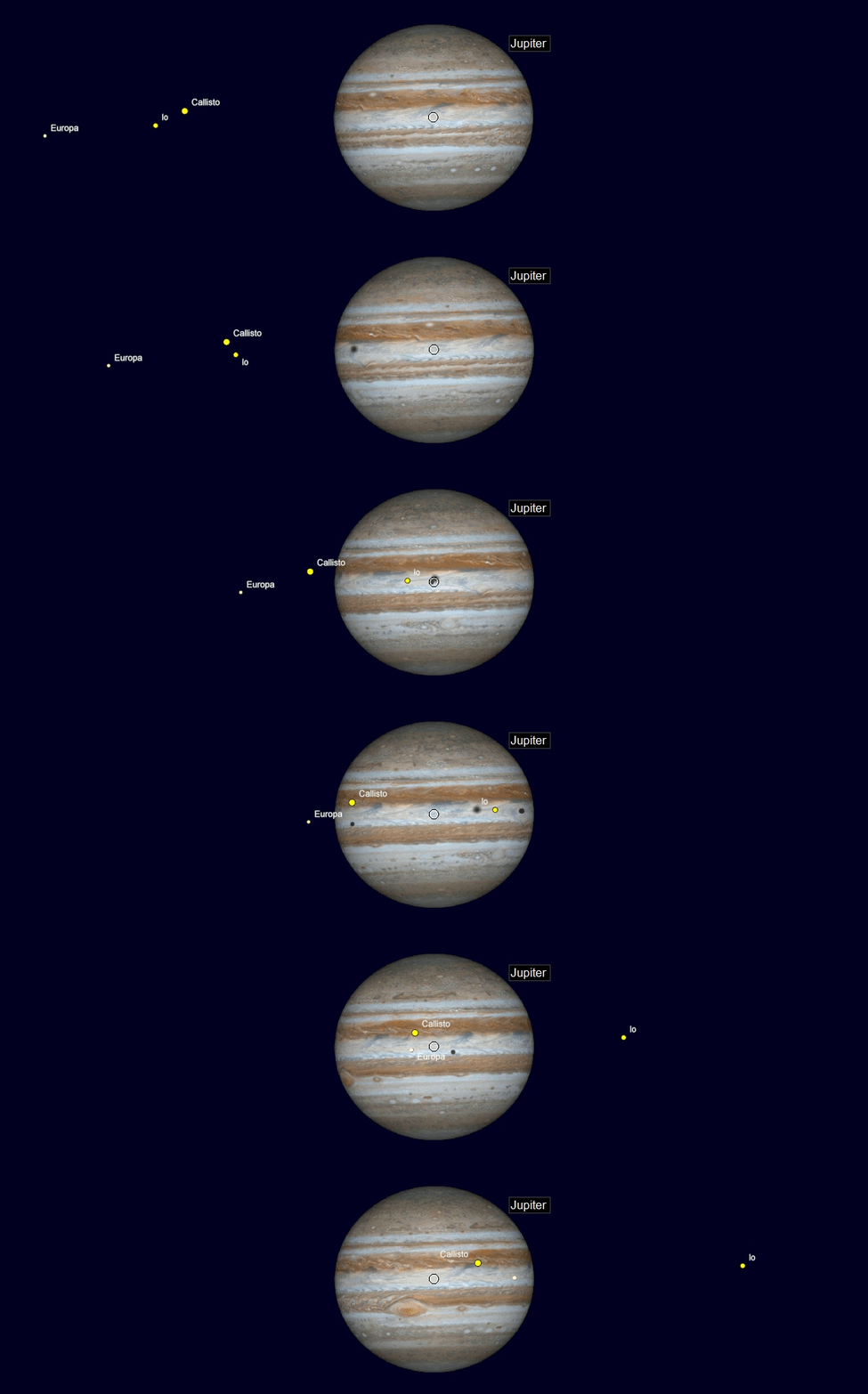
Animation of Jupiter’s satellite shadows starting at 9:45 p.m. and ending at 4:45 a.m. Created using Cartes du Ceil Sky Charts) and GIMP. The circle in the center of Jupiter is an artifact of the program. Click for a larger view.
01/06/2015 – Ephemeris – Star to stir up solar system’s comets, but you’re gotta wait a bit.
Ephemeris for Tuesday, January 6th. The sun will rise at 8:19. It’ll be up for 8 hours and 57 minutes, setting at 5:17. The moon, 2 days past full, will rise at 7:12 this evening.
In about a quarter to half a million years from now a star with the name HIP 85605 will pass through the Oort cloud of comets that is the extreme outer part of the solar system. The star’s name comes from the Hipparcos catalog created from data from the European satellite which created improved distances of nearby stars. HIP 85605 star is nearby and very faint. The star should pass through the Oort cloud twice, coming and going. What happens is the star will tend to scatter small bodies in its wake, throwing some comets in toward the sun and others it will eject from the solar system. There were all kinds of scare headlines out of this. Something like this “Will a comet shower end life on the Earth?” No it won’t. This kind of thing happens every few million years.
Times are for the Traverse City/Interlochen area of Michigan. They may be different for your location.
Addendum
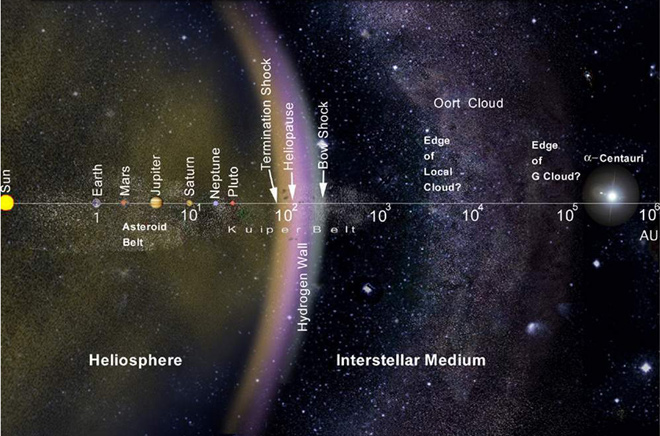
NASA diagram of the solar system on a logarithmic scale. Each interval is ten times longer than the one on the left. On this scale the star HIP 85605 will penetrate to the inner part of the Oort cloud. Click to enlarge.
Tip o’the old astronomer’s cap to Universe Today where I found this story.
10/23/2014 – Ephemeris – Partial solar eclipse tonight for most of the US
Ephemeris for Thursday, October 23rd. The sun will rise at 8:08. It’ll be up for 10 hours and 36 minutes, setting at 6:44. The moon is new today, and won’t be visible.
This evening there will be a partial solar eclipse, in which we will see only the first part before the sun sets. The eclipse will be visible for all but the extreme eastern part of the country. It will be a partial eclipse for all who can see it because the core of the Moon’s shadow will miss the Earth to the north. For the Interlochen Public Radio listening area (Northwestern Lower Michigan) the eclipse will star a couple of minutes before or after 5:32 p.m. and will end at sunset around 6:44 p.m. The low position of the sun make a lack of cloud cover necessary to be able to see it. Proper approved solar filters, or a projection method are necessary to view the eclipse. Do Not Look Directly at the Sun! The NMC Observatory south of Traverse City will be open, weather permitting starting at 5 p.m. Also the Platte River Point location at the Sleeping Bear Dunes National Lakeshore will also be available.
An added attraction for this eclipse is the appearance of the largest sunspot group to appear on the sun in years.
Times are for the Traverse City/Interlochen area of Michigan. They may be different for your location.
Addendum
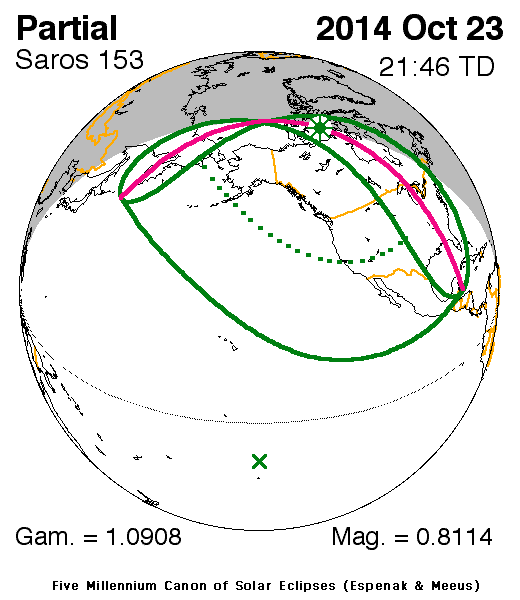
Coverage of the partial solar eclipse of October 23, 2014. Credit: NASA.

The setting partially eclipsed sun from Traverse City. Created using Stellarium.
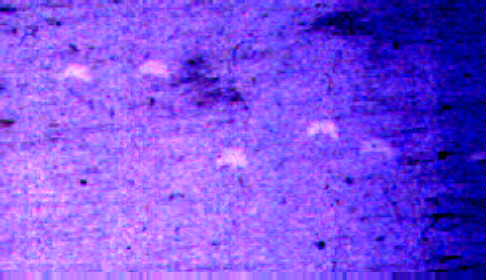
Partially eclipsed sun using a series of pinholes projected on a reasonably white surface.
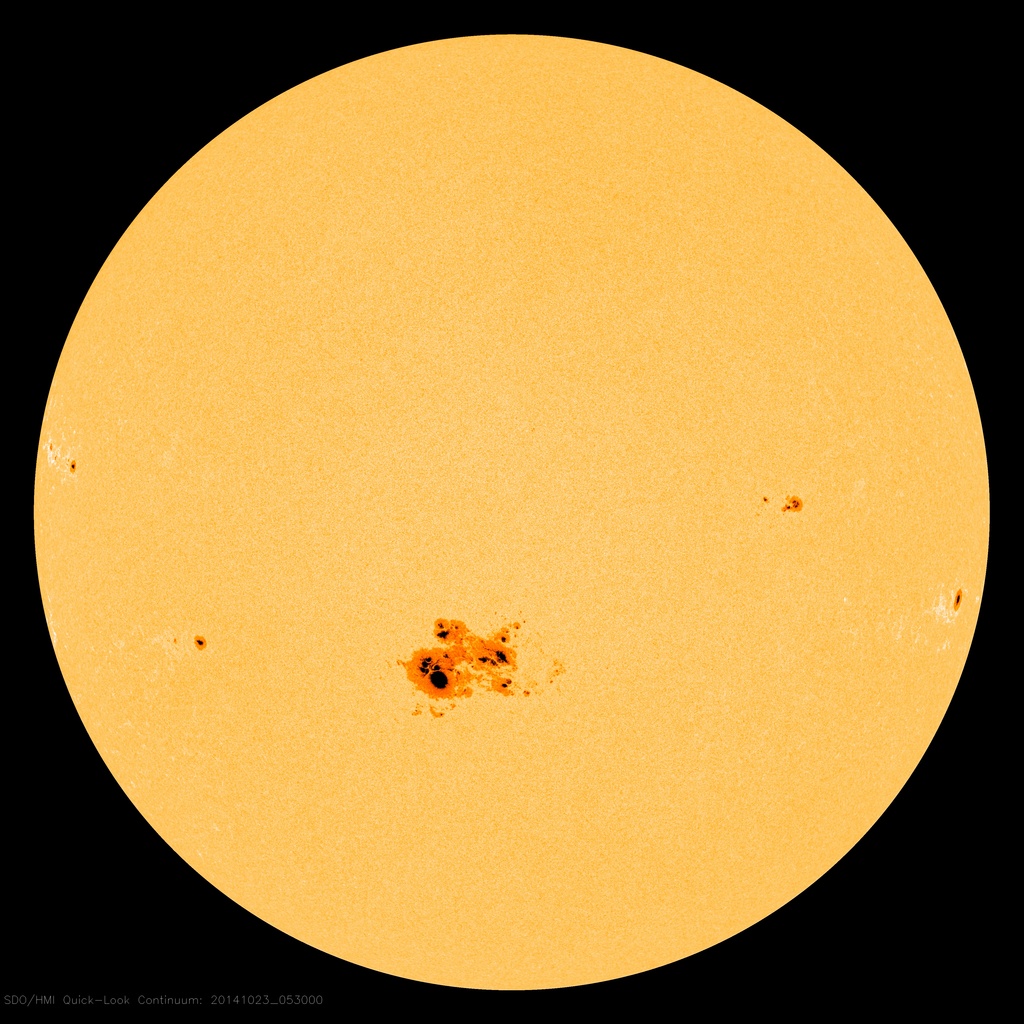
The Sun at 1:30 a.m. 10/23/2014 with large sunspot group AR 2192. Credit NASA – Solar Dynamics Observatory.
This baby gave off a X Class flare yesterday (10/22/2014). Could be more in store. Maybe we’ll see an aurora later this week.
07/03/2014 – Ephemeris – Today the Earth is its farthest from the Sun for this year
Thursday, July 3rd. Today the sun will be up for 15 hours and 28 minutes, setting at 9:30. The moon, 2 days before first quarter, will set at 12:35 tomorrow morning. Tomorrow the sun will rise at 6:02.
Later today the Earth will pass a point in its orbit called aphelion. This is the point where the Earth is its farthest from the Sun. Astronomers measure it in terms of the astronomical units AU), the mean distance between the Earth and the Sun. In astronomical units the Earth will be 1.01668 AU from the Sun at 6:59 p.m. (22:59 UT). Converted to miles it is 94.51 million miles (152.1 million km). The 1.7 percent farther distance from the Sun doesn’t really show up as making a difference in temperature. It is swamped by the greater effect of the Earth’s axial tilt currently giving us our summer season. The one thing about aphelion in summer gives us is a longer summer, than winter. The Earth travels slightly slower when farther from the Sun than when closer to it, so summer is the longest season at 94 days.
Times are for the Traverse City/Interlochen area of Michigan. They may be different for your location.
Addendum
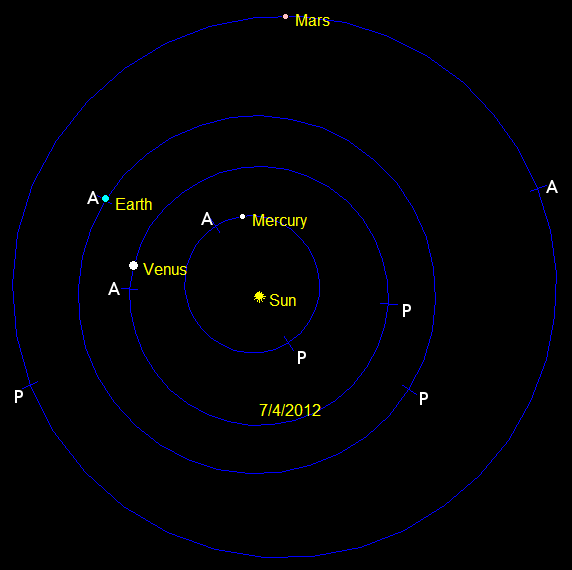
The orbits of the inner planets. (P)erihelion – (A)phelion
Note that the chart is from 2012. The date of aphelion and perihelion varies by a day or two each year. Mars and Mercury have the most eccentric orbits.
Want to check out what’s going on at the 224th American Astronomical Society meeting in Boston this week?
Twitter hashtag #aas224. You’ll get bits and pieces of what’s going on and lots of cool images.
Meteor Watch cloud and meteor status May 23/24, 2014
May 24, 5;33 a.m. EDT
Just got back from the Dune Climb. Yes Virginia there are Camelopardalids. Just not many of them. I saw about 10 meteors overnight with just over half Camelopardalids. Now I was busy with other things, running the star party. However it seemed that of the ones I saw, there were a better an average, compared to the Perseids, number of bright ones. One also left a smokey train that was visible for a few seconds. I didn’t have my binoculars with me to view it longer. But it was impressive. We had maybe 40-50 folks come out, coming and going over the night, with about 11 sticking it out to the bitter end at 4 a.m.
May 23, 5:32 p.m. EDT
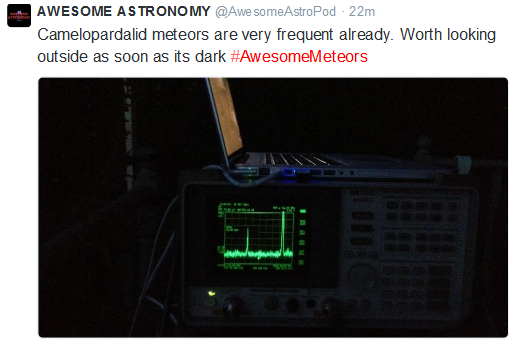
Weather is still great. Picked up a tweet saying the the Camelopardalids are being picked up via the radio reflection of their ionized trains.
 I’m going to head out in a half hour to the Visitors Center (see below) for the talk and to pick up some traffic cones.
May 23, 12:45 p.m. EDT
The weather is holding. The forecast is for clear skies through Sunday daytime. It should be a great Memorial Day weekend. For those venturing out to observe the meteor storm (we hope) dress warmly. The temperatures in northern Michigan will drop to the mid 40s. I plan to bring a light coat and my winter coat. For those who wish to lie on the ground to see the sky show bring two blankets one under you and one over you. It will get dewy. Hat, gloves and a thermos of warm drinks will also be welcome. Winter boots might be welcome for those who tend to get cold feet. Meteor watching is not an active pursuit, so you may want to walk around or climb up the dune a ways to keep warm. Remember there’s a talk by astronomer Tyler Nordgren at the Sleeping Bear Dunes National Lakeshore Philip A. Hart Visitor Center near the corner of M72 and M22 in Empire at 7 p.m. Sunset will be at 9:15 p.m.. The Grand Traverse Astronomical Society (GTAS) will be ready to observe the planets at the Dune Climb by 10 p.m.
May 22, 11:00 p.m. EDT
This is a pre-post entry. The blog will be published at noon on the 23rd and be updated as necessary. New updates will appear above older ones. I may also tweet. My twitter handle is @robertcmoler. The hashtag for the meteor shower appears to be #Camelopardalids. I hope you’re a good speller. The National Weather Service for tomorrow (Friday) and tomorrow night is for decreasing clouds during the day and mostly clear tomorrow night. Anttilla Danko’s Clear Sky Chart for the Leelanau School’s Lanphier Observatory also shows clear skies for the night of the 23rd/24th at this time. The observatory is located a few miles northeast of the Dune Climb area. New to the Sleeping Bear Dunes National Lakeshore? Here’s their website: http://www.nps.gov/slbe/index.htm Here’s a link to the map of the park. The Dune Climb is at points 7 & 8 on highway M109 just south of Glen Haven.
 Bob Moler's Ephemeris Blog