Archive
10/03/2013 – Ephemeris – Last call for the Midwest Space Fest
Thursday, October 3rd. The sun will rise at 7:43. It’ll be up for 11 hours and 35 minutes, setting at 7:18. The moon, 1 day before new, will rise at 7:19 tomorrow morning.
The Midwest Space Fest starts tomorrow evening. This is a bit late, but there could be seats available for some events. Check out magnorth.org for more information. Paid events are at the State Theater and ECCO Event Space, 121 Front St. Friday Night and Dr Filippenko Saturday morning. Free events are also Saturday including NASA and other astronomical exhibits at the ECCO Event Space plus sun viewing during the day and later on a star party at the Open Space on the bay. Full disclosure, the Space Fest is the brainchild of Carolyn McKellar a family friend. I knew her when she was yea high. She’s an amateur astronomer, who at one time wanted to be an astrophysicist. However her interest turned to coordinating events like this.
Times are for the Traverse City/Interlochen area of Michigan. They may be different for your location.
Addendum
Michigan Science Center is bringing their inflatable STARLAB planetarium which will be set up in room 101 in NMC’s Health and Science Building Saturday from 10 a.m. to 5 p.m. Free tickets can be reserved here.
08/29/2013 – Ephemeris – Midwest Space Fest coming in October
Ephemeris for Thursday, August 29th. The sun will rise at 7:01. It’ll be up for 13 hours and 22 minutes, setting at 8:23. The moon, 1 day past last quarter, will rise at 1:33 tomorrow morning.
The first weekend of October Traverse City will play host to the Midwest Space Fest, a celebration of astronomy and space. Venues include the State Theater, The ECCO Event Space and the Open Space. The keynote speaker is the world-renowned astronomer Alex Fillipenko, seen on many science TV programs like the Universe. He’ll talk about a hot topic: Dark Energy and the Runaway Universe. Events kick off Friday evening at the State Theater for a film and star talks explaining the starry ceiling of the theater. This will be followed by a launch party or a star party at the Rogers Observatory. Saturday is Dr. Fillipenko’s talk and observing the sun and stars at the open space. There’s more information at www.magnorth.org.
Times are for the Traverse City/Interlochen area of Michigan. They may be different for your location.
Addendum

Midwest Space Fest card
12/31/2012 – Ephemeris – Looking at the prospective comets of 2013
Ephemeris for New Years Eve, Monday, December 31st. The sun will rise at 8:19. It’ll be up for 8 hours and 53 minutes, setting at 5:12. The moon, 3 days past full, will rise at 8:51 this evening.
As we enter a new year tonight, let\s look ahead at what we expect to see in the skies in 2013. The big events next year will be two comets that could be quite bright. Mid-March will bring Comet PanSTARRS to the evening sky. This is a first time comet for astronomers, so its behavior may be unpredictable, but it is currently sticking to brightness projections and may be as bright as the brightest stars at its brightest. The second comet is Comet ISON. This will fly close to the sun on November 28th. It could disintegrate, its nucleus could split into multiple pieces, or it could survive intact. The last two scenarios will give us a bright morning comet in early December. So may we have a happy comet new year.
Times are for the Traverse City/Interlochen area of Michigan. They may be different for your location.
Addendum
Here are two links to the website of Seiichi Yoshida for each of the comets. Most revealing at this point are the magnitudes graphs showing the actual brightness measurements as black dots with the predicted magnitudes as an orange line, The vertical line is the perihelion date, the date the comet is closest to the sun. Comet ISON has a second magnitude graph for when the comet is closest the sun and may become bright enough to be seen in the daytime.
Magnitudes are like golf scores, the lower the number the better, or in this case brighter the comet is. the Faintest star visible to the naked eye is 6th magnitude. Jupiter is usually around -2, Venus -4, and the sun -26. As you can see from the scatter of the actual brightness estimates, pinning down the brightness of a fuzzy comet is rather difficult. Comets generally appear dimmer than their magnitudes would suggest.
Here are the ;inks:
08/10/2012 – Ephemeris – Weekend Meteor Watches
Ephemeris for Friday, August 10th. The sun rises at 6:39. It’ll be up for 14 hours and 15 minutes, setting at 8:54. The moon, 1 day past last quarter, will rise at 1:04 tomorrow morning.
There are two events this weekend to view the heavens and the Perseid meteor showers. First, part of the Port Oneida Fair the Grand Traverse Astronomical Society will work with the rangers of the Sleeping Bear Dunes National Lakeshore to hold a star party and meteor watch at Thoreson Farm on South Thoreson Road of M22, a couple miles north of Glen Arbor. That will start at 9 p.m. It will be about 10:30 when it’ll be dark enough spot the meteors. Sunday evening there’s a Meteors and S’mores event at the Leelanau State Park, at the tip of the Leelanau Peninsula. That event starts at 10:30 p.m. The society will participate there also. The moon won’t interfere with the meteor shower It’s been banished into the morning sky.
Times are for the Traverse City/Interlochen area of Michigan. They may be different for your location.
07/13/2012 – Ephemeris – The moon will join Venus and Jupiter Sunday morning
Ephemeris for Friday, July 13th. Today the sun will be up for 15 hours and 15 minutes, setting at 9:25. The moon, 3 days past last quarter, will rise at 2:26 tomorrow morning. Tomorrow the sun will rise at 6:11.
Sunday Morning maybe isn’t the most convenient time to get up early, but this Sunday it may be worth it. At 5 a.m. or so Jupiter will appear above Venus, as they have for the last few weeks. But Sunday morning the crescent moon will appear right between the two. For other parts of the world the moon will actually pass in front of Jupiter, an event called an occultation. This will occur before sunrise for us. But still the planet and moon group should be a beautiful sight in the twilit sky. Venus and Jupiter will soon separate, Venus to stay near the sun, while Jupiter due to the earth’s orbital motion moves away to rise earlier and earlier by somewhat less than a half hour a week. Jupiter lies in the constellation Taurus now.
Times are for the Traverse City/Interlochen area of Michigan. They may be different for your location.
Addendum
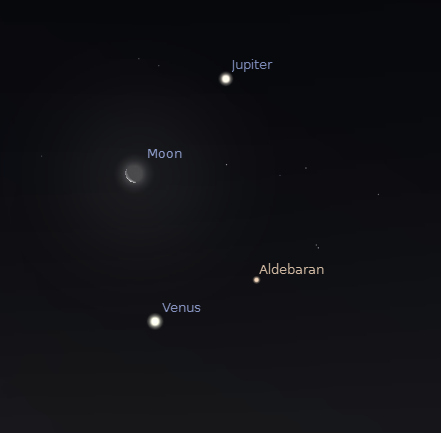
Jupiter, Venus and the moon on July 15, 2012 at 5 a,m, Created using Stellarium.
03/12/2012 – Ephemeris – Jupiter is level with Venus, also possible northern lights tonight
Ephemeris for Monday, March 12th. The sun will rise at 7:59. It’ll be up for 11 hours and 45 minutes, setting at 7:45. The moon, 2 days before last quarter, will rise at 1:33 tomorrow morning.
In the western evening sky, Jupiter and Venus are making a pass at each other. They shouldn’t, in the modern sense since Venus or Aphrodite of the Greeks was the daughter of Jupiter or Zeus. .Over this week we’ll watch as Jupiter slips below Venus to lead Venus in setting. Tonight Jupiter is level with and left of Venus. Venus will always be the brighter of the two. We also have an aurora watch for this evening. The sun has been active this weekend with a series of flares emanating from the largest sunspot group now visible called active region 1429. This group is rotating off so it’s flares soon won’t affect the earth. Check spaceweather.com for the latest. And check bobmoler.wordpress.com for an animation of the planet conjunction.
* Times are for the Traverse City/Interlochen area of Michigan. They may be different for your location.
Addendum
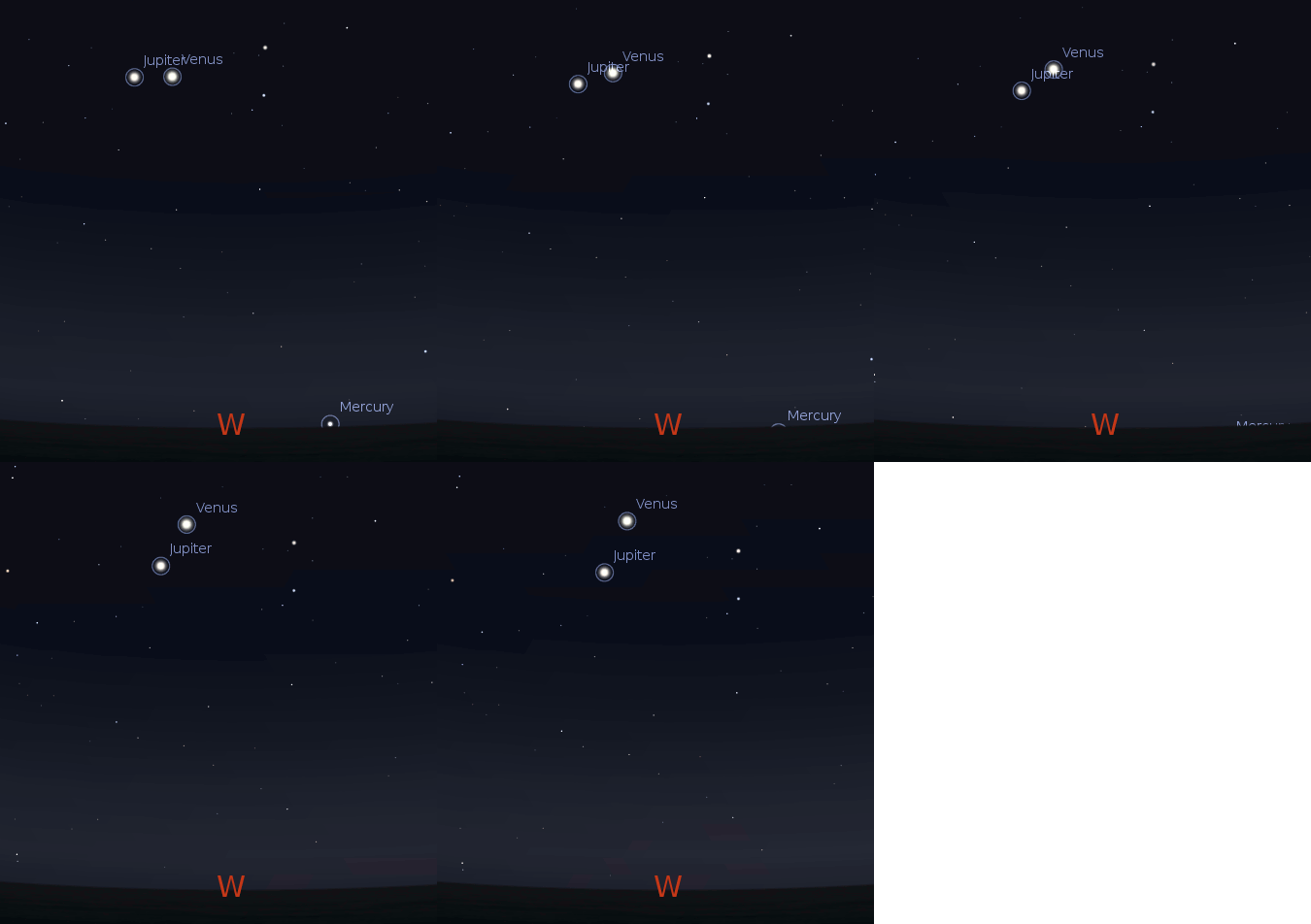
Jupiter and Venus at nightly intervals from March 12 to 16, 2012. Created using Stellarium.
The first frame of the animation is for tonight.
02/28/2012 – Ephemeris – The moon will pass south of the Pleiades tonight
Ephemeris for Tuesday, February 28th. The sun will rise at 7:22. It’ll be up for 11 hours and 5 minutes, setting at 6:28. The moon, 1 day before first quarter, will set at 1:34 tomorrow morning.
The fat crescent moon will appear below the Pleiades star cluster tonight. The Pleiades is also known as the Seven Sisters. With the moon as bright as it is the stars of the Pleiades may not be easily spotted, so a pair of binoculars might be needed. The Pleiades will appear nearly 8 moon diameters above the moon, so they might escape the moon’s glare somewhat. The moon will pass the Pleiades every 28 and a fraction days. Sometimes it passes south of the cluster, and sometimes north of it, and occasionally it passes in front of the stars of the cluster. The moon’s orbit of the earth wobbles or precesses once every 18.6 years. It’s why eclipses occur at different times of the year, and generally earlier one year to the next.
* Times are for the Traverse City/Interlochen area of Michigan. They may be different for your location.
Addendum
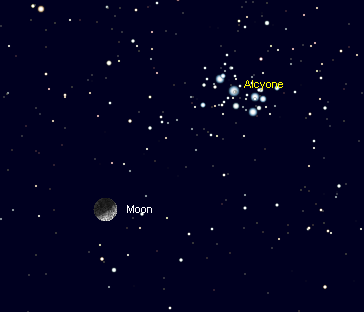
The moon south of the Pleiades at 10:19 p.m. February 28, 2012 from Michigan . Chart created using Cartes du Ciel (Sky Charts)
02/02/2012 – Ephemeris – February 2nd isn’t just for groundhogs
Ephemeris for Groundhog Day, Thursday, February 2nd. The sun will rise at 8:00. It’ll be up for 9 hours and 51 minutes, setting at 5:52. The moon, 3 days past first quarter, will set at 4:39 tomorrow morning.
I’m not sure if Punxsutawney Phil will see his shadow this morning or not, but February 2nd was a special day to the ancients. It is also Candlemas day for the Catholic Church. It is also celebrated as a cross-quarter day. The middle of the season of Winter, though the exact date of the middle of winter is the 4th. And if Phil sees his shadow and we do get 6 more weeks of winters, that’s OK too. By the calendar it actually more like 7 weeks to the vernal or spring equinox and the official end of winter. Of the other cross-quarter days, only one stands out today. It’s May 1st, May Day. The way this year has been going, winter has had a hard time getting started. The temperatures are above normal and the snowfall below normal.
* Times, as always are for the Traverse City/Interlochen area of Michigan.
01/16/2012 – Ephemeris – The moon will appear below Saturn and Spica this morning
Ephemeris for Martin Luther King Day, Monday, January 16th. The sun will rise at 8:15. It’ll be up for 9 hours and 13 minutes, setting at 5:29. The moon, at last quarter today, will rise at 2:31 tomorrow morning. | This morning the crescent moon will appear below Saturn and the bright blue-white star Spica in the southeast before twilight brightens too much. When seen together Saturn and Spica really show the difference in their colors. Saturn reflects the light of our yellow sun, and that’s accentuated by it’s cream colored clouds. Only Saturn’s rings reflect the sun’s light pretty much unaltered because they’re made mostly of ice. Spica has the hottest surface temperature of any first magnitude star and shines with a blue tinge. This came home to me a long time ago, when I photographed a lunar eclipse with color film when the moon was next to Spica. Spica came out looking very blue indeed.
* Times, as always are for the Traverse City/Interlochen area of Michigan.
Addendum
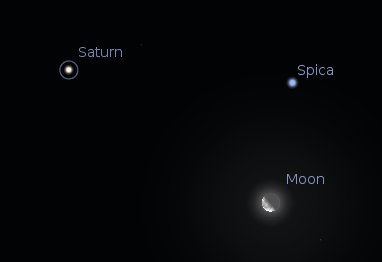
Saturn, Spica and the Moon on the morning of January 16, 2012. Created using Stellarium.
12/09/11 – Ephemeris – Glimpse a piece of a lunar eclipse tomorrow morning
Friday, December 9th. The sun will rise at 8:07. It’ll be up for 8 hours and 55 minutes, setting at 5:02, the earliest sunset of the year. The moon, 1 day before full, will set at 8:08 tomorrow morning.
There will be an eclipse of the moon tomorrow, however we will get a chance to spot the very beginning of the partial phase. The eclipse will be best seen in the western United States, Australia and most of Asia. The partial phase starts at 7:46 a.m. with the moon low in the west northwest. The sun will rise about the time the moon will set. That will occur at 8:09 a.m., give or take a few minutes depending where you are in northern Michigan. It will have to be really crystal clear to see this at all. Next year we’ll see the tail end of an eclipse of the sun as it sets on May 20th. And we’ll see partial eclipse of the moon on June 4th. The next evening we’ll have the rare transit of Venus which won’t reoccur for over 100 years.
* Times, as always are for the Traverse City/Interlochen area of Michigan.
Addendum
More Information here: http://eclipse.gsfc.nasa.gov/OH/OHfigures/OH2011-Fig06.pdf
Update
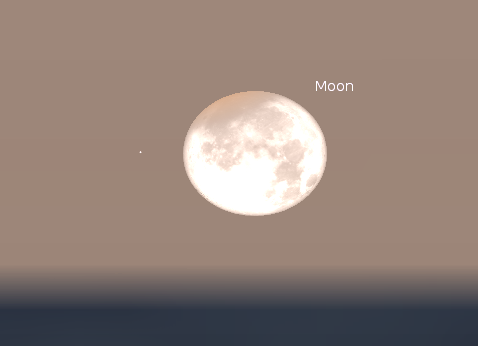
Lunar Eclipse at 8 a.m. December 10, 2011. Created using Stellarium.
 Bob Moler's Ephemeris Blog