Archive
03/17/2015 – Ephemeris – Jupiter’s cloud stripes
Ephemeris for St. Patrick’s Day, Tuesday, March 17th. The Sun will rise at 7:51. It’ll be up for 11 hours and 59 minutes, setting at 7:51. The Moon, 3 days before new, will rise at 6:37 tomorrow morning.
Jupiter is the one planet that we can see detail on with telescopes in the evening sky. Venus is so bright that it is hard to even see its gibbous phase. Actually the best way to see Venus is during the day with the blue sky around it. Jupiter is a big planet, 11 times the Earth’s diameter and 1,300 times it volume. Despite this it is only 318 times the Earth’s mass, so much of its mass is the atmosphere. It’s rotation rate is just under 10 hours at its equator. This drops with latitude, so its atmosphere is twisted into alternate belts and zones. The belts are dark brown while the zones are lighter. They move around the planet at different speeds causing storms that their boundaries. The Great Red Spot is a anticyclone in the south.
Times are for the Traverse City/Interlochen area of Michigan. They may be different for your location.
Addendum
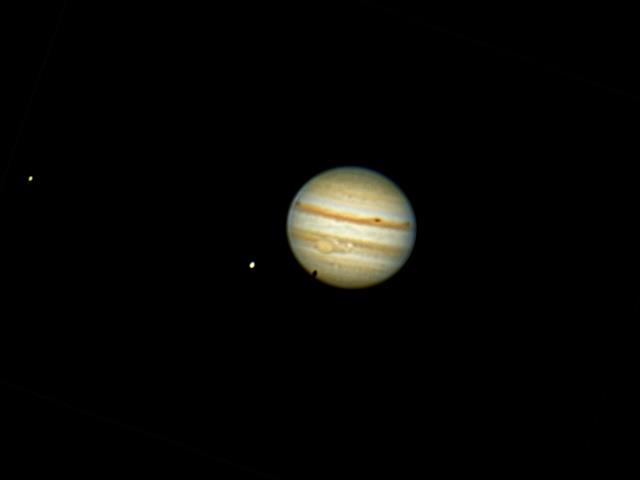
Jupiter by Scott Anttila November 14, 2011. With shadow on the planet and the Great Red Spot.
03/12/2015 – Ephemeris – Tonight’s a big night for Jovian satellite events
Ephemeris for Thursday, March 12th. The Sun will rise at 8:01. It’ll be up for 11 hours and 43 minutes, setting at 7:44. The Moon, 1 day before last quarter, will rise at 2:40 tomorrow morning.
Tonight will be a busy one in Jupiter’s system for those watching with telescopes. As it gets dark Jupiter’s moon Io will be in front of Jupiter and very difficult to spot. It’s shadow may be seen as a tiny inky black dot on the face of the planet. Io will move off the planet at 8:55 p.m., This will be followed by the shadow at 9:42 p.m. The fun isn’t over because the moon Europa will be appearing to approach Jupiter as Io leaves it. Europa will disappear behind Jupiter at 12:06 a.m. It will stay hidden until 4:32 a.m. Europe will clear the planet earlier, but will still be in Jupiter’s shadow until 4:32. When a moon’s in shadow, it is said to be eclipsed. When behind the planet it is occulted and when in front of Jupiter it is in transit.
Times are for the Traverse City/Interlochen area of Michigan. They may be different for your location.
Addendum
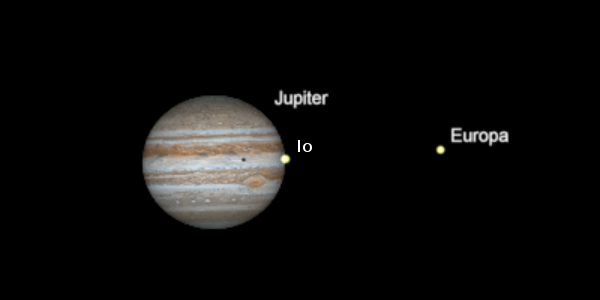
Io transit end at 8:55 p.m., March 12, 2015. Note Io’s shadow will leave the face of Jupiter at 9:32 p.m. Created using Cartes du Ciel (Sky Charts).
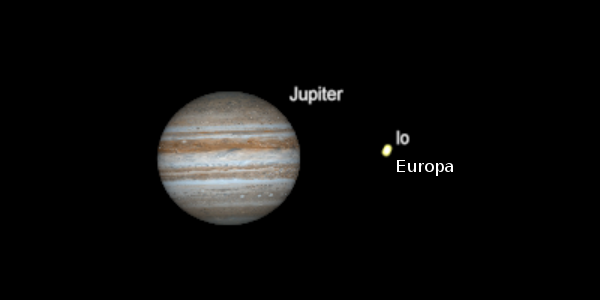
Io passes Europa about 10:20 p.m. March 12, 2015. Created using Cartes du Ciel (Sky Charts).
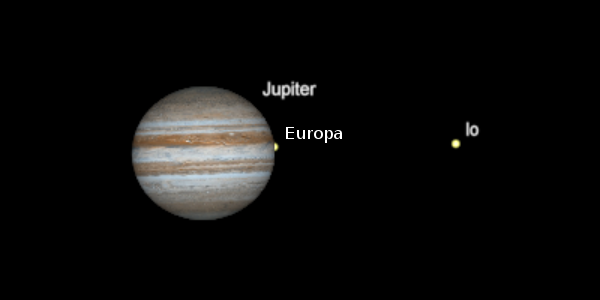
Europa’s occultation begins at 12:06 a.m., March 13, 2015. Created using Cartes du Ciel (Sky Charts).
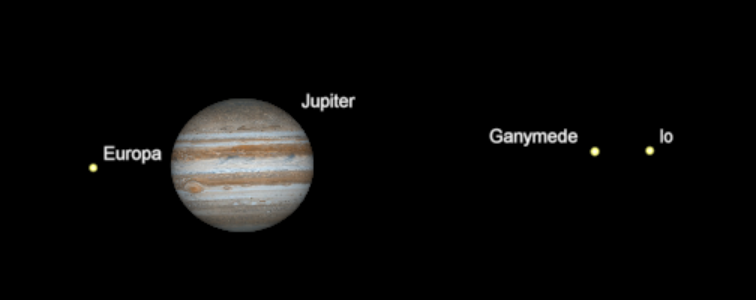
Europa emerges from eclipse by Jupiter’s shadow at 4:32 a.m., March 13, 2015. Note that Ganymede has entered the picture. It appeared to pass Io at about 3:30 a.m. Created using Cartes du Ciel (Sky Charts).
02/05/2015 – Ephemeris more about Jupiter it’s motion and mass
Thursday, February 5th. The sun will rise at 7:57. It’ll be up for 9 hours and 59 minutes, setting at 5:56. The moon, 2 days past full, will rise at 7:57 this evening.
Tomorrow the planet Jupiter will reach opposition from the Sun being about 180 degrees opposite the Sun in the sky. At opposition Jupiter is it’s closest to the earth, and appears its largest in a telescope, except for Venus when it is at its very closest to the Earth. This second brightest planet was named for the chief of the Roman gods, and takes a majestic 12 years to circumnavigate the sky staying in each zodiacal constellation for a year. It is currently between Cancer on the right and Leo on the left. In fact it crossed the astronomical boundary back into Cancer. Since we view all the other planets from our own moving planet, their apparent paths back up westward from their normal eastward motion when we are nearest them.
Times are for the Traverse City/Interlochen area of Michigan. They may be different for your location.
Addendum
I published this track of Jupiter’s motion for this Jovian viewing season a week ago, showing it’s backward or retrograde motion as we pass it.
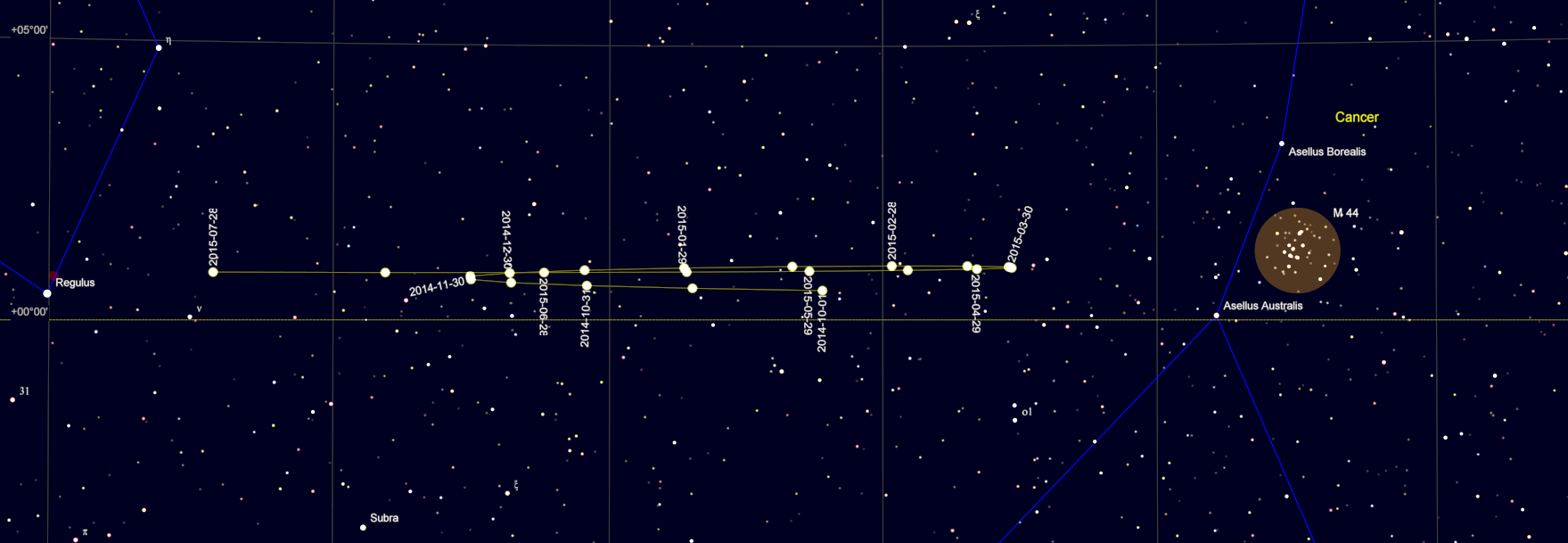
Jupiter’s retrograde path against the stars between Cancer and Leo October 2014 to July 2015. Created using Cartes du Ceil (Sky Charts). Click on the image to enlarge.
The planet Jupiter is the largest planet and also most massive. In fact Jupiter contains more mass than all the other planets of the solar system combined times 2.
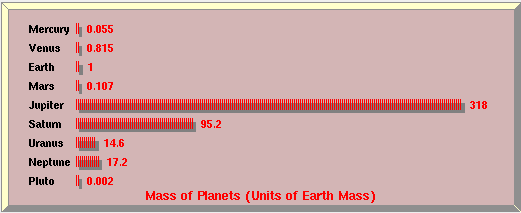
Masses of all the planets including the dwarf planet Pluto in terms of the Earth’s mass. Credit: University of Tennessee.
Or as the late great science and science fiction writer Isaac Asimov wrote: “The solar system is composed of the Sun, Jupiter and debris.”
Feeling small yet?
02/03/2015 – Ephemeris – Jupiter is really big and spins really fast
Ephemeris for Tuesday, February 3rd. The sun will rise at 7:59. It’ll be up for 9 hours and 54 minutes, setting at 5:53. The moon, at full today, will rise at 6:01 this evening.
Jupiter will appear to the left of the full moon tonight. The Galilean moons will be spread out with Callisto by its lonesome on one side then Europa, Io and Ganymede spaced out on the other. Jupiter’s cloud bands show the great planet’s rotation, and that the moon’s orbit over Jupiter’s equator, like most of the moons of the other planets. The clouds are whipped into parallel bands by Jupiter’s rapid rotation. Here’s a planet 11 times the diameter of the Earth, thirteen hundred times the volume, and over 300 times the mass of the Earth, rotating nearly two and a half times faster than the Earth. The equatorial rotation is 9 hours 50 minutes. The rapid rotation squishes the planet noticeably, which the cloud stripes visually enhance.
Times are for the Traverse City/Interlochen area of Michigan. They may be different for your location.
Addendum
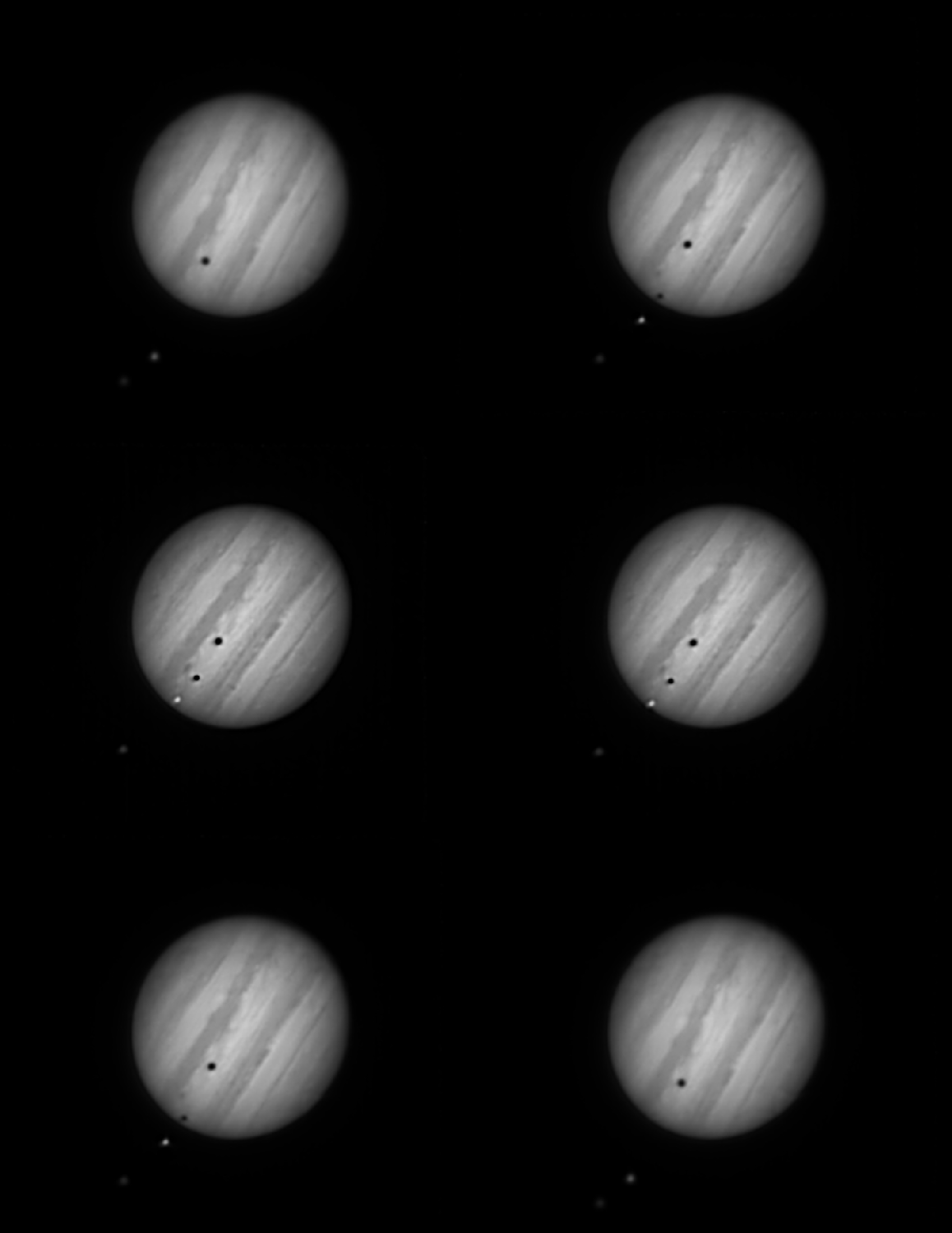
Rocking animation of the early stages of the shadow show on Jupiter. Callisto’s shadow already on the planet while Io’s shadow is just entering. Also Io’s transit is starting., following its shadow on the planet. Credit: Scott Anttila.
The above animation which I first posted last week demonstrates three of my points about Jupiter. The planet rotates rapidly, it’s polar diameter is shorter by about 7% than the equatorial diameter, and the satellites orbit over its equator. Jupiter also has a small axial tilt of 3º compared to the Earth’s 23 1/2º. As an aside we’re in the “season” where the satellites occult and eclipse each other.
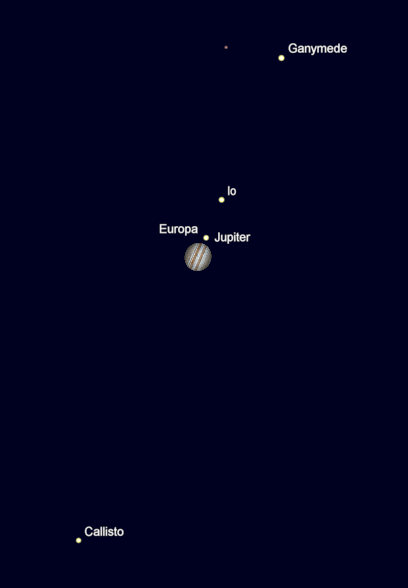
Telescopic Jupiter tonight (9 p.m. February 3, 2015) as described in the text of the program. Created using Cartes du Ceil (Sky Charts).
01/29/2015 – Ephemeris – The first thing noticed about Jupiter in a telescope
Ephemeris for Thursday, January 29th. The sun will rise at 8:05. It’ll be up for 9 hours and 41 minutes, setting at 5:46. The moon, 3 days past first quarter, will set at 4:33 tomorrow morning.
If it’s clear tonight dress up warmly and take the telescope out to look Jupiter. Jupiter is the brightest star-like object out tonight. It outshines Sirius the brightest night-time star lower in the sky and to its right. Jupiter, being the largest planet most of the time is the biggest planet in the telescope, It’s only challenger is Venus for a couple of months when its closest to us. The first thing one notices about Jupiter in a telescope is that it has companions, up to 4, strung out on either side of the planet. Those are the four moons or satellites discovered by Galileo in 1610. They will shift position from night to night and even as you watch. They can hide behind Jupiter or in its shadow or in front of the planet.
Times are for the Traverse City/Interlochen area of Michigan. They may be different for your location.
Addendum
Jupiter’s retrograde path against the stars between Cancer and Leo October 2014 to July 2015. Created using Cartes du Ceil (Sky Charts). Click to enlarge.
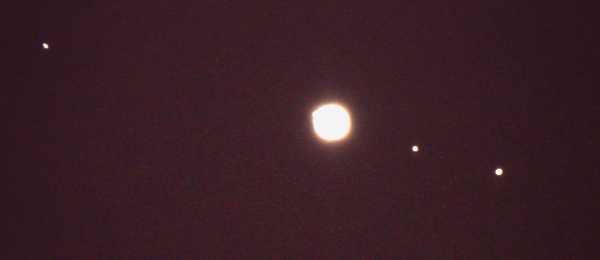
Jupiter and its four Galilean moons. The planet has to be over exposed to pick up the moons. But the eye can handle the brightness difference with no problem. This is one of my old pictures back in the days of film.
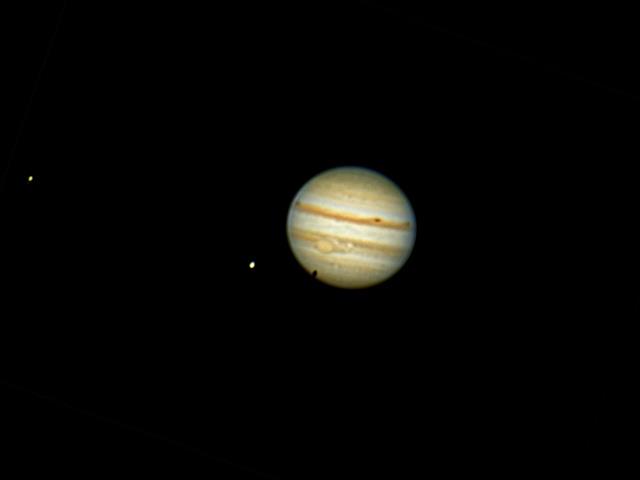
Jupiter with a solar eclipse in progress as Ganymede, lower left, casts its shadow on Jupiter on November 14, 2011. Credit: Scott Anttila.
Check out the Great Red Spot (GRS) above Ganymede’s shadow. It’s not really red. When I first aimed my telescope toward Jupiter back in the late 1950’s the GRS was indeed very red. Nowadays the GRS is very hard to find.
01/26/2015 – Ephemeris – First quarter Moon, a telescopic asteroid misses the Earth tonight and a Jupiter shadow recap
Note: Ephemeris program generally features objects in the sky that are visible to the naked eye or binoculars. However in the blog, with the ability to expand in both content and illustrations I can add information for telescopic observers and expand postings.
Ephemeris for Monday, January 26th. The sun will rise at 8:08. It’ll be up for 9 hours and 34 minutes, setting at 5:42. The moon, at first quarter today, will set at 1:30 tomorrow morning.
The Moon will be perfectly half illuminated by the sun at 11:48 p.m. The gray patches that appear on the Moon’s surface were called by early telescopic astronomers: seas; because they thought they were bodies of water. The Moon is pretty much bone dry, except for some eternally shadowed craters at the poles, which still aren’t wet because the water is frozen. Anyway the seas or maria on the moon are indeed low spots. The seas, from the top center of the moon down to the lower right are Serenity, Tranquility, Nectar and Fertility. To the upper right all by itself is the Sea of Crises. From Serenity to Fertility some can imagine an upside down rabbit, with ears of unequal sizes. In a few more days we’ll see the face of the man in the Moon.
Times are for the Traverse City/Interlochen area of Michigan. They may be different for your location.
Addenda
First Quarter Moon
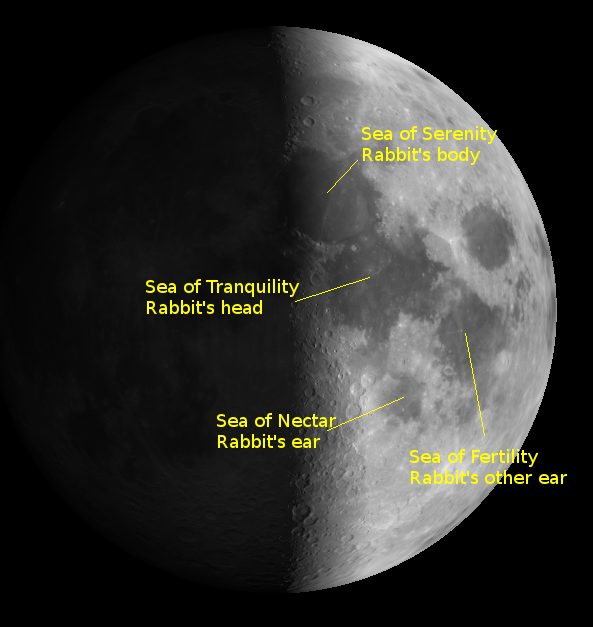
Rabbit in the first quarter Moon. Created using Virtual Moon Atlas.
Tonight Asteroid 2004 BL86 will pass three times the Moon’s distance from the Earth
This evening a rather large asteroid for a Near Earth Object or NEO will pass three-quarters of a million miles from the Earth. The asteroid has the designation 2004 BL86. The cool thing is that this asteroid is half a kilometer or so meters across, that’s 5 soccer or football fields in diameter. Radar from this close passage should nail down the size and shape. Between Goldstone Tracking Station and Arecibo Observatory in Puerto Rico the asteroid should be mapped down to 2 to 4 meters. It would be definitely not cool if this asteroid ever hit the Earth. It will be 9th magnitude, and so will be visible in small telescopes, and it will cross the east or left side of the Beehive star cluster also designated M44 starting about midnight tonight.
If you want to observe the event and don’t have the equipment head on over to www.slooh.com. This is the site for Slooh (pronounced “slew”) Community Observatory which has observatories in the Canary Islands and Chile, and partners with others. Besides these events, members can schedule time and use the telescopes via the internet. Check the above link for more information.
The chart below is from NASA/JPL’s Near Earth Object Program: Updated Charts for Asteroid 2004 BL86 Earth Flyby on Jan 26, 2015
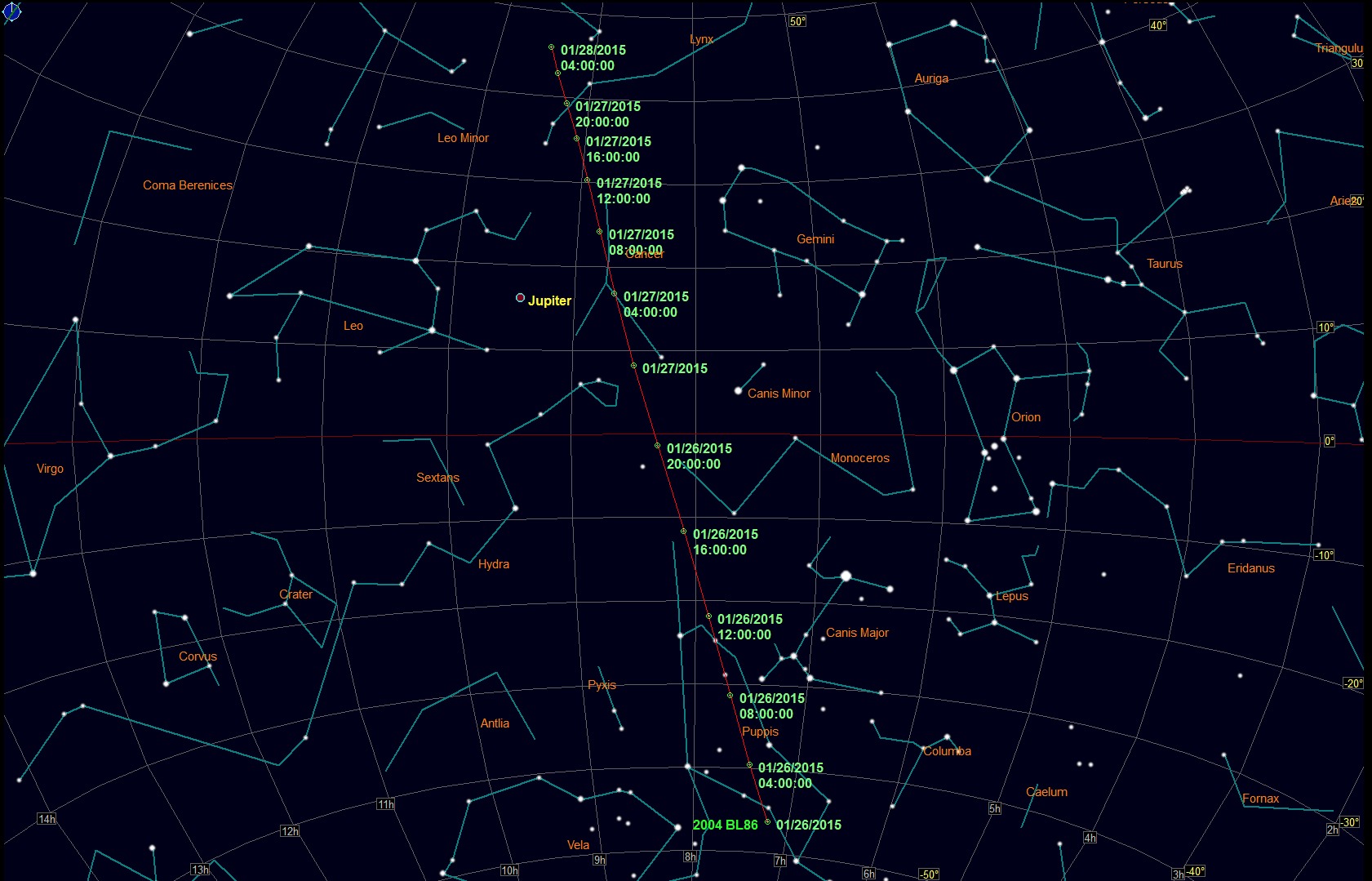
The track of asteroid 2004 BL86 as viewed from the Earth, plotted on a star chart with an equatorial coordinate grid. The asteroid location is shown at four-hour intervals from January 26 to 28. The indicated times are Universal Time; subtract 5 hours for Eastern Standard Time (EST), 6 hours for CST, and 8 hours for PST. On January 26, the asteroid will pass within 11 degrees of Jupiter, now shining brightly in the east in the evening sky. Image and caption credit: NASA/JPL-Caltech. JPL orbit solution #43, with star chart graphics produced using C2A. Click to enlarge.
Below is a chart from Universe Today. Here’s a link to their web page.
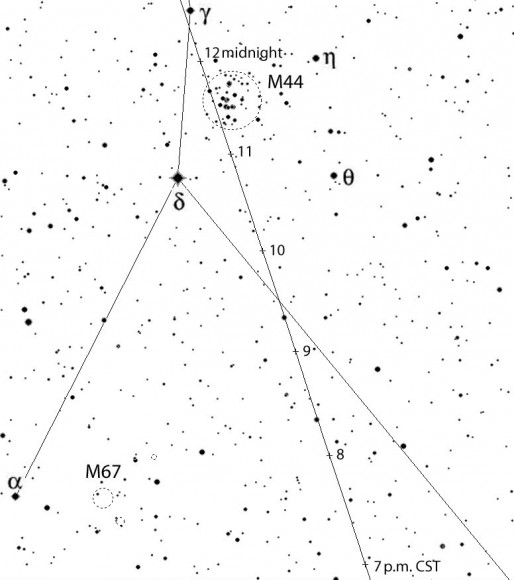
A Black on white chart of asteroid 2004 BL86 crossing to the right of M44. Note that the actual path depends on your location since the chart is based on the center of the Earth. The closer to your horizon the greatest deviation from the path shown. Time Ticks are for CST. Add one hour to them for EST. The Midnight tick mark is 0 h UT or GMT the 27th. Credit Universe Today and created with Chris Marriott’s SkyMap software.
Sky and Telescope has charts that have BL86’s track plotted about 15 minutes ahead of the track above. It is a newer chart, so the asteroid’s position may have been updated. The Sky and Telescope narrative and charts are here.
Results from Jupiter’s early Saturday satellite shadow play
The video live feed from the Griffith Planetarium in Los Angeles was a bust. It suffered from what astronomers call bad seeing. I mean really horrible seeing. Astronomers ascribe at least two qualities to the sky, other than brightness due to the moon or light pollution. That is transparency and seeing. Seeing is the steadiness of the sky. What Jupiter looked like was looking at a small disk at the bottom of a swimming pool while the kids are still playing in it. At first I ascribed it to Jupiter being low in the LA sky, being 3 hours west of here. But it didn’t get better as the night progressed. I could occasionally make out Callisto’s shadow, just because I knew where it’s supposed to be. But that’s it.
However my friend from the Detroit area, Scott Anttila, blessed at least for a while with clearer and calmer skies got some wonderful pictures of the first part of the multiple shadow event.
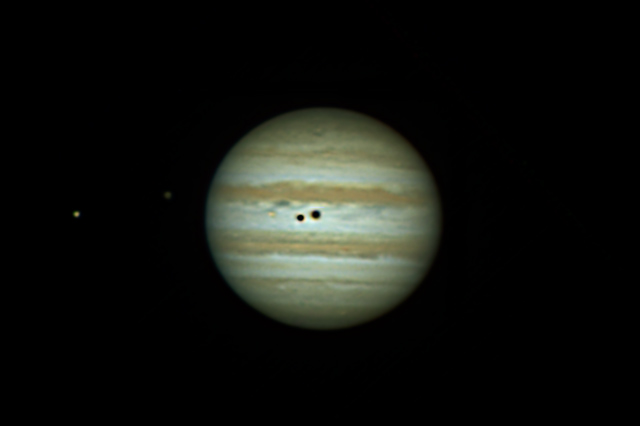
Left to right the shadows of Io and Callisto crossing the face of Jupiter at 12:52 a.m. January 24, 2015. Credit Scott Anttila.
Note that Callisto has a larger shadow than Io. That’s mainly due to it’s greater distance from Jupiter that makes its shadow larger and fuzzier than the closer Io.
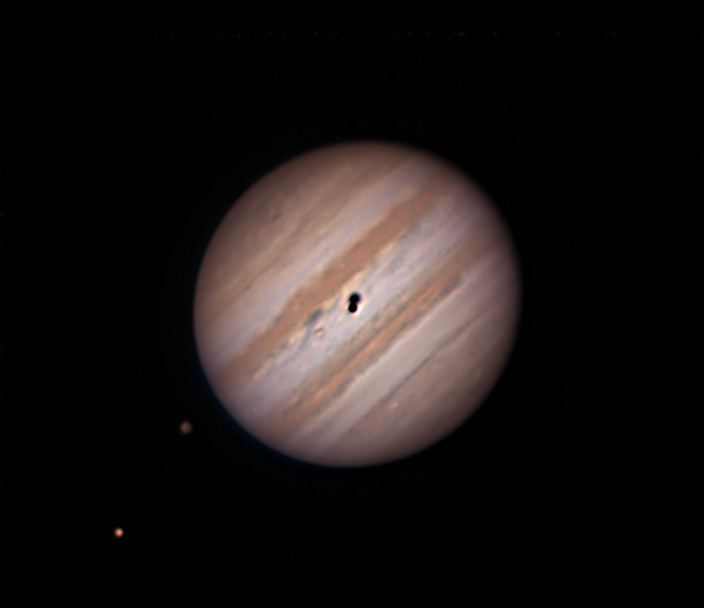
In this picture Io’s shadow has just caught up with Callisto’s shadow. Credit: Scott Anttila.
Rocking animation of the early stages of the shadow show on Jupiter. Callisto’s shadow already on the planet while Io’s shadow is just entering. Also Io’s transit is starting, following its shadow on the planet. Credit: Scott Anttila
01/23/2015 – Jupiter will experience three simultaneous total solar eclipses tonight!
Total solar eclipses on Jupiter are nearly a daily occurrence on Jupiter. However what we’ll see is the shadows of the moons crossing the face of the planet. Shadows of the Jovian moons on the fave of Jupiter are difficult to see with small telescopes. The look like tiny inky black dots.
Another way to watch the event is via Griffith Observatory in Los Angeles. The link is here. Their event starts at 11:30 p.m. EST because Jupiter rises later there. The email I received from them says the next triple shadow event on Jupiter won’t occur until 2032,
Here’s the schedule: Moons: I = Io, II = Europa, IV = Callisto; SHA = Shadow, Tra = Transit (a moon crossing disk of Jupiter)
Moon Event      UT Date    hh:mm  EST Date    Time
 IV: Sha start: 24 Jan 2015 3:11  23 Jan 2015  10:11 p.m.
  I: Sha start: 24 Jan 2015 4:36  23 Jan 2015  11:36 p.m.
  I: Tra start: 24 Jan 2015 4:56  23 Jan 2015  11:56 p.m.
 IV: Tra start: 24 Jan 2015 6:20  24 Jan 2015   1:20 a.m.
 II: Sha start: 24 Jan 2015 6:28  24 Jan 2015   1:28 a.m.
 I:  Sha end  : 24 Jan 2015 6:53  24 Jan 2015   1:53 a.m.
 II: Tra start: 24 Jan 2015 7:08  24 Jan 2015   2:08 a.m.
 I:  Tra end  : 24 Jan 2015 7:13  24 Jan 2015   2:13 a.m.
 IV: Sha end  : 24 Jan 2015 8:02  24 Jan 2015   3:02 a.m.
 II: Sha end  : 24 Jan 2015 9:23  24 Jan 2015   4:23 a.m.

Note: All three shadows will be on Jupiter at the same time from 1:28 to 1:53 a.m. EST.
Times provided by the Jevent.exe DOS program downloaded from http://www.projectpluto.com/
Here’s an animation of what the event might look like at half hour intervals look like starting at 9:45 p.m.
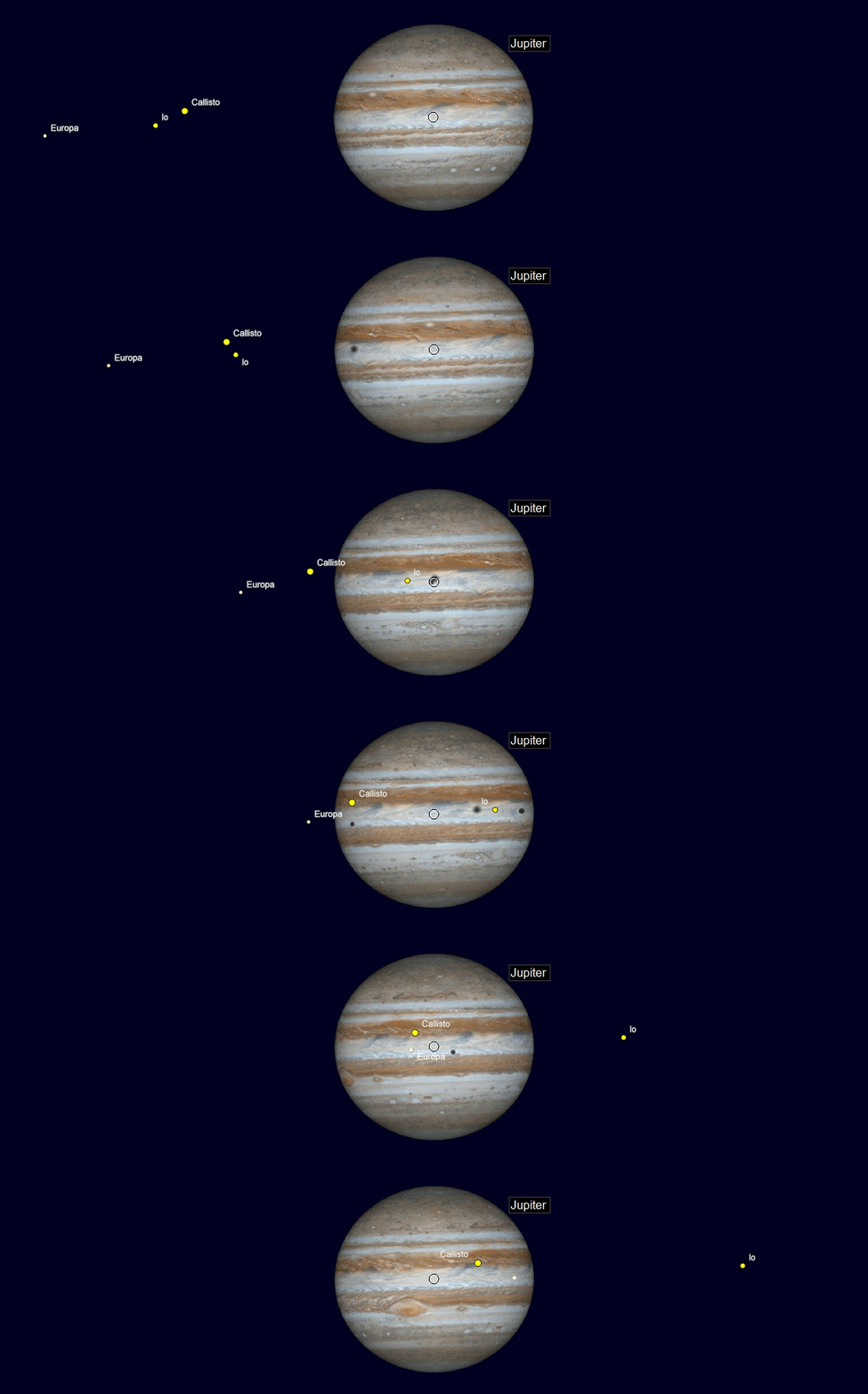
Animation of Jupiter’s satellite shadows starting at 9:45 p.m. and ending at 4:45 a.m. Created using Cartes du Ceil Sky Charts) and GIMP. The circle in the center of Jupiter is an artifact of the program. Click for a larger view.
Stupid Internet posts: No, gravity won’t be canceled January 4th.
Looks like the hoaxsters are at it again. Seems someone dusted off Sir. Patrick Moore’s April Fool’s joke from long ago and dressed it up as a phony NASA tweet and sent it out 9 days ago. Supposedly on January 4th, 2015 an alignment of Jupiter and Pluto will cancel gravity on the Earth for a few minutes that day. Both Newton and Einstein would be ticked off at that. Neither of their theories of gravity would predict anything so stupid. Besides Jupiter and Pluto are at nearly opposite parts of the sky. They don’t align with anything.
Don’t take my word for it as a lowly amateur astronomer. Check out the (A real astrophysics PhD) Bad Astronomer Phil Plait’s post: http://www.slate.com/blogs/bad_astronomy/2014/12/24/zero_g_day_nope.html.
Here’s a post from EarthSky with the same sentiments.
However January 4th, 2014 is special. It’s Perihelion Day, the day of the year the Earth is closest to the Sun. So break out the sunscreen, especially if you live in the southern hemisphere, where it’s summer now. The biggest effect we’ll see is that winter is the shortest season for us by a couple of days compared to summer, the longest season. The Earth moves its fastest in it’s orbit of the Sun at perihelion.
06/12/2014 – Ephemeris – Jupiter is making up for lost time and is heading rapidly eastward
Ephemeris for Thursday, June 12th. Today the sun will be up for 15 hours and 31 minutes, setting at 9:28. The moon, 1 day before full, will set at 6:38 tomorrow morning. Tomorrow the sun will rise at 5:56.
The planet Jupiter which is the brilliant star-like object in the west is starting to pick up its eastward motion in the stars. Several months ago as the earth was passing Jupiter when it was rising in the east at sunset, it had stopped its eastward motion against the stars and headed westward. This retrograde motion was due to Earth in essence passing the slower moving Jupiter. Now that it’s on the other side of the sun Jupiter is making up for lost time because it and Earth are now moving in opposite directions. This I see in the week to week setting times of Jupiter. Stars rise and set 4 minutes earlier each night. For Jupiter its down to three minutes, meaning it’s moving eastward. When we see it again in December it will have blown past Cancer to Leo, but it will later backtrack into Cancer.
Times are for the Traverse City/Interlochen area of Michigan. They may be different for your location.
Addendum
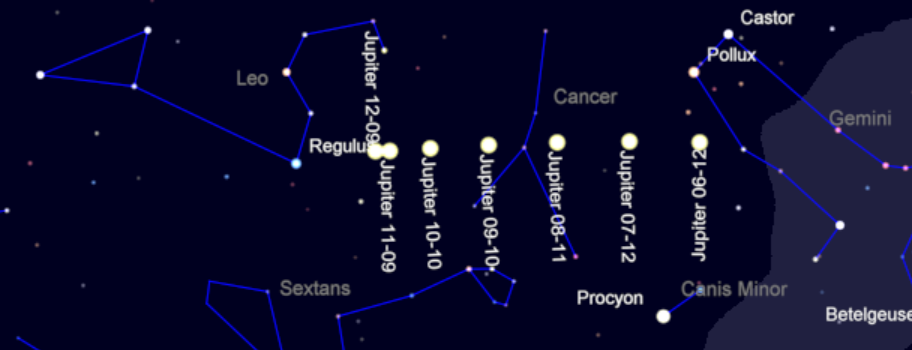
Jupiter’s apparent motion over the next 180 days. Note by December Jupiter will slow and will begin its retrograde loop as the Earth catches up with it again. Created using Cartes du Ciel (Sky Charts).
04/04/2014 – Ephemeris – Follow the Moon this weekend
Note: Sorry for the late post.
Ephemeris for Friday, April 4th. The sun will rise at 7:17. It’ll be up for 12 hours and 55 minutes, setting at 8:13. The Moon, 3 days before first quarter, will set at 1:32 tomorrow morning.
During this weekend the Moon will be slowly crossing the evening sky, approaching the planet Jupiter. Pay attention if you can to each night’s position and how its phase changes. It is moving farther from the sun in the sky, so we see it more and more illuminated by the sun. Sunday night it will draw even with Jupiter, with the planet some 10 moon widths north or above the Moon. It doesn’t seem at first thought that the Moon rotates, since we see the same face from the Earth all the time,. But the Moon does rotate, once a month. If it didn’t rotate we’d see all of it from our changing view of it over the month. The part of the Moon we can’t see from Earth is not the dark side, it is the far side which is fully illuminated at our new moon.
Times are for the Traverse City/Interlochen area of Michigan. They may be different for your location.
Addendum
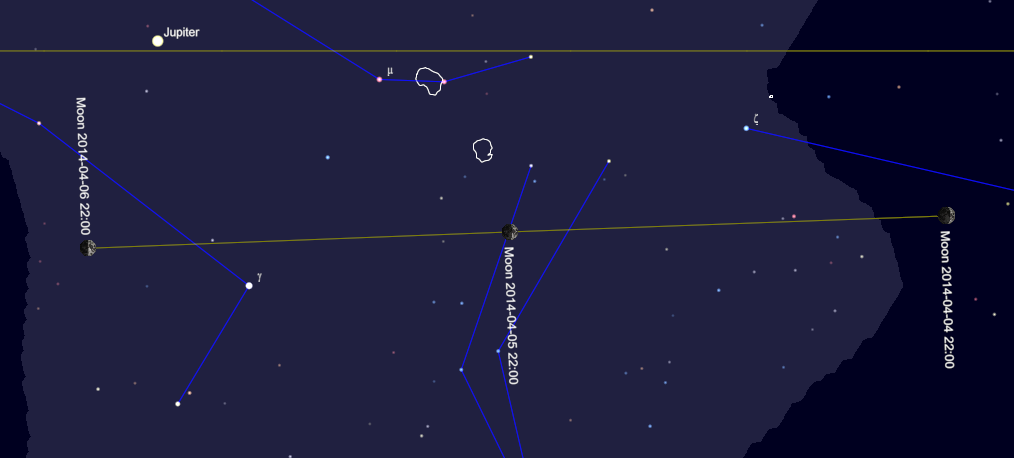
Motion and phase of the Moon for April 4, 5, and 6 2014. Created using Cartes duCiel (SkyCharts).
Click on image to enlarge. Yes, the moon is really that small.
 Bob Moler's Ephemeris Blog