Archive
02/21/2017 – Ephemeris – Finding Saturn this morning and Cassini’s future
Ephemeris for Tuesday, February 21st. The Sun will rise at 7:32. It’ll be up for 10 hours and 47 minutes, setting at 6:19. The Moon, 3 days past last quarter, will rise at 4:48 tomorrow morning.
This morning the crescent Moon will act as a pointer to the planet Saturn. The ringed planet will appear to the right of our Moon. Saturn’s rings will show in any telescope with 20 times magnification or greater. Out at Saturn for the last 13 years and for the next 7 months the robot spacecraft Cassini has been orbiting the ringed planet using gravity assists from the giant moon Titan as a fulcrum to leverage itself into many different orbits to study Saturn’s rings and collection of moons. In a bit over seven months it’s fantastic journey will be over. Low on fuel, it will plunge between the rings and the cloud tops, spiraling in towards its doom September 30th into the planet’s atmosphere so as not to contaminate the icy moons which could possibly harbor life.
Times are for the Traverse City/Interlochen area of Michigan. They may be different for your location.
Addendum
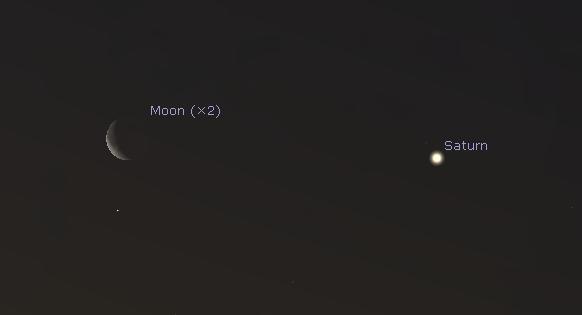
Using the Moon to locate Saturn in the southeast at 7 a.m. or earlier on February 21, 2017. The Moon is enlarged to show it better. Created using Stellarium.
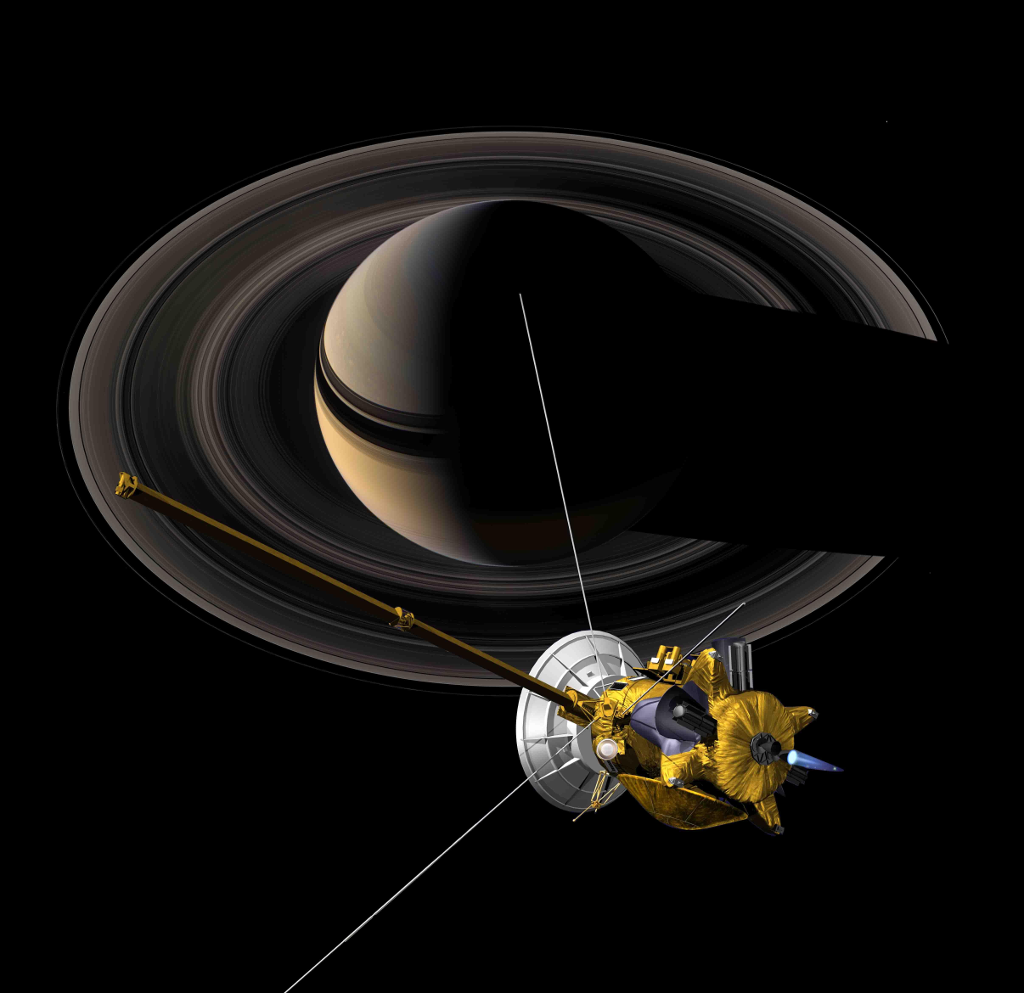
The Cassini spacecraft at Saturn. Credit: NASA/JPL.
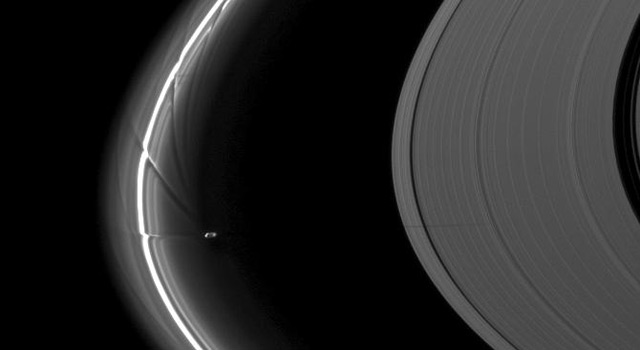
The shepherd satellite Prometheus leaving a wake in Saturn’s outer F Ring. Credit: NASA/JPL.
01/18/2017 – Ephemeris – Where are the bright planets this week?
Ephemeris for Wednesday, January 18th. The Sun will rise at 8:13. It’ll be up for 9 hours and 18 minutes, setting at 5:32. The Moon, 1 day before last quarter, will rise at 12:32 tomorrow morning.
Let’s check out the bright planets for this week. Saturn can be glimpsed this morning at 7 a.m. It will rise tomorrow at 5:49 in the east-southeast. Jupiter can be seen in the south-southwest this morning above the star Spica in Virgo. Jupiter will rise tomorrow at 12:40 a.m. Tomorrow the last quarter Moon will appear near Jupiter. Venus and Mars are in the evening sky. At 6:30 p.m. these planets will be seen in the southwestern sky. Venus is unmistakable as the brilliant evening star, Mars will be above and left of it and much dimmer and will set at 10:14. Venus itself will set at 9:39 p.m. Venus exhibits a fat crescent in small telescopes now, but next month as it gets closer the thinning crescent will be big enough to be seen in binoculars.
Times are for the Traverse City/Interlochen area of Michigan. They may be different for your location.
Addendum
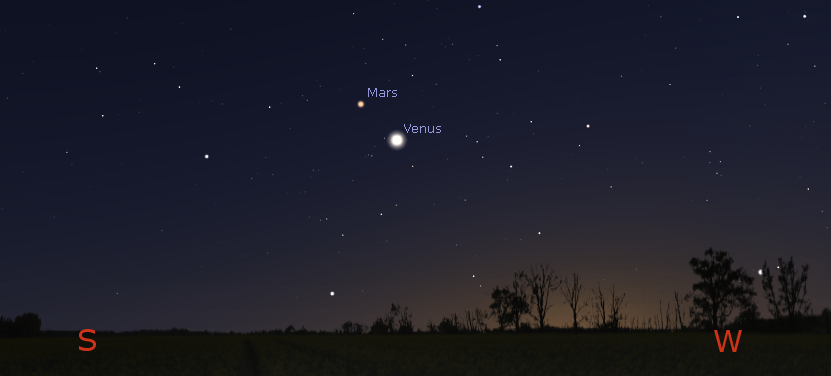
Venus, and Mars in the evening twilight of about an hour after sunset. 6:30 p.m. January 18, 2017. Created using Stellarium. Click image to enlarge.
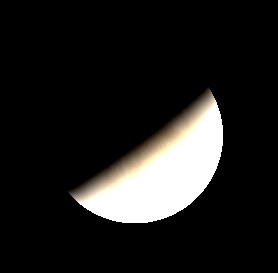
Venus as it might appear in a telescope tonight January 18, 2016. I processed the image to overexpose it as it would appear in a telescope. Created using Stellarium.
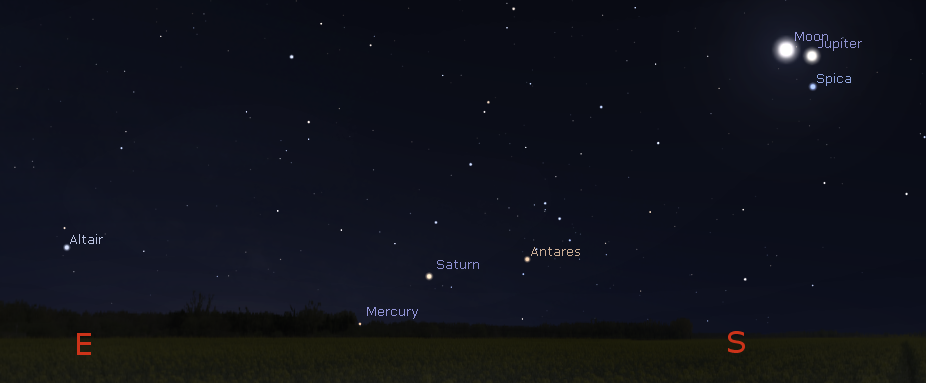
The Moon and Jupiter in the south above the star Spica with Saturn and Mercury peeking over the horizon in the southeast at 7 a.m. tomorrow morning, January 19, 2017. Created using Stellarium. Click image to enlarge.
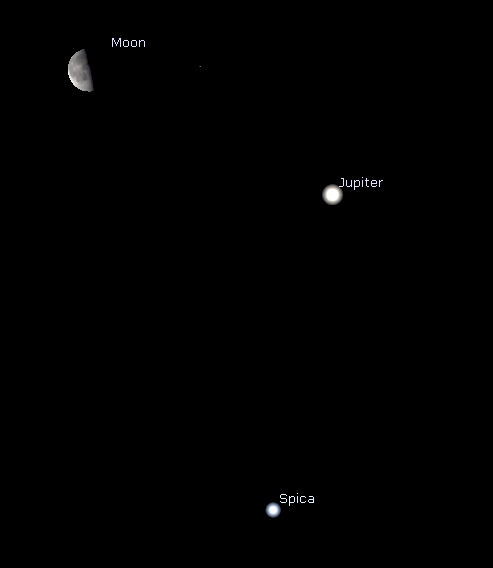
The Moon, Jupiter, and the star Spica tomorrow at 7 a.m., January 19, 2017. Created using Stellarium.
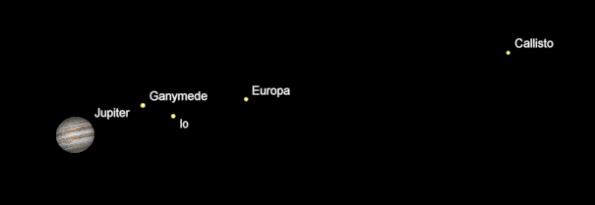
Jupiter and its moons tomorrow morning at 7 a.m., January 19, 2017. Created using Stellarium.
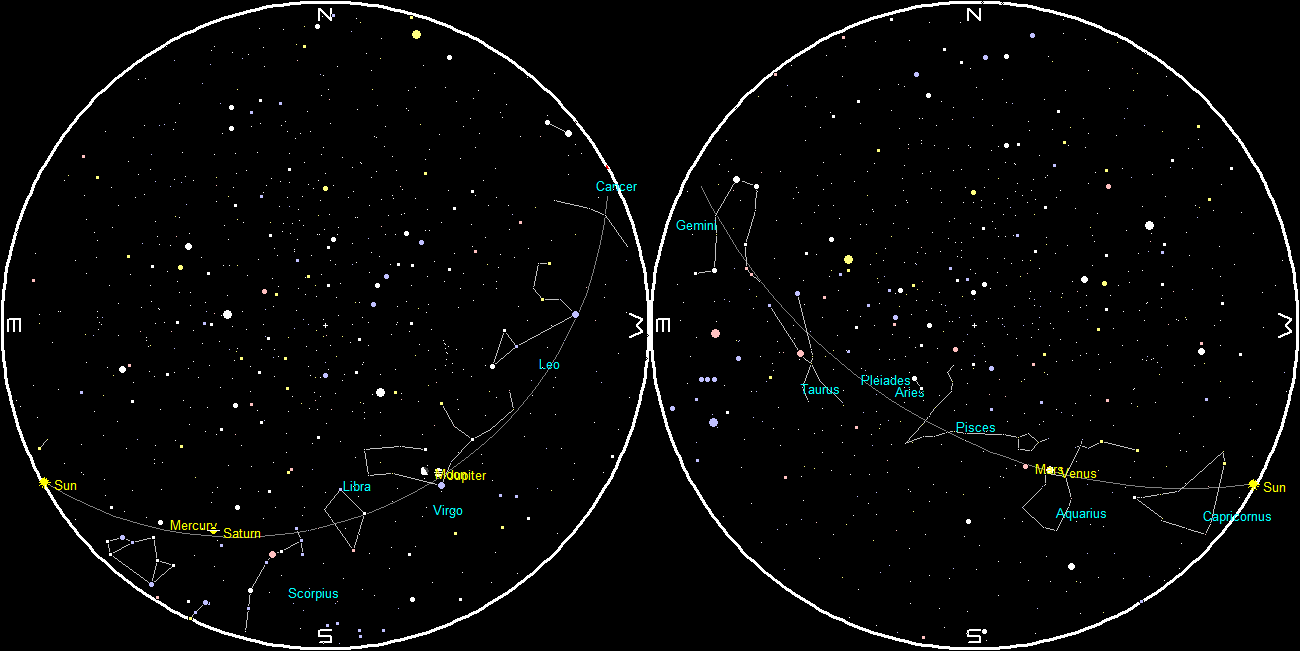
Planets and Moon at sunset and sunrise of a single night starting with sunset on the right on January 18, 2017. The night ends on the left with sunrise on January 19. Click on image to enlarge. Created using my LookingUp program.
In Memorium
Yesterday we lost the 11th man to set foot on the Moon and the last one to leave it. Eugene Cernan, the commander of Apollo 17 hated the title of “The last man to walk on the Moon”, and hoped before he died that another would walk on the Moon, lifting that title from his shoulders. Of the 12 men who walked on the Moon, half are now gone. The way things are going the next person to walk on the Moon will probably be Chinese. Godspeed Eugene Cernan.
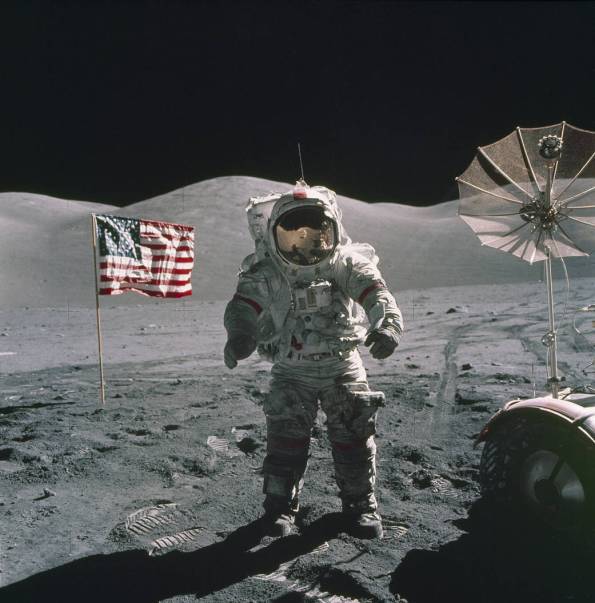
Eugene Cernan with the American Flag and the lunar rover. Credit: NASA/Harrison Schmitt

The first and last men on the Moon. Neil Armstrong, left and Eugene Cernan. File photo.
Godspeed John Glenn
With these words from the Capcom John Glenn was launched into the clear Florida sky on February 20, 1962, the first American to orbit the Earth. I cut my college classes to witness the launch on TV that day. He and Alan Shepard were the astronauts of firsts in the Mercury program and my special heroes. With Glenn’s passing all the Mercury astronauts now belong to history.
Godspeed John Glenn and Rest in peace.
10/13/2016 – Ephemeris – Europa appears to have water geysers like Enceladus
Ephemeris for Thursday, October 13th. The Sun will rise at 7:56. It’ll be up for 11 hours and 4 minutes, setting at 7:00. The Moon, 3 days before full, will set at 5:48 tomorrow morning.
On September 26th NASA announced that the Hubble Space Telescope has confirmed earlier observations that Europa, Jupiter’s second large moon is venting water vapor. It is pretty much known that Europa has a moon girdling ocean many tens of miles below its icy surface. The surface is devoid of craters, showing that there is some interaction with the ocean below and the cracks we see on the surface. Having plumes or geysers will allow spacecraft and landers to sample the ocean below without having to drill down to the ocean. NASA has okayed a mission to Europa. This could change the mission and instruments and maybe add a lander to probe the geysers, though first the have to find them.
Times are for the Traverse City/Interlochen area of Michigan. They may be different for your location.
Addendum
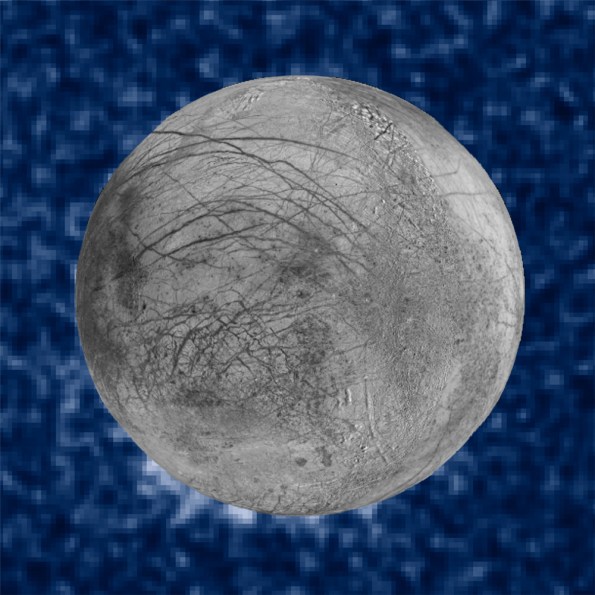
Composite photograph of plumes at the bottom of Europa with a Galileo image of Europa. Credit: NASA/Hubble/Galileo.
09/13/2016 – Ephemeris
Ephemeris for Tuesday, September 13th. The Sun will rise at 7:19. It’ll be up for 12 hours and 36 minutes, setting at 7:56. The Moon, 3 days before full, will set at 4:40 tomorrow morning.
Last Thursday evening an Atlas V rocket lifted off with NASA’s only interplanetary mission this year. The spacecraft called by one of NASA’s tortured acronyms OSIRIS-Rex is on its way to the asteroid Bennu, which was discovered in 1999, and named by a 3rd grader in a contest. Bennu is an Egyptian deity resembling a heron and also resembling the spacecraft. OSIRIS-Rex will take two years to reach the small asteroid, orbit it for two years mapping it in great detail and will approach to retrieve a sample. It will take 3 years to return the sample to the Earth in 2023. Bennu is interesting because it contains organic compounds from the origin of the solar system and because of the tiny chance it could hit the Earth in 200 years or so.
Times are for the Traverse City/Interlochen area of Michigan. They may be different for your location.
Addendum
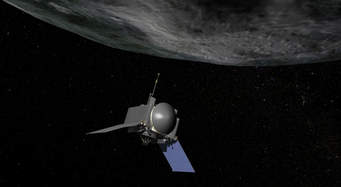
The OSIRIS-REx spacecraft with its sampler boom extended.
07/04/2016 – Ephemeris – NASA’s going to light off fireworks at Jupiter tonight
Ephemeris for Independence Day, Monday, July 4th. Today the Sun will be up for 15 hours and 27 minutes, setting at 9:31, and it will rise tomorrow at 6:03. The Moon is new today, and won’t be visible.
There are two astronomical highlights for your Independence Day enjoyment. The first comes at 11:59 this morning (15:59 UT) when the Earth is at its very farthest from the Sun this year. Some 1.7% farther than average. You’re still gonna need your sun screen anyway. Later this evening, a half billion miles from Earth NASA’s Juno spacecraft will fire it’s rocket engine for 35 minutes to begin to decelerate over the north pole of Jupiter to drop into a long elliptical orbit of that planet. NASA TV will begin broadcasting the event at 10:30 p.m. (2:30 UT, July 5) The 35 minute engine burn will start at 11:18 p.m. (3:18 UT, July 5) What we’ll see is a real-time graph of the Doppler signal from the spacecraft as it slows down to drop into orbit of Jupiter.
Times are for the Traverse City/Interlochen area of Michigan. They may be different for your location.
Addendum
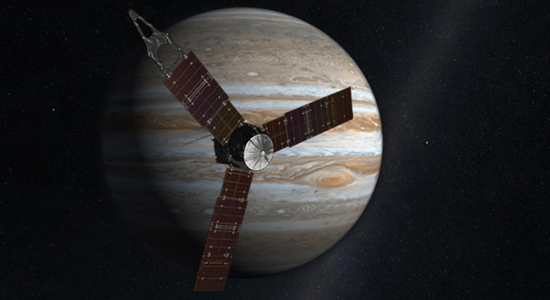
The Juno spacecraft. Credit: NASA.
The Planetary Society’s Emily Lakdawalla has more information on How to watch Juno’s orbit insertion at http://www.planetary.org/blogs/emily-lakdawalla/2016/07011514-how-to-watch-junos-orbit.html.
NASA also has an application in which you can see simulations of Juno’s orbital insertion. It’s called NASA’s Eyes and can be downloaded from http://eyes.nasa.gov/.
06/06/2016 – Ephemeris – Venus passes behind the Sun today
Ephemeris for Monday, June 6th. Today the Sun will be up for 15 hours and 27 minutes, setting at 9:25, and it will rise tomorrow at 5:57. The Moon, 2 days past new, will set at 10:52 this evening.
Today the planet Venus will be in superior conjunction with the Sun, and indeed will pass directly behind the Sun. That event will be completely unobservable due to the Sun’s brilliance. Fours years ago we observed the transit of Venus across the Sun. June 6, 2012. It got me thinking. Transits of Venus occur in pairs 8 years apart followed by a very long interval of over 100 years. It turns out the Venus orbits the Sun 13 times in approximately the same time that the earth orbits the Sun 8 times. In 4 years Venus goes around the Sun 6 ½ times and put’s Venus behind the Sun 4 years after 2012. Today to be precise. In another 4 years we’ll have Venus between the Earth and the Sun again, except Venus will be a bit too far north to transit the Sun.
Times are for the Traverse City/Interlochen area of Michigan. They may be different for your location.
Addendum
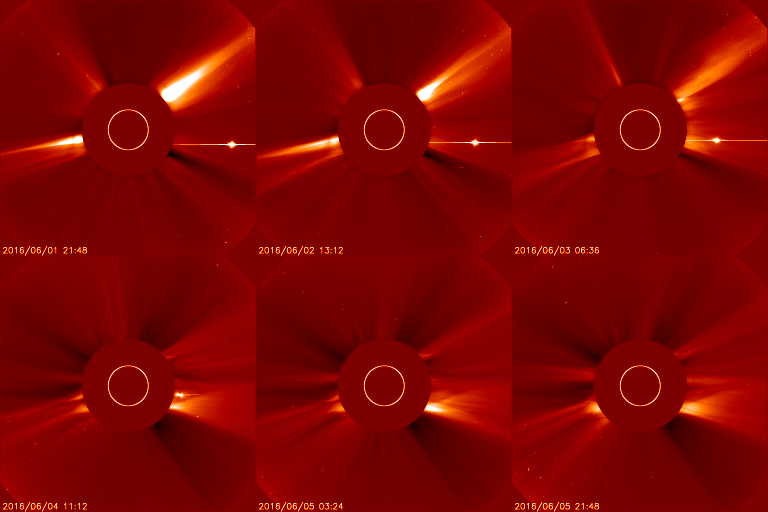
SOlar and Heliospheric Observatory (SOHO) stationed at the Earth-Sun Lagrangian point 1 (L1) a million miles sunward of the Earth. Sent back this animated GIF of Venus approaching the Sun in the last few days. In the LASCO C2 coronagraph the large disk at the center blocks the brightest part of the Sun’s image. The white circle represents the Sun’s disk size. Credit ESA/NASA.
04/21/2016 – Ephemeris – Up up and a way my beautiful balloon*
Ephemeris for Thursday, April 21st. The Sun rises at 6:47. It’ll be up for 13 hours and 48 minutes, setting at 8:36. The Moon, 1 day before full, will set at 7:16 tomorrow morning.
The successful launch of the SpaceX Falcon 9 spacecraft and the Dragon module marked the returned SpaceX to supplying the International Space Station after its failure last June. Besides the great achievement of landing the first stage of the Falcon on a barge, it delivered the Bigelow Aerospace BEAM inflatable module to the ISS. It’s already been attached to the station and will be inflated next month. Bigelow already has two inflatable satellites in orbit: Genesis I and II launched in 2006 and 2007 and though retired, are still in orbit. Inflatable spacecraft offer maximum volume for minimum weight. If the tests on the space station prove the concept, the Mars manned spacecraft may feature an inflatable living module.
Times are for the Traverse City/Interlochen area of Michigan. They may be different for your location.
*Apologies to the 5th Dimension and Bigelow Aerospace.
Addendum
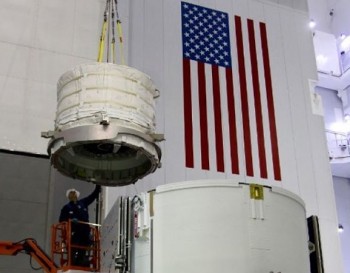
The BEAM module being loaded in the Dragon Trunk. Credit NASA / SpaceX.
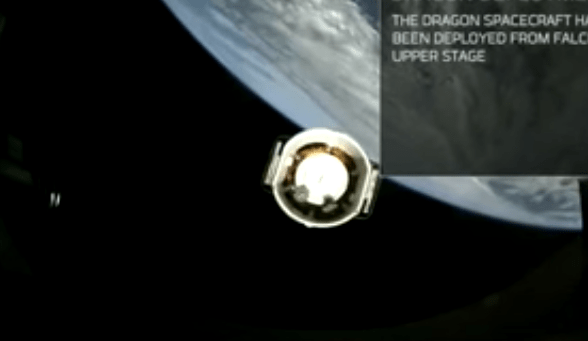
Dragon separating from the Falcon second stage with the BEAM module seen in the Dragon trunk. From a SpaceX/NASA video.
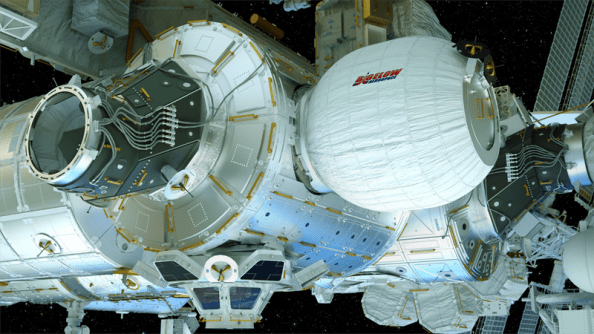
What the BEAM module will look like when attached to the ISS and inflated. Credit NASA.
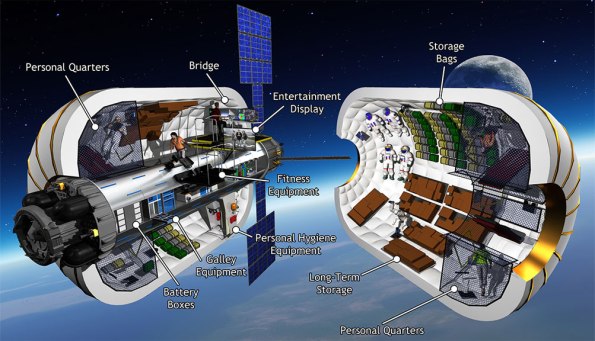
Cutaway view of the Bigelow Aerospace B330 Expandable Space Habitat. They are contracting with United Launch Alliance to send it into orbit. It will have 330 cubic meters of volume. Credit Bigelow Aerospace.
02/23/2016 – Ephemeris – The king of the planets is planning to conquer the evening sky. Tonight its enlisting help from the Moon.
Ephemeris for Tuesday, February 23rd. The Sun will rise at 7:31. It’ll be up for 10 hours and 50 minutes, setting at 6:21. The Moon, 1 day past full, will rise at 7:32 this evening.
Rising with the Moon tonight will be the planet Jupiter which will appear to the left of the Moon as they rise, to the upper left of the Moon at 10 p.m. and above the Moon at midnight. NASA’s Juno spacecraft, launched in 2011, is planned to arrive at Jupiter on July 4th this year. No, it’s not a coincidence. It will orbit the planet for nearly two years. It’s the only solar-powered spacecraft that can operate as far from the Sun as Jupiter, which is 5 times farther from the Sun as the Earth, which gets one 5th squared or one twenty-fifth the intensity of sunlight. It has 3 huge solar panels making the spacecraft 66 feet wide. It’s mission is about Jupiter, its internal structure, atmosphere and magnetic and radiation fields.
Times are for the Traverse City/Interlochen area of Michigan. They may be different for your location.
Addendum
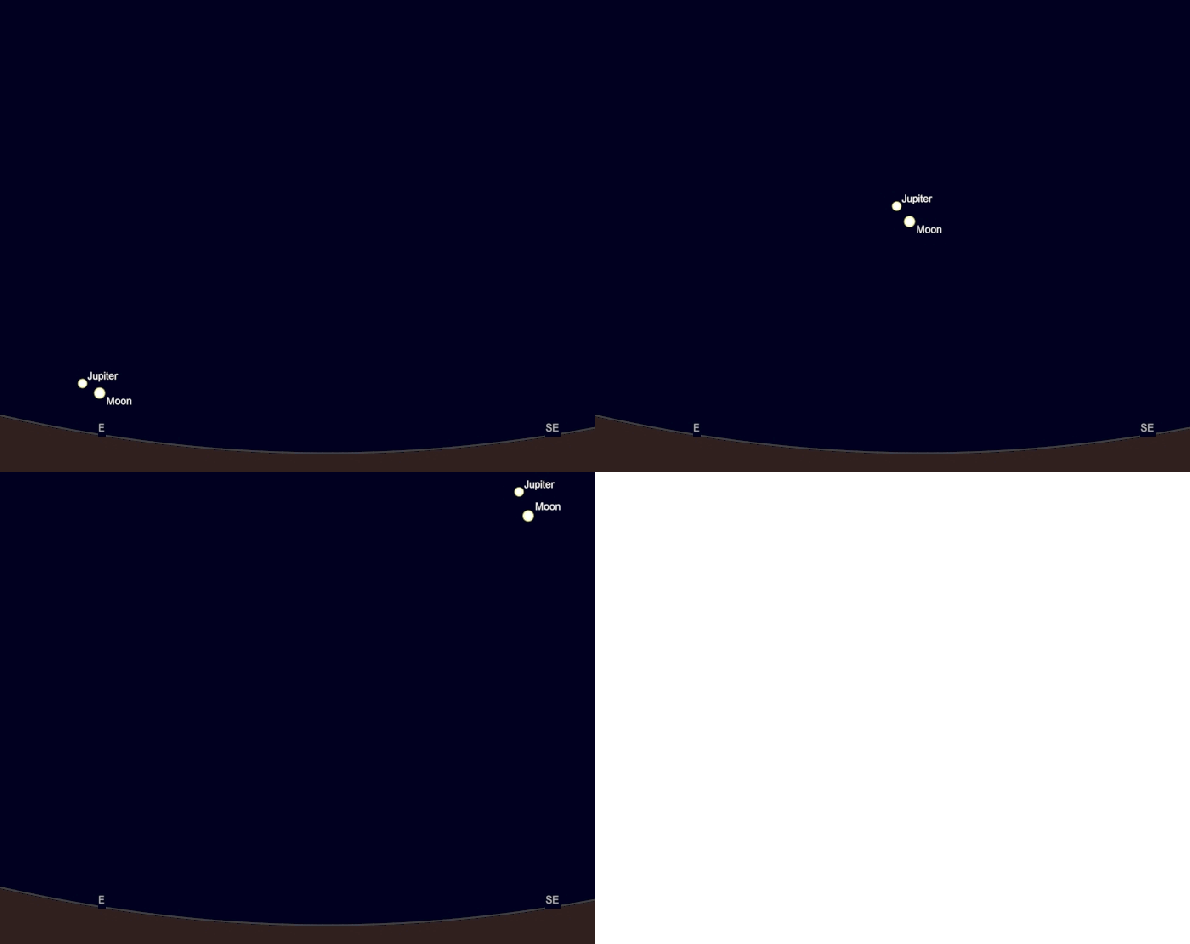
Jupiter and the Moon animation. Note their change in position relative to each other at 8 p.m., 10 p.m. and midnight. Created using Cartes du Ciel (Sky Chart) and GIMP.
.m.
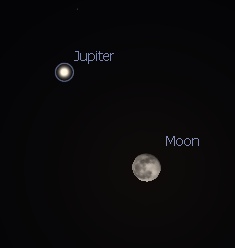
Closeup of Jupiter and the Moon at 10 p.m., February 23, 2016. The Moon is a whole lot brighter, and Jupiter dimmer than what’s shown here. Created using Stellarium.
The Juno spacecraft. Credit: NASA.
12/29/2015 – Ephemeris – Some space triumphs of 2015
Ephemeris for Tuesday, December 29th. The Sun will rise at 8:19. It’ll be up for 8 hours and 50 minutes, setting at 5:10. The Moon, half way from full to last quarter, will rise at 9:58 this evening.
This past year had several important events. Perhaps the biggest was the flyby of Pluto and its moons July 14th By the New Horizons spacecraft. The transmission of data and images will continue for most of 2016, but what has been revealed has been spectacular if puzzling. In other space news Blue Origin landed their New Shepard rocket vertically after sending it straight up 60 miles. In June the SpaceX Falcon 9 blew up while attempting to send its 7th resupply Dragon capsule to the International Space Station. Eight days ago The Falcon 9 returned to flight orbiting 11 satellites for Orbocomm, and flew the booster from over 100 miles up and 100 miles out over the Atlantic to land upright on its designated landing pad back at the cape.
Times are for the Traverse City/Interlochen area of Michigan. They may be different for your location.
Addendum
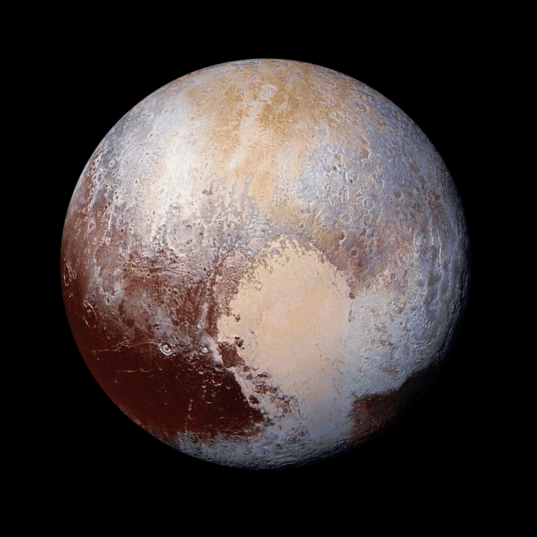
Enhanced color portrait of Pluto by the New Horizons spacecraft. Credit: NASA/JHUAPL/SwRI.

Blue Origin New Shepard rocket, with landing legs expended about to land. Credit: Blue Origin.
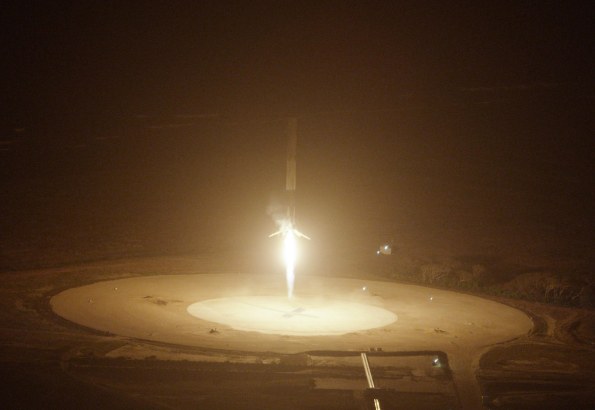
First stage of the SpaceX Falcon 9 descending on its center rocket engine to the center of the main landing pad at Cape Canaveral. Credit: SpaceX.
These weren’t the only highlights of 2015. Having only 45 seconds to devote to the story, I picked the three most important events. I consider the reuseability of rockets to be the Holy Grail of reducing the cost to access to space. The Space Shuttle was a partial, but ultimately failed solution. SpaceX had the most difficult task in refurbishment and reuse because the first stage had to endure a supersonic reentry, though it didn’t need a heat shield. We’ll have to see if the cost of recycling rocket boosters is cheaper than building one from scratch.
 Bob Moler's Ephemeris Blog