Archive
09/23/2014 – Ephemeris – NASA’s MAVEN satellite is in orbit of Mars
Ephemeris for Tuesday, September 23rd. The sun will rise at 7:30. It’ll be up for 12 hours and 7 minutes, setting at 7:37. The moon, 1 day before new, will rise at 7:53 tomorrow morning.
Last Sunday evening the MAVEN spacecraft fired its six main engines in alternating pairs for 33 minutes and was captured by Mars, entering orbit around the Red Planet. MAVEN is one of those NASA acronyms, it stands for Mars Atmospheric and Volatile EvolutioN Once in a capture orbit, the orbit will be changed from a 33 hour orbit to a 4 ½ hour a science orbit. It will investigate how Mars lost its original atmosphere which was dense enough to support liquid water to the thin carbon dioxide atmosphere it has today. It has several duties October 19th when Comet Siding Spring passes Mars to detect the interaction of the comet’s atmosphere with that of Mars. There are no cameras* on Maven, just hard data will be returned.
Times are for the Traverse City/Interlochen area of Michigan. They may be different for your location.
Addendum
* Actually I was mistaken. There is an Imaging Ultraviolet Spectrograph aboard which will take images in the ultraviolet of Mars upper atmosphere.
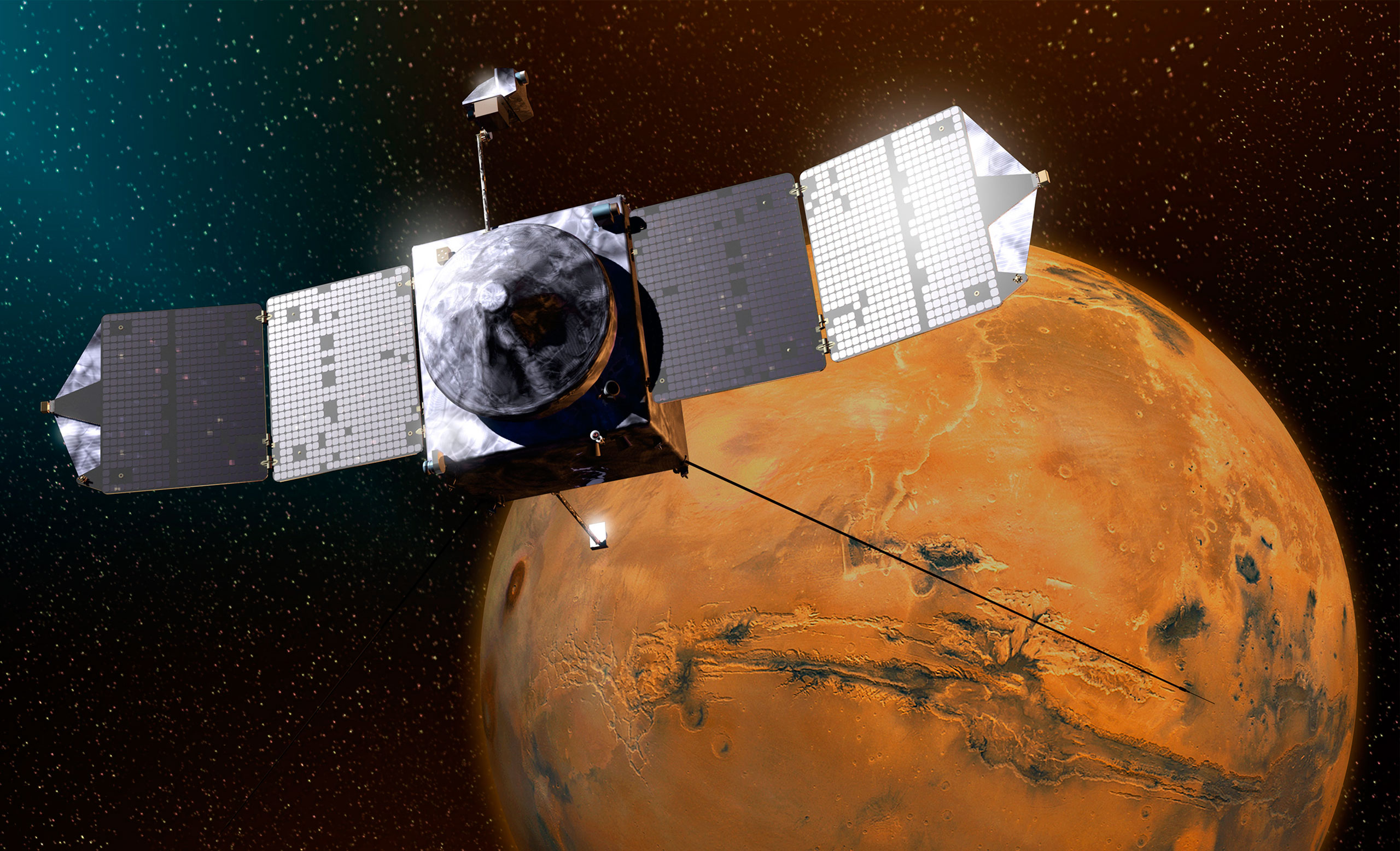
Artist’s rendition of the MAVEN spacecraft in Mars Orbit. Credit: Lockheed Martin/NASA.
07/14/2014 – Ephemeris – New Horizons to Pluto: 1 year and counting!
Ephemeris for Monday, July 14th. Today the sun will be up for 15 hours and 14 minutes, setting at 9:25. The moon, 2 days past full, will rise at 10:45 this evening. Tomorrow the sun will rise at 6:11.
Exactly one year from today the New Horizons spacecraft will fly by the dwarf planet Pluto. It will be taking photographs of Pluto and its moons, sniffing out Pluto and its large moon Charon. During most of the close flyby the spacecraft will be too busy to talk to Earth. When past Pluto the spacecraft will be able over the next few months to down-link to us all its information. At that great distance it must send data back to us with a transmission speed will make the old 300 baud modems of three decades ago seem fast. Recently the Hubble Space Telescope has been pressed into service to spot new targets beyond Pluto for New Horizons. It quickly found two, and is looking for more.
Times are for the Traverse City/Interlochen area of Michigan. They may be different for your location.
Addendum
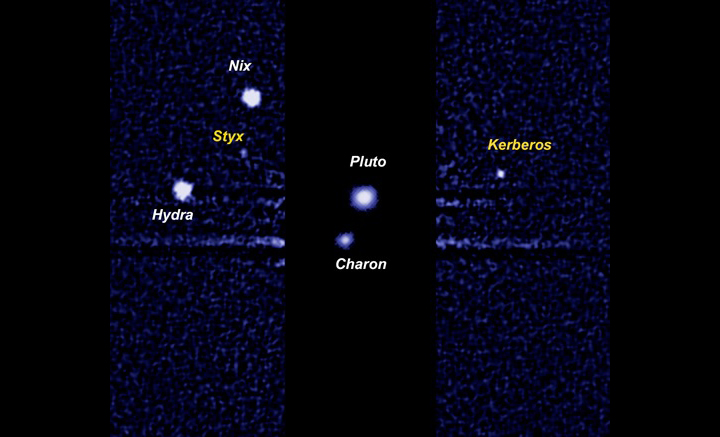
Pluto and its moons as photographed by the Hubble Space Telescope. Pluto and Charon were filtered to reduce their brightness to bring out the other dim moons. Credit: NASA/Hubble.
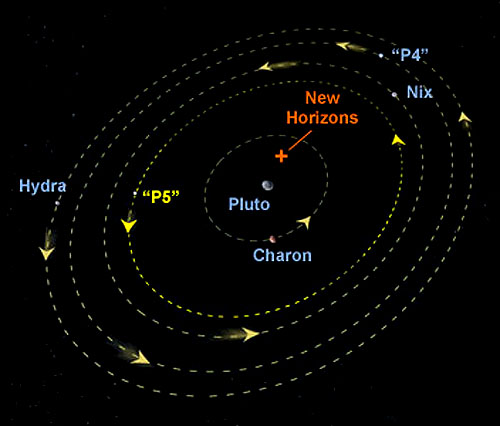
New Horizon’s aim point in relation to the moons. This was created before P4 and P5 received names. P4 became Styx, and P5 became Kerberos. Credit: NASA/GSFC.
When more and more moons were discovered around Pluto serious consideration was given to steer clear of the moon orbits. It is quite possible that there is much debris orbiting Pluto where all these satellites are. They all orbit Pluto in the same plane, along with Charon, above Pluto’s equator. It is thought that any material streaming toward Pluto would be intercepted by Charon, so the space between Charon and Pluto might be clear of debris, so New Horizons can punch through in safety. New Horizons is going like a bat out of heck and has no brakes. New Horizon’s velocity with respect to Pluto at closest approach will be 49,600 kilometers per hour or 30,800 mph according to the New Horizons article on Wikipedia (no citation given). The path of the spacecraft can be altered is a moon or other hazard is detected.
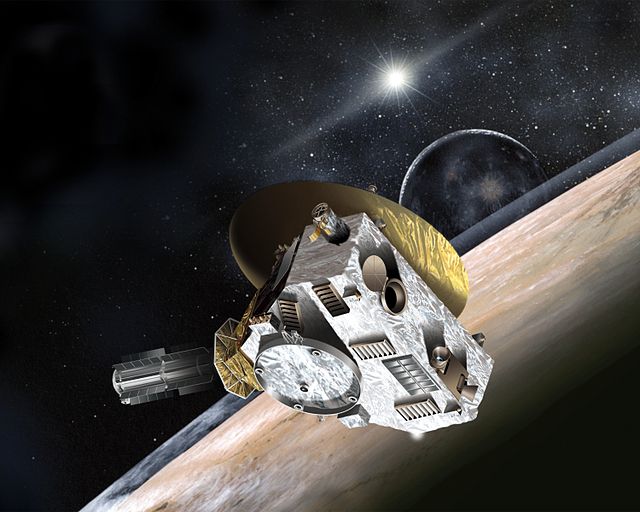
Artist conception of the New Horizons spacecraft at Pluto. Credit: NASA/Johns Hopkins University Applied Physics Laboratory/Southwest Research Institute.
New Horizon’s web page: http://pluto.jhuapl.edu/
05/26/2014 – Ephemeris – In memory of the fallen Space Shuttle Astronauts
Ephemeris for Memorial Day, Monday, May 26th. Today the sun will be up for 15 hours and 10 minutes, setting at 9:15. The moon, 2 days before new, will rise at 5:29 tomorrow morning. Tomorrow the sun will rise at 6:03.
Memorial day is a day of remembrance for those who paid the ultimate price for our freedom. When astronomers name craters or other features on planets or moons, they are names of those who have gone before. For instance craters near the moon’s north and south poles are named for explorers of the corresponding earthly pole. The Challenger astronauts have craters named for them in the moon system of Uranus, from discovery pictures relayed to the earth by Voyager 2 a few days before the Challenger accident. The Mars Rover Spirit is a memorial and located in the Columbia Hills, its features named for the astronauts who died 11 months before Spirit landed.
Times are for the Traverse City/Interlochen area of Michigan. They may be different for your location.
Addendum

The Challenger crew. From the left: Ellison Onizuka, Michael Smith, Christa McAuliffe, Dick Scobee, Gregory Jarvis, Judith Resnick, and Ronald McNair. Credit: NASA

The Columbia crew. From the left: Mission Specialist David Brown, Commander Rick Husband, Mission Specialists Laurel Clark, Kalpana Chawla and Michael Anderson, Pilot William McCool and Payload Specialist Ilan Ramon. Credit: NASA.
I was remiss in my program to omit the Apollo 1 crew.
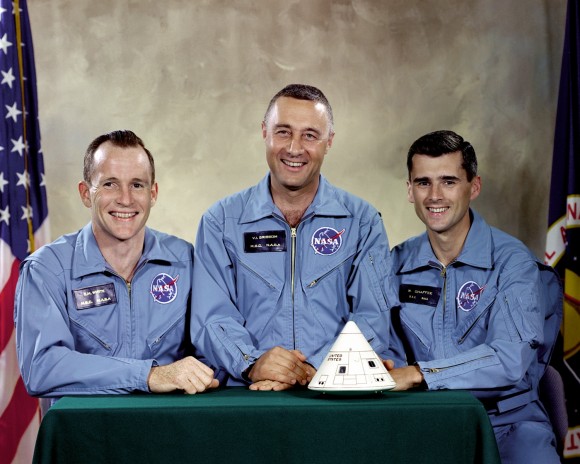
The Apollo 1 crew. From the left: Ed White, Gus Grissom, and Roger Chaffee. Credit: NASA
Apollo 1 never flew. A spark and the faulty design of the spacecraft doomed the men during a test on the pad. Roger Chaffee, from my home town of Grand Rapids, MI was the rookie and had never flown in space. They are immortalized with craters on the far side of the moon.
For more information check out Amy Shira Teitel’s excellent article in Universe Today.
05/12/2014 – Ephemeris – NASA’s OSIRIS-REx mission to an asteroid
Ephemeris for Monday, May 12th. Today the sun will be up for 14 hours and 42 minutes, setting at 9:00. The moon, 2 days before full, will set at 5:37 tomorrow morning. Tomorrow the sun will rise at 6:16.
Construction is beginning on a spacecraft called OSIRIS-REx, which is slated to be launched in September of 2016 to reach asteroid Bennu in 2018 and retrieve a 2 or so ounce sample and return it in 2023. It is important to discover the physical features of near earth asteroids or NEOs, and so learn how best to deflect them, or even mine them for resources. If you’d like your name to ride along on the spacecraft to orbit the Sun forever, well for several billion years; and be apart of the return capsule, which will probably reside at the Smithsonian at the end of its travels, go to the Planetary Society website at http://www.planetary.org/get-involved/messages/bennu/, and sign up yourself and your family. Be part of space history.
Times are for the Traverse City/Interlochen area of Michigan. They may be different for your location.
Addendum
Mission webpage: http://www.asteroidmission.org/
NASA mission page: http://www.nasa.gov/mission_pages/osiris-rex/#.U3Br1HbDuBw
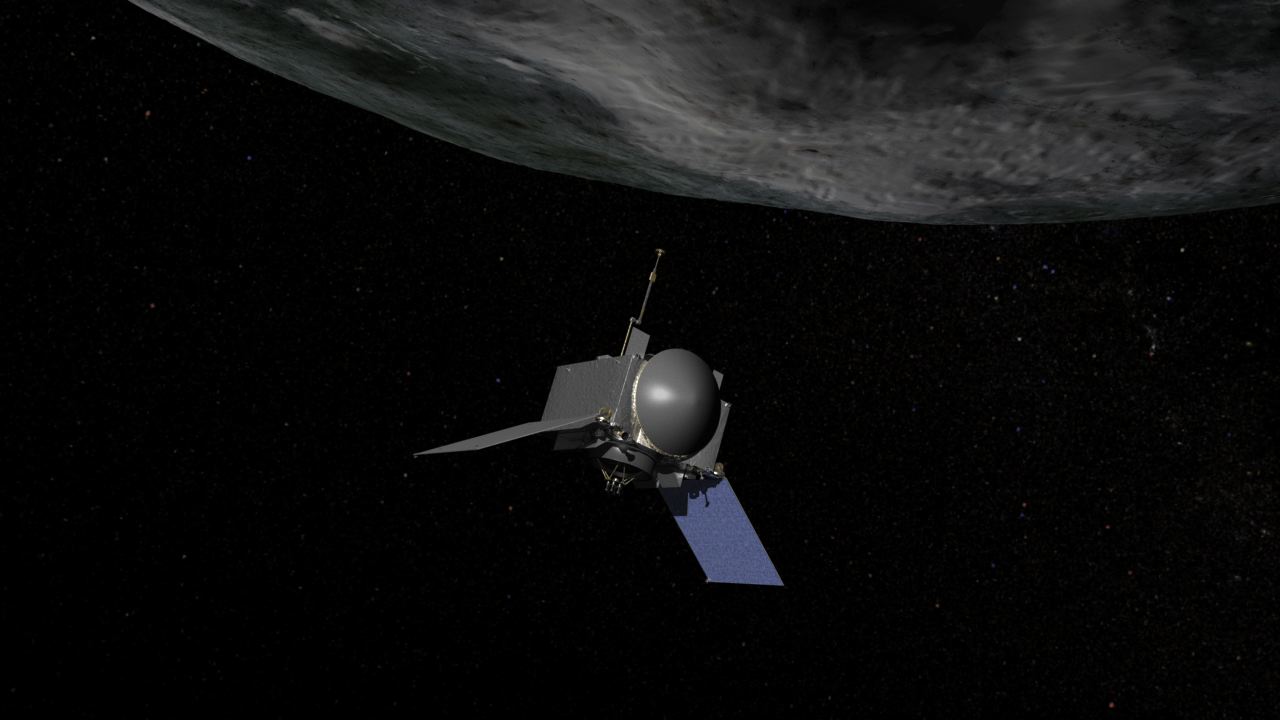
Artist’s conception of OSIRIS-REx about to collect a sample from asteroid Bennu. Image Credit:
NASA/Goddard/Chris Meaney
05/05/2014 – Ephemeris – LADEE is no more but its mission goes on
Ephemeris for Monday, May 5th. The sun rises at 6:27. It’ll be up for 14 hours and 24 minutes, setting at 8:52. The moon, 1 day before first quarter, will set at 2:09 tomorrow morning.
The Lunar Atmosphere and Dust Environment Explorer or LADEE spacecraft that was in a close orbit of the moon to sniff out the Moon’s tenuous exosphere of gases and dust, augured into the moon’s far side April 17th as planned. This was just the end of the data acquisition phase of the mission. The data will be pored over for years to develop a picture of the lunar environment. This will aid lunar explorers to come both robotic and human. Something similar is happening to the Kepler mission to find transiting planets of other stars. The data gathering phase is over but there was an announcement a week or such ago of an earth sized planet in a stars habitable zone. Discoveries will go on for years.
Times are for the Traverse City/Interlochen area of Michigan. They may be different for your location.
Addendum
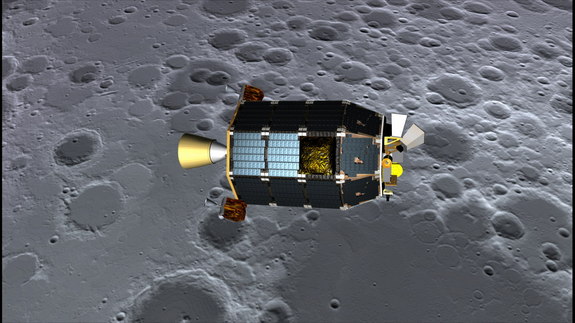
Artist’s depiction of LADEE in orbit of the Moon. Courtesy NASA.
More about the LADEE Mission is here.
03/13/2014 – Ephemeris – An asteroid self destructs
Ephemeris for Thursday, March 13th. The sun will rise at 7:58. It’ll be up for 11 hours and 47 minutes, setting at 7:46. The moon, 3 days before full, will set at 6:40 tomorrow morning.
The solar system is getting weirder and weirder. Last week came the announcement from the Hubble Space Telescope folks, that they have been watching an asteroid in the main asteroid belt falling apart. The object was picked up last year by two sky survey groups and communicated to the Keck Telescope and Hubble telescope folks for further study. Both found that it was an asteroid slowly breaking up into smaller pieces, and watched it over several months breaking into smaller and smaller pieces. It’s thought that this asteroid is or was a rubble pile and the pressure of sunlight caused it to rotate fast enough to break it apart. The speeds of the dispersing particles is a mere earthly walking speed, ruling out a collision.
Addendum
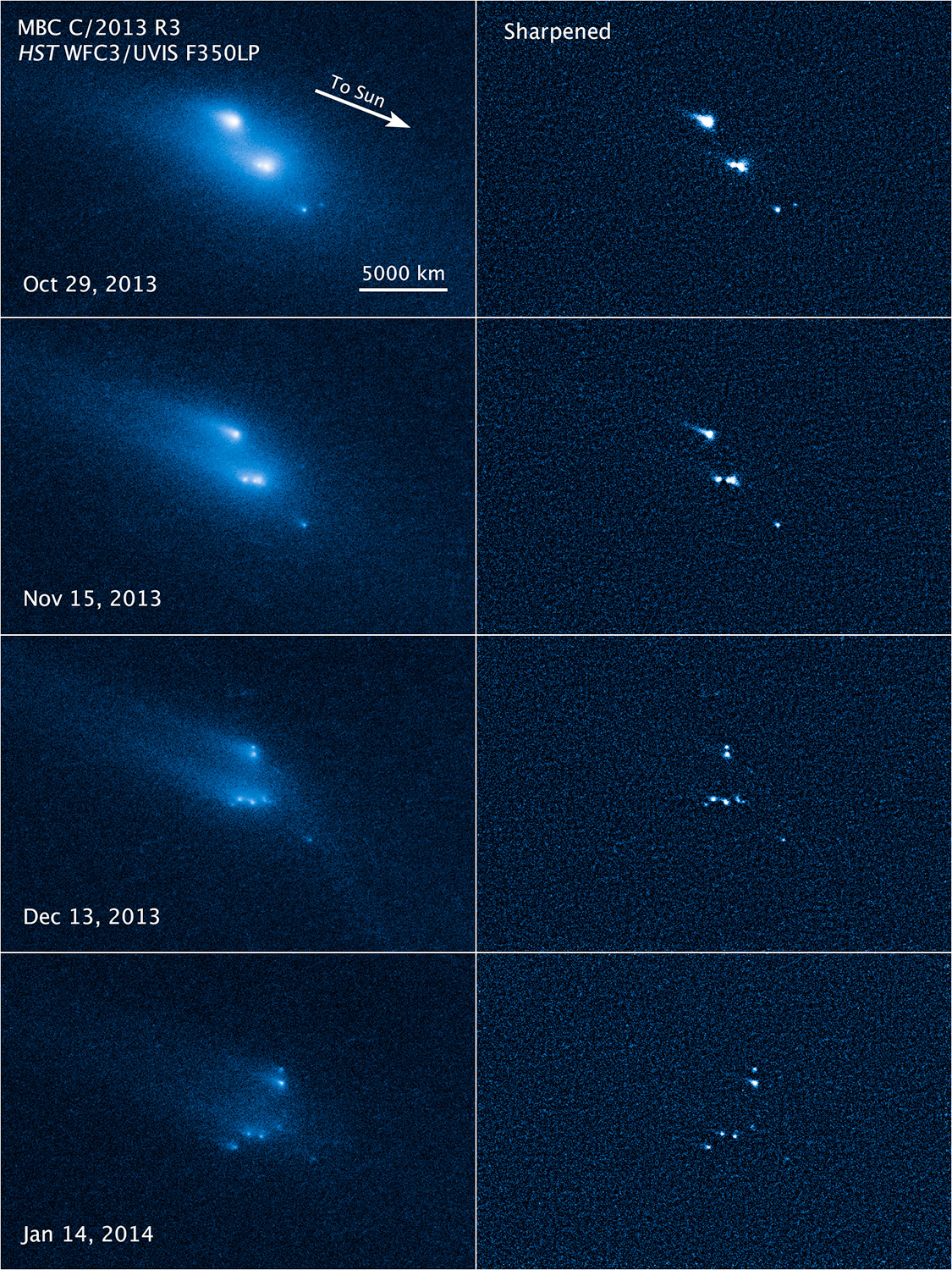
Four images of an asteroid breaking up over 3 months. The largest piece is perhaps the size of 4 football fields. Image Credit: NASA, ESA, D. Jewitt (UCLA).
Click here for the NASA page with more information.
02/13/2014 – Ephemeris – Dwarf planet Ceres is the next stop for the Dawn spacecraft.
Ephemeris for Thursday, February 13th. The sun will rise at 7:45. It’ll be up for 10 hours and 22 minutes, setting at 6:08. The Moon, 1 day before full, will set at 7:10 tomorrow morning.
The Dawn spacecraft is in the asteroid belt. After spending a year orbiting the asteroid Vesta two years ago, it has set its sights on Ceres, the largest asteroid, which was promoted by the same reasoning that Pluto was demoted, as a dwarf planet. Recently it was announced that Ceres is out-gassing water molecules. Dawn, with its ion engine is slowly approaching Ceres and will enter orbit of the body in April next year, a few months before the new Horizons spacecraft will fly by the dwarf planet Pluto on Bastille Day 2015. Dawn will stay in orbit of Ceres for a year at least. It will take at least several months to download all the images and data from the Pluto encounter from New Horizons, so we will have a very eventful 2015.
Times are for the Traverse City/Interlochen area of Michigan. They may be different for your location.
Addendum
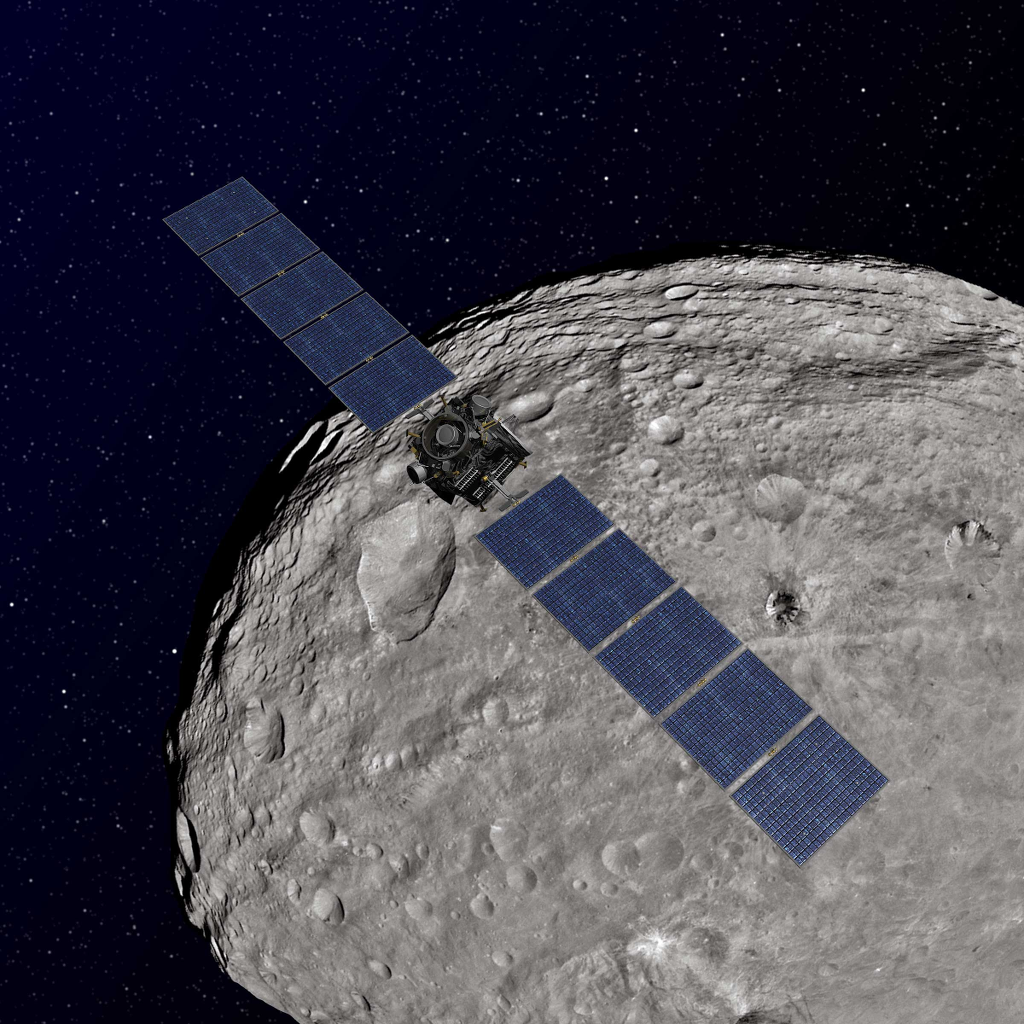
Artist’s rendition of the Dawn spacecraft at Vesta. Credit: NASA/JPL.
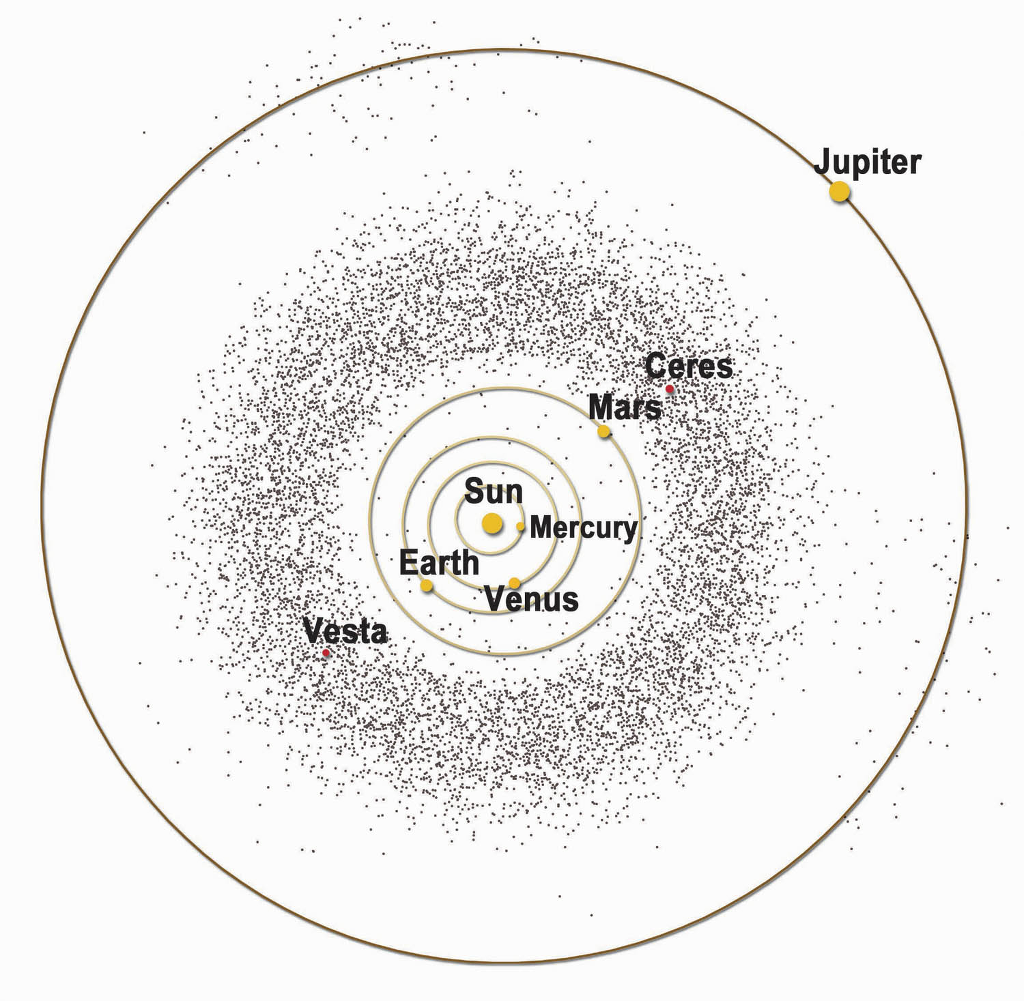
The asteroid belt n the inner solar system. Credit: NASA/JPL.
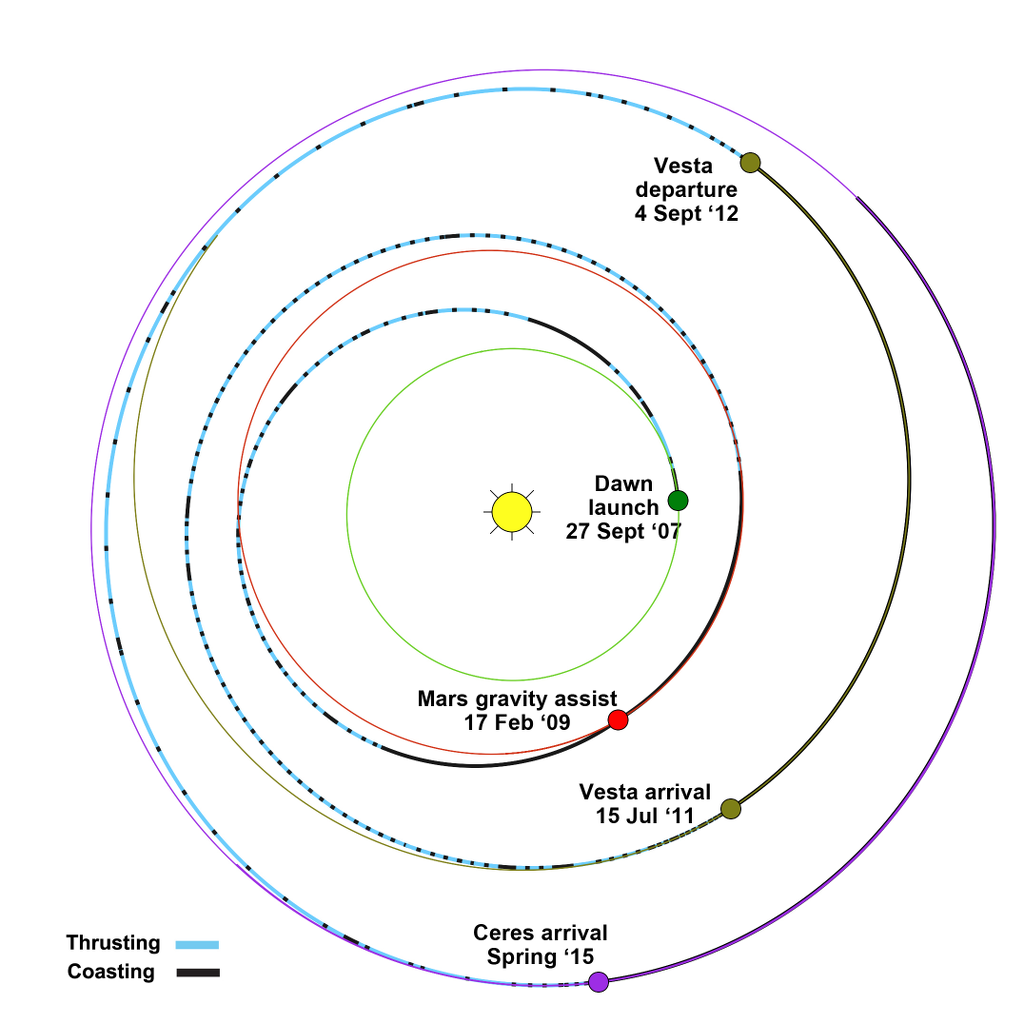
Dawn orbital track past Mars, stopping at Vesta and continuing to Ceres. Credit: NASA/JPL.
The Dawn spacecraft uses ion propulsion, which though 10 times more efficient than chemical fuels, has the thrust comparable to that of the weight of a piece of a piece of paper. Consequently the spacecraft spends most of its time thrusting. Since it’s antenna is bolted on the spacecraft, it cannot thrust and communicate with the earth at the same time, so it has to stop thrusting and turn toward the earth to report back at scheduled intervals before resuming thrusting again.
11/28/2013 – Ephemeris – Comet ISON T minus Zero day
Ephemeris for Thanksgiving Day, Thursday, November 28th. The sun will rise at 7:55. It’ll be up for 9 hours and 8 minutes, setting at 5:04. The moon, 3 days past last quarter, will rise at 3:53 tomorrow morning.
This is T minus Zero day for Comet ISON. At 1:35 this afternoon it will pass perihelion, its closest point to the sun, only a bit more than the sun’s diameter above the bright ball of the sun’s photosphere. It’s will look closer than that because the comet will be slightly behind the sun. It will still be visible in the Solar Dynamic Observatory’s telescopes. To check on the comet throughout the day go on the Internet go to spaceweather.com at the page bottom click on STEREO, then click on Latest Images You can call up the Solar Dynamics Observatory (SDO) and the SOHO LASCO images, or go to bobmoler.wordpress.com. I’m sure by tomorrow there will be time-lapse movies on Universe Today.
Times are for the Traverse City/Interlochen area of Michigan. They may be different for your location.
Addendum
There is a NASA sponsored Google + Hangout that will be transmitted on all NASA TV channels.
November 28, Thursday
1 – 3:30 p.m. EST – NASA Google+ Hangout: Comet ISON – GSFC (All Channels)
Here’s a link to NASA-TV: http://www.nasa.gov/multimedia/nasatv/
SOHO LASCO C3 image as of this update (10:10 EST 11/27/13):
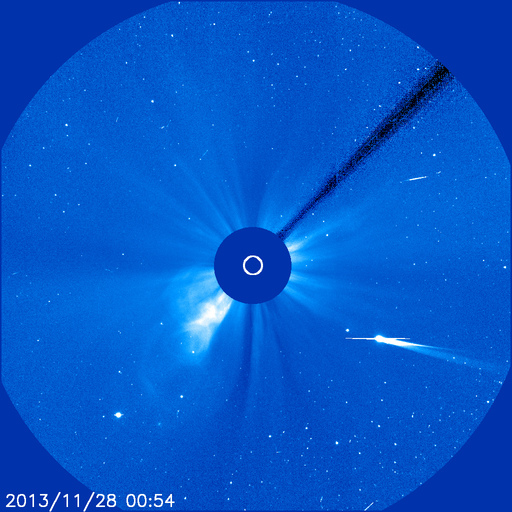
SOHO LASCO C3 image of the sun and Comet ISON. Image timestamped 11/28/13 at 00:54 UT. 7:54 p.m. November 27, 2013 EST. Credit NASA/ESA.
11/27/2013 – Ephemeris – Where are the bright planets and what’s up with Comet ISON?
Ephemeris for Wednesday, November 27th. The sun will rise at 7:54. It’ll be up for 9 hours and 10 minutes, setting at 5:05. The moon, 2 days past last quarter, will rise at 2:46 tomorrow morning.
Let’s see where the bright planets are this eventful week. Venus is brilliant in the southwest after sunset. It will set at 7:53 p.m. The giant planet Jupiter will rise at 8:01 p.m. in the east northeast. It’s cruising against the stars of Gemini now. It will pass due south at 3:38 a.m. Mars will rise at 1:47 a.m. also in the east northeast. Reddish Mars is midway between Regulus in Leo and Spica in Virgo and tomorrow morning will be about 12 moon diameters above left of the moon. Mercury and Saturn will be together in the east southeast by 7 a.m. Mercury is the lower and brighter of the two. Comet ISON is now too close to the sun to be seen. Check bobmoler.wordpress.com (see below) for how to view Comet ISON near the sun.
Times are for the Traverse City/Interlochen area of Michigan. They may be different for your location.
Addendum
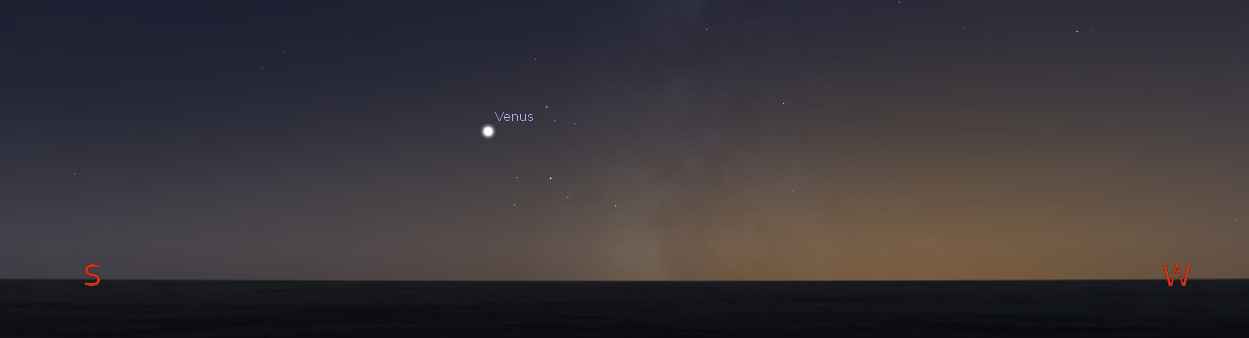
Venus as it should appear at 6 p.m. on 11/27/2013. Created using Stellarium.
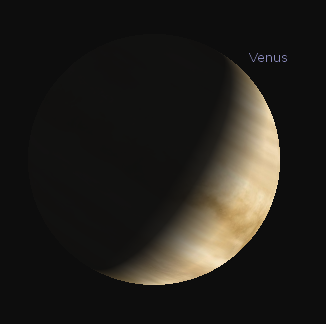
Telescopic view of Venus as it should appear at 6 p.m. on 11/27/2013. Created using Stellarium.
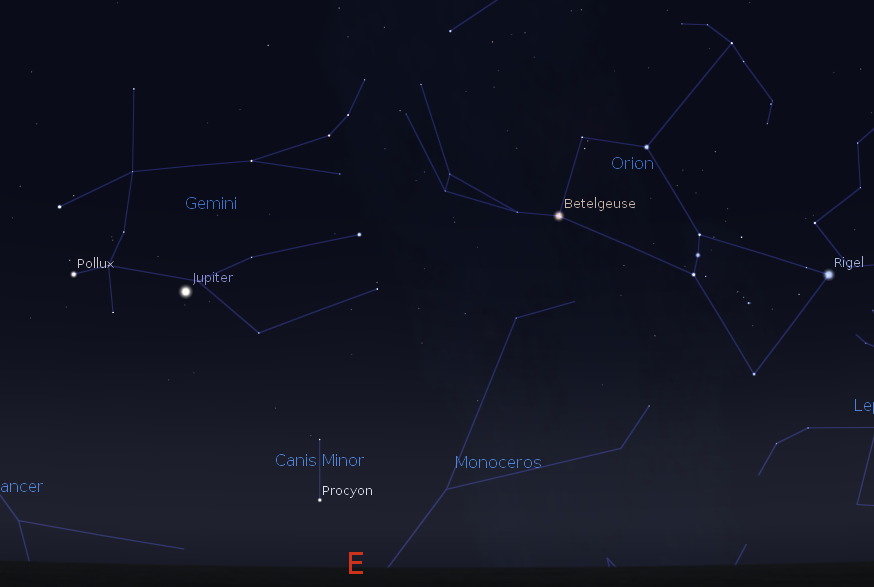
Jupiter and some winter constellations as they should appear at 10 p.m. on 11/27/2013. Created using Stellarium.
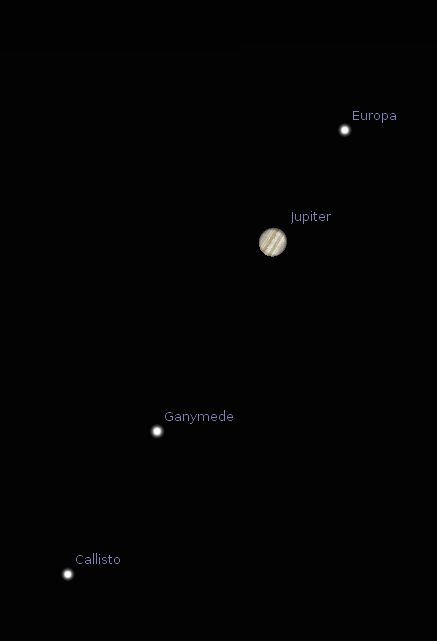
Telescopic view of Jupiter and its satellites as they should appear at 10 p.m. on 11/27/2013. The satellite Io is behind the planet and won’t appear until after midnight. Created using Stellarium.
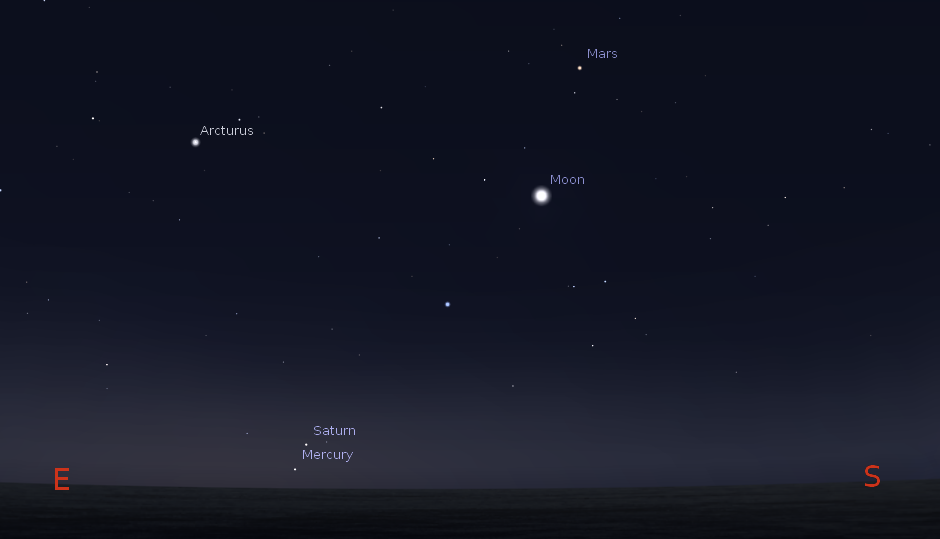
The morning planets Mars, Saturn and Mercury plus the Moon at 6:45 a.m. November 28, 2013. Created using Stellarium
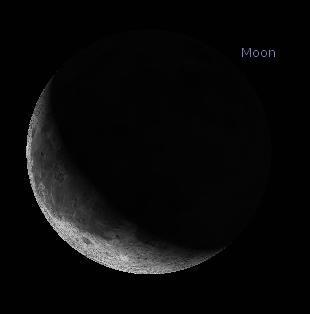
The Moon at 6:45 a.m. November 28, 2013. Created using Stellarium.
Comet ISON
Phil Plait the Bad Astronomer reported Monday that Comet ISON had suddenly decreased the amount of ices that it was emitting and pretty much simultaneously greatly increased the amount of dust it was producing. One of the possible explanations was that its nucleus had been disrupted. The comet’s nucleus is the small, maybe 2 km diameter, solid part of the comet. All the other parts of the comet are the thin ejected gas and dust from that nucleus. The head and tail of the comet is still a pretty good vacuum by earthly standards. There is still questions about it today. Here’s a YouTube video posted by the Planetary Society’s Emily Lakdawalla created by Emily from images taken by the STEREO Ahead spacecraft. It seems to be holding its own:
Here is the Planetary Society Blog entry that discusses Comet ISON’s then current status.
At the time of this posting (10 p.m. 11/26) the STEREO Behind COR 2 image shows Comet ISON entering on the lower left. Also SOHO’s LASCO C3 imager shows Comet ISON entering the view from the lower right. There’s also a coronal mass ejection (CME) erupting toward the comet. It could pass behind it, in front of it or actually toward it. It should be interesting.
Live programming of NASA-TV Thanksgiving Day
November 28, Thursday
1 – 3:30 p.m. – NASA Google+ Hangout: Comet ISON – GSFC (All Channels)
Here’s a link to NASA-TV: http://www.nasa.gov/multimedia/nasatv/
08/22/2013 – Ephemeris – A new mission to the moon starts next month
Thursday, August 22nd. The sun rises at 6:53. It’ll be up for 13 hours and 42 minutes, setting at 8:36. The moon, 2 days past full, will rise at 9:11 this evening.
Though we all know that the moon is airless, surrounded by a better vacuum that we can pump down on the earth. Nonetheless the moon has a tenuous atmosphere of gas and dust. Next month NASA has scheduled the launch of another unmanned spacecraft to the moon. This one is LADEE, an acronym for Lunar Atmosphere and Dust Environment Explorer. It will take 30 days to reach the moon and will measure the dust and tenuous atmosphere of the moon. It will looking for the high altitude glows seen by the Apollo astronauts above the moon. There is also a demonstration laser communication system, at least six times faster than current radio technology.
Times are for the Traverse City/Interlochen area of Michigan. They may be different for your location.
Addendum
Artist’s depiction of LADEE in orbit of the Moon. Credit: NASA Ames / Dana Berry.
 Bob Moler's Ephemeris Blog