Archive
02/16/2021 – Ephemeris – Perseverance lands on Mars in two days
This is Ephemeris for Fat Tuesday, Tuesday, February 16th. Today the Sun will be up for 10 hours and 32 minutes, setting at 6:13, and it will rise tomorrow at 7:39. The Moon, 3 days before first quarter, will set at 11:24 this evening.
In two days, Thursday afternoon, the Perseverance Rover will land on the planet Mars in a crater call Jezero. It’s mission to actually look for evidence of past life, fill specimen tubes to be cached for later pickup and returned to earth by a future mission, presumably by the end of the decade. It is also bringing a helicopter drone named Ingenuity to check out the feasibility of using future aircraft in Mars rarefied atmosphere. The vehicle, including the back shell and descent stage sports 23 cameras. Even Ingenuity has 2 cameras. That shouldn’t be a big deal today. Heck, my smartphone has 5 cameras, each with lots more megapixels than the digital camera I bought 15 years ago. Only two days to go to landing.
The event times given are for the Traverse City/Interlochen area of Michigan. They may be different for your location.
Addendum
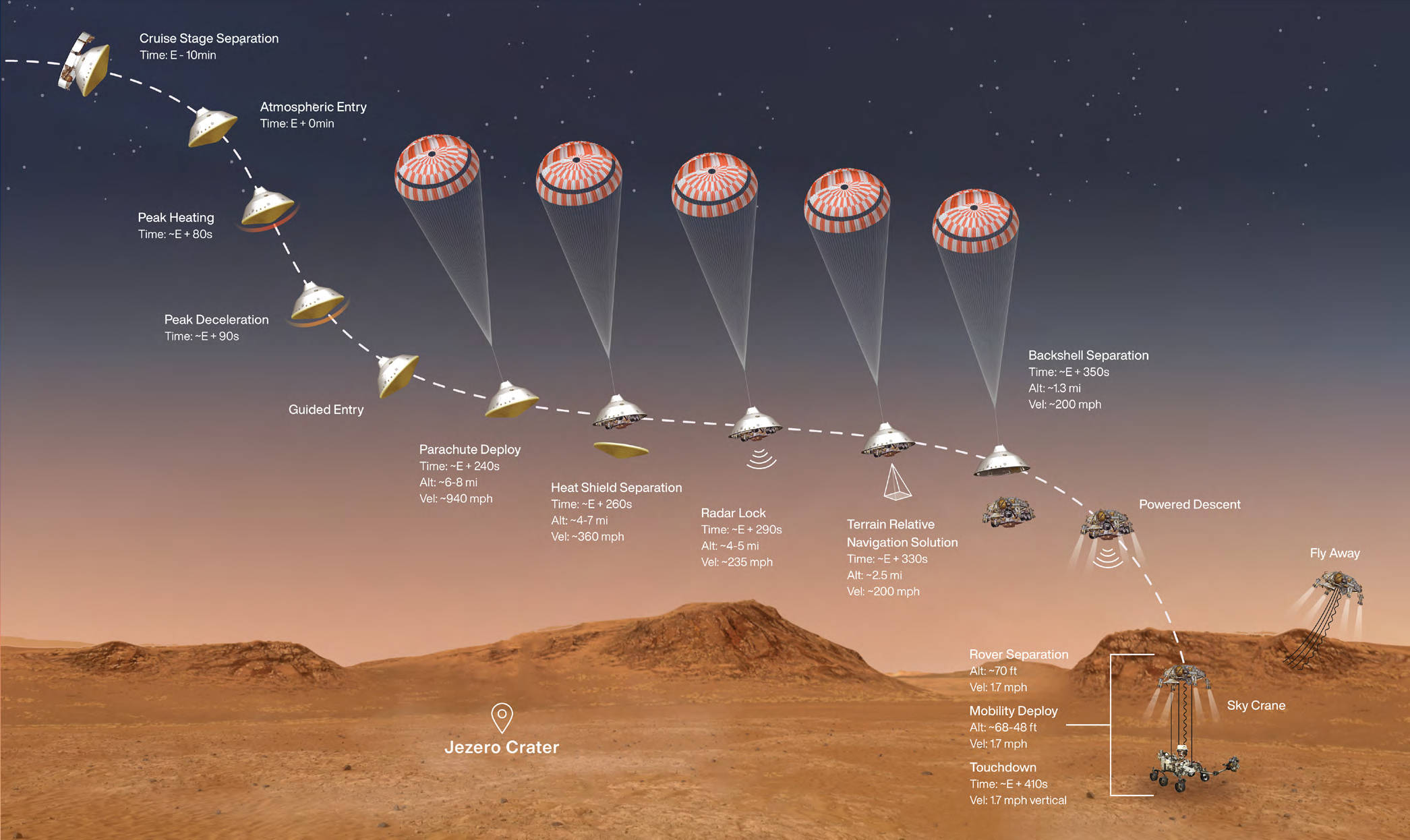
Graphic of the Entry, Descent and Landing (EDL) of the Perseverance Rover. Click on the image to enlarge. Credit: NASA/JPL.
01/21/2021 -Ephemeris – The Perseverance rover is less than a month from landing on Mars
This is Ephemeris for Thursday, January 21st. Today the Sun will be up for 9 hours and 24 minutes, setting at 5:36, and it will rise tomorrow at 8:11. The Moon, 1 day past first quarter, will set at 2:40 tomorrow morning.
The Mars Perseverance Rover is approaching the Red Planet. In a bit less than a month, on February 18th it will plunge into the martian atmosphere to land near an ancient river delta in the 28 mile (45 kilometer) wide crater Jezero. The dramatic entry-descent-and-landing or EDL is what the Jet Propulsion Laboratory, that built and manages the rover, calls Seven Minutes of Terror due to the complexity of the landing process and the fact that they will be bystanders at that point. By the time they receive confirmation that the encapsulated rover has hit the top of the martian atmosphere it would have already landed, or crashed on the martian surface. It will take over 11 minutes for signals to reach us from Mars that day.
The event times given are for the Traverse City/Interlochen area of Michigan. They may be different for your location.
Addendum

Delta of ancient river that flowed into a lake in the Jezero crater. This is a false color imaging highlighting mineral types. Credit NASA.

Mars Perseverance Rover’s planned landing ellipse partially overlapping the dried up river delta. Credit: NASA/JPL.

Mars 2020 Rover “Perseverance” destined for the martian crater Jezero.
11/05/2020 – Ephemeris – Water found on the daylit side of the Moon
This is Ephemeris for Thursday, November 5th. Today the Sun will be up for 9 hours and 58 minutes, setting at 5:25, and it will rise tomorrow at 7:28. The Moon, 3 days before last quarter, will rise at 8:55 this evening.
Last week NASA announced some results from their SOFIA airborne observatory. They had detected the spectral signature of water in a large crater on the Moon named Clavius. This was a high latitude crater, 58.6 degrees south. Supposedly one could process a cubic meter of the regolith to extract a half liter of water. Clavius, which science fiction fans will note was the location of the American base on the Moon in 2001 a Space Odyssey. It is also one of my favorite lunar craters, one of the largest with a distinctive arc of diminishingly sized craters in its floor. As far as resources go, we’ve just literally scratched the surface of the Moon in its equatorial regions with our Apollo and other country’s robotic missions.
The event times given are for the Traverse City/Interlochen area of Michigan. They may be different for your location.
Addendum
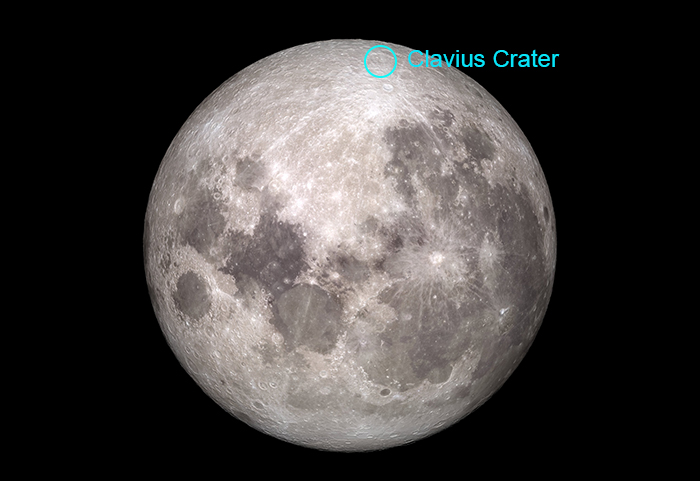
The Moon as seen from Australia (south up) with the crater Clavius circled. This is the same view of the Moon that users of a Newtonian reflector telescope in the northern hemisphere see, and how I first explored the Moon with my reflecting telescope. Source abc.net.au.
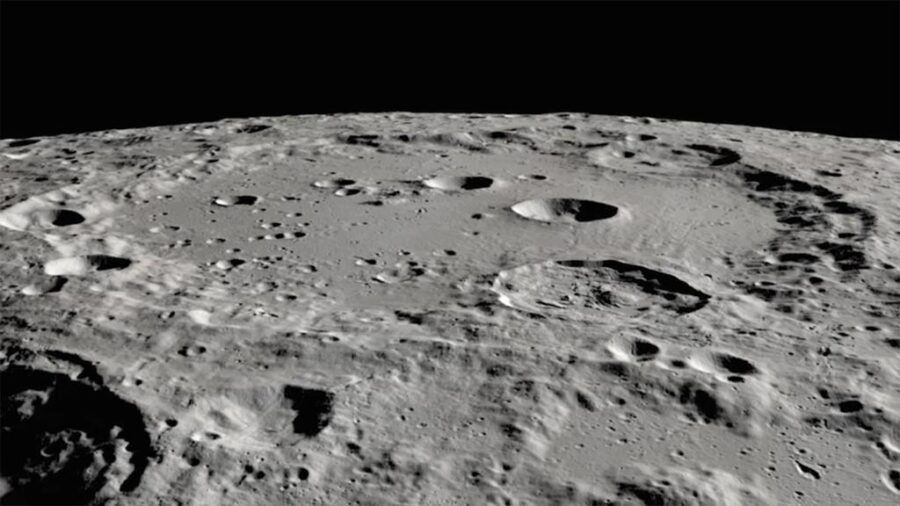
Closeup of Clavius from the Lunar Reconnaissance Orbiter. Credit: NASA/LRO.

The SOFIA Airborne Observatory. A modified Boeing 747 with a 106 inch (2.7 meter) telescope mounted crosswise in its fuselage. It is a joint project between NASA and the German Aerospace Center (DLR) and for some reason always on the verge of being canceled. Credit: NASA.
SOFIA is of course an acronym for Stratospheric Observatory for Infrared Astronomy. For more on SOFIA click here: https://www.nasa.gov/mission_pages/SOFIA/index.html.
10/29/2020 – Ephemeris – A look at Bennu the asteroid
This is Ephemeris for Thursday, October 29th. Today the Sun will be up for 10 hours and 17 minutes, setting at 6:34, and it will rise tomorrow at 8:18. The Moon, 2 days before full, will set at 7:06 tomorrow morning.
Tonight we will have Mars appearing above the bright gibbous Moon in the evening sky. Out in space NASA’s OSIRIS-REx spacecraft is still in the vicinity of the tiny asteroid Bennu. The asteroid is about 60 percent the distance between the Earth’s and Mars’ orbits, but on the far side of the Sun from us. This is why it will take 3 years to return the sample to the Earth. Bennu is small, only 743 feet (226.5 meters) in diameter. And is a rubble pile asteroid with lots of empty voids between the rocks. The sampler instead of stopping at the surface, punched into the asteroid surface a bit. Bennu was picked because is a potential hazardous asteroid and is a particularly primitive type of asteroid.
The event times given are for the Traverse City/Interlochen area of Michigan. They may be different for your location.
Addendum
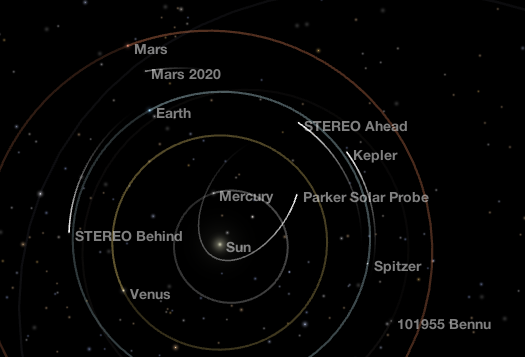
Inner Solar when OSIRIS REx took its sample from Bennu. Bennu’s official designation is 101955 Bennu. The number designation is the consecutive number it is given when placed on the official list of asteroids and dwarf planets when its orbit is determined. Notice that it was on the other side of the Sun. Credit NASA’s Eyes app.
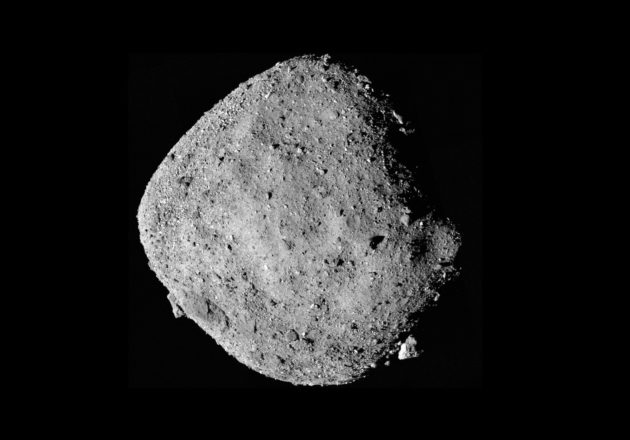
The asteroid Bennu is 743 feet (226.5 meters) in diameter. It is a carbonaceous asteroid. OSIRIS-REX has already discovered water bearing clays on its surface. Credit NASA
10/27/2020 – Ephemeris – NASA’s cup runneth over with asteroid bits
This is Ephemeris for Tuesday, October 27th. Today the Sun will be up for 10 hours and 23 minutes, setting at 6:37, and it will rise tomorrow at 8:16. The Moon, half way from first quarter to full, will set at 5:04 tomorrow morning.
One week ago the NASA’s OSIRIS Rex spacecraft unfolded its sampling arm, and folded up it solar panels so as to look like a one legged stork landing and touched a small level patch of small jagged rocks on the tiny asteroid Bennu. A nitrogen bottle was triggered to blow soil and small rocks into a cylindrical container which created quite a blizzard of small rocks. A flap on the collection device was supposed to close, keeping the collected bits in, but was propped open by a large rock, so some of the contents started to leak out. Now flight controllers must gently maneuver the collector into the return canister without losing too much of the contents. The sample canister is expected to return to Earth in 2023.
The event times given are for the Traverse City/Interlochen area of Michigan. They may be different for your location.
Addendum
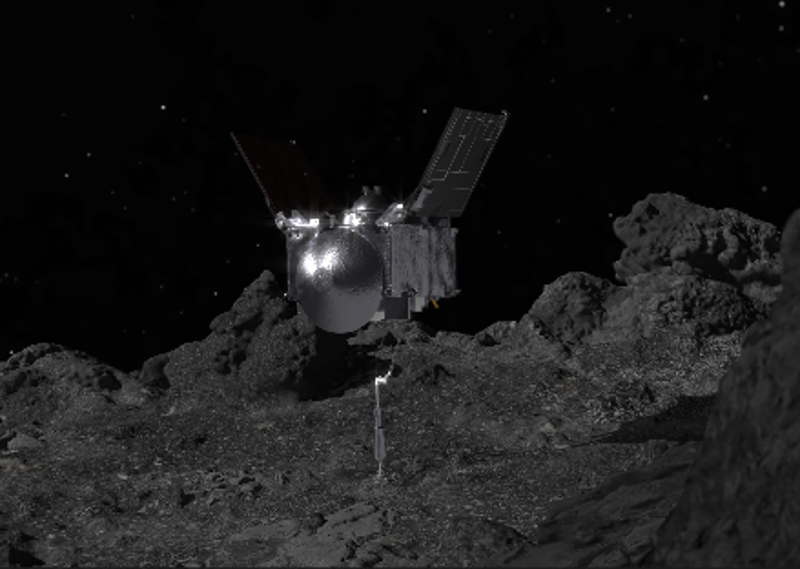
Artist depiction OSIRIS-REx TAG (Touch and Go) from video. Credit NASA.

Animated GIF of the actual sample collection TAG (Touch and Go). Credit NASA.
For more information go to https://www.nasa.gov/osiris-rex
10/23/2020 – Ephemeris – What is a Near Rectilinear Halo Orbit?
This is Ephemeris for Friday, October 23rd. Today the Sun will be up for 10 hours and 34 minutes, setting at 6:44, and it will rise tomorrow at 8:10. The Moon, at first quarter today, will set at 12:46 tomorrow morning.
When the astronauts of the Artemis program head for a landing on the Moon is as little as four years from now they will meet their lunar landing craft or Lunar Gateway space station with landing craft docked to it before they descend to the Moon. The orbit of the gateway and/or lander is an odd one. It’s called a near rectilinear halo orbit. And uses the motion and gravitational interaction of the Moon and Earth to create an orbit of the Moon which is nearly face-on to the Earth. The vehicles will never pass behind the Moon. The orbit will pass 1,900 miles (3,000 km) above the Moon’s north pole and out to 43,000 miles (70,000 km) above the south pole. It’s called a halo orbit, because as seen from the Earth it appears to trace a halo around the Moon.
The event times given are for the Traverse City/Interlochen area of Michigan. They may be different for your location.
Addendum
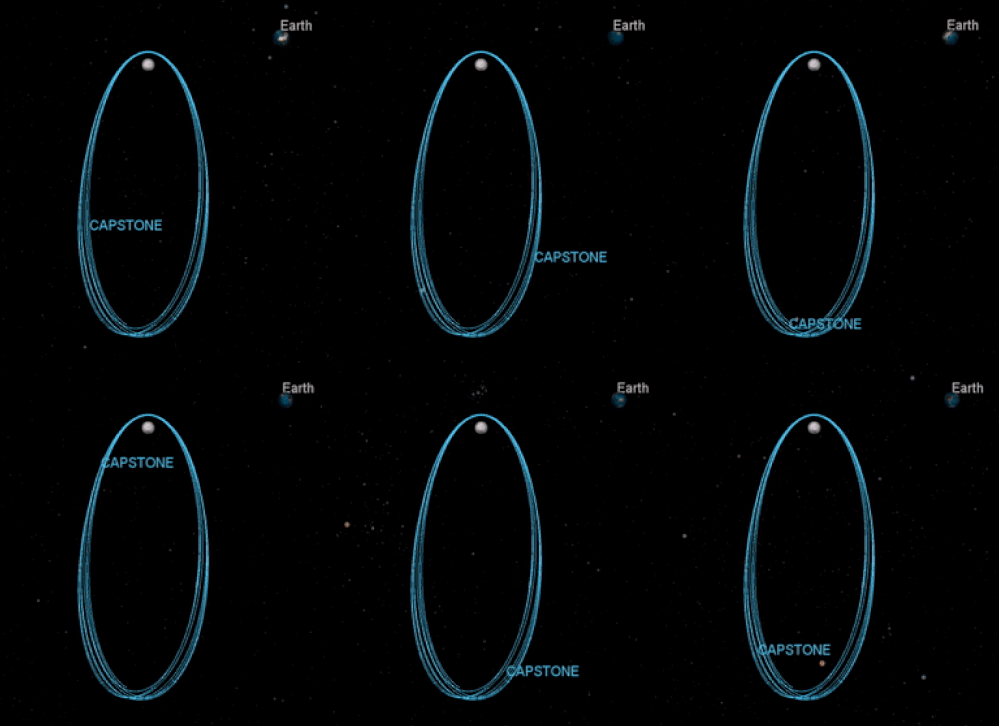
NASA CAPSTONE* pathfinder for gateway orbit is to be launched next year by Rocket Lab to prove out the near rectilinear orbit for the Lunar Gateway. The orbit will always be more or less face on to the Earth, so it and the lunar lander will be always be in contact with the Earth. Credit Advanced Space via Spaceflight Now.
* Yes, CAPSTONE is an acronym: Cislunarˆ Autonomous Positioning System Technology Operations and Navigation Experiment. Aren’t you glad you asked?
ˆ Cislunar: The volume of space between the Earth and Moon’s orbit.
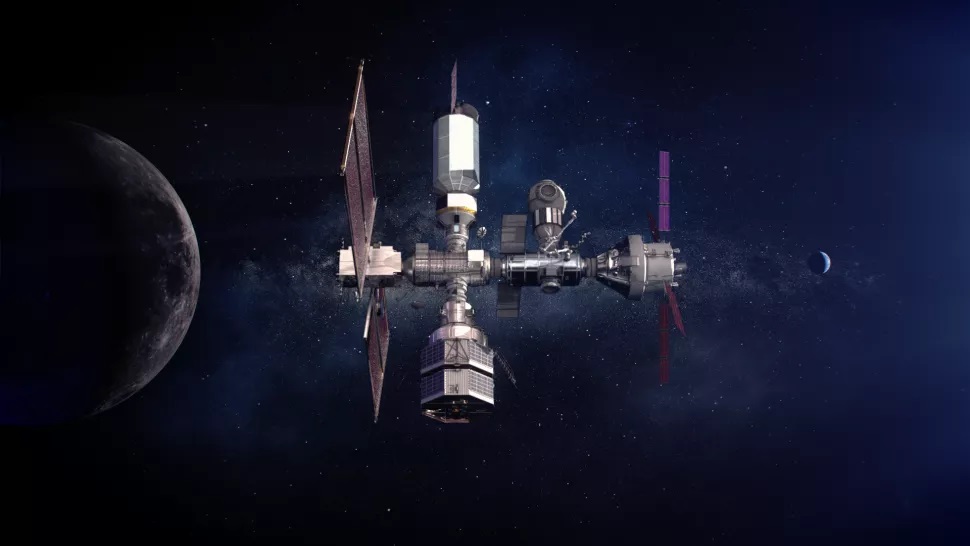
An artist’s rendition of the Lunar Gateway with the Orion spacecraft docked to it. Credit NASA.
For more information
https://www.space.com/nasa-capstone-cubesat-moon-gateway.html
10/02/2020 – Ephemeris – The rocket that will take NASA crews to the Moon
This is Ephemeris for Friday, October 2nd. Today the Sun will be up for 11 hours and 37 minutes, setting at 7:20, and it will rise tomorrow at 7:43. The Moon, 1 day past full, will rise at 8:05 this evening.
While we’re looking at the nearly full Moon tonight lets look at the rocket that will take crews to the Moon or as NASA says first woman and next man to the Moon in the Artemis program. It’s called the Space Launch System or SLS, which has been in development for a very long time. The core stage looks the color of the Space Shuttle main tank, because it uses the same insulation. At its bottom are four shuttle main engines. These will not be reused. Strapped to the sides will be two shuttle derived solid rocket boosters or SRBs, with 5 segments, rather than 4, and are upgraded for extra thrust. These will also be discarded, rather than reused. The second stage now is an interim stage to be replaced after a few flights with a more powerful stage. To top it off will be the service module and Orion capsule with an escape tower.
The event times given are for the Traverse City/Interlochen area of Michigan. They may be different for your location.
Addendum
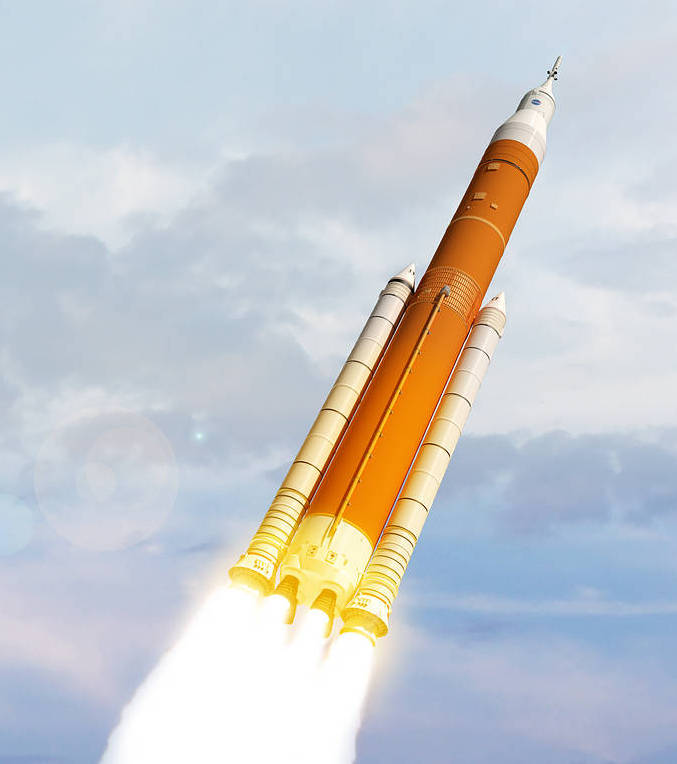
The Block 1b version of the Space Launch System (SLS) which uses elongated Space Shuttle boosters and a core stage with 4 Space Shuttle main engines for the first stage. At lift-off the core stage and the boosters will ignite. The boosters will burn for two minutes and 6 seconds 7,2000,000 pounds (32,000 kN) of thrust. The core stage contributes 1,670,000 pounds (7,440 kN) of thrust and will burn for 8 minutes, nearly achieving orbit. The Interim Cryogenic Propulsion Stage and later the Exploration Upper Stage will place the payload first into orbit, and then to send it to the Moon, or interplanetary destination. Credit NASA.
Note that the rocket configuration does not contain a lunar lander craft like the Saturn V of Apollo. The lander, a commercially developed craft will be sent up before the astronauts by a commercial company like SpaceX or Blue Origin and be waiting in lunar orbit or at the Lunar Gateway satellite.
09/04/2020 – Ephemeris – What area of the Moon is the Artemis program interested in?
This is Ephemeris for Friday, September 4th. Today the Sun will be up for 13 hours and 3 minutes, setting at 8:13, and it will rise tomorrow at 7:10. The Moon, 2 days past full, will rise at 9:40 this evening.
Where will Artemis missions land when they get to the Moon? The Apollo missions mostly landed on the flat lunar seas which were really lava plains. The Artemis missions are headed to the Moon’s south polar regions. The Moon, unlike the Earth has very little axial tilt, so some of the crater floors at the poles are forever in shadow and near absolute zero, so are cold traps for volatile matter like water. Satellites over the years have found hydrogen over the south pole of the moon hinting that there is water ice there from impacting comets. There’s also crater peaks that are always in sunlight where solar panels can be erected to provide power throughout the month long lunar day. On the Moon, water is more precious than gold. There’s water in them thar craters!
The event times given are for the Traverse City/Interlochen area of Michigan. They may be different for your location.
Addendum
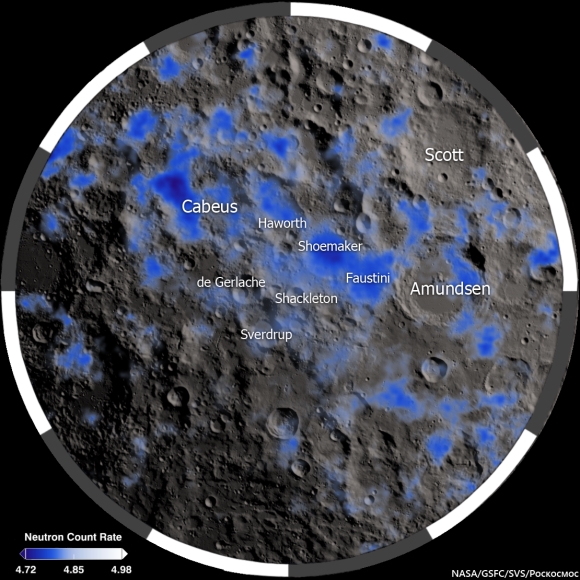
The south pole of the Moon where the presence of water ice is detected by the absorption of neutrons by the hydrogen atoms in the ice. Credit NASA/GSFC/SVS/Roscosmos. Notice a theme in the crater names here?
09/03/2020 – Ephemeris – Why is the new NASA Moon landing program called Artemis?
This is Ephemeris for Thursday, September 3rd. Today the Sun will be up for 13 hours and 6 minutes, setting at 8:14, and it will rise tomorrow at 7:09. The Moon, 1 day past full, will rise at 9:20 this evening.
Why is the new NASA crewed Moon landing program called Artemis? And why is it crewed, and not manned? Artemis was a Greek deity and Apollo’s twin sister. He was the god of the Sun and she was goddess, among other things, of the Moon. So she has a greater connection to the Moon than Apollo did. Spacecraft now-a-days are crewed, rather than manned to denote that both sexes are chosen to be astronauts in nearly equal numbers now. Of course that’s crewed spelled c-r-e-w-e-d, not c-r-u-d-e, though they sound the same. Deities of the Moon tend to be female be they Artemis, Cynthia, Luna, Selene, or Chang’e. Astronomers use Cynthia, Luna, and Selene (pronounced Sel-e-nae) in naming various aspects of the Moon and Chang’e is the goddess that the Chinese name their lunar landers after.
The event times given are for the Traverse City/Interlochen area of Michigan. They may be different for your location.
Addendum

The logo chosen by NASA for the Artemis Program. The blue crescent at the bottom represents the earth. The gray ball at the top is the Moon. The curved red path is the stylized return path from the Moon to the Earth of the Orion capsule. Credit: NASA.

Artemis, goddess of the hunt and the Moon. Credit: Disney (Fantasia) source Daily Kos.
08/31/2020 – Ephemeris – Artemis, NASAs new program to land men and women on the Moon
This is Ephemeris for Monday, August 31st. Today the Sun will be up for 13 hours and 15 minutes, setting at 8:20, and it will rise tomorrow at 7:05. The Moon, 2 days before full, will set at 6:10 tomorrow morning.
The Artemis program is the United States follow on, after more than 50 years, to return to the Moon. It’s main rocket, the Space Launch System or SLS uses components of the Space Shuttle that include the main engines, using 4 instead of three, and two longer solid boosters. The Orion capsule sits atop the second stage. Unlike Apollo, the lunar lander will be sent up on a separate rocket into lunar orbit. Eventually there will be a lunar orbiting space station called the Lunar Gateway as a way point. But not for the first attempt. NASA has accepted three bids for commercial landers, Dynetics with a squat lander with drop-tanks. The National team of several companies with an Apollo-like lander on steroids, and SpaceX’s Starship.
The event times given are for the Traverse City/Interlochen area of Michigan. They may be different for your location.
Addendum
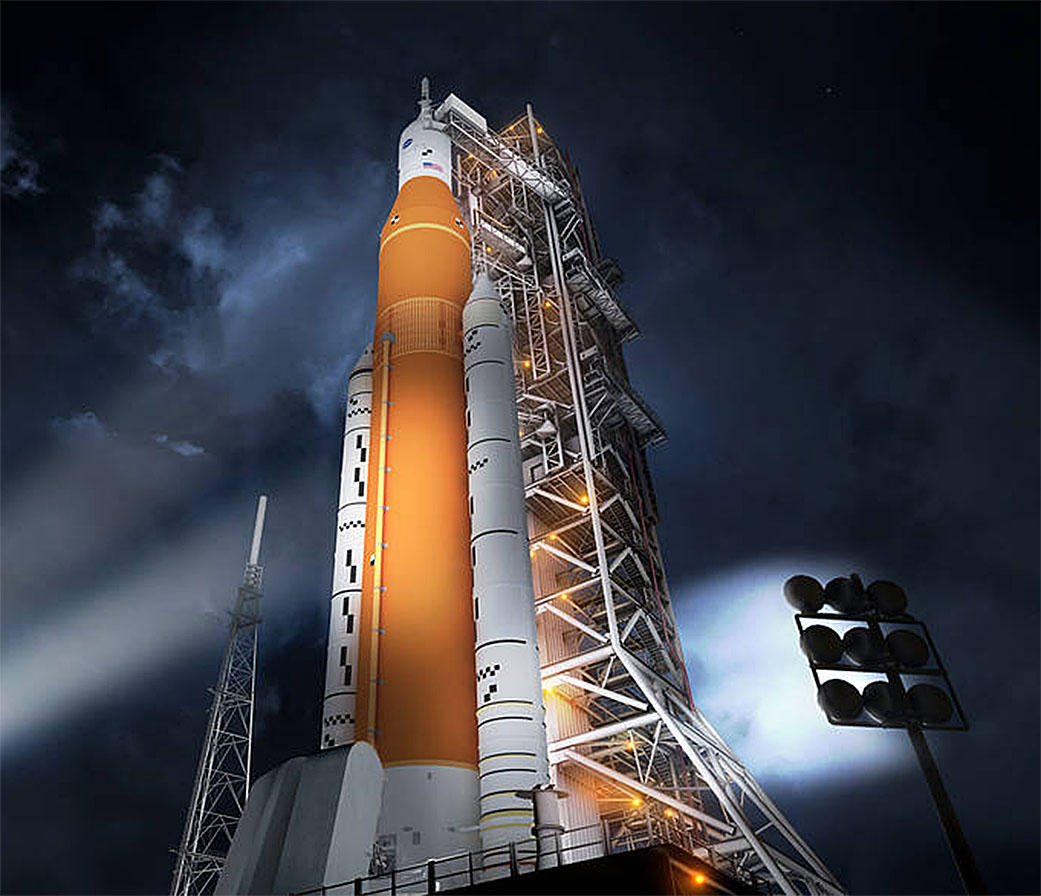
Block 1 Space Launch System with Orion Capsule. Credit NASA.

Three Lunar Lander proposals. Credit Dynetics, SpaceX, and Blue Origin.
 Bob Moler's Ephemeris Blog