Archive
10/23/2020 – Ephemeris – What is a Near Rectilinear Halo Orbit?
This is Ephemeris for Friday, October 23rd. Today the Sun will be up for 10 hours and 34 minutes, setting at 6:44, and it will rise tomorrow at 8:10. The Moon, at first quarter today, will set at 12:46 tomorrow morning.
When the astronauts of the Artemis program head for a landing on the Moon is as little as four years from now they will meet their lunar landing craft or Lunar Gateway space station with landing craft docked to it before they descend to the Moon. The orbit of the gateway and/or lander is an odd one. It’s called a near rectilinear halo orbit. And uses the motion and gravitational interaction of the Moon and Earth to create an orbit of the Moon which is nearly face-on to the Earth. The vehicles will never pass behind the Moon. The orbit will pass 1,900 miles (3,000 km) above the Moon’s north pole and out to 43,000 miles (70,000 km) above the south pole. It’s called a halo orbit, because as seen from the Earth it appears to trace a halo around the Moon.
The event times given are for the Traverse City/Interlochen area of Michigan. They may be different for your location.
Addendum
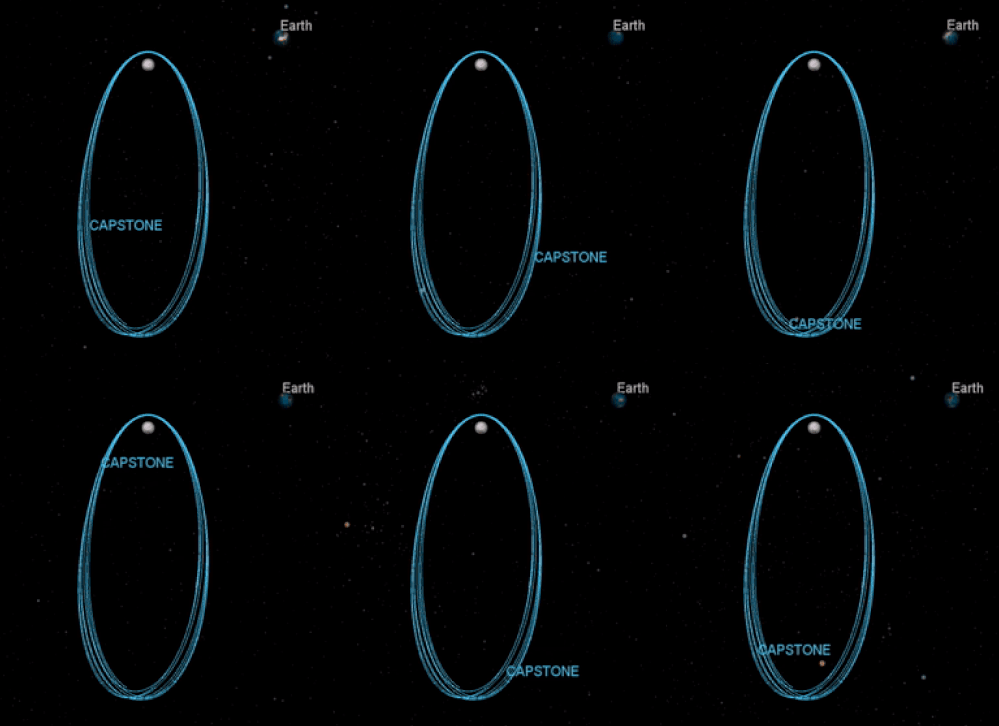
NASA CAPSTONE* pathfinder for gateway orbit is to be launched next year by Rocket Lab to prove out the near rectilinear orbit for the Lunar Gateway. The orbit will always be more or less face on to the Earth, so it and the lunar lander will be always be in contact with the Earth. Credit Advanced Space via Spaceflight Now.
* Yes, CAPSTONE is an acronym: Cislunarˆ Autonomous Positioning System Technology Operations and Navigation Experiment. Aren’t you glad you asked?
ˆ Cislunar: The volume of space between the Earth and Moon’s orbit.
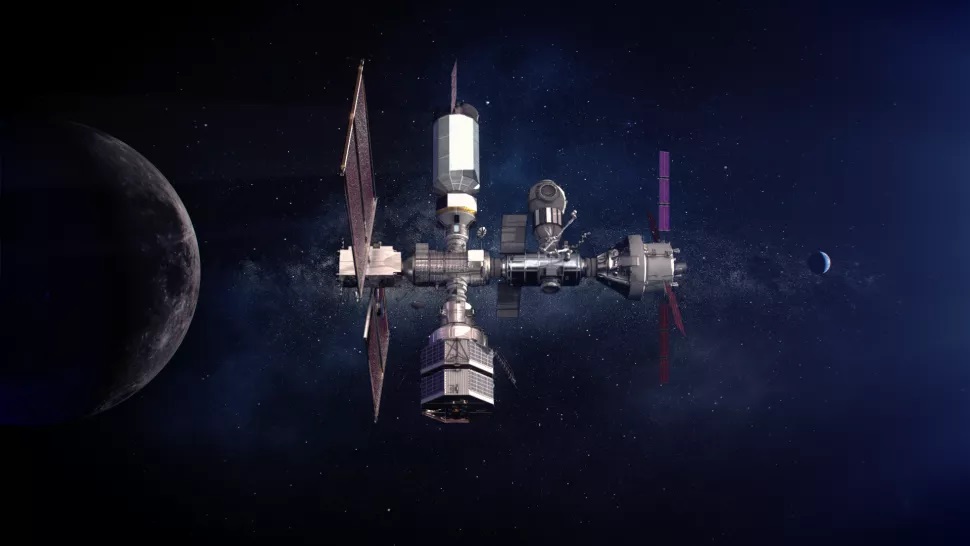
An artist’s rendition of the Lunar Gateway with the Orion spacecraft docked to it. Credit NASA.
For more information
https://www.space.com/nasa-capstone-cubesat-moon-gateway.html
10/02/2020 – Ephemeris – The rocket that will take NASA crews to the Moon
This is Ephemeris for Friday, October 2nd. Today the Sun will be up for 11 hours and 37 minutes, setting at 7:20, and it will rise tomorrow at 7:43. The Moon, 1 day past full, will rise at 8:05 this evening.
While we’re looking at the nearly full Moon tonight lets look at the rocket that will take crews to the Moon or as NASA says first woman and next man to the Moon in the Artemis program. It’s called the Space Launch System or SLS, which has been in development for a very long time. The core stage looks the color of the Space Shuttle main tank, because it uses the same insulation. At its bottom are four shuttle main engines. These will not be reused. Strapped to the sides will be two shuttle derived solid rocket boosters or SRBs, with 5 segments, rather than 4, and are upgraded for extra thrust. These will also be discarded, rather than reused. The second stage now is an interim stage to be replaced after a few flights with a more powerful stage. To top it off will be the service module and Orion capsule with an escape tower.
The event times given are for the Traverse City/Interlochen area of Michigan. They may be different for your location.
Addendum
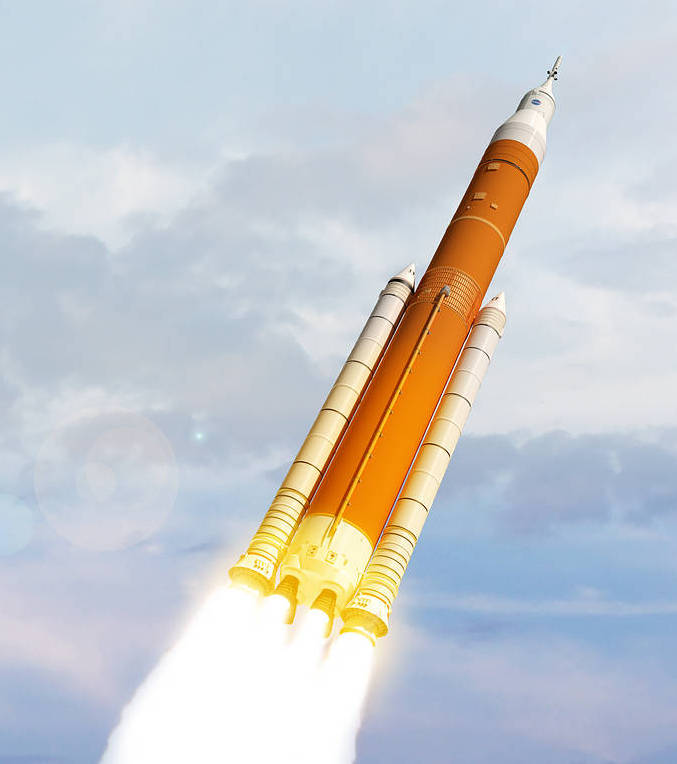
The Block 1b version of the Space Launch System (SLS) which uses elongated Space Shuttle boosters and a core stage with 4 Space Shuttle main engines for the first stage. At lift-off the core stage and the boosters will ignite. The boosters will burn for two minutes and 6 seconds 7,2000,000 pounds (32,000 kN) of thrust. The core stage contributes 1,670,000 pounds (7,440 kN) of thrust and will burn for 8 minutes, nearly achieving orbit. The Interim Cryogenic Propulsion Stage and later the Exploration Upper Stage will place the payload first into orbit, and then to send it to the Moon, or interplanetary destination. Credit NASA.
Note that the rocket configuration does not contain a lunar lander craft like the Saturn V of Apollo. The lander, a commercially developed craft will be sent up before the astronauts by a commercial company like SpaceX or Blue Origin and be waiting in lunar orbit or at the Lunar Gateway satellite.
09/04/2020 – Ephemeris – What area of the Moon is the Artemis program interested in?
This is Ephemeris for Friday, September 4th. Today the Sun will be up for 13 hours and 3 minutes, setting at 8:13, and it will rise tomorrow at 7:10. The Moon, 2 days past full, will rise at 9:40 this evening.
Where will Artemis missions land when they get to the Moon? The Apollo missions mostly landed on the flat lunar seas which were really lava plains. The Artemis missions are headed to the Moon’s south polar regions. The Moon, unlike the Earth has very little axial tilt, so some of the crater floors at the poles are forever in shadow and near absolute zero, so are cold traps for volatile matter like water. Satellites over the years have found hydrogen over the south pole of the moon hinting that there is water ice there from impacting comets. There’s also crater peaks that are always in sunlight where solar panels can be erected to provide power throughout the month long lunar day. On the Moon, water is more precious than gold. There’s water in them thar craters!
The event times given are for the Traverse City/Interlochen area of Michigan. They may be different for your location.
Addendum
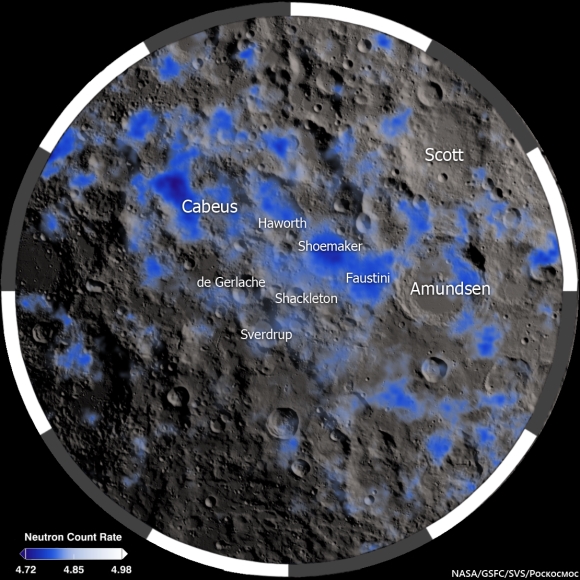
The south pole of the Moon where the presence of water ice is detected by the absorption of neutrons by the hydrogen atoms in the ice. Credit NASA/GSFC/SVS/Roscosmos. Notice a theme in the crater names here?
09/03/2020 – Ephemeris – Why is the new NASA Moon landing program called Artemis?
This is Ephemeris for Thursday, September 3rd. Today the Sun will be up for 13 hours and 6 minutes, setting at 8:14, and it will rise tomorrow at 7:09. The Moon, 1 day past full, will rise at 9:20 this evening.
Why is the new NASA crewed Moon landing program called Artemis? And why is it crewed, and not manned? Artemis was a Greek deity and Apollo’s twin sister. He was the god of the Sun and she was goddess, among other things, of the Moon. So she has a greater connection to the Moon than Apollo did. Spacecraft now-a-days are crewed, rather than manned to denote that both sexes are chosen to be astronauts in nearly equal numbers now. Of course that’s crewed spelled c-r-e-w-e-d, not c-r-u-d-e, though they sound the same. Deities of the Moon tend to be female be they Artemis, Cynthia, Luna, Selene, or Chang’e. Astronomers use Cynthia, Luna, and Selene (pronounced Sel-e-nae) in naming various aspects of the Moon and Chang’e is the goddess that the Chinese name their lunar landers after.
The event times given are for the Traverse City/Interlochen area of Michigan. They may be different for your location.
Addendum

The logo chosen by NASA for the Artemis Program. The blue crescent at the bottom represents the earth. The gray ball at the top is the Moon. The curved red path is the stylized return path from the Moon to the Earth of the Orion capsule. Credit: NASA.

Artemis, goddess of the hunt and the Moon. Credit: Disney (Fantasia) source Daily Kos.
08/31/2020 – Ephemeris – Artemis, NASAs new program to land men and women on the Moon
This is Ephemeris for Monday, August 31st. Today the Sun will be up for 13 hours and 15 minutes, setting at 8:20, and it will rise tomorrow at 7:05. The Moon, 2 days before full, will set at 6:10 tomorrow morning.
The Artemis program is the United States follow on, after more than 50 years, to return to the Moon. It’s main rocket, the Space Launch System or SLS uses components of the Space Shuttle that include the main engines, using 4 instead of three, and two longer solid boosters. The Orion capsule sits atop the second stage. Unlike Apollo, the lunar lander will be sent up on a separate rocket into lunar orbit. Eventually there will be a lunar orbiting space station called the Lunar Gateway as a way point. But not for the first attempt. NASA has accepted three bids for commercial landers, Dynetics with a squat lander with drop-tanks. The National team of several companies with an Apollo-like lander on steroids, and SpaceX’s Starship.
The event times given are for the Traverse City/Interlochen area of Michigan. They may be different for your location.
Addendum
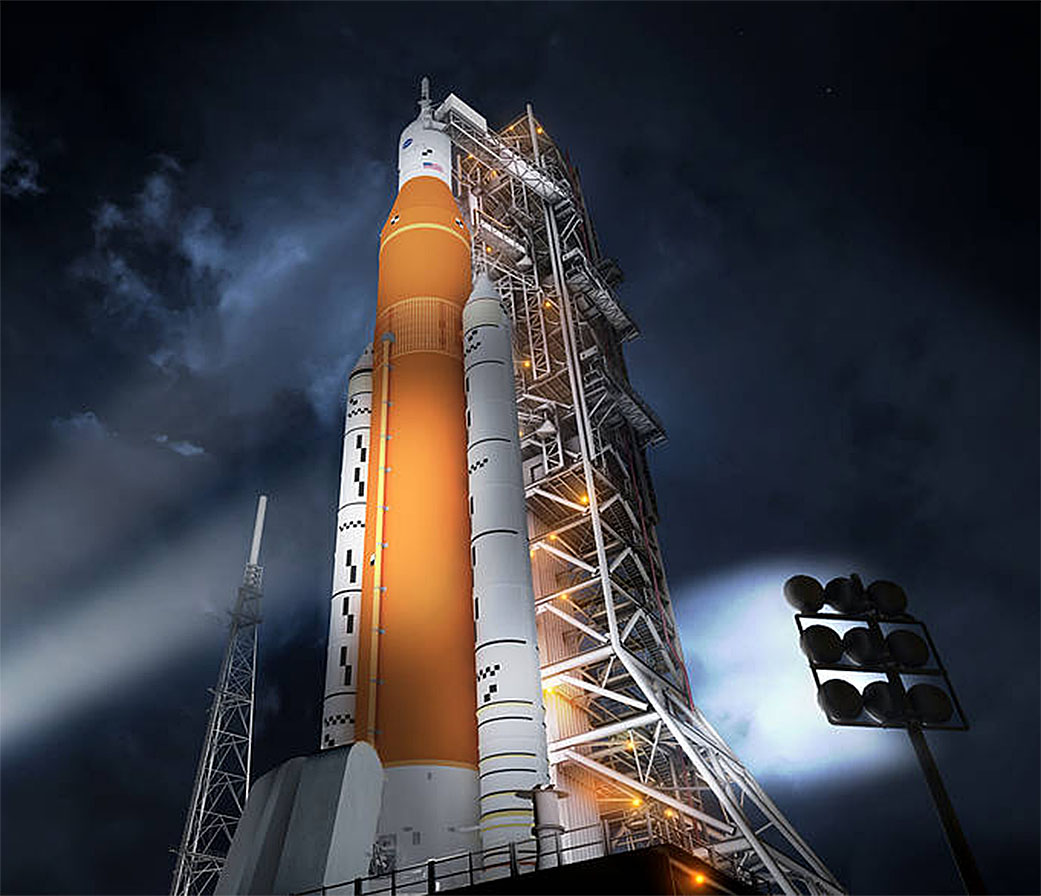
Block 1 Space Launch System with Orion Capsule. Credit NASA.

Three Lunar Lander proposals. Credit Dynetics, SpaceX, and Blue Origin.
08/03/2020 – Ephemeris – What is the Perseverance Rover going to do on Mars?
This is Ephemeris for Monday, August 3rd. Today the Sun will be up for 14 hours and 33 minutes, setting at 9:05, and it will rise tomorrow at 6:33. The Moon, at full today, will rise at 9:35 this evening.
The Mars Perseverance Rover looks a lot like the Curiosity Rover that landed on Mars in Gale Crater almost exactly 8 years ago (Earth years that is). It has more and better cameras, some different tools on its arm. It will have a laser like Curiosity. It can take core samples and store them in sealed tubes for later return to the Earth. It has an experimental helicopter drone named Ingenuity that must, like the rover be autonomous since it cannot be controlled in real-time from the Earth. The main mission this time is to look for signs of life in a spot we know water had flowed in the ancient past. The surface water and the life is long gone, but there might be signs that it might have been present in the distant past before Mars lost most of its atmosphere and water.
The event times given are for the Traverse City/Interlochen area of Michigan. They may be different for your location.
Addendum

Artist rendition of the Mars 2020 “Endurance” Rover. Credit NASA.

Artist’s concept of the Mars Helicopter “Ingenuity”. Credit: NASA/JPL-Caltech.
07/30/2020 – Ephemeris – This morning is the first opportunity to launch the Perseverance Rover to Mars
This is Ephemeris for Thursday, July 30th. Today the Sun will be up for 14 hours and 42 minutes, setting at 9:10, and it will rise tomorrow at 6:28. The Moon, 3 days past first quarter, will set at 3:11 tomorrow morning.
This morning is the scheduled launch of the Mars 2020 Rover named Perseverance. The launch will have or had launched at 7:50 am. Or the whole thing was scrubbed for today. I can’t tell, I recorded this last Sunday night. To hit a spot on Mars less than six miles in diameter after a six and a half month coasting flight is quite a fete. Mars is not only moving in orbit of the Sun, but also rotating. The aeroshell the rover is packed in must hit the Mars atmosphere in the right place, and the right time despite the light time from Mars of 11 minutes, 22 seconds. It will take 6 minutes, 50 seconds for the rover to land after it hits the top of Mars’ atmosphere. So it will have landed one way or another before we get the signal that it hit the atmosphere.
The event times given are for the Traverse City/Interlochen area of Michigan. They may be different for your location.
Addendum
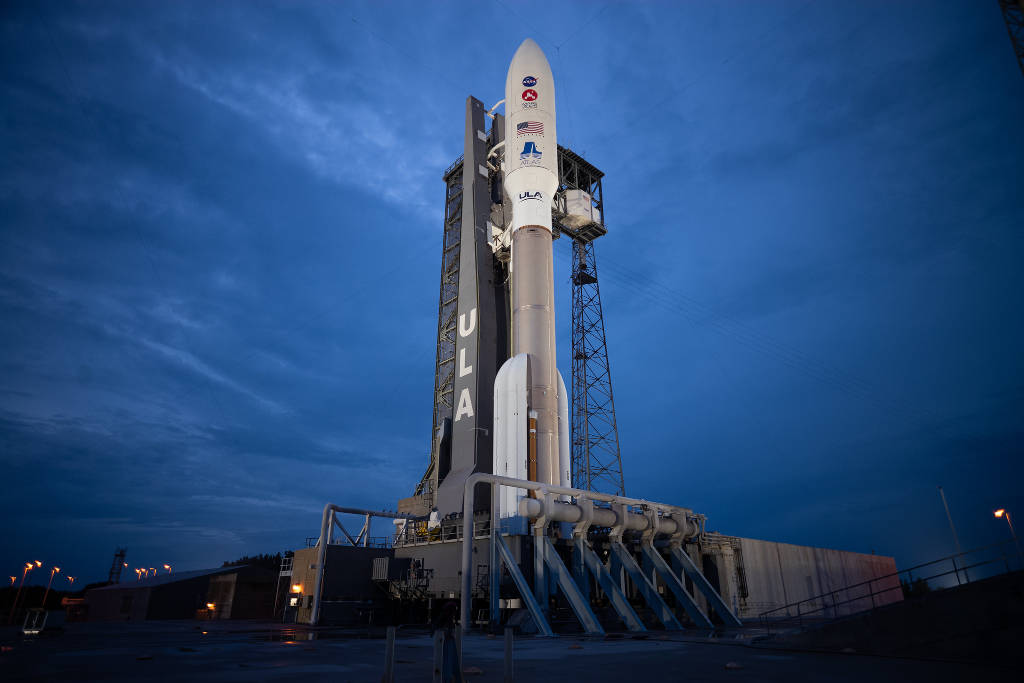
Atlas V with Mars 2020 Rover aboard on launch pad. Click on the image to enlarge. Credit: United Launch Alliance (ULA).
07/28/2020 – Ephemeris – The Mars Endurance Rover may launch to Mars on Thursday
This is Ephemeris for Tuesday, July 28th. Today the Sun will be up for 14 hours and 47 minutes, setting at 9:12, and it will rise tomorrow at 6:26. The Moon, 1 day past first quarter, will set at 1:49 tomorrow morning.
This Thursday at 7:50 am is the first opportunity to launch the Mars 2020 or Perseverance Rover to Mars to arrive on February 18th 2021. The rover will be launched on a United Launch Alliance Atlas 5/Centaur rocket with 4 solid boosters. To send a payload to Mars one must launch within a specific window of time called a launch period. This was originally from July17 to August 11th. Some issues with testing caused a delay to July 30th. The launch period was extended to August 15th. Miss that and it’s a wait of 26 months until Earth and Mars are in the same relative position to try again. The landing area or ellipse is less than 6 miles long on the long axis and partially overlaps an ancient dried river delta that flowed into Jezero crater.
The event times given are for the Traverse City/Interlochen area of Michigan. They may be different for your location.
Addendum

An artist’s concept of the Mars 2020 Rover launch. The rocket is an Atlas V with 4 solid boosters and a Centaur upper stage. Credit NASA.
05/26/2020 – Ephemeris – The first launch of humans to orbit from American soil in 9 years could happen tomorrow
This is Ephemeris for Tuesday, May 26th. Today the Sun will be up for 15 hours and 12 minutes, setting at 9:16, and it will rise tomorrow at 6:03. The Moon, 3 days before first quarter, will set at 1:07 tomorrow morning.
As of Sunday when I’m recording this NASA and SpaceX are still GO for the launch of two American astronauts to the International Space Station tomorrow. This will be the first human launch from the United States since Space Shuttle Atlantis left this same launch pad 39a left on July 8th, 2011. On that flight Doug Hurley was pilot, and he will command this flight. He visited the ISS twice, however his wife Karen Nyberg also visited the ISS twice, however the last time she stayed nearly 6 months. Bob Behnken the second astronaut is also a space shuttle veteran with two construction flights to the ISS and like Hurley is married to an astronaut, Megan McArthur who flew on the last Hubble Space Telescope repair mission.
The event times given are for the Traverse City/Interlochen area of Michigan. They may be different for your location.
Addendum

SpaceX Demo-2 astronauts Bob Behnken (left) and Doug Hurley. Credit: SpaceX.
05/25/2020 – Ephemeris – Comet SWAN is in our skies in evening twilight
When I recorded this program on the evening of the17th there was hope that Comet SWAN would have achieved naked-eye visibility. It did earlier this month when it was too far south for us to see from 45° North latitude. Predictions now are for it to be 7th magnitude, 2.5 times dimmer than the faintest star visible to the unaided eye.
This is Ephemeris for Memorial Day, Monday, May 25th. Today the Sun will be up for 15 hours and 10 minutes, setting at 9:15, and it will rise tomorrow at 6:03. The Moon, 3 days past new, will set at 12:18 tomorrow morning.
Comet SWAN just might be visible in binoculars tonight by about 10:30 p.m. with binoculars or a small telescope low in the northwestern sky. A pointer to it is the bright star Capella also in that direction. Comet SWAN will be located in the direction of 4 o’clock (to the right and a bit down) by 10 degrees angle, the width of your fist held at arms length. It will be a small fuzzy spot. I doubt you would spot the comet’s tail. It is a thin ion or gaseous tail that is revealed in photographs only. Over the next week it will be moving toward Capella and on June 1st will be just below Capella but half as bright as it is now. There’s another comet coming. Comet NeoWISE will be visible in our skies by late July if it holds up.
The event times given are for the Traverse City/Interlochen area of Michigan. They may be different for your location.
Addenda
Comet SWAN
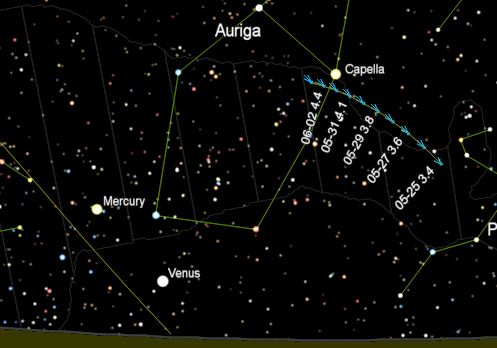
Comet SWAN track against the stars for 10 pm May 25 to June 3, 2020 with Mercury and Venus for the 25th They will be moving too. Comet labels show month-day and magnitude. However add 4 to the magnitude to get the approximate actual magnitude. The comet would be hard to spot in binoculars even in a dark sky. But who knows, the comet might flare up and be visible. Created using Cartes du Ciel (Sky Charts).
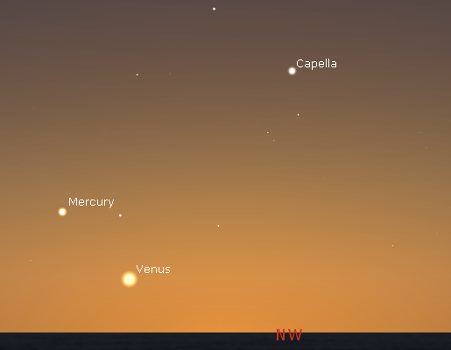
Northwestern horizon tonight at 10 pm May 25, 2020 with a scale that’s close to that of the image above. The comet is not bright enough to show here. Created using Stellarium.
In Memoriam
Today as we prepare to send humans into space from American soil for the first time in 9 years we pause to remember those who gave their lives for our country. For purposes of this program that includes those courageous enough to sit on top of or beside a million pounds of explosives to be launched into space. From the three astronauts who died in the Apollo one file in 1967, the explosion of the Space Shuttle Challenger in 1986, to the disintegration of the Columbia in 2003, 17 Americans and other nationals have died in NASA space accidents. The Russians too have lost cosmonauts in the exploration of space. Brothers and sisters in the quest for knowledge and to expand the horizons of human habitation. Per aspera, ad astra, Through difficulties to the stars!
A listing of Astronaut and Cosmonaut deaths: http://www.aerospaceweb.org/question/history/q0114.shtml
The Vatican Observatory Calendar
Being Catholic, I occasionally check the Vatican Observatory Foundation website. Besides the director of the Vatican Observatory is Brother Guy Consolmagno SJ, a fellow Michigander, born in Detroit. There were a couple of items on the May calendar that caught my eye.
Today, was marked as Memorial Day, but also Towel Day. Towel Day? It’s the 42nd anniversary of the first BBC Radio broadcast of Douglas Adams’ Hitchhiker’s Guide to the Galaxy. And if you don’t know the significance of a towel or the number 42, I won’t spoil it for you.
Also May 15th was the 300th birthday of Maximilian Hell SJ, first director of the Vienna Observatory, who also observed the transit of Venus in1769 from northern Norway. The crater on the Moon Hell is named for him. I’ve always had fun showing the crater a day or two after first quarter and mentioning that the crater Hell is named after a priest.

