Archive
09/08/2021 – Ephemeris – Let’s search for the naked-eye planets for this week
This is Ephemeris for Wednesday, September 8th. Today the Sun will be up for 12 hours and 52 minutes, setting at 8:06, and it will rise tomorrow at 7:14. The Moon, 2 days past new, will set at 9:16 this evening.
Let’s search for the naked-eye planets for this week. Venus should be visible in the western evening twilight before 8:30 tonight. It will set at 9:41 pm. By 8:30 pm, Jupiter and Saturn will be seen low in the southeastern sky. The brighter Jupiter will be easy to spot at that hour. Saturn will be dimmer, but a bit higher and to its right. Both these planets will be visible for most of the night, with Saturn setting first at 3:53 am, with Jupiter setting at 5:21 tomorrow morning. Saturn’s rings can be seen in a spotting scope of about 20 power magnification. Though at that power, the rings won’t appear separated from the planet, so Saturn will look like an elliptical spot. Most of Jupiter’s 4 brightest moons can even be spotted in binoculars.
The astronomical event times given are for the Traverse City/Interlochen area of Michigan (EDT, UT – 4 hr). They may be different for your location.
Addendum
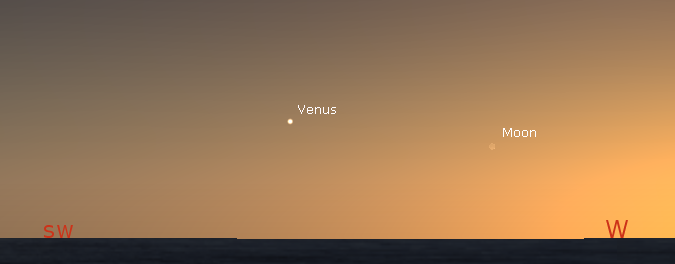
Venus and the Moon in evening twilight at 8:30 pm tonight, September 8, 2021. This is about 25 minutes after sunset. Created using Stellarium.
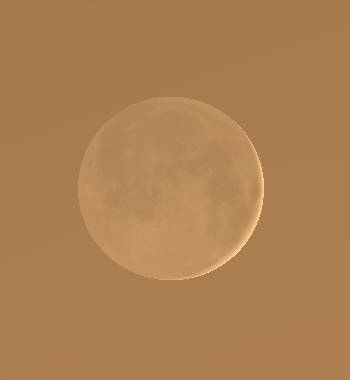
The thin crescent Moon as it might appear with earth shine in binoculars at 8:30 pm tonight, September 8, 2021. Created using Stellarium.
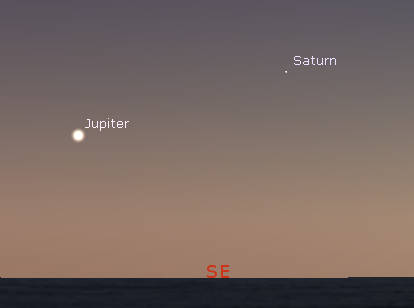
Jupiter and Saturn in the southeast at 8:30 pm, about a half hour after sunset tonight, September 8, 2021. Created using Stellarium.
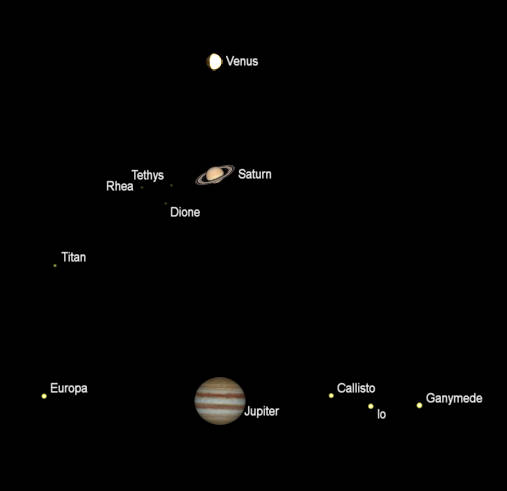
Telescopic view of the bright planets (north up) as they would be seen in a small telescope, with the same magnification, this evening. Venus at 8:30 pm, and the other two at 10 pm, September 8, 2021. Apparent diameters: Venus, 15.88″ 70% illuminated; Saturn 18.19″, its rings 42.36″; Jupiter, 48.43″. Jupiter’s moons will slowly approach the planet from our viewpoint overnight. The ” symbol means seconds of arc (1/3600th of a degree.) Created using Cartes du Ciel (Sky Charts).
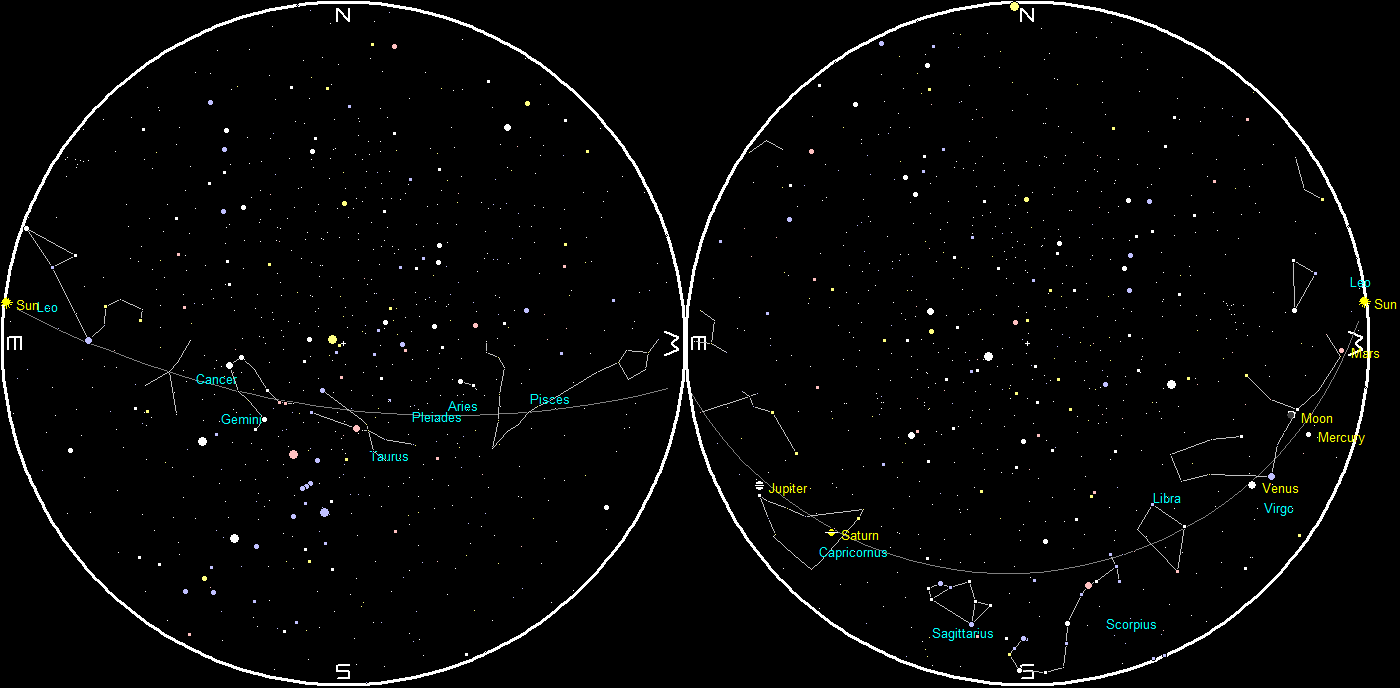
Planets and the Moon at sunset and sunrise of a single night, starting with sunset on the right on September 8, 2021. The night ends on the left with sunrise on the 9th. Click on the image to enlarge it. Created using my LookingUp program.
09/01/2021 – Ephemeris – Let’s search for the naked-eye planets for this week
This is Ephemeris for Wednesday, September 1st. Today the Sun will be up for 13 hours and 13 minutes, setting at 8:18, and it will rise tomorrow at 7:06. The Moon, 2 days past last quarter, will rise at 1:57 tomorrow morning.
Let’s search for the naked-eye planets for this week. Venus should be visible in the western evening twilight before 9 tonight. It will set at 9:41 pm. By 9 pm, Jupiter and Saturn will be seen low in the southeastern sky. The brighter Jupiter will be easy to spot at that hour. Saturn will be dimmer, but a bit higher and to its right. Both these planets will be visible for most of the night, with Saturn setting first at 4:22 am, with Jupiter setting at 5:53 tomorrow morning. Saturn’s rings can be seen in a spotting scope of about 20 power magnification. Though at that power, the rings won’t appear separated from the planet, so Saturn will look like an elliptical spot. Most of Jupiter’s 4 brightest moons can be spotted in binoculars.
The astronomical event times given are for the Traverse City/Interlochen area of Michigan (EDT, UT – 4 hr). They may be different for your location.
Addendum
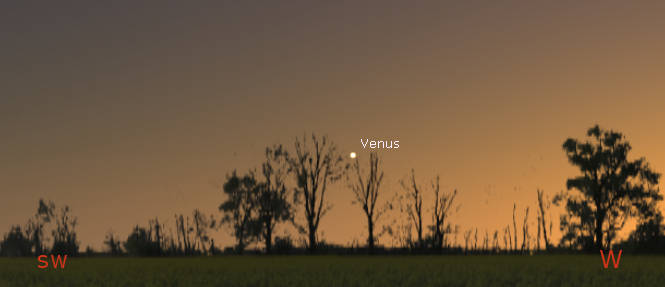
Venus in twilight at 8:45 pm, about 1/2 hour after sunset tonight, September 1, 2021. Created with Stellarium.
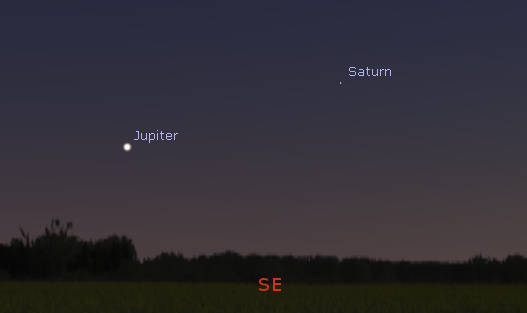
Jupiter and Saturn in the southeast about three quarters of an hour after sunset. Created using Stellarium.
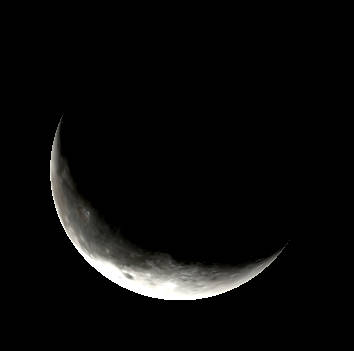
The waning crescent Moon as it might be seen in binoculars or low magnification telescope at 6 am tomorrow morning, September 2, 2021.
Created using Stellarium.
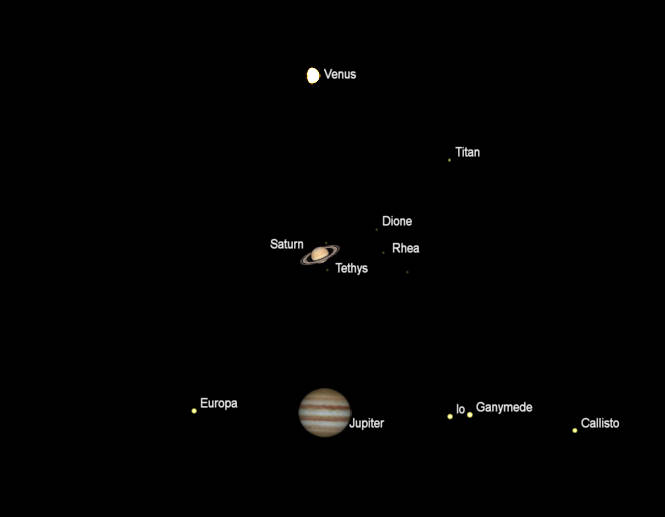
Telescopic view of the bright planets (north up) as they would be seen in a small telescope, with the same magnification, this evening. Venus at 9 pm, and the other two at 11 pm, September 1, 2021. Apparent diameters: Venus, 15.16″, 73% illuminated; Saturn 18.32″, its rings 42.67″; Jupiter, 48.83″. Jupiter’s moons Io and Europa will slowly approach the planet over the morning hours. Io will be occulted by the planet around 4:05 am (08:05 UT). Europa will begin its transit across the face of the planet around 5:04 am (09:04 UT). The ” symbol means seconds of arc (1/3600th of a degree.) Click on the image to enlarge it. Created using Cartes du Ciel (Sky Charts). Jovian satellite event times determined from Stellarium.
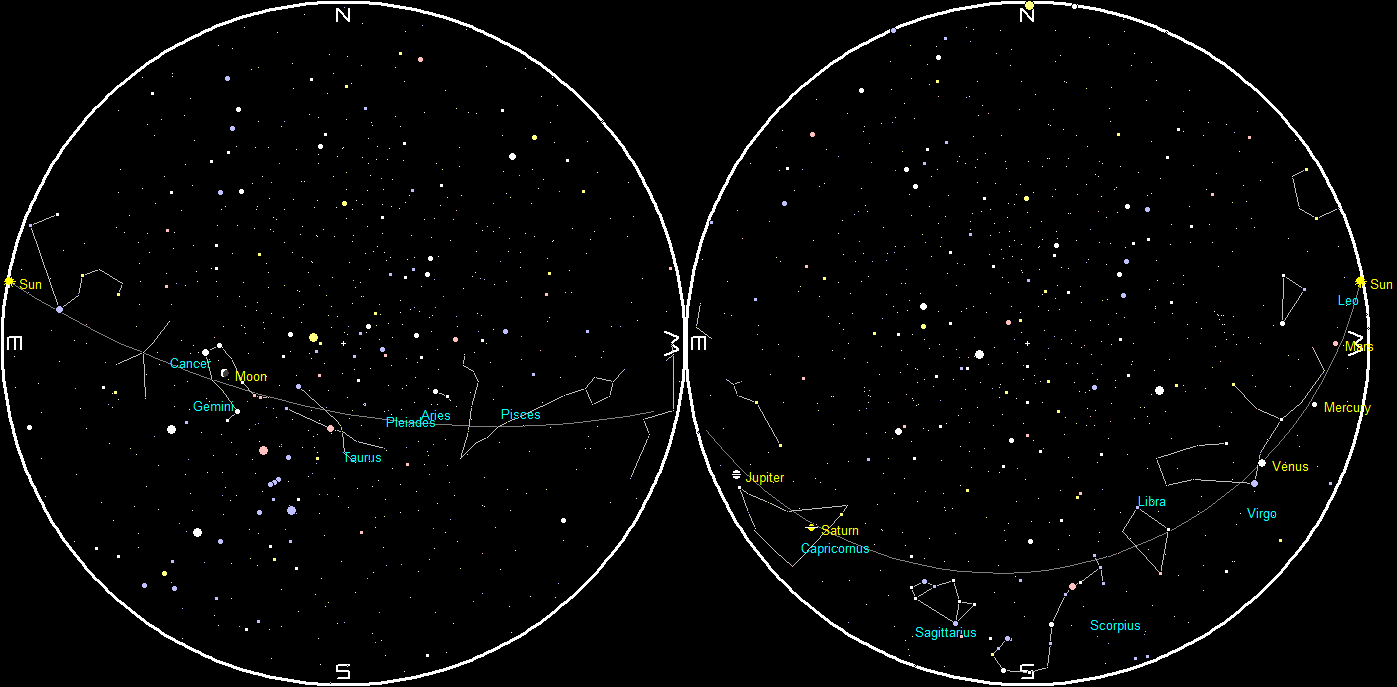
Planets and the Moon at sunset and sunrise of a single night, starting with sunset on the right on September 1, 2021. The night ends on the left with sunrise on the 2nd. Click on the image to enlarge. Created using my LookingUp program.
Note: Mars and Mercury are too close to the direction of the Sun to be visible from Northern Michigan. However, Mercury will be easily visible far south of here and into the Southern Hemisphere.
08/25/2021 – Ephemeris – Let’s search for the naked-eye planets for this week
This is Ephemeris for Wednesday, August 25th. Today the Sun will be up for 13 hours and 34 minutes, setting at 8:31, and it will rise tomorrow at 6:58. The Moon, 3 days past full, will rise at 10:20 this evening.
Let’s search for the naked-eye planets for this week. Venus should be visible in the western evening twilight before 9 tonight. It will set at 9:53 pm. By 9 pm, Jupiter and Saturn will be seen low in the southeastern sky. The brighter Jupiter will be easy to spot at that hour. Saturn will be dimmer, but a bit higher and to its right. Both these planets will be visible for most of the night, with Saturn setting first at 4:52 am, with Jupiter setting at 6:26 tomorrow morning. Saturn’s rings can be seen in a spotting scope of about 20 power magnification. Though at that power, the rings won’t appear separated from the planet, so Saturn will look like an elliptical spot. Most of Jupiter’s 4 brightest moon can be spotted in binoculars.
The astronomical event times given are for the Traverse City/Interlochen area of Michigan (EDT, UT – 4 hr). They may be different for your location.
Addendum
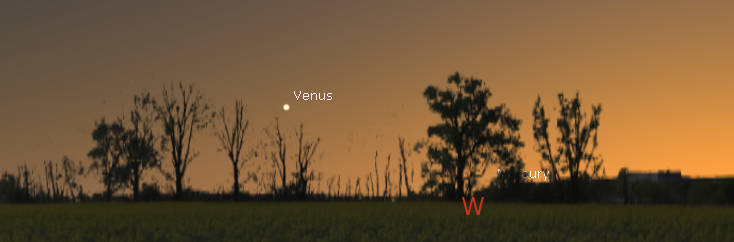
Venus in evening twilight tonight, August 25, 2021 at 9 pm, about 1/2 hour after sunset. Created using Stellarium.
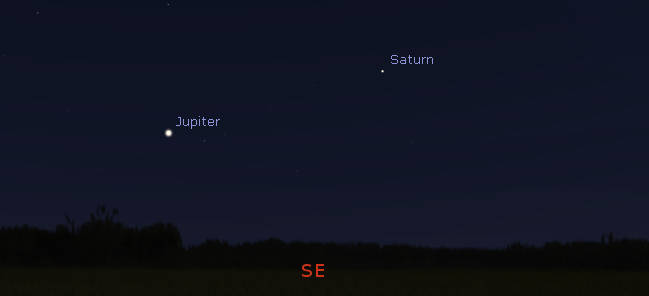
Jupiter and Saturn in the southeast at 9:30 pm tonight, August 25, 2021, about 45 minutes after sunset. Created using Stellarium.
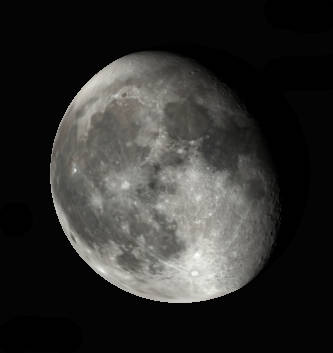
The Moon as it might appear tonight in binoculars or a small telescope at 11:30 pm, about an hour after it rises tonight, August 25, 2021. Created using Stellarium.
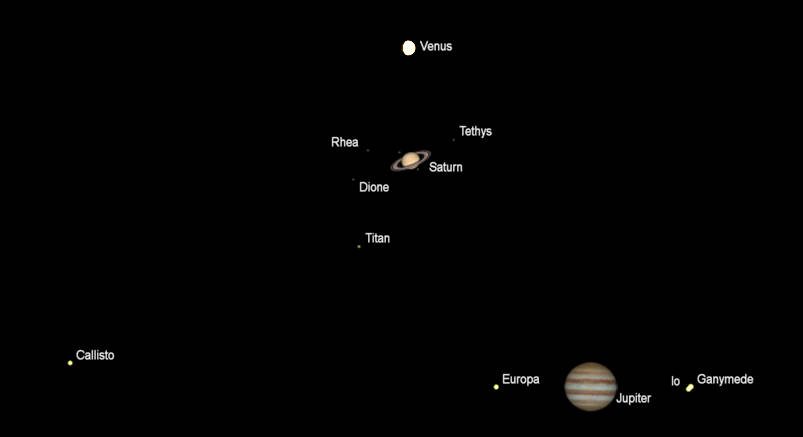
Telescopic view of the bright planets (north up) as they would be seen in a small telescope, with the same magnification, this evening. Venus at 9:15 pm, and the other two at 11 pm, August 25, 2021. Apparent diameters: Venus, 14.51″ 75% illuminated; Saturn 18.43″, its rings 42.93″; Jupiter, 49.06″. Jupiter’s moons Io and Ganymede will slowly separate after 11 pm. The ” symbol means seconds of arc (1/3600th of a degree.) Click on the image to enlarge it. Created using Cartes du Ciel (Sky Charts).
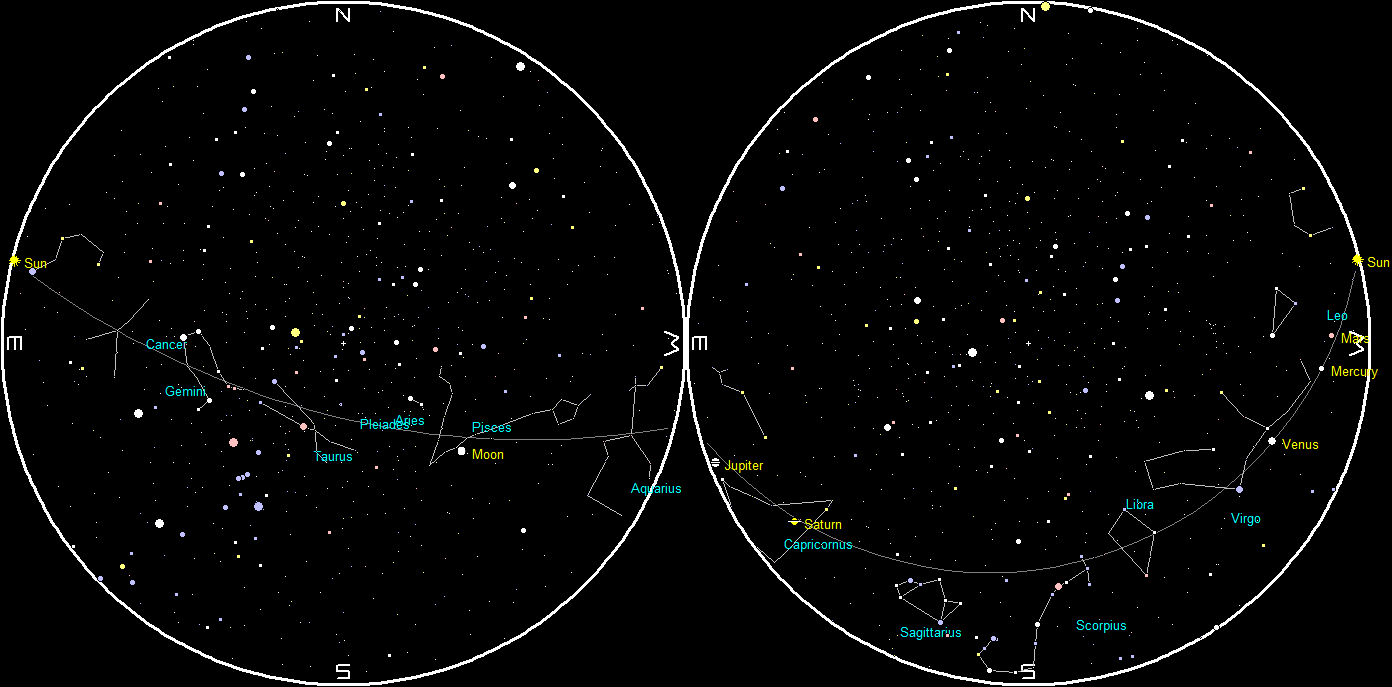
Planets and the Moon at sunset and sunrise of a single night, starting with sunset on the right on August 25, 2021. The night ends on the left with sunrise on the 26th. Click on the image to enlarge. Created using my LookingUp program.
08/19/2021 – Ephemeris – Jupiter is at opposition today!
This is Ephemeris for Thursday, August 19th. Today the Sun will be up for 13 hours and 51 minutes, setting at 8:41, and it will rise tomorrow at 6:51. The Moon, 3 days before full, will set at 4:11 tomorrow morning.
Tonight, Jupiter will be at opposition. That’s a shortcut term for Jupiter being opposite the Sun in our sky. At that time, Jupiter rises at sunset and sets at sunrise. It is also at its closest to us. It also officially becomes an evening planet, available in the evening for those of us with daytime jobs. In even small telescopes, Jupiter shows two dark bands. There’s more, but those two are the most prominent. Its four largest moons will be visible before 9:50 pm tonight, after that the innermost of the four, Io, will start to cross the face of Jupiter. It will leave Ganymede on Jupiter’s east side. On the west side will be the moon Europa, and farther out, Callisto. At 12:08 am, Io will reappear on the west side of Jupiter, joining Europa and Callisto. The moons do put on a show.
The astronomical event times given are for the Traverse City/Interlochen area of Michigan (EDT, UT – 4 hr). They may be different for your location.
Addendum
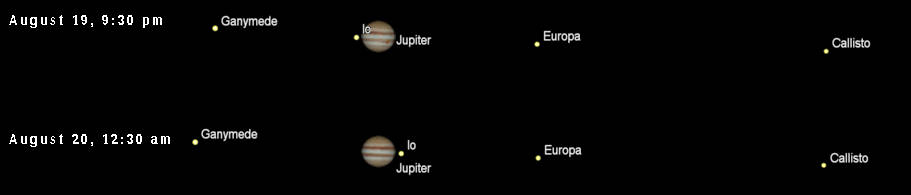
Jupiter’s Galilean moons at two times tonight, August 19th at 9:30 pm (01:30 on the 20th, UT) and 12:30 am (04:30 UT). From 9:50 pm to 12:08 am (01:50 – 04:08 UT), Io will pass in front of Jupiter and be practically invisible. Click on the image to enlarge it. Created using Cartes du Ciel (Sky Charts).
08/18/2021 – Ephemeris – Let’s search for the naked-eye planets for this week
This is Bob Moler with Ephemeris for Wednesday, August 18th. Today the Sun will be up for 13 hours and 54 minutes, setting at 8:43, and it will rise tomorrow at 6:50. The Moon, 3 days past first quarter, will set at 3:02 tomorrow morning.
Let’s search for the naked-eye planets for this week. Venus should be visible in the western evening twilight by 9:15 tonight. It will set at 10:04 pm. By 9:30 pm, Jupiter and Saturn will be seen low in the southeastern sky. The brighter Jupiter will be easy to spot at that hour. Saturn will be dimmer, but a bit higher and to its right. Jupiter, just a day from opposition from the Sun, will be at its brightest and closest to us. It’s now 373 million miles (600 million km) from us. It won’t change much by tomorrow. Actually it’s a closer approach than average, so it’s brighter than at an average opposition and larger appearing than normal in telescopes. Jupiter and four of its largest moons always provide for a great show.
The astronomical event times given are for the Traverse City/Interlochen area of Michigan (EDT, UT – 4 hr). They may be different for your location.
Addendum
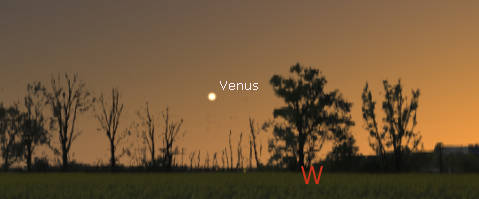
Venus low in the west, tonight at 9:15, about a half hour after sunset, August 18, 2021. Created using Stellarium.
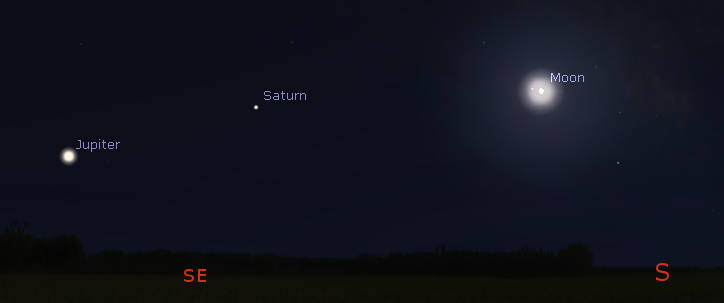
Jupiter, Saturn and the Moon at 10 pm, about an hour and a quarter after sunset tonight, August 18, 2021. Click on the image to enlarge it. Created using Stellarium.
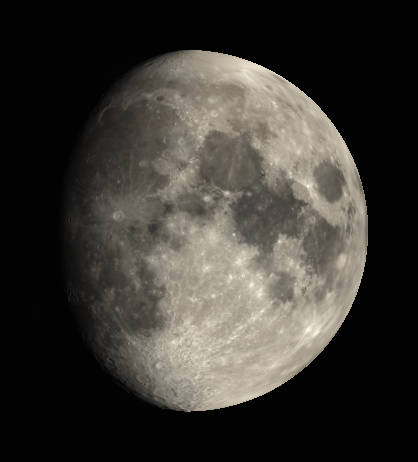
The waxing gibbous Moon as it might appear tonight in binoculars or a small telescope. Created using Stellarium.
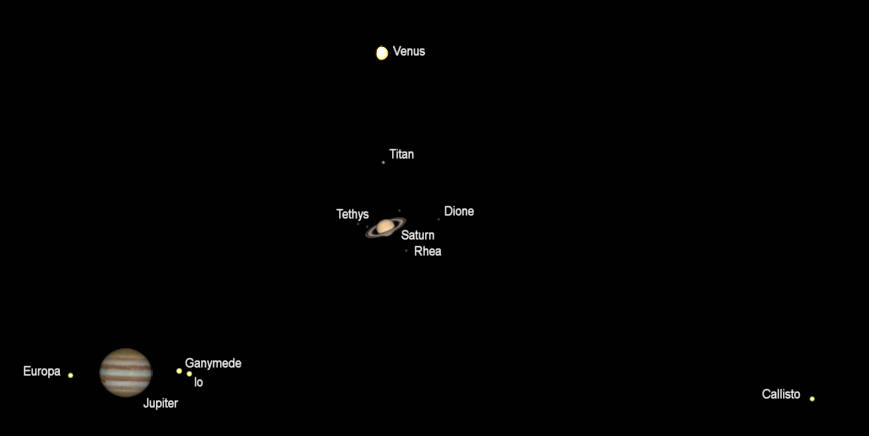
Telescopic view of the bright planets (north up) as they would be seen in a small telescope, with the same magnification, this evening. Venus at 10 pm, and the other two at 11 pm, August 18, 2021. Apparent diameters: Venus, 13.93″; Saturn 18.51″, its rings 43.13″; Jupiter, 49.12″. Jupiter’s moon have a cluster of events in the am hours. See below. The ” symbol means seconds of arc (1/3600th of a degree.) Click on the image to enlarge it. Created using Cartes du Ciel (Sky Charts).
Satellite  Event             EDT (UT-4)   UT
Europa     Shadow start      12:34 am     04:34
Europa	   Transit start     12:37 am     04:37
Io         Occultation start 12:37 am     04:37
Ganymede   Eclipse start     12:43 am     04:43
Io         Occultation end    2:55 am     06:55
Europa     Shadow end         3:25 am     07:25
Europa     Transit end        3:27 am     07:27
Ganymede   Occultation end    4:24 am     08:24

From 12:43 to 2:55 am, only Callisto of the four Galilean moons will be visible.
The above times were determined using Stellarium, and may be off by several minutes.
Shadow events are when a satellite’s shadow is cast onto the face of the planet
Transit events are when the satellite passes in front of the planet. The satellite is usually not visible
Eclipse events are when a satellite passes through the planet’s shadow
Occultation events are when the satellite passes behind the planet
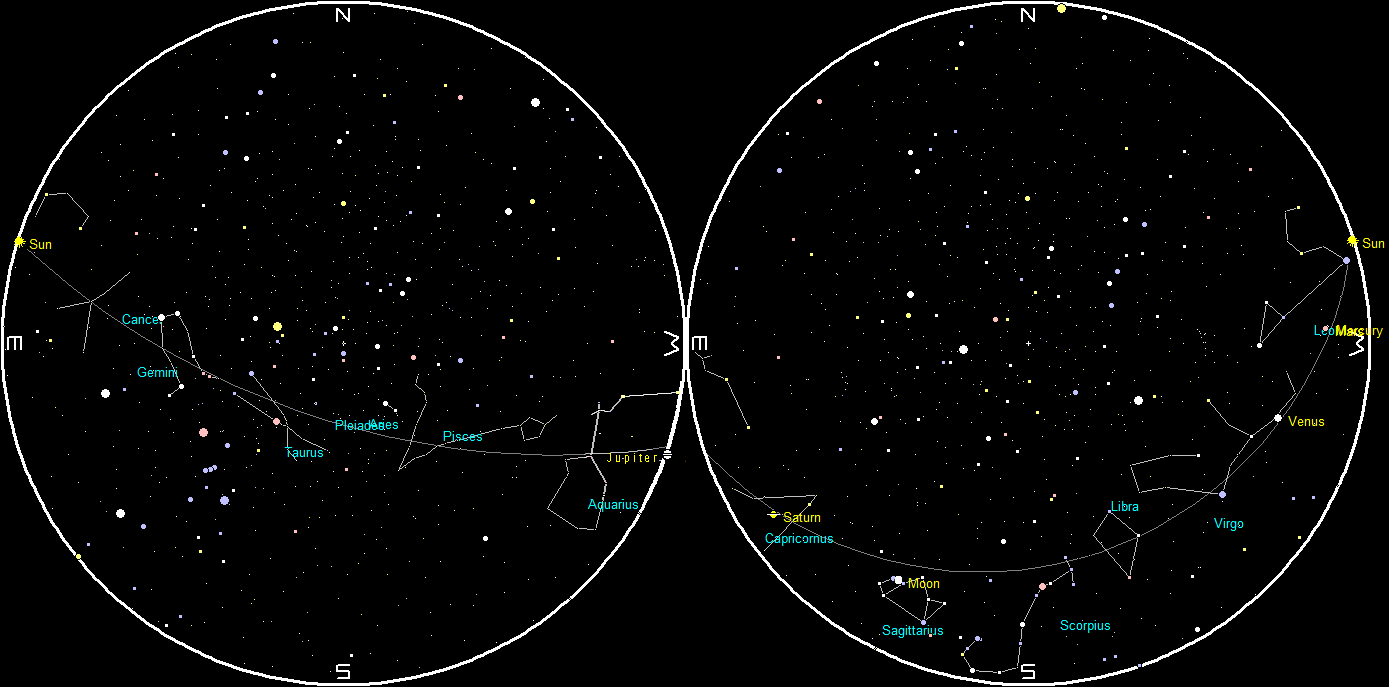
The naked-eye planets and the Moon are shown at sunset and sunrise of a single night, starting with sunset on the right on August 18, 2021. The night ends on the left with sunrise on the 19th. Mars and Mercury will be in conjunction in Leo that evening, so their labels overlap. Click on the image to enlarge. Created using my LookingUp program.
08/17/2021 – Ephemeris – Jupiter is big and bright in the evening
This is Bob Moler with Ephemeris for Tuesday, August 17th. Today the Sun will be up for 13 hours and 56 minutes, setting at 8:44, and it will rise tomorrow at 6:49. The Moon, 2 days past first quarter, will set at 2:02 tomorrow morning.
The brilliant planet we see rising in the east-southeast in the evening is not Venus, which is low in the west, ensnared in evening twilight. It’s Jupiter, the second-brightest planet and the largest by far. Jupiter would be the brightest planet except that the strength of sunlight falling on it is only 1/25th of what we get on the Earth and less than 1/50th of what Venus gets. Plus, it’s a lot farther away. Even in binoculars, Jupiter appears as not quite star-like. Most of the time, Jupiter is the largest appearing planet in telescopes. It is only beaten by Venus for a couple of months when it is nearest to us. When I was a kid, just learning about the planets, Jupiter had 12 moons. Astronomers by now have discovered 68 more.
The astronomical event times given are for the Traverse City/Interlochen area of Michigan (EDT, UT – 4 hr). They may be different for your location.
Addendum
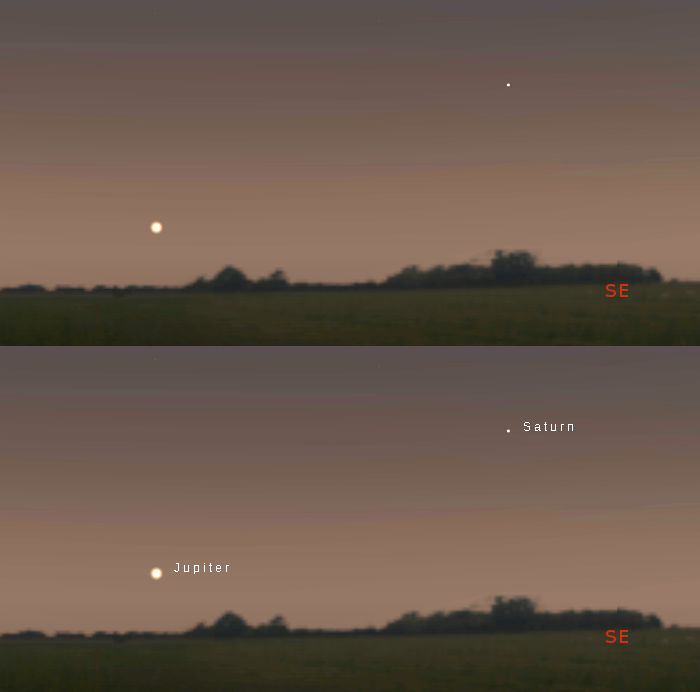
Jupiter finder animation for tonight, August 17, 2021, at 9:15 pm. Venus i is in the west, which is brighter but suffering in bright twilight. Saturn may not be as easily visible as it is shown here until later. Credit: Stellarium and GIMP.
08/11/2021 – Ephemeris – Let’s search for the naked-eye planets for this week, and meteors tonight
This is Bob Moler with Ephemeris for Wednesday, August 11th. Today the Sun will be up for 14 hours and 13 minutes, setting at 8:54, and it will rise tomorrow at 6:42. The Moon will be 3 days past new tonight.
Let’s search for the naked-eye planets for this week. Venus and the Moon will be close together tonight, with Venus below and right of the waxing crescent Moon by 9:30 tonight. Venus will set at 10:18 pm. With the Moon following at 10:50. By 10 pm, Jupiter and Saturn will be seen low in the southeastern sky. The brighter Jupiter will be easy to spot at that hour. Saturn will be dimmer, but a bit higher and to its right. Tonight and especially in the morning hours tomorrow, the Perseid meteors will be at their peak. These bits of Comet Swift-Tuttle, liberated by the comet’s prior passes in through the warmth of the inner solar system, will flash into incandescence as they enter the Earth’s atmosphere at interplanetary speeds.
The astronomical event times given are for the Traverse City/Interlochen area of Michigan (EDT, UT – 4 hr). They may be different for your location.
Addendum
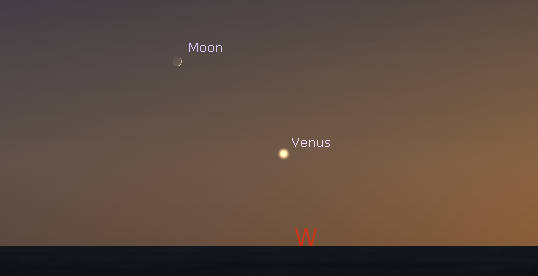
Venus and the 3-day-old Moon ion evening twilight at 9:45 tonight, August 11, 2021. Created using Stellarium.
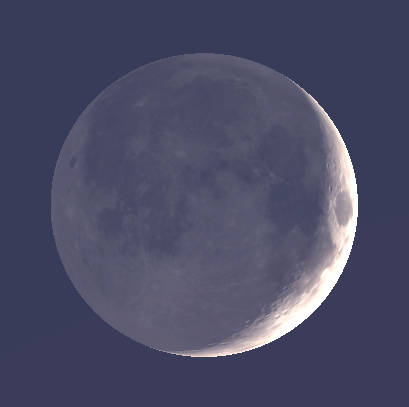
The Moon as it might appear in binoculars tonight, August 11, 2021, with earth shine on its night side, illuminated by the bright Earth in its sky.
Created using Stellarium.
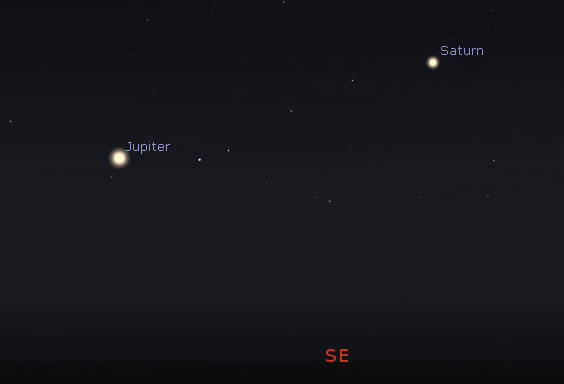
Jupiter and Saturn in the southeastern sky at 10:30 in the evening tonight, August 11, 2021. Created using Stellarium.
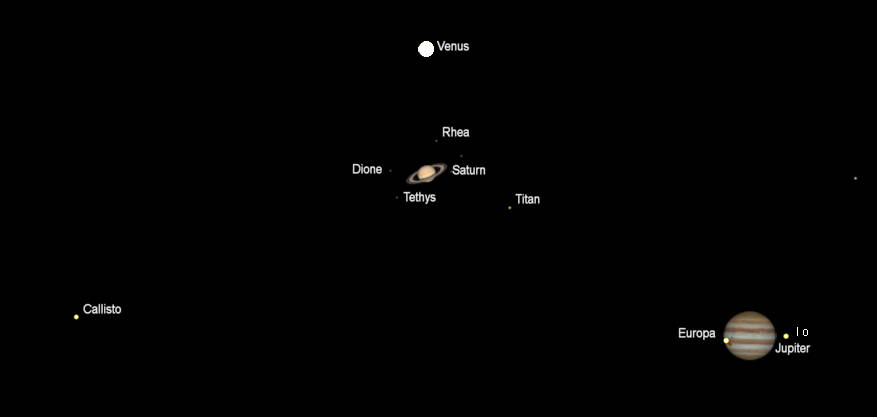
Telescopic view of the bright planets (north up) as they would be seen in a small telescope, with the same magnification, this evening, at 10 pm August 11, 2021. Apparent diameters: Venus, 13.40″; Saturn 18.57″, its rings 43.26″; Jupiter, 49.00″. Jupiter’s moon have a cluster of events in the evening. See below. The ” symbol means seconds of arc (1/3600th of a degree.) Click on the image to enlarge it. Created using Cartes du Ciel (Sky Charts).
                Jupiter's Satellite events
Moon      Event            EDT (pm-11th, am-12th) UT (12th)
Europa    Shadow enters    10:00 pm               02:00
Europa    Transit starts   10:25 pm               02:25
Io        Eclipse starts   10:41 pm               02:41
Europa    Shadow exits     12:51 am               04:51
Ganymede  Occultation ends  1:06 am               05:06
Io        Occultation ends  1:11 am               05:11
Europa    Transit ends      1:12 am               05:12
The above times were determined using Stellarium, and may be off by several minutes.
Shadow events are when a satellite’s shadow is cast onto the face of the planet
Transit events are when the satellite passes in front of the planet
Eclipse events are when a satellite passes through the planet’s shadow
Occultation events are when the satellite passes behind the planet
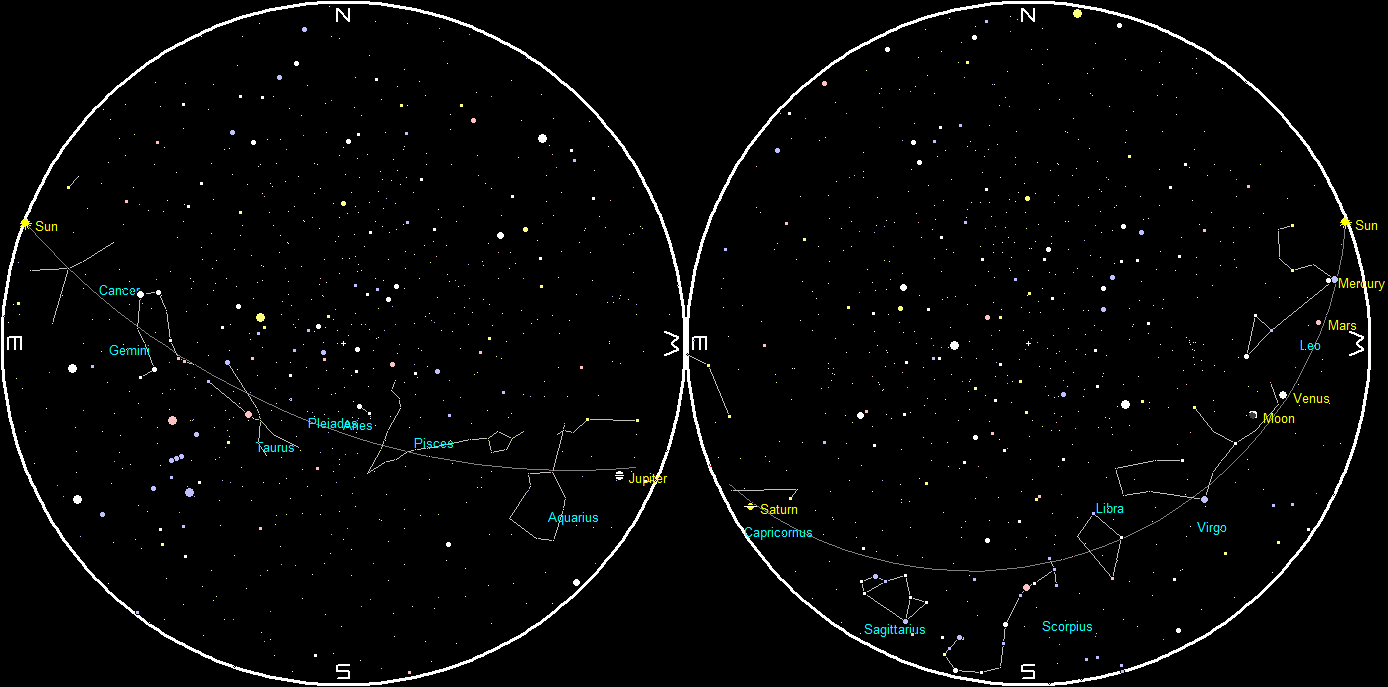
Planets and the Moon at sunset and sunrise of a single night, starting with sunset on the right on August 11, 2021. The night ends on the left with sunrise on the 12th. Click on the image to enlarge. Created using my LookingUp program.
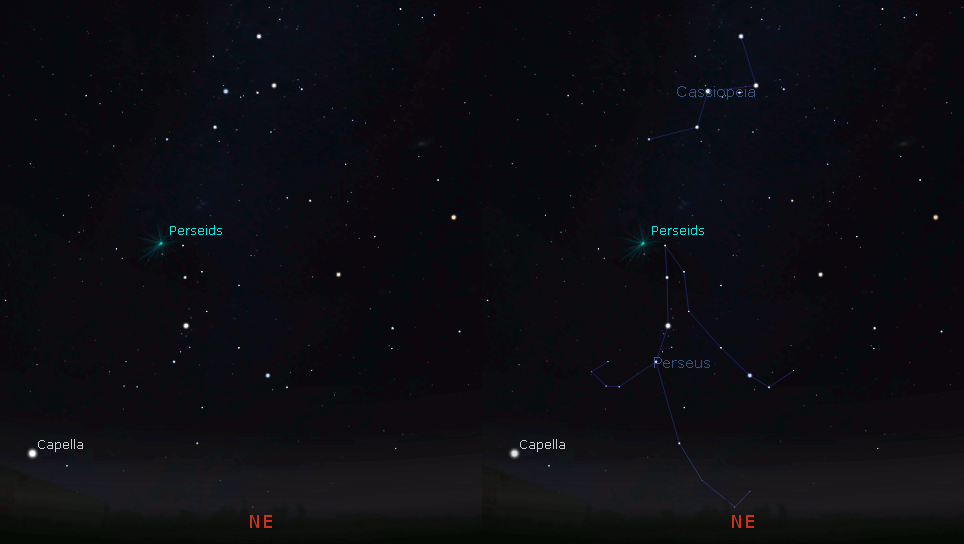
Perseid Radiant finder automation for midnight, August 11th. Created using Stellarium and GIMP.
More on the Perseids on Monday and Tuesday’s posts.
08/04/2021 – Ephemeris – Let’s search for the naked-eye planets for this week
This is Bob Moler with Ephemeris for Wednesday, August 4th. Today the Sun will be up for 14 hours and 31 minutes, setting at 9:04, and it will rise tomorrow at 6:33. The Moon, halfway from last quarter to new, will rise at 3:16 tomorrow morning.
Let’s search for the naked-eye planets for this week. Venus can be spotted low in the western twilight by 9:45 pm. It will set at 10:29 pm. Venus will be spending the rest of summer low in the western sky, and not be as conspicuous as it usually is as the Evening Star. Mars is to faint and close to the Sun to be seen from northern latitudes. Saturn, now officially an evening planet, rises before sunset. It will be seen low in the southeast in the evening. Brighter Jupiter will rise at 9:38 pm in the east-southeast and will be seen thereafter trailing Saturn to it’s left or east. Jupiter will join Saturn as an evening planet on the 19th when it too reaches opposition from the Sun.
The astronomical event times given are for the Traverse City/Interlochen area of Michigan (EDT, UT – 4 hr). They may be different for your location.
Addendum
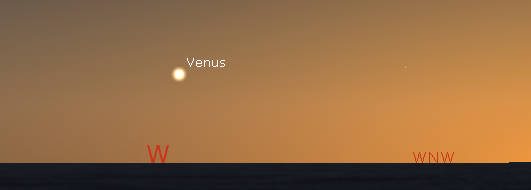
Venus in evening twilight at 9:45 pm, or about 40 minutes after sunset tonight, August 4, 2021. Created using Stellarium.
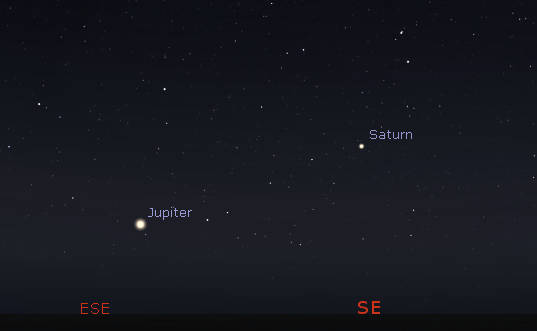
Jupiter and Saturn in the Southeastern sky at 10;30 pm tonight, August 4, 2021. Created using Stellarium.
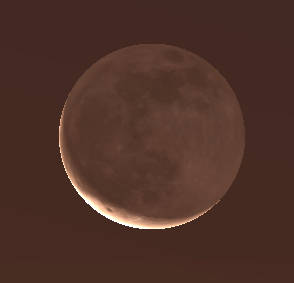
The waning crescent Moon as it might be seen in binoculars tomorrow morning at 6 am, about an half an hour before sunrise. Created using Stellarium.
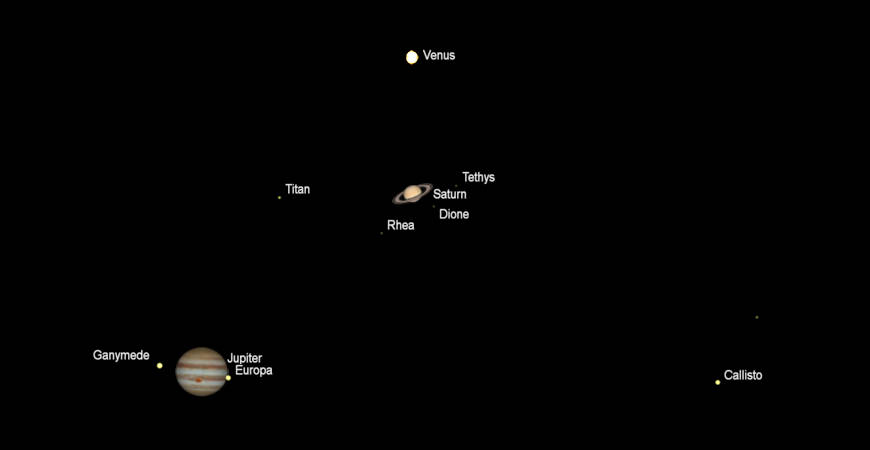
Telescopic view of the bright planets (north up) as they would be seen in a small telescope, with the same magnification, this evening, August 4, 2021. Apparent diameters: Venus, 12.93″; Saturn 18.60″, its rings 43.32″; Jupiter, 48.71″. The ” symbol means seconds of arc (1/3600th of a degree.) Click on the image to enlarge it. Created using Cartes du Ciel (Sky Charts).
Note on Jupiter and its moons. The Great Red Spot will be visible on the face of Jupiter. Europa will end its transit of the planet around 11:00 pm (03:00 UT on the 5th) Io will be occulted by Jupiter (behind the planet) in the early evening until about 11:27 pm (03:27 UT on the 5th) and will appear to the east of the planet.
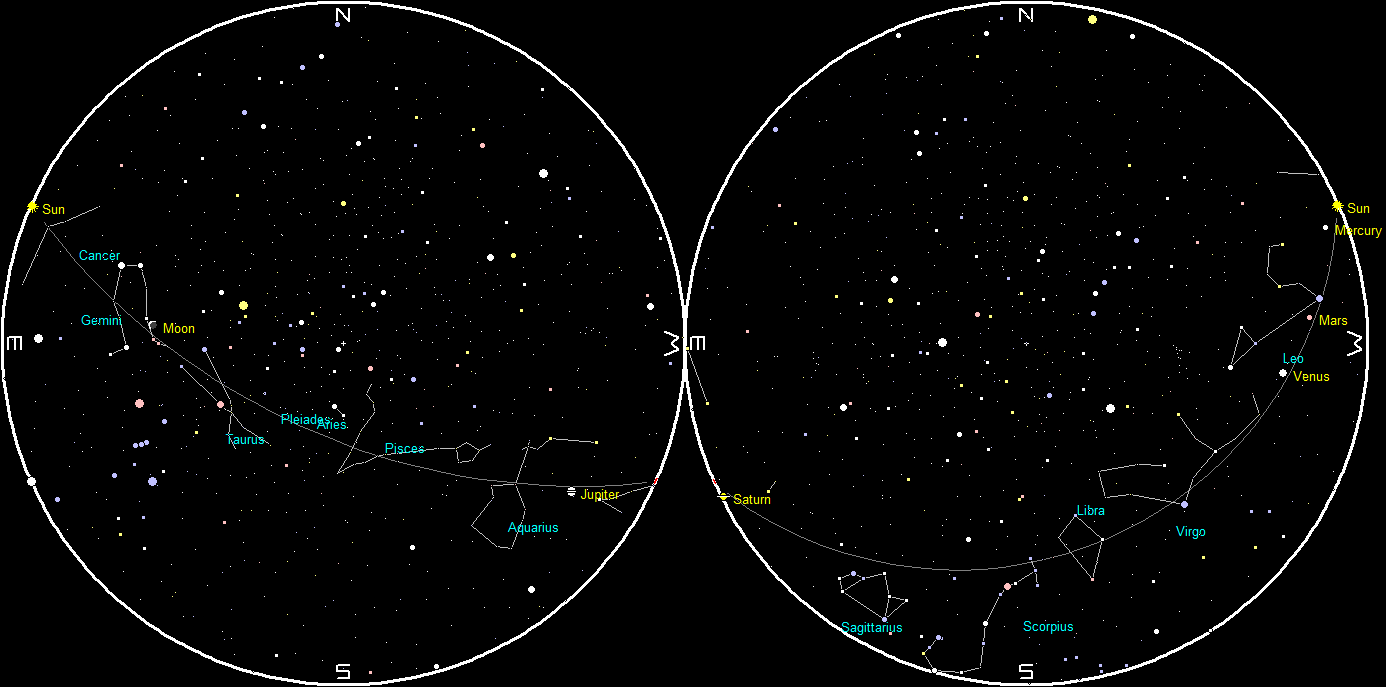
Planets and the Moon at sunset and sunrise of a single night, starting with sunset on the right on August 4, 2021. The night ends on the left with sunrise on the 5th. Click on the image to enlarge. Created using my LookingUp program.
07/28/2021 – Ephemeris – Searching for the naked-eye planets on the last Wednesday in July
This is Ephemeris for Wednesday, July 28th. Today the Sun will be up for 14 hours and 48 minutes, setting at 9:13, and it will rise tomorrow at 6:25. The Moon, 3 days before last quarter, will rise at 11:58 this evening.
Let’s search for the naked-eye planets for this week. Venus can be spotted low in the west-northwest twilight by 9:45 pm. It will set at 10:39 pm. Venus will be spending the rest of summer low in the western sky, and not be as conspicuous as it usually is as the Evening Star. Mars, I believe, is too faint and close to the Sun to be seen from northern latitudes. Saturn will be seen low in the southeast in the evening, with Jupiter rising later. Saturn, 5 days from opposition, that is being opposite the Sun in the sky and closest to Earth, will rise at 9:21 pm. Brighter Jupiter will rise at 10:12 pm, both planets will rise in the east-southeast. By 5:30 am, these two planets will be in the southwestern sky in the morning twilight.
The astronomical event times given are for the Traverse City/Interlochen area of Michigan (EDT, UT – 4 hr). They may be different for your location.
Addendum
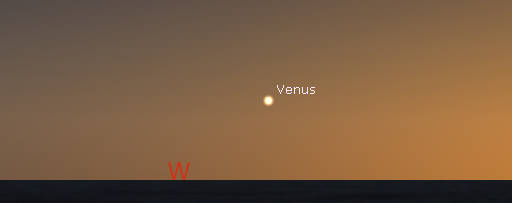
Venus in evening twilight in the west at 10 pm, July 28, 2021. Created using Stellarium.
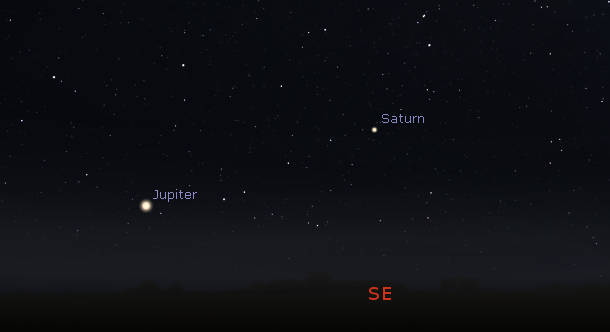
Jupiter and Saturn low in the southeast at 11 pm. Created using Stellarium.
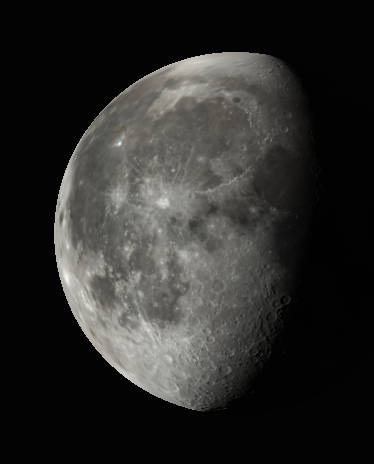
The waning gibbous Moon as it might be seen in binoculars or small telescope at 5:30 am, July 29, 2021. Created using Stellarium.
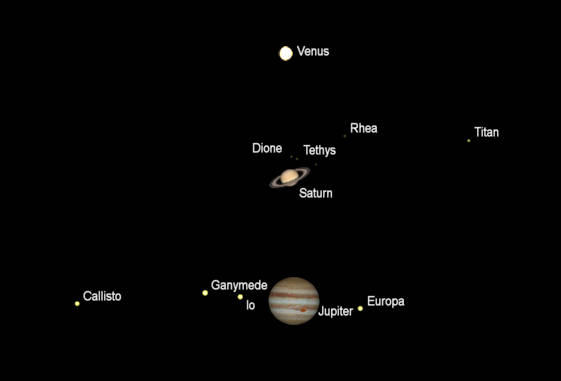
Telescopic view of the bright planets (north up) as they would be seen in a small telescope, with the same magnification, this evening, July 28, 2021. Apparent diameters: Venus, 12.58″; Saturn 18.59″, its rings 43.31″; Jupiter, 48.28″. The ” symbol means seconds of arc (1/3600th of a degree.) Click on the image to enlarge it. Created using Cartes du Ciel (Sky Charts).
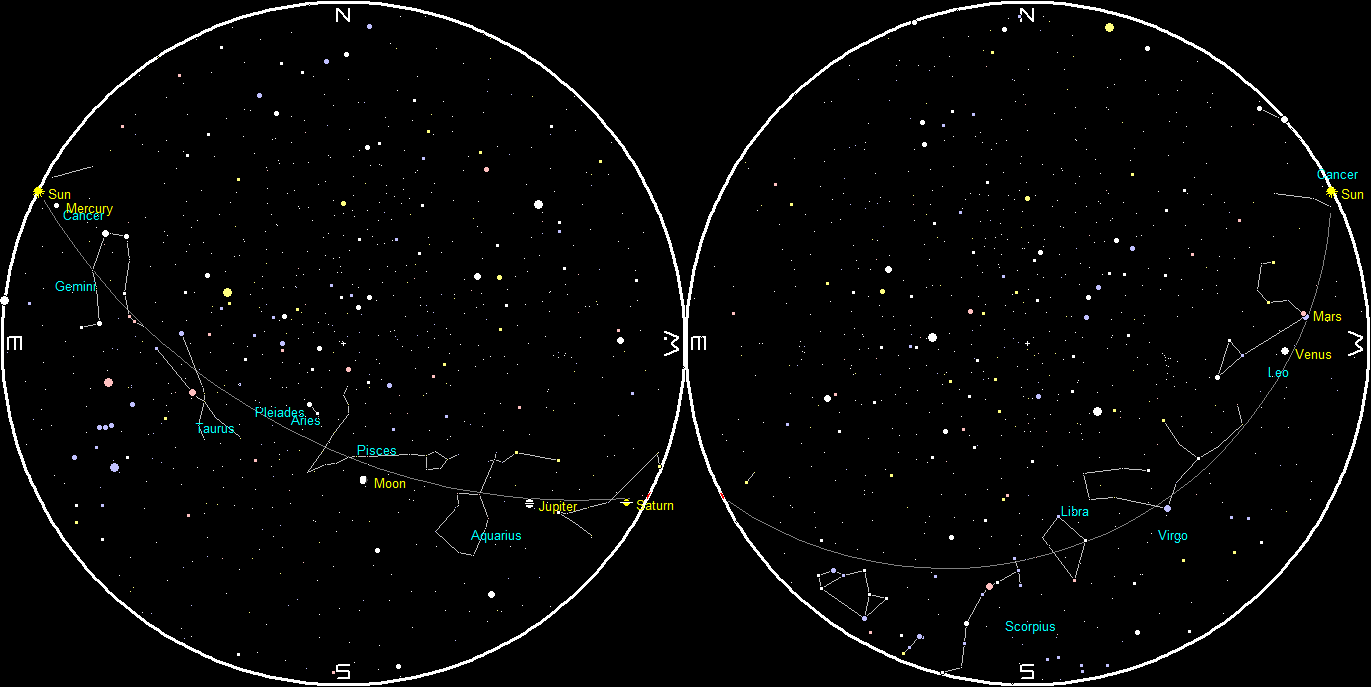
Planets and the Moon at sunset and sunrise of a single night, starting with sunset on the right on July 28, 2021. The night ends on the left with sunrise on the 29th. Click on the image to enlarge. Created using my LookingUp program.
07/14/2021 – Ephemeris – It’s Wednesday, do you know where your naked-eye planets are?
This is Bob Moler with Ephemeris for Wednesday, July 14th. Today the Sun will be up for 15 hours and 15 minutes, setting at 9:26, and it will rise tomorrow at 6:11. The Moon, 3 days before first quarter, will set at 12:23 tomorrow morning.
Let’s search for the naked-eye planets for this week. Venus can be spotted low in the west-northwest twilight by 10 pm or a little after. It will set at 10:57 pm. Venus will be spending the rest of summer low in the western sky, and not be as conspicuous as it usually is as the Evening Star. Mars’ visibility is a real problem. It will be to the right and a bit below Venus in the evening, and will set at 10:52 pm. It’s much dimmer than Venus, so I doubt anyone at our northern latitude could spot it. Saturn and Jupiter, are seen starting very late in the evening and best in the morning sky. Saturn will rise at 10:18 pm. Brighter Jupiter will rise at 11:09 pm, both in the east-southeast. By 5 am, these two planets will be in the southern sky in the morning twilight.
The astronomical event times given are for the Traverse City/Interlochen area of Michigan (EDT, UT – 4 hr). They may be different for your location.
Addendum
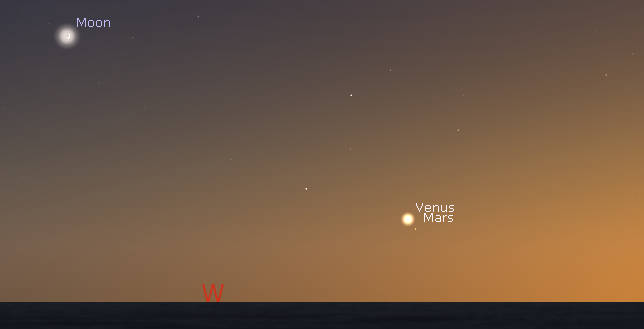
Venus, Mars and the Moon in evening twilight at 10:15 pm, about 50 minutes after sunset on July 14, 2021. Created using Stellarium.
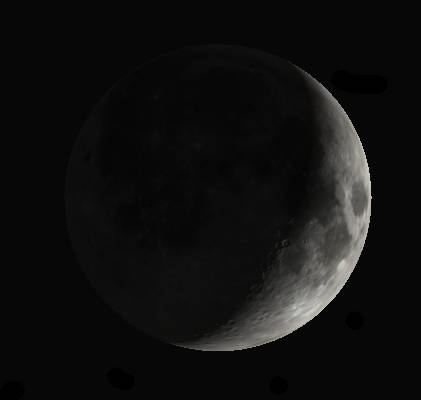
The Moon as it might appear in binoculars or small telescope this evening, July 14, 2021. Created using Stellarium.
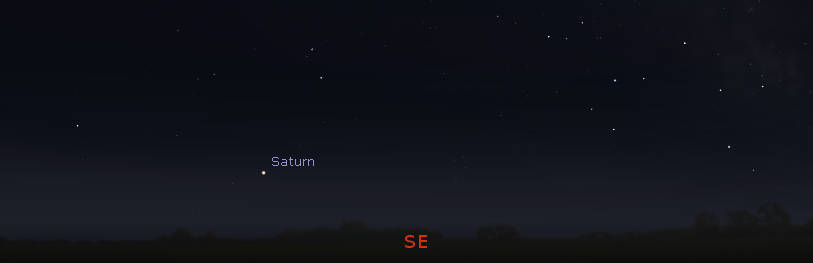
Saturn, rising in the southeast at 11 pm, about an hour and a half after sunset tonight, July 14, 2021. Astronomical twilight here has not yet ended. The Teapot asterism of Sagittarius is seen in the south-southeast. Scorpius’ tail, not shown, is scraping the horizon in the south. Saturn is in Capricornus, with two of its stars visible above it. Click on the image to enlarge it. Created using Stellarium.
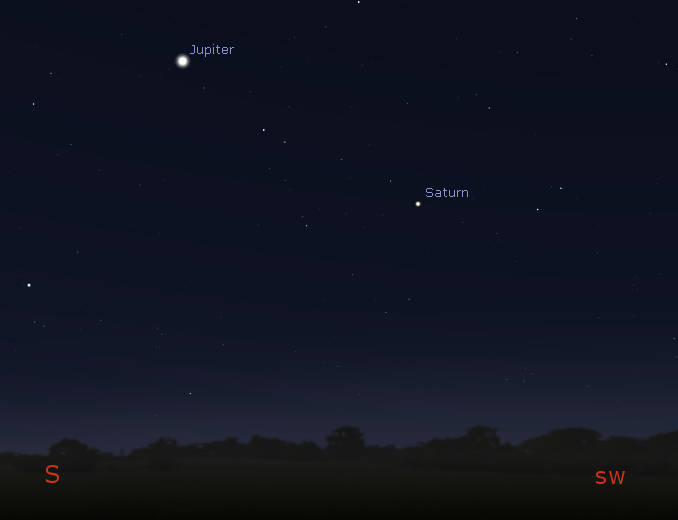
Jupiter and Saturn at 5 am tomorrow morning. Click on the image to enlarge it. Created using Stellarium.
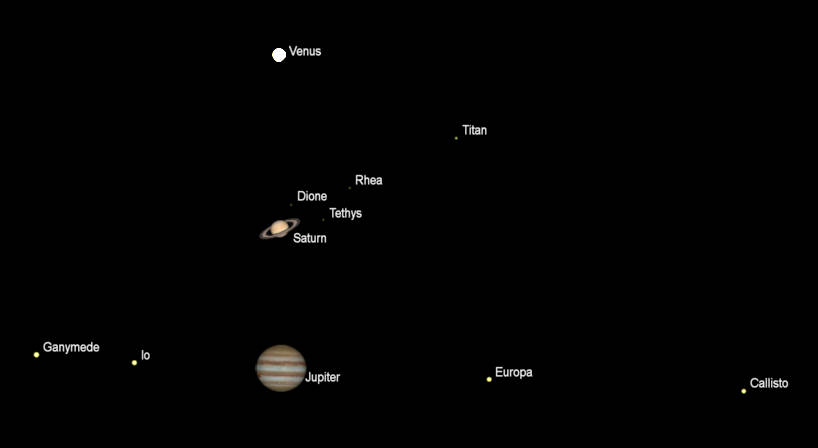
The planets as seen in a telescope (north up) with the same magnification for the night of July 14/15, 2021. Times of the display are: Venus, 10:30 pm; Saturn and Jupiter, 5 am. Apparent diameters: Venus, 11.77″; Saturn 18.50″, its rings 43.09″; Jupiter, 46.99″. Mars has an apparent diameter of only 3.75″ and is not represented. The ” symbol means seconds of arc (1/3600th of a degree.) Click on the image to enlarge it. Created using Cartes du Ciel (Sky Charts).
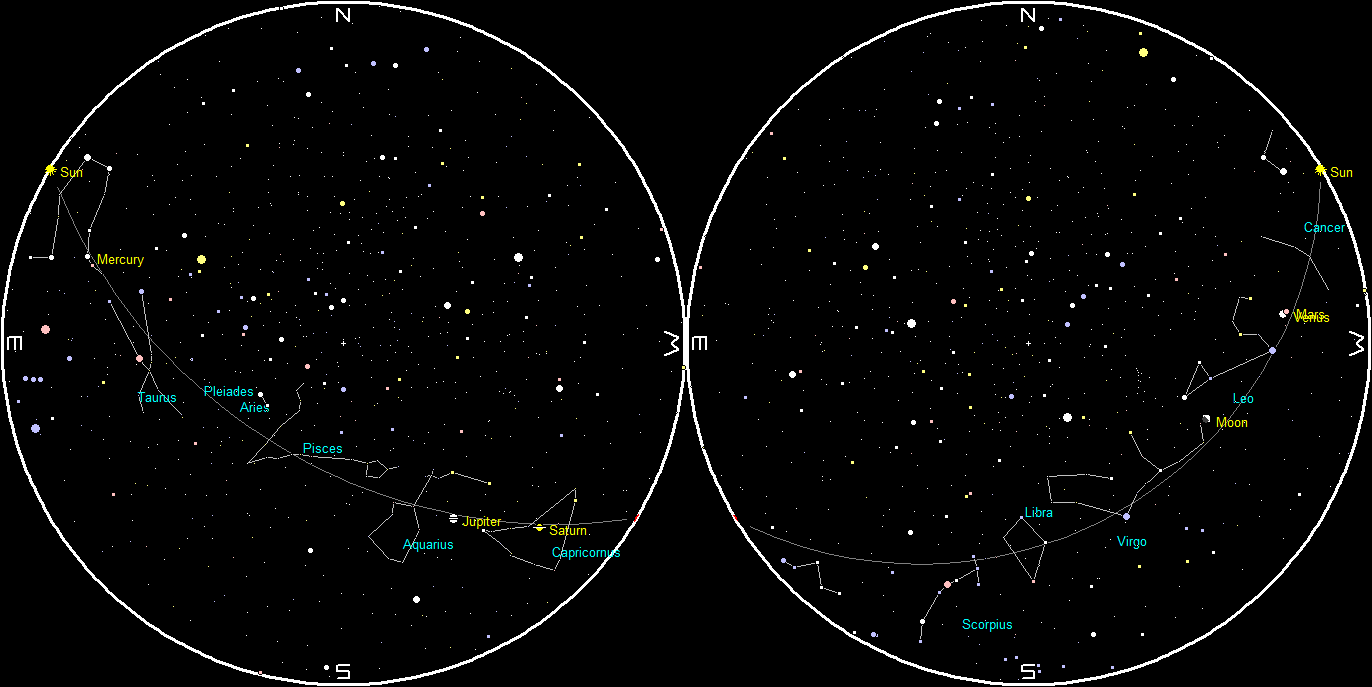
Planets and the Moon at sunset and sunrise of a single night, starting with sunset on the right on July 14, 2021. The night ends on the left with sunrise on the 15th. Click on the image to enlarge. Created using my LookingUp program.
 Bob Moler's Ephemeris Blog