Archive
03/19/2013 – Ephemeris – PanSTARRS, of course, plus a spring preview
Ephemeris for Tuesday, March 19th. The sun will rise at 7:47. It’ll be up for 12 hours and 6 minutes, setting at 7:53. The moon, at first quarter today, will set at 3:38 tomorrow morning.
Comet PanSTARRS continues to be seen low in evening twilight. It is moving now into the west northwest. When it becomes dark enough it will display a fan shaped tail in binoculars. It is moving away from both the sun and the earth. Tomorrow will see our own milestone as the earth moves into a position where the sun appears over the earth’s equator, and the sun sets at the south pole of the earth and rises at the north pole. It will be the vernal or spring equinox. Australians and other folks south of the equator may prefer to call it the March equinox, because for them autumn starts. The exact time the sun will appear to cross the equator heading northward will be 7:02 tomorrow morning. The sun will keep heading northward until June 21st.
Times are for the Traverse City/Interlochen area of Michigan. They may be different for your location.
Addendum
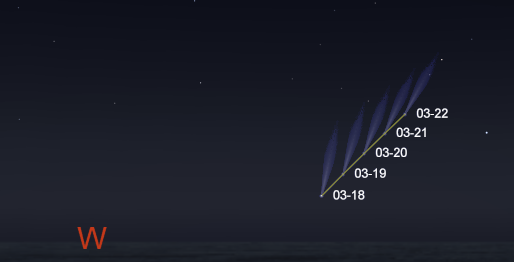
Comet PanSTARRS for this week’s weekdays at 9:15 p.m. Created using Stellarium and Cartes du Ciel.

The earth as seen from the sun near the vernal equinox. See the earth from north pole to south pole. Created using Celestia.
01/01/2013 – Ephemeris – We start the year with the sun closest to us.
Ephemeris for New Years Day, Tuesday, January 1st 2013. The sun will rise at 8:19. It’ll be up for 8 hours and 53 minutes, setting at 5:13. The moon, 3 days before last quarter, will rise at 9:55 this evening.
Happy New Year and happy perihelion Day. What’s a perihelion? Well. It’s not two helions, whatever they are. Perihelion is the point in an orbit of the sun that is nearest to the sun. This evening the earth will reach that point in its travels around the sun. Since its winter time, the sun’s distance apparently doesn’t cause the seasons. Actually the sun now as about a million and a half miles closer than mean, which isn’t much out of 93 million miles. But, although we don’t notice it in northern Michigan, it makes winter the shortest season at 89 days. The real cause of the seasons is the tilt of the earth’s axis. Now the sun appears highest over the southern hemisphere. The sun’s up less than 9 hours here and hangs low over the southern horizon at noon.
Times are for the Traverse City/Interlochen area of Michigan. They may be different for your location.
12/20/2012 – Ephemeris – Winter starts tomorrow morning.
Ephemeris for Thursday, December 20th. The sun will rise at 8:15. It’ll be up for 8 hours and 48 minutes, setting at 5:04. The moon, at first quarter today, will set at 1:51 tomorrow morning.
Tomorrow morning at 6:12 a.m. The sun will pass through the point where is appears the farthest south. We call it the winter solstice, or winter sun stand still. If you are measuring the shadow of the sun cast by a stick at noon, tomorrow will be the date of the longest noon time shadow. The ancients, who were not too sure the sun would come back partied big time as the sun stopped the southern progress and began to head back north. This was and is a big festival time featuring lots of lights, be it candles, torches, the burning of the yule log and Christmas lights. For those in the southern hemisphere they are celebrating the summer solstice. In any case our winter is the shortest season.
Times are for the Traverse City/Interlochen area of Michigan. They may be different for your location.
Addendum
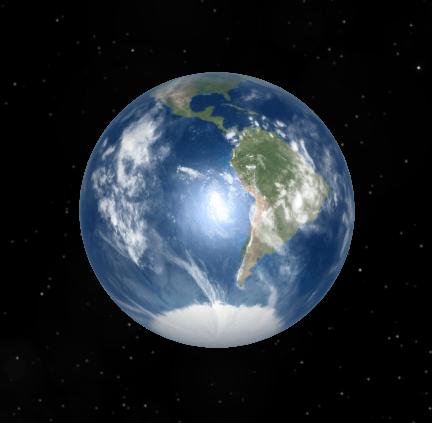
Noon in Michigan at the winter solstice. Created using Celestia.
To keep the earth large enough, I’ve had to move in to 10 earth radii, so Michigan at the top is a bit closer to the limb than it is to the sun. The vantage point is over the Tropic of Capricorn, 23 1/2 degrees south latitude. The short daylight hours and low sun angle hasn’t caught up to us yet. The coldest days are expected in January.
07/04/2012 – Ephemeris – The earth at aphelion
Ephemeris for Independence Day, Wednesday, July 4th. Today the sun will be up for 15 hours and 27 minutes, setting at 9:30. The moon, 1 day past full, will rise at 10:02 this evening. Tomorrow the sun will rise at 6:03.
Today, Independence Day the earth is at its greatest distance from the sun or about 94.5 million miles from the sun. It doesn’t do much to weaken the strength of sunlight, as you will find out when you go to the beach, But, occurring in summer, makes summer the longest season by a several days over winter. Our calendar tries to keep up with the seasonal or tropical year, while the earths revolution from its farthest or aphelion point to the next is slightly longer. Back in 1776 at the founding of our country the earth was farthest from the sun on June 30th. As we go more centuries into the future summer will get even a bit longer. But remember the poor Aussies whose winter will also get longer.
Times are for the Traverse City/Interlochen area of Michigan. They may be different for your location.
Addendum
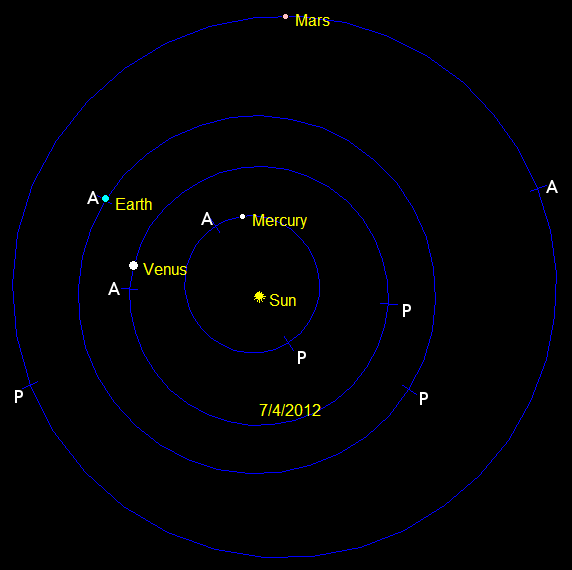
The orbits of the inner planets. (P)erihelion – (A)phelion
Perihelion is the closest point in an orbit to the sun, while aphelion is the farthest. The earth and Venus have the most circular orbits while Mars and Mercury have markedly elliptical orbits.
06/20/2012 – Ephemeris – Summer begins tonight!
Ephemeris for Wednesday, June 20th. Today the sun will be up for 15 hours and 33 minutes, setting at 9:31. The moon, 1 day past new, will set at 10:12 this evening. Tomorrow the sun will rise at 5:57.
We interrupt our weekly planet report to bring you this important news. At 7: 07 (EDT) this evening summer will begin. That instant of time is called the summer solstice. Solstice means “sun standstill”. That makes today the longest day in terms of daylight hours, though you will notice very little change for the next week or so. We have come to the point in earth’s orbit when the north pole of the earth is tipped its maximum toward the sun so the northern hemisphere will receive the most heat from the sun. The southern hemisphere will experience at that same instant their winter solstice. The earth now is not at its closest to the sun. In fact we’ll be at our farthest from the sun in two weeks.
Times are for the Traverse City/Interlochen area of Michigan. They may be different for your location.
03/20/2012 – Ephemeris – First day of spring
Ephemeris for Tuesday, March 20th. The sun will rise at 7:44. It’ll be up for 12 hours and 10 minutes, setting at 7:55. The moon, 2 days before new, will rise at 6:54 tomorrow morning.
At 1:14 this morning the season of spring started. The sun crossed the celestial equator heading northward. On the day of the equinox, either today’s vernal equinox or September’s autumnal equinox the sun rises due east and sets due west. From today until that September date the sun will rise and set north of those points. The sun will also rise higher in the sky until the summer solstice. The combination of longer daylight hours and it rising higher in the sky will mean more solar heat falling on the northern hemisphere of the earth and less falling on the southern. This will give us spring and summer, and the southern hemisphere autumn and winter. After a really screwy winter I wonder what spring and summer will bring.
* Times are for the Traverse City/Interlochen area of Michigan. They may be different for your location.
Heading to work the morning before the equinox
Turning onto M72 east in Acme I was presented with the sun half risen on top of the hill. This was taken a minute or so later.

03/19/2012 – Ephemeris – The last day of winter
Ephemeris for Monday, March 19th. The sun will rise at 7:46. It’ll be up for 12 hours and 7 minutes, setting at 7:54. The moon, 3 days before new, will rise at 6:30 tomorrow morning.
This is the last full day of winter. And a strange winter it is, ending today with record high temperatures. Tomorrow at 1:14 a.m. spring will officially start. At that time the earth will move to a point in its orbit where the sun will appear to cross the equator in the sky, and will appear to pass directly overhead if you lived on the equator. The event of the crossing and the point on the celestial sphere that the sun crosses the equator is called the vernal equinox. It’s the Greenwich of the heavens. All measurements east and west in the sky are measured from this point. And its position in relation to the prime meridian on the earth at Greenwich, near London is the fundamental measure of the earth’s rotational position.
* Times are for the Traverse City/Interlochen area of Michigan. They may be different for your location.
Addendum
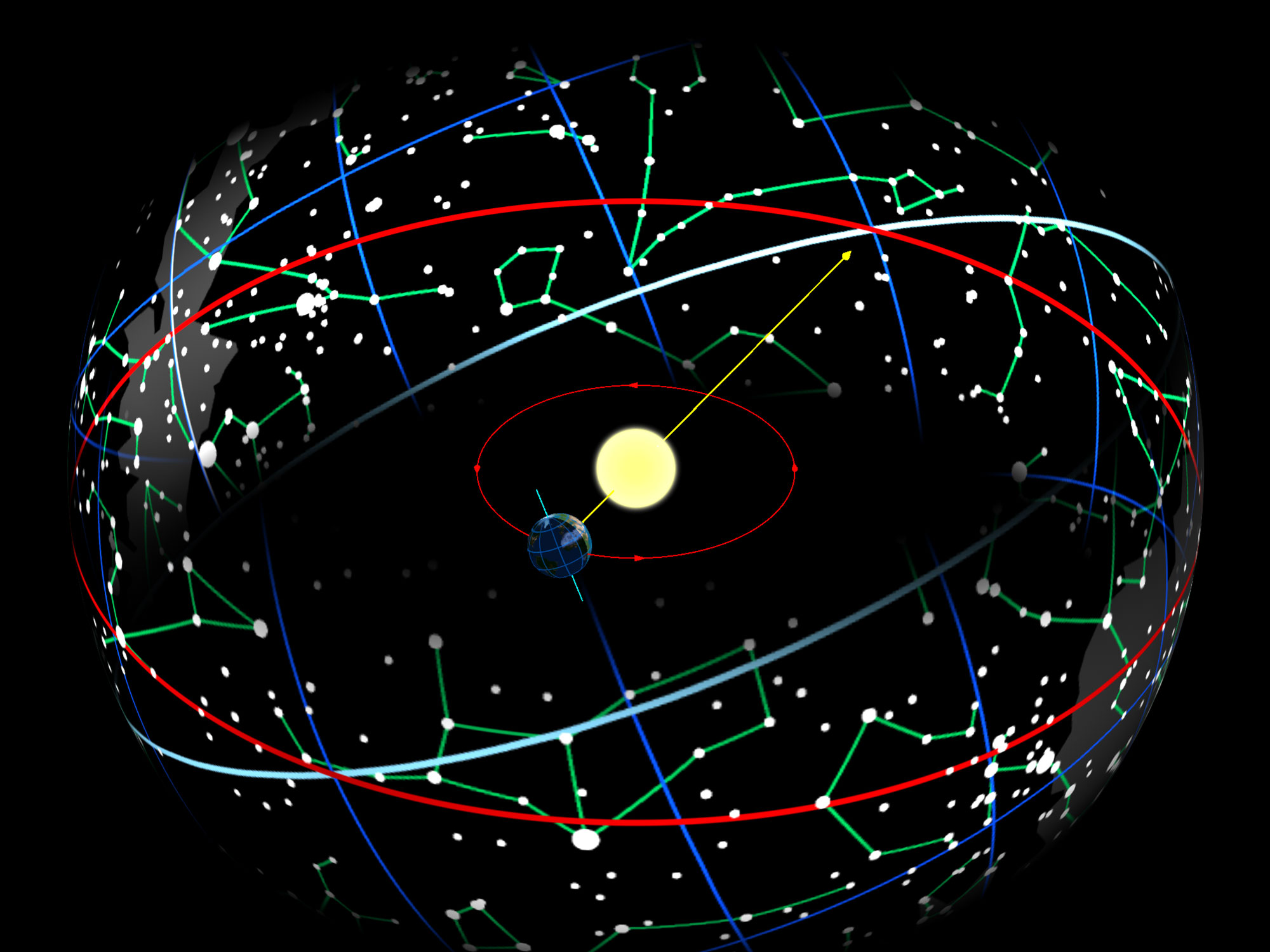
The sun at the vernal equinox. Diagram by Wikipedia contributor Tauʻolunga GNU Free Document License
Click on image to enlarge.
12/22/11 – Ephemeris – Winter is here!
Thursday, December 22nd. The sun will rise at 8:16. It’ll be up for 8 hours and 48 minutes, setting at 5:05. The moon, 2 days before new, will rise at 7:06 tomorrow morning.
At 12:30 this morning the sun reached its farthest southerly travel and is now slowly beginning to turn northward again. That point was the winter solstice, or to be more general the December solstice, because in the southern hemisphere of the earth summer has arrived, while we star winter. December 21st is the usual day of the solstice, and it will be again next year because next year is the leap year and will set the calendar back to match the seasons. The adding of the extra day every 4 years came under the auspices of Julius Caesar and gave us the Julian calendar. It slightly over corrected the calendar. The latest adjustment was the Gregorian reform that will fix the calendar for the next few millennia.
* Times, as always are for the Traverse City/Interlochen area of Michigan.
10/25/11 – Ephemeris – The lonely star Fomalhaut
Tuesday, October 25th. The sun will rise at 8:10. It’ll be up for 10 hours and 31 minutes, setting at 6:42. The moon, 1 day before new, will rise at 8:02 tomorrow morning
There’s a bright and lonely star that appears low in the south for only seven and a half hours a night on autumn evenings. It’s appearance is a sign as sure as the falling leaves that autumn is here At 9 p.m. tonight it’s low in the south southeast. The star’s name is Fomalhaut, which means fish’s mouth. This is appropriate because it’s in the constellation of Piscis Austrinus, the southern fish. At our latitude it’s the fish that got away, because Fomalhaut appears to be quite alone. The dimness of the constellation’s other stars and location close to the horizon make the fainter stars hard to spot. They would be overhead in Australia. The earth’s thick atmosphere near the horizon reduces the stars brightness by a factor of two or more, so Fomalhaut appears to keep a lonely vigil in the south.
* Times are for the Traverse City/Interlochen area of Michigan. They may be different for your location.
Addendum
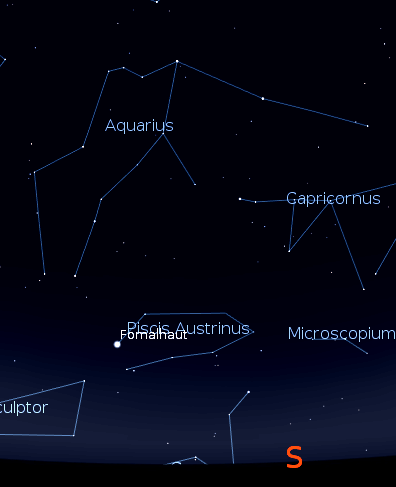
Aquarius and Fomalhaut as visualized by Stellarium
 Bob Moler's Ephemeris Blog