Archive
09/21/2021 – Ephemeris – Autumn starts tomorrow
This is Bob Moler with Ephemeris for Tuesday, September 21st. Today the Sun will be up for 12 hours and 12 minutes, setting at 7:41, and it will rise tomorrow at 7:30. The Moon, 1 day past full, will rise at 8:23 this evening.
Enjoy the last full day of summer. Summer will last until 3:21 pm (19:21 UTC) tomorrow, when the center of the Sun will cross the celestial equator, an imaginary line above the Earth’s equator, heading southward. At that instant, autumn will begin. Shortly after, the Sun will be up less than half the day. The day and the point in the sky that the Sun crosses is called the autumnal equinox. The word equinox means equal night, implying that day and light are of equal length. Geometrically that’s true, but the Earth’s atmosphere and the definition of sunrise and sunset, prolong daylight by a few minutes. The amount of heat we are getting and will get from the Sun cannot sustain our current temperatures, and it will get a lot colder on average before it gets warmer again.
The astronomical event times given are for the Traverse City/Interlochen area of Michigan (EDT, UT-4 hours). They may be different for your location.
Addendum

That is not a pumpkin on the head of the motorcyclist. That’s the Sun rising as I’m traveling east on South Airport Road south of Traverse City, MI on the autumnal equinox. This is the east-west section of the road. The Sun is rising over the hills some 6 miles to the east. When the Sun is on the celestial equator, it rises due east and sets due west. Credit: Bob Moler.
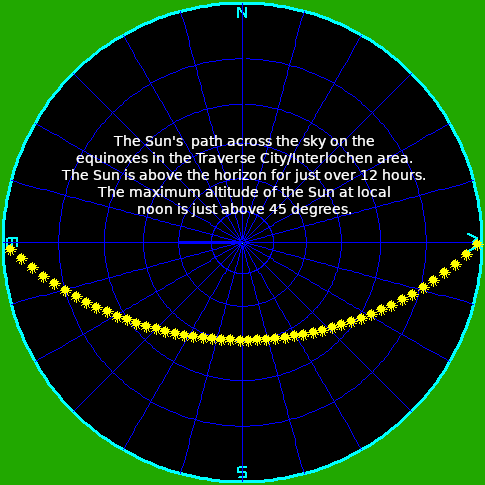
The Sun’s path through the sky on an equinox day from the Traverse City/Interlochen area in Michigan. The Sun is plotted every 15 minutes. This is a stereographic projection which compresses the image near the zenith and enlarges the image towards the horizon. Created using my LookingUp program.
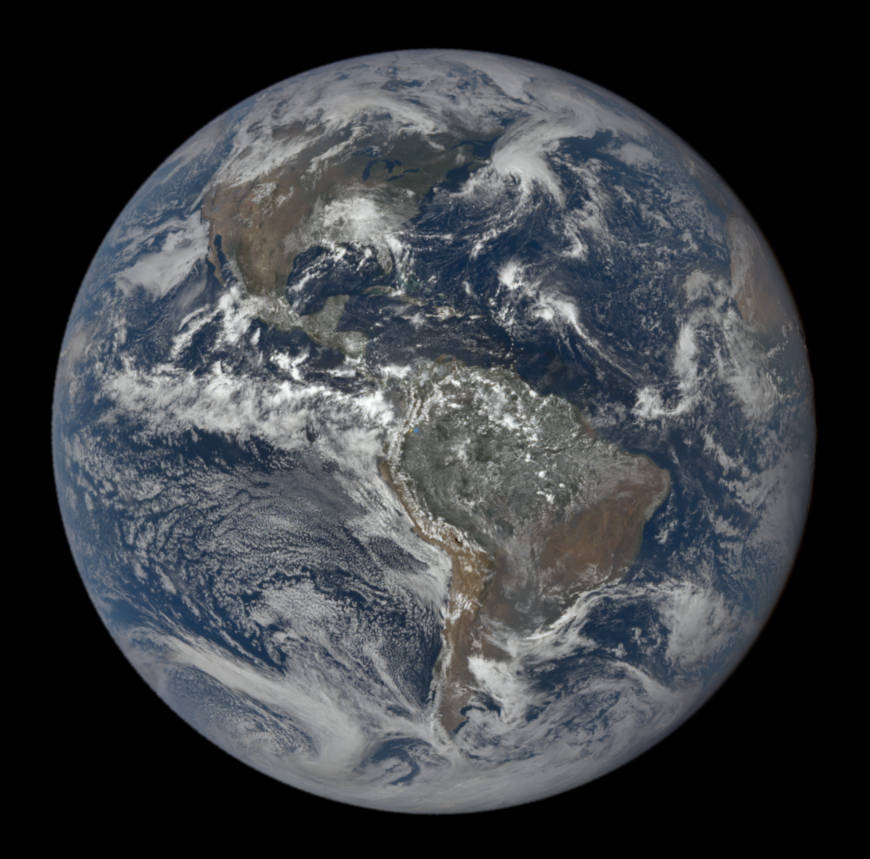
Earth 3 days before autumnal equinox, 1:17 pm EDT, September 19, 2021. The mitten shape of Michigan was in the clear that day and is visible above center of the image. The image taken by the Earth Polychromatic Imaging Camera (EPIC) on the DSCOVR satellite in halo orbit around the Earth-Sun L1 Lagrange point, about a million miles sunward of the Earth. At the time, DSCOVR was 892,682 miles (1,436,797 kilometers) from Earth.
06/18/2021 – Ephemeris – Summer* will start Sunday night
This is Bob Moler with Ephemeris for Friday, June 18th. Today the Sun will be up for 15 hours and 34 minutes, setting at 9:31, and it will rise tomorrow at 5:56. The Moon, 1 day past first quarter, will set at 2:41 tomorrow morning.
Summer is just a couple of days away, though we have already been sweltering through a very hot first half of June. Summer will officially arrive for us on Earth’s Northern Hemisphere at 11: 32 pm, June 20th. If you are south of the equator, winter will arrive. If you are listening to this on the Internet, or reading this on my blog, it’s 3:32 UT, June 21st. And to be season agnostic, it’s the June solstice. From the 20th to the December solstice, the first day of winter for we northern hemispherians, (I think that’s a word) the daylight hours will get shorter as the Sun heads south. Solstice means Sun standstill as it stops its northerly motion and will, after Sunday, head back south again. The Northern Hemisphere will still be heating up for another month.
The astronomical event times given are for the Traverse City/Interlochen area of Michigan (EDT, UT – 4hr). They may be different for your location.
* Summer in the Northern Hemisphere only. Winter starts in the Southern Hemisphere.
Addendum
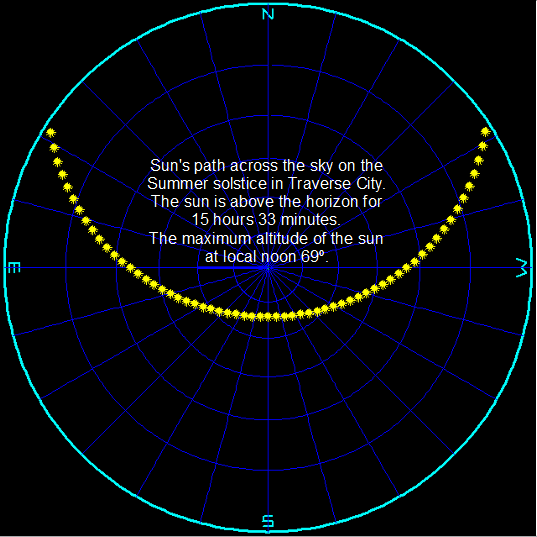
The Sun’s path through the sky on the summer solstice day from Traverse City, MI. The Sun is plotted every 15 minutes. The Sun’s motion is constant. The closeness of the Sun plots at higher altitudes is an artifact of portraying a hemispherical sky on a flat screen. It is a stereographic projection. Created using my LookingUp program.
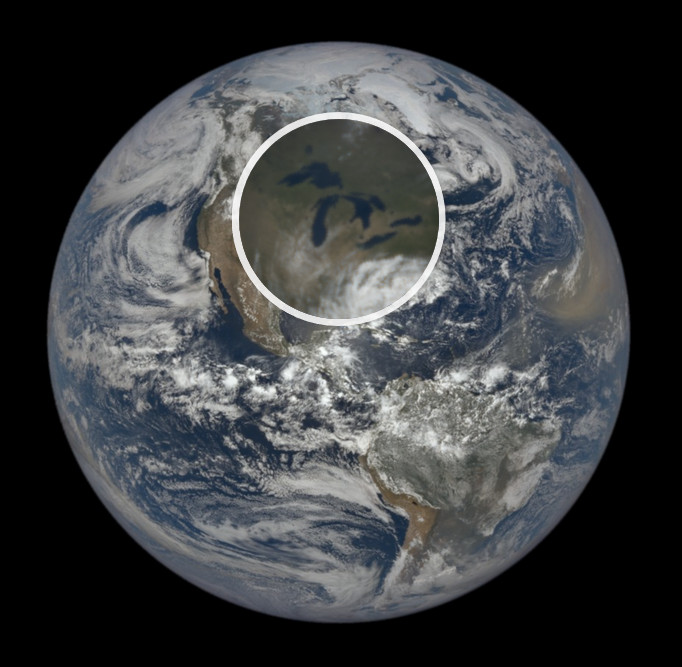
Earth and magnified local area near summer solstice. Image taken near local noon June 17, 2020. Credit NOAA DSCOVR satellite orbiting the Sun-Earth L1 point 994,970 miles (1,601,432 kilometers) sunward from the Earth.
06/15/2021 – Ephemeris – Today we had the earliest sunrise of the year
This is Ephemeris for Tuesday, June 15th. Today the Sun will be up for 15 hours and 33 minutes, setting at 9:30, and it will rise tomorrow at 5:56. The Moon, 2 days before first quarter, will set at 1:29 tomorrow morning.
Today is the day of the year with the earliest sunrise, which in the Interlochen/Traverse City area is 6:56 am. We are 5 days before the summer solstice, the longest day in terms of sunshine hours. With the Sun nearing its maximum angle above the celestial equator, the projection of the Earth’s equator on the sky it cuts those longitude timelines quicker because they are closer together than at the equator. This is counters somewhat the Sun’s speed slowing down as the Earth is reaching the farthest point in its orbit. The latest sunset will occur about June 26th, a span of 11 days. In December the span between the earliest sunset and latest sunrise because of the Sun’s increased speed, by being nearly at its closest to us, is 24 days.
The astronomical event times given are for the Traverse City/Interlochen area of Michigan. They may be different for your location.
Addendum
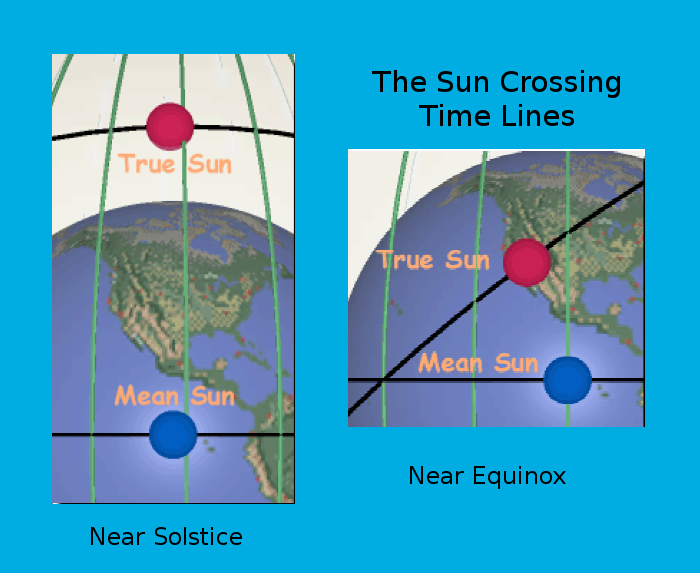
How the Sun’s declination affects how rapidly it appears to cross time lines (meridians)
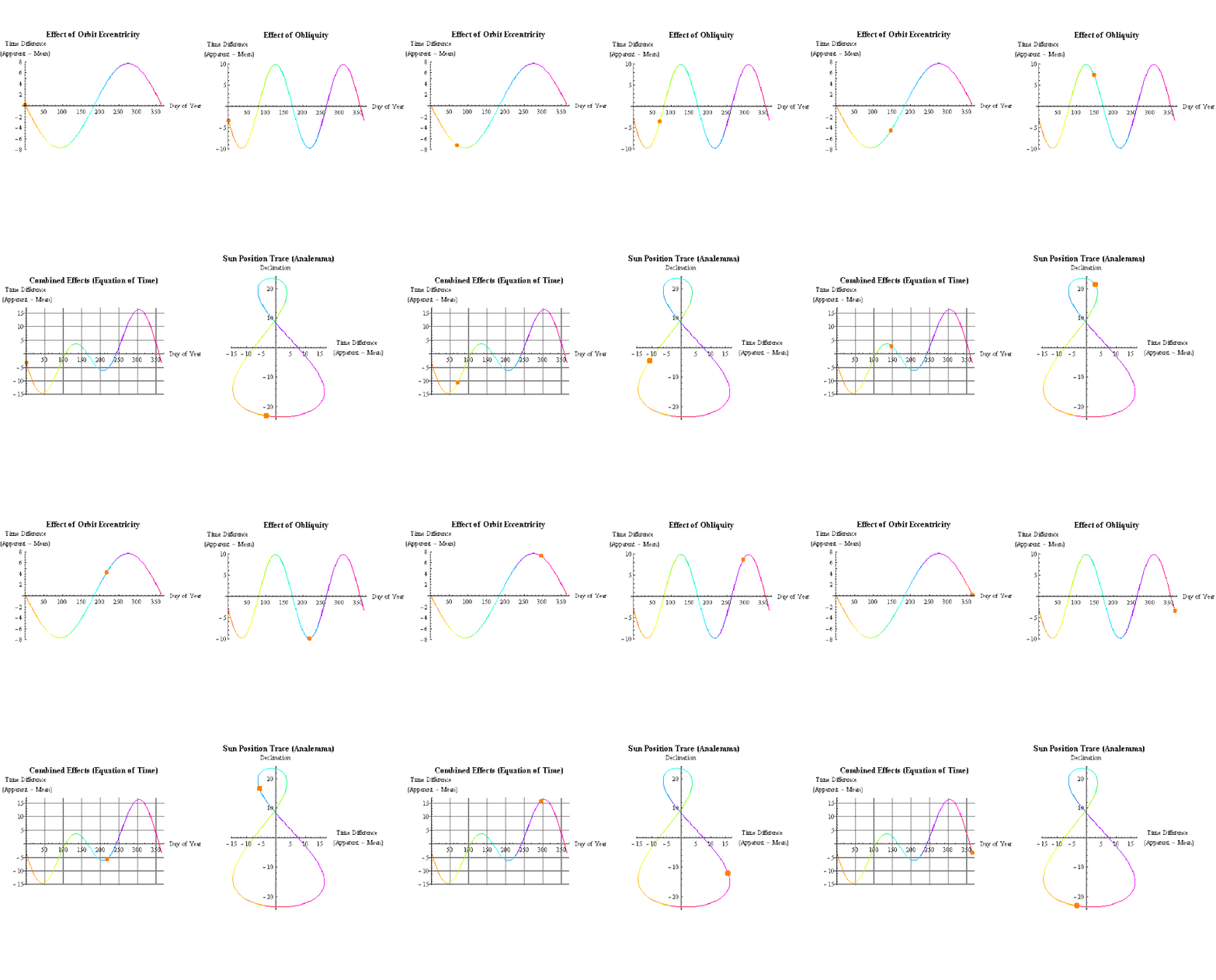
These graphs show how the earth’s orbit eccentricity and tilt of the Earth’s axis (obliquity) affect sundial time keeping vs. actual clocks. This also affects sunrise and sunset times. The figure 8 in the lower right is the analemma, sometimes seen on old Earth globes, a graphical representation of the equation of time (sundial corrections from apparent to mean solar time).
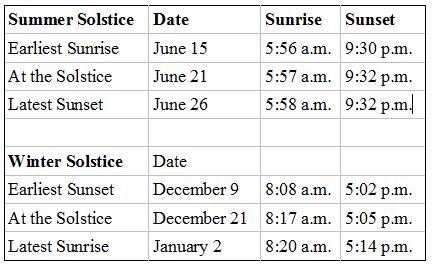
Table of Earliest and Latest Sunrises and Sunsets during the year for Interlochen/Traverse City area of Michigan. This table was created for 2017, 4 years ago. However, the instant of the summer solstice occurred just after midnight on June 21st, That instant slipped back into just before midnight in 2021. This is why we use the Gregorian calendar. The slide is corrected by having 3 out of four century years being normal years.
03/19/2021 – Ephemeris – Enjoy this last full day of winter!
This is Ephemeris for Friday, March 19th. Today the Sun will be up for 12 hours and 7 minutes, setting at 7:54, and it will rise tomorrow at 7:45. The Moon, 2 days before first quarter, will set at 2:23 tomorrow morning.
Spring is almost here. It will arrive at 5:37 tomorrow morning, so this is the last full day of winter, such as it was. That point in time and the point in the sky where the Sun crosses the celestial equator, the imaginary line in the sky above the Earth’s equator, heading northward is called the vernal equinox. Vernal means spring and equinox means equal night, meaning that day and night are equal, which they actually were last Tuesday. Since western civilization has spread south of the equator where the seasons are reversed, our Northern Hemisphere spring equinox is the Southern Hemisphere’s autumnal equinox, so to be understandable to both hemispheres we generally say March or September equinox instead.
Addendum
The Sun’s path through the sky on an equinox day from the Traverse City/Interlochen area in Michigan. The Sun is plotted every 15 minutes. This is a stereographic projection which compresses the sky near the zenith and enlarges the sky toward the horizon. Created using my LookingUp program.
02/02/2021 – Ephemeris – Happy Groundhog Day
This is Bob Moler with Ephemeris for Ground Hog Day, Tuesday, February 2nd. Today the Sun will be up for 9 hours and 53 minutes, setting at 5:53, and it will rise tomorrow at 7:59. The Moon, 2 days before last quarter, will rise at 11:48 this evening.
I’m not sure if Punxsutawney Phil will see his shadow this morning or not, but February 2nd was a special day to the ancients. It is also Candlemas day for the Catholic Church. It is also celebrated as a cross-quarter day. The middle of the season of Winter, though the exact date of the middle of winter is the 4th. And if Phil sees his shadow, and we do get 6 more weeks of winter, that’s OK too. By the calendar it is actually 6 weeks and 5 days to the vernal or spring equinox, the official end of winter. But this is northern Michigan. Of the other cross-quarter days, only one stands out today. It’s May 1st, May Day. The way this year has been going, winter has had a hard time getting started. But when it gets going… Look out!
The event times given are for the Traverse City/Interlochen area of Michigan. They may be different for your location.
Addendum

Poor Punxsutawney Phil, rousted out of his mid winter nap on a previous Groundhog Day. Phil looks kind of grumpy. I don’t blame him. Credit: http://www.fuzzytoday.com.
12/22/2020 – Ephemeris – Winter is going to be colder before it starts to warm up in a little over a month
This is Ephemeris for Tuesday, December 22nd. Today the Sun will be up for 8 hours and 48 minutes, setting at 5:05, and it will rise tomorrow at 8:18. The Moon, 1 day past first quarter, will set at 1:47 tomorrow morning.
Now that winter is here, it’s going to get snowier and colder even though the amount of heat the Northern Hemisphere gets from the Sun bottomed out yesterday. There are two consequences of the Earth’s axial tilt with regard to the Sun on the winter solstice. First, the Sun is only up 8 hours 48 minutes. Second at its highest at local noon the Sun is so low, only 22 degrees above the horizon around here that its heat is spread out over a greater area so is diluted to only 40% of the peak heat we get from the Sun at noon on the summer solstice. And on the summer solstice the Sun stays up almost six and three-quarters of an hour longer. Even though it doesn’t feel like it at our latitude winter is 4 days shorter than summer. You’ll find out why in less than two weeks.
Addendum
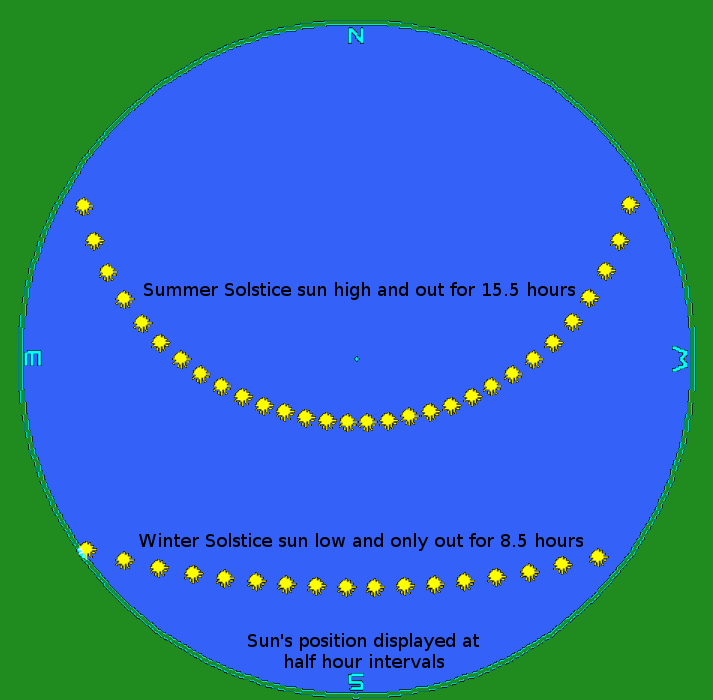
Comparing the sun’s path at the summer and winter solstices. This is a stereographic representation of the whole sky which distorts the sky and magnifies the size of the sun’s path near the horizon.
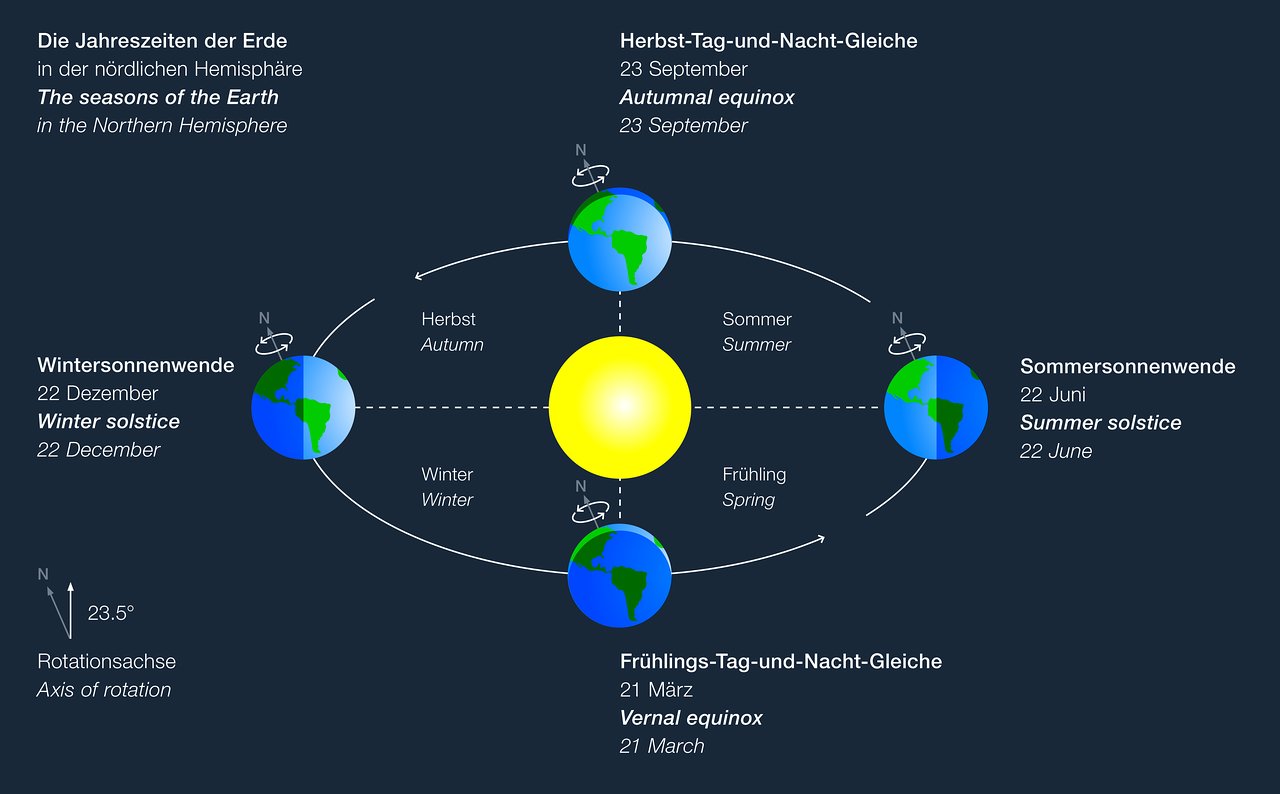
Earth’s position at the solstices and equinoxes. This is an not to scale oblique look at the Earth’s orbit, which is nearly circular. The Earth is actually farthest from the Sun on July 4th. Click on the image to enlarge. Credit: ESO (European Southern Observatory which explains the captions in German and English.
12/18/2020 – Ephemeris – Winter begins Monday morning
This is Ephemeris for Friday, December 18th. Today the Sun will be up for 8 hours and 48 minutes, setting at 5:03, and it will rise tomorrow at 8:16. The Moon, 3 days before first quarter, will set at 9:29 this evening.
Monday will host two astronomical events. The second will be the extremely close conjunction or appearing together of the planets Jupiter and Saturn, which I’ll talk about then. But first, at 5:02 Monday morning winter will begin with the winter or December solstice. The word solstice means Sun stand still. On or about December 21st, the Sun appears to stop moving southward measured at noon and will begin moving northward again. All this is the result of the Earth’s 23 ½ degree axial tilt and our motion around the Sun. Our area of the globe is now receiving less energy from the Sun to support our temperatures, and they will continue to fall for the next month or so even as the Sun rises higher and stays out longer.
The event times given are for the Traverse City/Interlochen area of Michigan. They may be different for your location.
Addendum
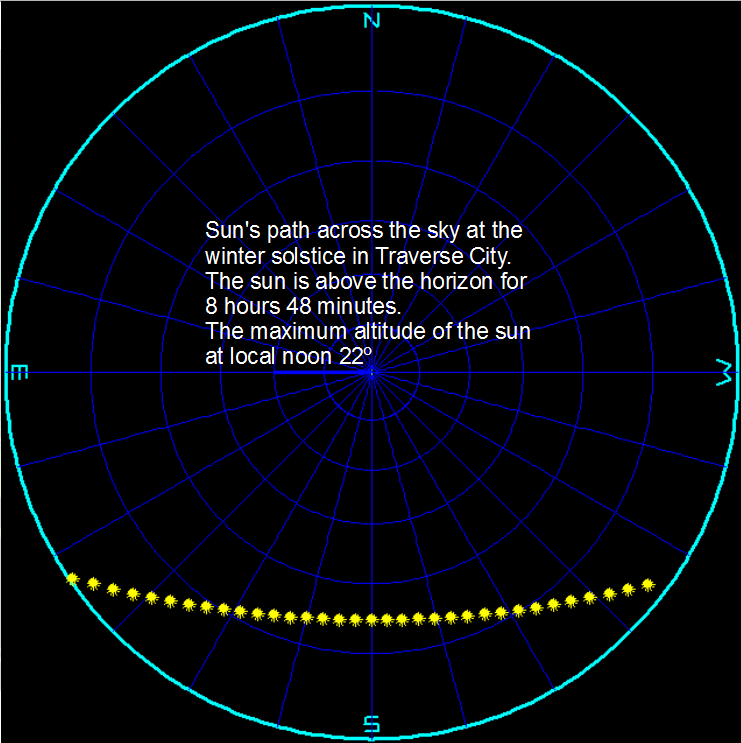
The sun’s daily path through the sky from horizon to horizon on the first day of winter, the winter solstice. Credit My LookingUp program.
09/29/2020 – Ephemeris – The Harvest Moon is in two days
This is Ephemeris for Tuesday, September 29th. Today the Sun will be up for 11 hours and 47 minutes, setting at 7:26, and it will rise tomorrow at 7:40. The Moon, 2 days before full, will set at 6:09 tomorrow morning.
This upcoming full moon is the Harvest Moon. It is the most famous of the named full moons, and was very useful in the days before electric lights. The reason is that the Moon, around the time it is full now doesn’t advance its rising time very much from night to night effectively extending the light of twilight to allow more time to gather in crops. This is because the Moon is moving north as well as eastward. The farther north it is the longer it stays up and retards the advance in rise times. On average the Moon rises 50 minutes later each night. This week the interval is down near 20 minutes advance in moonrise times per day extending twilight and the time each day to harvest the crops for a few more days.
The event times given are for the Traverse City/Interlochen area of Michigan. They may be different for your location.
Addendum
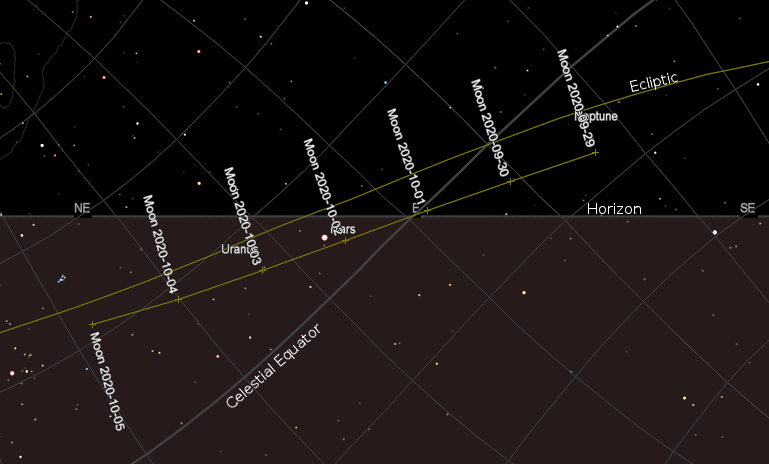
The motion of the moon from tonight through next Monday night. This is looking east at where the Moon will rise, and we’re able to see below the horizon. The celestial equator, a projection of the Earth’s equator on the sky, crosses the horizon at an angle equal to 90 minus one’s latitude. Around my location that’s 45.5 degrees. The Moon and stars will rise parallel to the celestial equator. Its daily orbital motion is at the shallow angle of 5 degrees to the ecliptic, the apparent path of the Sun. So the advance in rise times starts off at 20 minutes later each night, rather than the average 50 minutes.
09/22/2020 – Ephemeris – Autumn starts this morning
This is Bob Moler with Ephemeris for Tuesday, September 22nd. Today the Sun will be up for 12 hours and 8 minutes, setting at 7:39, and it will rise tomorrow at 7:31. The Moon, 1 day before first quarter, will set at 11:05 this evening.
Fall is about to a, well… fall upon us and in a few weeks so will the leaves. At 9:31 this morning (13:31 UTC*) the Sun will cross the celestial equator heading south. The celestial equator is an imaginary line in the sky above the earth’s equator. At that point the Sun will theoretically set at the north pole and rise at the south pole. The day is called the autumnal equinox and the daylight hours today is 12 hours and 8 minutes instead of 12 hours exactly. That’s due to our atmosphere and our definition of sunrise and sunset. The reason for the cooler weather now and the cold weather this winter is that the length of daylight is shortening, and the Sun rides lower in the sky, spreading its heat over a larger area, thus diluting its intensity.
The event times given are for the Traverse City/Interlochen area of Michigan. They may be different for your location.
Addendum
* UTC – Coordinated Universal Time. Greenwich Mean Time if you haven’t kept up. Zulu if you’re in the military.
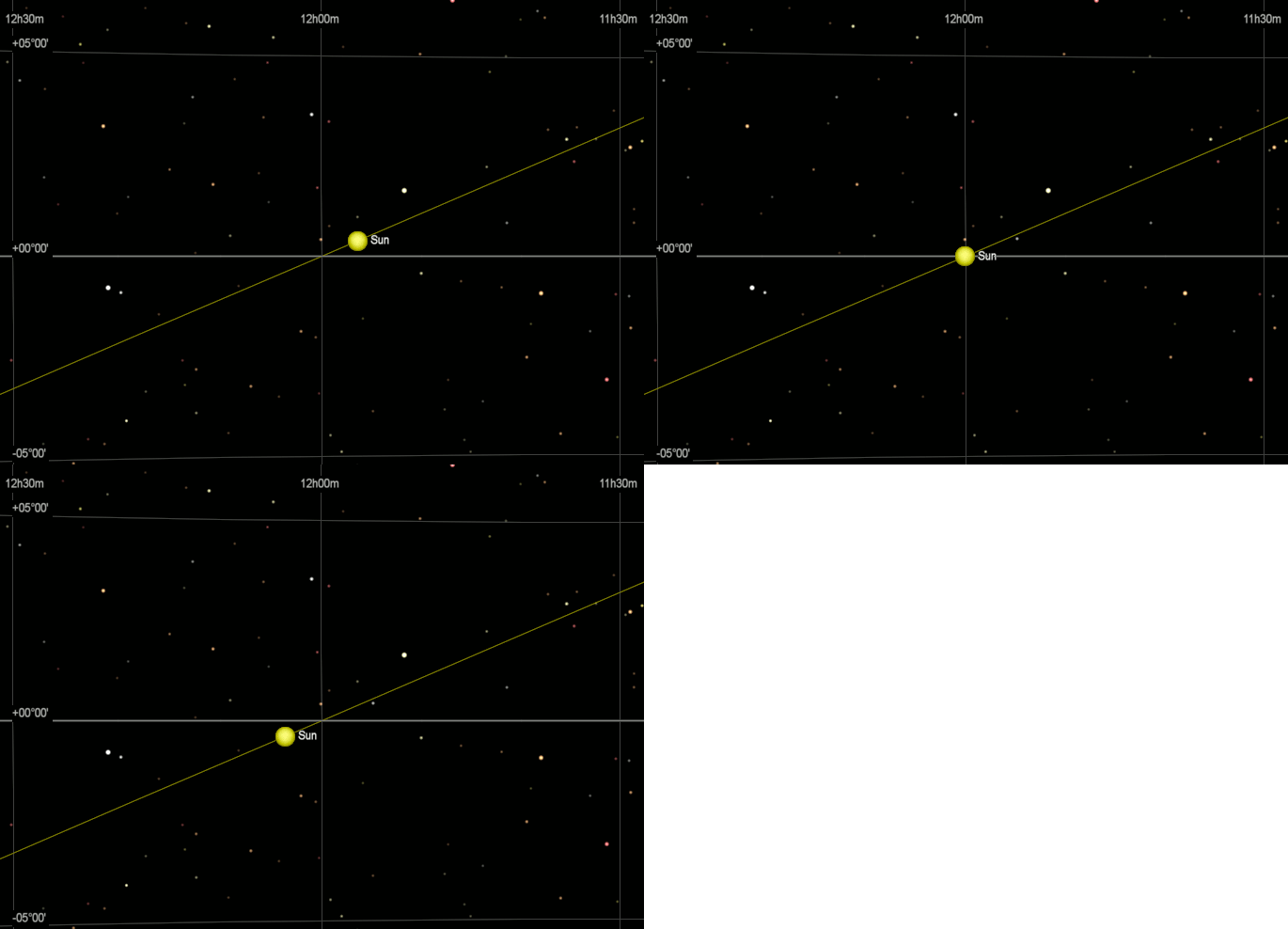
The Sun crossing the celestial equator in three steps: 9:31 am Sept 21, 22, and 23 2020. Created using Stellarium and GIMP.
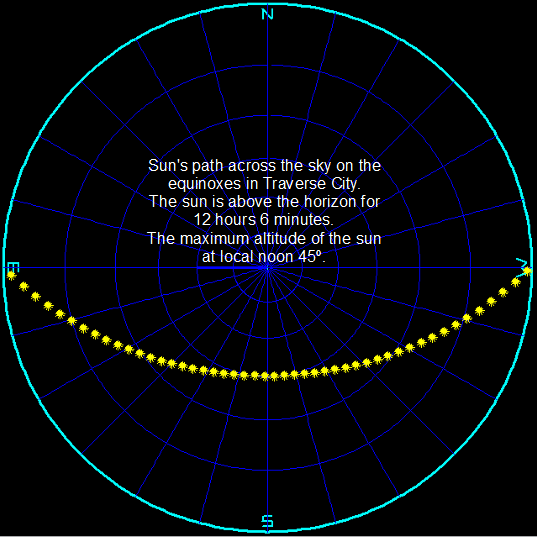
The Sun’s path through the sky on the equinox day from Traverse City, MI. Created using my LookingUp program.
That is not a pumpkin on the head of the motorcyclist. That’s the Sun rising as I’m traveling east on South Airport Road south of Traverse City Mi. on the autumnal equinox. This is the east-west section of the road. The Sun is rising over the hills some 6 miles to the east. Credit: Bob Moler.
09/21/2020 – Ephemeris – This is the last full day of summer
This is Ephemeris for Monday, September 21st. Today the Sun will be up for 12 hours and 11 minutes, setting at 7:41, and it will rise tomorrow at 7:30. The Moon, 2 days before first quarter, will set at 10:24 this evening.
Enjoy the last full day of summer. Summer will last until 9:31 am (05:31 UTC) tomorrow when the center of the Sun will cross the celestial equator, an imaginary line above the Earth’s equator, heading southward. At that instant autumn will begin for Earth’s northern hemisphere and spring will begin in the southern hemisphere. Shortly, for us, the Sun will be up less than half the day. The day and the point in the sky that the Sun crosses is called the autumnal or September equinox. The word equinox means equal night, implying the equality of day and night. Geometrically that’s true, but the Earth’s atmosphere and the definition of sunrise and sunset, prolong daylight by a few more minutes. The amount of heat we are getting and will get from the Sun cannot sustain our current temperatures, and it will get a lot colder on average before it gets warmer again.
The event times given are for the Traverse City/Interlochen area of Michigan. They may be different for your location.
Addendum
The Sun crossing the celestial equator in the sky moving southward in three steps: 9:31 am Sept 21, 22, and 23 2020. The vertical axis is declination, the exact match to latitude on the Earth. The horizontal line at 00°00′ is the celestial equator, a projection of the Earth’s equator on the sky. The diagonal line that the Sun appears to travel on is the ecliptic, the plane of the Earth’s orbit. Due to the tilt of the Earth’s axis it is inclined by 23.5° to the celestial equator. The horizontal values mark right ascension, the celestial analog of longitude. One hour equals 15°. Since the Earth rotates, the right ascension that is on one’s meridian, the north-south line passing through the zenith, is best kept track of by using a clock. A clock that runs 3 minutes 56 seconds fast a day. We call that a sidereal clock. Created using Cartes du Ciel (Sky Chart) and GIMP.
 Bob Moler's Ephemeris Blog