Archive
12/16/2022 – Ephemeris – The Anishinaabe constellation of Winter Maker announces the coming of winter
This is Ephemeris for Friday, December 16th. Today the Sun will be up for 8 hours and 49 minutes, setting at 5:03, and it will rise tomorrow at 8:14. The Moon, at last quarter today, will rise at 1:22 tomorrow morning. | The native peoples of the Great Lakes area are the Anishinaabe, composed of the Odawa or Ottawa, and Chippewa or Ojibwe tribes. One of their great constellations is the Winter Maker, whose central part we know as Orion. Instead of turning to face the charge of Taurus the bull, holds his arms outstretched to embrace all the winter stars. His rising in November foretells the coming of winter. His name in their Anishinaabemowin language means North Wind. Now that winter is almost here, he is moving to the southern part of the sky in the evening to reign over the brilliant stars of winter. The star we call Sirius, the brightest nighttime star, is called Gizhii’anung. Anung means “star”.
The astronomical event times given are for the Traverse City/Interlochen area of Michigan (EST, UT –5 hours). They may be different for your location.
Addendum
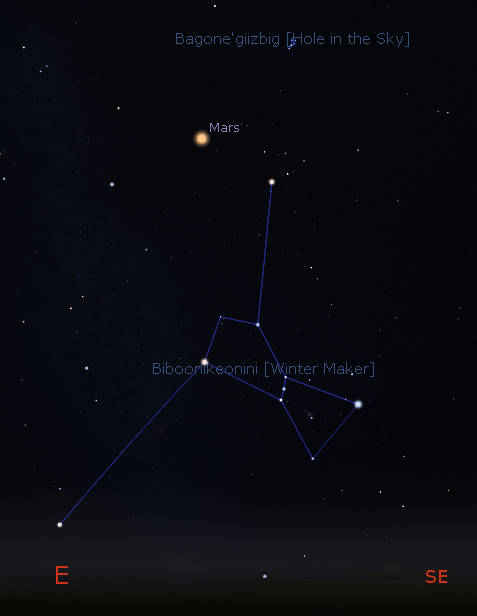
The Anishinaabe constellation of the Winter Maker, whose arms will encompass the rest of the winter stars, once they rise later in the evening. Also shown is the Hole in the Sky, which we know as the Pleiades.
12/08/2022 – Ephemeris – Tonight’s full-ish Moon is near where the June solstice Sun was
This is Ephemeris for Thursday, December 8th. Today the Sun will be up for 8 hours and 54 minutes, setting at 5:02, and it will rise tomorrow at 8:08. The Moon, 1 day past full, will rise at 5:10 this evening.
The bright Moon near full in December rises very high in the south around midnight to 1 am. It is near where the Sun is at the summer solstice. Actually, tonight it is to the lower right of the constellation of Gemini, and to give a topical reference. Tonight, the Moon appears as a soccer ball being kicked by Castor, one of the twins. It’s right off the toe of his foot. In June, the Sun and Full Moon’s positions are reversed. The Sun rises very high in the southern sky at local noon, while the full moon stays low in the south. Or Moon is odd in that respect, Most large satellites of the other planets orbit over their primary’s equator. Our Moon’s orbit is aligned to about 5 degrees off Earth’s own orbit of the Sun, which is angled at 23 and a half degrees from Earth’s equator.
The astronomical event times given are for the Traverse City/Interlochen area of Michigan (EST, UT –5 hours). They may be different for your location.
Addendum
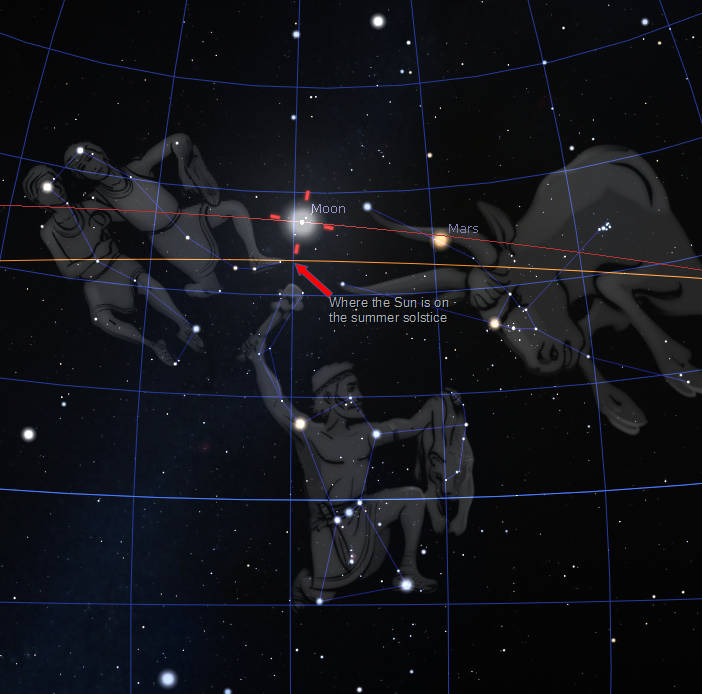
The Moon near the summer solstice point overnight tonight at 1:15 am (the 9th). The sky is overlaid with the equatorial grid. The bright blue line that runs just above Orion’s belt is the celestial equator. The declination lines match Earth’s latitude lines are 10 degrees apart. The vertical blue lines are right ascension lines, like earthly longitude lines, and are 15 degrees apart. Each one represents one hour. The orange line is the ecliptic, the path of the Sun in the sky, also the plane of the Earth’s orbit. The red line is the Moon’s orbit, which is inclined by about 5 degrees to the ecliptic. Click on the image to enlarge it. Created using Stellarium and LibreOffice Draw.
11/03/2022 – Ephemeris – The Persephone Period
This is Ephemeris for Thursday, November 3rd. The Sun will rise at 8:23. It’ll be up for 10 hours and 5 minutes, setting at 6:28. The Moon, 2 days past first quarter, will set at 3:53 tomorrow morning.
The Moon, tonight, is spending its second night between Saturn and Jupiter. Tomorrow night will find it just above Jupiter. Down in our area, the Persephone period is starting. I didn’t find out about this until recently. According to Greek myth, Persephone, daughter of Zeus and Demeter, was abducted by her uncle the god Hades to be made his queen of the underworld. When she was in the underworld, the crops died. An arrangement had to be made by her father Zeus, so she would spend part of the year above ground, so that crops would flourish, and part of the year below. When the daylight hours drop below 10 hours, which it is doing in our area now, we are entering the Persephone period, where there is too little sunlight for plants to thrive. This period will last until around February 5th. When daylight hours advance past 10 hours.
The astronomical event times given are for the Traverse City/Interlochen area of Michigan (EDT, UT – 4 hours). They may be different for your location.
Addendum
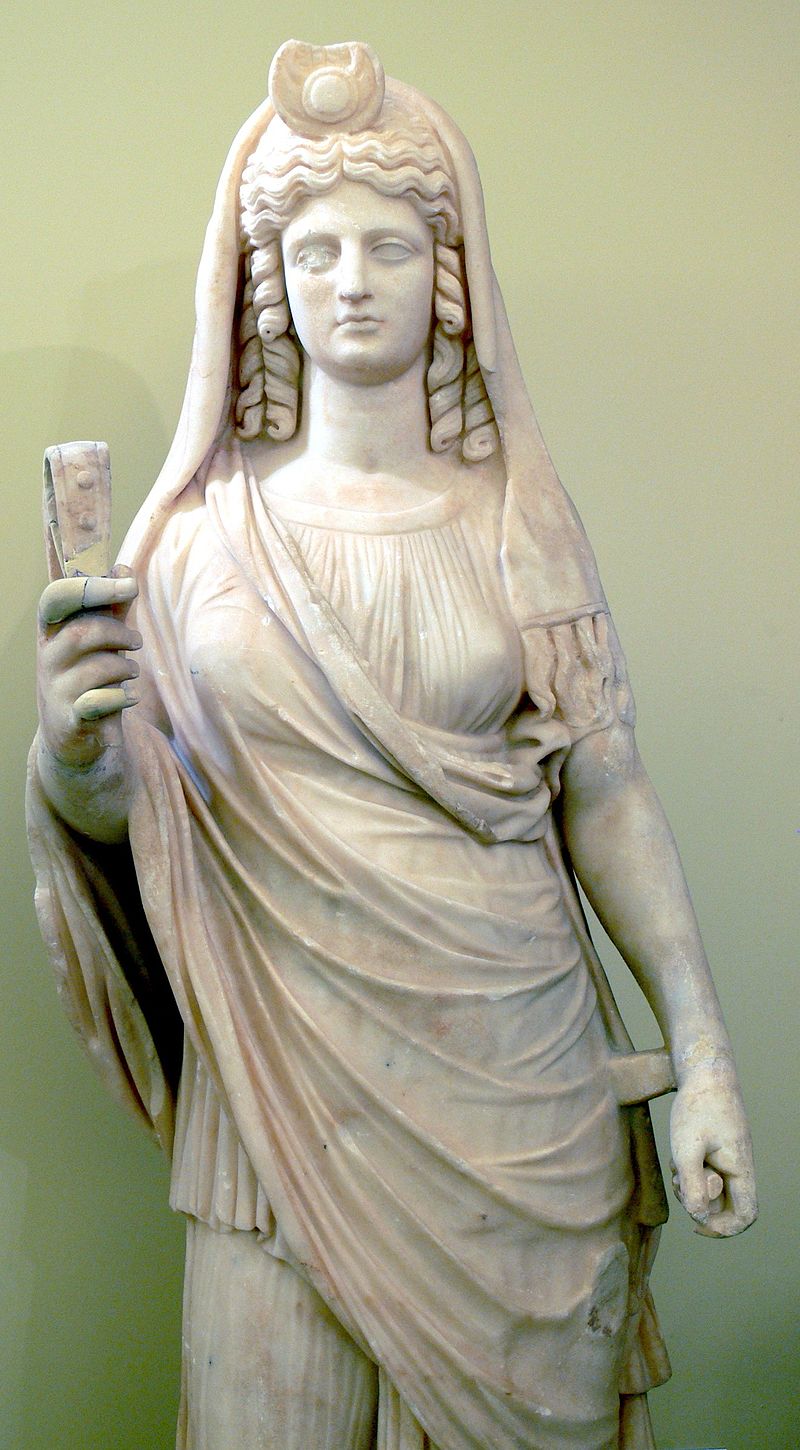
Statue of Persephone-Isis at the Heraklion Archaeological Museum, Crete. Credit: Wolfgang Sauber
Around here, in the Grand Traverse Region of Michigan, and indeed the whole state, the Persephone period generally starts after the first killing frost, though this year only the tenderest plants have succumbed to whatever frost there was so far at my place. Daytime temperatures this week have reached the high 60s, which is unusual. The end of the Persephone period comes way early for us. Snow could persist for another two and a half months.
09/22/2022 – Ephemeris – Autumn will begin this evening
This is Ephemeris for Thursday, September 22nd. Today the Sun will be up for 12 hours and 10 minutes, setting at 7:40, and it will rise tomorrow at 7:31. The Moon, 3 days before new, will rise at 4:46 tomorrow morning.
The season of fall is about to, ah well, fall upon us and in a few weeks so will the leaves. At 9:04 this evening (1:04 UT tomorrow) the Sun will cross the celestial equator heading south. The celestial equator is an imaginary line in the sky above the earth’s equator. At that point, the Sun will theoretically set at the North Pole and rise at the South Pole. The day is called the autumnal equinox and the daylight hours today is 12 hours and 10 minutes instead of 12 hours exactly. That’s due to our atmosphere and our definition of sunrise and sunset. The reason for the cooler weather now and the cold weather this winter is that the length of daylight is shortening, and the Sun rides lower in the sky, spreading its heat over a larger area, thus diluting its intensity.
The astronomical event times given are for the Traverse City/Interlochen area of Michigan (EDT, UT – 4 hours). They may be different for your location.
Addendum
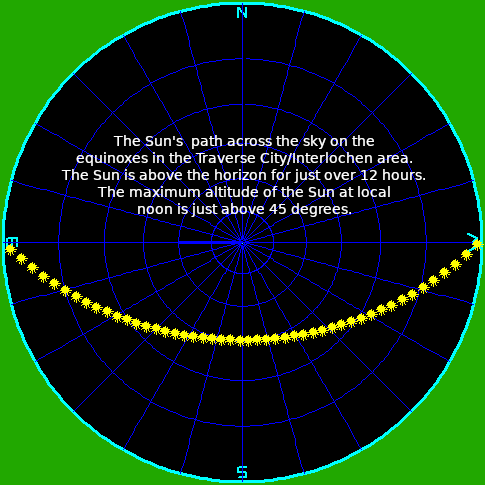
The Sun’s path through the sky on an equinox day from the Traverse City/Interlochen area in Michigan. The Sun is plotted every 15 minutes. This is a stereographic projection which compresses the image near the zenith and enlarges the image towards the horizon. Note that the Sun rises due east and sets due west. Created using my LookingUp program.
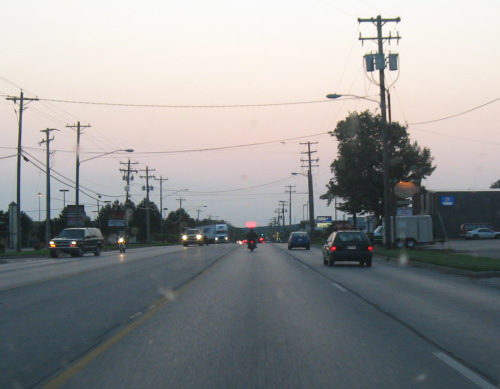
That is not a pumpkin on the head of the motorcyclist. That’s the Sun rising as I’m traveling east on South Airport Road south of Traverse City, MI on the autumnal equinox. This is the east-west section of the road. The Sun is rising over the hills some 6 miles to the east. When the Sun is on the celestial equator, it rises due east and sets due west. Credit: Bob Moler.
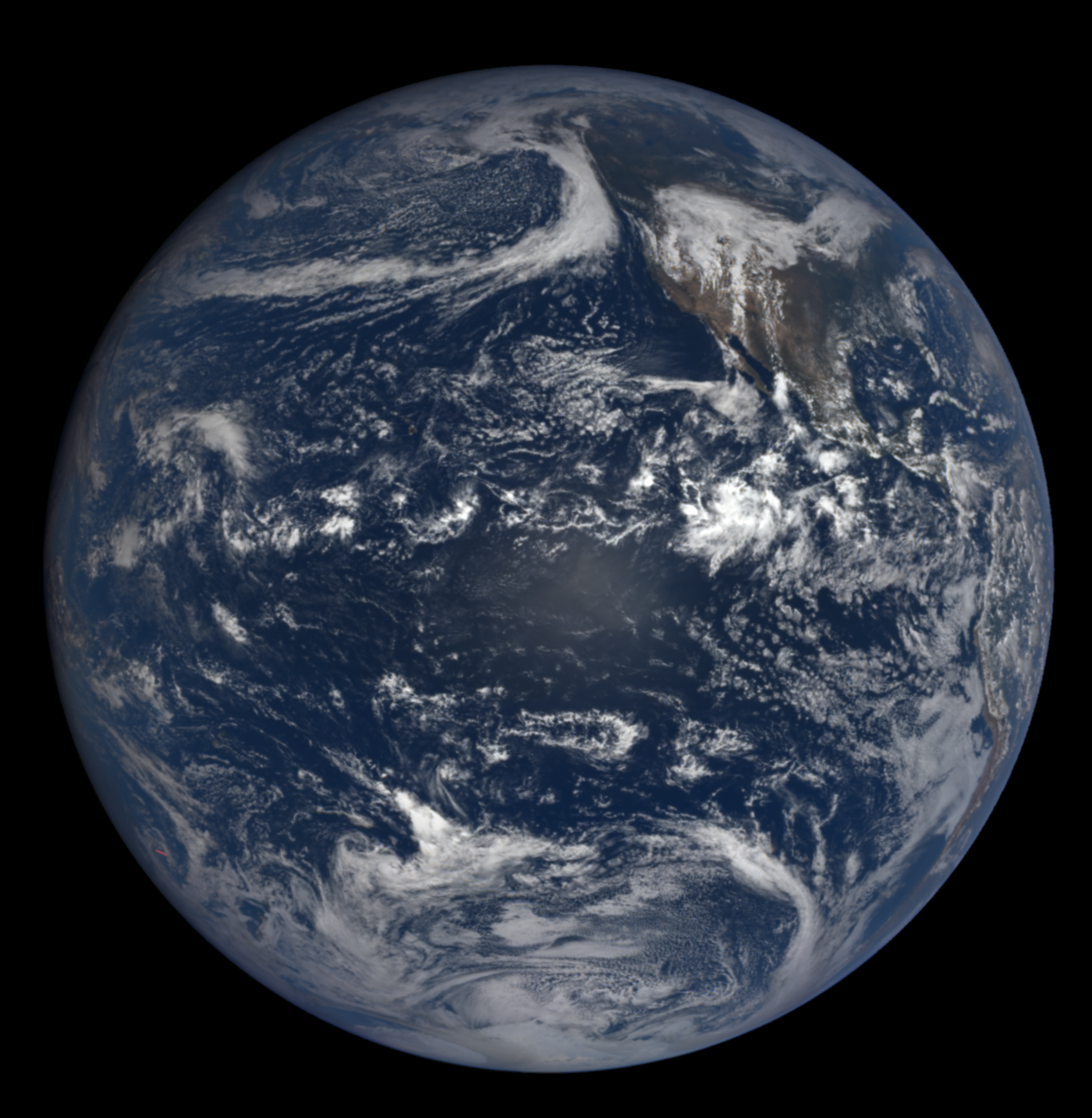
Image from the Earth Polychromatic Imaging Camera (EPIC) on NOAA’s DSCOVR satellite in halo orbit around the Earth-Sun L-1 point 1 million miles sunward from the Earth on the autumnal equinox of 2016. North America is in the upper right of the globe.
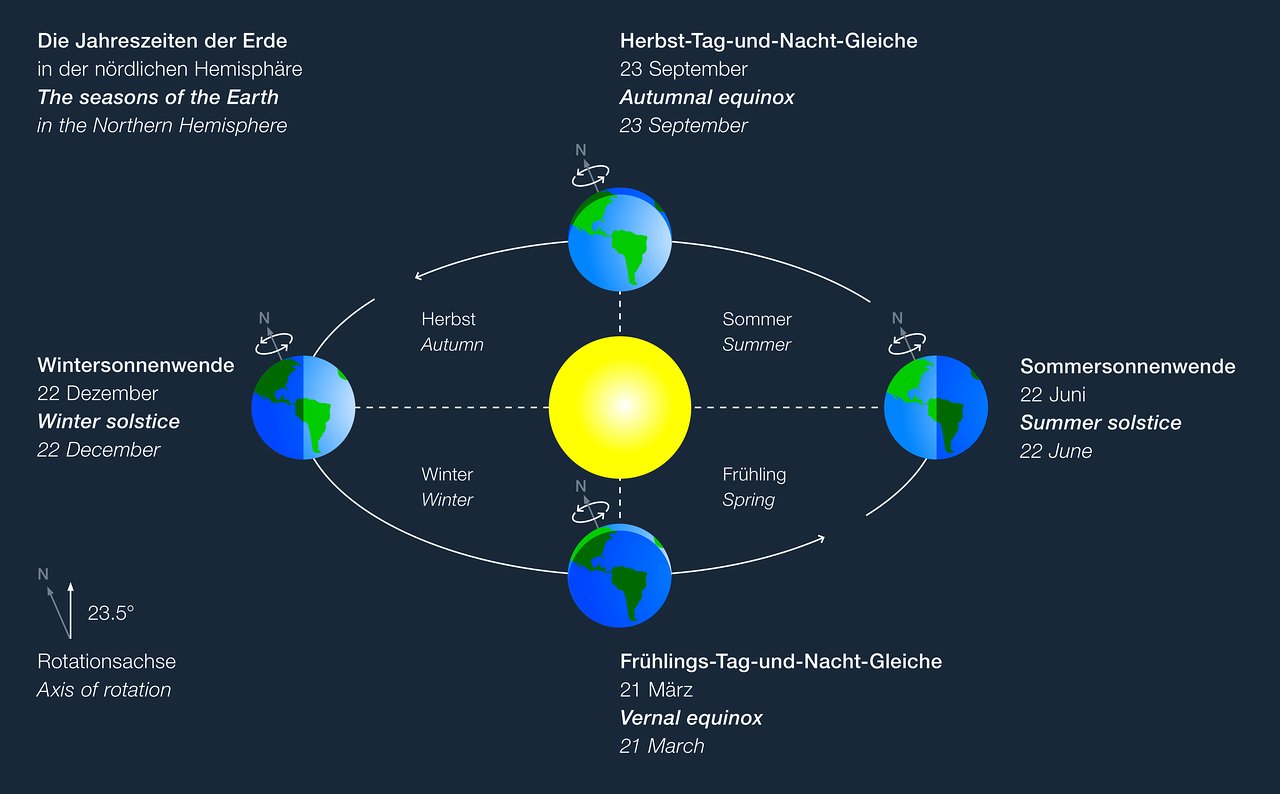
Earth’s position at the solstices and equinoxes. This is an not to scale oblique look at the Earth’s orbit, which is nearly circular. The Earth is actually farthest from the Sun on July 4th. Click on the image to enlarge. Credit: ESO (European Southern Observatory), which explains the captions in German and English.
09/08/2022 – Ephemeris – We are going to have an early Harvest Moon this year
This is Bob Moler with Ephemeris for Thursday, September 8th. Today the Sun will be up for 12 hours and 53 minutes, setting at 8:06, and it will rise tomorrow at 7:14. The Moon, 2 days before full, will set at 5:54 tomorrow morning.
We are going to have an early Harvest Moon this year, on the early morning of Saturday the 10th, this Saturday coming up. The Harvest Moon is the closest full moon to the autumnal equinox, which is on the 22nd. The earliest a Harvest Moon can fall is on the 8th of September. The reason that the Harvest Moon is so famous is that at sunset the Moon’s path, in the sky, is shallow to the horizon. So it rises much less than its average 50 minutes later each night. This effectively lengthens the amount of useful twilight, allowing more time to harvest the crops. It compensated for the rapid retreat of the daylight hours this time of year. It’s not so important now, but back before electric lights it definitely was.
The astronomical event times given are for the Traverse City/Interlochen area of Michigan (EDT, UT – 4 hours). They may be different for your location.
Addendum
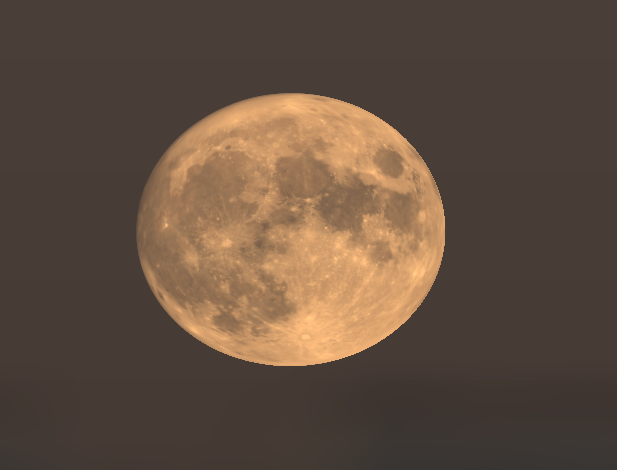
The Harvest Moon rising as seen in Stellarium. The planetarium program Stellarium, which I use a lot, also colors the rising and setting Moon and Sun. It also reproduces the effect of atmospheric refraction, which makes objects close to the horizon look higher than they are. Thus, extended objects close to the horizon appear squashed a bit vertically.
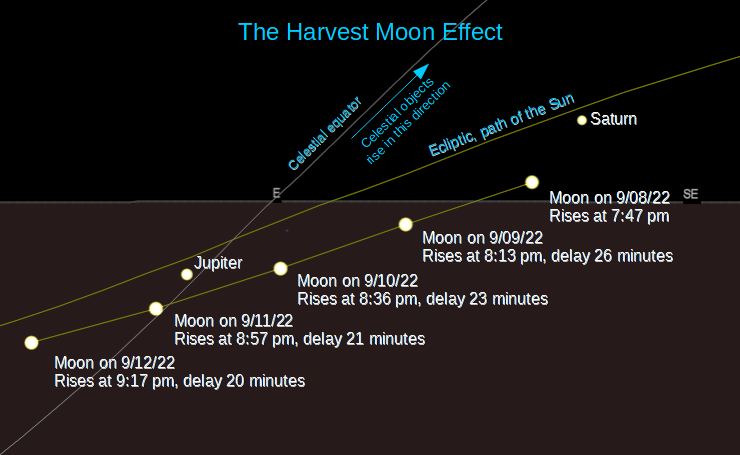
The Harvest Moon effect is a phenomenon where the Moon’s nightly advance in rising times become much shorter than the average 50 minutes. This has the effect of extending the bright part of twilight for up to a week near the Harvest Moon. Complicating effects this year are the fact that the Harvest Moon is a supermoon, being a bit brighter than normal, and also moving faster than normal, negating the harvest moon effect somewhat. The Moon’s perigee was on the 7th, so the Moon is slowing down*, which shows in the delay numbers. Also helping to shorten the delay is that the path of the Moon is a bit shallower than the ecliptic. The Moon is south of the ecliptic, heading northward to its ascending node.
The Moon moves fastest in its orbit at perigee, and its slowest at apogee, at its farthest from the Earth.
09/05/2022 – Ephemeris – It’s Labor Day, the unofficial end of summer
This is Ephemeris for Labor Day, Monday, September 5th. Today the Sun will be up for 13 hours and 2 minutes, setting at 8:12, and it will rise tomorrow at 7:11. The Moon, 2 days past first quarter, will set at 1:55 tomorrow morning.
Even though we have 17 more days officially, of summer, according to the actual seasons, today seems like it, the end of summer. Summer seems to be defined or confined to between the time that the kids get out of school, to Labor Day. Schools in many locales have been back for almost two weeks now. As far as the summer sky goes, the summer Milky Way will stick around until October, until we lose the Teapot of Sagittarius over the southwestern horizon. The Summer Triangle of bright summer stars, won’t leave the sky until December, as they move ever westward. However, in the east the autumn stars are even now rising, pushing the Milky Way to the west. The predawn sky is already featuring the winter stars.
The astronomical event times given are for the Traverse City/Interlochen area of Michigan (EDT, UT – 4 hours). They may be different for your location.
Addendum
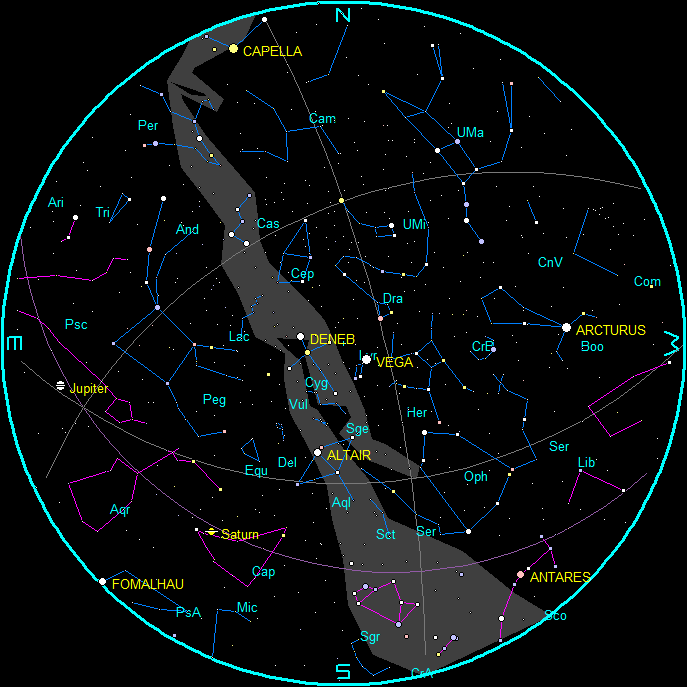
The constellations of Labor Day Evening, September 5, 2022, at 10 pm, around 2 hours after sunset. Note that the Summer Triangle Stars of Vega, Altair and Deneb are overhead. Click on the chart to enlarge it. Credit: my App LookingUp. I only allowed 8 character star names, so Fomalhaut shows up as Fomalhau.
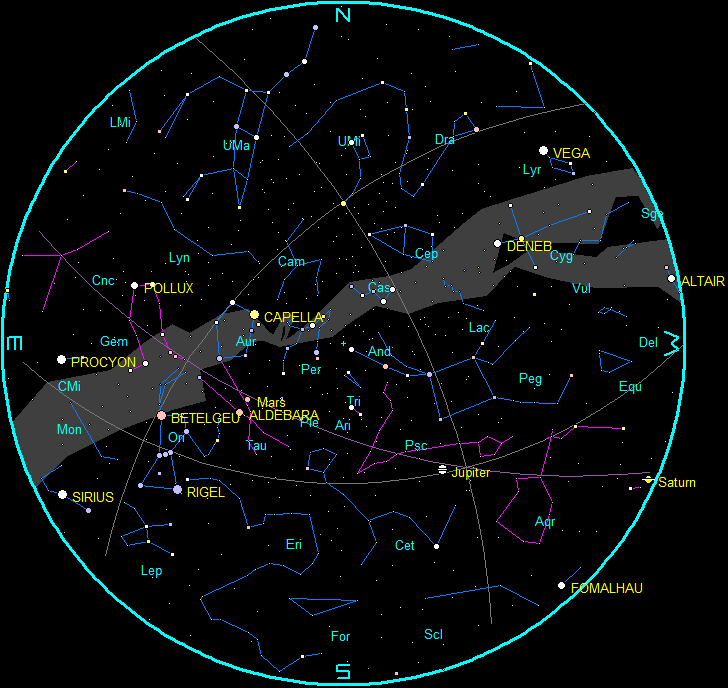
The constellations of the day after Labor Day morning, September 6, 2022, at 5 am, around 2 hours before sunrise. Note that the Summer Triangle Stars are setting in the northwest. All the brightest winter stars are now up, and constellations, except for the southern half of Canis Major, of which Sirius is a part. This is equivalent to an evening in mid-December, except the planets Mars, Jupiter and Saturn will have moved a bit. Click on the chart to enlarge it. Again, some of the star names have been truncated: Fomalhaut, Aldebaran, and Betelgeuse. Credit: my App LookingUp.
For a list of constellation names to go with the abbreviations, click here.
06/21/2022 – Ephemeris – Summer arrives today!
This is Ephemeris for Tuesday, June 21st. Today the Sun will be up for 15 hours and 34 minutes, setting at 9:32, and it will rise tomorrow at 5:57. The Moon, 1 day past last quarter, will rise at 2:28 tomorrow morning.
Summer arrived at 5:14 this morning (9:14 UT). In all the excitement, I forgot to mention that the waning Moon is passing the long line of planets in the morning. Tomorrow morning, it will be nearing Mars. Today, the Sun will be out a bit over 15 ½ hours for us in the Interlochen/Traverse City area. Also, the Sun will reach up to nearly 67 degrees altitude above the southern horizon at local noon, that’s 1:44 pm. We are now climbing down from those extreme values, at first slowly, but with increasing rapidity as summer goes on. However, the Northern Hemisphere is continuing to warm up. Our warmest average temperatures tend to be near the end of July. What’s really neat is, that the Earth is farther from the Sun than it was six months ago as winter started.
The astronomical event times given are for the Traverse City/Interlochen area of Michigan (EDT, UT – 4 hours). They may be different for your location.
Addendum
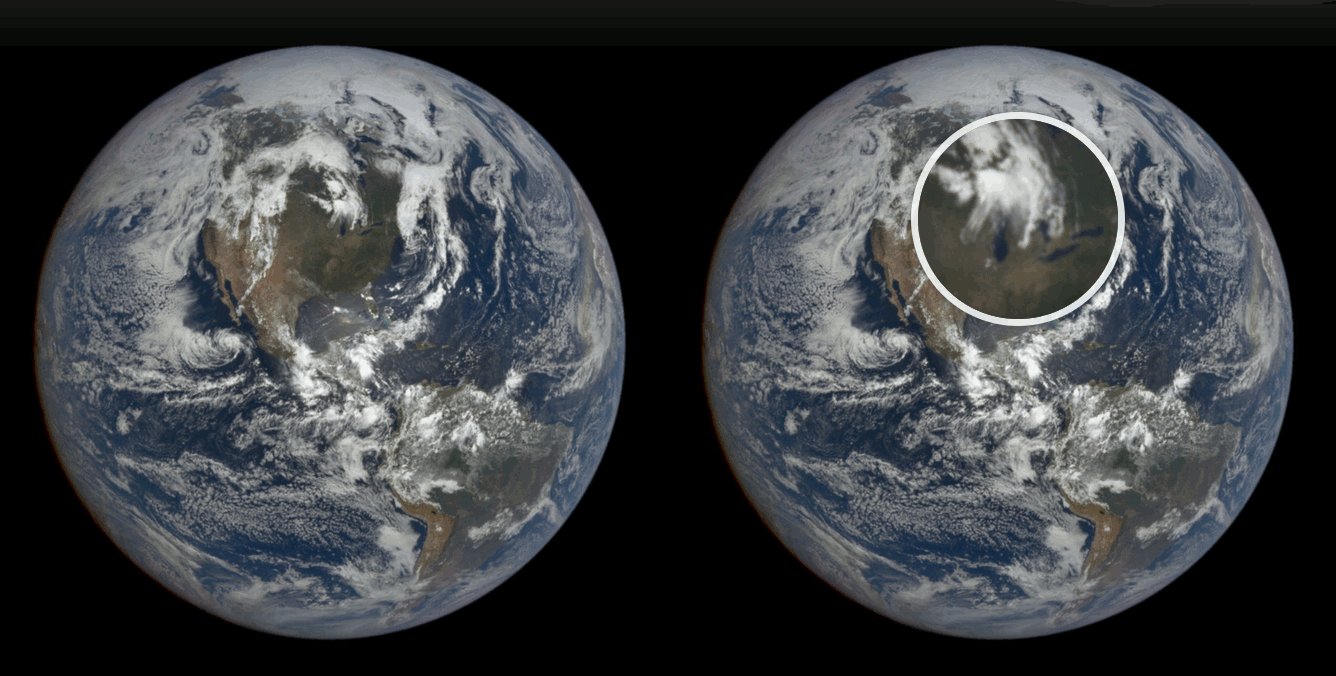
DSCOVR image of Earth near summer solstice with magnified Michigan animation. Most of Michigan’n mitt is obscured in the north where I’m located, plus the Upper Peninsula. Image taken 1:26 pm EDT, June 19, 2022. Credit NASA/NOAA DSCOVR satellite in halo orbit of Sun-Earth L1 Lagrange Point.
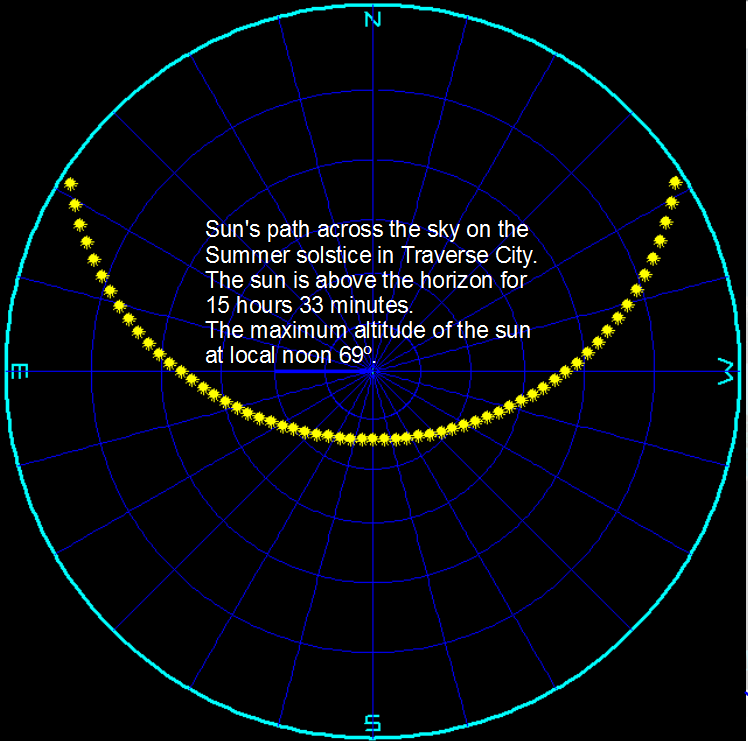
The sun’s daily path through the sky from horizon to horizon on the first day of summer, the summer solstice. Credit My LookingUp program.
06/20/2022 – Ephemeris – Here we are at the last full day of spring
This is Ephemeris for Juneteenth, Observed, Monday, June 20th. Today the Sun will be up for 15 hours and 34 minutes, setting at 9:31, and it will rise tomorrow at 5:57. The Moon, at last quarter today, will rise at 2:09 tomorrow morning.
Here we are at the last full day of spring. Summer will begin at 5:14 EDT, or 9:14 UT tomorrow morning, when the Sun reaches its highest point on the celestial sphere, and directly over the northern latitude line called the Tropic of Cancer. At that time, folks at or north of the Arctic Circle at about 66 ½ degrees north latitude won’t see the Sun set. As it is, Interlochen is only about 4 degrees latitude south of the land of the all night twilight. It’s neat, around here in the western part of the Lower Michigan, to go out around midnight and see a bit of the last twilight glow near the north. Remember that around here, local or astronomical midnight occurs around 1:45 am. Ah politicians, aren’t they wonderful. And they’ve just made Daylight Saving Time permanent.
The astronomical event times given are for the Traverse City/Interlochen area of Michigan (EDT, UT – 4 hours). They may be different for your location.
Addendum
The event at 5:14 am EDT or 9:14 UT is called the summer solstice, or in deference to our Southern Hemisphere neighbors, the June solstice, because for them winter is starting. Solstice means “Sun stands still”. It doesn’t, of course. The sun is always moving eastward against the stars. However, if one checks the altitude of the Sun in the south at local noon each day, the Sun would move higher each day since the winter solstice until around June 21st, and go no further. It would slowly begin a retreat, day by day. That pause at the highest point is the solstice.
01/31/2022 – Ephemeris – The winter circle of bright stars
This is Ephemeris for Monday, January 31st. Today the Sun will be up for 9 hours and 47 minutes, setting at 5:50, and it will rise tomorrow at 8:01. The Moon, 1 day before new, will rise at 8:48 tomorrow morning.
The winter skies are blessed with more first magnitude stars than any other season. Six of these stars lie in a large circle centered on the seventh, It’s called the Winter Circle. This circle is up in the evening. Starting high overhead is yellow Capella in Auriga the charioteer. Moving down clockwise is orange Aldebaran in the face of Taurus the Bull. Then down to Orion’s knee, we find blue-white Rigel. Down and left is the brightest star of all the brilliant white Sirius the Dog Star in Canis Major, lowest of these stars in the south-southeast. Moving up and left is white Procyon in Canis Minor, Above Procyon is Pollux in Gemini, the twins. All these are not quite centered on Betelgeuse, the bright red star in Orion’s shoulder.
The astronomical event times given are for the Traverse City/Interlochen area of Michigan (EST, UT – 5 hours). They may be different for your location.
Addendum
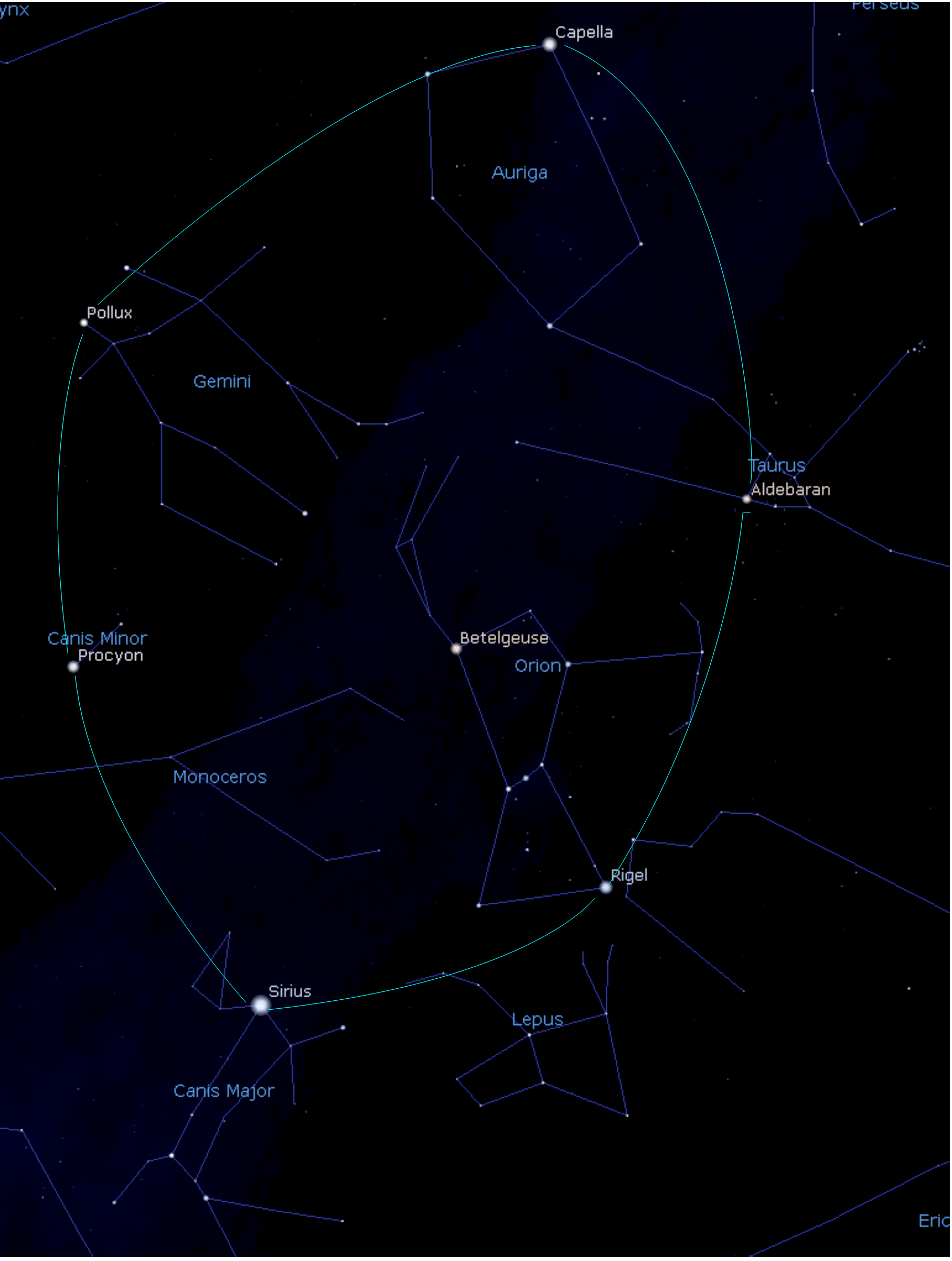
The bright stars of winter arrayed in a not so accurate circle. Some call it the Winter Hexagon. These stars are what make the winter sky so brilliant on the rare clear night in winter. Created using Stellarium.
01/03/2022 – Ephemeris – We’re the closest we get to the Sun of the whole year today
This is Bob Moler with Ephemeris for Monday, January 3rd, 2022. The Sun will rise at 8:20. It’ll be up for 8 hours and 54 minutes, setting at 5:14. The Moon, 1 day past new, will set at 6:14 this evening.
Today we are as close to the Sun as we’ll get for the rest of the year. The Earth will reach the perihelion point in its orbit at 7:59 this evening, at only 91.4 million miles. Since this is only a million and a half miles closer than average, it doesn’t affect the amount of heat the Earth as a whole gets from the Sun. But, since the Earth moves faster at perihelion than at any other time of the year, it makes winter the shortest season. Winter at 89 days is nearly 4 days shorter than the longest season, summer. I know, it doesn’t seem like it, but we live in Northern Michigan, and seemingly long winters come with the territory. January’s only major meteor shower, the Quadrantids, reaches peak at about 4 pm today. It reaches and falls off-peak rapidly, so we won’t have an impressive Quadrantid meteor shower this year.
The astronomical event times given are for the Traverse City/Interlochen area of Michigan (EST, UT – 5 hours). They may be different for your location.
Addendum
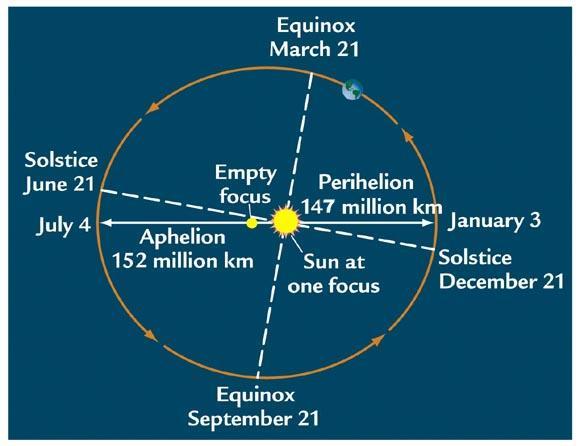
The Earth’s orbit, somewhat exaggerated, showing perihelion and the seasons. Credit: “Starts with a Bang” blog by Ethan Siegel.
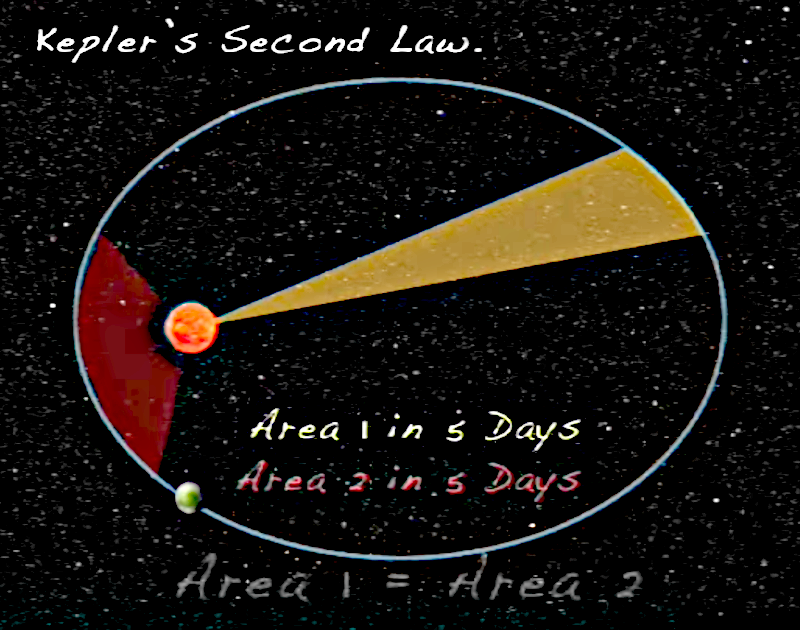
Kepler’s Second Law of Planetary Motion: the imaginary line joining a planet and the Sun sweeps equal areas of space during equal time intervals as the planet orbits. Credit: NASA, a screen capture from a video Solar Systems Dynamics-Orbits and Kepler’s Laws.
A note on the naming of the Quadrantid meteor shower. Meteor showers get their names from the constellation or nearby star where the meteor seem to come from at their peak. That point is called the radiant. The Quadrantids were named because they came from a constellation called the Mural Quadrant, back when the shower was discovered. The Mural Quadrant didn’t make the modern list of 88 constellations. The area where the Mural Quadrant resided is an area between northern Boötes, Draco and the handle of the Big Dipper.

