Archive
05/14/2018 – Ephemeris – Big Dipper: Pointer to the Stars
Ephemeris for Monday, May 14th. Today the Sun will be up for 14 hours and 47 minutes, setting at 9:03, and it will rise tomorrow at 6:14. The Moon, 1 day before new, will rise at 6:45 tomorrow morning.
The Big Dipper points to other stars and constellations. Right now the Big Dipper is nearly overhead. The front bowl stars point to Polaris, the North Star which never seems to move in the sky. The handle can be used to find two stars. First follow the arc of the handle away from the bowl to find the fourth brightest night-time star Arcturus in the base of the kite shaped constellation of Boötes. Straighten the arc to a spike and continue to the south and you will come to the bright blue-white star Spica in Virgo the virgin. You can remember these stars with the phrase “Follow the arc of the handle to Arcturus and then spike to Spica” or if you prefer the alternate pronunciation of the latter star “Speak to Speeka”.
The times given are for the Traverse City/Interlochen area of Michigan. They may be different for your location.
Addendum
As can be seen below, there was one pointer function that didn’t make it into the program: A leaky dipper drips on Leo.
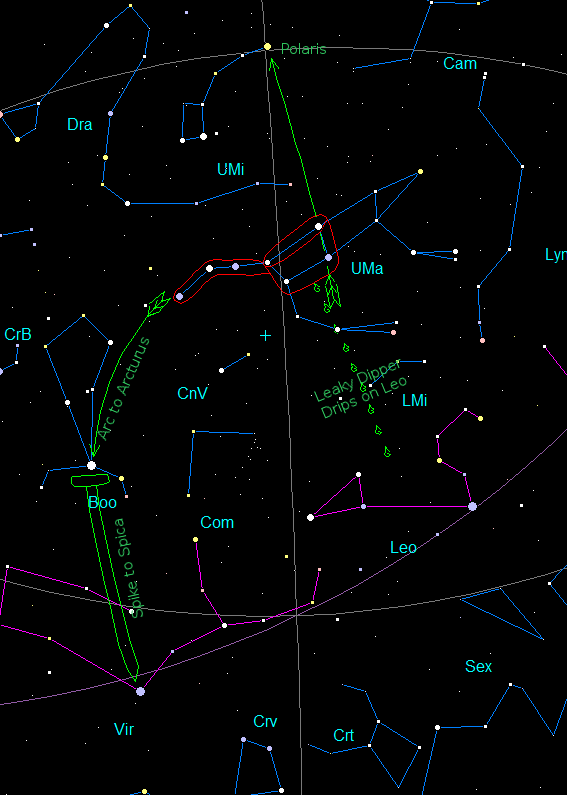
Using the Big Dipper as a pointer to other stars. The pointers to Polaris could be life saving, since it is always north. The view is southward. The cross displayed near the center is the zenith. One might want to lay down to take all this in. Created using my LookingUp program.
04/13/2018 – Ephemeris – Regulus, in Leo the lion, the “Little King” star.
Ephemeris for Friday, April 13th. The Sun will rise at 7:01. It’ll be up for 13 hours and 23 minutes, setting at 8:25. The Moon, 2 days before new, will rise at 6:42 tomorrow morning.
The brightest star in the constellation Leo, which is high in the south these evenings is Regulus, whose name means “Little King”. It is appropriate due to its position in the heart of the king of beasts Leo the lion. Regulus is dead last in brightness of the 21 first magnitude stars, the brightest night-time stars. Even so, it is much brighter than the Sun. It is 79 light years away. The Sun would require a telescope to be spotted at that distance. Regulus appears to be a quadruple star system. The bright star itself is really two stars with a bright star orbited by a much dimmer star every 40 days. There are two dimmer stars much further out that share Regulus’ motion through space. There are an infinite variety of star system arrangements in the galaxy and beyond.
The times given are for the Traverse City/Interlochen area of Michigan. They may be different for your location.
Addendum
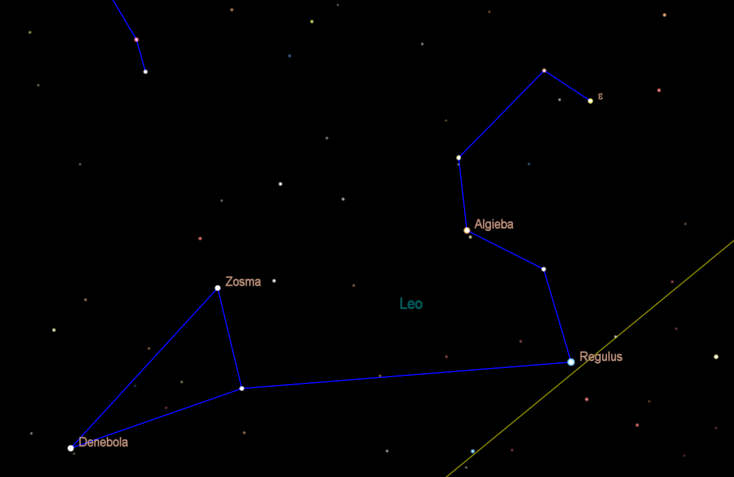
The naked eye stars of Leo, including Regulus at 10 p.m. April 13, 2018. Note that Algieba is a binary star that can be seen in small telescopes. The yellow line that passes Regulus is the ecliptic the apparent path of the Sun. The Moon and planets also hang out near that line. Created using Cartes du Ciel (Sky Charts).
Note: The original scheduled topic for today was the announcement of a star party at the Sleeping Bear Dunes National Lakeshore tomorrow, April 14th. It seems the weather gods have a different plan. There’s a winter storm watch from late Friday night (tonight) to noon Sunday with 3-6 inches of slushy snow.
04/09/2018 – Ephemeris – Follow the arc to Arcturus
Ephemeris for Monday, April 9th. The Sun will rise at 7:09. It’ll be up for 13 hours and 11 minutes, setting at 8:20. The Moon, 1 day past last quarter, will rise at 4:40 tomorrow morning.
The fourth brightest night-time star is now up in the east. It is Arcturus, a bright star with an orange hue. It can be found otherwise by finding the Big Dipper and tracing out and extending the curve of the handle and remembering the line “Follow the arc of the handle to Arcturus”. To remember the name of the star and how to find it. Arcturus is about 37 light years from us and is moving quite rapidly across the sky, compared to most stars, though one would not notice it to the naked eye in one’s lifetime. Arcturus is slightly more massive than our Sun, and about 7 billion years old, and is entering its red giant stage of life after using all the hydrogen fuel in its core. Our Sun, being slightly less massive will survive on hydrogen a bit longer.
The times given are for the Traverse City/Interlochen area of Michigan. They may be different for your location.
Addendum
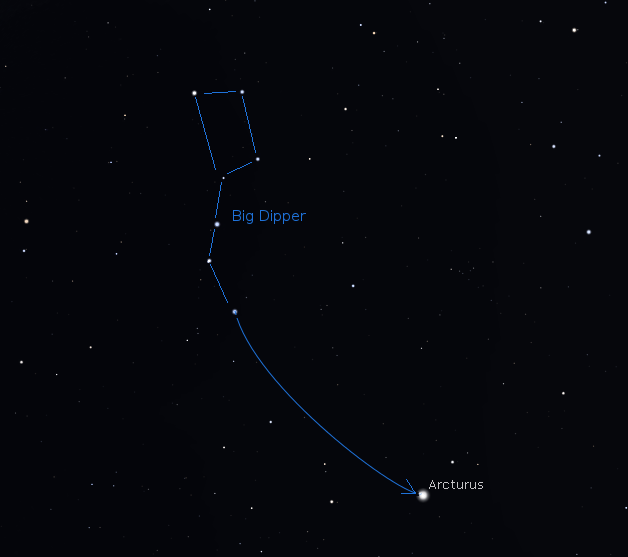
Look high in the east on a spring evening to follow the arc of the Big Dipper’s handle to Arcturus. Created using Stellarium ans GIMP.
02/13/2018 – Ephemeris – The Big Dipper as a pointer to other stars and constellations
Ephemeris for Tuesday, March 13th. The Sun will rise at 7:58. It’ll be up for 11 hours and 47 minutes, setting at 7:46. The Moon, 4 days before new, will rise at 6:42 tomorrow morning.
With the Big Dipper up in the northeastern sky it is a sign that spring is coming. At 9 p.m. The Big Dipper can be used to find other stars and constellations. The Big Dipper’s most famous function is in locating Polaris the North Star. It’s a good way of finding directions at night. The altitude of Polaris, that is angle above the horizon, will give one’s approximate latitude north of the equator. Another constellation that can be found is Leo the lion. It is rising in the east in the evening, but it can also be found from the Big Dipper by imagining that a hole were drilled in the bottom of the bowl to let the water leak out. It would fall on Leo’s back. The Big Dipper can be used to find two more stars, but they have not yet risen.
The times given are for the Traverse City/Interlochen area of Michigan. They may be different for your location.
Addendum
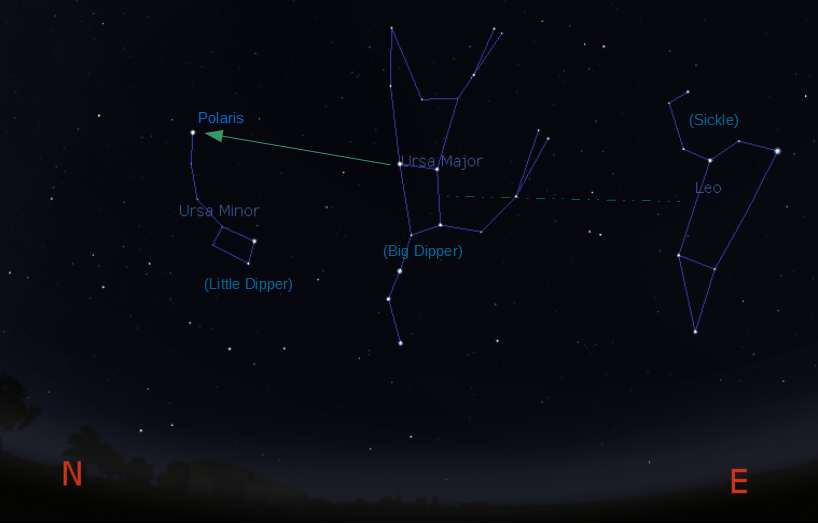
The Big Dipper points to Polaris, the, North Star, and to Leo the lion at 9 p.m., March 13th. In another hour the 4th brightest night-time star Arcturus will appear above the eastern horizon pointed to by the arc of the handle of the Big Dipper. We’ll revisit the Big Dipper next month when Arcturus and Spica will also be found by the use of the Big Dipper. Created using Stellarium and Libre Office.
02/23/2018 – Ephemeris – Meet the stars Castor and Pollux
Ephemeris for Friday, February 23rd. The Sun will rise at 7:30. It’ll be up for 10 hours and 52 minutes, setting at 6:22. The Moon, at first quarter today, will set at 2:54 tomorrow morning.
The star Pollux is at the head of the same named brother of Gemini the twins. Castor is the slightly dimmer star right above it. Pollux is about 34 light years away. It’s twice as massive as the Sun, and has run out of hydrogen in its core and is in the process of evolving into a red giant star. One planet, recently given the name Thestias, has been detected around it. Castor is at 51 light years away. There are 6 stars in its system. The brightest three are visible in telescopes. Each is a spectroscopic binary, meaning that the companion stars are detected by the Doppler shifts of the lines in their spectra as the stars orbit each other. The Doppler shift is just one of the many pieces of information revealed by the spectroscope.
The times given are for the Traverse City/Interlochen area of Michigan. They may be different for your location.
Addendum
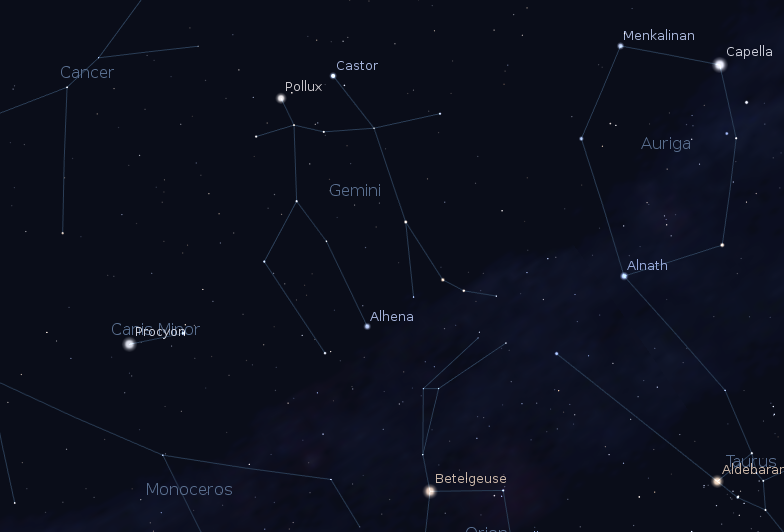
Gemini with the stars Castor and Pollux. Created using Stellarium.
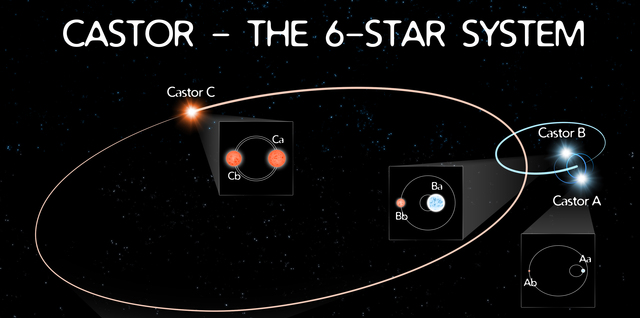
The Castor star system exploded in this JPL/NASA infographic.
02/22/2018 – Ephemeris – The blue-white star at Orion’s knee
Ephemeris for Thursday, February 22nd. The Sun will rise at 7:32. It’ll be up for 10 hours and 49 minutes, setting at 6:21. The Moon, 1 day before first quarter, will set at 1:46 tomorrow morning.
The bright star at the bottom right corner of the big upright rectangle that is the giant hunter Orion’s body in the south-southeast is Rigel. It is a white star with a bluish tinge. It compares in brightness with Betelgeuse at the opposite end of Orion’s rectangle, though it’s usually a bit brighter. The mismatch in color makes brightness comparisons difficult. Rigel is about 860 light years away, It’s 23 times the mass of the Sun, 120 thousand the times brighter than the Sun, and a diameter almost the size of the orbit of Mercury. It’s age is thought to be about 8 million years. It has a visual companion star that can be seen in amateur telescopes. It’s not that dim, but suffers by being close to the arc light brightness of Rigel.
The times given are for the Traverse City/Interlochen area of Michigan. They may be different for your location.
Addendum
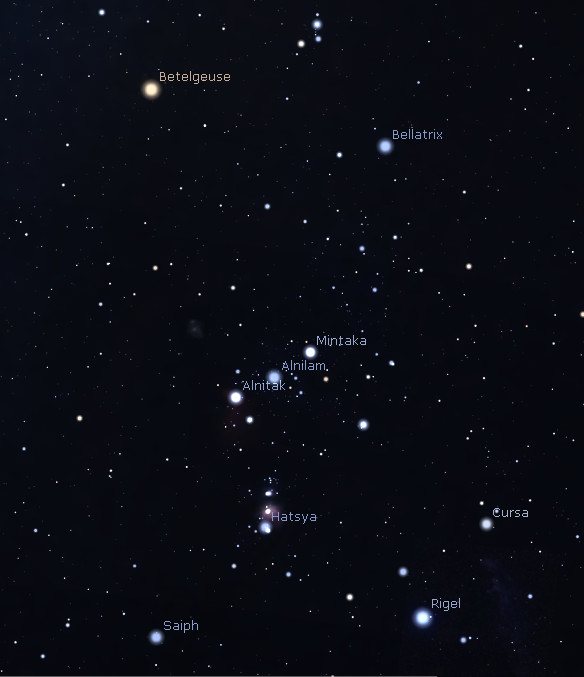
Orion’s named stars including the belt stars. Created using Stellarium.

Rigel with its companion star as photographed through a telescope. No attribution. Source: http://washedoutastronomy.com/content/urban-orion?page=1
02/12/2018 – Ephemeris – The Winter Circle
Ephemeris for Monday, February 12th. The Sun will rise at 7:47. It’ll be up for 10 hours and 19 minutes, setting at 6:07. The Moon, 3 days before new, will rise at 6:29 tomorrow morning.
The winter skies are blessed with more first magnitude stars than any other season. Six of these stars lie in a large circle centered on the seventh, It’s called the Winter Circle. This circle is up at 9 p.m. Starting high overhead is yellow Capella in Auriga the charioteer. Moving down clockwise is orange Aldebaran in the face of Taurus the Bull. Then down to Orion’s knee we find blue-white Rigel. Down and left is the brightest star of all the brilliant white Sirius the Dog Star in Canis Major, lowest of these stars in the south-southeast. Moving up and left is white Procyon in Canis Minor, Above Procyon is Pollux in Gemini the twins. All these are centered, well not quite, on Betelgeuse the bright red star in Orion’s shoulder.
The times given are for the Traverse City/Interlochen area of Michigan. They may be different for your location.
Addendum
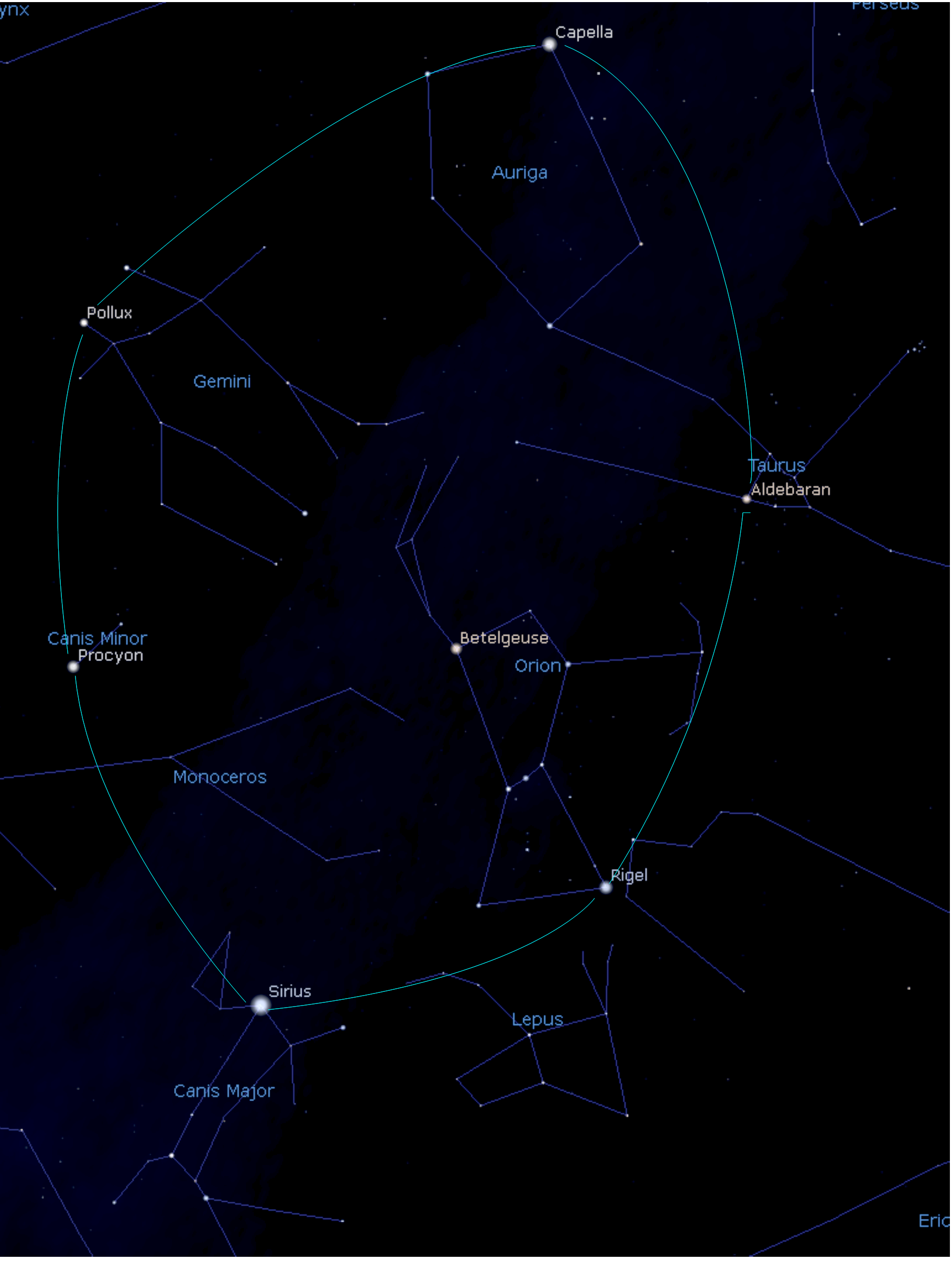
The bright stars of winter arrayed in a circle (well almost). Created using Stellarium.
01/22/2018 – Ephemeris – The Pup
Ephemeris for Monday, January 22nd. The Sun will rise at 8:11. It’ll be up for 9 hours and 25 minutes, setting at 5:37. The Moon, 2 days before first quarter, will set at 11:24 this evening.
Sirius is the brightest night-time star and is located in the southeast at 9 p.m. below and a bit left of Orion the Hunter. We’ve visited Sirius last week. There is another star in the Sirius system that is practically invisible due to its dazzling glare. It’s Sirius B, nicknamed the Pup, alluding to Sirius’ Dog Star title. The tiny star was suspected as far back as 1834 due to Sirius’ wavy path against the more distant stars. Sirius is only 8.6 light years away. Sirius A and the Pup have 50 year orbits of each other. The star was first seen by Alvan Clark in 1862 while testing a new telescope. The Pup was the first of a new class of stars called white dwarfs. The Pup is about the size of the Earth, with the mass of our Sun, and 5 times hotter than the Sun’s surface. It’s out of fuel and slowly collapsing.
The times given are for the Traverse City/Interlochen area of Michigan. They may be different for your location.
Addendum
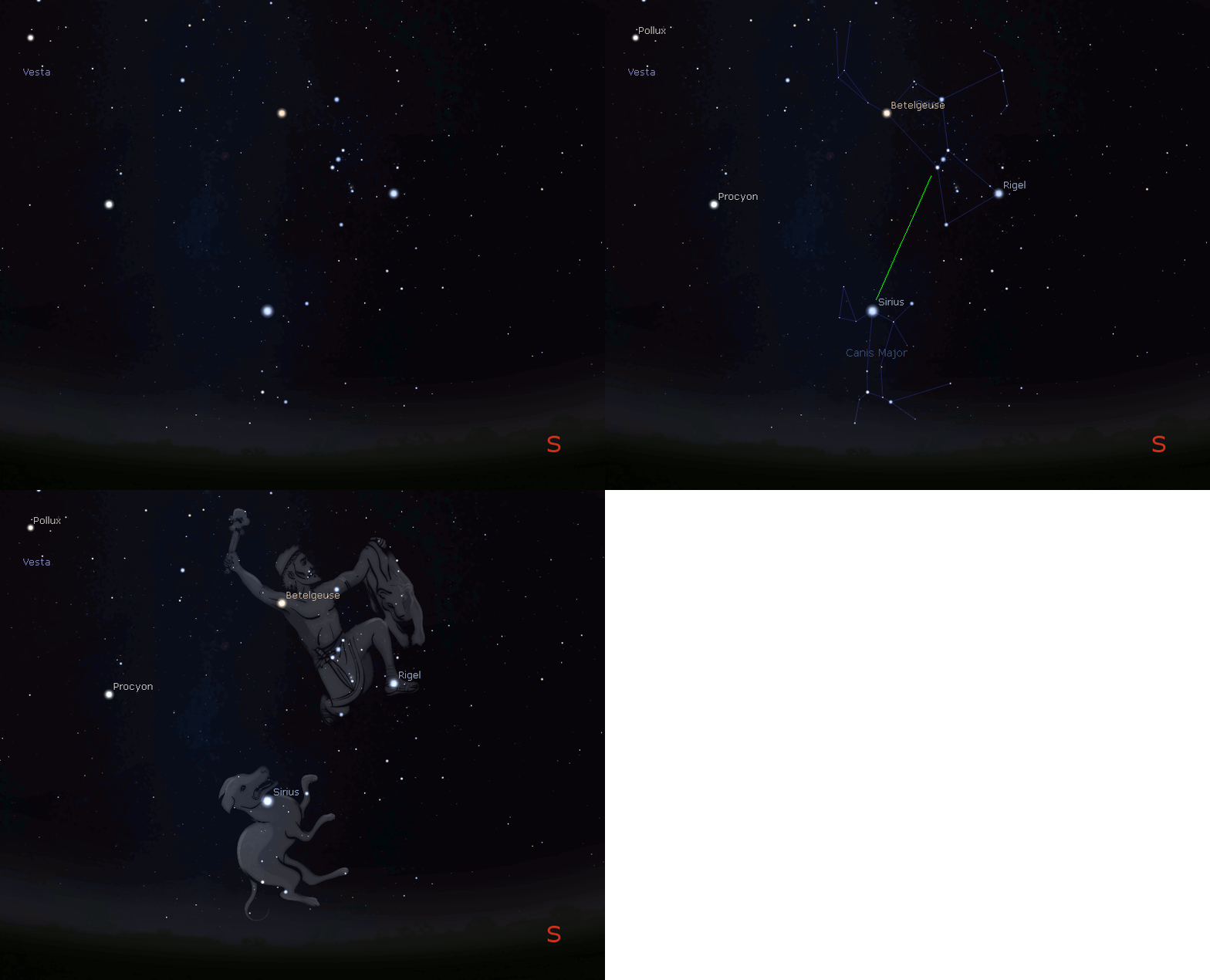
Orion and Canis Major Animation for 9 p.m. January 20, 2017. Created using Stellarium and GIMP.
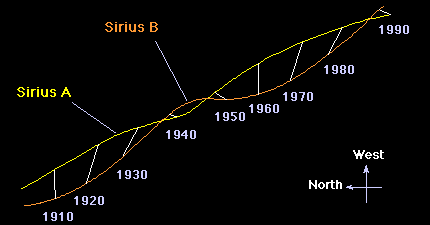
Sirius A & B’s path in the sky showing the wobble that betrayed the Pup’s presence. Credit Mike Guidry, University of Tennessee.

Sirius A and B (near the diffraction spike to the lower left), A Hubble Space Telescope photograph. Credit NASA, ESA.
12/18/2017 – Ephemeris – The little dog shall lead
Ephemeris for Monday, December 18th. The Sun will rise at 8:14. It’ll be up for 8 hours and 49 minutes, setting at 5:03. The Moon is new today, and won’t be visible.
The constellation Orion has two hunting dogs. At 9 p.m. we’ll see one of them, the lesser dog, Canis Minor whose bright star Procyon is low in the East. Just two stars mark the constellation. Is it a dachshund or maybe a hot dog? The name Procyon means “Before the dog”, an odd title. It means that though east of Sirius, the bright dog star in Orion’s large dog, Canis Major, it rises before Sirius, due to its more northerly position in the sky. At 9 Sirius is just rising in the east-southeast. In many ways Procyon is nearly a twin of Sirius. It shines with the same white color, although a bit cooler, and has a white dwarf companion like Sirius. It’s a bit farther away than Sirius’ 8.6 light years. Procyon is at a distance of 11.46 light years.
The times given are for the Traverse City/Interlochen area of Michigan. They may be different for your location.
Addendum
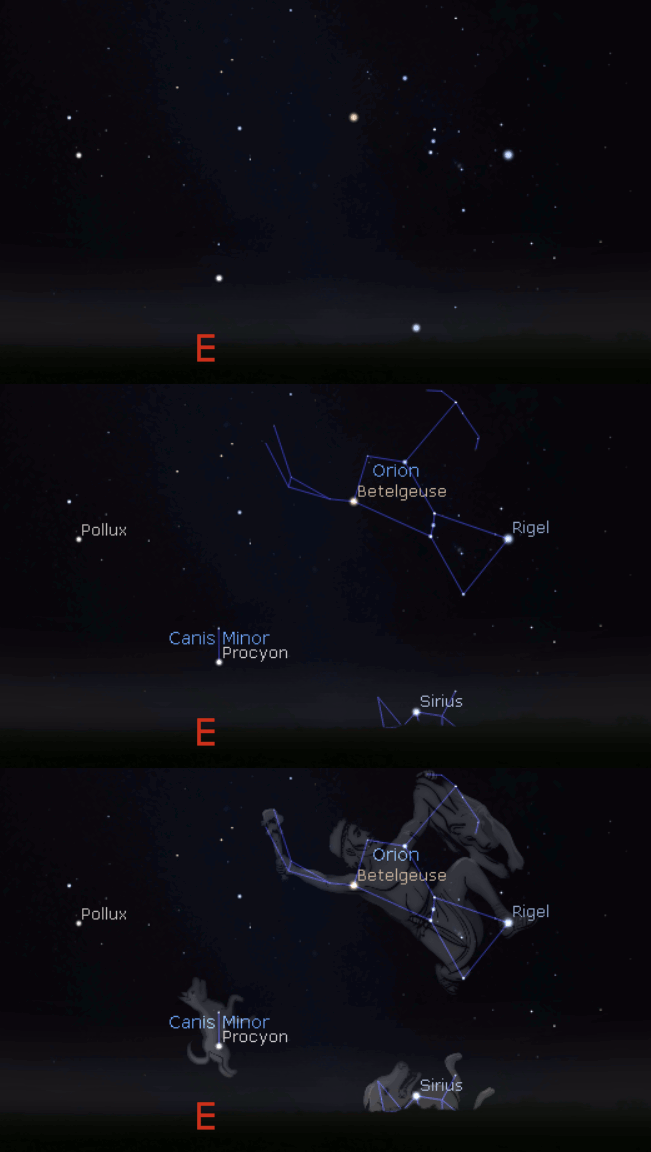
Stars and constellations in the east at 9 p.m., about 4 hours after sunset, on December 18th. This only works for locations above 30 degrees north latitude. Created using Stellarium.
12/15/2017 – Ephemeris – Taurus, Bullish on Winter
Note: The title of this post I’ve taken from an article I wrote for the December 1999 issue of the Stellar Sentinel, the monthly newsletter of the Grand Traverse Astronomical Society, which I will reprint with some tweaks, as the addendum to this post. Winter will arrive in six days, though I’m not particularly bullish on it, but it fits the constellation I’m talking about today.
Ephemeris for Friday, December 15th. The Sun will rise at 8:12. It’ll be up for 8 hours and 50 minutes, setting at 5:02. The Moon, 3 days before new, will rise at 6:25 tomorrow morning.
Low in the east-southeast at 9 p.m. is the constellation of Orion the giant hunter. Above him is Taurus the bull. His face is a letter V shape of stars lying on its side with the bright orange-red star Aldebaran at the bottom tip of the V as its angry blood-shot eye. Orion is depicted in the sky facing him with club in one hand and a shield in the other the approaching and in some depictions charging Taurus. The V of stars is a star cluster called the Hyades. The Pleiades are in his shoulder above. Taurus, in Greek mythology, was the guise the god Zeus when he carried off the maiden Europa. Europa’s still with him, sort of, as the intriguing satellite with a buried ocean orbiting Zeus’ Roman equivalent the planet Jupiter.
The times given are for the Traverse City/Interlochen area of Michigan. They may be different for your location.
Addendum
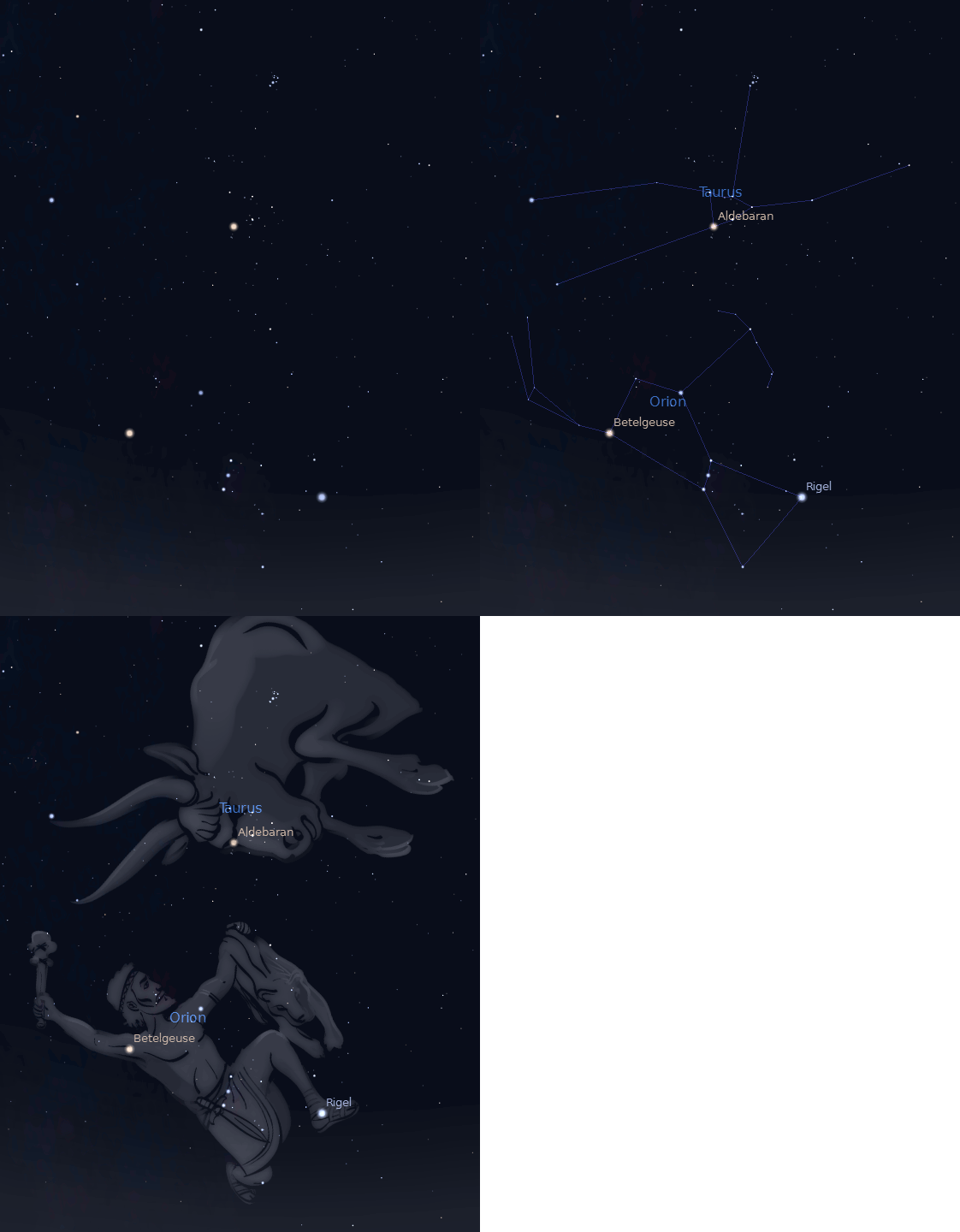
Three views of Taurus the bull and Orion the hunter for about p.m. in December.
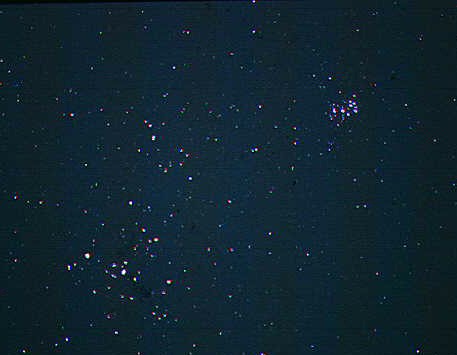
The Hyades (lower left) and the Pleiades (upper right). My photograph from many years ago BD (Before Digital).
The first constellation of winter to appear is probably a toss-up between Auriga the charioteer and Taurus the Bull. Auriga never quite disappears, or at least Capella its brightest star is circumpolar and never quite sets here in Northern Michigan. But Auriga sneaks up slowly in the northeast. Taurus on the other hand makes a grand entrance on autumn evenings preceded by the Pleiades, the Seven Sisters star cluster.
Taurus’ brightest star is Aldebaran, the bull’s angry bloodshot eye. It is at the left tip of a letter V of stars that is the bull’s face. Above the V are single stars that form the tips of its very long horns. Other stars below form the front legs of this beast. That’s it. Only the front part of the bull appears in the sky. In its shoulder are the Pleiades.
According to Greek mythology Taurus represents the god Zeus, the Roman Jupiter, who, in the disguise of a bull abducted the beautiful maiden Europa. This isn’t the only celestial disguise of Zeus. Cygnus is the disguise of Zeus in the famous Leda and the swan affair.
The Pleiades and the Hyades, the V-shaped star cluster of Taurus’ head also have their places in Greek Mythology. The Hyades and Pleiades are half sisters of each other who share Atlas as their father. But it is the Pleiades which are more prominent and have more stories about them. It is the Pleiades that are pursued by Orion the hunter, the central constellation of winter. And since the Pleiades are west of Orion it does appear that Orion continues to chase them around and around the sky daily. To the Kiowa Indians the Pleiades were also young maidens. As the story goes they were being chased by a large bear. The Great Spirit placed them on what we know today as Devil’s Tower in Wyoming to keep them out of reach of the bear. It is said that even today the sides of this tower show the scars of the bear’s claws. Devil’s Tower was the prominent landmark in the movie Close Encounters of the Third Kind. To the Anishinaabek native peoples around here the Pleiades is the “Hole in the Sky” or the seven sweating stones that are heated for the sweat lodge ceremony.
What do we know about Taurus today? Aldebaran is an orangish giant star which lies at a distance of 65 light years. It doesn’t belong to the Hyades, which is about 151 light years away. Aldebaran’s diameter is 40 times the Sun’s, about the diameter as the orbit of Mercury. It’s only 1.7 times tha mass of the Sun. Aldebaran shines at 153 times the Sun’s output.
Aldebaran appears to be part of the Hyades cluster, but it is less than half the distance to this most important star cluster. Though less prominent as the Pleiades, the Hyades is the most important star cluster in the heavens. The reason is because the Hyades was until recently the only star cluster close enough to get an accurate distance measurement by direct means. That direct means is parallax, measuring the shift of the star’s position in the sky due to the earth’s changing position in orbit of the Sun. The Hipparcos satellite has been refining these parallaxes over the past few years. Its measurement of the distance of the Hyades cluster is 151 light years give or take a bit less than a light year. The Hyades distance is the basis for all more distant measurements to the ends of the known universe.
The Hyades is a good binocular object with over 100 stars visible. The cluster actually overflows the binocular’s field of view. This cluster is also known as the Taurus Moving Cluster because its stars are receding towards a point northeast of Orion’s Betelgeuse.
Of course the splashiest part of Taurus is the Pleiades. For people with good vision 6 or more stars can be seen. I can see 4 or 5 stars and fuzz, which are unresolved stars. Many, who see the Pleiades for the first time, think the tiny pattern of stars is the Little Dipper. The stars do indeed look like a tiny dipper, with a nice bowl and a sawed off handle. And that’s what I call it: the Tiny Dipper. The big surprise of the Hipparcos distance measurements is the distance of the Pleiades. The generally accepted distance was about 410 light years. Hipparcos measured 375 light years. This means that the stars of the Pleiades are somewhat dimmer than believed before. Pleiades prior measurement was based on photometric or brightness measurements with the stars of the Hyades and other stars of the same type and known brightness and distance. So it turns out in the case of the Pleiades that the former measurements weren’t as accurate as thought, and means we have more to understand about stellar evolution as it relates to star brightness. Or perhaps Hipparcos is wrong. And interesting debate and more measurements are sure to follow.
The age of the Pleiades is thought to be around 100 million years, young compared to the Sun’s 4.6 billion years. Long exposure photographs and some telescopes can still spot the remaining wisp’s of the nebulae they were born from. The material is probably dust simply reflecting the light of the stars in the cluster.
Taurus is a great constellation to scan with a pair of binoculars.
 Bob Moler's Ephemeris Blog