Archive
01/26/2017 – Ephemeris – Is it a dachshund or a hot dog?
Ephemeris for Thursday, January 26th. The Sun will rise at 8:07. It’ll be up for 9 hours and 36 minutes, setting at 5:43. The Moon, 1 day before new, will rise at 7:40 tomorrow morning.
The constellation Orion has two hunting dogs. We’ve seen Canis Major the greater dog at Orion’s feet with Sirius in its heart. The lesser dog, Canis Minor is level with Betelgeuse in Orion’s shoulder and off to the left. Just two stars mark it. Is it a dachshund or is it a hot dog? You decide. It’s brighter star’s name is Procyon which means “Before the dog”, an odd title. It means that though east of Sirius, it rises before Sirius, due to its more northerly position in the sky. In many ways Procyon is nearly a twin of Sirius. It shines with the same white color, although a bit cooler, and has a white dwarf companion like Sirius. It’s a bit farther away than Sirius’ 8 light years. Procyon is 11 and a half light years away. Procyon, Betelgeuse and Sirius make the winter triangle.
Times are for the Traverse City/Interlochen area of Michigan. They may be different for your location.
Addendum
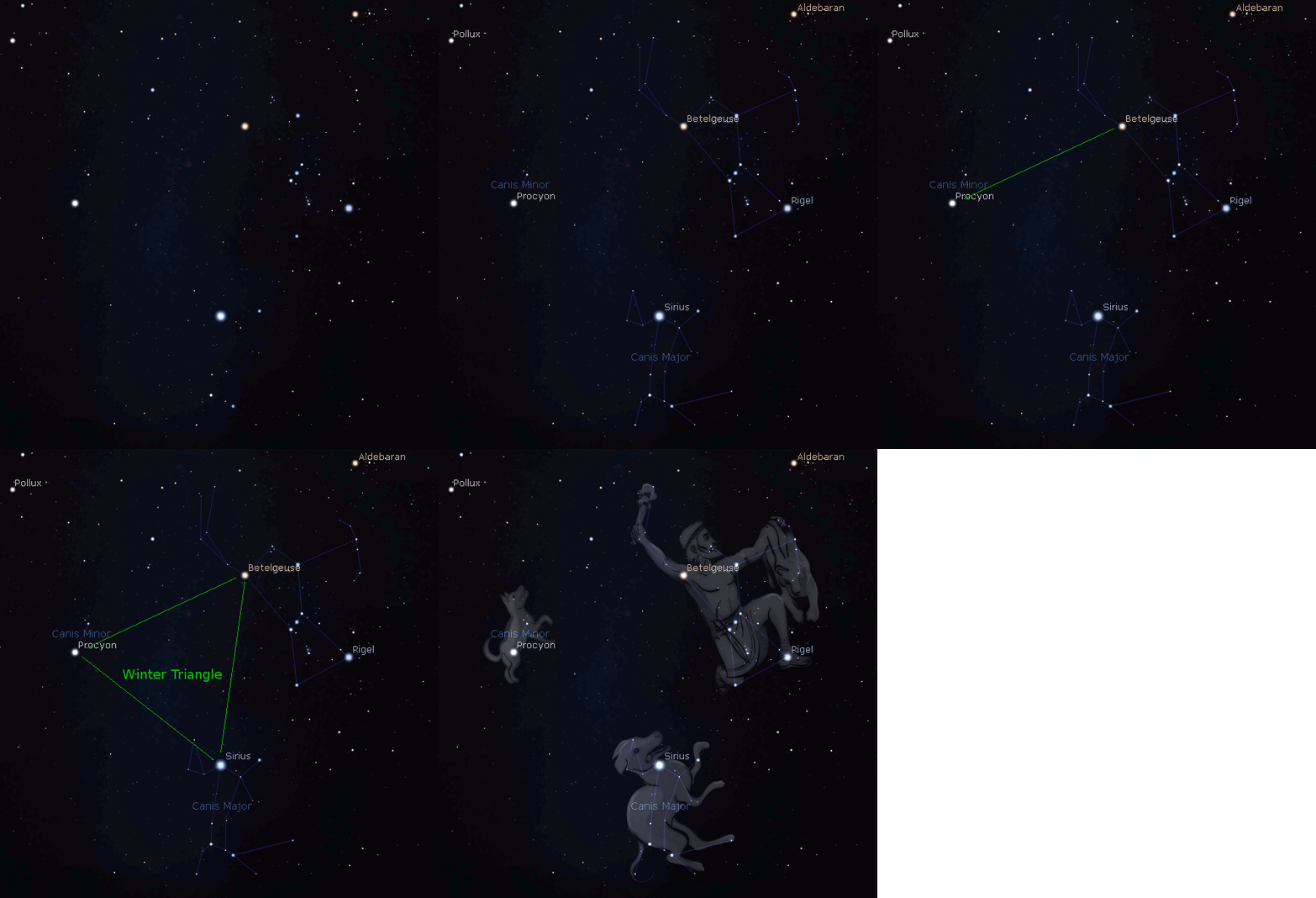
Procyon and Orion’s hunting dogs animation also showing the Winter Triangle asterism*. Created using Stellarium and GIMP.
* Asterism – an informal constellation like the Big Dipper, the Northern Cross, or the Summer Triangle. Not one of the 88 official constellations.
01/10/2017 – Ephemeris – Rigel, the blue super-giant in Orion
Ephemeris for Tuesday, January 10th. The Sun will rise at 8:17. It’ll be up for 9 hours and 4 minutes, setting at 5:22. The Moon, 2 days before full, will set at 7:10 tomorrow morning.
Yesterday I talked about the star Betelgeuse the bright red star in the top left of Orion’s upright rectangle. Orion is seen in the southeast at 9 in the evening. The blue-white star in Orion’s opposite corner is usually brighter. It is Rigel whose longer Arabic name of which Rigel is the first part means Left Leg of the Giant. Rigel is a giant itself, actually a super giant star, which is more a measure of its mass than its size, that of 23 solar masses. Its surface temperature is twice as hot as the Sun. It is 120 thousand times as bright as the sun and 79 times its diameter. Its distance is around 860 light years. Those with telescopes might be able to spot a close companion star to Rigel, just at the edge of the bright arc light image of Rigel itself.
Times are for the Traverse City/Interlochen area of Michigan. They may be different for your location.
Addendum
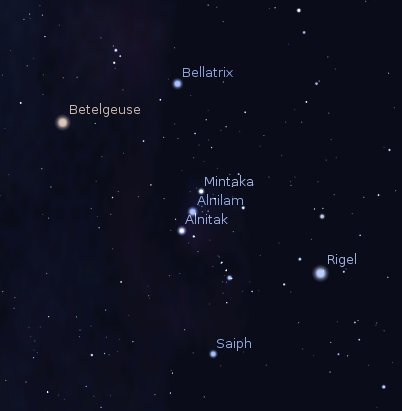
The named stars of Orion. Created using Stellarium.

Rigel with its companion star as photographed through a telescope. No attribution. The source website no longer exists.
01/09/2017 – Ephemeris – Betelgeuse the bright red star in Orion
Ephemeris for Monday, January 9th. The Sun will rise at 8:18. It’ll be up for 9 hours and 3 minutes, setting at 5:21. The Moon, 3 days before full, will set at 6:06 tomorrow morning.
The bright red star in constellation Orion’s shoulder is Betelgeuse, 643 light years away give or take 146 light years. Betelgeuse is a shortened form of an Arabic phrase that means “Armpit of the central one”. Orion is seen in the south in the evening. Even at its great distance it’s the star whose surface is easiest seen, after the sun of course. That’s because it’s so big. Possibly larger around than the orbit of Jupiter, though that’s hard to determine. Recent telescopic observations of Betelgeuse have shown shells of gas surrounding the star. A star like Betelgeuse is so bloated that it can be described as a red-hot vacuum, thus its edge or limb is much darker than its center. The sun has limb darkening too, but it is much less noticeable.
Times are for the Traverse City/Interlochen area of Michigan. They may be different for your location.
Addendum
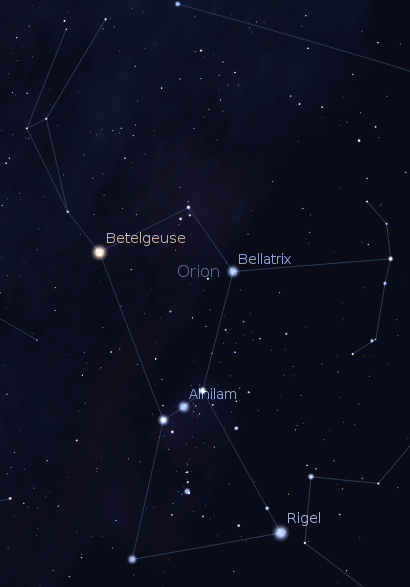
Orion upright and due south. Created using Stellarium.
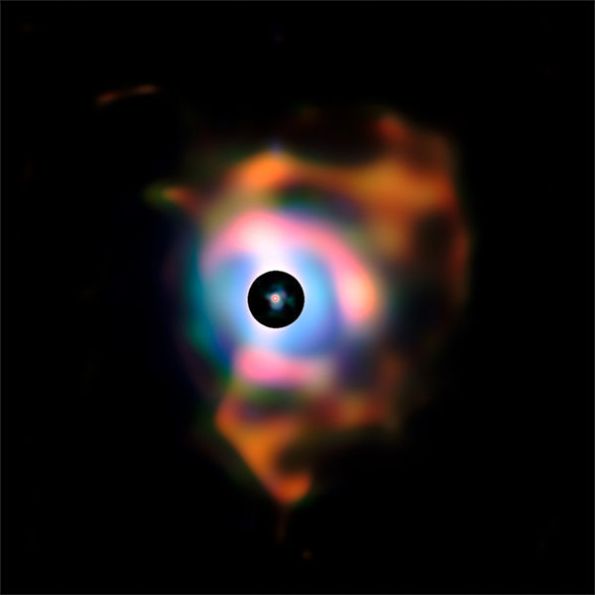
Betelgeuse and its nebula. From European Southern Observatory’s Very Large Telescope.
Betelgeuse is a single star like the Sun there is evidence that Betelgeuse may have eaten its companion star 100,000 years ago, yum! http://phys.org/news/2016-12-famous-red-star-betelgeuse-faster.html
12/08/2016 – Ephemeris – Aldebaran, the follower
Ephemeris for Thursday, December 8th. The Sun will rise at 8:07. It’ll be up for 8 hours and 54 minutes, setting at 5:02. The Moon, 1 day past first quarter, will set at 2:26 tomorrow morning.
The central constellation of winter, Orion, is low in the east-southeast at 9 p.m. Above it is Taurus the bull. The bright orange star in Taurus is Aldebaran. Aldebaran appears at the bottom left tip of a letter V group of stars lying on its side that is the face of the bull. Aldebaran isn’t actually part of the group, called the Hyades star cluster. The cluster is about 151 light years away, while Aldebaran is a bit less than half that. The star has an orange hue because its surface is cooler than the Sun’s. However Aldebaran is 44 times larger in diameter, and shines 350 times brighter than the Sun. Next Monday night the 12th, the Moon will pass in front of Aldebaran in an event called an occultation I’ll have more information on it then. The name Aldebaran means The Follower, since it follows the Pleiades across the sky as the Earth rotates.
Times are for the Traverse City/Interlochen area of Michigan. They may be different for your location.
Addendum
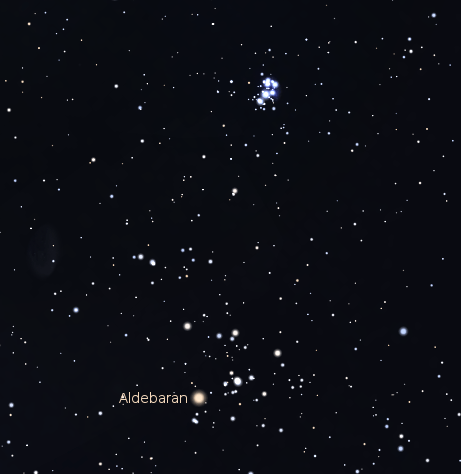
Aldebaran in the ‘V’ shape of the Hyades (The face of Taurus the bull) with the Pleiades above. Created using Stellarium.
12/06/2016 – Ephemeris – Capella the northernmost first magnitude star
Ephemeris for Tuesday, December 6th. The Sun will rise at 8:05. It’ll be up for 8 hours and 56 minutes, setting at 5:02. The Moon, 1 day before first quarter, will set at 12:08 tomorrow morning.
A bright star called Capella has slowly been rising in the northeastern sky in the evenings for the past few months. At 8 p.m. now it is low in the east-northeast to the upper left of Orion, rising in the east. This winter Capella will be overhead, the highest of winter’s seven brilliant first magnitude stars. Capella never quite sets for anyone north of Ludington. Due to its brightness, and being the closest first magnitude star to the pole, Capella appears to move slowly as the earth rotates, and spends summer and autumn evenings close to the horizon, and has, in years past, elicited a few phone calls and other queries about that ‘bright object in the northeast’. Capella belongs to the pentagonal constellation of Auriga the charioteer.
Times are for the Traverse City/Interlochen area of Michigan. They may be different for your location.
Addendum
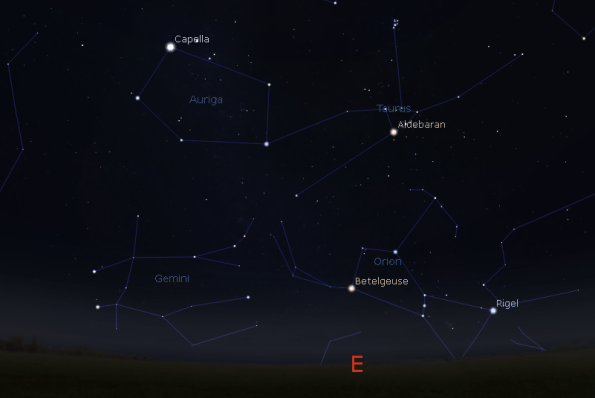
The star Capella with the other stars and constellations of Winter rising in the east. Created using Stellarium.
10/24/2016 – Ephemeris – Fomalhaut, the loneliest star in the sky
Ephemeris for Monday, October 24th. The Sun will rise at 8:10. It’ll be up for 10 hours and 31 minutes, setting at 6:42. The Moon, 2 days past last quarter, will rise at 3:01 tomorrow morning.
There’s a bright star that appears for only seven and a half hours on autumn evenings. It’s appearance, low in the south at 10 p.m., is a clear indication of the autumn season. The star’s name is Fomalhaut, which means fish’s mouth. That’s fitting because it’s in the constellation of Piscis Austrinus, the southern fish. At our latitude it’s kind of the fish that got away, because Fomalhaut appears to be quite alone low in the sky. The dimness of the constellation’s other stars and location close to the horizon make the faint stars hard to spot. The earth’s thick atmosphere near the horizon reduces their brightness by a factor of two or more, so Fomalhaut, one of the brightest stars in the sky, keeps a lonely vigil in the south.
Times are for the Traverse City/Interlochen area of Michigan. They may be different for your location.
Addendum
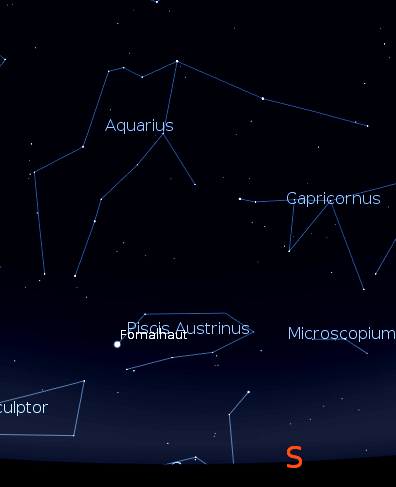
Aquarius and Fomalhaut as visualized by Stellarium.
05/27/2016 – Ephemeris – Alkaid, the star at the end of the Big Dipper
Ephemeris for Friday, May 27th. Today the Sun will be up for 15 hours and 14 minutes, setting at 9:17, and will rise tomorrow at 6:02. The Moon, 2 days before last quarter, will rise at 1:40 tomorrow morning.
The star at the end of the handle of the Big Dipper is named Alkaid. It is the bright star that’s closest to the zenith at 11 p.m. It is a rare blue-white star. Alkaid and Dubhe, at the other end of the Big Dipper are stars that do not belong to the Ursa Major Association. And thousands of years from now these two stars will leave the central stars of the dipper behind, and deform the Big Dipper. Over the millennia the Big Dipper would look like a tin cup. Near Alkaid are two popular deep sky objects. And being this far from the hazy band of the Milky Way one would guess that they would be galaxies. And they are. The Whirlpool Galaxy and the Pinwheel Galaxy. Two gorgeous spiral galaxies.
Times are for the Traverse City/Interlochen area of Michigan. They may be different for your location.
Addendum
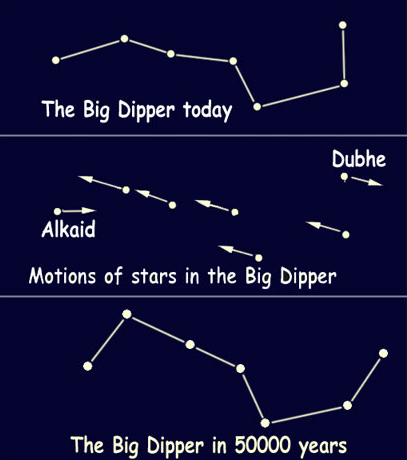
The change in the Big Dipper over time. Source: stargazerslounge.com. Ultimate source: Stellarium.
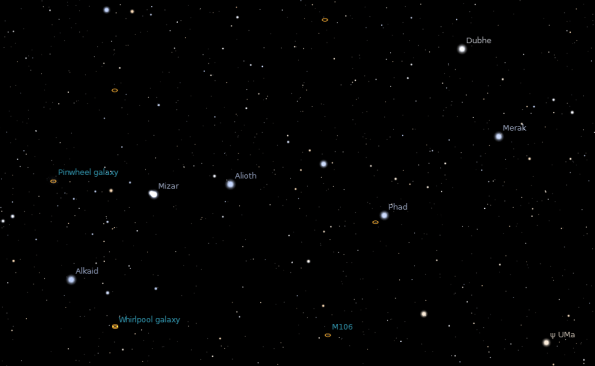
The Big Dipper and Alkaid with the Whirlpool (M51) and Pinwheel (M101) galaxies. Created using Stellarium.
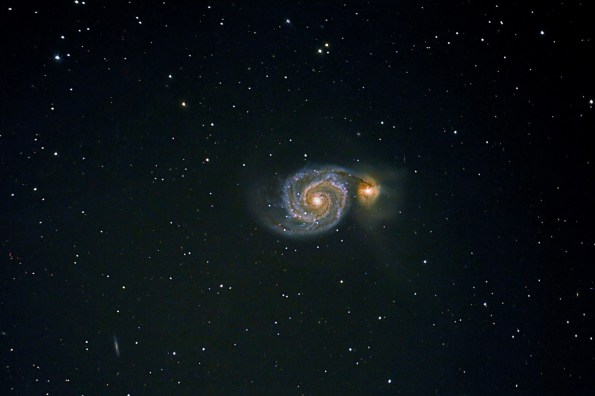
The Whirlpool Galaxy, M51. Credit Scott Anttila.
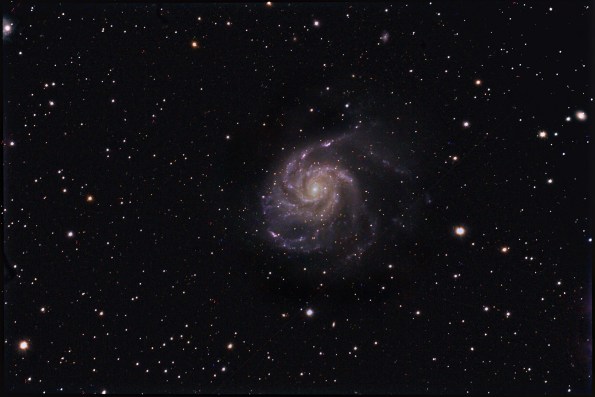
The Pinwheel Galaxy, M101. Credit Scott Anttila.
05/26/2016 – Ephemeris – Polaris the North Star
Ephemeris for Thursday, May 26th. Today the Sun will be up for 15 hours and 12 minutes, setting at 9:16, and will rise tomorrow at 6:03. The Moon, 3 days before last quarter, will rise at 1:02 tomorrow morning.
The star Polaris is perhaps the most important star in the northern hemisphere sky. That’s because it is nearly over the Earth’s north pole. It’s also called the North Star or the Pole Star. Polaris can be found by using the two stars at the front of the bowl of the Big Dipper, These two stars, we call Pointer Stars do point very accurately to Polaris. It is not the brightest star as some think, but a brighter than average star in a most unique position in the sky. During the lifetimes of those now living Polaris will be getting slowly closer to the pole. It won’t reach it, but in 100 years will begin to recede from the pole. The altitude of Polaris in degrees approximately equals ones latitude.
Times are for the Traverse City/Interlochen area of Michigan. They may be different for your location.
Addendum
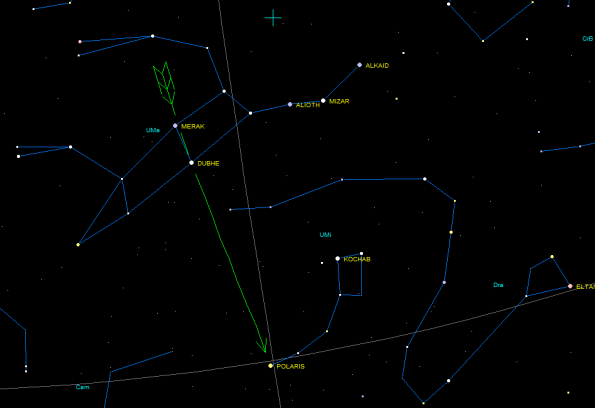
Looking North at the Big Dipper pointing at Polaris. Created using my Looking Up program.
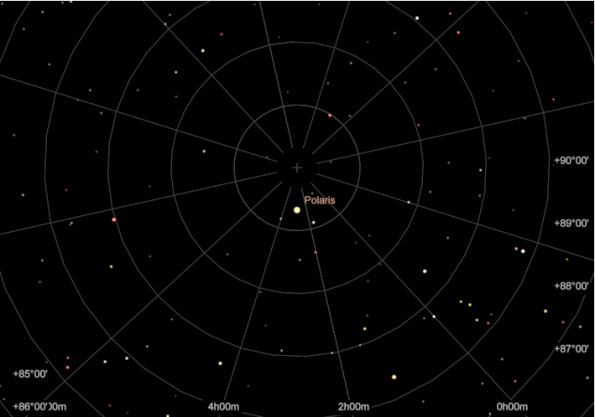
Closeup of Polaris and the Celestial North Pole. The declination lines are 1 degree apart. Created using Cartes du Ciel (Sky Charts).
05/24/2016 – Ephemeris – Follow the spike to Spica
Ephemeris for Tuesday, May 24th. Today the Sun will be up for 15 hours and 9 minutes, setting at 9:14, and will rise tomorrow at 6:04. The Moon, 3 days past full, will rise at 11:35 this evening.
Just about due south at 11 p.m. is the bright star Spica which can be found from all the way back overhead to the Big Dipper. Follow the arc of the handle of the Big Dipper to the bright star Arcturus high in the south, southeast. Then straighten the curve of the arc to a straight spike which points to Spica. Arcturus is much brighter than Spica and has an orange tint to Spica’s bluish hue. In fact Spica is the bluest of the 21 first magnitude stars. That means that it is hot. Actually Spica is really two blue stars orbiting each other in 4 days. Spica is 250 light years away, which is reasonably close. Spica was an important star to the ancients. One temple was built, and aligned to its setting point.
Times are for the Traverse City/Interlochen area of Michigan. They may be different for your location.
Addendum
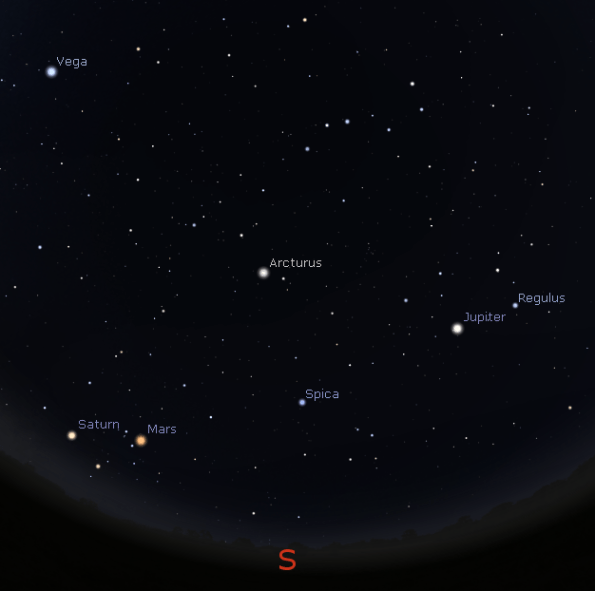
The evening sky to the south. All the finder stars are there, so follow the arc of the Big Dipper’s handle to Arcturus. Straighten it to a spike that points to Spica. Created using Stellarium.
04/26/2016 – Ephemeris – Arcturus, just passing through
Ephemeris for Tuesday, April 26th. The Sun rises at 6:39. It’ll be up for 14 hours and 2 minutes, setting at 8:42. The Moon, 3 days before last quarter, will rise at 12:48 tomorrow morning.
Arcturus is an orange-colored giant star, 37 light years away. We see it high in the east and pointed to by following the arc of the handle of the Big Dipper. Arcturus is a rapidly moving star. It’s velocity is about 76 miles per second (122 km/s). It’s almost at its nearest to the Sun now. In the next 2,000 years it will move about one degree, twice the width of the Moon toward Spica. Arcturus may be part of a dwarf galaxy being assimilated by the Milky Way which may account to its odd motion. Arcturus is thought to be close to 8% more massive than the Sun and about 6 to 8 ½ billion years old. It has entered its red giant stage after running out of hydrogen in its core. It may be a glimpse of what the sun will look like in 5 billion years.
Times are for the Traverse City/Interlochen area of Michigan. They may be different for your location.
Addendum
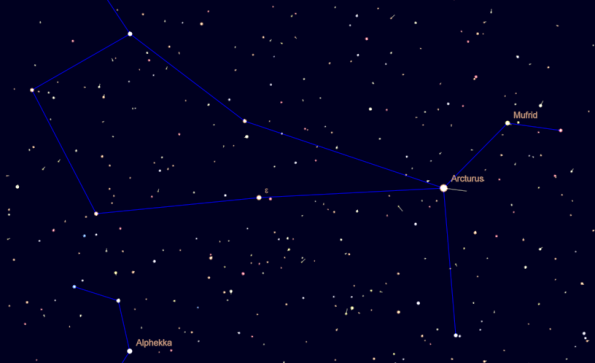
The constellation Bootes and the 4th brightest star in the night sky. The thin line extending to the right from Arcturus is the distance it will travel in the next 2,000 years. That line is nearly one degree ling, or 2 Mon diameters. Created using Cartes du Ciel (Sky Charts)
 Bob Moler's Ephemeris Blog