Archive
03/29/2016 – Ephemeris – The Little King Star, Regulus
Ephemeris for Tuesday, March 29th. The Sun will rise at 7:28. It’ll be up for 12 hours and 39 minutes, setting at 8:07. The Moon, 2 days before last quarter, will rise at 2:00 tomorrow morning.
Regulus is the brightest star in the constellation of Leo the lion at the bottom of the backward question mark that is the head and mane of Leo. It’s in the southeast at 9 p.m. above the much brighter Planet Jupiter. Alluding to the lion’s status in the animal kingdom, Regulus is the little king star. It is dead last in order of brightness of the 21 brightest first magnitude stars, 1/13th the brightness of Sirius the brightest star low in the southwest at the same time. To the Babylonians it was the king, the 15th of their constellations that marked the passage of the sun. Regulus is about 79 light years away, and 288 times the brightness of the sun. It is a rapidly spinning ellipsoid 3 times the sun’s diameter, rotating in just under 16 hours.
Times are for the Traverse City/Interlochen area of Michigan. They may be different for your location.
Addendum
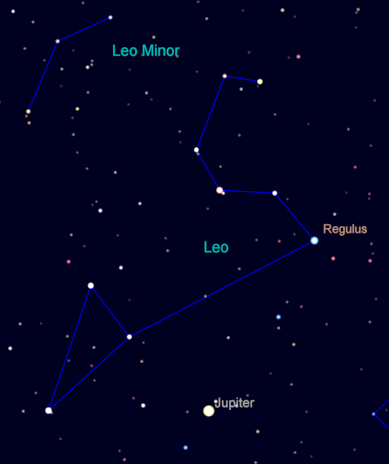
Regulus and Jupiter in the constellation of Leo at 10 p.m., March 29, 2016. Created using Cartes du Ciel (Sky Charts).
03/28/2016 – Ephemeris – The brightest spring star is now rising in the east
Ephemeris for Monday, March 28th. The Sun will rise at 7:30. It’ll be up for 12 hours and 35 minutes, setting at 8:06. The Moon, 3 days before last quarter, will rise at 1:07 tomorrow morning.
Rising in the eastern sky at 10 p.m. is the 4th brightest night-time star. It’s found off the curve of the handle of the Big Dipper above it in the northeast. It’s the tail end of a kite shaped constellation of Boötes the herdsman. Arcturus is an orange-colored giant star, 37 light years away. Its light was used open the 1933 Chicago Worlds Fair believing its light left the star in 1893 the year of the previous Chicago Worlds Fair. It turns out that Arcturus is 3 light years closer than what they thought. Arcturus is a rapidly moving star. It’s velocity is about 76 miles (122 km) per second. It’s at its nearest to the sun now. Arcturus is thought to be close to the sun’s mass, and much older. It may be a glimpse of what the sun will look like in 5 billion years.
Times are for the Traverse City/Interlochen area of Michigan. They may be different for your location.
Addendum
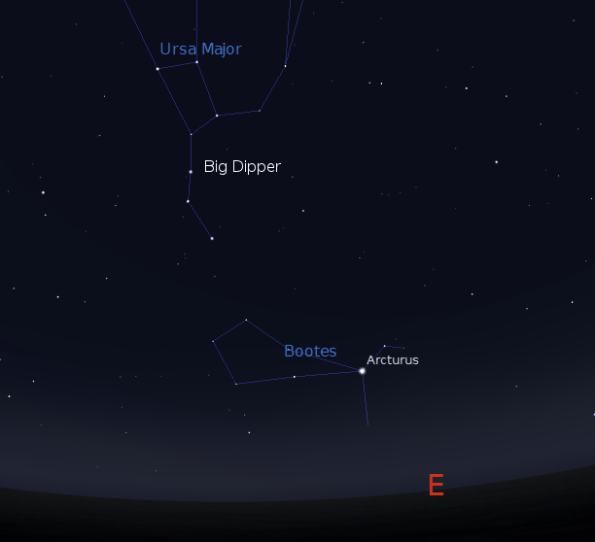
Arcturus off the handle of the Big Dipper rising. Created using Stellarium.
03/17/16 – Ephemeris – Why are there no green stars?
Ephemeris for St. Patrick’s Day, Thursday, March 17th. The Sun will rise at 7:50. It’ll be up for 12 hours and 1 minute, setting at 7:52. The Moon, 2 days past first quarter, will set at 5:10 tomorrow morning.
Today we celebrate the patron saint of the Emerald Isle. And green is the color of the day. When we look to the skies we don’t see a lot of green. Well, maybe in the Hubble Space Telescope’s false color photographs like the original Pillars of Creation, where green represents hydrogen, and in the northern lights. The colors we see in stars are red or orange if they are cooler than the Sun, yellow if they are the same temperature as the Sun, and white or bluish if hotter than the Sun. In the spectrum of light we can see, green is in the middle, between yellow and blue. As a matter of fact the Sun radiates its energy most heavily in the green. So if you got rid of those other colors the Sun itself would be green.
Times are for the Traverse City/Interlochen area of Michigan. They may be different for your location.
Addendum

Star cluster showing star colors, probably enhanced. Source uncredited image from planetsforkids.org.
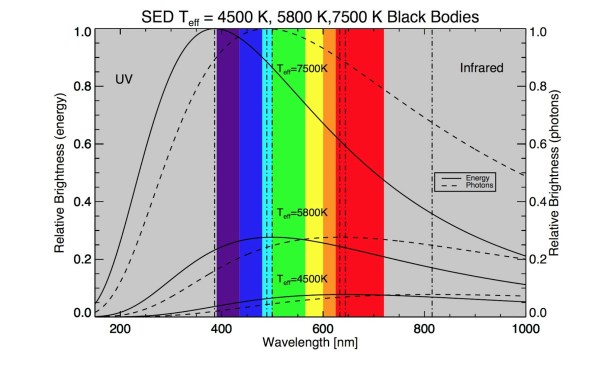
“Black body” Radiation Curves by temperatures. The Sun’s surface temperature is around 5800 Kelvin. Note the peak radiation besides increasing in amplitude slides from red to blue with increasing temperature.

Aurora looking north at 10/24/2011 at 10:52 p.m. The first color visible in an aurora or northern lights is green. More active aurorae give off other colors. Credit: Bob Moler.
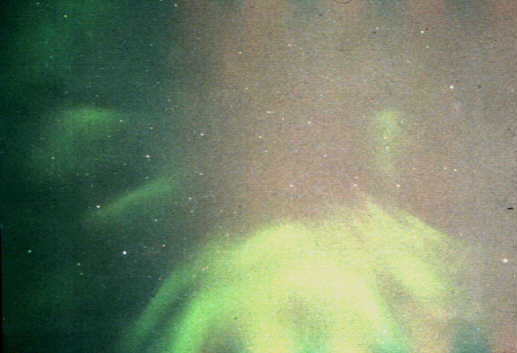
Looking overhead in an active aurora, and the variety of colors, even green. Credit: Bob Moler.
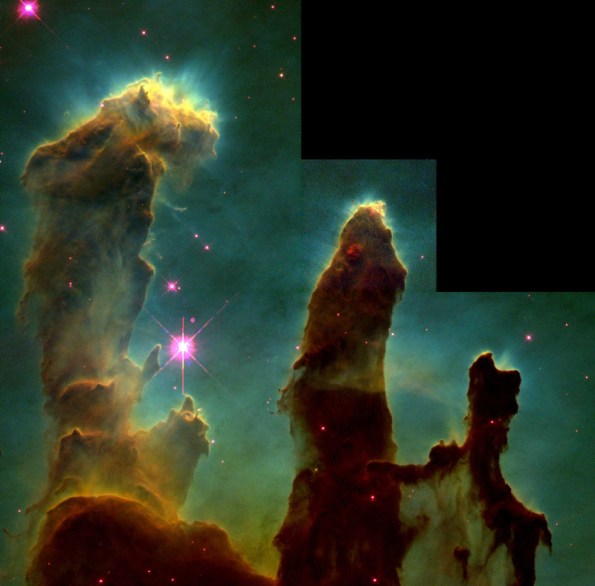
Pillars of Creation in false color by the Hubble Telescope. Sometimes the colors are given to specific elemental emissions, of shifted because the colors represent radiation that is invisible to the human eye. Credit: NASA/ESA/HST.
02/18/2016 – Ephemeris – Castor and Pollux
Ephemeris for Thursday, February 18th. The Sun will rise at 7:39. It’ll be up for 10 hours and 35 minutes, setting at 6:14. The Moon, 3 days past first quarter, will set at 5:28 tomorrow morning.
The star Pollux is at the head of the same named brother of Gemini the twins. Castor is the slightly dimmer star right above it. Pollux is about 34 light years away. It’s twice as massive as the Sun, and has run out of hydrogen in its core and is in the process of evolving into a red giant star. One planet, twice as massive as Jupiter has been detected around it. Castor is at 51 light years away. There are 6 stars in its system. The brightest three are visible in telescopes. Each is a spectroscopic binary, meaning that the companion stars are detected by the Doppler shifts of the lines in their spectra as the stars orbit each other. The Doppler shift is just one of the many pieces of information revealed by the spectroscope.
Times are for the Traverse City/Interlochen area of Michigan. They may be different for your location.
Addendum
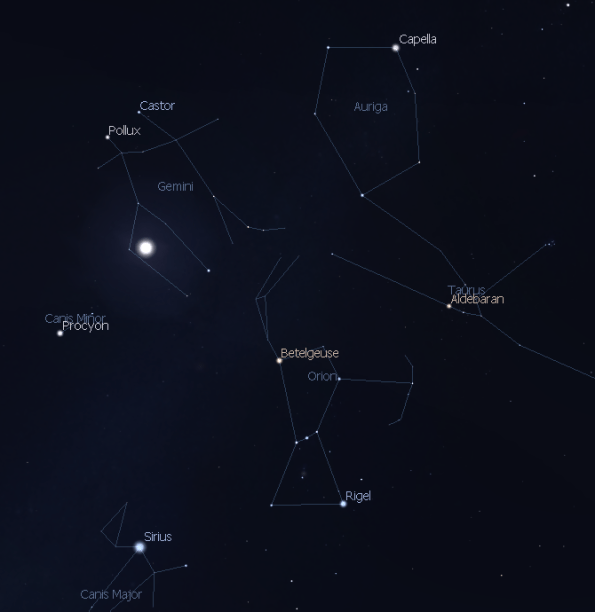
Castro and Pollux with the bright Moon and other bright stars and constellations of winter. 9 p.m. February 18, 2016. Created using Stellarium.
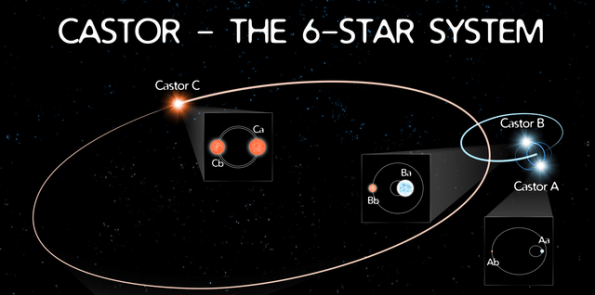
The Castor star system exploded in this JPL/NASA infographic.
The entire infographic is here.
02/16/2015 – Ephemeris – The little Dog Star
Ephemeris for Tuesday, February 16th. The Sun will rise at 7:42. It’ll be up for 10 hours and 29 minutes, setting at 6:12. The Moon, 1 day past first quarter, will set at 3:45 tomorrow morning.
Procyon is the bright star to the east or left of Betelgeuse in the sky tonight, which puts it in the east-southeast at 9 tonight. Procyon is the brightest of the two stars in Canis Minor, Orion’s little hunting dog. Procyon is sometimes called the Little Dog Star for that reason. The Dog Star Sirius is a ways below and right of it. The name Procyon means “Before the Dog”, because Procyon, though east of Sirius, rises before it due to its more northerly position. This only works if one is north of 30 degrees north latitude. South of that, Sirius rises first. Procyon is a white star 11 and a half light years away, 3 light years farther than Sirius, and like Sirius it has a faint white dwarf companion. It’s a bit less than half the Sun’s age.
Times are for the Traverse City/Interlochen area of Michigan. They may be different for your location.
Addendum
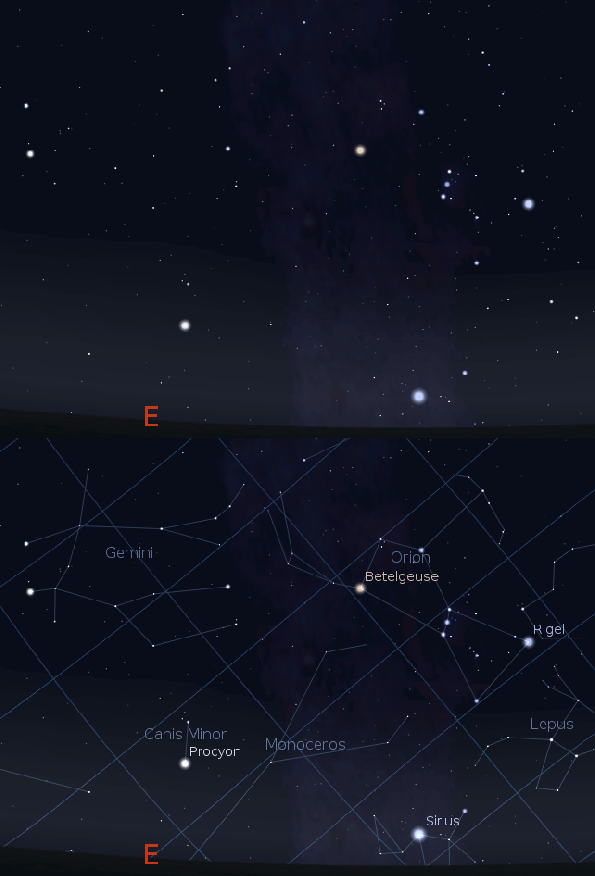
Procyon, Sirius and the stars of winter. Created using Stellarium
Note that at their rising Procyon is higher in the sky than Sirius.
There are some grid lines on the chart. The ones running from lower left to upper right are lines of declination, which are like latitude lines on the Earth. On this chart they are 10º apart. The line that intersects the horizon at the east compass point is the celestial equator. It will meet the western compass point at the horizon. As the Earth rotates the stars and planets will move westward in the direction of these declination lines. The lines that run from upper left to lower right are hour lines of right ascension. Here they are 15 degrees or one hour apart, The Earth rotates 360º in a sidereal* day. 360 divided by 24 hours gives 15º an hour. So the celestial sphere of stars and planets will slide 15º westward in a sidereal hour.
* A sidereal day, rotation with respect to the stars, is about 4 minutes shorter that the solar day, the day and time we keep based on the Sun. The Sun moves about one degree eastward each day, so the rotation has to catch up that one degree each day. The rotation of one degree takes 4 minutes. I’ll let you work that one out for yourself.
02/12/2016 – Ephemeris – A circle of bright stars in winter
Ephemeris for Friday, February 12th. The Sun will rise at 7:48. It’ll be up for 10 hours and 18 minutes, setting at 6:06. The Moon, 3 days before first quarter, will set at 11:19 this evening.
The winter skies are blessed with more first magnitude stars than any other season. With the moon out these stars will stand out even more, as dimmer stars are suppressed. Six of these stars lie in a large circle centered on the seventh, the Winter Circle.
This circle is up at 9 p.m. Starting high nearly overhead is Capella in Auriga the charioteer. Moving clockwise down to the south, we come to Aldebaran in the face of Taurus the Bull. Then down to Orion’s knee we find Rigel. Down and left is the brightest star of all Sirius in Canis Major Orion’s large hunting dog, lowest of these stars in the southeast. Moving up and left there is Procyon in Canis Minor, Above is Pollux in Gemini the twins. All are centered on Betelgeuse the bright red star in Orion’s shoulder.
Times are for the Traverse City/Interlochen area of Michigan. They may be different for your location.
Addendum
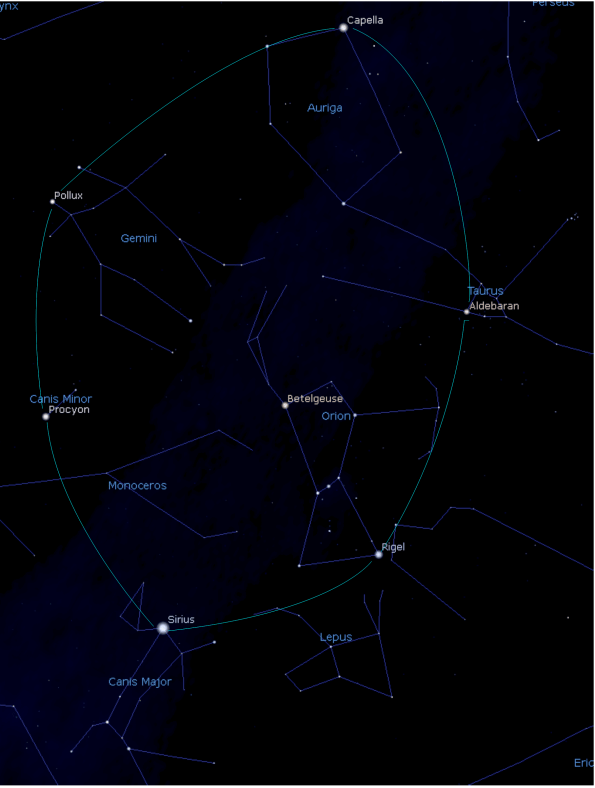
The bright stars of winter arrayed in a circle. Created using Stellarium.
Some also see a Winter Triangle consisting of the stars Betelgeuse, Sirius and Procyon.
02/11/2016 – Ephemeris – What do star colors reveal?
Ephemeris for Thursday, February 11th. The Sun will rise at 7:49. It’ll be up for 10 hours and 15 minutes, setting at 6:05. The Moon, 3 days past new, will set at 10:06 this evening.
The bright stars of winter have subtle differences in color. But what do those colors mean? In stars color is indicative of surface temperature. From coolest to hottest are red, orange, yellow, and white to blue, the hottest. Interior decorators may disagree, but that’s how it is. Coolest of the bright stars is red Betelgeuse in Orion’s shoulder, then orange Aldebaran in the face of Taurus the bull, and Pollux in Gemini. Hotter yet is yellow Capella in Auriga the Charioteer, about the temperature of the Sun. Then we come to the white-hot Procyon and Sirius in the little and big dogs of Orion. Hottest is blue-white Rigel in Orion’s knee. There are hotter stars in Orion, the center and rightmost stars of Orion’s belt are bluer and hotter yet.
Times are for the Traverse City/Interlochen area of Michigan. They may be different for your location.
Addendum
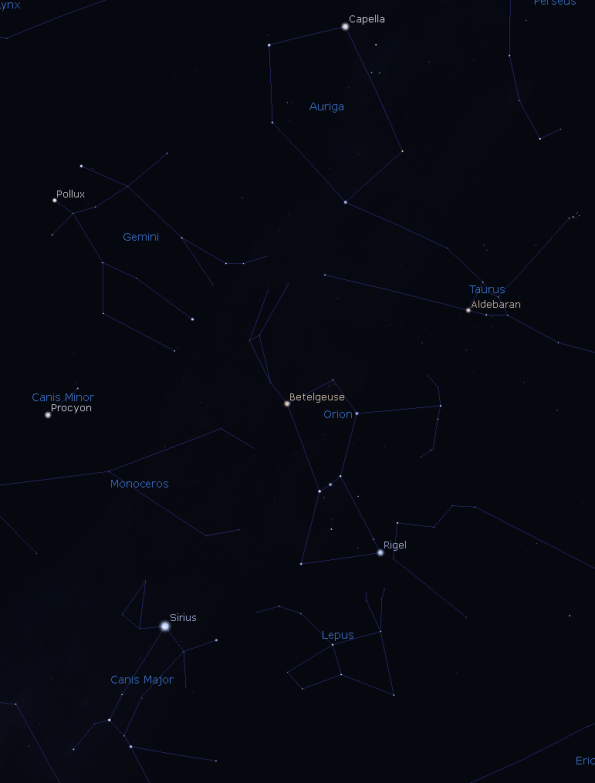
Bright stars of winter with hints as to their colors. The star label is the color of the star. Created using Stellarium.
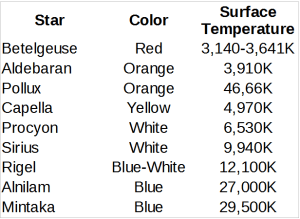
A table of star color and surface temperatures. Created from data in Wikipedia.
The star Alnilam is the center star of Orion’s belt, while Mintaka is the rightmost star of the belt. The temperature scale K is the Kelvin scale which is the Celsius scale plus 273.15. Zero on the Kelvin scale is absolute zero. 1 degree Celsius equals 1 Kelvin. One never says degrees Kelvin.
Betelgeuse is a variable star, so its surface temperature varies.
02/09/2016 – Ephemeris – The Dog Star has a pup
Ephemeris for Fat Tuesday, Tuesday, February 9th. The Sun will rise at 7:52. It’ll be up for 10 hours and 9 minutes, setting at 6:02. The Moon, 1 day past new, will set at 7:39 this evening.
Sirius is the brightest night time star and is located in the southeast at 9 p.m. below and a bit left of Orion the Hunter. We’ve visited Sirius once before this winter. But there is another star in the Sirius system that is practically invisible due to Sirius’ dazzling glare. Its name is Sirius B, nicknamed the Pup, alluding to Sirius’ Dog Star title. The tiny star was suspected as far back as 1834 due to Sirius’ wavy path against the more distant stars. Sirius and the Pup have 50 year orbits of each other. The Pup was first seen by famed 19th century telescope maker Alvan Clark in 1862 while testing a new telescope. The Pup is a white dwarf star, as small as the Earth but with the mass of the sun, out of hydrogen fuel and slowly collapsing.
Times are for the Traverse City/Interlochen area of Michigan. They may be different for your location.
Addendum
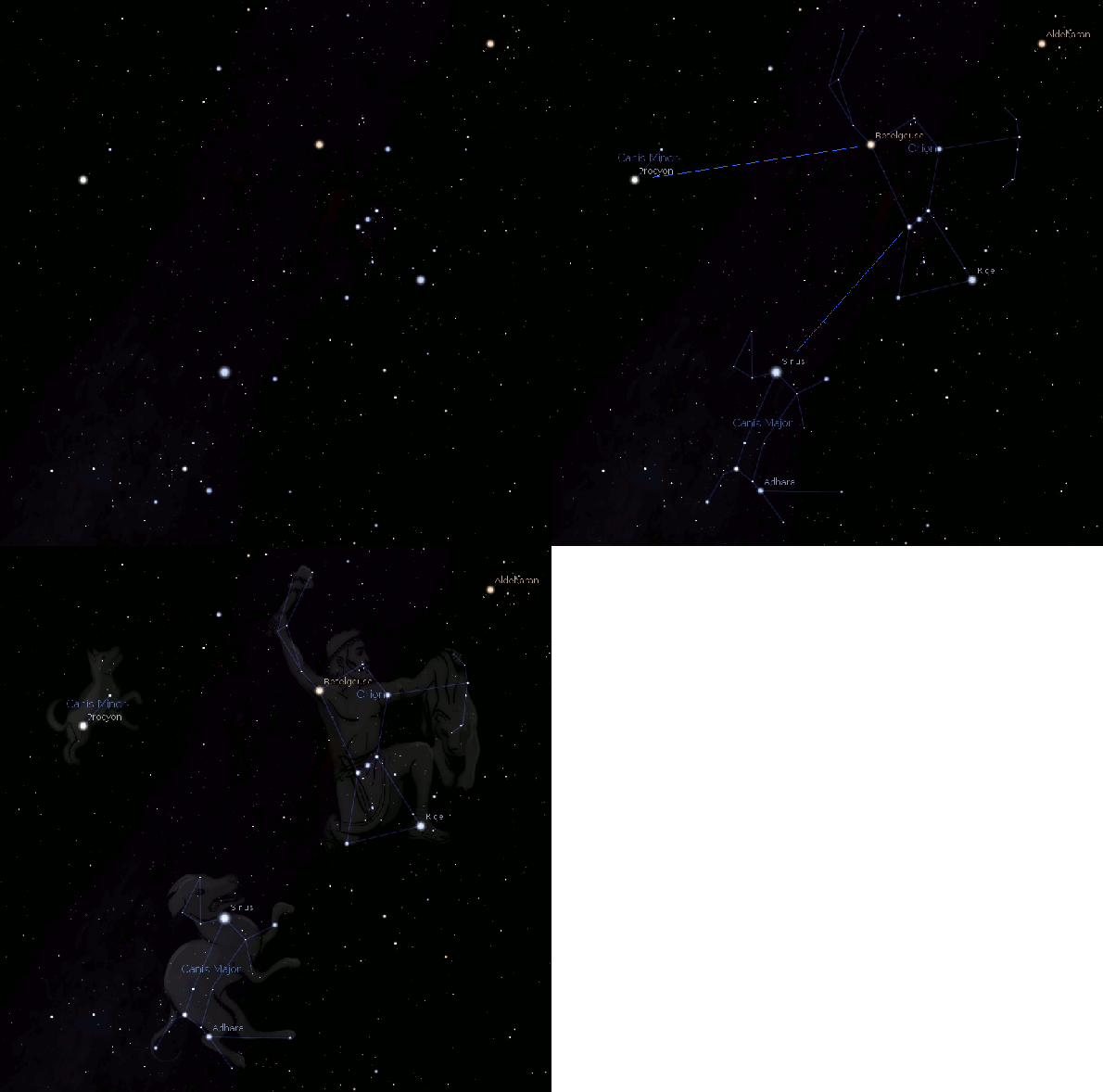
Orion and his hunting dogs revealed in animation. Created with Stellarium and GIMP.
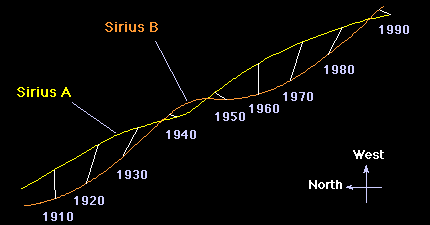
Sirius A & B’s path in the sky showing the wobble that betrayed the Pup’s presence. Credit Mike Guidry, University of Tennessee.
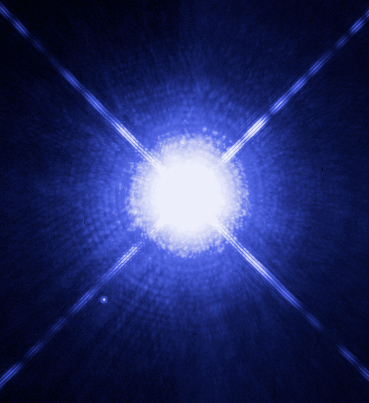
Sirius A and B (near the diffraction spike to the lower left), A Hubble Space Telescope photograph. Credit NASA, ESA.
01/25/2016 – Ephemeris – Sirius the Dog Star
Ephemeris for Monday, January 25th. The Sun will rise at 8:09. It’ll be up for 9 hours and 31 minutes, setting at 5:41. The Moon, 2 days past full, will rise at 7:43 this evening.
While we’re waiting for the bright Moon to leave the evening sky, let’s look at another bright star. This one is the brightest of all, Sirius the Dog Star. The Dog Star name comes from its position at the heart of the constellation Canis Major, the great dog of Orion the hunter. The three stars of Orion’s belt tilt to the southeast and point to Sirius. The name Sirius means ‘Dazzling One’, a reference to its great brilliance and twinkling. The Romans thought Sirius added its heat to that of the Sun in summer to bring on the scorching Dog Days of July and August. Its ancient Egyptian name was Sothis, and its first appearance in the morning twilight in late June signaled the flooding of the Nile, and the beginning of the Egyptian agricultural year.
Times are for the Traverse City/Interlochen area of Michigan. They may be different for your location.
Addendum
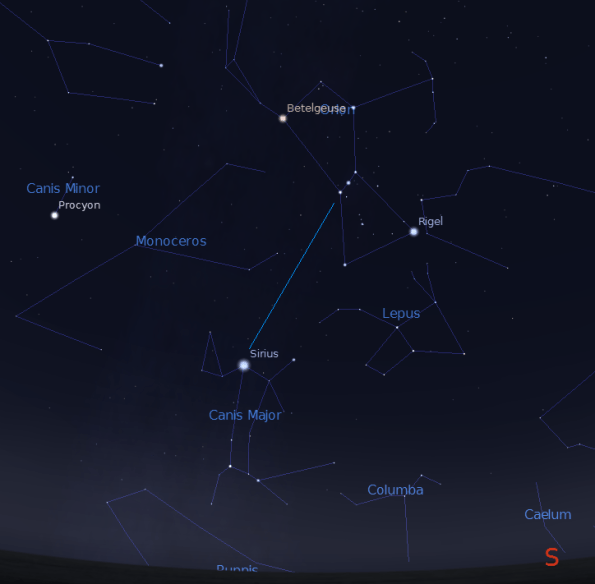
Orion’s Belt points to Sirius. Created using Stellarium.
01/21/2016 – Ephemeris – Rigel, Orion’s other bright star
Ephemeris for Thursday, January 21st. The Sun will rise at 8:12. It’ll be up for 9 hours and 22 minutes, setting at 5:35. The Moon, 2 days before full, will set at 6:44 tomorrow morning.
The bright star at the bottom right corner of the big upright rectangle that is the giant hunter Orion’s body in the south-southeast is Rigel. It is a white star with a bluish tinge. It compares in brightness with Betelgeuse at the opposite end of Orion’s rectangle, though it’s usually a bit brighter. The mismatch in color makes brightness comparisons difficult. Rigel is about 860 light years away, It’s 20 times the mass of the Sun, 120 thousand the times brighter than the Sun, and a diameter about the size of the orbit of Mercury. It’s age is thought to be about 8 million years. It has a visual companion star that can be seen in amateur telescopes. It’s not that dim, but suffers by being close to the arc light brightness of Rigel.
Times are for the Traverse City/Interlochen area of Michigan. They may be different for your location.
Addendum
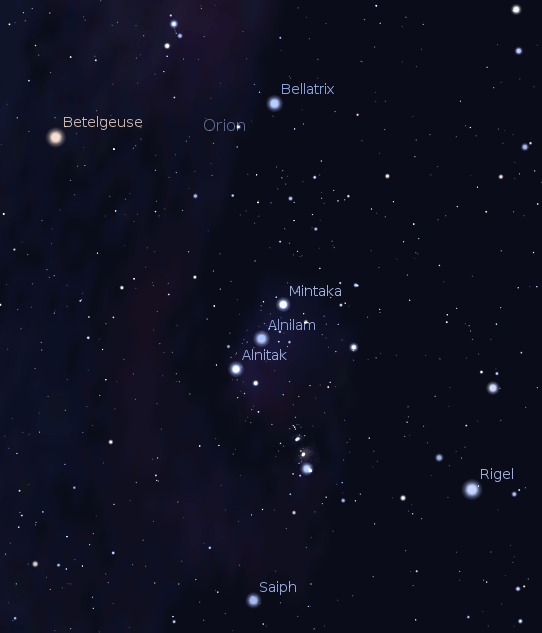
Torso of Orion centered on his belt. Created using Stellarium.
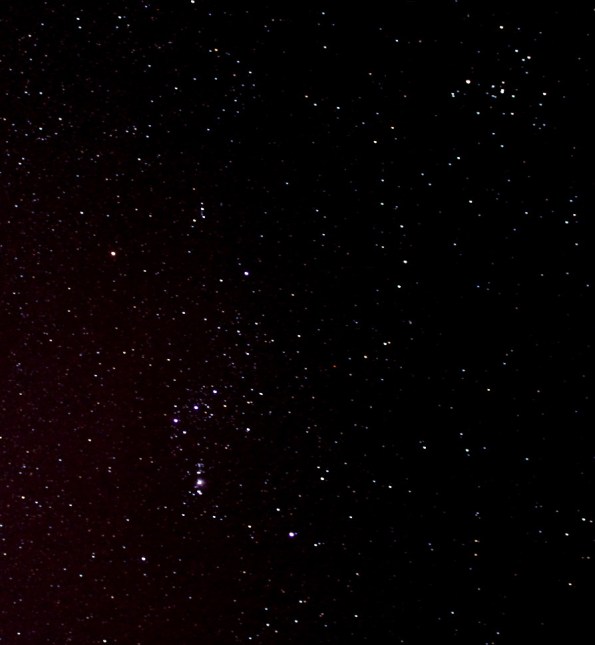
Orion and the head of Taurus photograph by myself January 4, 2016 at 11:30 p.m. It’s a stack of untracked 20 exposures.
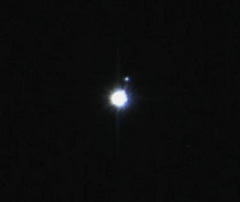
Rigel with its companion star as photographed through a telescope. No attribution. Source: http://washedoutastronomy.com/content/urban-orion?page=1
 Bob Moler's Ephemeris Blog