Archive
Ephemeris: 12/09/2025 – Aldebaran, the “Follower”
This is Ephemeris for Tuesday, December 9th. Today the Sun will be up for 8 hours and 53 minutes, setting at 5:02, and it will rise tomorrow at 8:09. The Moon, 2 days before last quarter, will rise at 10:34 this evening.
Tonight will be the night of the earliest sunset of the year. For the last few nights the Sun has been setting within the same minute. Soon the Sun will set noticeably later.
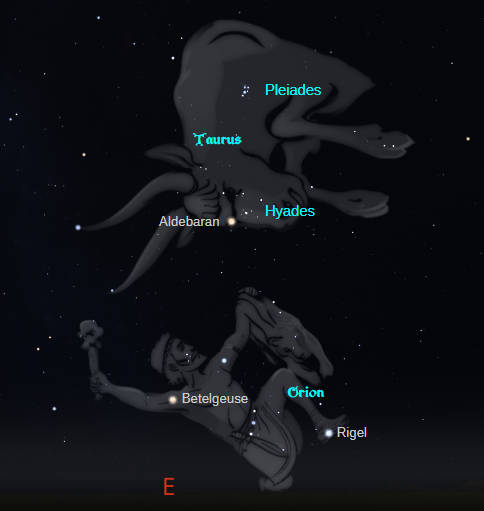
The bright star Aldebaran appears at the lower left tip of a letter V group of stars laying on it’s side, the Hyades star cluster and the face of Taurus the Bull. It’s in the east in the evening, above Orion. Aldebaran isn’t actually part of the group. The cluster is about 153 light years away, while Aldebaran is 65. The star has an orange hue because its surface is cooler than the Sun’s. However, Aldebaran is 44 times larger in diameter, and shines 425 times brighter than the Sun. The name Aldebaran means “Follower” because it follows the Pleiades star cluster across the sky.
The astronomical event times given in this blog are for the Traverse City/Interlochen area of Michigan (Lat 44.7° N, Long 85.7° W; EDT, UT – 4 hours) unless stated otherwise. Times will be different for other locations.
Addendum
Ephemeris: 11/10/2025 – Waiting on a stellar explosion
This is Ephemeris for Monday, November 10th. Today the Sun will be up for 9 hours and 46 minutes, setting at 5:19, and it will rise tomorrow at 7:34. The Moon, 2 days before last quarter, will rise at 10:22 this evening.
According to one astronomer, that I mentioned last Thursday, today is about the day he expects a star to erupt as a nova in the constellation Corona Borealis, the Northern Crown. In the early evening, it will appear low in the west northwest. The star is designated T Coronae Borealis (T CrB). Its appearance should make the normal news outlets, because it will be the brightest stellar outburst in a very long time. It will appear just left of the constellation Corona Borealis and be about as bright as its brightest normal star. However, it will soon fade and to be less the naked eye brightness in about a week. So we’re hoping for clear skies, if it happens. If it’s not this time, the next predicted time is June 25th, next year. Or he could be wrong, and it could go off at any time. Spaceweather.com has more information.
The astronomical event times given in this blog are for the Traverse City/Interlochen area of Michigan (Lat 44.7° N, Long 85.7° W; EDT, UT – 4 hours) unless stated otherwise. Times will be different for other locations.
Addendum
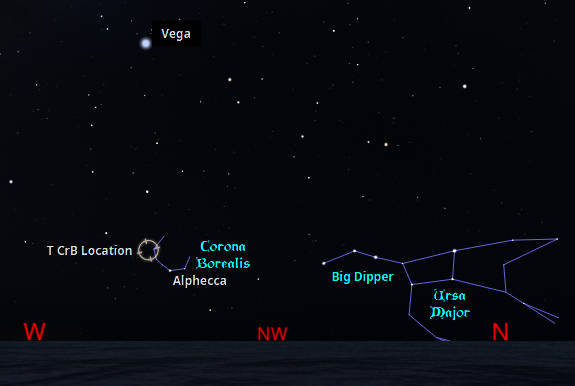
According to a paper in the Research Notes of the American Astronomical Society, Jean Schneider with the Paris Observatory predicted that the next eruption of T Coronae Borealis would be somewhere around November 10th 2025, or June 25th 2026. The first prediction of the 27th of March earlier this year turned out to not have occurred. These were tentative predictions based on the orbit around each other, of the two stars involved. The period of 80 years between eruptions is an approximation. There is an additional periodicity due to the fact that the two stars involved, a red giant and a white dwarf, have an orbital period of about 228 days which is why the predictions are 228 days apart. There have been four previous eruptions of the star observed. The first was in 1217, the next in 1787, then in 1866 and then finally in 1946. The reason for the big gap between 1217 and 1787 is unknown. Either the star didn’t erupt, or more likely, nobody observed and recorded it. The times of the first two eruptions weren’t accurately reports, but fell within what the 228-day periodicity would explain.
T Coronae Borealis is far enough north in the sky so that it is visible sometime during the night, year round. Currently, it would be best seen at the end of twilight in the west northwest. This will shift over to the morning sky, before morning twilight, after about the 25th of November, only 15 days from now in the east northeast. This star like any other star that rises and sets does so approximately 4 minutes earlier each night, or 28 minutes per week. So after the 25th the best observing opportunity will be before dawn in the morning until much later in the late winter, when it will be available also in the evening sky again.
Ephemeris: 10/30/2025 – Algol, the perfect Halloween star
This is Ephemeris for Thursday, October 30th. Today the Sun will be up for 10 hours and 15 minutes, setting at 6:33, and it will rise tomorrow at 8:19. The Moon, 1 day past first quarter, will set at 2:03 tomorrow morning.
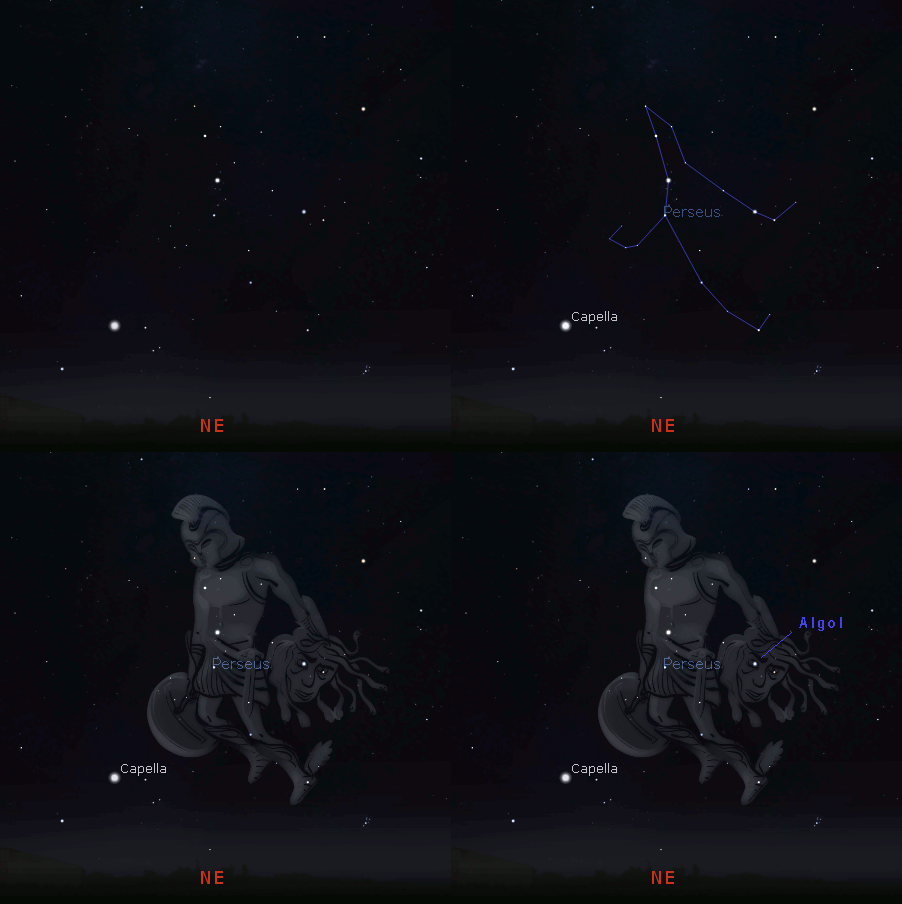
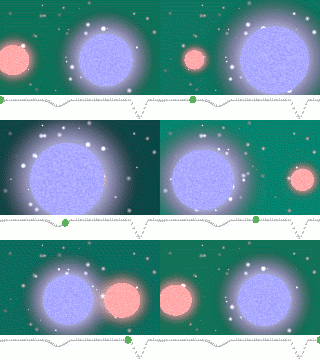
Not all the ghosts and goblins out tomorrow night will be children. One will be out every night because it’s a star. Its name is Algol, from the Arabic for Ghoul Star or Demon Star. It’s normally the second-brightest star in the constellation Perseus the hero, visible in the northeast this evening. The star is located where artists have drawn the severed head of Medusa, whom he had slain. Medusa was so ugly that she turned all who gazed upon her to stone. Algol is her still glittering eye. The star got these names before we knew what was wrong with it. It does a slow wink every two days, 21 hours. That’s because Algol is two stars that eclipse each other. Her next evening wink will be its dimmest at 10:12 p.m. Tuesday, November 4th.
The astronomical event times given in this blog are for the Traverse City/Interlochen area of Michigan (Lat 44.7° N, Long 85.7° W; EDT, UT – 4 hours) unless stated otherwise. Times will be different for other locations.
Addendum
Ephemeris: 10/17/2025 – Fomalhaut, lonely again
This is Ephemeris for Friday, October 17th. Today the Sun will be up for 10 hours and 52 minutes, setting at 6:54, and it will rise tomorrow at 8:02. The Moon, halfway from last quarter to new, will rise at 5:04 tomorrow morning.
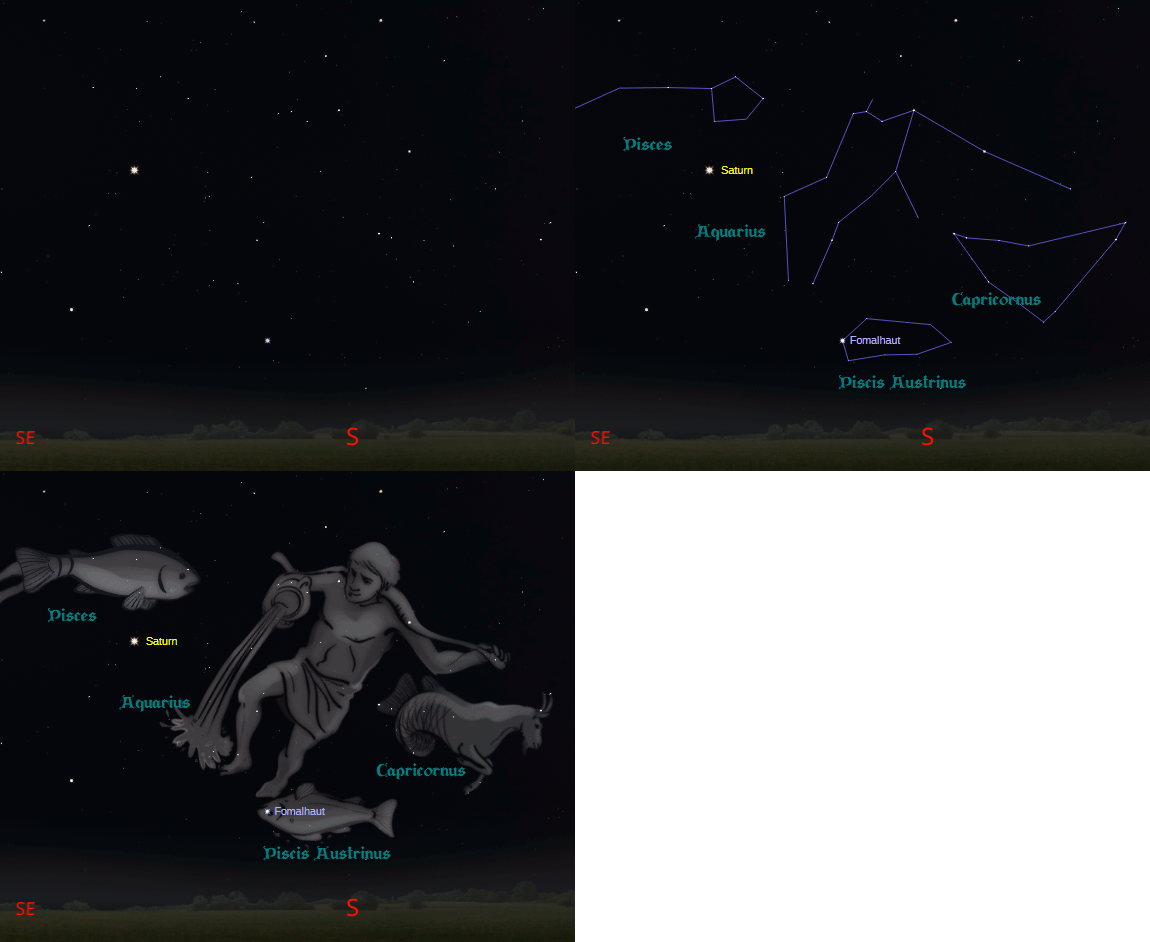
There’s a bright star that appears for only seven and a half hours on autumn evenings. Its appearance, low in the south in the evening, is a clear indication of autumn. It is currently below and right of the much brighter Saturn. The star’s name is Fomalhaut, which means fish’s mouth. That’s fitting because it’s in the constellation of Piscis Austrinus, the southern fish. At our latitude it’s kind of the fish that got away, because Fomalhaut is low in our skies where stars lose more than half their brightness. For the last few years Jupiter, then Saturn have kept it company. However, Saturn is moving on, having shifted into Pisces, leaving Fomalhaut to its lonely vigil in the south.
The astronomical event times given in this blog are for the Traverse City/Interlochen area of Michigan (Lat 44.7° N, Long 85.7° W; EDT, UT – 4 hours) unless stated otherwise. Times will be different for other locations.
Addendum
Ephemeris: 08/04/2025 – Mars’ twin
This is Bob Moler with Ephemeris for Monday, August 4th. Today the Sun will be up for 14 hours and 31 minutes, setting at 9:04, and it will rise tomorrow at 6:33. The Moon, 3 days past first quarter, will set at 2:10 tomorrow morning.
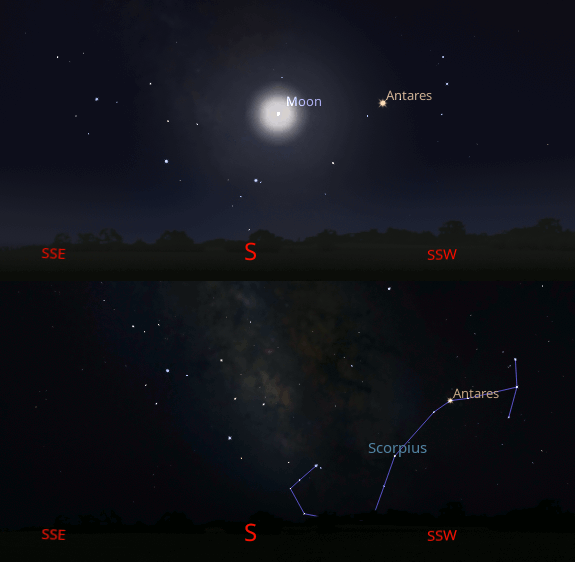
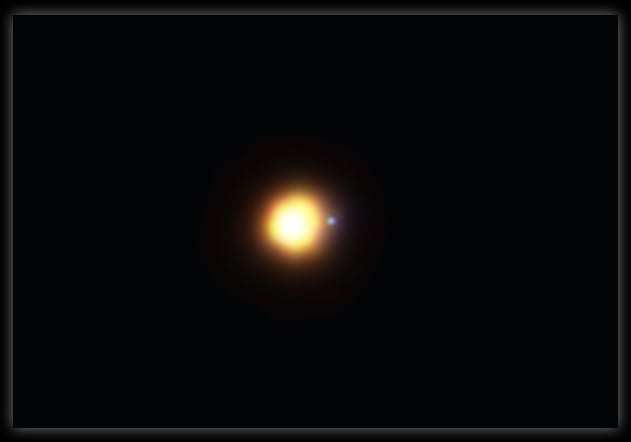
Low in the south as it gets dark is the red giant star Antares. It lies at the heart of Scorpius the scorpion. Its name means Rival of Mars, because it has the same hue as the red planet. In Mars case the color comes from iron oxide, rust. In Antares case it has a cool surface temperature, relatively speaking, of 7,000 degrees Fahrenheit (3,660 K). As a red giant star Antares is near the end of its life, though compared to the Sun it is young – possibly 12 million years old. At that age the Sun was just getting started. Antares, with around 13 to 16 times the Sun’s mass, has already run out of fusible hydrogen in its core and has bloated out to double Mars’ orbit in size. Antares is 550 light years away and has a companion star in its system that looks greenish in contrast to Antares red. But, when Antares A, the red giant’s light is blocked, the companion looks bluish.
The astronomical event times given in this blog are for the Traverse City/Interlochen area of Michigan (Lat 44.7° N, Long 85.7° W; EDT, UT – 4 hours) unless stated otherwise. Times will be different for other locations.
Addendum
Ephemeris: 07/29/2025 – Altair, the nearest Summer Triangle star
This is Ephemeris for Tuesday, July 29th. Today the Sun will be up for 14 hours and 45 minutes, setting at 9:11, and it will rise tomorrow at 6:27. The Moon, 3 days before first quarter, will set at 11:23 this evening.
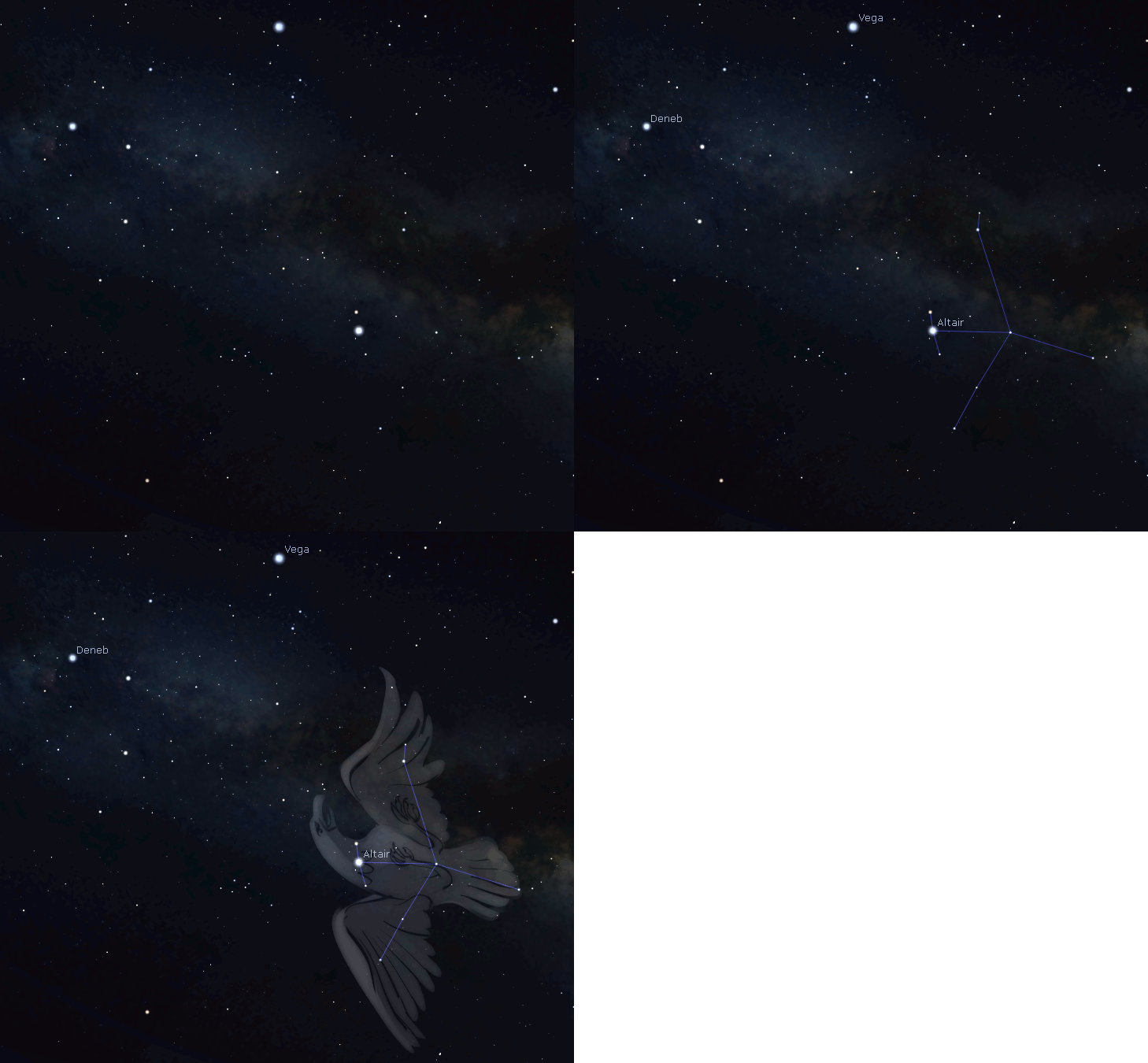
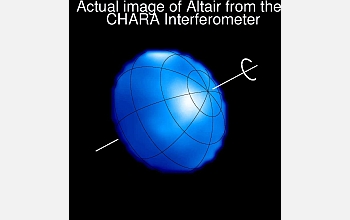
The southernmost star of the Summer Triangle is Altair, high in the east-southeast. The other two stars of the triangle are Vega nearly overhead in the east, and Deneb high in the east-northeast. Altair is the nearest of the three at a distance of 16.7 light years away. One light year is nearly 6 trillion miles. Altair is 10 times the brightness of the Sun. If seen at Altair’s distance, the Sun would only be as bright as one of the two stars that flank it. What is rather different about Altair is its rapid rotation. While it’s almost twice the sun’s diameter, it rotates once in about 9 hours, The CHARA Interferometer at Mt. Wilson has actually imaged its squashed disk in the infrared. Our Sun’s a slow poke, taking nearly a month to rotate once.
The astronomical event times given in this blog are for the Traverse City/Interlochen area of Michigan (Lat 44.7° N, Long 85.7° W; EDT, UT – 4 hours) unless stated otherwise. Times will be different for other locations.
Addendum
Ephemeris: 07/28/2025 – Deneb, a truly brilliant star
This is Ephemeris for Monday, July 28th. Today the Sun will be up for 14 hours and 48 minutes, setting at 9:12, and it will rise tomorrow at 6:26. The Moon, halfway from new to first quarter, will set at 11:06 this evening.
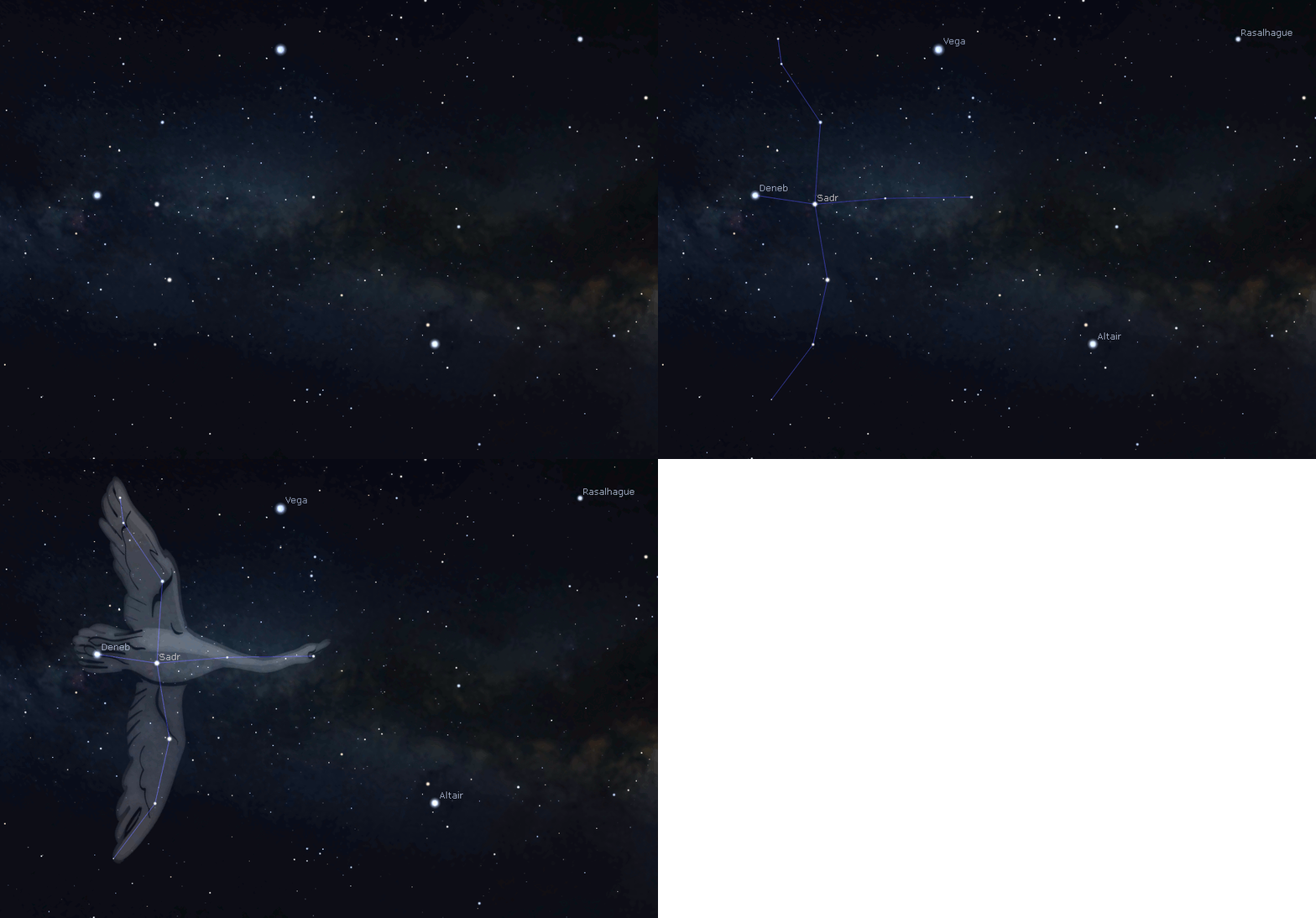
This evening when it gets dark enough the bright star Deneb in Cygnus the swan will be high in the east-northeast. Deneb is the dimmest star of the summer triangle. Of the other stars of the triangle, Vega is higher in the east, while Altair is lower in the southeast. Deneb’s apparent magnitude, or brightness as seen from Earth, is deceptive. Its vast distance of possibly 2,600 light years is over 100 times the distance of Vega. If brought as close as Vega, Deneb would be almost as bright as the quarter moon. It is possibly as bright as 200 thousand Suns; and a huge star, possibly as large as half the diameter of Earth’s orbit. For all this, it is only 19 to 25 times the mass of the Sun.
The astronomical event times given in this blog are for the Traverse City/Interlochen area of Michigan (Lat 44.7° N, Long 85.7° W; EDT, UT – 4 hours) unless stated otherwise. Times will be different for other locations.
Addendum
Ephemeris: 07/24/2025 – Vega, nearing the zenith in the evening now
This is Ephemeris for Thursday, July 24th. Today the Sun will be up for 14 hours and 56 minutes, setting at 9:17, and it will rise tomorrow at 6:21. The Moon is new today, and won’t be visible.
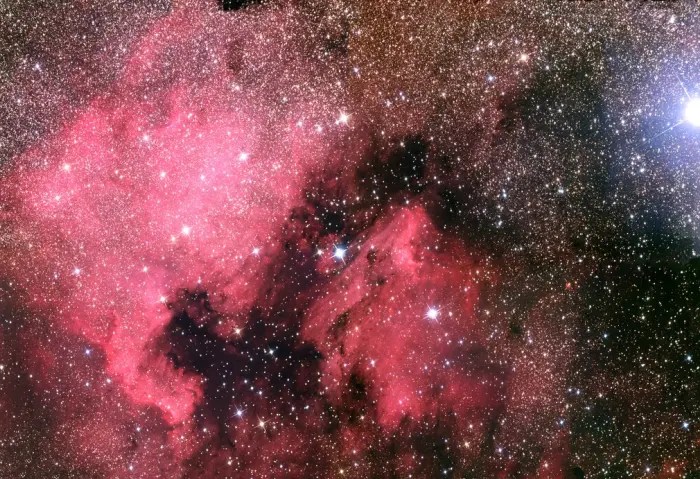
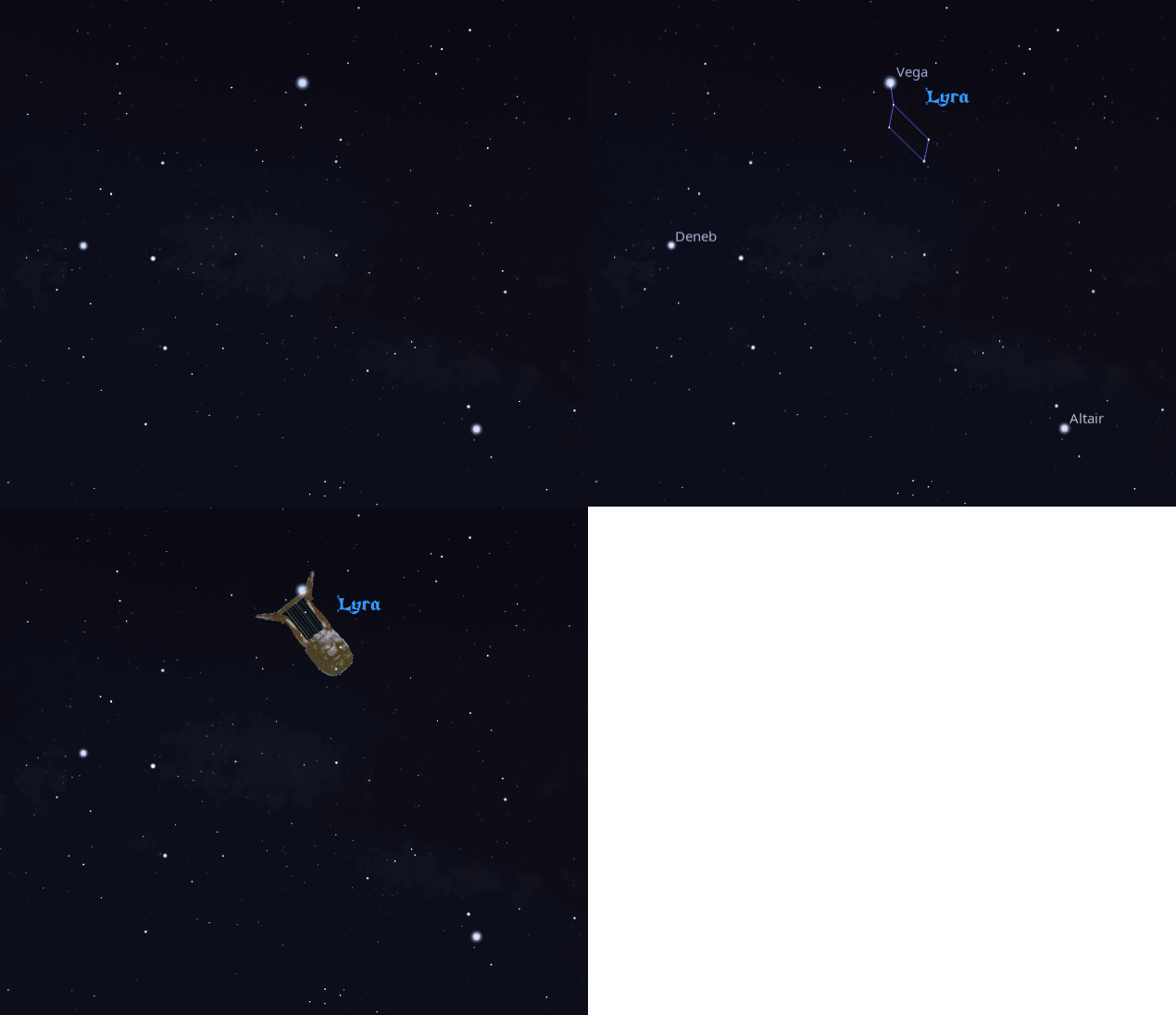
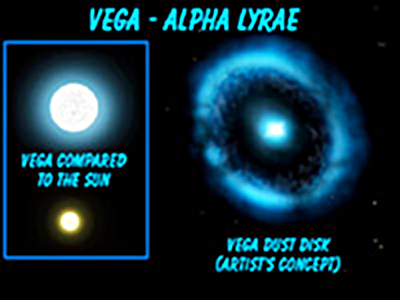
Vega, in the constellation Lyra the harp, is the highest bright star In the east and brightest star of the Summer Triangle also rising in that direction. It is an important and much studied star, first as a standard for brightness for the magnitude scale at almost exactly zero. In 1983 the Infrared Astronomy Satellite, IRAS, discovered an excess of infrared radiation coming from the star. It seems now that there are two orbiting rings around the star, an inner warm ring and an outer cold ring. This is somewhat like the two disks of material the Sun has: The asteroid belt between Mars and Jupiter and the Kuiper belt, beyond Neptune. No planets have yet been discovered around Vega, but I wouldn’t bet against it.
The astronomical event times given in this blog are for the Traverse City/Interlochen area of Michigan (Lat 44.7° N, Long 85.7° W; EDT, UT – 4 hours) unless stated otherwise. Times will be different for other locations.
Addendum
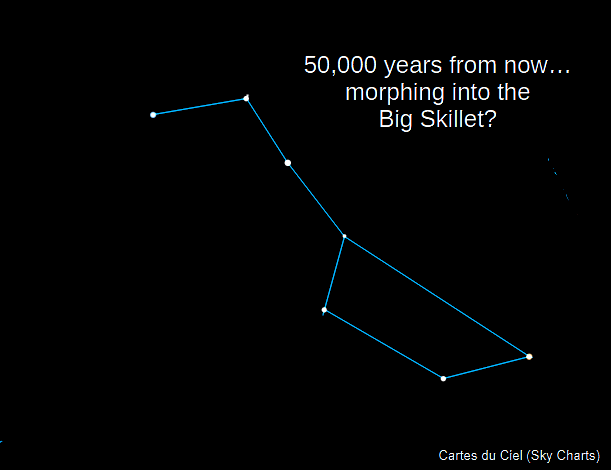
Ephemeris: 06/23/2025 – The Big Dipper is tearing itself apart
This is Ephemeris for Monday, June 23rd. Today the Sun will be up for 15 hours and 34 minutes, setting at 9:32, and it will rise tomorrow at 5:58. The Moon, 2 days before new, will rise at 4:33 tomorrow morning.
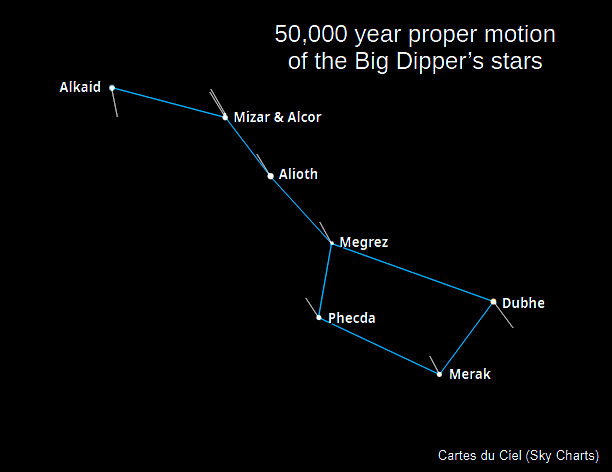
The usual impression is to think that the stars of a constellation are actually located close together. This is usually not true. The stars of a constellation can be at vastly different distances. The Big Dipper is different. The five stars, excepting the two end stars of the dipper and 12 other dimmer stars in the general area are of similar distance and have the same motion through space. The group is called the Ursa Major Moving Cluster or Ursa Major Association, and is moving about 9 miles per second relative to the solar system to the east. An association is a rather loose, sparse star cluster. This association lies about 80 light years away. If it were five and a half times farther away, it would be the same distance as the Pleiades.
The astronomical event times given in this blog are for the Traverse City/Interlochen area of Michigan (Lat 44.7° N, Long 85.7° W; EDT, UT – 4 hours) unless stated otherwise. Times will be different for other locations.
Addendum
Ephemeris: 06/12/2025 – Another look at the star Spica
This is Ephemeris for Thursday, June 12th. Today the Sun will be up for 15 hours and 32 minutes, setting at 9:29, and it will rise tomorrow at 5:56. The Moon, 1 day past full, will rise at 11:20 this evening.
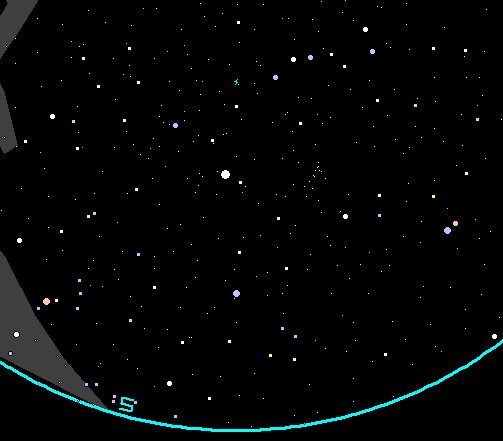
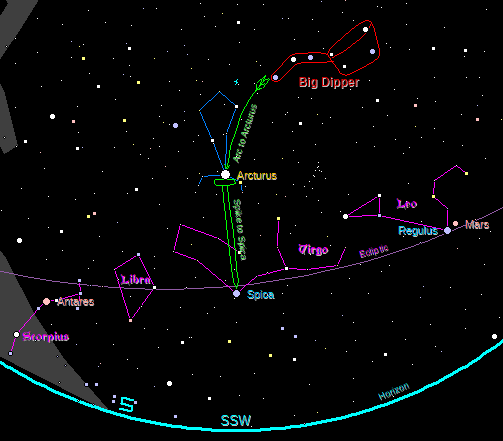
In the south-southwest at 11 PM is the bright star Spica in Virgo the virgin. Arcturus, high in the south, is much brighter than Spica and has an orange tint to Spica’s bluish hue. In fact, Spica is the 15th brightest and the bluest of the 21 first magnitude stars. That means that it has a really hot surface temperature. Spica is actually two stars in a tight 4-day orbit of each other. They are both reasonably matched in mass and brightness. I found that out once photographing a lunar eclipse near Spica, The star came out very blue. The twin stars of Spica are 250 light years away. I’m glad the stars are young now. They will have a very interesting future as they age and interact in the next few million years.
The astronomical event times given in this blog are for the Traverse City/Interlochen area of Michigan (Lat 44.7° N, Long 85.7° W; EDT, UT – 4 hours) unless stated otherwise. Times will be different for other locations.
Addendum