Archive
Ephemeris: 05/16/2025 – Two bright stars, alike but different
This is Bob Moler with Ephemeris for Friday, May 16th. Today the Sun will be up for 14 hours and 52 minutes, setting at 9:05, and it will rise tomorrow at 6:12. The Moon, halfway from full to last quarter, will rise at 1:21 tomorrow morning.
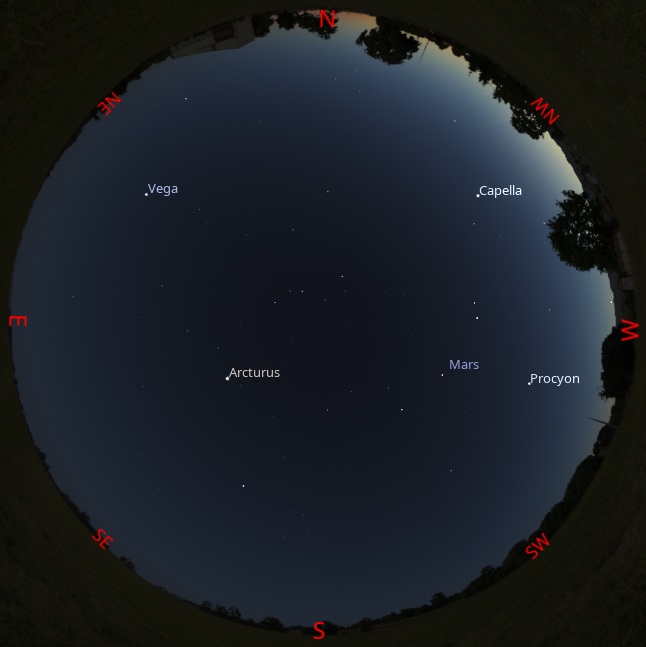
Two stars which I’ve been known to confuse in the twilit sky in late spring and late summer are Arcturus and Vega. These stars have about the same brightness and in some lists of stars swap places between the 4th and 5th brightest stars in the sky. Arcturus is an orangish star, now high in the southern sky in the evening, while Vega is a pure white star which to my eyes tends towards a little tinge of blue. Vega is high in the south, actually almost overhead, in the late summer. Now, in mid to late Spring Vega is rather low in the northeastern sky. Arcturus is a cool star on the outside which has depleted the hydrogen in its core and is a red giant star, while the younger and more massive Vega, still turning hydrogen into helium.
The astronomical event times given in this blog are for the Traverse City/Interlochen area of Michigan (Lat 44.7° N, Long 85.7° W; EDT, UT – 4 hours) unless stated otherwise. Times will be different for other locations.
Addendum
Ephemeris: 05/13/2025 – Arcturus, extragalactic visitor?
This is Ephemeris for Tuesday, May 13th. Today the Sun will be up for 14 hours and 45 minutes, setting at 9:02, and it will rise tomorrow at 6:15. The Moon, 1 day past full, will rise at 10:39 this evening.
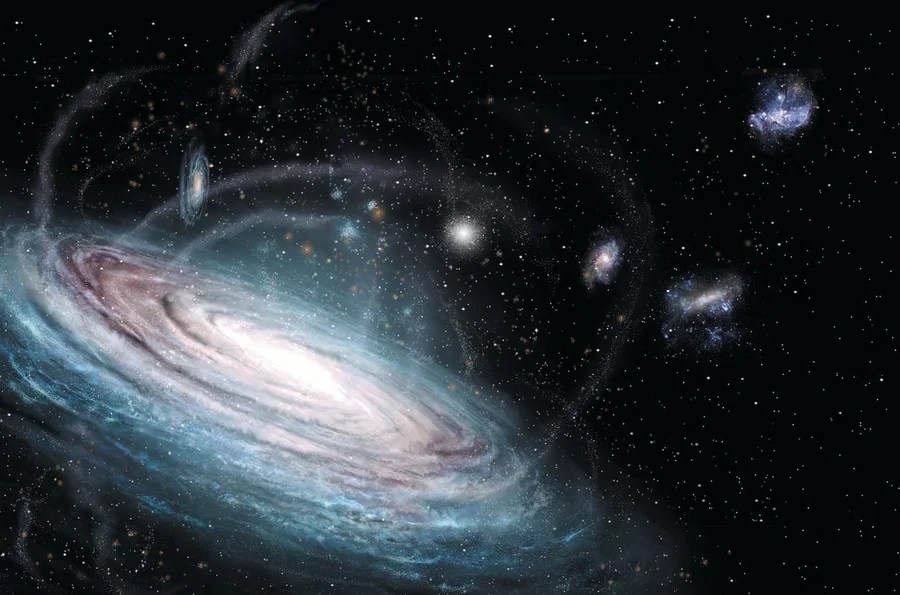
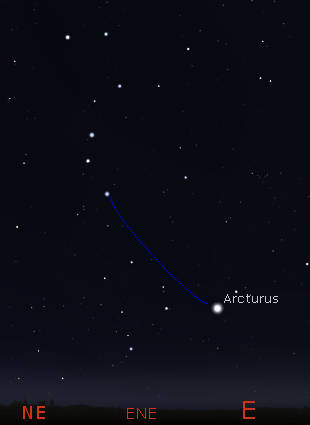
The bright orange star high in the southeast at 10 PM is Arcturus. Remember: Follow the arc of the handle of the Big Dipper to find Arcturus. It is an interesting star in many respects. Arcturus is somewhat more massive than the Sun and a bit older. It is starting its red giant phase having run out of hydrogen in its core and starting to use helium as its heat source, transmuting it into carbon and other elements. It has a very high velocity with respect to the Sun of about 100 kilometers per second. Arcturus is thought to be, by some astronomers, part of the remnants of a dwarf galaxy that collided with the Milky Way, and has now been assimilated. So Arcturus isn’t from around here.
-The astronomical event times given in this blog are for the Traverse City/Interlochen area of Michigan (Lat 44.7° N, Long 85.7° W; EDT, UT – 4 hours) unless stated otherwise. Times will be different for other locations.
Addendum
Ephemeris: 04/25/2025 – The star that opened a World’s Fair
This is Ephemeris for Arbor Day, Friday, April 25th. Today the Sun will be up for 13 hours and 59 minutes, setting at 8:40, and it will rise tomorrow at 6:39. The Moon, 2 days before new, will rise at 5:50 tomorrow morning.
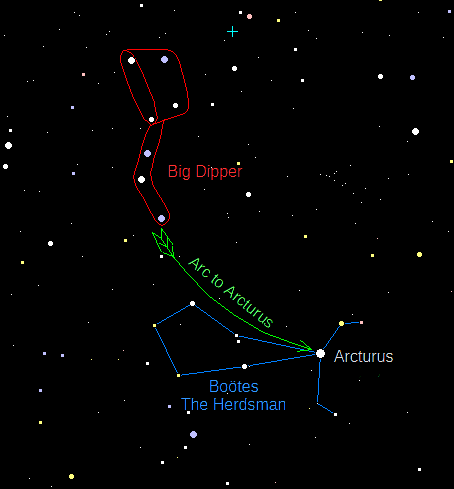
High in the eastern sky at 10 tonight can be found the kite shaped constellation of Boötes the herdsman, chasing or herding the Great Bear Ursa Major of which the Big Dipper is the hind end, across the sky. The bright star at the base of the kite is the 4th brightest nighttime star, Arcturus. It can be found and name remembered by first locating the Big Dipper and by following the arc or curve of the handle to Arcturus. This star is an orange-colored giant star, 37 light years away. Its light was used to open the 1933 Chicago Worlds Fair believing its light left the star in 1893 the year of the previous Chicago Worlds Fair. It turns out that Arcturus is 3 light years closer than what they thought.
The astronomical event times given are for the Traverse City/Interlochen area of Michigan (EDT, UT – 4 hours). Times will be different for other locations.
Addendum

For more on how they did it go to: https://chicagology.com/centuryprogress/1933fair54/
Ephemeris: 04/21/2025 – Follow the spike to Spica
This is Ephemeris for Monday, April 21st. Today the Sun will be up for 13 hours and 47 minutes, setting at 8:35, and it will rise tomorrow at 6:46. The Moon, 1 day past last quarter, will rise at 4:25 tomorrow morning.
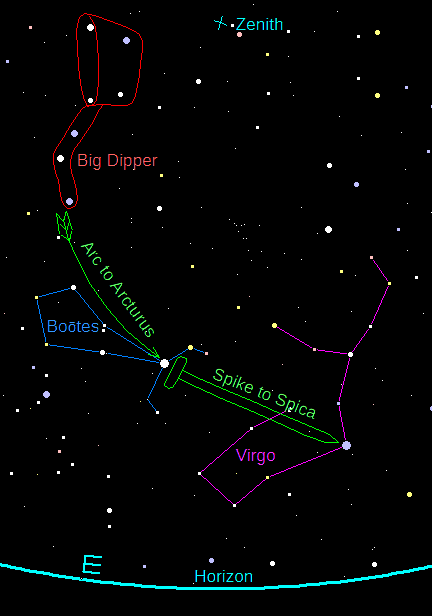
In the south-southeast at 10:30 p.m. is the bright star Spica, which can be found from all the way back overhead to the Big Dipper. Follow the arc of the handle of the Big Dipper to the bright star Arcturus below it in the east-southeast. Then straighten the curve of the arc to a straight spike which points to Spica, the brightest star in Virgo the virgin. Arcturus is much brighter than Spica and has an orange tint to Spica’s bluish hue. In fact, Spica is the bluest of the 21 first magnitude stars. That means that it has a really hot surface temperature. Actually, Spica is really two blue-white stars orbiting each other in 4 days. Spica is 250 light years away. It also was an important star to the ancient Greeks. One temple was built and aligned to its setting point. The astronomical event times given are for the Traverse City/Interlochen area of Michigan (EDT, UT – 4 hours). Times will be different for other locations.
The astronomical event times given are for the Traverse City/Interlochen area of Michigan (EDT, UT – 4 hours). Times will be different for other locations.
Addendum

Ephemeris: 04/14/2025 – Follow the arc to Arcturus
This is Ephemeris for Monday, April 14th. Today the Sun will be up for 13 hours and 27 minutes, setting at 8:27, and it will rise tomorrow at 6:57. The Moon, 2 days past full, will rise at 10:36 this evening.
The fourth or fifth-brightest nighttime star, depending on whose list you see, is now up in the east in the evening. It is Arcturus, a bright star with an orange hue. It can be found otherwise by finding the Big Dipper and tracing out and extending the curve of the handle and “Follow the arc of the handle to Arcturus”, to remember the name of the star and how to find it. Arcturus is about 37 light years from us and is moving quite rapidly across the sky, compared to most stars, though one would not notice it to the naked eye in one’s lifetime. Arcturus is slightly more massive than our Sun, and about 7 billion years old, and is entering its red giant stage of life after using all the hydrogen fuel in its core. Our Sun, being slightly less massive will survive on hydrogen a bit longer.
The astronomical event times given are for the Traverse City/Interlochen area of Michigan (EDT, UT – 4 hours). Times will be different for other locations.
Addendum

Ephemeris: 04/08/2025 – A look at Proxima Centauri
This is Ephemeris for Tuesday, April 8th. Today the Sun will be up for 13 hours and 9 minutes, setting at 8:19, and it will rise tomorrow at 7:08. The Moon, halfway from first quarter to full, will set at 5:57 tomorrow morning.
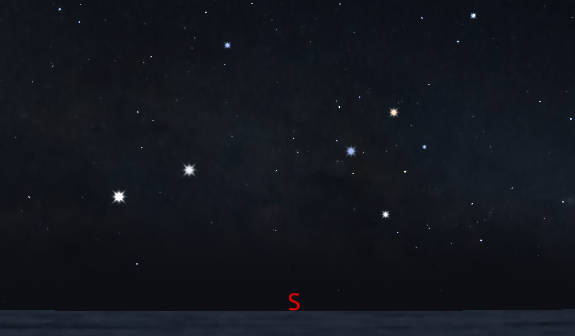
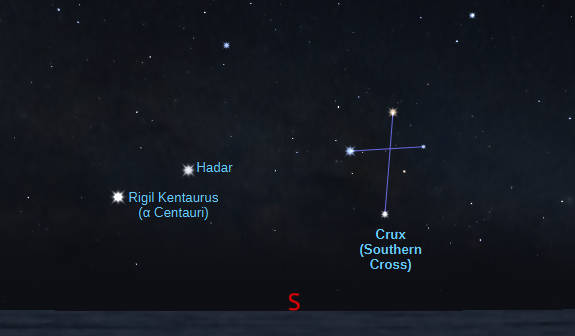
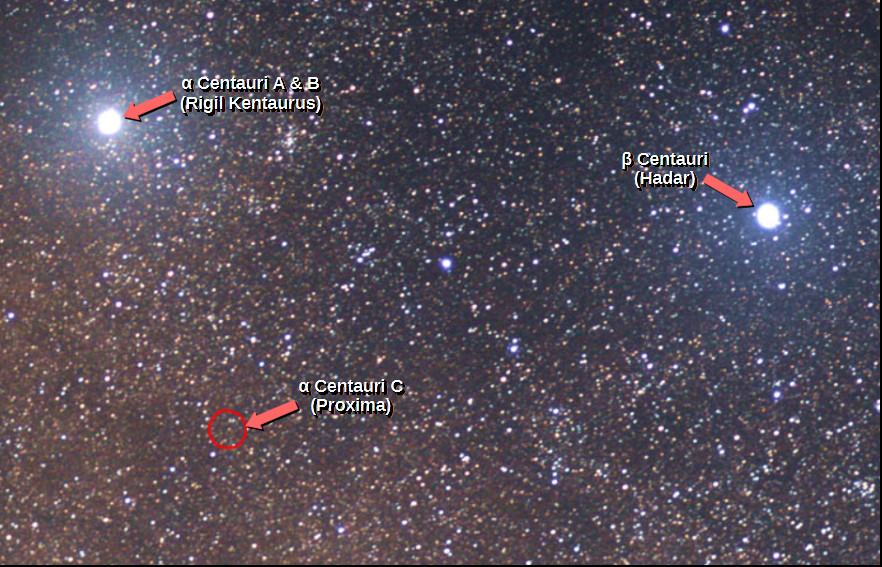
The nearest star to our Sun is a triple star system called Alpha Centauri or Rigil Kentaurus. It is in the skies of the Southern Hemisphere, but visible from the far southern parts of the United States. I’ve seen it from the Florida Keys and also from the latitude of the Big Island of Hawai’i. The closest member of that group this is a star we call Proxima Centauri or just Proxima for short. It is not visible to the naked eye. It is a red dwarf star maybe 12% the Sun’s mass, and at 11th magnitude. Proxima would be tough to spot with a pair of binoculars in a region of the sky which is filled with stars because it’s in the band of the Milky Way. Alpha Centauri, itself, is located near the Southern Cross, the farthest of the two bright stars to the east of it.
The astronomical event times given are for the Traverse City/Interlochen area of Michigan (EDT, UT – 4 hours). Times will be different for other locations.
Addendum
Ephemeris: 02/21/2025 – Orion’s most distinctive feature
This is Bob Moler with Ephemeris for Friday, February 21st. Today the Sun will be up for 10 hours and 46 minutes, setting at 6:20, and it will rise tomorrow at 7:31. The Moon, 1 day past last quarter, will rise at 4:09 tomorrow morning.
Orion’s belt of three stars is one of the most noticeable star groupings in the sky. There are no other groups of three bright stars in a straight line visible anywhere else in the sky. The star’s names from left to right are Alnitak, Alnilam and Mintaka. They are actually a bit farther away than the other bright stars of Orion. Alnilam, the center star, is over three times the distance of red giant Betelgeuse above it and over twice as far as blue white giant star Rigel below it. Alnilam is 375 thousand times brighter than the Sun. These three stars were also known as Frigga’s Spindle by the Norsemen. Frigga, also known as Freya, is the goddess from whom we get the name of the day of the week we call Friday.
The astronomical event times given are for the Traverse City/Interlochen area of Michigan (EST, UT – 5 hours). Times will be different for other locations.
Addendum
Ephemeris: 01/30/2025 – What’s up with Betelgeuse
This is Bob Moler with Ephemeris for Thursday, January 30th. Today the Sun will be up for 9 hours and 45 minutes, setting at 5:49, and it will rise tomorrow at 8:02. The Moon, 1 day past new, will set at 7:20 this evening.
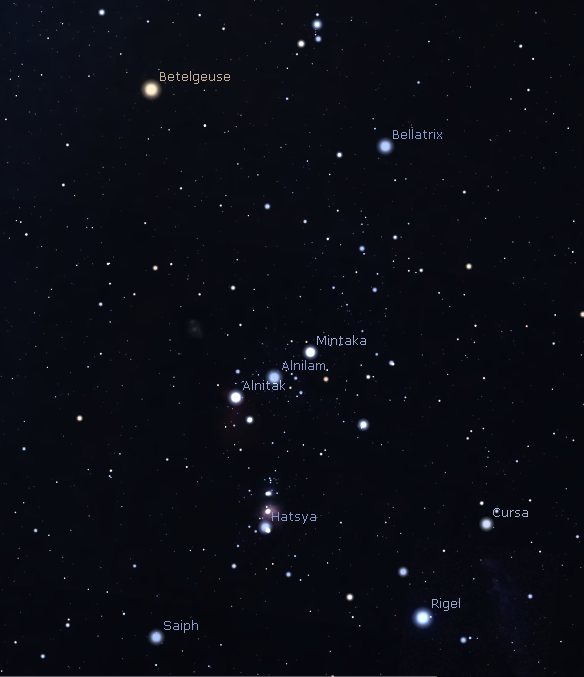
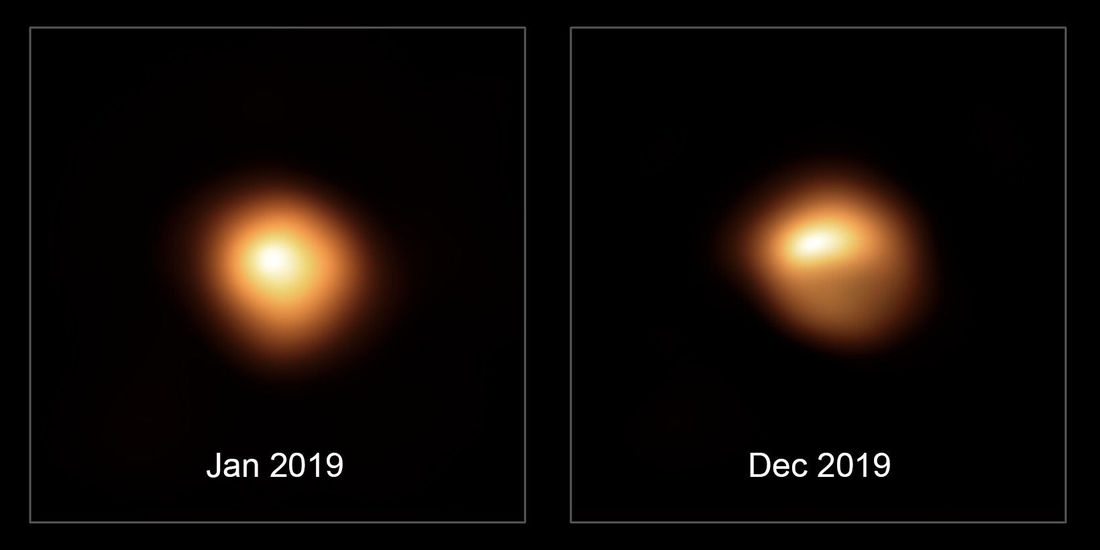
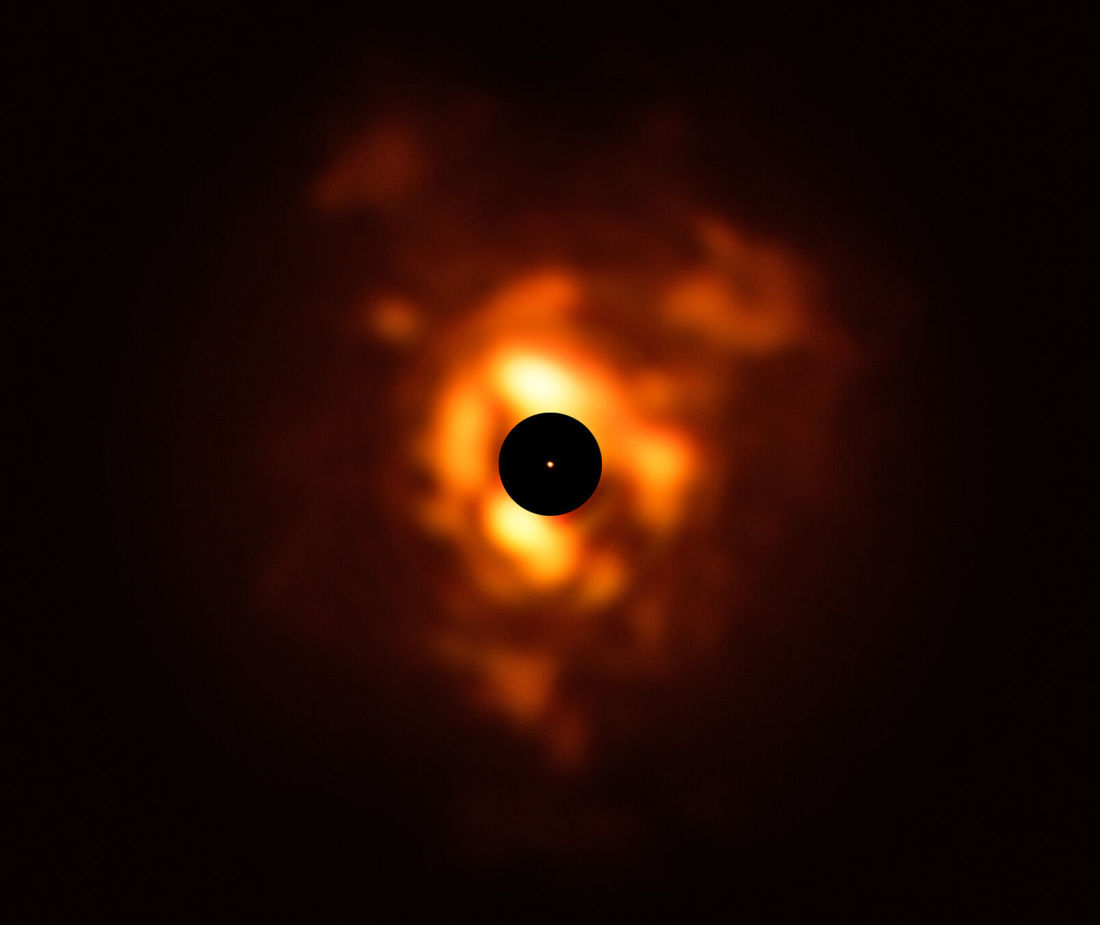
The constellation Orion is in the southeast at 8 PM, so what’s up with Betelgeuse. Betelgeuse is the bright reddish upper leftmost star of the torso of Orion the hunter, it’s in his shoulder. Betelgeuse has been acting up lately. In 2019 and 2020 Betelgeuse had dimmed significantly. Astronomers didn’t know why at the time, but found out later that it ejected a large cloud of gas and dust which blocked the light from the star. Since then Betelgeuse has increased its brightness significantly, so it’s much brighter than normal. Again, we don’t exactly know why. Some have speculated that Betelgeuse is will soon go supernova. We’ve known that for a while, but soon is measured in hundreds of thousands of years. So astronomers are keeping an eye on Betelgeuse to see what happens next.
The astronomical event times given are for the Traverse City/Interlochen area of Michigan (EST, UT – 5 hours). Times will be different for other locations.
Addendum
Ephemeris: 01/28/2025 – Tranquility amongst chaos
This is Bob Moler with Ephemeris for Tuesday, January 28th. Today the Sun will be up for 9 hours and 40 minutes, setting at 5:46, and it will rise tomorrow at 8:04. The Moon, 1 day before new, will rise at 8:34 tomorrow morning.
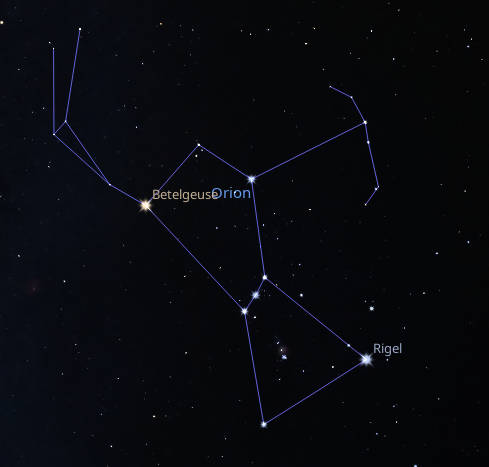
We’ve come off a tumultuous week, and while this program deals with topics generally in the heavens. Events on the Earth more than occasionally intrude. I often remind folks that the Earth is a planet too; an astronomical object in someone else’s sky. I consider astronomy not to be just about the heavens but about the entire universe of which the Earth is a part. The heavens above the Earth to the naked eye at least seems to be a tranquil place. That is because we cannot, with our human senses, pick up the energies of the great collisions and the other cataclysms in the universe, due to distance, our protective atmosphere and our limited senses. So going out under the stars for a while is a way to get away from it all: far, far away.
The astronomical event times given are for the Traverse City/Interlochen area of Michigan (EST, UT – 5 hours). Times will be different for other locations.
Addendum

Ephemeris: 01/20/2025 – The planets augment the Winter Hexagon
This is Ephemeris for Martin Luther King Jr. Day, Monday, January 20th. Today the Sun will be up for 9 hours and 22 minutes, setting at 5:35, and it will rise tomorrow at 8:12. The Moon, 1 day before last quarter, will rise at 12:56 tomorrow morning.
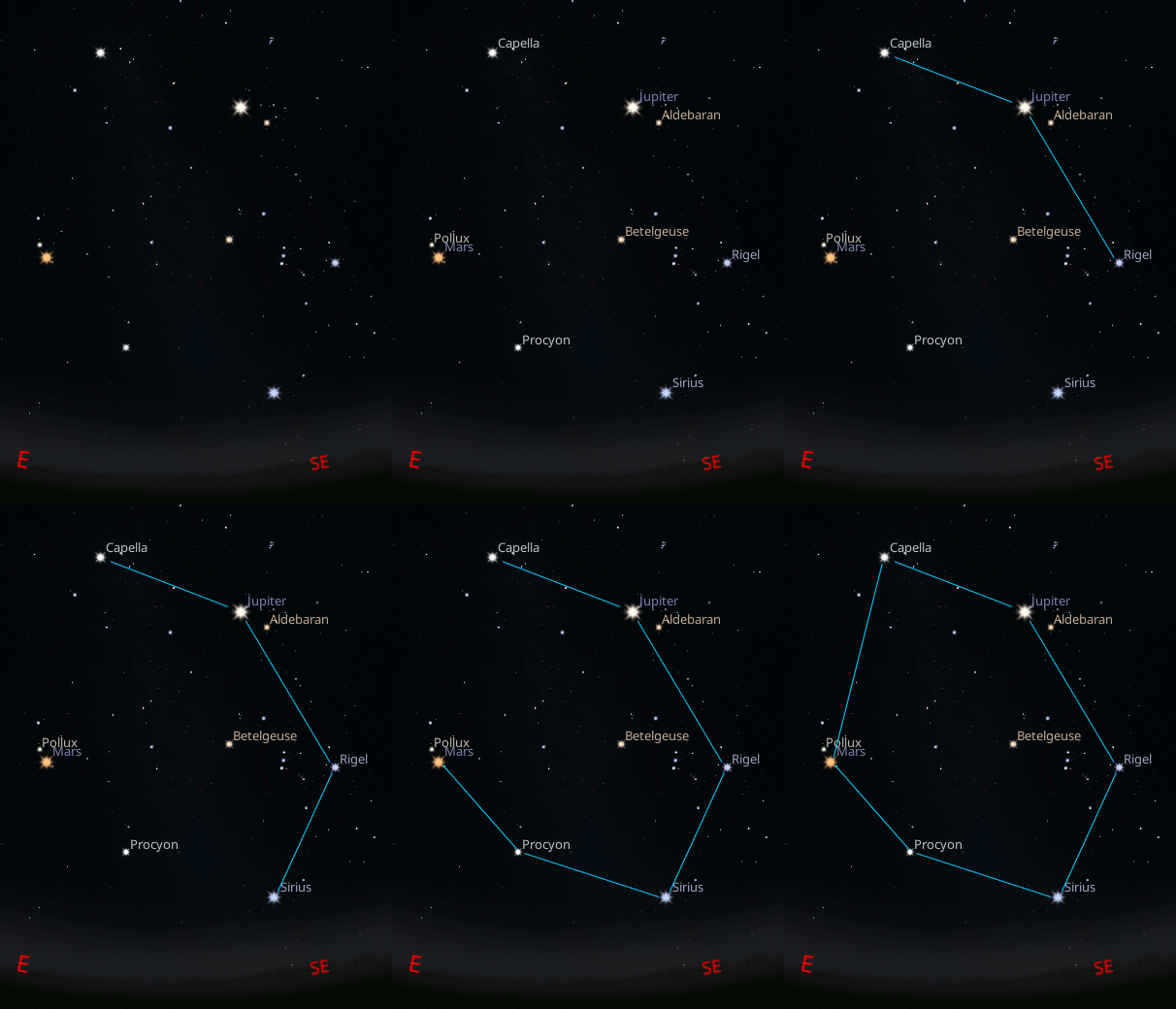
The winter circle or more properly hexagon, seen in the winter sky this evening, has the addition of two planets, and they’re in the proper location so that they don’t spoil the hexagon. We start at the top with the star Capella high in the east. We move clockwise downward to Jupiter and below it the star Aldebaran. We drop lower to Orion’s knee and the star Rigel, then down to Sirius, low in the southeast, the brightest nighttime star, but doesn’t hold a candle to Jupiter. Then we go above left to Procyon and upwards and left to Mars, which is near Pollux, and finally back up to Capella. That’s that is our winter hexagon right now, so take it in while you can, before Jupiter and Mars move off and mess it up.
The astronomical event times given are for the Traverse City/Interlochen area of Michigan (EST, UT – 5 hours). Times will be different for other locations.
Addendum
 Bob Moler's Ephemeris Blog