Archive
02/07/2013 – Ephemeris – The brother stars Castor and Pollux
Ephemeris for Thursday, February 7th. The sun will rise at 7:53. It’ll be up for 10 hours and 6 minutes, setting at 6:00. The moon, 3 days before new, will rise at 6:22 tomorrow morning.
At 9 p.m. the constellation of Gemini the twins will be seen high in the southeast. The namesake stars of the two lads are the two bright stars at the top of the constellation. Pollux the pugilist, or boxer, is the lower of the two, while Castor, the horseman, is the other star, or rather a six star system. In telescopes two close stars may be seen each is a spectroscopic binary, meaning the lines of two stars can be seen in the spectrum. A faint nearby spectroscopic binary also belong. Pollux, though a single star, does have at least one planet, one over twice the mass of Jupiter orbiting the star at a distance somewhat greater than Mars is from the sun. Pollux is 34 light years away while Castor is 50 light years away. Not too far away as stars go.
Times are for the Traverse City/Interlochen area of Michigan. They may be different for your location.
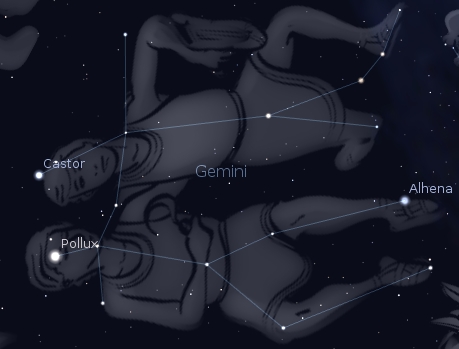
Gemini with Castor and Pollux. Created with Stellarium.
Addendum
02/05/2013 – Ephemeris – The bright stars Castor and Pollux of Gemini
Ephemeris for Tuesday, February 5th. The sun will rise at 7:56. It’ll be up for 10 hours and 1 minute, setting at 5:57. The moon, 2 days past last quarter, will rise at 4:42 tomorrow morning.
The constellation Gemini, the Twins is visible high in the southeast at 9 p.m. The namesake stars of the two lads, will be on the upper left edge of the constellation, diagonally aligned. Castor is to the upper right, while Pollux, a slightly brighter star is below left. Lines of stars from castor and Pollux to the lower right delineate the lads. In Greek mythology Castor and Pollux were twins, and half brothers, Castor was fathered by a mere mortal, while Pollux was fathered by Zeus in the famous Leda and the swan affair. The brothers, however were inseparable, and when Castor was killed during the quest for the Golden Fleece, Pollux pleaded with Zeus to let him die also. Zeus granted his wish, so both appear in the sky together forever.
Times are for the Traverse City/Interlochen area of Michigan. They may be different for your location.
Addendum
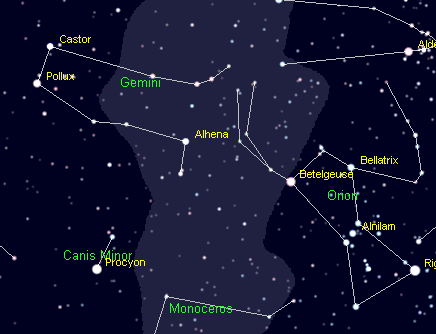
Gemini and Orion. Created using Cartes du Ciel
01/29/2013 – Ephemeris – Procyon, the Little Dog Star
Ephemeris for Tuesday, January 29th. The sun will rise at 8:04. It’ll be up for 9 hours and 43 minutes, setting at 5:47. The moon, 3 days past full, will rise at 8:52 this evening.
The constellation Orion has two hunting dogs. We’ve seen Canis Major the greater dog at Orion’s feet with Sirius in its heart. The lesser dog, Canis Minor iS level with Betelgeuse in Orion’s shoulder and off to the left. Just two stars mark it. Is it a dachshund or maybe a hot dog? It’s brighter star’s name is Procyon which means “Before the dog”, an odd title. It means that though east of Sirius, it rises before Sirius, due to its more northerly position in the sky. In many ways Procyon is nearly a twin of Sirius. It shines with the same white color, although a bit cooler, and has a white dwarf companion like Sirius. It’s a bit farther away than Sirius 8 light years. Procyon is at a distance of 11.46 light years. Procyon, Betelgeuse and Sirius make the winter triangle.
Times are for the Traverse City/Interlochen area of Michigan. They may be different for your location.
Addendum
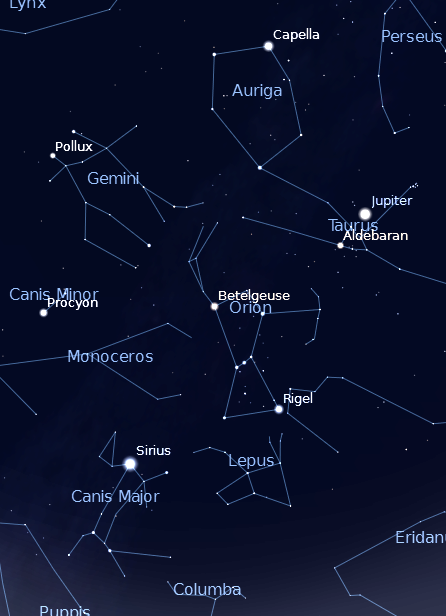
Winter Circle and Jupiter with Procyon to the far left. Created using Stellarium.
01/25/2013 – Ephemeris – The star names of Orion
Ephemeris for Friday, January 25th. The sun will rise at 8:08. It’ll be up for 9 hours and 33 minutes, setting at 5:42. The moon, 1 day before full, will set at 7:23 tomorrow morning.
The constellation of Orion the hunter is visible in the south at 9 p.m. The stars of Orion are interesting in themselves. Starting at the top left of the seven bright stars of Orion’s torso is Betelgeuse the bright red star, whose name means something like “Armpit of the Giant”. The star in Orion’s other shoulder is Bellatrix the “Amazon Star”. Below are the three stars of Orion’s belt, from left to right; Alnitak, Alnilam and Mintaka. Their names mean “Girdle”, “Belt of Pearls”, and “Belt” respectively. Down to Orion’s knees we look on the left to the star Saiph which means “Sword”, though it is some ways from the stars of Orion’s sword. Finally there’s the bright blue-white star Rigel whose name means “left Leg of the Giant”.
Times are for the Traverse City/Interlochen area of Michigan. They may be different for your location.
Addendum
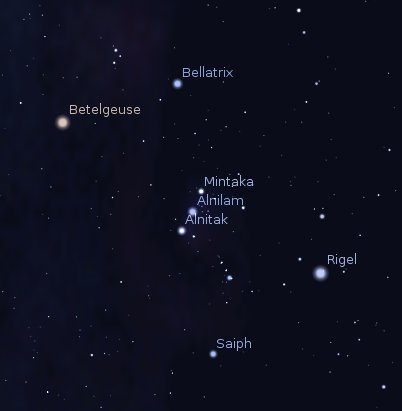
Orion with star names
01/24/2013 – Ephemeris – Sirius B, the Pup
Ephemeris for Thursday, January 24th. The sun will rise at 8:09. It’ll be up for 9 hours and 31 minutes, setting at 5:40. The moon, 2 days before full, will set at 6:48 tomorrow morning.
Sirius is the brightest night-time star and is located in the south at 9 p.m. below and a bit left of Orion the Hunter. We’ve visited Sirius Tuesday. But there is another star in the Sirius system that is practically invisible due to Sirius’ dazzling glare. Its name is Sirius B, nicknamed the Pup, alluding to Sirius’ Dog Star title. The tiny star was suspected as far back as 1834 due to Sirius’ wavy path against the more distant stars. Sirius and the Pup have 50 year orbits of each other. The Pup was first seen by famed 19th century telescope maker Alvan Clark in 1862 while testing a new telescope. The Pup was the first of a new class of stars to be discovered, white dwarfs. The Pup, with the mass of the sun, is only the size of the earth.
Times are for the Traverse City/Interlochen area of Michigan. They may be different for your location.
Addendum
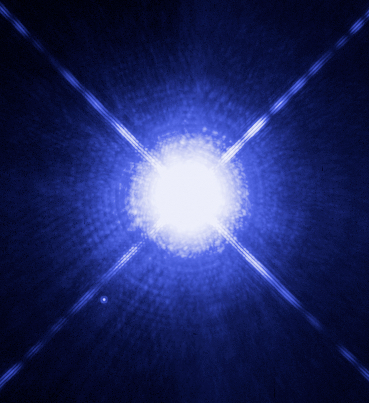
Sirius A and B (near the diffraction spike to the lower left), A Hubble Space Telescope photograph. Credit NASA, ESA.
The Hubble Space Telescope has two mirrors to produce its main image. The concave primary mirror, and a secondary mirror in front supported by 4 vanes called a spider. Light passing these vanes are bent or diffracted causing bright stars to have these 4 spikes. Most reflecting telescopes produce these diffraction spikes.
01/22/2013 – Ephemeris – Sirius the Dog Star
Ephemeris for Tuesday, January 22nd. The sun will rise at 8:10. It’ll be up for 9 hours and 27 minutes, setting at 5:37. The moon, half way from first quarter to full, will set at 5:23 tomorrow morning.
The brightest star-like object in the evening sky is Jupiter high in the sky now. The second brightest star-like object is Sirius, also known as the Dog Star. It also is the brightest night-time star in our skies period. Tonight at 9 p.m. it’s located low in the southeastern sky. The Dog Star name comes from its position at the heart of the constellation Canis Major, the great dog of Orion the hunter. The three stars of Orion’s belt tilt to the southeast and point to Sirius. The name Sirius means ‘Dazzling One’ or ‘Scorcher’, a reference to its great brilliance and twinkling. Its Egyptian name was Sothis, and its appearance in the dawn skies in late June signaled the flooding of the Nile, and the beginning of the Egyptian agricultural year.
Times are for the Traverse City/Interlochen area of Michigan. They may be different for your location.
Addendum
Winter Circle and Jupiter with Sirius at the bottom. Created using Stellarium.
01/18/2013 – Ephemeris – Aldebaran, Taurus’ angry read eye
Ephemeris for Friday, January 18th. The sun will rise at 8:13. It’ll be up for 9 hours and 18 minutes, setting at 5:32. The moon, at first quarter today, will set at 1:42 tomorrow morning.
The bright orange star Aldebaran is the most westerly bright star of winter Aldebaran appears at the upper left tip of a letter V group of stars that is the face of the bull, his angry red eye. Aldebaran isn’t actually part of the group, called the Hyades star cluster. Aldebaran is 65 light years away, less than half the distance of the Hyades. The name Aldebaran means “The Follower” because it follows the Pleiades across the skies. The Pleiades is the brightest star cluster in Taurus, also known as the Seven Sisters. Aldebaran has an orange hue because its surface is cooler than the sun’s. However Aldebaran is 44 times larger in diameter, and shines 500 times brighter than the sun. It’s the type of star that’s in the red giant phase of life.
Times are for the Traverse City/Interlochen area of Michigan. They may be different for your location.
Addendum
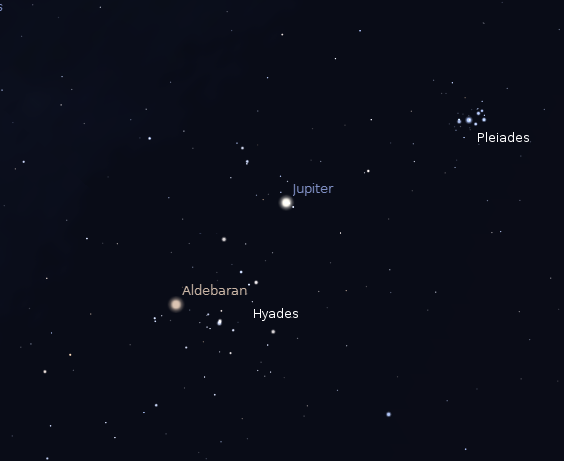
Aldebaran,Jupiter, the Hyades, and the Pleiades on January 18 2913. Created using Stellarium.
01/17/2013 – Ephemeris – The blue super-giant star Rigel
Ephemeris for Thursday, January 17th. The sun will rise at 8:14. It’ll be up for 9 hours and 16 minutes, setting at 5:31. The moon, 1 day before first quarter, will set at 12:41 tomorrow morning.
Tuesday I talked about the star Betelgeuse the bright red star in the top left of Orion’s upright rectangle. Orion is seen in the south in the evening. The blue-white star in Orion’s opposite corner is usually brighter. It is Rigel whose longer Arabic name of which Rigel is the first part means Left Leg of the Giant. Rigel is a giant itself, actually a super giant star, which is more a measure of its mass than its size, that of 50 solar masses. Its surface temperature is more than twice as hot as the sun. It is 57 thousand times as bright as the sun and 50 times its diameter. Its distance is 860 light years. Those with telescopes might be able to spot a close companion star to Rigel, just at the edge of the bright arc light image of Rigel itself.
Addendum
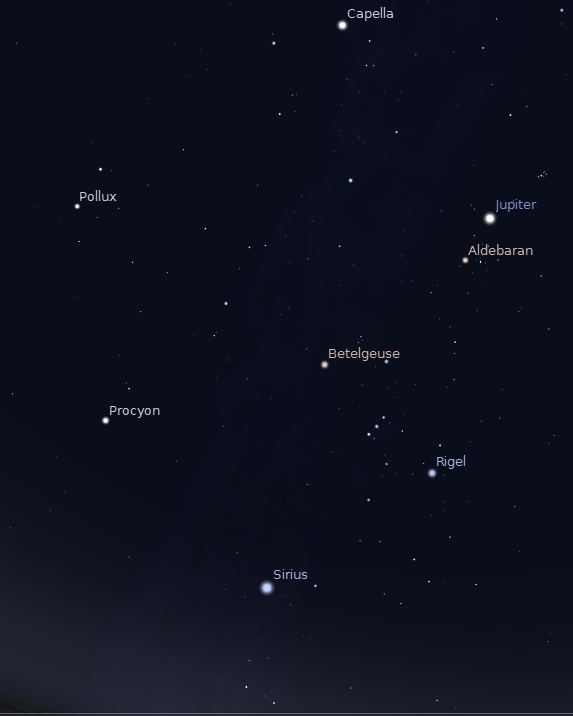
Rigel in the winter circle of bright winter stars plus Jupiter.this year. Created using Stellarium.
01/15/2013 – Ephemeris – The red giant star with a funny name Betelgeuse (Beetle Juice), plus STEM Night tonight at Greenspire School
Ephemeris for Tuesday, January 15th. The sun will rise at 8:15. It’ll be up for 9 hours and 13 minutes, setting at 5:28. The moon, 3 days before first quarter, will set at 10:31 this evening.
The bright red star in constellation Orion’s shoulder is Betelgeuse, 643 light years away give or take 146 light years. Betelgeuse is a shortened form of an Arabic phrase that means “Armpit of the central one”. Orion is seen in the south in the evening. Even at its great distance it’s the star whose surface is easiest seen, after the sun of course. That’s because it’s so big. As somewhat larger around than the orbit of Jupiter, it turns out. Recent telescopic observations of Betelgeuse have shown plumes of gas surrounding the star. A star like Betelgeuse is so bloated that it can be described as a red hot vacuum, thus its edge or limb is much darker than its center. The sun has limb darkening too, but it is much less noticeable.
Tonight:

STEM (Science, Technology, Engineering, Mathematics) Night.
We’ll have Gary Carlisle and I will be there to view the moon and Jupiter if it’s clear, Make craters hands-on. I’ll be helping to make comets. Bring your gloves because comets are COLD! We’ll be representing the Grand Traverse Astronomical Society.
Times above are for the Traverse City/Interlochen area of Michigan. They may be different for your location.
Addendum
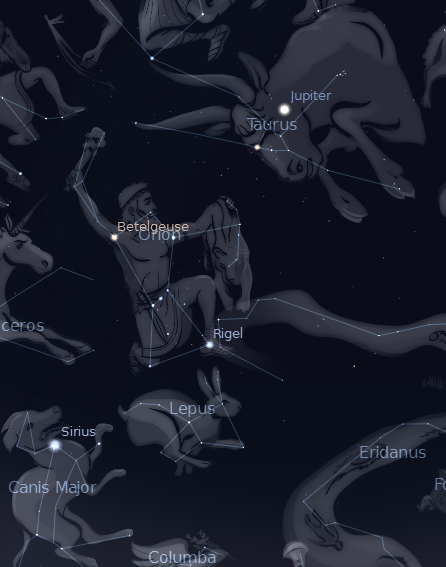
Orion facing Taurus letting Lepus escape with Jupiter in 2013. Check out Betelgeuse. Created using Stellarium.
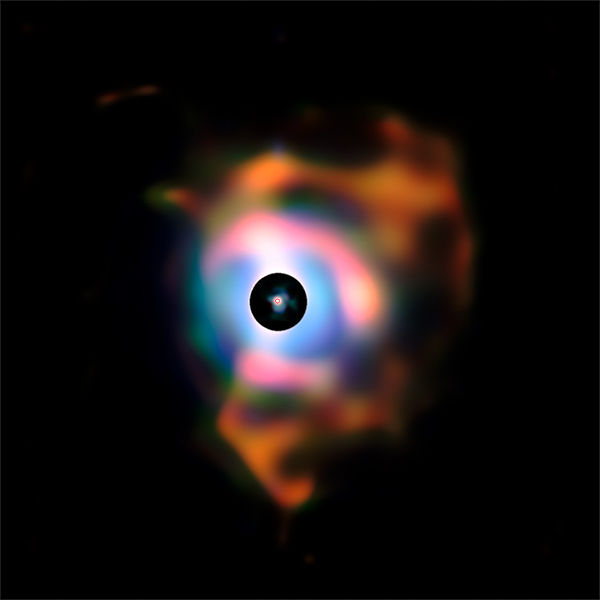
Betelgeuse and its nebula. From the European Southern Observatory’s Very Large Telescope.
11/16/2012 – Ephemeris – Capella the winter that doesn’t set (around here)
Ephemeris for Friday, November 16th. The sun will rise at 7:41. It’ll be up for 9 hours and 32 minutes, setting at 5:13. The moon, 3 days past new, will set at 8:11 this evening.
Midway up the sky in the east northeast at 9 p.m. You will find the bright star Capella. It is above and left of the bright planet Jupiter. Capella is located at one corner of a pentagon of stars that is the constellation Auriga the Charioteer. Capella represents a little she goat, while a slim triangle of stars are her kids. That triangle is known as the Kids. Capella is circumpolar for locations north of Ludington, meaning that this winter star doesn’t set, even in summer. Capella is a close binary star of stars with the same color as the sun, but much brighter. They orbit each other in 104 days. It looks like a single star in most telescopes. Spotting it low on the northern horizon at midnight in July is a reminder that winter will come soon enough.
Times are for the Traverse City/Interlochen area of Michigan. They may be different for your location.
Addendum
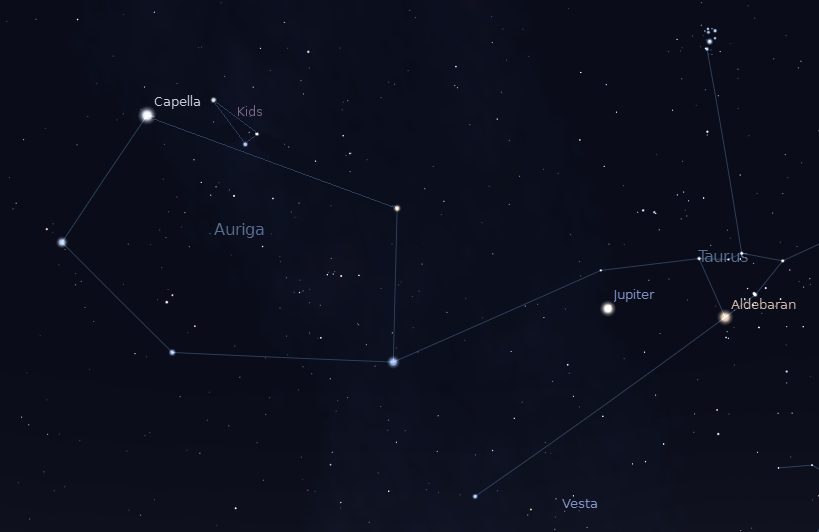
Capella in Auriga with the Kids at 9 p.m. on November 16, 2012. Created using Stellarium.
 Bob Moler's Ephemeris Blog