Archive
01/22/2013 – Ephemeris – Sirius the Dog Star
Ephemeris for Tuesday, January 22nd. The sun will rise at 8:10. It’ll be up for 9 hours and 27 minutes, setting at 5:37. The moon, half way from first quarter to full, will set at 5:23 tomorrow morning.
The brightest star-like object in the evening sky is Jupiter high in the sky now. The second brightest star-like object is Sirius, also known as the Dog Star. It also is the brightest night-time star in our skies period. Tonight at 9 p.m. it’s located low in the southeastern sky. The Dog Star name comes from its position at the heart of the constellation Canis Major, the great dog of Orion the hunter. The three stars of Orion’s belt tilt to the southeast and point to Sirius. The name Sirius means ‘Dazzling One’ or ‘Scorcher’, a reference to its great brilliance and twinkling. Its Egyptian name was Sothis, and its appearance in the dawn skies in late June signaled the flooding of the Nile, and the beginning of the Egyptian agricultural year.
Times are for the Traverse City/Interlochen area of Michigan. They may be different for your location.
Addendum
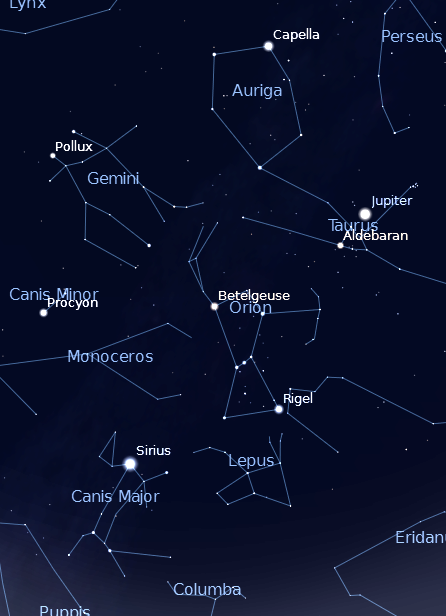
Winter Circle and Jupiter with Sirius at the bottom. Created using Stellarium.
01/18/2013 – Ephemeris – Aldebaran, Taurus’ angry read eye
Ephemeris for Friday, January 18th. The sun will rise at 8:13. It’ll be up for 9 hours and 18 minutes, setting at 5:32. The moon, at first quarter today, will set at 1:42 tomorrow morning.
The bright orange star Aldebaran is the most westerly bright star of winter Aldebaran appears at the upper left tip of a letter V group of stars that is the face of the bull, his angry red eye. Aldebaran isn’t actually part of the group, called the Hyades star cluster. Aldebaran is 65 light years away, less than half the distance of the Hyades. The name Aldebaran means “The Follower” because it follows the Pleiades across the skies. The Pleiades is the brightest star cluster in Taurus, also known as the Seven Sisters. Aldebaran has an orange hue because its surface is cooler than the sun’s. However Aldebaran is 44 times larger in diameter, and shines 500 times brighter than the sun. It’s the type of star that’s in the red giant phase of life.
Times are for the Traverse City/Interlochen area of Michigan. They may be different for your location.
Addendum
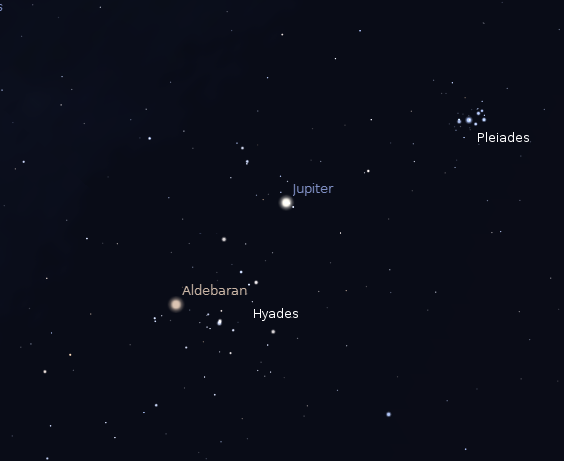
Aldebaran,Jupiter, the Hyades, and the Pleiades on January 18 2913. Created using Stellarium.
01/17/2013 – Ephemeris – The blue super-giant star Rigel
Ephemeris for Thursday, January 17th. The sun will rise at 8:14. It’ll be up for 9 hours and 16 minutes, setting at 5:31. The moon, 1 day before first quarter, will set at 12:41 tomorrow morning.
Tuesday I talked about the star Betelgeuse the bright red star in the top left of Orion’s upright rectangle. Orion is seen in the south in the evening. The blue-white star in Orion’s opposite corner is usually brighter. It is Rigel whose longer Arabic name of which Rigel is the first part means Left Leg of the Giant. Rigel is a giant itself, actually a super giant star, which is more a measure of its mass than its size, that of 50 solar masses. Its surface temperature is more than twice as hot as the sun. It is 57 thousand times as bright as the sun and 50 times its diameter. Its distance is 860 light years. Those with telescopes might be able to spot a close companion star to Rigel, just at the edge of the bright arc light image of Rigel itself.
Addendum
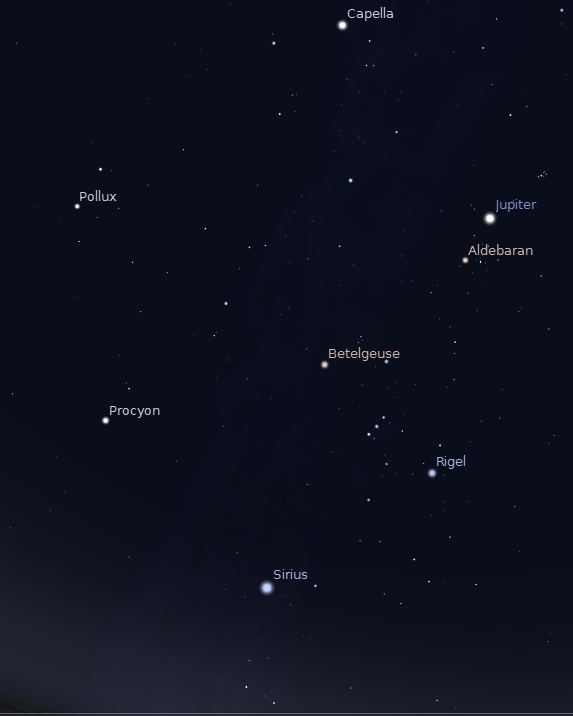
Rigel in the winter circle of bright winter stars plus Jupiter.this year. Created using Stellarium.
01/15/2013 – Ephemeris – The red giant star with a funny name Betelgeuse (Beetle Juice), plus STEM Night tonight at Greenspire School
Ephemeris for Tuesday, January 15th. The sun will rise at 8:15. It’ll be up for 9 hours and 13 minutes, setting at 5:28. The moon, 3 days before first quarter, will set at 10:31 this evening.
The bright red star in constellation Orion’s shoulder is Betelgeuse, 643 light years away give or take 146 light years. Betelgeuse is a shortened form of an Arabic phrase that means “Armpit of the central one”. Orion is seen in the south in the evening. Even at its great distance it’s the star whose surface is easiest seen, after the sun of course. That’s because it’s so big. As somewhat larger around than the orbit of Jupiter, it turns out. Recent telescopic observations of Betelgeuse have shown plumes of gas surrounding the star. A star like Betelgeuse is so bloated that it can be described as a red hot vacuum, thus its edge or limb is much darker than its center. The sun has limb darkening too, but it is much less noticeable.
Tonight:

STEM (Science, Technology, Engineering, Mathematics) Night.
We’ll have Gary Carlisle and I will be there to view the moon and Jupiter if it’s clear, Make craters hands-on. I’ll be helping to make comets. Bring your gloves because comets are COLD! We’ll be representing the Grand Traverse Astronomical Society.
Times above are for the Traverse City/Interlochen area of Michigan. They may be different for your location.
Addendum
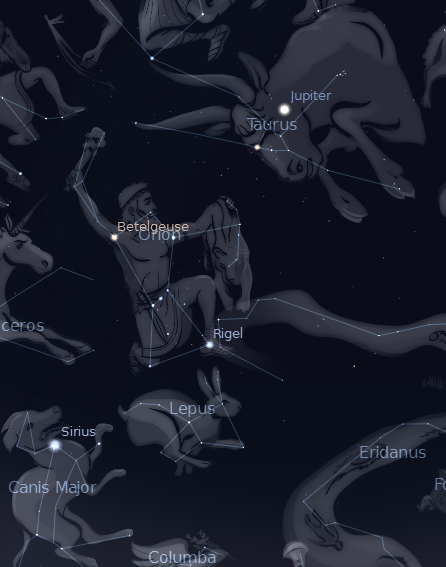
Orion facing Taurus letting Lepus escape with Jupiter in 2013. Check out Betelgeuse. Created using Stellarium.
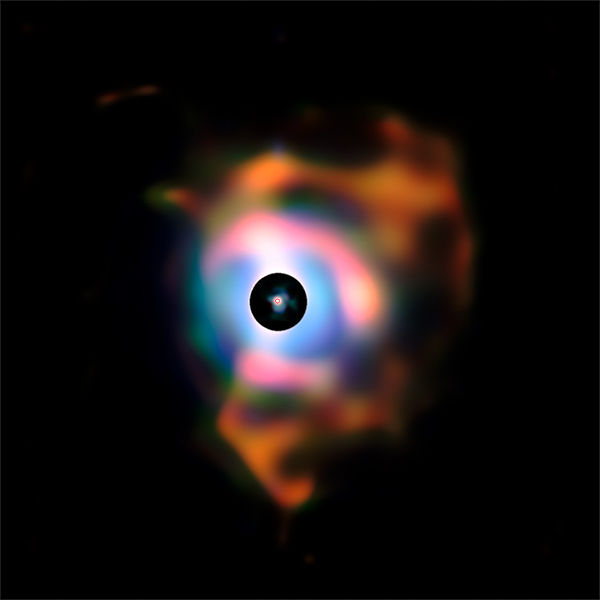
Betelgeuse and its nebula. From the European Southern Observatory’s Very Large Telescope.
11/16/2012 – Ephemeris – Capella the winter that doesn’t set (around here)
Ephemeris for Friday, November 16th. The sun will rise at 7:41. It’ll be up for 9 hours and 32 minutes, setting at 5:13. The moon, 3 days past new, will set at 8:11 this evening.
Midway up the sky in the east northeast at 9 p.m. You will find the bright star Capella. It is above and left of the bright planet Jupiter. Capella is located at one corner of a pentagon of stars that is the constellation Auriga the Charioteer. Capella represents a little she goat, while a slim triangle of stars are her kids. That triangle is known as the Kids. Capella is circumpolar for locations north of Ludington, meaning that this winter star doesn’t set, even in summer. Capella is a close binary star of stars with the same color as the sun, but much brighter. They orbit each other in 104 days. It looks like a single star in most telescopes. Spotting it low on the northern horizon at midnight in July is a reminder that winter will come soon enough.
Times are for the Traverse City/Interlochen area of Michigan. They may be different for your location.
Addendum
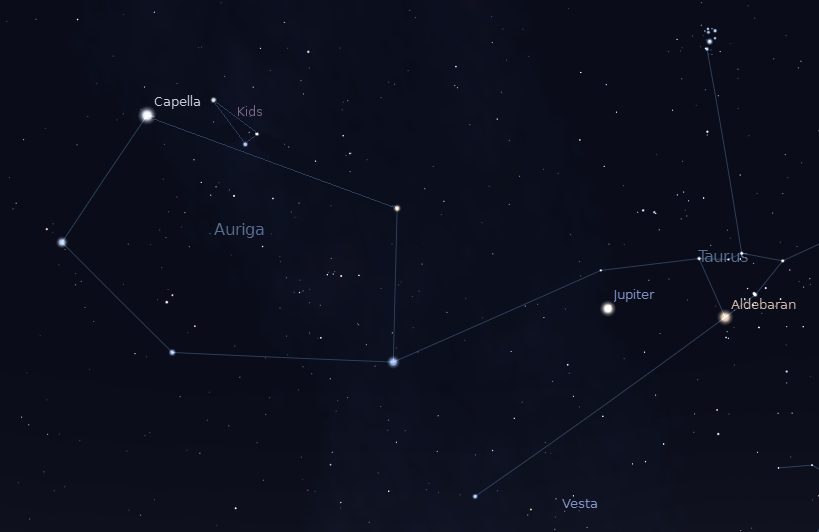
Capella in Auriga with the Kids at 9 p.m. on November 16, 2012. Created using Stellarium.
10/31/2012 – Epmeneris – The Ghoul Star
Ephemeris for Halloween, Wednesday, October 31st. The sun will rise at 8:19. It’ll be up for 10 hours and 12 minutes, setting at 6:32. The moon, 2 days past full, will rise at 7:37 this evening.
Not all the ghosts and goblins out tonight will be children. One will be out every night, because it’s a star. Its name is Algol, from the Arabic for Ghoul Star or Demon Star. The Chinese had a name for it that meant a mausoleum or more ominously ‘piled up corpses’. It’s the second brightest star in the constellation Perseus the hero, rising in the northeast this evening. The star is located where artists have drawn the severed head of Medusa, whom he had slain. Medusa was so ugly that she turned all who gazed upon her to stone. Algol is her still glittering eye. Astronomers finally found out what was wrong with Algol. It does a slow 6 hour wink every two days 21 hours, because it is two very close stars that eclipse each other in that period.
Times are for the Traverse City/Interlochen area of Michigan. They may be different for your location.
Addendum
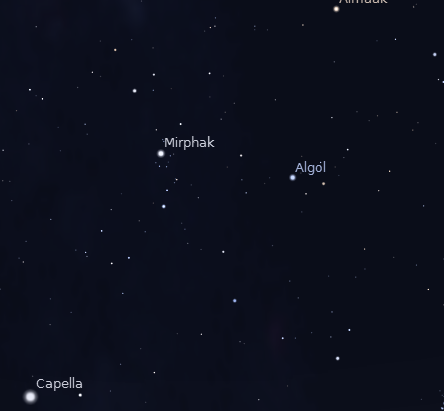
The constellation Perseus in the northeast at 9 p.m. on October 31, 2012. Created using Stellarium.
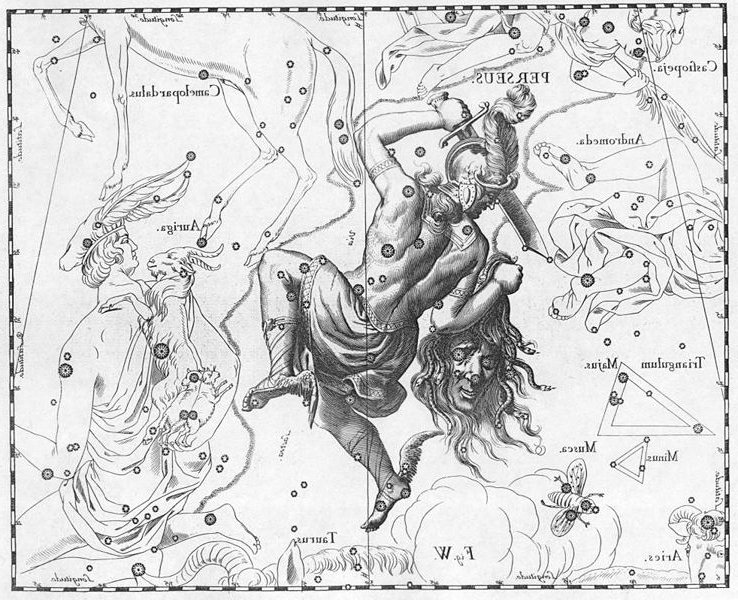
Perseus and the head of Medusa from the 1690 Uranographia by Johannes Hevelius. Image found with the article on Algol in Wikipedia.
Note that this is a mirror image. The star charts in the 17th century were based on celestial globes, which represented the constellations as seen from the outside of the celestial sphere instead of from the inside. I reversed the image to match Perseus as we see him.
10/15/2012 – Ephemeris – Autumn wonders for binoculars or small telescope: The Double Cluster
Ephemeris for Monday, October 15th. The sun will rise at 7:58. It’ll be up for 10 hours and 58 minutes, setting at 6:57. The moon is new today, and won’t be visible.
This week we’ll be looking at some of the wonders of the autumn sky that might better be seen in binoculars or a small telescope. Tonight we turn our attention to the Double Cluster, a fine pair of star clusters just below the W of the constellation of Cassiopeia the queen located in the northeast. Draw a vertical line down from the middle star of the W through the next star into the glow of the Milky Way. The Double Cluster appears to the unaided eye as a brighter glow of the Milky Way. This is confirmed with binoculars. But in a small telescope it becomes two piles of sparkling diamonds. The clusters are much younger than the sun so their brightest stars are blue-white to our eyes. The average distance of the two from earth is 7,200 light years and the are 1200 light years from each other.
Times are for the Traverse City/Interlochen area of Michigan. They may be different for your location.
Addendum
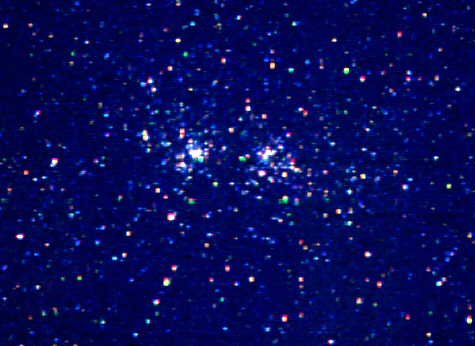
Double Cluster as it would be seen in a small telescope.
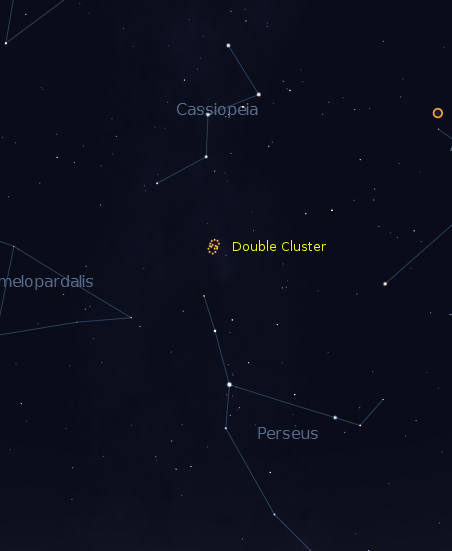
Chart for finding the Double cluster in October. Created using Stellarium.
10/04/2012 – Ephemeris – The lonely autumn star Fomalhaut
Ephemeris for Thursday, October 4th. The sun will rise at 7:44. It’ll be up for 11 hours and 32 minutes, setting at 7:16. The moon, 4 days before last quarter, will rise at 9:40 this evening.
There’s a bright star that appears for only seven and a half hours on autumn evenings. It’s appearance, low in the southeast at 10 p.m., is a clear indication of the autumn season. The star’s name is Fomalhaut, which means fish’s mouth. That’s fitting because it’s in the constellation of Piscis Austrinus, the southern fish. At our latitude it’s kind of the fish that got away, because Fomalhaut appears to be quite alone low in the sky. The dimness of the constellation’s other stars and location close to the horizon make the faint stars hard to spot. The earth’s thick atmosphere near the horizon reduces their brightness by a factor of two or more, so Fomalhaut, one of the brightest stars in the sky, keeps a lonely vigil in the south.
Times are for the Traverse City/Interlochen area of Michigan. They may be different for your location.
Addendum
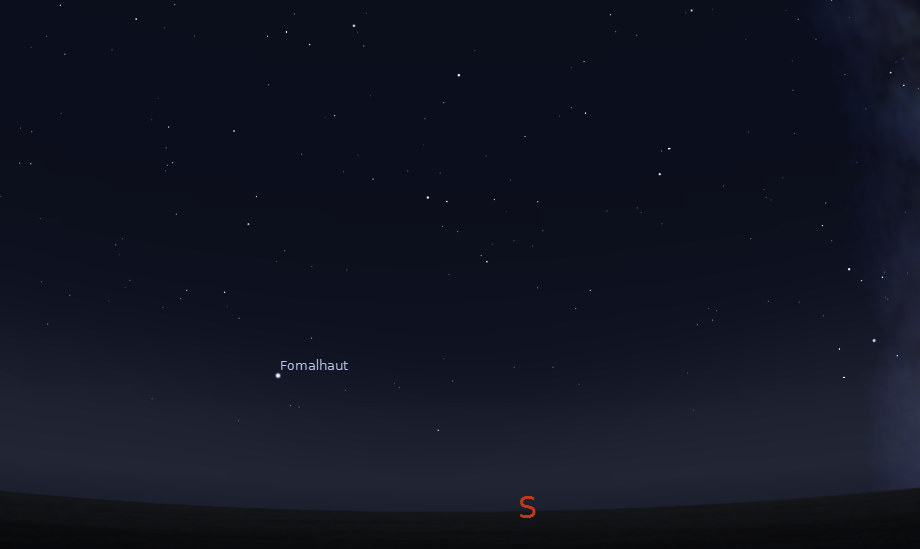
The bright star Fomalhaut all alone at 10 p.m. on October 4, 2012. Created using Stellarium.
Click image to enlarge.
08/28/2012 – Ephemeris – Altair, fatter in the middle
Ephemeris for Tuesday, August 28th. The sun will rise at 7:00. It’ll be up for 13 hours and 24 minutes, setting at 8:25. The moon, 3 days before full, will set at 4:54 tomorrow morning.
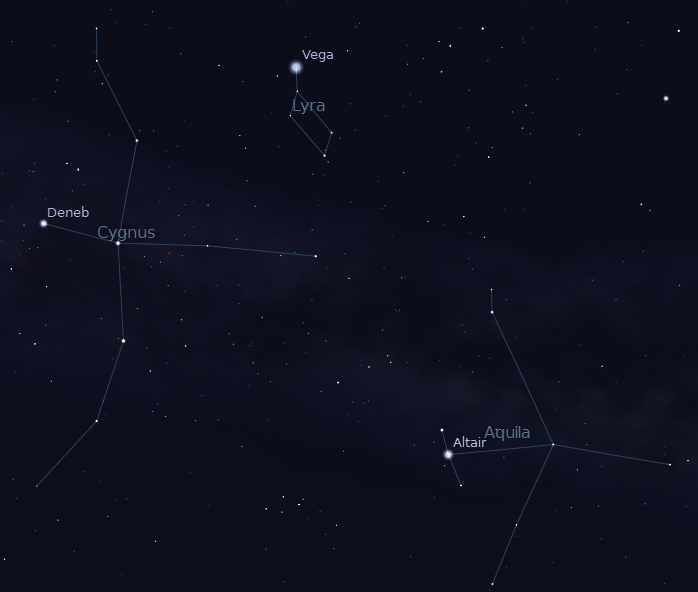
The southernmost star of the Summer Triangle is Altair, high in the south. The other two stars of the triangle are Vega nearly overhead, and Deneb high in the east. Altair is the closest of the three at a distance of 16.8 light years away. One light year is nearly 6 trillion miles. Altair is 10 times the brightness of the sun. If seen at Altair’s distance, the sun would only be as bright as one of the two stars that flank it. What is rather different about Altair is it’s rapid rotation. While its almost twice the sun’s diameter, it rotates once in only 9 hours, and has a decidedly squashed appearance when seen close up. There are techniques that can actually accomplish this. Our sun’s a slow poke, taking nearly a month to rotate once.
Times are for the Traverse City/Interlochen area of Michigan. They may be different for your location.
Addendum
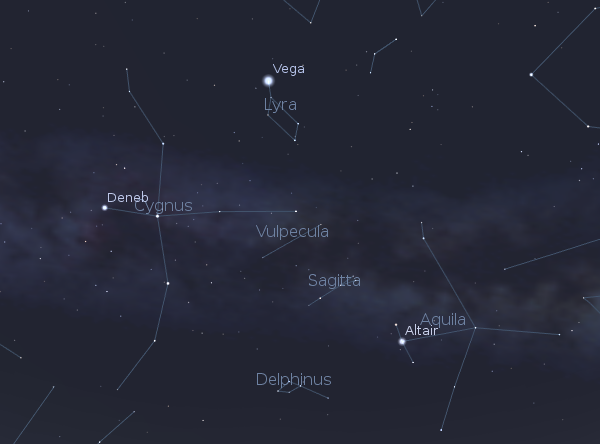
The constellations Lyra, Cygnus and Aquila. Created using Stellarium.
Check out Altair to the lower right.
07/30/2012 – Ephemeris – A closeup look at the bright star Deneb
Ephemeris for Monday, July 30th. The sun rises at 6:27. It’ll be up for 14 hours and 42 minutes, setting at 9:09. The moon, 2 days before full, will set at 4:47 tomorrow morning.
At 10:30 this evening the bright star Deneb in Cygnus the swan will be high in the east in the tail of Cygnus the swan. Deneb is the dimmest star of the summer triangle. Of the other stars of the triangle, Vega is nearly overhead, and Altair to the south. While Deneb’s apparent magnitude, or brightness as seen from earth, makes it the dimmest of the three bright stars, Deneb’s vast distance of possibly 1,500 to 2,600 light years makes it nearly 100 times the distance of Vega. If brought as close as Vega, Deneb would be several time brighter than Venus. For all this it is only 13-21 times the mass of the sun. It will have an extremely short life and it will explode, go supernova, in perhaps a few million years.
Times are for the Traverse City/Interlochen area of Michigan. They may be different for your location.
Addendum
Summer Triangle. Created using Stellarium.
 Bob Moler's Ephemeris Blog