Archive
Ephemeris: 06/20/2024 – Summer starts this afternoon
This is Ephemeris for Thursday, June 20th. Today the Sun will be up for 15 hours and 34 minutes, setting at 9:31, and it will rise tomorrow at 5:57. The Moon, 1 day before full, will set at 4:59 tomorrow morning.
Well, this is it, the summer solstice! Summer will begin at 4:51 this afternoon. In the Southern Hemisphere the season of winter will begin, and the South Pole of the Earth in the middle of its six months of darkness. Maybe we should call it the June solstice, because winter also begins in the Southern Hemisphere. The north above 66 ½ degrees north latitude is the land of the midnight Sun. Over summer that line will creep northward as the Sun heads southward. The seasons are caused by the tilt of the Earth’s axis, not by the Earth’s change in distance from the Sun. In fact, we are approaching our farthest distance from the Sun, of about 94.5 million miles (152 million kilometers) on July 5th, called aphelion. The greater than normal distance makes summer the longest season at 93.7 days, winter being the shortest at 89 days. The Sun will be at its highest, of just under 69 degrees altitude at 1:44 pm for the Interlochen/Traverse City area, and about a degree lower than that in the Straits area, though their daylight hours will be 12 minutes longer.
The astronomical event times given are for the Traverse City/Interlochen area of Michigan (EDT, UT–4 hours). They may be different for your location.
Addendum
06/20/2023 – Ephemeris – Summer starts tomorrow!
This is Bob Moler with Ephemeris for Tuesday, June 20th. Today the Sun will be up for 15 hours and 34 minutes, setting at 9:31, and it will rise tomorrow at 5:57. The Moon, 2 days past new, will set at 11:58 this evening.
Tomorrow is the day of the longest daylight hours, the summer solstice. The exact time of the summer solstice will occur at 10:58 am. One really can’t tell where the Sun is against the constellations and its eastward motion along the ecliptic because when the Sun’s out the sky is blue and the stars are invisible. However the ancients could notice that the Sun changed its height in the South over the year and the summer solstice was the time that the Sun was highest in the sky. The word solstice means “Sun standstill”. All through winter and spring the Sun has been moving northward in the sky at local noon. This has slowed down and tomorrow it will stop. After that it will begin to descend in the South at local noon until the winter solstice on December 21st.
The astronomical event times given are for the Traverse City/Interlochen area of Michigan (EDT, UT –4 hours). They may be different for your location.
Addendum
06/15/2023 – Ephemeris – Today we have the earliest sunrise of the year
This is Ephemeris for Thursday, June 15th. Today the Sun will be up for 15 hours and 33 minutes, setting at 9:30, and it will rise tomorrow at 5:56. The Moon, 3 days before new, will rise at 4:28 tomorrow morning.
Today is the day of the earliest sunrise, though the time will stay within the same minute for a few days. In six days the Sun will reach it’s farthest north in our sky. And be above the horizon for fifteen hours and thirty four minutes. That’s the summer solstice for those living in the north hemisphere. It’s also known as the longest day. The retired computer programmer in me likes to take things literally, so no, June 21st, the summer solstice is not the longest day. It’s 24 hours long, like any other day, however it has the longest daylight hours. Daylight hours being defined as the time interval from sunrise to sunset, which, in Interlochen and Traverse City, is 15 hours 34 minutes. Five or six days later, we’ll have the latest sunset.
The astronomical event times given are for the Traverse City/Interlochen area of Michigan (EDT, UT –4 hours). They may be different for your location.
Addendum
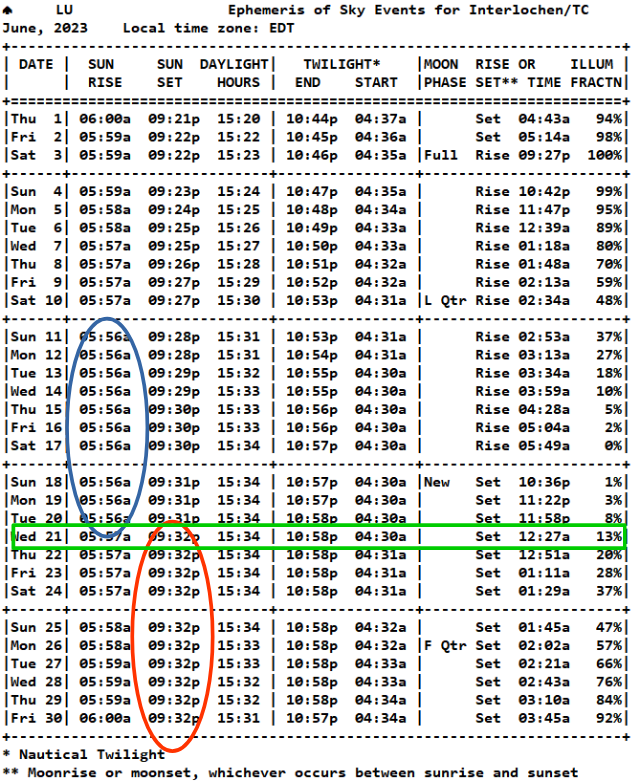
If the Earth had no axial tilt and had a circular orbit of the Sun, The earliest sunrise and latest sunset would occur on the summer solstice. But since that is not the case the Earth’s axial tilt and elliptical orbit cause the the earliest sunrise and latest sunset to differ from each other and the summer solstice.
12/08/2022 – Ephemeris – Tonight’s full-ish Moon is near where the June solstice Sun was
This is Ephemeris for Thursday, December 8th. Today the Sun will be up for 8 hours and 54 minutes, setting at 5:02, and it will rise tomorrow at 8:08. The Moon, 1 day past full, will rise at 5:10 this evening.
The bright Moon near full in December rises very high in the south around midnight to 1 am. It is near where the Sun is at the summer solstice. Actually, tonight it is to the lower right of the constellation of Gemini, and to give a topical reference. Tonight, the Moon appears as a soccer ball being kicked by Castor, one of the twins. It’s right off the toe of his foot. In June, the Sun and Full Moon’s positions are reversed. The Sun rises very high in the southern sky at local noon, while the full moon stays low in the south. Or Moon is odd in that respect, Most large satellites of the other planets orbit over their primary’s equator. Our Moon’s orbit is aligned to about 5 degrees off Earth’s own orbit of the Sun, which is angled at 23 and a half degrees from Earth’s equator.
The astronomical event times given are for the Traverse City/Interlochen area of Michigan (EST, UT –5 hours). They may be different for your location.
Addendum
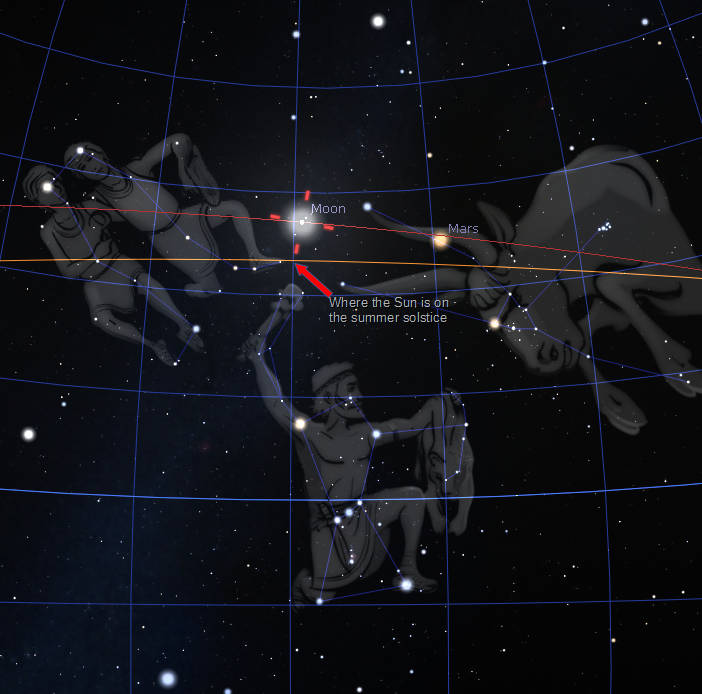
The Moon near the summer solstice point overnight tonight at 1:15 am (the 9th). The sky is overlaid with the equatorial grid. The bright blue line that runs just above Orion’s belt is the celestial equator. The declination lines match Earth’s latitude lines are 10 degrees apart. The vertical blue lines are right ascension lines, like earthly longitude lines, and are 15 degrees apart. Each one represents one hour. The orange line is the ecliptic, the path of the Sun in the sky, also the plane of the Earth’s orbit. The red line is the Moon’s orbit, which is inclined by about 5 degrees to the ecliptic. Click on the image to enlarge it. Created using Stellarium and LibreOffice Draw.
06/22/2020- Ephemeris – Summer has begun
This is Ephemeris for Monday, June 22nd. Today the Sun will be up for 15 hours and 34 minutes, setting at 9:32, and it will rise tomorrow at 5:57. The Moon, 1 day past new, will set at 11:04 this evening.
On Friday’s program I was way too busy with the summer solstice and the annular eclipse in Asia to properly give summer its due, so here goes. Last Saturday the northern end of the Earth’s axis was tilted toward the Sun to its maximum extent, giving the northern hemisphere its most direct sunlight, and the longest daylight hours. North of the arctic circle of 66 ½ degrees latitude got 24 hours of daylight, and the north pole midday in its six months of continuous sunlight. At the south pole it’s literally midnight of its six months night. The northern hemisphere got its greatest amount of heat from the Sun that day, however this part of the Earth is still warming up, so our hottest days average in late July when the shortening daylight hours and the lowering of the Sun in the south can’t maintain the heat anymore and we begin to cool.
The event times given are for the Traverse City/Interlochen area of Michigan. They may be different for your location.
Addendum
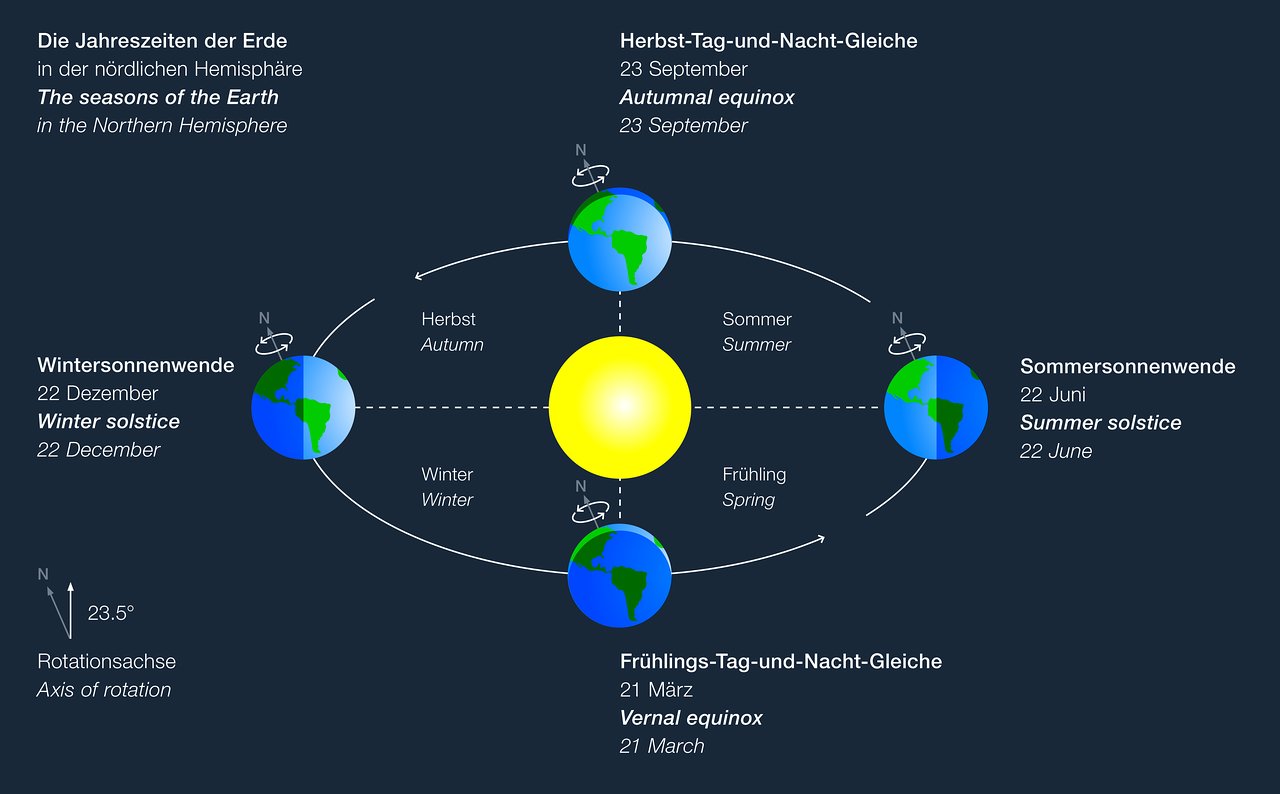
Earth’s position at the solstices and equinoxes. This is an not to scale oblique look at the Earth’s orbit, which is nearly circular. The Earth is actually farthest from the Sun on July 4th. Click on the image to enlarge. Credit: ESO (European Southern Observatory which explains the captions in German and English.
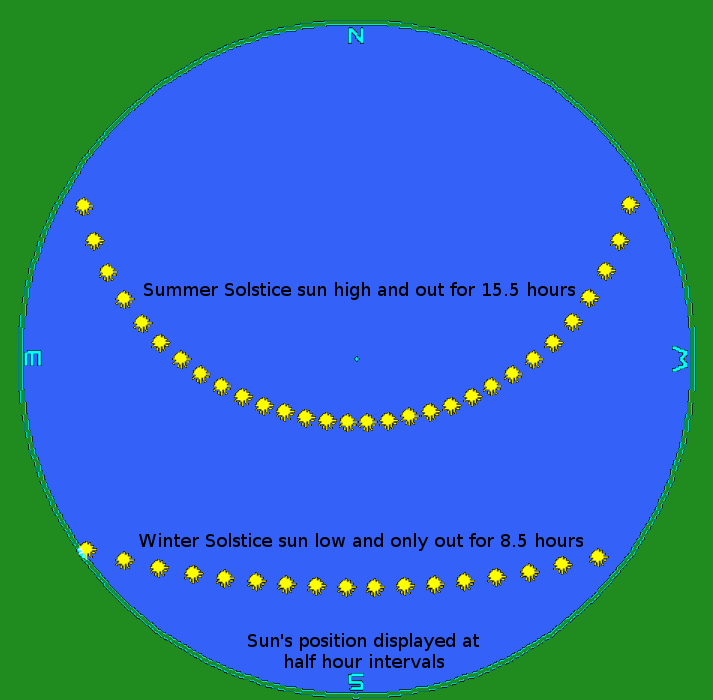
Comparing the sun’s path at the summer and winter solstices. This is a stereographic representation of the whole sky which distorts the sky and magnifies the size of the sun’s path near the horizon.
06/19/2020 – Ephemeris – Summer arrives tomorrow with an eclipse of the Sun the next day
This is Ephemeris for Friday, June 19th. Today the Sun will be up for 15 hours and 34 minutes, setting at 9:31, and it will rise tomorrow at 5:57. The Moon, 2 days before new, will rise at 5:25 tomorrow morning.
Tomorrow afternoon at 5:43 pm summer will begin, as the Sun reaches its greatest northerly excursion, right over the tropic of Cancer, 23 ½ degrees north latitude on the Earth’s surface. It’s called the summer solstice for those of us north of the equator. Early Sunday morning there will be an annular eclipse of the Sun. We won’t see it in the United States, however it will be visible for parts of Africa and southern Asia. The Moon will be too far away to completely cover the face of the Sun leaving a ring or annulus at maximum eclipse, a so-called Ring of Fire. It is the second of a triad of eclipses this eclipse season. Two weeks ago there was a slight eclipse of the Moon and two weeks from now another slight eclipse of the Moon to finish the season.
The event times given are for the Traverse City/Interlochen area of Michigan. They may be different for your location.
Addenda
Annular Eclipse
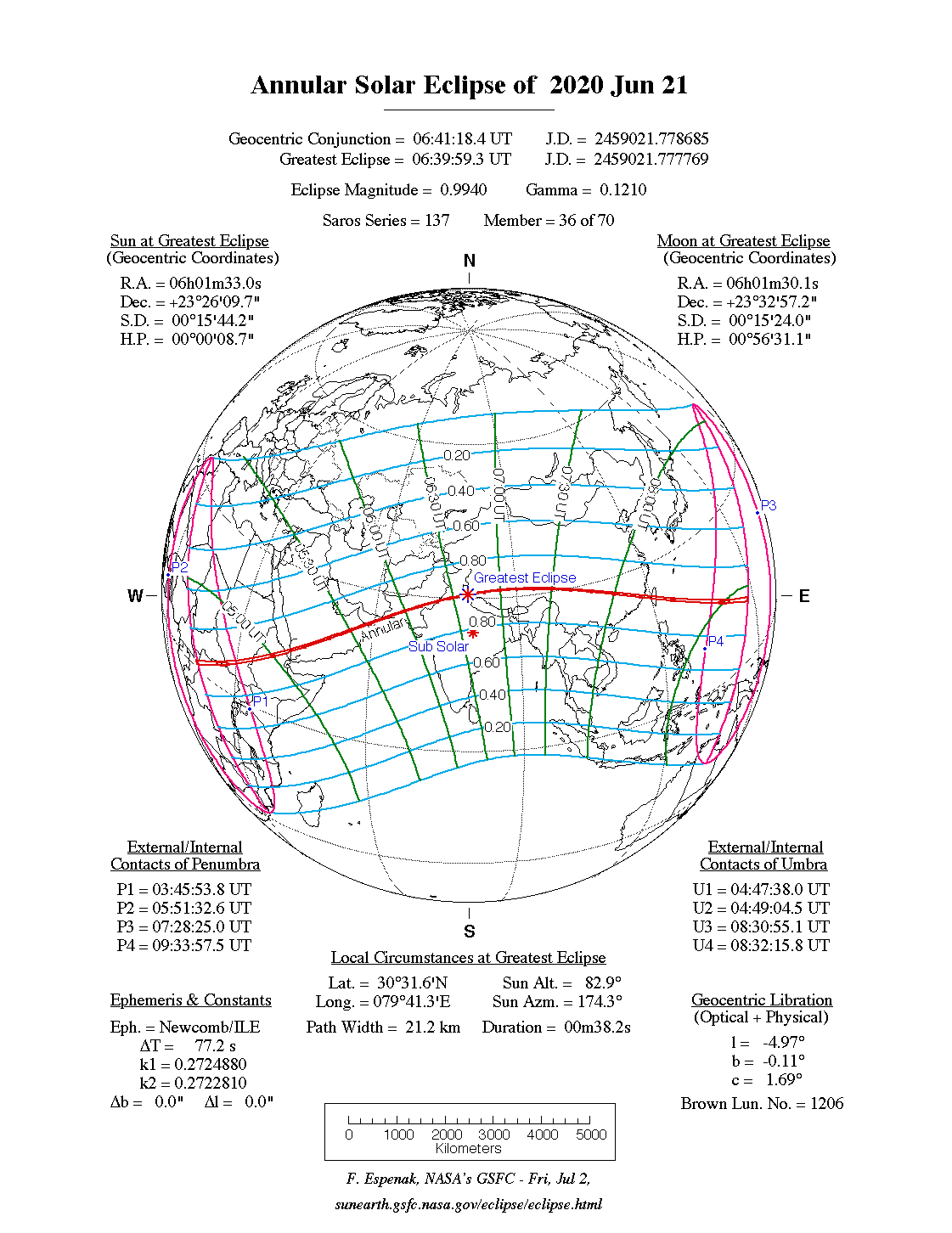
Areas of the Earth where the solar eclipse of June 21, 2020 will be visible. The central double red line delineates the path of annularity. Click on the image to see the original chart. Credit NASA GSFC, Fred Espenak.
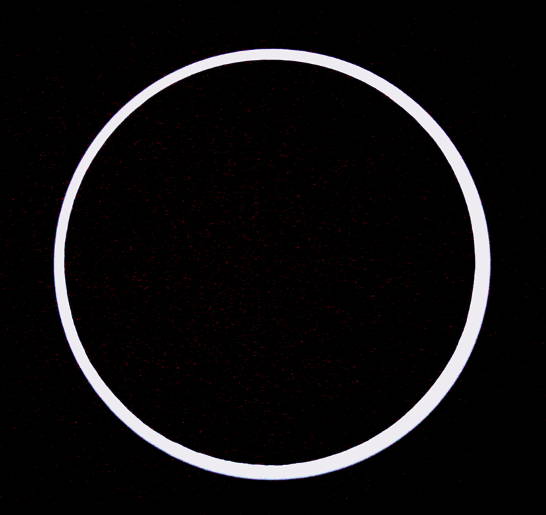
My photograph of the Annular eclipse May 10 1994 taken east of Toledo, Ohio, May 10, 1994.
Summer Solstice
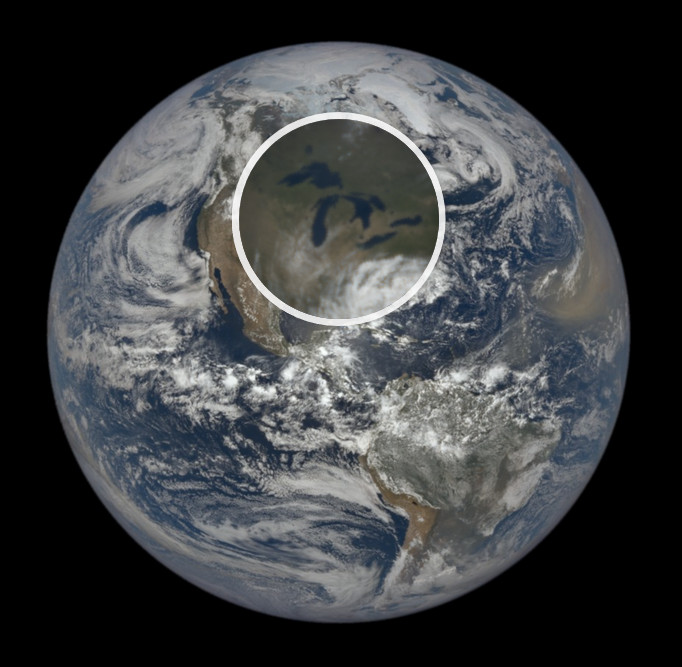
Earth and magnified local area near summer solstice. Image taken near local noon June 17, 2020. Credit NOAA DSCOVR satellite orbiting the Sun-Earth L1 point 994,970 miles (1,601,432 kilometers) sunward from the Earth. For once it’s clear enough to see the mitten of the Lower Peninsula of Michigan.
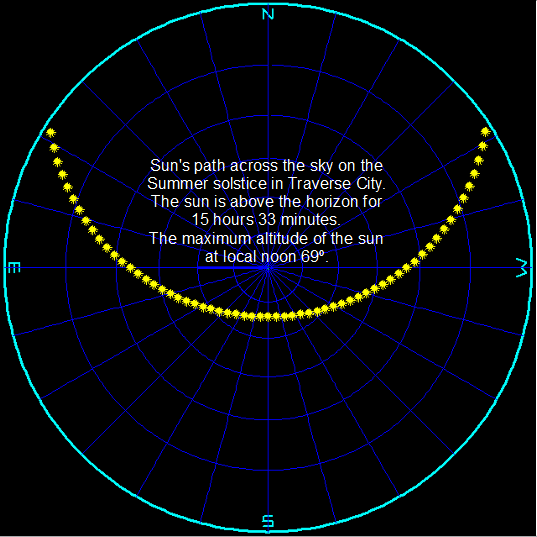
The Sun’s path through the sky on the summer solstice day from Traverse City, MI. Created using my LookingUp program..
06/21/2018 – Ephemeris – Yay, summer is here!
Ephemeris for Thursday, June 21st. Today the Sun will be up for 15 hours and 34 minutes, setting at 9:32, and it will rise tomorrow at 5:57. The Moon, 1 day past first quarter, will set at 2:57 tomorrow morning.
Welcome to summer! It began at 6:07 this morning. If you remember back to winter and the beautiful constellation of Orion. Some folks could trace the club he was holding over his head off the red star Betelgeuse. The Sun now appears above that. If you remember Gemini the twins, well the Sun is off Castor’s big toe. That’s all pretty high in the sky and giving us 15 hours and 34 minutes of daylight. That’s why summer’s so hot. This despite the fact that in two weeks we will be the farthest we get from the Sun all year. The 3 million mile difference in the Sun’s annual distance is peanuts compared to the seasonal fluctuations caused by the tilt of the Earth’s axis.
The times given are for the Traverse City/Interlochen area of Michigan. They may be different for your location.
Addendum
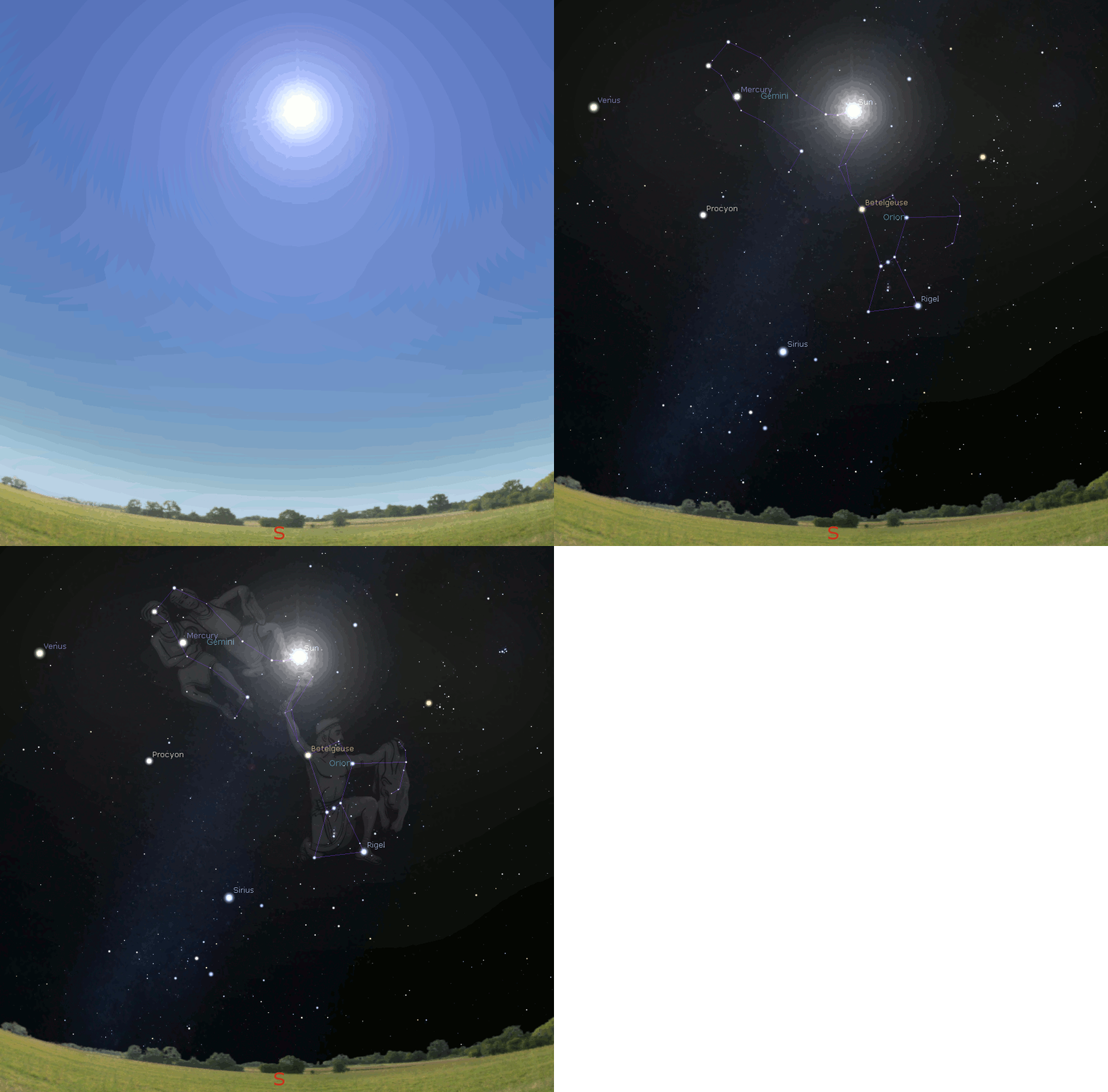
The Sun with its position with the stars at the summer solstice, June 2018. Click on the image to enlarge. Created using Stellarium and GIMP.
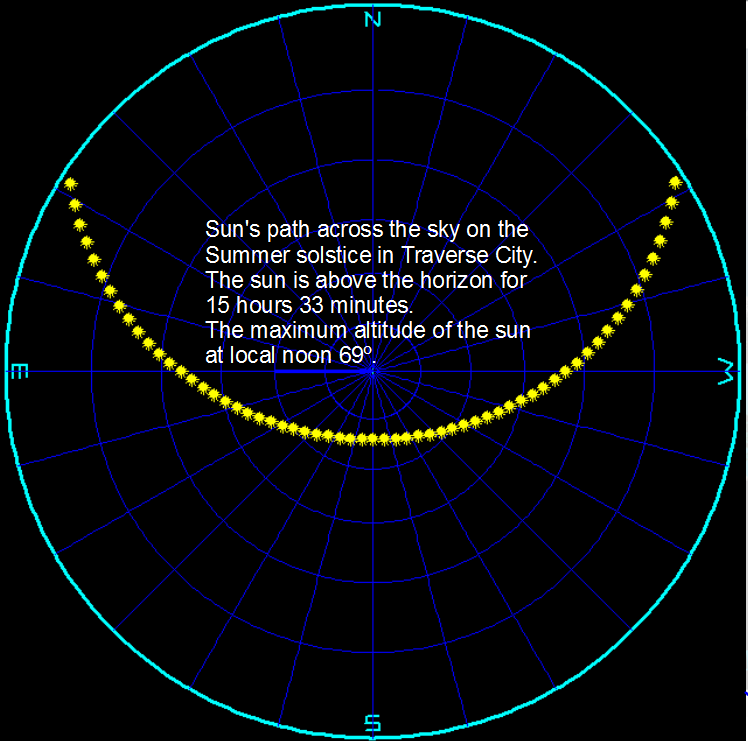
The sun’s daily path through the sky from horizon to horizon on the first day of summer, the summer solstice. Grid lines are 15° apart. The Sun os plotted at 15 minute intervals. Credit: My LookingUp program.
06/20/2017 – Ephemeris – Summer will begin overnight tonight
Ephemeris for Tuesday, June 20th. Today the Sun will be up for 15 hours and 33 minutes, setting at 9:31, and it will rise tomorrow at 5:57. The Moon, half way from last quarter to new, will rise at 4:11 tomorrow morning.
Summer will begin overnight at 12:25 a.m. (4:25 UT June 21, 2017) The sun will at its highest at noon today and tomorrow, well at local solar noon that is, which is 1:44 p.m. in the Interlochen Traverse City area. At that time the Sun will reach an altitude or angle above the southern horizon of nearly 69 degrees. If you want to get an idea of the difference between that and the Sun at the winter solstice, check out Saturn tonight. It is almost to the point in the sky where the Sun was at the winter solstice. Notice how low it is in the sky, and how few hours it is up. The cause is the tilt of the earth’s axis of 23 and a half degrees. It gives us a 47 degree span of altitudes of the sun over the year. It is not the sun’s distance that causes seasons, as we’ll see next month.
The times given are for the Traverse City/Interlochen area of Michigan. They may be different for your location.
Addendum
The Sun’s path through the sky on the summer solstice day from Traverse City, MI. Created using my LookingUp program.
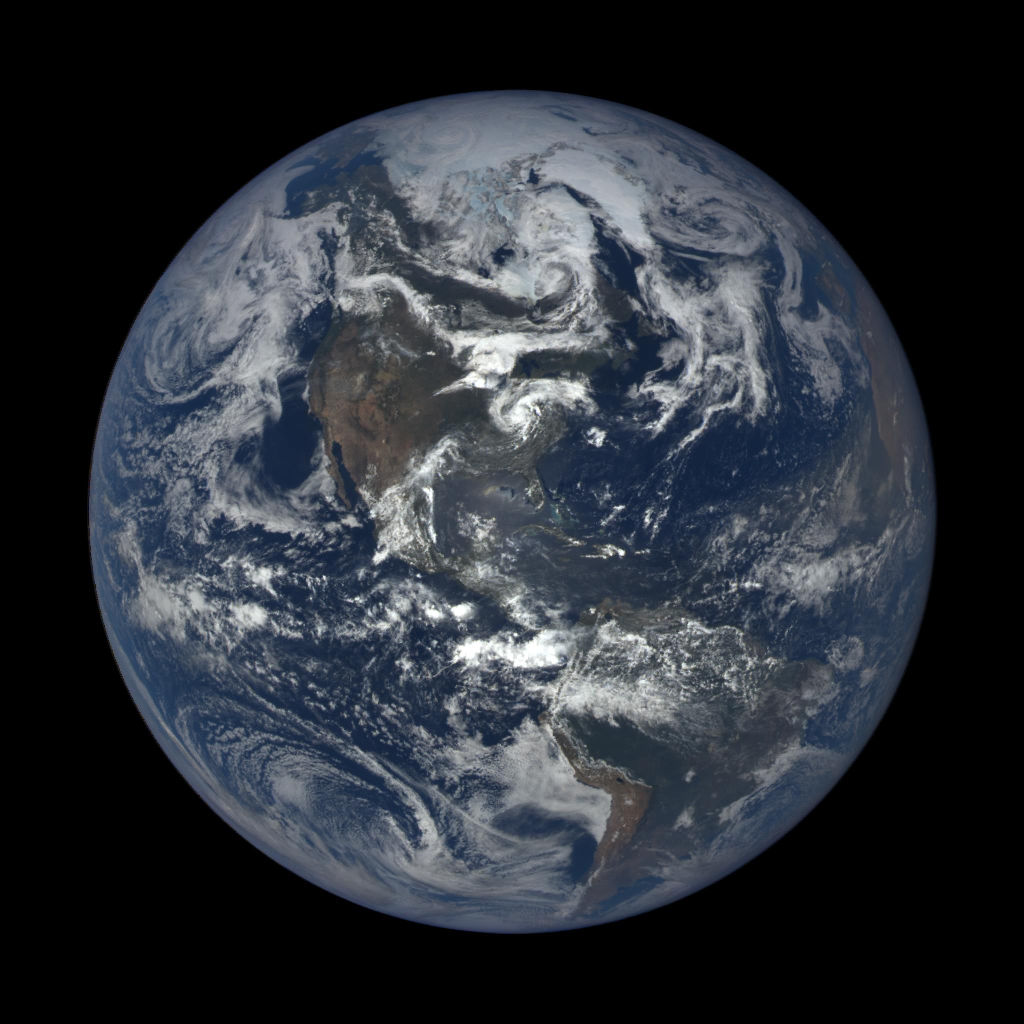
Earth from the DSCOVR satellite at the June solstice 2015. Credit NOAA
06/20/2016 – Ephemeris – Summer will start later today
Ephemeris for Monday, June 20th. Today the Sun will be up for 15 hours and 34 minutes, setting at 9:31, and it will rise tomorrow at 5:57. The Moon, at full today, will rise at 9:32 this evening.
Well, this is it, the last 12 hours of spring. Summer will begin at 6:35 this evening. In the southern hemisphere the season of winter will begin, and the south pole of the Earth will begin* is in the middle of its six months of darkness. The north above 66 ½ degrees north latitude is the land of the midnight Sun. Over summer that line will creep northward as the Sun heads southward. The seasons are caused by the tilt of the Earth’s axis, not by the Earth’s change in distance from the Sun. In fact we are approaching our farthest distance from the Sun, of about 94.5 million miles (152 million km) on the fourth of July called aphelion. The greater than normal distance makes summer the longest season at 93.7 days, winter being the shortest at 89 days.
Times are for the Traverse City/Interlochen area of Michigan. They may be different for your location.
* Thanks to Jeff Silagy for spotting the error.
Addendum
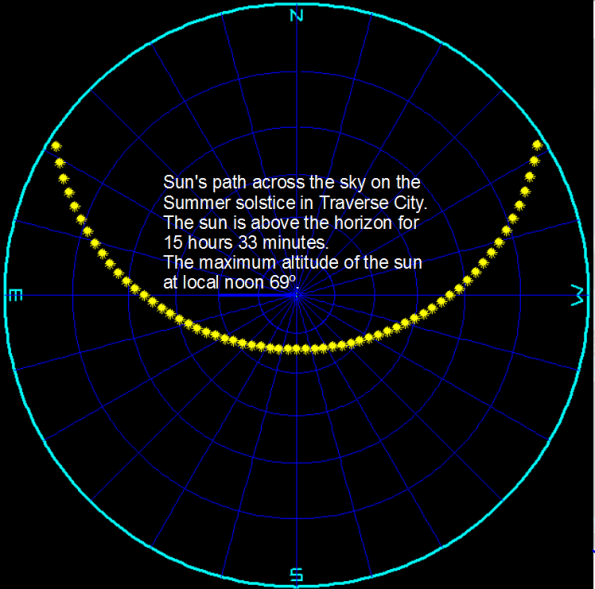
The sun’s daily path through the sky from horizon to horizon on the first day of summer, the summer solstice. Credit My LookingUp program.
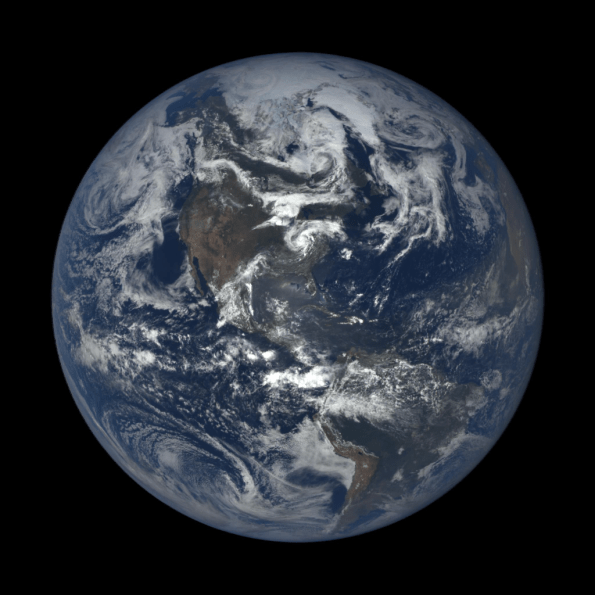
Earth from the DSCOVR satellite at the June solstice 2015. Credit NOAA.
06/14/2016 – Ephemeris – Tomorrow is the earliest sunrise of the year
Ephemeris for Flag Day, Tuesday, June 14th. Today the Sun will be up for 15 hours and 33 minutes, setting at 9:30, and it will rise tomorrow at 5:56. The Moon, 2 days past first quarter, will set at 3:22 tomorrow morning.
Tomorrow morning’s sunrise is the earliest sunrise of the year. Sunrises of the next few days will stay within the same minute. The bottoming out of the earliest sunrise is a slow affair, but the advance of the sunrise times will accelerate in the coming weeks. We are still nearly two weeks from the latest sunset on the 26th. That means that the summer solstice, the first day of summer is near, on the 20th. The reason for the uneven sunrise and sunset peaks is due to a combination of the Earth’s axial tilt and the Earth’s elliptical orbit which is too complicated to explain here. These times of sunrise and sunset are for the Traverse City/Interlochen area. I have a link for other locations and times on bobmoler.wordpress.com.
Times are for the Traverse City/Interlochen area of Michigan. They may be different for your location.
Addendum
Here is the link to the calendar page on my Ephemeris website.
 Bob Moler's Ephemeris Blog