Archive
12/15/2015 – Ephemeris – Procyon the star that’s “Before the dog”
Ephemeris for Tuesday, December 15th. The Sun will rise at 8:13. It’ll be up for 8 hours and 49 minutes, setting at 5:02. The Moon, 3 days before first quarter, will set at 9:48 this evening.
Visible low in the east at 9:30 p.m. appears the star Procyon to its lower left is Sirius the brightest night-time star. Procyon is the bright star in the constellation Canis Minor, or lesser dog. I can find only one other star in Canis Minor. Perhaps it’s a hot dog. If Sirius, in Canis major is the Dog Star then Procyon should be the Little Dog Star. However Procyon is an interesting name. It means “Before the dog”, which is an allusion to the fact that Procyon, though east of Sirius actually rises before it. This is due to Procyon’s more northerly position. This effect doesn’t work south of the equator, however. Sirius will rise at about 9 tonight. Procyon is a star much like Sirius but is 32% farther away. It’s 11.4 to Sirius’ 8.6 light years away.
Times are for the Traverse City/Interlochen area of Michigan. They may be different for your location.
Addendum
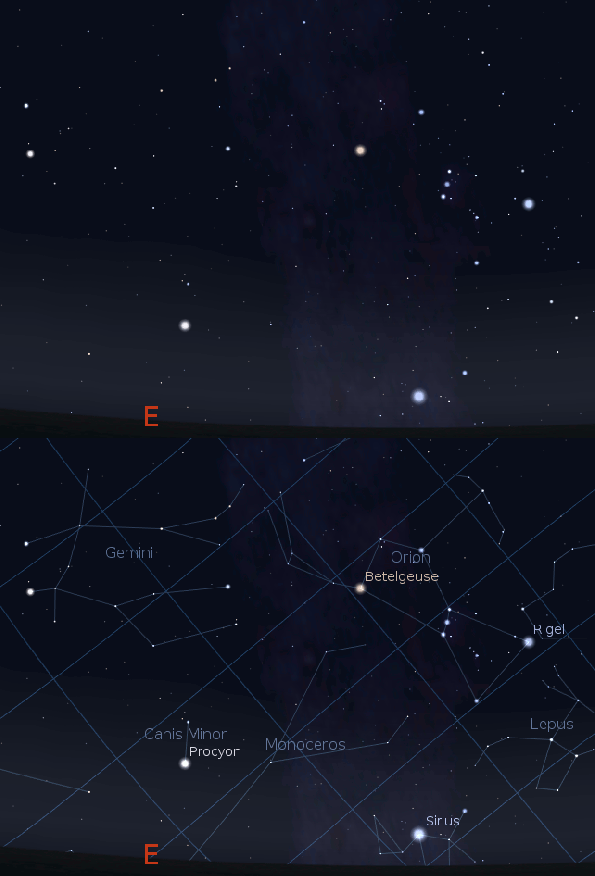
Procyon, Sirius and the stars of winter. Created using Stellarium
In the above chart, beside the constellation lines, we have the grid of right ascension, from lower left to upper right; and declination, from upper left to lower right. right ascension lines are like longitude on the Earth, while declination lines are latitude lines. They are tipped because I don’t live at either the equator or one of the poles. As the Earth rotates the Sun, stars and planets slide westward in the direction of the declination lines. Note that Sirius is closer to the horizon than Procyon. Also that Sirius is west of the 7 hour right ascension line. (Take my word for it.) Procyon is east of that line, thus Sirius is west of Procyon.
Other cool things can be seen in the chart. Note the declination line that touches the horizon at the east compass point and runs just above Orion’s belt. It is 0º declination, or the celestial equator. It extends to the west compass point on the western horizon. The Sun on the equinoxes will rise due east and set due west. The 6 hour right ascension line runs past Betelgeuse in Orion. At 23½º north declination, near Castor’s big toe in Gemini is where the Sun appears on the first day of summer, the summer solstice.
P.S. It was cloudy and rainy the last two days. Didn’t see a Geminid meteor again this year, keeping my record intact.
06/19/2015 – Ephemeris – Two events this weekend: one local, one global
Ephemeris for Friday, June 19th. Today the Sun will be up for 15 hours and 34 minutes, setting at 9:31. The Moon, 3 days past new, will set at 11:34 this evening. Tomorrow the Sun will rise at 5:56.
There’s a couple of astronomical events coming up this weekend. On Saturday there will be another Sun ‘n Star Party at the Sleeping Bear Dunes National Lakeshore if weather cooperates. This time the telescopes will be set up at the Pierce Stocking Scenic Drive, Stop 3, the Dunes Overlook from 4 to 6 p.m. and from 9 to 11 p.m. The best place to park is Picnic Mountain, just before the Dunes Overlook. On Sunday a truly global event, the Summer solstice will occur at 12:38 p.m. (16:38 UT), when the Sun will reach its farthest north signaling the start of summer in the northern hemisphere. For folks south of the equator it will be the winter solstice signaling the start of winter for them.
Times are for the Traverse City/Interlochen area of Michigan. They may be different for your location.
Addendum
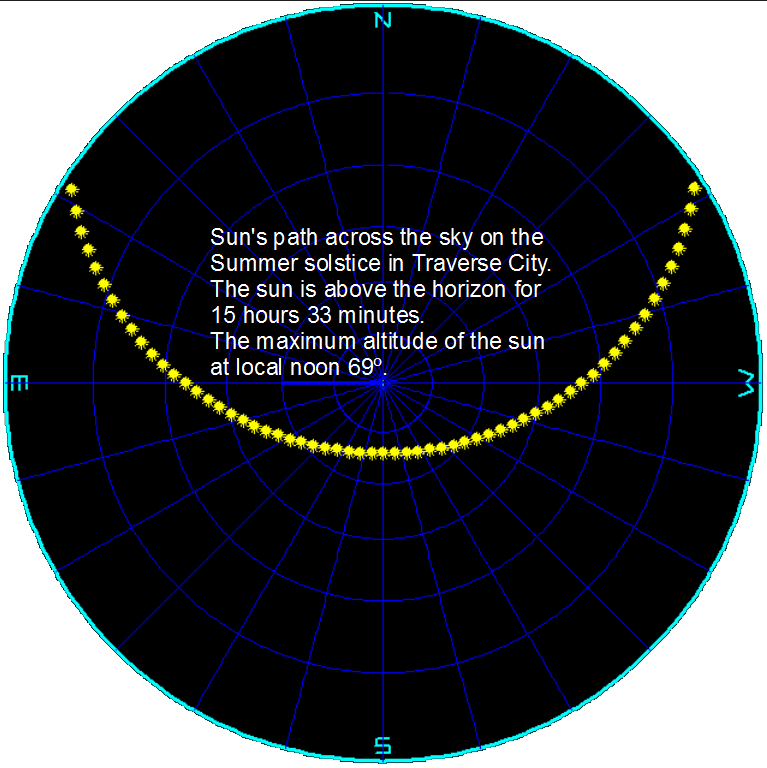
The Sun’s apparent path in the sky on the summer solstice. The cyan circle is the horizon and the Sun is plotted every 15 minutes throughout the day. Created by Bob Moler using LookingUp. This is a slide from his school program on the cause of the seasons.
06/16/2014 – Ephemeris – Dates of the earliest sunrise and latest sunset
Ephemeris for Monday, June 16th. Today the sun will be up for 15 hours and 33 minutes, setting at 9:29. The moon, half way from full to last quarter, will rise at 12:11 tomorrow morning. Tomorrow the sun will rise at 5:56.
Yesterday saw the earliest sunrise for the year. My sunrise times will start to show a change on Thursday. The day-to-day change in sunrise times are now a few seconds. The summer solstice, or longest day will be this Saturday, and the latest sunset won’t occur until next week Thursday. The reason these dates don’t coincide has to do with the tilt of the earth’s axis and the earth’s slightly elliptical path around the sun. Actually the disparity between these dates is more pronounced at the winter solstice when the Earth is closer to the sun and moving faster. Yup, the sun is farther away now than it was in December. Actually we’re moving slower now, so summer lasts a few days longer than winter.
Times are for the Traverse City/Interlochen area of Michigan. They may be different for your location.
02/18/2014 – Ephemeris – Gemini and the summer solstice
Ephemeris for Tuesday, February 18th. The sun will rise at 7:38. It’ll be up for 10 hours and 37 minutes, setting at 6:15. The moon, half way from full to last quarter, will rise at 10:19 this evening.
The constellation Gemini lies above and left of Orion in the southern evening sky. Jupiter is now seen against its stars. Gemini is called the twins and its head stars at the upper left of the constellation are Castor and Pollux. Pollux is to the lower left of Castor. Stick figures of the lads can be seen extending to the lower right of these stars. Currently the place in the sky where the sun is on the winter solstice is just to the right of Castor’s big toe. So it would seem that the sun is entering Gemini on the first day of summer, not Cancer as the astrologers would tell you. That solstice point is moving westward at one degree every 71.6 years, a motion called precession. I checked two astronomy programs and that point has now moved into Taurus the bull.
Times are for the Traverse City/Interlochen area of Michigan. They may be different for your location.
Addendum
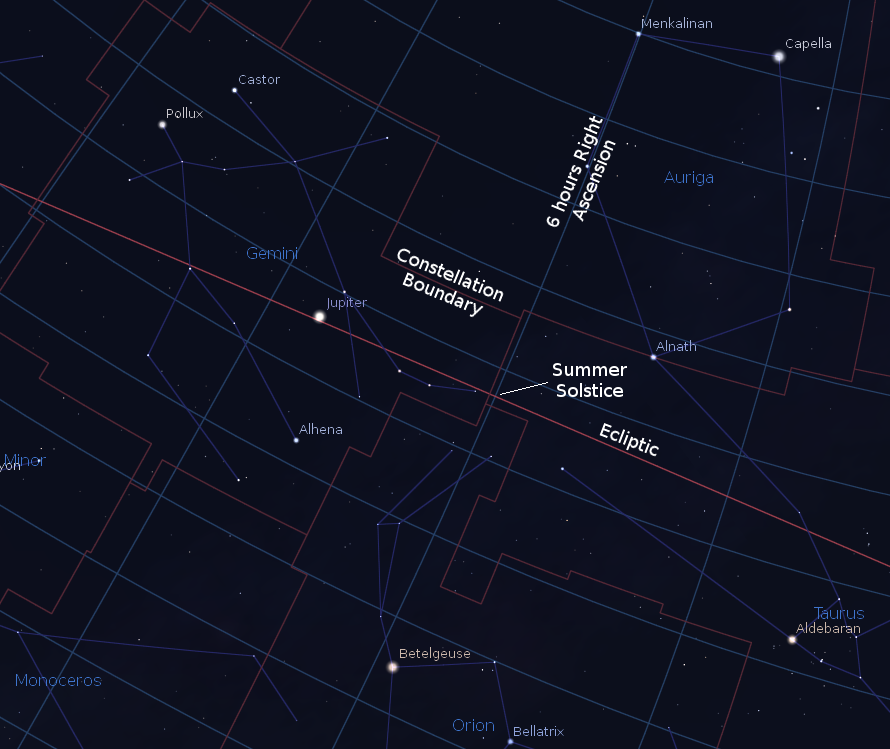
The constellation Gemini and the summer solstice point in the sky. Created using Stellarium.
The summer solstice point in the sky is the intersection of the ecliptic, the suns path in the sky and the 6 hour line of right ascension which is like longitude on the earth. The other blue lines are lines are lines of declination which is like latitude in the sky. Note also that the summer solstice point is the point on the ecliptic closest to the blue declination line which is the 25º north declination line. It’s at approximately 23½º north declination, right over the earth’s 23½º north latitude line also known as the Tropic of Cancer.
Back a couple of thousand of years ago the sun was entering the constellation of Cancer, off our image to the left, on the first day of summer. Since then the summer solstice point has moved westward against the stars at one degree every 71.6 years. This is due to what is called general precession, of the slow wobble of the earth’s axis caused by the pull of the Moon and Sun on the Earth’s equatorial bulge. This torques the earth and causes the 26,000 year wobble, like a spinning top. Since back then the solstice point passed all the way across Gemini and in 1989 entered the territory of Taurus.
 Bob Moler's Ephemeris Blog